ATC Farm-out must be prohibited
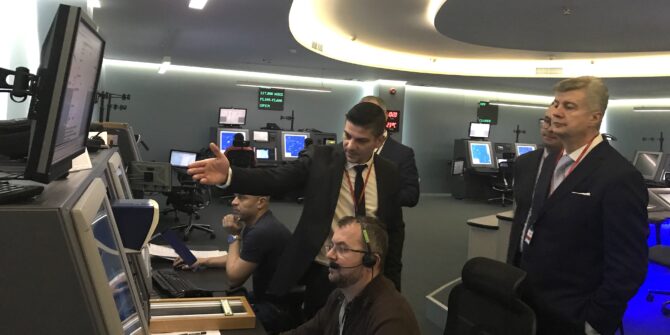
If you’re overflying the Tirana FIR tonight, the Air Traffic Controller in whose hands the safety of your flight rests will be one of these three: a Turkish controller, who has just been drafted in and who has never seen the airspace before; or an Albanian controller who has been forced to work under huge duress, while colleagues remain in prison.

And if you think there will be a NOTAM to tell you about any of this, you’re mistaken. Albania does not want you to know.

There are a plethora of troubling issues in the ongoing Albanian ATC dispute. Arresting workers for organizing industrial action is draconian and aggressive, and an approach discarded by nations that have moved beyond totalitarian regimes of the past. But the issue that presents the greatest risk to aircraft operations is the farm-out of ATC service: a practice whereby the ATC authority recruits foreign, untrained controllers in an attempt to break a strike.

The same scenario occurred in the Ethiopian ATC strike of 2018. The Ethiopia CAA recruited stop-gap controllers from Kenya, Sudan, Zimbabwe, Malawi, and other countries, and at the same time, launched a PR campaign declaring that “everything is operating normally”, including this bizarre attempt at Photoshopping a duo of Ethiopian Airlines aircraft onto an image of Addis Tower.
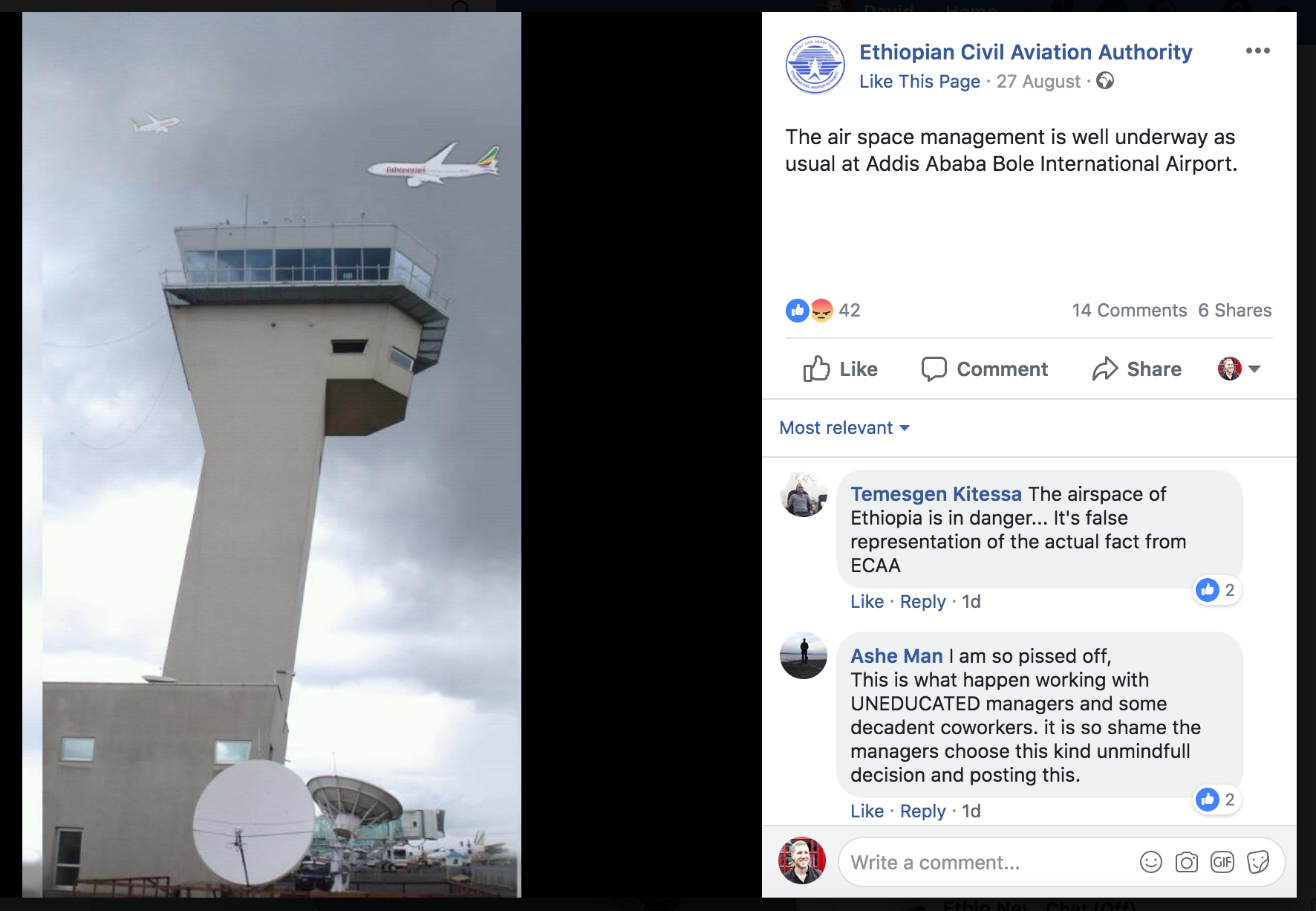
In the Ethiopian case, the cover-up belied the fact that the Air Traffic Control service was in tatters – many ATCO’s were in prison, many were fired, and the idea that a busload of controllers from Sudan could somewhow safely replace the local controllers was tantamount to attempted manslaughter on the part of the Civil Aviation Authority. Safety was well down the pecking order of motivating factors – commerce, politics, and thinly-veiled vengeance came first.

In Tirana, tonight, the situation is almost identical. Three Albanian controllers are in prison, and those at work in the Tirana ACC are there only because they have been forced onto position by their government. Albcontrol has clearly signalled its intent to draft in Turkish controllers to replace the unhappy domestic ones.

This tactic carries a profound danger that at first glance may not be obvious. If we cross to the other side of the microphone, and look at pilots, we could argue that a 737-rated pilot could fly from Adelaide to Melbourne as easily as they could fly from Dublin to London, and apart from some company procedures and airport familiarisations, that would be largely true. If a group of airline pilots go on strike, management could therefore replace them with a group of other airline pilots with the same type rating – who would earn the monniker of Strikebreaker (or worse). A deeply unpopular move, which happens from time to time, but not one that carries the same risk as attempting to do this with controllers.

Why? Because safe Air Traffic Control is predicated on deeply-learned local familiarity with the airspace, the terrain, the boundaries, and above all, how the traffic flows. This is why it takes six months, on average, for a controller trained in one country to re-qualify in another. For a newly-qualifying controller, that time line is closer to two years.

OK, where are the mountains again?” is not a question you’d want to know was being asked on the floor of an Approach Control unit. But that is precisely the level of vague airspace acquaintance that a drafted-in controller, even one with thirty years experience in another unit, would have. It is simply not possible to provide a safe ATC service with a weeks training. Even more importantly, the normal time required is based on the training relationship between student and trainer being supportive and co-operative. With the resentment that a Strike breaking controller would face, that cooperation would be entirely absent: the atmosphere will be hostile.

And so, it is a fundamental breach of trust for a sovereign nation to provide ATC service to foreign aircraft under the guise of “operations normal”, when such a catastrophically misguided attempt has been made to solve the dispute.

The relationship between the ATC provider (the state), and the customer (the foreign aircraft), is an extremely unusual one. There is no written contract, no KPI’s, no audit of quality. There is nothing other than a sacrosanct, inherent commitment to safely separate aircraft, crew, and passengers flying over the state. International convention, not corporate agreement, dictates this foundational principle.

And so, international convention must make it clear to countries and ATC authorities alike, that the practice of farming out ATC to untrained, unfamiliar controllers from other countries as a strike-breaking tactic is absolutely unacceptable. Countries must find ways of solving domestic disputes without subjecting uninvolved, unaware pilots and passengers to high-risk scenarios such as this.

Organizations and agencies like CANSO, ICAO, and in this case, EASA, must ensure that this flawed and covertly dangerous pseudo-solution is placed firmly back under the rock it crawled out from.


New warning for Albanian airspace

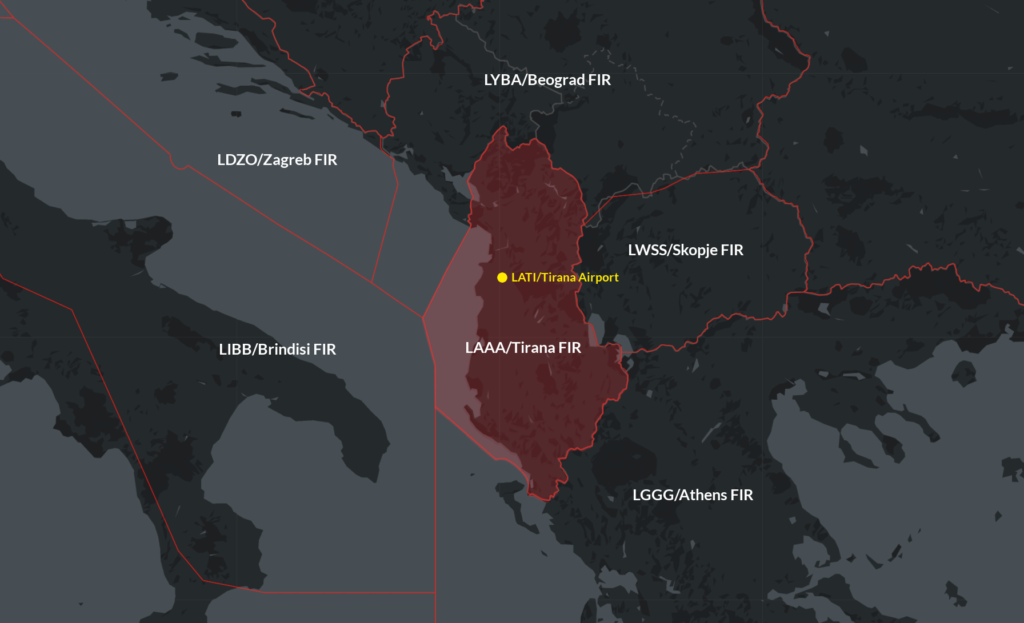
On April 8, Albanian airspace (the LAAA/Tirana FIR) along with LATI/Tirana Airport was forced to close, after a number of local air traffic controllers declared themselves temporarily unfit to work. Several international organisations, including IFALPA and IFATCA, have since issued statements warning pilots to exercise extreme caution while operating in Albanian airspace due to a heightened risk of degraded ATC services.

Why? Two reasons:

  1. Local controllers are now back at work but under significant duress, having been threatened with being fired (or worse – being arrested and jailed) if they do not declare themselves fit for duty.
  2. Foreign controllers have reportedly been brought in to replace some local controllers who were arrested, despite the fact that they are not trained or rated on any of the local positions.

What happened?

Mid-2020

  • Albcontrol (the National Air Traffic Agency) cut the salary of the controllers by up to 70%.

Early April 2021

  • Some controllers declared themselves temporarily unfit to work due to stress caused by these pay cuts. They were fired by Albcontrol.

April 6

  • A large number of local controllers (estimated at around 60-70% of ATCOs) declared themselves temporarily unfit to work due to stress, in line with the EASA regulations and the international standards. What these regulations essentially say is that being ‘fit for work’ is a personal assessment by the controller to avoid undue pressure from management to perform safety critical tasks when unfit for duty.

April 7

  • LATI/Tirana Airport issues closed at 1000z due to lack of ATC staff. Albanian airspace (the LAAA/Tirana FIR) closed at 1800z. Both stayed closed until 0659z on April 9, with a few exceptions when they reopened for short periods of time to allow humanitarian and medevac flights to operate.
  • Albania’s government sent troops and police to clear the “protesting” controllers out of the tower and their offices. About two dozen controllers were questioned by police. Three were arrested, charged with ‘abuse of office’. Two remain in jail; the third is under house arrest.

April 8

  • Several reports emerged that the Albanian Government had brought in Turkish controllers to replace the local ones. No official announcement was made, so their status as to training and local ratings is unknown.

April 9

  • LATI/Tirana Airport and Albanian airspace reopened at 0659z.
  • The Albanian Government issued an order officially recognising foreign ATCO licenses, allowing for foreign air traffic controllers to take over in emergency situations in Albania – an attempt to justify its actions the previous day and establish legal authority for the foreign controllers already installed.
  • Local controllers returned to work (except those still in jail/under house arrest) and were forced to sign a “fit for work” declaration.

What’s been the response?

The international response has been unequivocally damning, with IFALPA, IFATCA and ATCEUC all issuing several statements denouncing the action of the Albanian authorities (both the government and Albcontrol).

IFALPA have published a Safety Bulletin advising pilots to exercise extreme caution while operating within Albanian airspace, providing more detail in a Press Release calling on the Albanian authorities to adhere to international regulations. IFATCA have published similar info here, and ATCEUC has also issued a statement which can be found here.

Advice to operators

Reminiscent of the Ethiopian ATC strike and subsequent cover-up by the authorities in 2018, the action of the Albanian authorities should be seen for what it is – a terrible misjudgement, creating a safety risk across Albanian airspace.

IFATCA define it best, in their April 10 press release

“The International Convention on Civil Aviation prohibits an air traffic controller from exercising the privileges of their licences and related ratings at any time when they are aware of any decrease in their medical fitness which might render them unable to safely and properly exercise these privileges. It is considered unsafe to have a person perform air traffic control that is physically or mentally impaired in any way, or unqualified and untrained for the position.

It is the obligation of the Service Provider to provide a safe and functional workplace environment that supports the personnel to perform these complex safety roles free from distraction and duress.

The Albanian authorities continue to have disregard for the safety critical nature of these roles…

Albanian authorities have taken an irresponsible gamble on safety and stability of the air traffic services over their territory and the Network by attempting to continue operations with unlicensed and unqualified staff to operate, masquerading as a safe and functional service.”

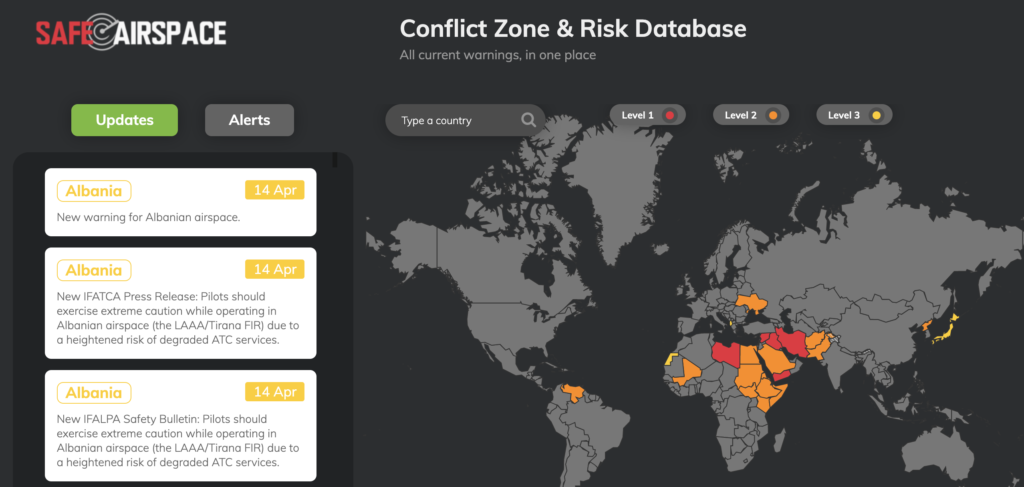
At SafeAirspace.net we are now listing Albania as “Level 3 – Caution” following these events. Pilots should exercise extreme caution while operating in Albanian airspace (the LAAA/Tirana FIR) due to a heightened risk of degraded ATC services.

Further reading:


International Bulletin: Winter is Coming, Updated Canada Requirements

Winter is coming 09NOV With the clocks changing, it’s a reminder that we’re not far away from the snowstorms, deicing delays, cancelled flights, airport shutdowns, and those big invoices for de-icing fluid. Our new author Frank Young has an article.

Updated Canada requirements 09NOV From tomorrow, November 10, an eTA is now mandatory for flights to Canada (for most people), and there’s an update to flying to Canada with a previous conviction. Read the article.


BIKF/Keflavik Long a destination for flight certification testing (because it’s cold and windy), will not accept test flights until February next year, thanks to runway renovation work.

ZZZZ/Worldwide Last week we ran a story about the new ICAO SID/STAR phraseolgies. In short, some countries are implementing, and others aren’t. We’re going to make a list of who’s doing what, so that you as an operator or pilot will have some idea. Can you help us? What is your country doing? Tell us at bulletin@fsbureau.org.

LTBA/Istanbul At about 0100 local time on 6 November, two people on a motorcycle opened fire outside Istanbul Ataturk International Airport, prompting a temporary closure. Reports indicate that authorities apprehended both suspects and did not find additional weapons or explosives on their persons. Officials briefly placed the airport on lockdown but reopened the facility at about 0130. The incident reportedly did not affect flights, and the gunfire harmed no civilians or police officers.

CZZZ/NAT Region The FAA has recently determined that time estimates provided by pilots in oceanic CTAs are less accurate than expected, particularly when adverse weather causes pilots to deviate from the planned course. These inaccurate estimates can compromise the separation of aircraft. Have a read.

YMML/Melbourne Be aware of recent hoax ATC calls. Someone with a handheld radio has been making “go-around” transmissions on the Tower frequency, and at least one aircraft has responded. Airservices says there have been 15 such transmissions in the last few weeks.

CZZZ/Canada The NBAA has issued useful updated info for flying to Canada with previous convictions – Canada is known for refusing entry based on DUI charges. Today, November 9, is also the last day that you can enter Canada without an eTA.

PWAK/Wake Island – an ETOPS alternate – is closed on 11NOV for Veterans Day. They do say they will attend with 30 mins notice, so maybe two ETOPS circles are required for that day. Check other US ETOPS alternates on this date also.

UCZZ/Kyrgyzstan Since 4 November, if you’re staying for longer than 5 days, you must register with the local authorities.

PKMJ/Majuro is downgraded to Cat 6 until November 23, which may affect some operators using this as an ETOPS alt.

EGNX/East Midlands airport has some weekend closures for the next six weeks.

VIZZ/India announced on 8 November that 500 and 1,000 rupee banknotes will cease to be legal tender as of 0000 local on 9 November 2016.

EVLA/Liepaja (one of Latvia’s three international airports) is now closed to all operations. They say they will be open again in Spring 2017. Fingers crossed.

LAZZ/Albania has been experiencing heavy rains, high winds and flooding throughout the country, causing road blockages, school closures, and disruptions in ferry services. The army has been mobilized for rescue and relief operations.

LFLL/Lyon If you’ve been using LFLL as an alternate at weekends, you’ll have to cut that out from December 10th, they don’t want weekend diversions of non-sched flights.

EGKK/Gatwick has advised of a new series of rail strikes that will run through to January next year.

MHTG/Central America FIR reminds operators that a CENAMER notification by AFTN is required for all flights planning to enter the airspace.

MTZZ/Haiti The US has published updated advice for Haiti: U.S. citizens are advised not to travel to the southern peninsula of Haiti, commonly referred to as the “southern claw.” The U.S. Embassy has currently banned unofficial travel to the southern peninsula and allows official travel only after consultation with its security office. There is widespread devastation throughout the southern claw with the most affected areas on the western tip of the peninsula. Travelers can expect difficult travel conditions with roads made impassable by landslides, damaged roads, and bridge failures. There is also widespread damage to buildings and infrastructure, including gas stations and cell towers, loss of electricity, and shortages of food and potable water. U.S. citizens who choose to travel to the southern claw in spite of these risks should carry sufficient water, food, fuel, and medicine to last longer than their anticipated stay. The security environment around the southern claw is fluid and uncertain.

LFOB/Paris Beauvais is closed overnight from 2200 to 0600Z, for 14-25 November inclusive, due to stuff.

HAZZ/Ethiopia On November 8, the Command Post – the body tasked with implementing Ethiopia’s state of emergency – lifted the restriction imposed on foreign diplomats, which restricted them from traveling more than 25 mi/40 km outside of Addis Ababa. The Command Post also lifted and revised several other state of emergency provisions; however, the changes are minor and are not likely to affect the current situation. The curfew and communication restrictions remain in place

NFTF/Tonga Fua’amoto (the main airport) has new operating hours – these are, in UTC: 1600 SUN TO 0530 MON, 1025 MON TO 0800 TUE, 1600 TUE TO 0530 WED, 1000 WED TO 0800 THU,0900 THU TO 1200 THU, 1600 THU TO 0530 FRI, 1600 FRI TO 0800 SAT. They’ll accept div traffic outside these hours, call +676 22 608 – but prefer no surprises on Sundays.

OMAA/Abu Dhabi will see heavy traffic for the Grand Prix on November 27, avoid if possible.

SBZZ/Brazil The office that processes Foreign Civil overlight and landing permits has updated hours of operation: Mon-Fri 1230Z-2230Z.

SBCT/Curitiba airport would like 4 hour PPR notice for non-scheduled flights, and request that you call them on 55-41-3381-1478 to arrange that.

SPJC/Lima, Peru has an upcoming APEC meeting 14-21 November, with a decent increase in traffic expected, and a few restrictions. They’ve also warned pilots to pay attention to radios and transponder codes to avoid them sending up the jets – good advice.

TVSV/ET Joshua Airport is closed due to flooding.

VECC/Kolkata Radio has a new HF frequency: 8861, with hours 1330Z-0130Z. Use this if 6556 or 10066 isn’t working for you.

CZQX/Gander is going to auto-send you a “Confirm Assigned Route” message from 01DEC, on entry into their OCA – if you are FANS 1/A equipped. If you’re not sure how to feel about that, read our previous article.

LCCC/Nicosia There’s a good deal of mil activity – UN, and Russian – in the Cyprus region at the moment. Read the LCCC and surrounding FIR Notams carefully. Oh, and if you’re not up to date on your Greek-Turkish FIR dispute, add LGGG and LTBB to that. As 2016 draws to a close, enough regional history has been published for an entire novel. This weeks Notam series covers the 1923 Lausanne Peace Treaty.

NZZC/New Zealand published a change to SID procedures today, and our brain hurts. We’re not sure if this is related to the 10NOV ICAO SID/STAR changes, or .. something else. If you’ve got it deciphered, let us know. THE STANDARD INSTRUMENT DEPARTURE (SID) SPECIFIES IN BOTH DIAGRAMMATIC AND NARRATIVE FORM ANY OF THE FOLLOWING: THE DIRECTION OF TURN, HEADINGS, TRACK, DISTANCES, SIGNIFICANT POINTS AND ALTITUDE REQUIREMENTS. WHERE TRACKING TO OR FROM A NAVIGATION AID IS NOT POSSIBLE, DESIRED TRACKS ARE SHOWN AND DUE ALLOWANCE FOR WIND IS TO BE MADE. AIRCRAFT ARE TO CONTINUE CLIMBING THROUGHOUT THE SID UNLESS IN COMPLIANCE WITH PUBLISHED ATC MAINTAINS, DEPARTURE MINIMUM SAFE ALTITUDE (MSA) OR AS OTHERWISE INSTRUCTED. WHERE CONTINUOUS CLIMB TO THE END OF THE SID IS NOT REQUIRED A DEPARTURE MSA MAY BE DEPICTED ON THE RELEVANT CHART. THE DEPARTURE MSA REPRESENTS THE LOWEST ALTITUDE FOR OBSTACLE CLEARANCE ALONG THE ENTIRE DEPARTURE ROUTE (INCLUDING TRANSITIONS). IT REMAINS THE PILOT’S RESPONSIBILITY TO MEET SUBSEQUENT ENROUTE MSA/MINIMUM FLIGHT ALTITUDE (MFA)/MRA/MEA REQUIREMENTS APPLICABLE AFTER SID TERMINATION. DEPARTURE MINIMUM SAFE ALTITUDES DO NOT ENSURE CONTROLLED AIRSPACE CONTAINMENT.

OEZZ/Saudi Arabia has issued an extension of the policy that requires all aircraft with a destination in Yemen to first land in OEBH/Bisha – through to 08FEB next year. The only exceptions are the UN, Red Cross, and MSF.

VHHK/Hong Kong is going to move to a new ACC and ATC Tower towards the end of this month. There will be delays. The actual date hasn’t yet been notified, we’ll let you know when we hear.

View the full International Bulletin 09NOV2016