July 2024: Afghanistan Overflight Update

Key Points
  • Read to the end for an OPSGROUP Team report from a recent flight over Afghanistan.
  • Afghanistan’s procedural Notams for overflights have been re-issued: the entire airspace remains uncontrolled.
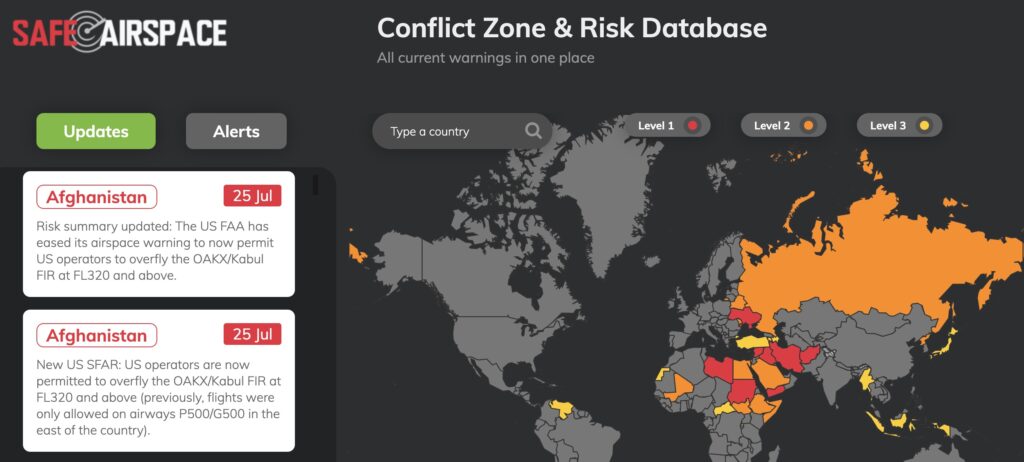
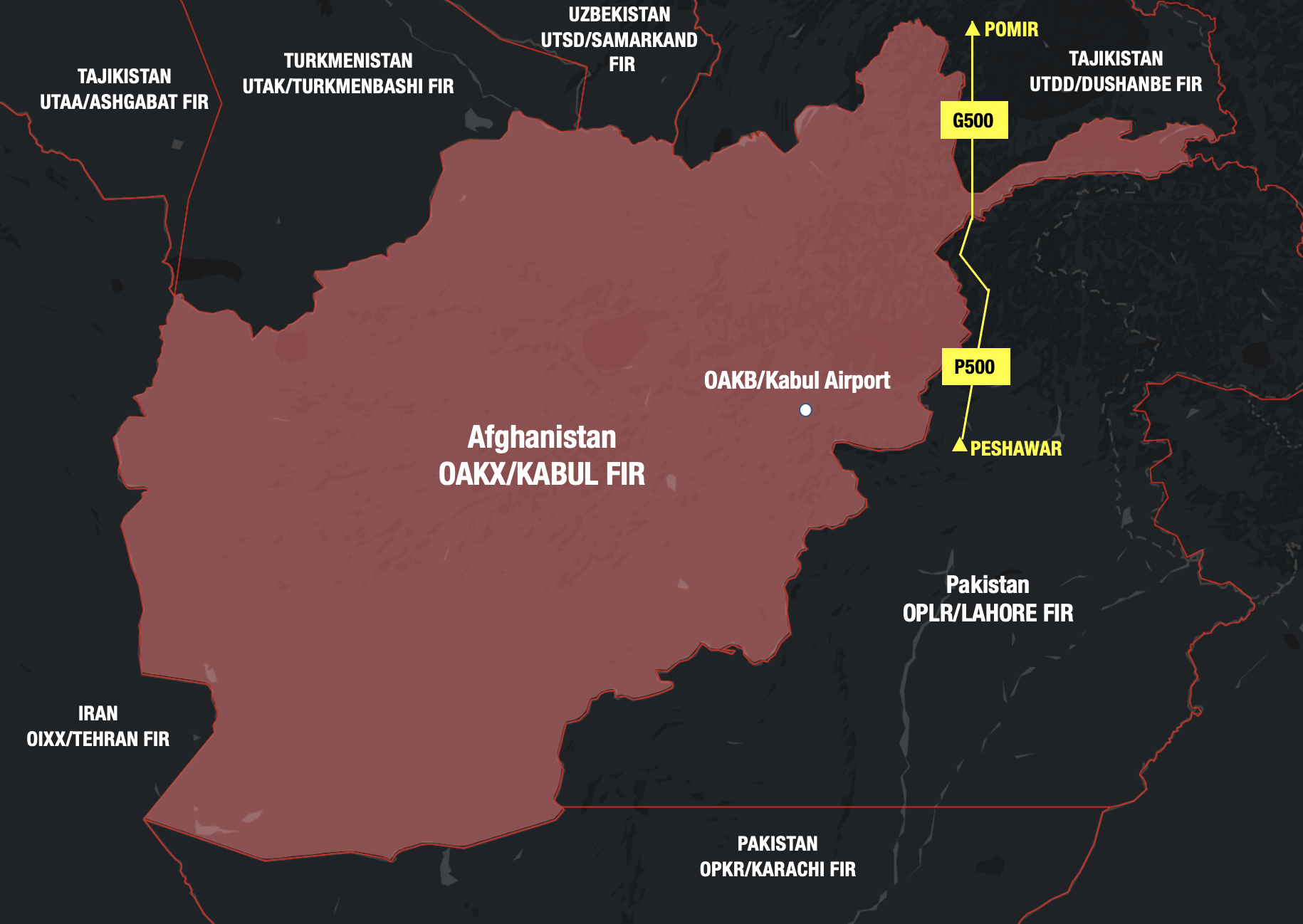
  • The US FAA has amended its airspace warning for the OAKX/Kabul FIR: US operators are still permitted to overfly at FL320 or above but they can now use airways P500/G500 in the far east of the airspace as low as FL300.
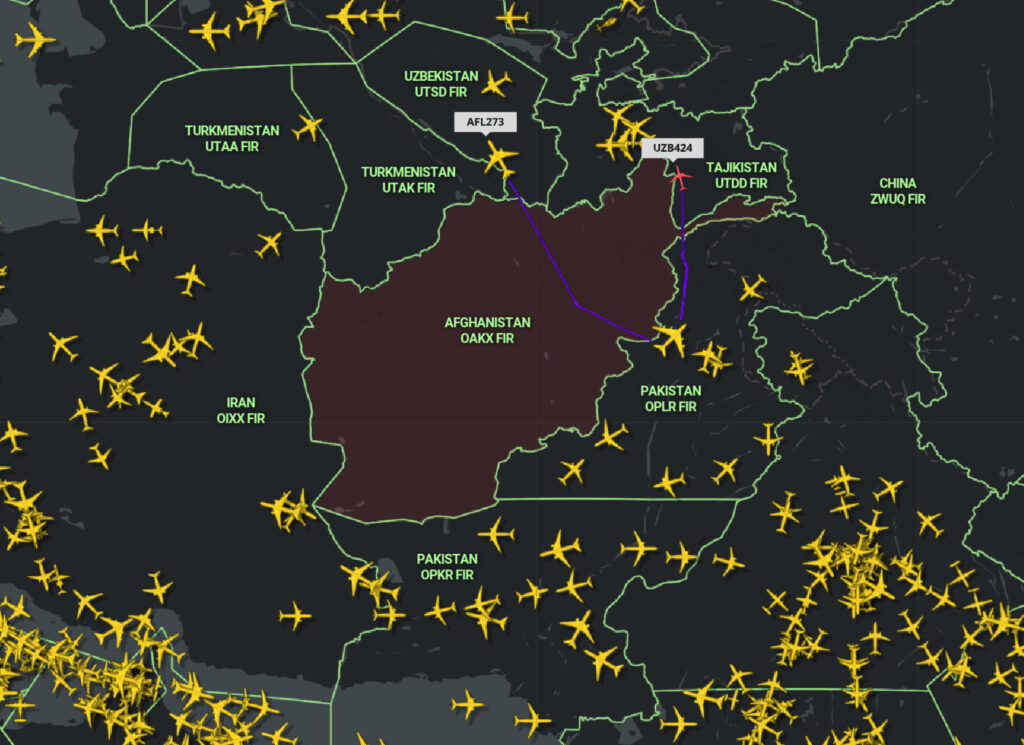
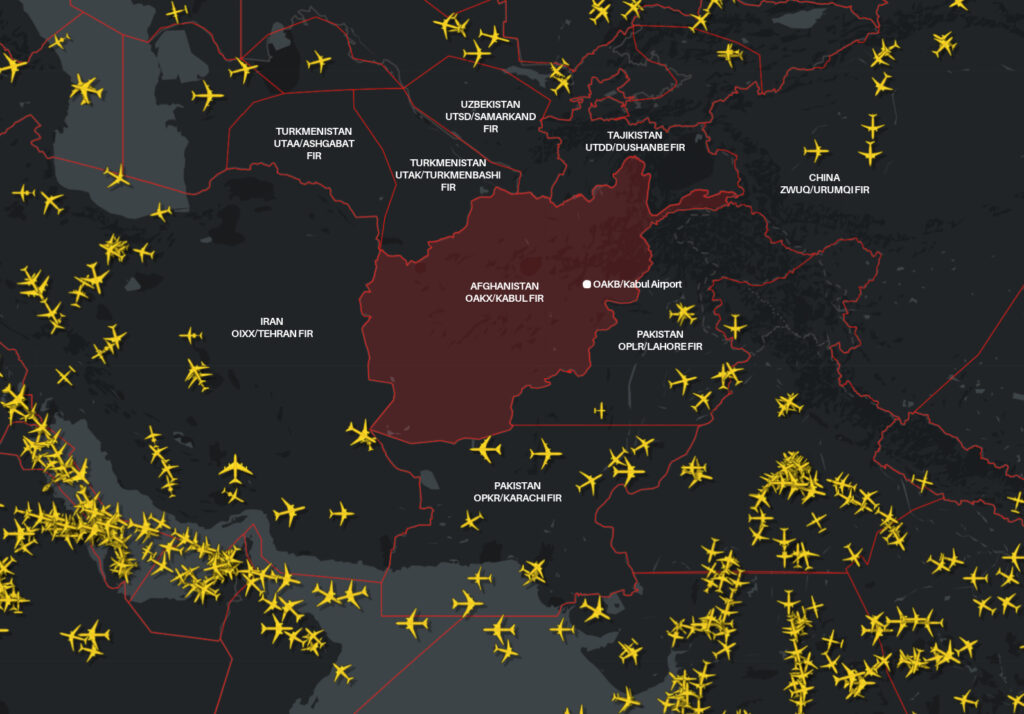
  • For the large volume of traffic now using Afghanistan as an air corridor connecting Europe, the Middle East and Asia, we figured it was time for an update on what to expect, and the risks aircraft are taking to use it.

A Little Background

For all intents and purposes, the security situation and the safety of the airspace above has not changed since the Taliban re-assumed control of the country in late September 2021.

What has changed is the normalisation of risk – as more traffic (including major carriers) has been using the airspace without incident, it is important to remember these two facts when considering an overflight (along with your own appetite for risk):

  • The entire FIR is uncontrolled.
  • There is no guarantee of crew or passenger safety if you have to land.

With these factors in mind, here is a brief refresher on what you need to know if you do choose to go ahead and overfly.

With major airlines now regularly overflying Afghanistan, the decision for GA/BA operators to do the same may be murkier than before.

Before You Go

Essentially you need to check three things:

  1. PPR. All operators need prior approval to enter the Kabul FIR with at least 72 hours’ notice. To get that, you need to email flightpermissions.acaa@gmail.com.
  2. Compliance with state-issued rules. Several states have long-term airspace warnings in place for Afghan airspace. US operators need to check the current SFAR (more on that below) and any applicable KICZ Notams.
  3. Insurance. Some providers will not cover extended flight through uncontrolled airspace with the risks that apply both in the air and on the ground in Afghanistan.

Overflight

The procedures to overfly the Kabul FIR have not changed – they’re found in a series of Notams recently republished and extended. We previously took a detailed look at those here.

For the purposes of this article, this is the highlight reel:

  • Adjacent FIRs manage the flow in and out of the Kabul FIR and apply 15 minute spacing.
  • Only some routes and levels are available.
  • The entire Kabul FIR is uncontrolled, with TIBA procedures in effect.
  • You can’t change speed or level once inside the Class G (except to avoid traffic or you have an emergency).
  • ICAO contingency procedures apply if you need to descend in a hurry.

Unplanned Landings

For traffic deciding to overfly the Kabul FIR, it is critical to have contingency plans in place for a diversion.

For most operators, this would be to consider a landing at an Afghan airport a last resort (akin to a ditching in oceanic airspace).

Enroute planning should include ETP considerations for the most fuel critical scenario so that aircraft have enough on board to remain airborne and clear Afghan airspace before landing.

As such, be aware of westward diversions into Iran (the OIIX/Tehran FIR). US operators are currently banned from entering at any level due to high risk of misidentification, anti-aircraft fire and unannounced military activity. France, Germany, Canada and the UK also hold similar warnings.

On the Ground

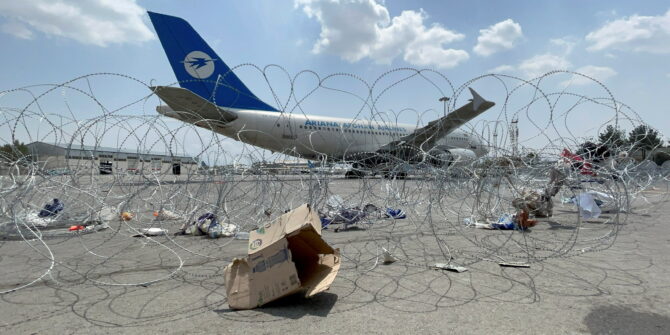
If you do need to land in Afghanistan, welcome to the wild west.

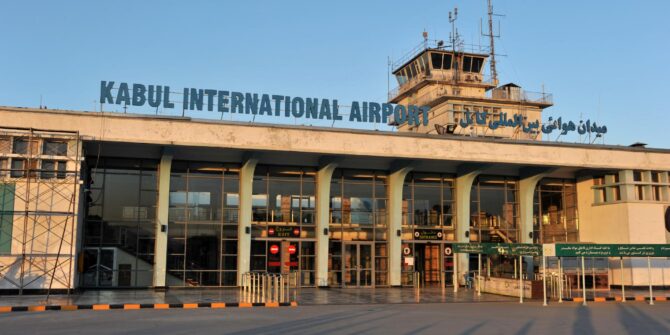
OAKB/Kabul airport is your most likely target and there is no approach control, or tower service in use. As such, weather forecasting and Notams should be considered unreliable at best.

They do provide a phone number you can try and contact for the Kabul Notam Office, +93730006669. Failing that, try +93705769453.

As for crew/pax security, there is none. No country officially recognizes the Taliban as a legitimate government yet.

The Latest US Department of State Travel Advisory is starkdo not go there. If you do, you are at risk of wrongful detention, kidnapping and crime. There is no consular assistance available.

Updated FAA Airspace Warning

Another change to report.

On July 5, the US FAA (slightly) amended its airspace warning for Afghanistan.

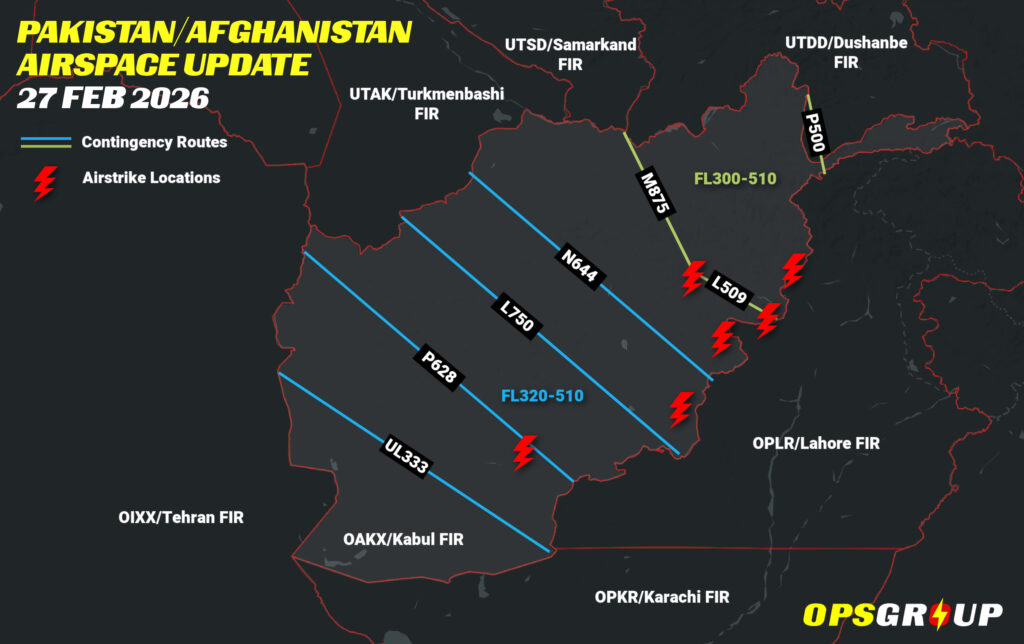
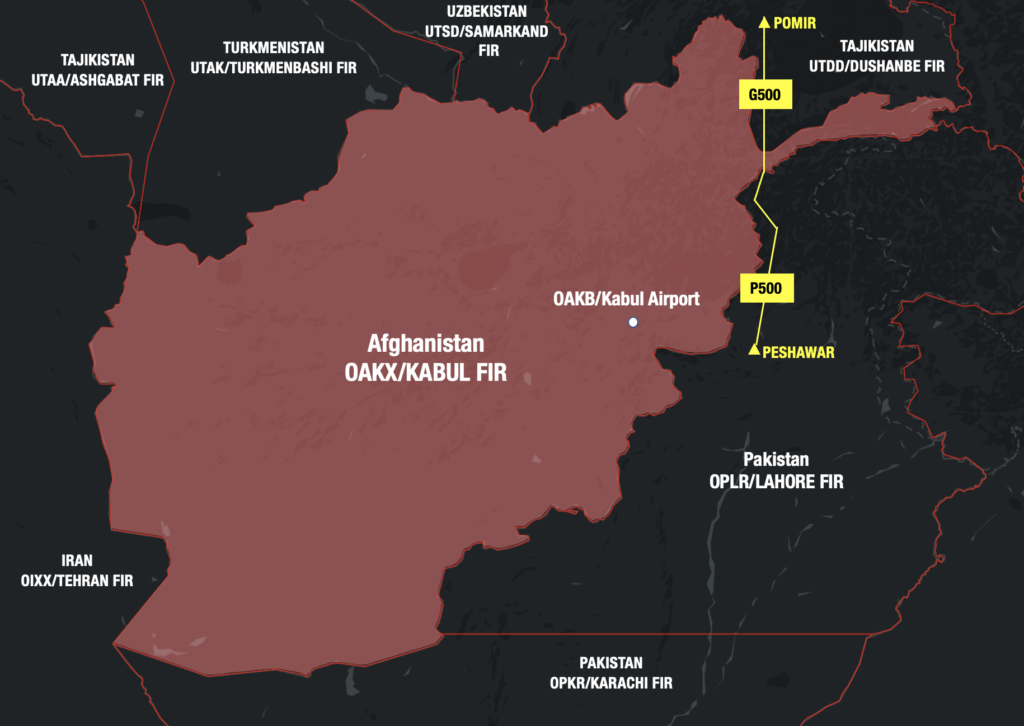
US operators are still permitted to overfly the OAKX/Kabul FIR at FL320 or above but they can now use airways P500/G500 in the far east of the airspace as low as FL300.

US operators can now use P500/G500 as low as FL300.

The FAA’s reason for the change: some operators were struggling to use these airways at higher levels. There have been no incidents here so far, and you don’t spend much time in Afghan airspace while transiting them.

You can view the updated SFAR here.

Our Pilot Report – here’s what we did …

There is a hefty dose of ‘at your own risk’ about all of this. The choice to overfly is not an easy one. To give you a much better idea of what to expect, here’s an OPSGROUP Team report from a recent flight over Afghanistan:

We operated through OAKX FIR on a EHAM/Amsterdam-WMSA/Kuala Lumpur flight

Overflight Permit: Getting the permit was relatively easy. We emailed flightpermissions.acaa@gmail.com (cc to flightpermission.atm@mota.gov.af) and received a response within 24 hours. They replied to us saying that to cross the airspace is charged a flat fee of $700 USD. You will need to fill out the form provided (this Excel document) and then forward that, plus copies of your Insurance, Airworthiness Certificate, and Aircraft Reg. If you are operating commercially, they also want your AOC. They ask for a minimum of 48 hours’ notice, although we put our application in a week in advance.

Insurance: Our insurance (like most) doesn’t allow operations within certain countries; however, they permit overflights on ATC-approved airways, and if you end up diverting due to an emergency, you are covered. We checked, and L750 was considered OK. Several air routes are “open.”

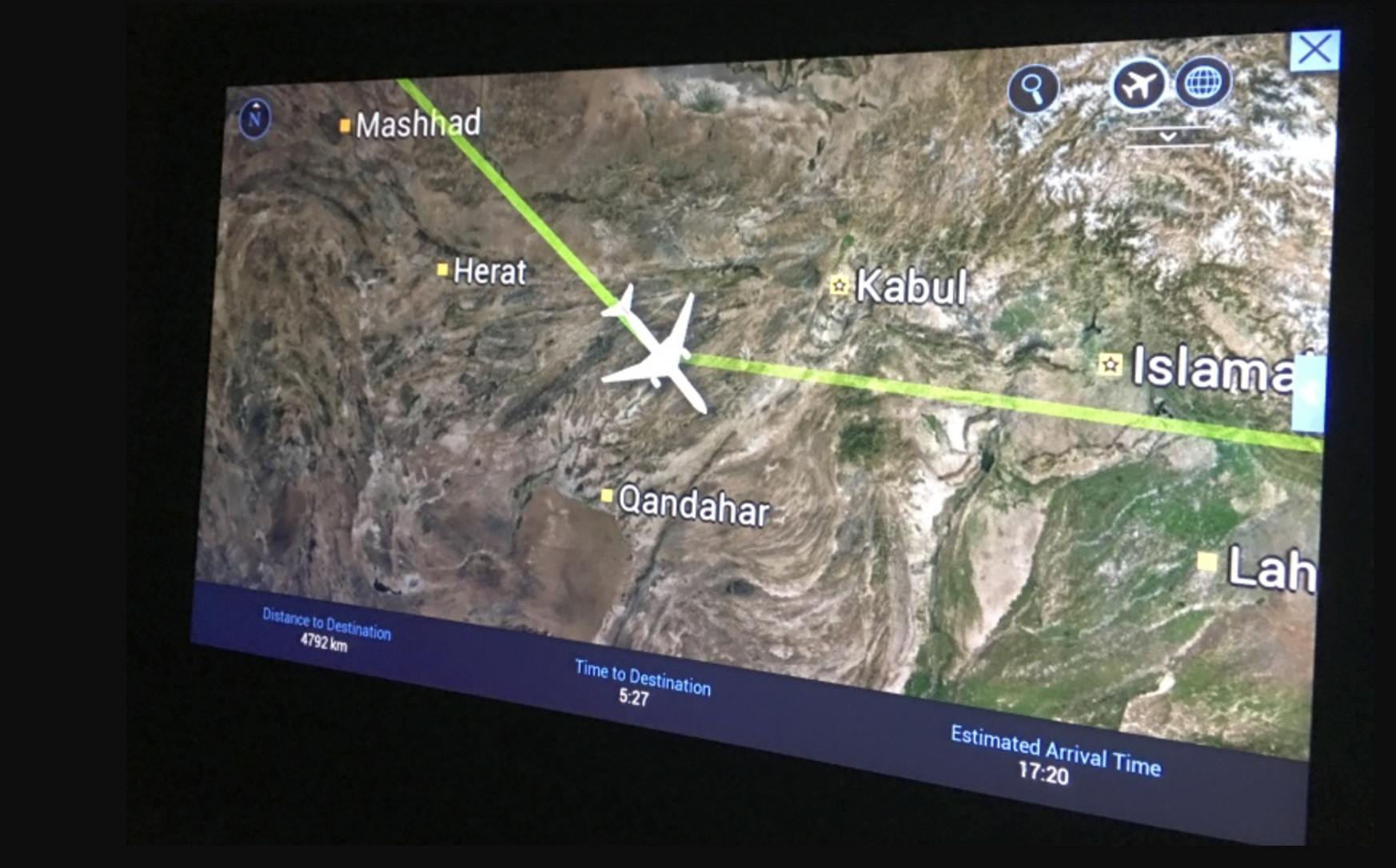
Routing: We had planned on L750, which runs from UTAV (Turkmenabat) to OPLR (Lahore). They also sent us the Kabul FIR Contingency Procedure document. The most important thing to read is the broadcast procedures since there is NO ATC service. The flight was very straightforward, and this route saved us a fair chunk of time and fuel.

ATC Comms: About 5 minutes before Kabul’s boundary, the UTAV controller asked us to “report ATC established with Kabul.” We tried calling Kabul on 125.2, knowing full well there was no ATC service. We told UTAV that we were going to continue TIBA procedures in Kabul FIR, and they told us, “Radar services terminated, frequency change approved. Good night.” All our external lights were switched on. We used Comm 2 as our TIBA box (125.2), Comm 1 stayed with the UTAV frequency, and Comm 3 (our data link was set to SAT) to monitor 121.5. Revise your TIBA calls; they suggest you broadcast them every 5 minutes. We used each fix, and it worked at about the right time.

Over Afghanistan: There was one aircraft departing OAKB/Kabul airport, a commercial jet on its way to Dubai, and aside from that, there was no one else. Up at FL450, we had a great view of the terrain – the word is “inhospitable.”

We could continue to hear UTAV on Comm 1 until about 15 minutes into Kabul when we switched to 124.1, the OPLR (Lahore) FIR frequency; about 15 minutes before we got to the boundary, we could hear calls from other aircraft. We had about 10 minutes of “dead” time on Comm 1.

I had an ETP using UTAV/Turkmenabat and OPIS/Islamabad and did not consider using any of the airports within Kabul FIR as available airports. This was treated just like a NOPAC or NAT crossing. There is nowhere to go, so if something eventful happens, you can keep going or turn back based on your ETP.

We checked in with Lahore about 10 minutes before reaching BIROS, and they told us to call overhead BIROS.

Key Points: It is relatively straightforward; brush up on the TIBA calls. There is more traffic nowadays as several airlines are using the routes for daytime flights, so it was a bit busier the last time I used it. However, at best, you will have a couple of airliners in the mid to high FL300s. There was no GPS Spoofing / Jamming or bad ATC, so I would use this route again, considering the other options in that region.

Let’s help crew make a more informed decision with more reports from other pilots.

You experience is invaluable – if you are overflying Afghanistan and have some operational advice, please share it with the group. You can reach us on team@ops.group, or file an Airport Spy report anonymously here.
Aug 2023: Who wants to overfly Afghanistan?

No one! There’s no ATC service across the entire country, there’s a seemingly endless list of surface-to-air weaponry they might start shooting at you if you fly too low, and if you have to divert then good luck with the Taliban.

US operators can now overfly Afghanistan

The US FAA has just published a new SFAR for Afghanistan which amends its airspace warning for the country. US operators are now permitted to overfly the OAKX/Kabul FIR at FL320 and above.

Previously, flights were only allowed on airways P500/G500 in the east of the country. This made more sense from an airspace-risk point of view, as flights on these routes transit Afghan airspace only very briefly.

But now, if you’re a US operator, you’re no longer limited to those two airways – you can fly where you like across that big red blob as long as it’s at FL320 or above.

The US are not the only ones who have eased their airspace warning in this way. EASA also recommend FL320 or above, and Germany say FL330 or above. All the other countries who regularly issue airspace warnings – France, UK, Italy, and Canada – say that overflights should only be on those P500/G500 airways.

Why the change?

To understand the rationale behind the FAA’s easing of the airspace warning, the place to head is the “Discussion of the Final Rule” section in the SFAR.

Here’s a summary:

  • Essentially, the FAA think the only risk at the higher flight levels is the lack of ATC.
  • After the Taliban takeover of Afghanistan, ICAO made contact with Afghanistan’s CAA. Together with neighbouring ANSPs and IATA, they published a Contingency Plan for the resumption of overflights of the OAKX/Kabul FIR. 
  • With this specific risk diminished, the FAA now allows US operators to overfly Afghanistan at FL320 and above.
  • The FAA still considers altitudes below FL320 hazardous for flights due to ongoing security risks from Taliban and ISIS. They cite the possibility of access to various weapons by terrorist groups, including MANPADS. Cross-border attacks into Pakistan by VEOs pose additional risks below FL320.

How do the Contingency Procedures work?

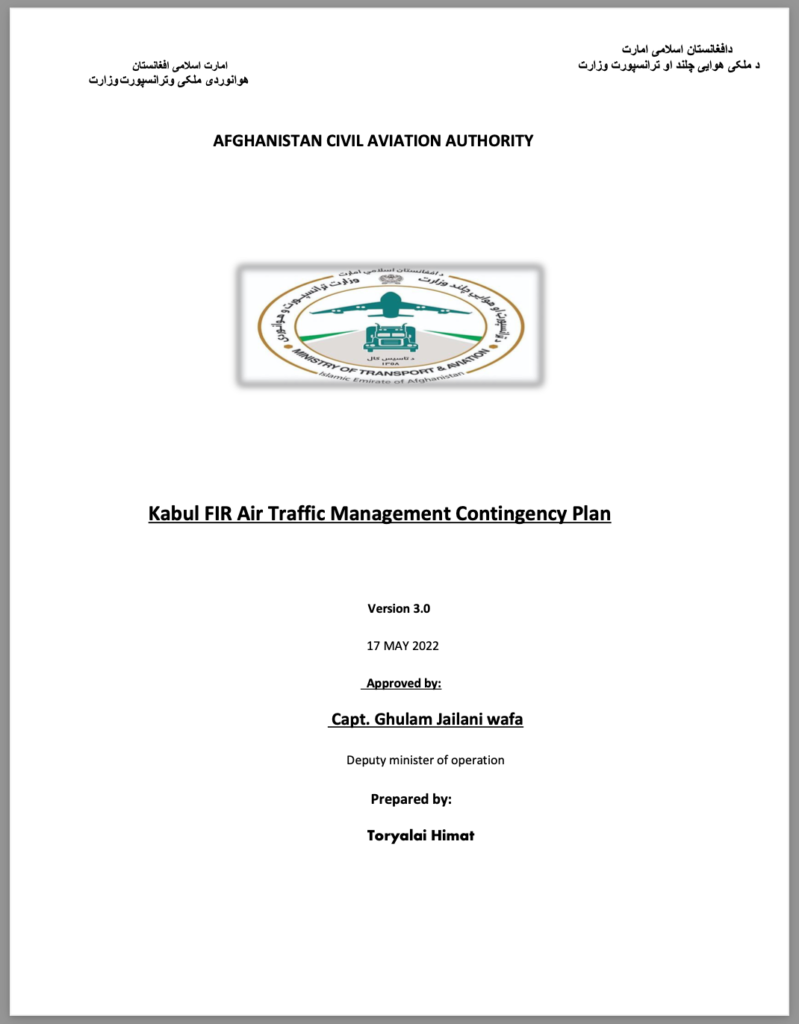
You can find these on the Afghanistan CAA homepage, or by clicking below:

This Contingency Plan is activated by Notam, and applies when the Kabul FIR is unattended – which has been the case for some time now.

In a nutshell it relies on adjacent FIRs coordinating with one another, and with aircraft to make sure they follow assigned routes and assigned levels while transiting Afghan airspace to reduce collision risk.

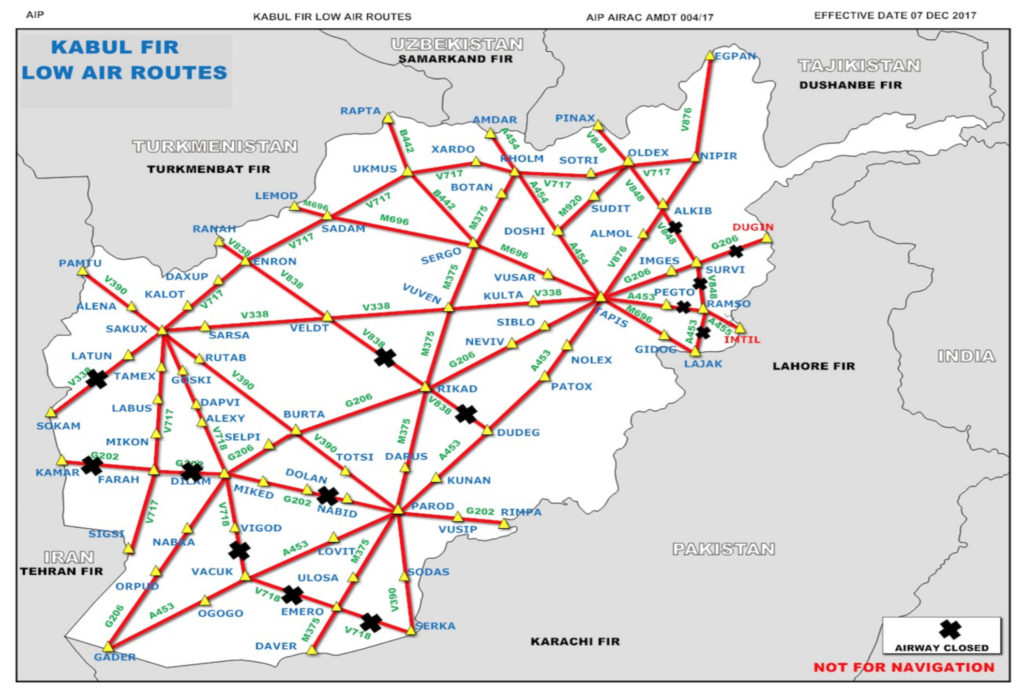
They are effectively broken down into two sections – lower airspace (FL160 – FL290) and upper airspace (FL300 – 510).

Lower Airspace

We’re not really interested in this, because we don’t want to fly at these lower levels! But anyway, here’s how it works:

  • OAKB/Kabul, OAMS/Mazar-e-Sharif and OAHR/Herat airports will all provide surveillance services in their terminal areas.
  • When outside them, you must follow a published low-level route. When descending or climbing, remain right of track unless you’re below MSA on an IFR procedure. You’ll also need to make TIBA broadcasts on 125.2.

Upper Airspace

OK, the bit we’re interested in!

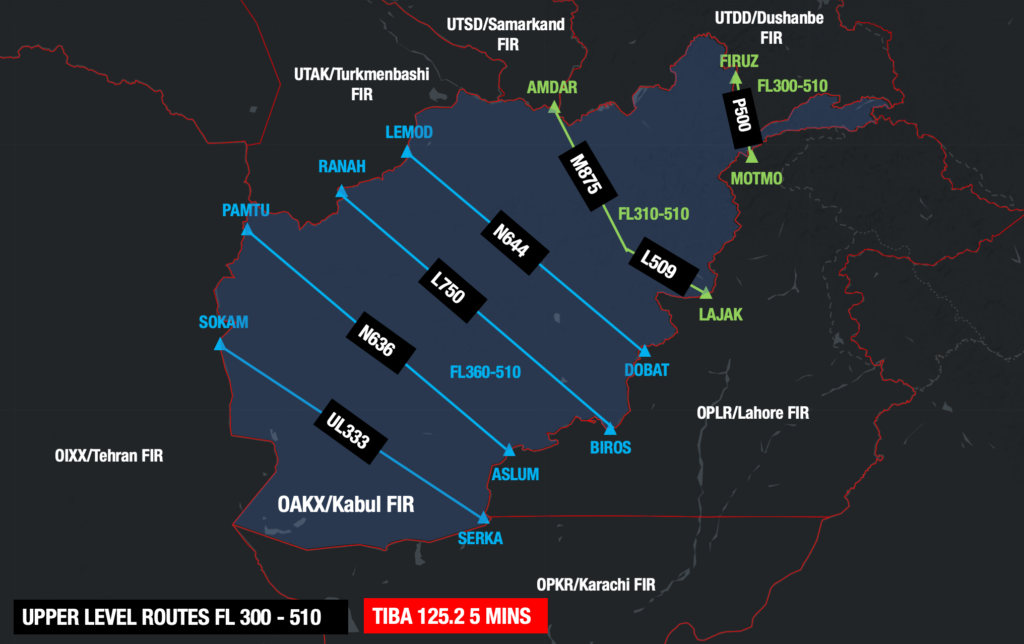
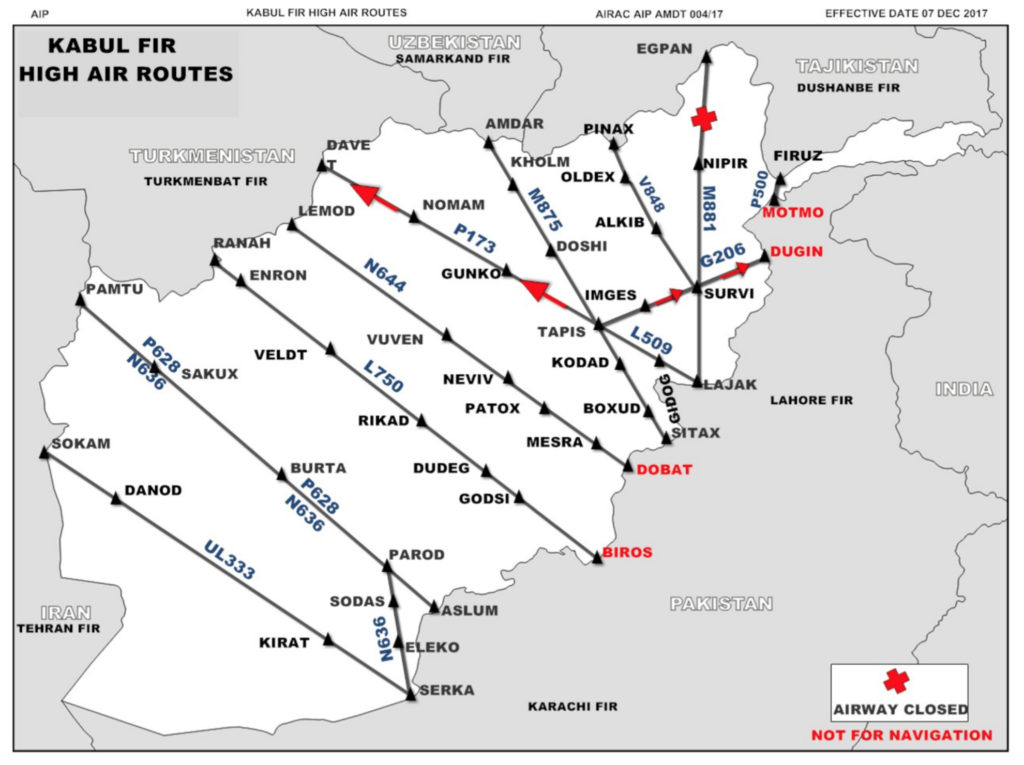
The Contingency Plan mentions all the available routes, and the Notams make it clear what levels are available:

OAKX G0306/23 - ALL OVER FLIGHTS SHALL USE THE FOLLOWING 
LATERALLY DE-CONFLICTED HIGH ROUTES (HIGH SECTOR) STARTING 
AT FL360-FL510 EXCEPT ON M875/L509 ROUTES SHALL USE
FL310-FL510 AND P500 SHALL USE FL300-510
TRANSMISSION SHALL TAKE PLACE EVERY 5 MINUTES ON TIBA
FREQ 125.2MHZ FOR THE TEMPORARY PURPOSE ONLY.)
1.FIRUZ-P500-MOTMO(FL300-FL510)
2.AMDAR-M875-TAPIS-L509-LAJAK(FL310-FL510)
3.LEMOD-N644-DOBAT(FL360-FL510)
4.RANAH-L750-BIROS(FL360-FL510)
5.PAMTU-P628-ASLUM(FL360-FL510)
6.SOKAM-UL333-SERKA(FL360-FL510). 
10 JUL 06:50 2023 UNTIL 05 OCT 23:59 2023 ESTIMATED. 
CREATED: 10 JUL 11:34 2023

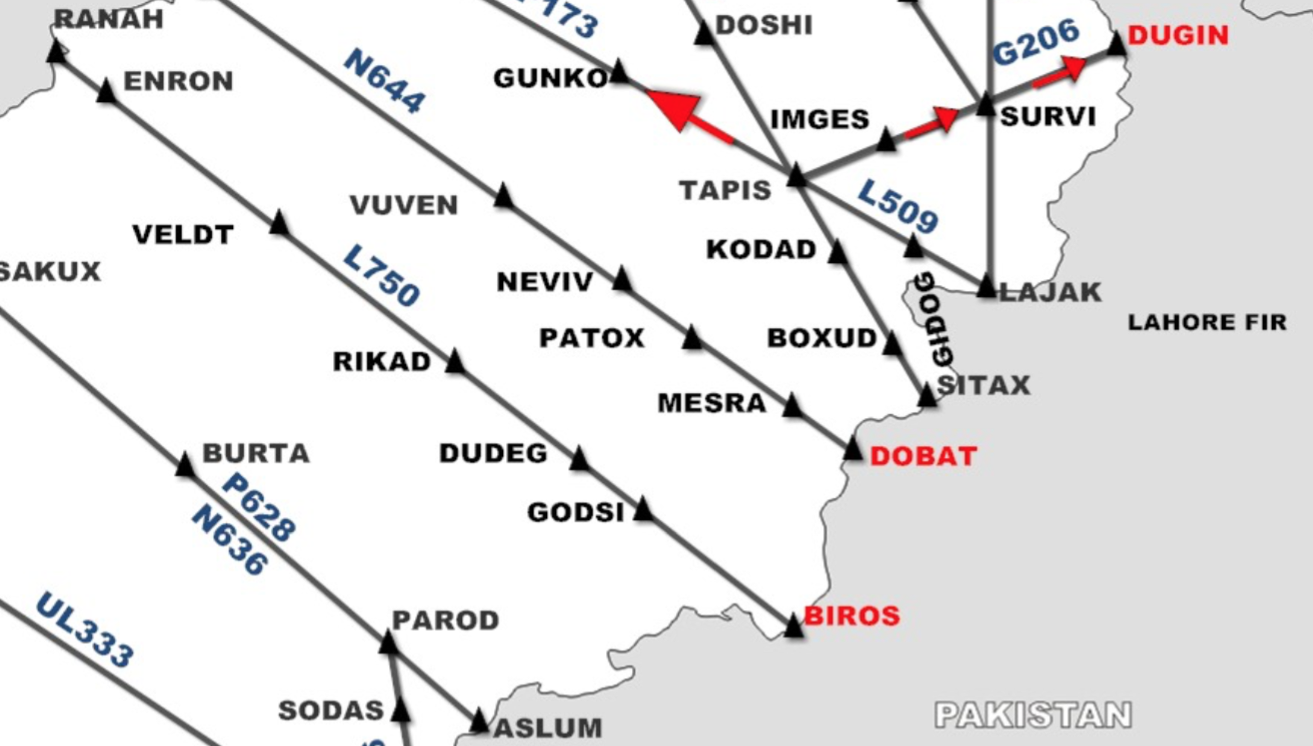
So here’s what that looks like:

  • These are bi-directional routes, and only available between certain levels (as per the map above!).
  • Try and avoid using FL300. It is sometimes reserved for military traffic as advised by Notam.
  • On entry to the Afghan airspace: adjacent FIRs will apply in-trail spacing of 15 mins on each route at each level. The routes provide at least 50nm lateral spacing. As per usual, westbound traffic should be at an even level, and eastbound at an odd one.
  • While inside the Class G airspace: TIBA procedures will apply at all times on 125.2. Expect to contact the next FIR at least 10 minutes before the boundary on VHF.
  • The good news is that the ‘up-stream’ FIR will also coordinate with the ‘downstream’ FIR to let them know you are coming.

Other Gotchas

  • Despite being Class G, flight plans must still follow the rules found in Afghanistan’s AIP. This includes the requirement for RNAV10 or better, and the submission of your plan to the Kabul FIR via AFTN.
  • Priority will be given to ‘long haul’ international flights in the higher levels. Regional and domestic operators needs to remain in lower airspace.

What are most operators doing?

Avoiding Afghanistan! Just like they did before.

  • Most major international airlines still appear to be avoiding Afghanistan’s airspace for overflights, although some are still using airways P500/G500 in the east of the country like they did before.
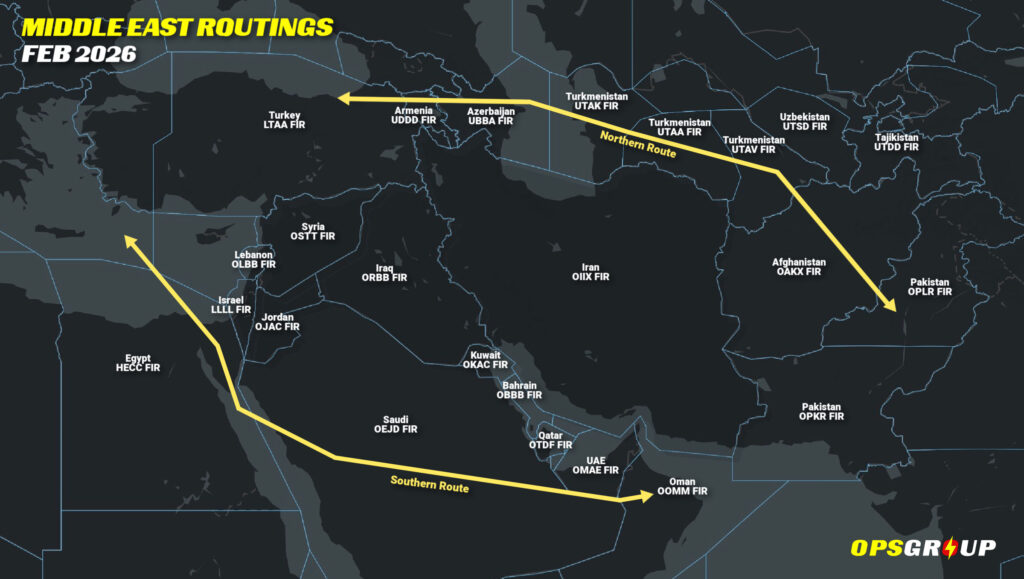
  • Most traffic continues to route south via Pakistan/Iran, or even further south via the UAE and Arabian Sea.
  • There are risk warnings to consider for the airspace on this southerly routing too. Several countries have warnings in place for Iran’s airspace (the OIIX/Tehran FIR), including a total flight ban by the US. The southern part of Saudi Arabia’s airspace (the OEJD/Jeddah FIR) carries risk as well, although there have been no reported drone strikes from Yemen in the past year.
  • To the north of Afghanistan: the options for overflights are fairly limited – via Turkmenistan, Uzbekistan and Tajikistan, avoiding Russia – potentially useful if operating from Europe to the Far East (China, Hong Kong, Japan, etc.)

Should I overfly Afghanistan?

Despite there being contingency routes now in place, and despite the easing of the airspace warning by the FAA, there are still several risks here: lack of ATC, and serious safety and security risks at both the lower flight levels and on the ground.

If you have an engine failure or depressurization, will you be able to stay above FL320 all the way across the FIR? If you had to divert to an airport in Afghanistan, how confident would you be that you would be able to get out again in one piece?

For more info, check Safeairspace.net – our Conflict Zone & Risk Database.


Afghanistan Update – September 2021

The situation in Kabul remains dynamic. An update was issued today regarding ongoing changes within the OAKX/Kabul FIR and at OAKB/Kabul airport.

The full notice issued by ICAO following their most recent video-teleconference is available here.

The ongoing situation

Qatar and Turkey continue to work with the new Afghanistan government to help bring Kabul airport back to operational status, and to restore safe overflights. This includes the repair of damaged radar and other facilities, as well assisting in restructuring the CAA.

Qatar officials are coordinating with the Afghanistan CAA are conducting assessments on capacity and needs. They have apparently deployed a technical team to Kabul to carry out work. The DME has been re-established but notams suggest the VOR remains out of operation.

Turkey maintains a military presence at Kabul airport to assist and is apparently in discussions to help run the airport again – having done so for 6 years previously.

ICAO remain in contact with the Afghanistan Civil Aviation Authority who have provided updates confirming newly appointed members, and a designated point of contact.

Operational updates

  • OAKB/Kabul airport and OAMS/Mazar-e-Sharif airport are both reported to now have limited ATS services. There is a limited tower service to support VFR operations at Kabul between 0330-1330 UTC. Mazar-e-Sharif has an FIS available, but the scope of this is unknown.
    • A shortage of ATC staff continues to reduce capability.
  • Pakistan is assisting Afghanistan in the restoration of the Afghanistan NOTAM service. The service has been partially restored as of Sep 6, and is available via https://www.afgais.com/
    • Out of date Notams remain in the system so caution is advised using the site.
  • The Kabul FIR remains effectively closed to overflights – the OAKX/Kabul FIR is uncontrolled.

Updated OAKX Notams

The following Notams are the up-to-date Notams issued by the restored office.

  • A0721/21 address contingency procedures and advises that aircraft requiring emergency descent should follow ICAO Doc 4444 procedures, but rather than advising ATS, should broadcast on the relevant TIBA frequency. 
  • A0720/21 advises flights will encounter delaying action prior to entering the Kabul FIR to ensure 15 minute separation. This is as per Notam A0715/21 which requires all traffic below FL280 to be spaced at 15 minutes prior to the FIR entry point.
  • A0719/21 advises that the AIS services including Notam office is now operational 24/7.
  • A0718/21 advises that all flight plans must be filed at least 24 hours prior to the flight. The contact email is permissions.acaa@gmail.com.
  • A0717/21 advises PSR and SSR are now available at OAKB/Kabul, with an advisory information service only.
  • A0716/21 advises that OAKB/Kabul is open for domestic and international flights. Operating hours are 0330-1330 UTC.

Our previous post covering the background to the situation can be read here.

The ICAO presentation from the recent video teleconference is available to view here.

IFALPA have updated their Safety Bulletin

Following the notice issued by ICAO, IFALPA updated their safety bulletin for the OAKX/Kabul FIR.

Here are the key changes:

  • Unknown aircraft have been observed on random tracks between FL220 and FL250.
  • There is limited ATS at OAKB/Kabul – radar services are advisory only.
  • The ILS is working, but should be monitored closely.
  • People and vehicles have been seen entering the runway.
  • The status of other airports isn’t known.

Germany have changed their warning

EDWW has issued a new Notam B1244/21 valid from Sep 13. German operators are prohibited from entering the OAKX/Kabul FIR, except for overflights above FL330 on airways P500-G500. The only change is the exception of those airways which connect Pomir in Tajikistan to Peshawar for alternate routing from Europe to Pakistan and Asia.

The US has published some new background info

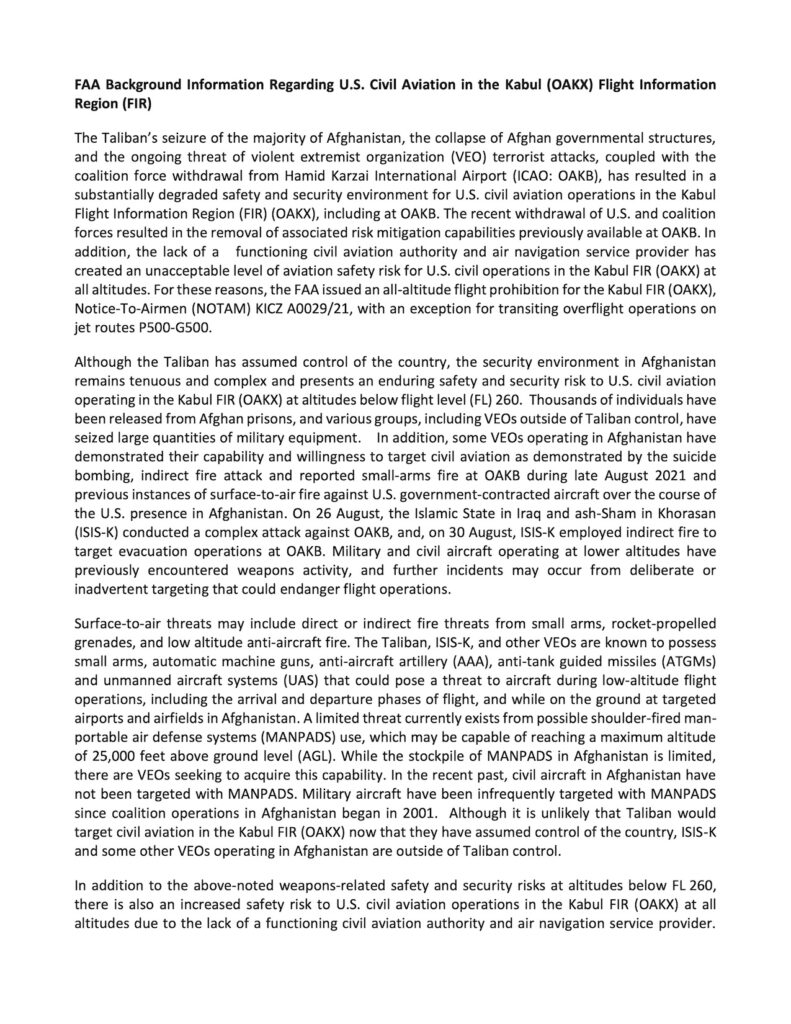
On Sep 14, the US FAA published a new Background Information note for Afghanistan, following their flight ban issued in August as per KICZ A0029/21.


The primary risk on the ground and at lower altitudes relates to the ongoing threat of weapons activity and terrorist attacks – and following the withdrawal of US and coalition forces there are no longer any risk mitigation capabilities available at OAKB/Kabul airport. Although it is unlikely that Taliban would target civil aviation now that they have assumed control of the country, ISIS and other militant group are still operating in Afghanistan outside of Taliban control.

The primary risk for overflights relates to the lack of ATC service, functioning CAA and air navigation service provider.

Bottom line, US operators are banned from the OAKX/Kabul FIR except for airway P500/G500.

To view all current published airspace warnings for Afghanistan, head to SafeAirspace.net.


The India-Pakistan Conflict: Impact on Flight Operations

The current situation in Afghanistan has led to the effective closure of the OAKX/Kabul FIR to overflights, which means that some traffic routing between Europe, India and the Far East may now need to plan routes which cross the northern Pakistan/India border.

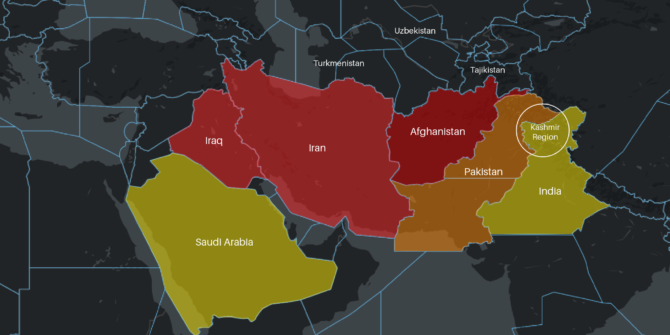
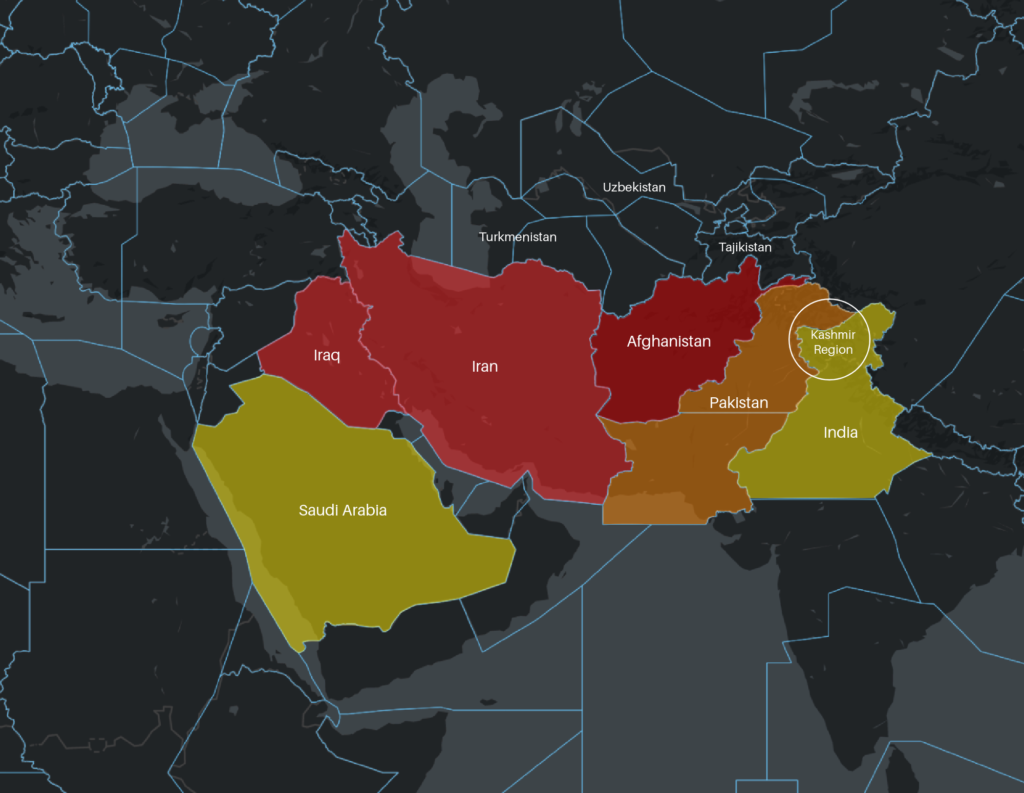
This post will take a look at the additional operational threats and info to be considered here, particularly due to the ongoing dispute over the Kashmir region, and the airspace warnings in place for Pakistan because of this.

The conflict in brief.

This conflict is rooted in who controls the region, with both India and Pakistan laying territorial claim to it. In fact, this conflict has been ongoing since 1947 and shows no signs of resolving in the near future.

Currently India control around 55% of the area, Pakistan approximately 35% and China have a third party hand in the remaining 20%.

There is also a secondary focus on the region from both sides due to cross-border terrorism and security and safety issues. Pakistan’s border with Afghanistan on the other side poses a similar threat.

The route structure of the region.

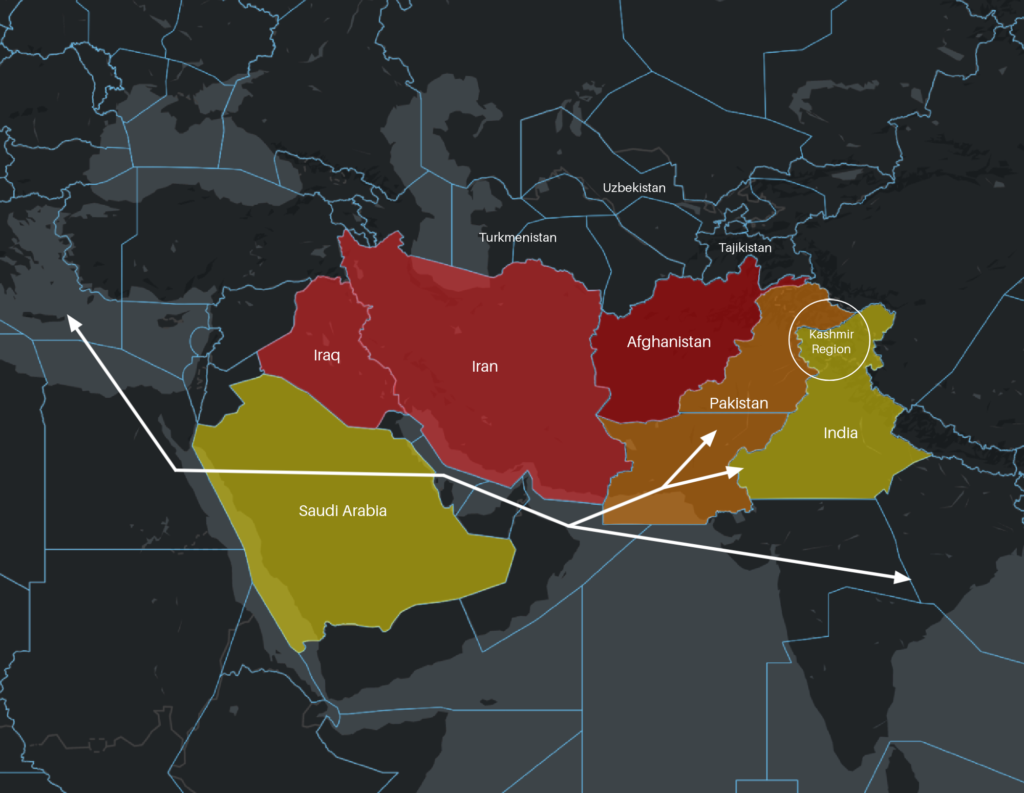
Aircraft routing from Europe and across to India and beyond have historically had 3 general routing options available to them:

  1. Via Saudi Arabia and then east direct to India. This avoids Pakistani airspace, or crosses just the most southerly portion of the airspace;
  2. Via Turkey and down through Iraq/Iran and then east via southern Pakistani airspace and into India;
  3. Across Eastern Europe via Azerbaijan, Turkmenistan and then south east crossing Afghanistan’s central airspace, avoiding the northerly Kashmir region.

That third routing option which utilised Afghanistan’s airspace, bypassed Saudi Arabia, Iran and Iraq – all of which have airspace safety considerations. Overflights across Iran and Iraq, for instance, are prohibited to US operators.

While Afghanistan also had airspace safety risks associated with it, these were previously generally low level and not “all altitude” concerns. That has recently changed with the Taliban takeover of Afghanistan. However, though the US and several other countries have since issued airspace bans and warnings for Afghanistan, overflights are still generally allowed on airways P500 and G500 which run along the eastern boundary of the Kabul FIR.

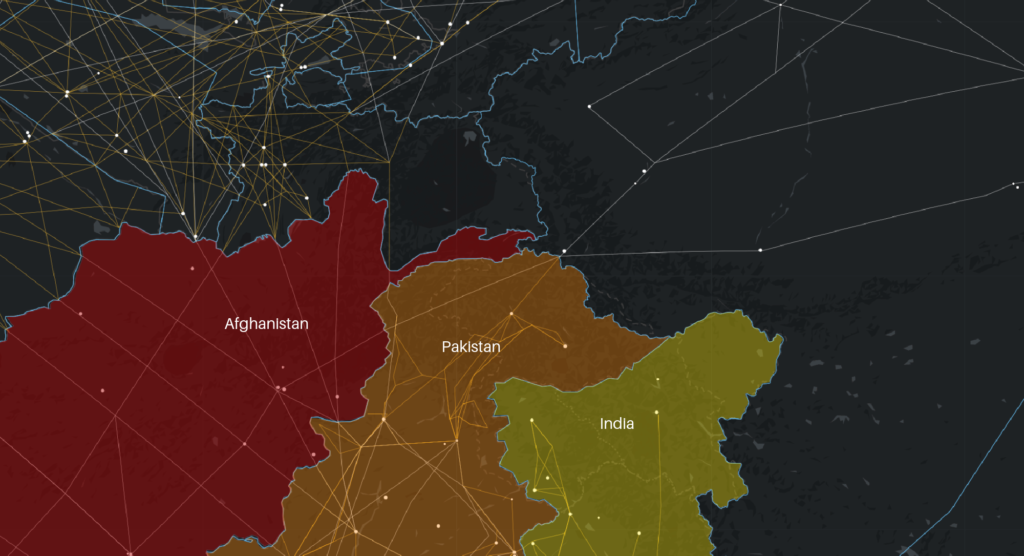
Aircraft now needing to re-route to avoid Afghanistan’s uncontrolled OAKB/Kabul FIR, and who do not wish, or are unable to utilise Saudi, Iran or Iraq airspace, may now be limited to this more northerly routing – via the G500/P500 airway in eastern Afghanistan, the northern portion of Pakistan and into India, potentially through the Kashmir region.

What is the risk in this region?

Several countries have long-standing airspace warnings for Pakistan which advise against overflights below FL260, due the risk posed by small-arms fire and indirect weapons fire. There is also a potential anti-aircraft fire risk, and there have been previous attacks against airports.

What is the current situation?

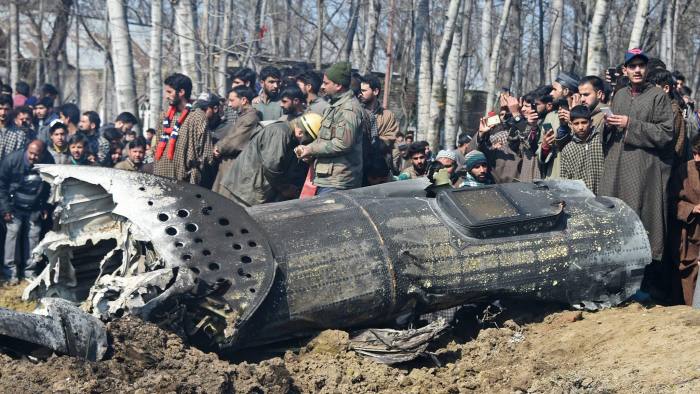
An escalation in activity across the border has been seen of late, with the number of drone attacks and activity across the line of control increasing, including several attacks against Indian Air Bases since 2019.

India possess strong air defense systems and an active air force. Historically, they have employed both fighter jets and conventional SAM systems to mitigate attacks. With the increase in both drone size and capability, and the escalation in number of attacks, there is a risk they will resort to SAM systems and fighter jets once again. If this happens, this will lead to a higher risk at all altitudes for aircraft mis-identification.

General considerations for operating over or into Pakistan.

Operators to OPIS/Islamabad have been reporting an increase in security measures and crew procedures. Crew can expect more stringent security and ID checks. Pakistan are actively guarding against terror threats at the airport and passengers may experience stricter security and ID controls as well.

Pakistan is an ADIZ and requires crew to check-in prior to entry. Comms handover between India and Pakistan can also be difficult so an advance confirmation of next frequencies is advisable when routing across any part of the border.

There traffic levels in Pakistan’s airspace have also increased recently, and crew should be aware of potential separation and traffic conflict concerns.

Pakistan airspace closures.

Pakistan have previously closed sections of their airspace. In Feb 2019, conflict between India and Pakistan resulted in Pakistan closing its airspace to overflights. The conflict was a result of escalating clashes between the two countries in the disputed Kashmir region, with numerous airstrikes on both sides. The airspace slowly reopened, and only became fully open again in August 2019.

Diversion options.

Both India and Pakistan allow tech stops (up to 24 hours) and are accommodating of diverting and emergency aircraft, however, avoiding Indian Military Air Bases (unless a dire emergency) will save you a fair amount of extra security checks, paperwork and grief on the ground.

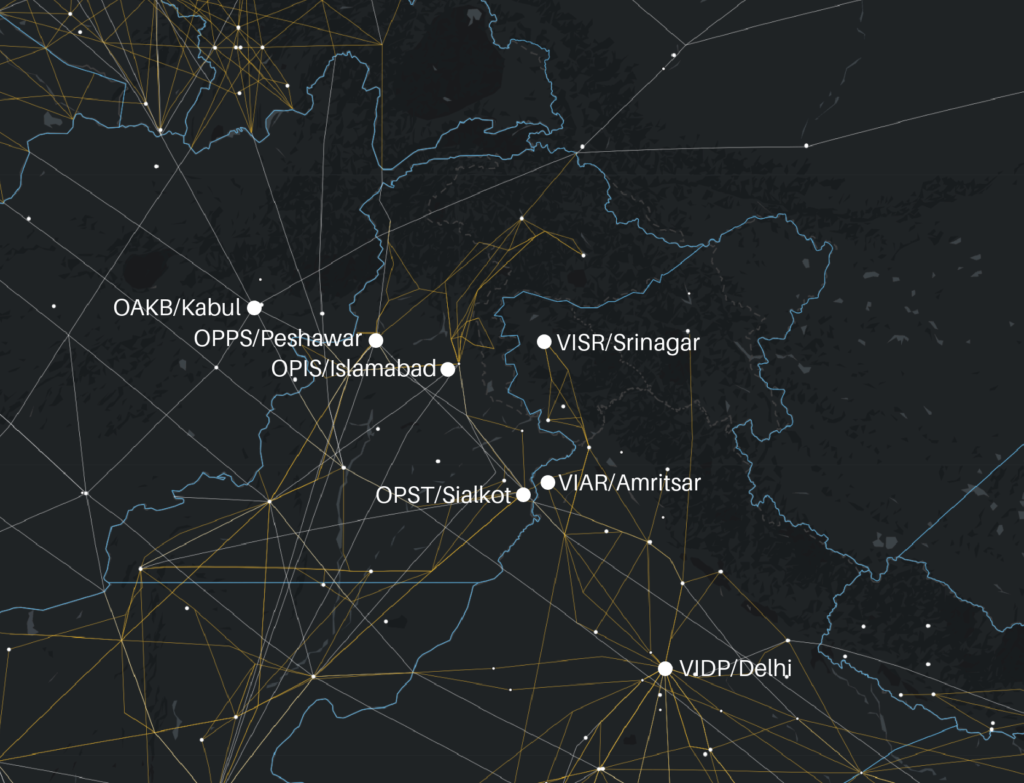
OPIS/Islamabad is a major Pakistani international airport close to the border, and is used as a southerly Himalayan diversion airport. It offers two well equipped CAT II/III runways of 12,001′.

OPST/Sialkot has a single runway, 11,811′, with an ILS and an RNP approach available.

VISR/Srinagar on the Indian side has s single 12,090′ runway.

VIAR/Amritsar also offers a single CAT II/III equipped 12,001′ runway.

There are also several other smaller airports which serve domestic routes.

Permits and overflights

Both India and Pakistan require overflight and landing permits.

For India, the lead in time for overflights is 3 days, while for landing it is 7 days. All permit applications are sent to the Ministry of Civil Aviation (MOCA) and then pass through several other government departments for security checks. You need your PPR overflight number available before reaching Indian airspace and they do often ask for it so have it handy.

India have fairly strict slot policies at several of their airports. During peak times they also might change your slot at short notice, or give you lengthy delays (2 hours+).

We recommend the use of an agent to assist with the permit process:

Freedom Air +91 11 2981 3311 / ops@freedomair.aero / freedomair@airtelmail.in

The CAA of India contact info is +91 11 2462 0784 / +91 11 2462 9221 / dgoffice.dgca@nic.inirsec.dgca@nic.in

For Pakistan, overflight and landing permits are issued through the Pakistan CAA. These take around 96 hours for overflight and 6 days for landing.

An agent can also assist with the process:

Aircraft Aviation Services (ACAS) +92 213 468 0109 / ops@acas.com.pkops1@acas.com.pk

CAA of Pakistan contact info – +91 21 997 1111 extn: 2288/2289 / +91 21 9924 2004 / support@caapakistan.com.pk / AFTN: OPHQYAYX

In summary

With the exception of US operators, flights between Europe and India/the Far East generally opt for routings via Saudi Arabia, Iran or Iraq. While routings via Tajikistan are possible, the lack of coordination between Pakistani and Indian ATC, and with few established airways, presents a planning and potential safety risk.

Pakistan has airspace safety concerns, particularly in the northern airspace (OPLR/Lahore FIR). With the closure of Afghan airspace, flights routing from Europe to Pakistan may benefit from routing via Tajikistan. However, most international flights continue to use the southerly routing for overflights.

Further Information

Information on Pakistan airspace can be found on the Pakistan CAA website.

If any operators or crew have experience of overflying this region please send us any insights you have on it so we can share the information team@ops.group.


Afghanistan: Do Not Fly

US and allied forces have now pulled out of Afghanistan, and the Taliban have taken control of the country. Afghanistan’s airspace is now effectively closed to overflights – the OAKX/Kabul FIR is uncontrolled, and overflying traffic should route around the country.

Overflights

For overflights of the region, flights between Europe and parts of Asia will be those most affected by the effective closure of the OAKX/Kabul FIR. All major international airlines have now stopped using Afghanistan’s airspace for overflights, most electing to route south via the airspace over the United Arab Emirates and Arabian Sea off the south coast of Pakistan.

However, there are risk warnings to consider for the airspace here too. Several countries have warnings in place for Iran’s airspace (the OIIX/Tehran FIR), including a total flight ban by the US, which were issued following the shoot-down of Ukraine Int Airlines flight 752 over Tehran in Jan 2020. The southern part of Saudi Arabia’s airspace (the OEJD/Jeddah FIR) carries risk as well, with increasing Houthi drone and missile attacks over the past year.

To the north of Afghanistan, the options for overflights are fairly limited – via Kyrgyzstan, Kazhakstan, or even farther north via Russia. So these are not really practical unless operating from northern Europe to China, Hong Kong, Japan, etc.

Airspace Warnings

Following the Taliban takeover, several countries have updated their airspace warnings for Afghanistan. The FAA now bans US operators from Afghanistan’s airspace, only permitting overflights on airways P500 and G500 in the far east of the OAKX/Kabul FIR. EASA, along with authorities in several western countries, are now advising operators to avoid Afghanistan’s airspace entirely.

At SafeAirspace.net we are now listing Afghanistan as Level One: Do Not Fly. Check here for a full briefing.


FAA issues Emergency Order for Afghanistan (Updated)

On August 30, the FAA revised its Emergency Order for Afghanistan, with a new KICZ Notam.

Effective immediately, US operators and flight crew are prohibited from operating in the Kabul Flight Information Region (OAKX) at all levels. The FAA cites three specific risk factors: extremist/militant activity, limited risk mitigation capabilities, and disruptions to Air Traffic Services.

The main change is that flights to and from OAKB/Kabul airport are no longer exempt. 

Therefore the only exceptions are now as follows:

1. You can operate in the Kabul FIR (OAKX) if another US government agency authorizes it together with the FAA, or by way of “deviation, exemption, or other authorization” issued by the FAA Administrator. If you do plan to fly, you must call the FAA Operations Center in Washington.

2. You can overfly on one airway: Use of airway P500/G500 is authorized for transiting overflights. (That airway cross the sliver of Afghan airspace in the east of Afghanistan between Pakistan and Tajikistan)

3. If you are experiencing an emergency.

The NOTAM is issued with permanent validity, and is presented in full below.

For further on Afghanistan, pilot and local situation reports, procedures, and assistance:

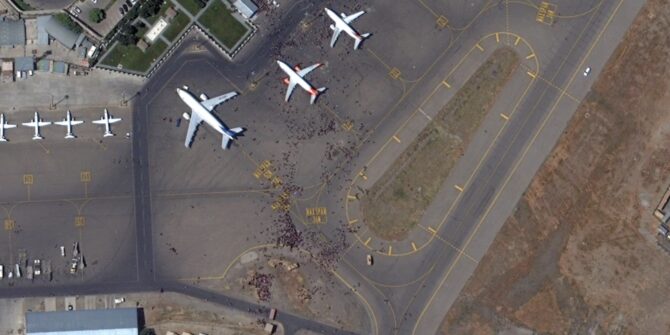
Satellite image via Washington post, Maxar Technologies 2021.


KICZ Notam A0029/21
Issued Aug 30, 1955 UTC
Valid until: Permanent

SECURITY..UNITED STATES OF AMERICA PROHIBITION AGAINST CERTAIN FLIGHTS IN THE KABUL FLIGHT INFORMATION REGION (OAKX)

THOSE PERSONS DESCRIBED IN PARAGRAPH A (APPLICABILITY) BELOW ARE PROHIBITED FROM OPERATING AT ALL ALTITUDES IN THE KABUL FLIGHT INFORMATION REGION (FIR)(OAKX), EXCEPT AS PROVIDED IN PARAGRAPH B (PERMITTED OPERATIONS) AND PARAGRAPH C (ALLOWANCES) BELOW, DUE TO THE RISK POSED BY EXTREMIST/MILITANT ACTIVITY, LACK OF RISK MITIGATION CAPABILITIES, AND DISRUPTIONS TO AIR TRAFFIC SERVICES.

A. APPLICABILITY. THIS NOTAM DOES NOT APPLY TO THE UNITED STATES DEPARTMENT OF DEFENSE. IT DOES APPLY TO: ALL U.S. AIR CARRIERS AND COMMERCIAL OPERATORS; ALL PERSONS EXERCISING THE PRIVILEGES OF AN AIRMAN CERTIFICATE ISSUED BY THE FAA, EXCEPT WHEN SUCH PERSONS ARE OPERATING U.S.-REGISTERED AIRCRAFT FOR A FOREIGN AIR CARRIER; AND ALL OPERATORS OF AIRCRAFT REGISTERED IN THE UNITED STATES, EXCEPT WHEN THE OPERATOR OF SUCH AIRCRAFT IS A FOREIGN AIR CARRIER.

B. PERMITTED OPERATIONS. THIS NOTAM DOES NOT PROHIBIT PERSONS DESCRIBED IN PARAGRAPH A (APPLICABILITY) ABOVE FROM CONDUCTING FLIGHT OPERATIONS IN THE ABOVE-NAMED AREA WHEN SUCH OPERATIONS ARE AUTHORIZED EITHER BY ANOTHER AGENCY OF THE UNITED STATES GOVERNMENT WITH THE APPROVAL OF THE FAA OR BY A DEVIATION, EXEMPTION, OR OTHER AUTHORIZATION ISSUED BY THE FAA ADMINISTRATOR. OPERATORS MUST CALL THE FAA WASHINGTON OPERATIONS CENTER AT 202-267-3333 TO INITIATE COORDINATION FOR FAA AUTHORIZATION TO CONDUCT OPERATIONS.

C. ALLOWANCES. USE OF JET ROUTES P500-G500 IS AUTHORIZED FOR TRANSITING OVERFLIGHTS.

D. EMERGENCY SITUATIONS. IN AN EMERGENCY REQUIRING IMMEDIATE DECISION AND ACTION FOR THE SAFETY OF THE FLIGHT, THE PILOT IN COMMAND OF AN AIRCRAFT MAY DEVIATE FROM THIS NOTAM TO THE EXTENT REQUIRED BY THAT EMERGENCY.

THIS NOTAM IS AN EMERGENCY ORDER ISSUED UNDER 49 USC 40113(A), 44701(A)(5), AND 46105(C).

ADDITIONAL INFORMATION IS PROVIDED AT:

HTTPS://WWW.FAA.GOV/AIR_TRAFFIC/PUBLICATIONS/US_RESTRICTIONS/

SFC – FL999, 30 AUG 19:55 2021 UNTIL PERM. CREATED: 30 AUG 19:59 2021


New FAA Airspace Warning for Afghanistan

The FAA has issued an emergency order for Afghanistan’s airspace which bans all US operators below FL260 throughout the OAKX/Kabul FIR.

KICZ Notam A0020/21 has the details but essentially there are only three exceptions:

  • Flights in and out of OAKB/Kabul are allowed to continue.
  • If a flight has a special approval from either the FAA or the state.
  • If you have an emergency and have to land.

What’s the risk?

Due to increased extremist activity on the ground, civil aircraft are increasingly exposed to a number of threats. Aircraft at low levels and those taking-off and landing are especially vulnerable.

The first is indirect fire caused by militant groups targeting airports with mortars and rockets. OAKB/Kabul was attacked in December last year by ballistic weapons which damaged a parked aircraft.

The second is direct fire from a variety of sources. Militia are known to have access to multiple weapons that can be used to target low level aircraft. These include rocket propelled grenades and man-portable air defence systems (MANPADS) which are capable of reaching aircraft as high as FL250. Even small arms fire has been actively used to target aircraft.

In recent years there have been several reports of anti-aircraft fire incidents from both military and civilian traffic. Tragically in two cases, military aircraft were actually shot down.

So why now? What’s changed?

While the threat from militant activity in Afghanistan isn’t new, the FAA has been closely monitoring the situation there for changes in safety and security. And things are changing…

As US forces begin to withdraw, two groups are now engaged in an escalating conflict there – the Taliban and Afghanistan’s own military, which may lead to a civil war if no agreement can be met. Essentially the Taliban seek to regain power, while the existing government is defending itself.

For aviation this means an increase in exposure to known risks. The situation is volatile, and no one really knows where the conflict is headed. But with increasing extremist activity on the ground and a possible intention to make an international statement, the FAA appears to have decided that a simple caution is no longer enough.

What about above FL260?

US operators can continue to overfly the OAKX/Kabul FIR above FL260 but is recommended you stay on established airways. It’s also important you continue to monitor the situation on the ground which may change with little warning.

What are other countries saying?

Several long running airspace warnings remain in place, and it is likely we will see these changed in the near term as the situation in Afghanistan continues to evolve.

France follows similar rules and requires all operators to remain at or above FL260 throughout the Kabul FIR. Both German and UK operators are advised to consider the risks of operating below FL330 and FL250 respectively.

Stay safe up there.

As US troops withdraw the real question now is whether the Afghan Government (or another international force) can put the brakes on a resurgent Taliban.

Until that happens, the situation remains unpredictable. You can keep up to date with airspace risk changes as they happen over at SafeAirspace.net – our conflict zone & risk database.

Click here for a full global briefing.


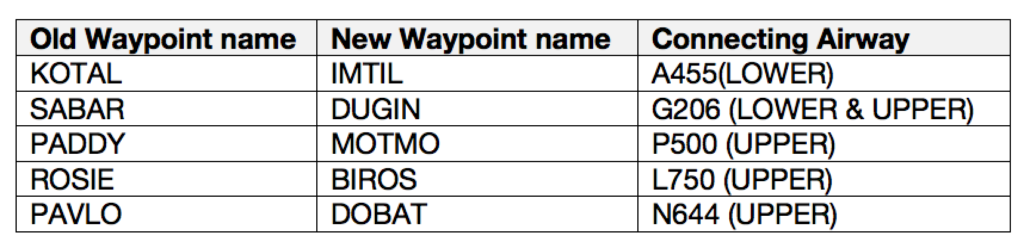
Afghan/Pakistan border waypoint name changes

Afghanistan has changed a bunch of waypoint names on its border with Pakistan today. If you’re flying that way, you’ll need to know these for when you submit your Pakistan permit – they only approve permits for specific entry/exit points.

For more details, check out the full AIP AIRAC AMDT here.

Overflight advice for Afghanistan averages out at a minimum FL250, though as with other mountainous countries we think FL320 is a better starting point. For Pakistan, the consensus among foreign authorities is to cross the OPLR/Lahore and OPKR/Karachi FIR’s at higher flight levels. For full details check out safeairspace.net

If you want to know exactly how to get your landing or overflight permits, check out our Permit Book, which tells you how to get a permit for each and every country in the world!


New overflight charges for Kabul FIR

Effective August 1st, the new charge for overflying the Kabul FIR is a flat fee of $700 USD.

Previously, the charge was $400 USD. The Afghanistan Civil Aviation Authority (ACAA) has determined the increase was necessary to support the additional infrastructure costs now that it manages its own ATC.

The fee applies to all civil flight operations using the FIR to transit enroute, regardless of aircraft size or distance flown.


Midweek Briefing: NAT changes postponed, Matthew Airport Update

NAT changes postponed 05OCT Phase 2 of Reduced Separation on the North Atlantic NAT Tracks will not go ahead as planned, slowing down the rate of change in the NAT region. Read the article.

Matthew: Airport Update 05OCT The next 24 hours will dictate the impact that Hurricane Matthew will have on Florida, as it leaves Cuba and begins to track north through the Bahamas. Airports Update: for Haiti, MTPP/Port-au-Prince … Read the article.


DGAA/Accra, Ghana has a radar outage until Oct 19th in the southern area.

EGKK/London Gatwick has a Runway Occupancy Trial starting on 08OCT, all medium and large aircraft (A319 upwards) should plan to vacate at FR. Smaller aircraft vacate at E.

ENGM/Oslo has a fueler strike – plan to carry return fuel to avoid issues, until 10OCT at least.

OAZZ/Afghanistan Security reminder from Kabul: serious threats to safety and security exist in the city of Kabul and throughout Afghanistan. The threat of kidnapping is high. The potential also exists for protests to occur in Afghan cities at short notice. Militant groups usually plan attacks against locations and individuals with potential American connections, including: Afghan and U.S. government facilities, foreign embassies, military installations, commercial entities, non-governmental organization offices, restaurants, hotels, airports, and educational centers.Travel to all areas of Afghanistan remains unsafe due to the ongoing risk of kidnapping, hostage taking, military combat operations, landmines, banditry, armed rivalry between political and tribal groups, militant attacks, direct and indirect fire, suicide bombings, and insurgent attacks, including attacks using vehicle-borne or other improvised explosive devices.

MYZZ/Bahamas all Airports closed due to Hurricane Matthew with effect today until 1900Z on 07OCT.

YMHB/Hobart is extending the 12/30 runway, see AIC H30/16 for impact information.

FEFF/Bangui has an overnight airport curfew from 2200-0500Z until the end of the year.

DIAP/Ivory Coast It’s now possible to apply for a visa online; after registering and paying online, you can collect the visa on arrival at Abidjan airport.

LTZZ/Turkey The state of emergency will officially be extended until January 2017. The announcement came after a Cabinet meeting; President Recep Tayyip Erdogan has also supported the extension. The state of emergency was put in place on 20 July following the 15 July attempted coup.

Typhoon Chaba While many eyes are on Hurricane Matthew, on the other side of the world Chaba is tracking north towards Japan after strongly impacting South Korea, however the system is weakening.

BIZZ/Iceland Volcano Katla downgraded to colour code Green, after last weeks concerns of elevated activity.

HAAB/Addis Ababa There are reports of anti-government protests taking place on the outskirts of Addis Ababa on Oct 4th. Unconfirmed reports indicate that protesters are attacking government property in the Akaki, Alem Gena, Burayu, Sebeta, Keta and Ayer Tena areas and that police officers have been deployed to the affected locations. Meanwhile, in the city center, shops have reportedly closed and there have been isolated reports of gunfire. Transportation to and from the affected areas has shut down.

LGZZ/Greece Greek trade unions have announced strike action that is expected to cause disruption to a number of domestic flights between 4 October and 8 October.

FVZZ/Zimbabwe The UNIVISA system has been suspended. If travelling between Zimbabwe and Zambia more than once either way, you should get a double entry visa; due to the ongoing cash liquidity crisis, authorities have announced a series of measures designed to stem the flow of US dollars out of the country; take sufficient cash to cover your needs for the duration of your travel.

View full International Bulletin 05OCT2016


Comms problems in the Kabul FIR

Aircraft in the eastern sections of the Kabul FIR can expect some radio issues, as a comm unit (VSAT at Ghanzi) is out of action.

Frequencies affected:

  • 118.3
  • 128.5
  • 126.325

Airways

  • M696 (between GIDOG and LAJAK)
  • A453
  • G206
  • N644
  • L750
  • M875

The advice from ATC in Afghanistan is to keep trying the assigned frequency until within range of a different transmitter; in the meantime, a bit of SLOP, IFBP and TCAS should keep you out of trouble.


Monday Briefing: Cyclone Ula strengthens towards Fiji, TSA Waiver program changes

Cyclone Ula maintains strength towards Fiji The first tropical cyclone for 2016 is lashing Fiji’s outlying islands, after causing destruction in parts of Tonga. Category three Cyclone Ula is bringing 150-kilometre-an-hour winds, strong gusts and heavy rain to the Lau group, in Fiji’s eastern division. Fiji Met Service has the latest information.

TSA Waiver program changes 04JAN The requirement for foreign operators to obtain a TSA Waiver for domestic flights within the US has been dropped, but only for aircraft under 45 tons. See new Notams FDC 5/6289, 5/5782, and 5/5806.


OAKB/Kabul. Afghanistan At approximately 1100 local time (0630 UTC) on 04JAN an explosion was reported near Hamid Karzai International Airport (OAKB/KBL). According to police sources, the blast occurred when a suicide bomber in a vehicle detonated explosives at a police checkpoint near the airport. With the exception of the assailant, the bombing did not result in injuries or fatalities, and there was no indication that airport operations were affected.

South Pacific / Tropical Storm Ula located approximately 230 nm south-southeast of Suva, Fiji. The current intensity is assessed at 85 knots based on Dvorak intensity estimates ranging from 77-102 knots. The system is expected to slow significantly under a weak steering influence, before shifting northwest as the ridge to the south begins to build.

UIBB/Bratsk A common Polar ETOPS alternate has issued a notice that non-scheduled aircraft must have prior permission due to fuel supply issues.

UIII/Irkutsk A common Polar ETOPS alternate. The main and only runway 12/30 is closed due to repair from 05JAN until 26JAN. Please see NOTAM A5600/15 for further details.

UUDD/Moscow Arrival of An-124 and B747 aircraft only by prior coordination with the Airport Company until March.

VHHK/Hong Kong International Airport opened a new $10 billion concourse this week. The Midfield Concourse’s 19 gates and 20 aircraft parking stands will allow the airport to handle an additional 10 million passengers per year and will serve approximately 20% of passenger flights once it begins operating at full capacity in March, Hong Kong International said. The five-story, 1.1 million-square-foot concourse sits between the airport’s two existing runways and connects to Terminal 1 via an automatic people mover.

NFFF/Nadi FIR Until Jan 21/2016. Operators of RNAV equipped aircraft intending to operate within the NADI FIR shall plan using random routes only if the aircraft are equipped with RNP10 or better and must have HF. Non-RNP aircraft will be permitted to operate but will be required to flight plan vis published fixes air routes. Please see NOTAM A1521/15.

HSSS/Khartoum, Sudan has no Jet A1 available for Ad-hoc operations between 27DEC and 05JAN. Carry return fuel or choose another tech stop.


View the full International Operations Bulletin 04Jan2016


Monday Briefing: Kanlaon Volcano Eruption, Colombia Permit requirements

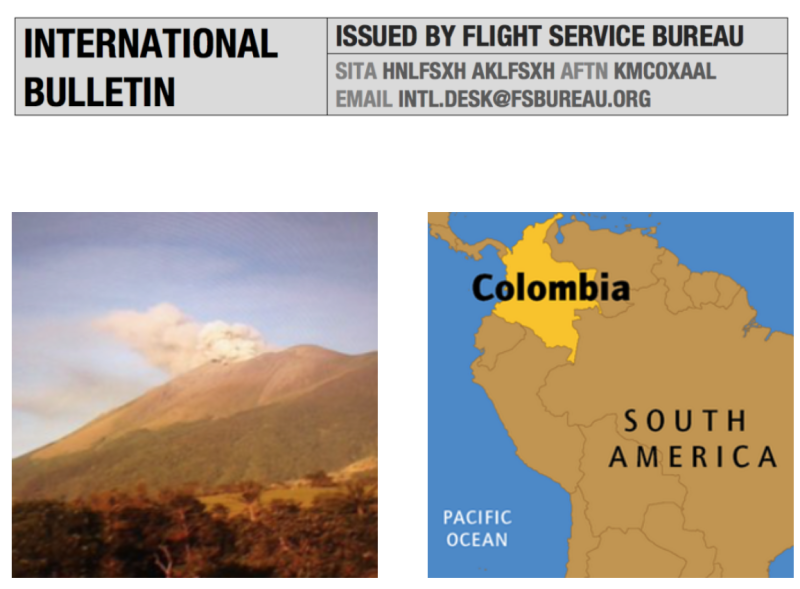
Kanlaon Volcano Eruption 28DEC The Kanlaon Volcano in the Philippines erupted on 27DEC, with an initial ASHTAM issued up to FL260. Extreme caution advised for airways B472, B473, and W7. You can get the latest updates through the Tokyo VAAC.

Updated Colombia Permit requirements 22DEC For Non-Commercial aircraft, ie. Ferry flights, General Aviation – authorisation is required only if stopping in Colombia longer than 48 hours, or operating to more than 1 Colombian Airport. Updated list of document requirements in AIP Supp 22/15 issued 22DEC.


New Years closures. Check opening times carefully during the next week, as many major airports and FBO’s have closures, especially on 31DEC/01JAN.

Kxxx/USA Scattered thunderstorms, some of which will be strong to severe, will move east across Kentucky, Tennessee, eastern Mississippi, Alabama, western Georgia and the Florida Panhandle. Heavy rain will once again trigger flash flooding over portions of the South. Airports in the risk area include KATL/Atlanta, KBNA/Nashville, KMEM/Memphis, KCHA/Chattanooga, KBHM/Birmingham, KMOB/Mobile and KLEX/Lexington.

FYWH/Windhoek, Namibia has new opening hours from 23DEC, 0700-2000LT Daily.

HSSS/Khartoum, Sudan has no Jet A1 available to Ad-hoc operations between 27DEC and 05JAN. Carry return fuel or choose another tech stop.

MUFH/Havana FIR, Cuba Airspace restrictions in place 23DEC-31DEC due to staff shortages, airways UB760 and UL210 are northbound only, and between 1400-0100Z daily, all aircraft will be spaced 25nm apart through the Havana FIR, regardless of altitude.

OAKB/Kabul, Afghanistan a car bomb detonated near Kabul International Airport at approximately 0800 local time (0330 UTC) today.Taliban militants took responsibility for the attack.

UIBB/Bratsk continues to have fuel supply issues, fuel limitation extended to 12JAN

LSZH/Zurich has parking issues for Private flights, the Airport Company will generally only accept 6 hours ground time. Extended stays will require a reposition to another airport, limitation until 06JAN.

Space Weather/Polar Ops 55% risk of R1-R2 Minor to Moderate Radio Blackout risk predicted through Dec 30th. For the most up to date information please see the NOAA Space Weather Dashboard for Aviation.

LTFJ/Istanbul A Kurdish militant group has claimed responsibility for an attack at Istanbul’s second airport that killed 1 person, and threatened more assaults.

FAA/North Atlantic Aircraft operators crossing the North Atlantic have been required to include the aircraft registration and six-character hexadecimal code that is the aircraft’s address in Item 18 of their ICAO flight plans. However, an FAA review of flight plans filed during a one week period revealed that many operators were not meeting this requirement. Therefore, the agency has issued Information for Operators (InFO) 15015, which emphasizes the importance of providing the required information in the proper format.

Vxxx/India Signaling a major shift in granting air traffic rights, the government is looking at restricting the number of landing points for overseas airlines irrespective of their seat entitlements.A senior Civil Aviation Ministry official said it was looking at restricting the ports of call given to foreign airlines under bilateral rights, while remaining flexible on seat entitlements.

VAJB/Jabalpur The Aviation regulator DGCA has suspended the license of Jabalpur airport following an incident early this month, in which a herd of wild boars marched onto the runway during the taxiing of a commercial aircraft. Following suspension of its license, no flight operations can take place from Jabalpur airport, sources said adding that the AAI has been told to remove deficiencies including proper fencing of the operational area.

RKxx/South Korea South Korea’s Ministry of Health and Welfare has formally declared an end to the Middle East Respiratory Syndrome (MERS) health threat on December 23. According to the Ministry of Health and Welfare, its decision follows World Health Organization. MERS was first confirmed in South Korea on 20MAY, and the last fatality from MERS-related complications in the country occurred on 25NOV.