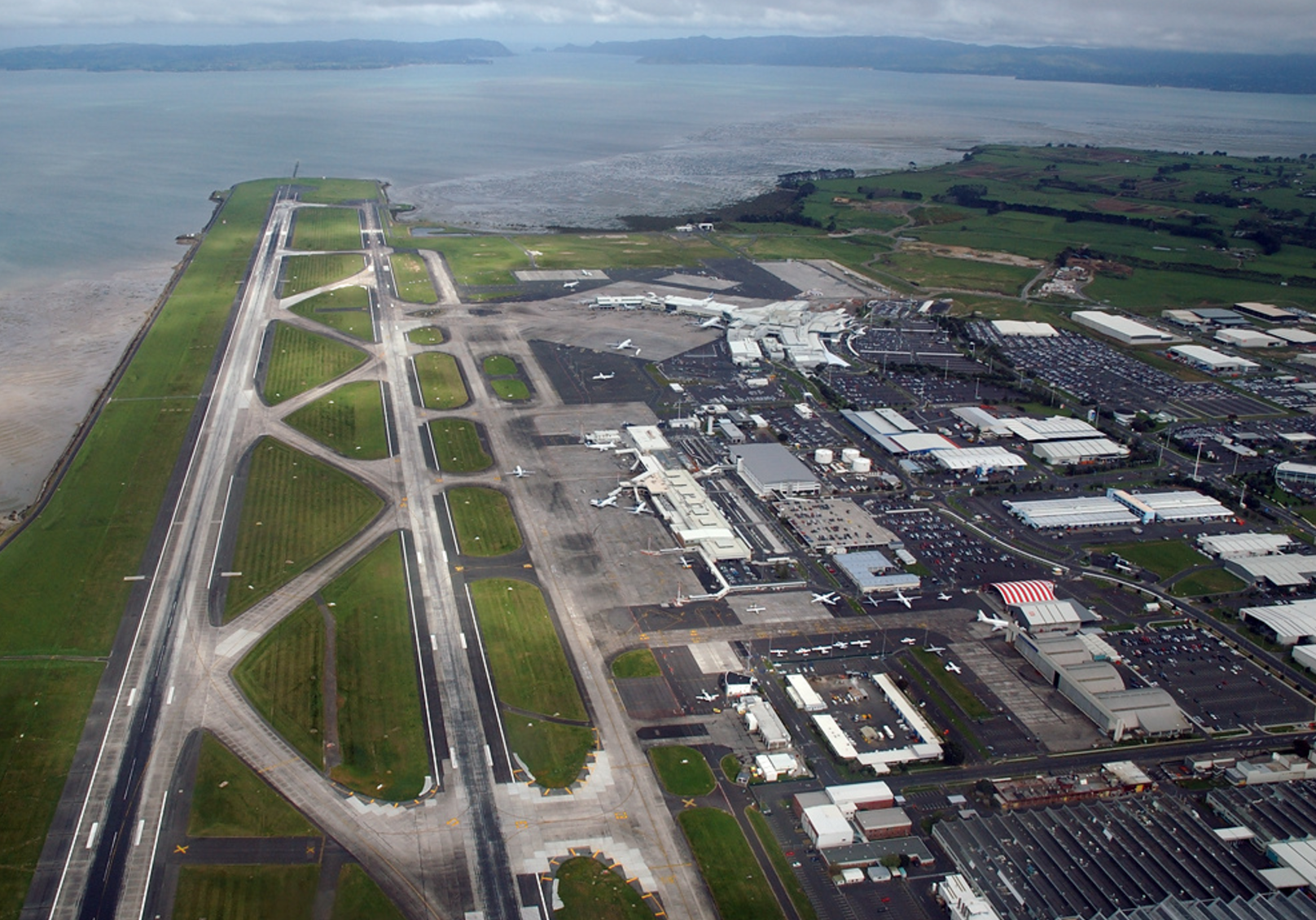
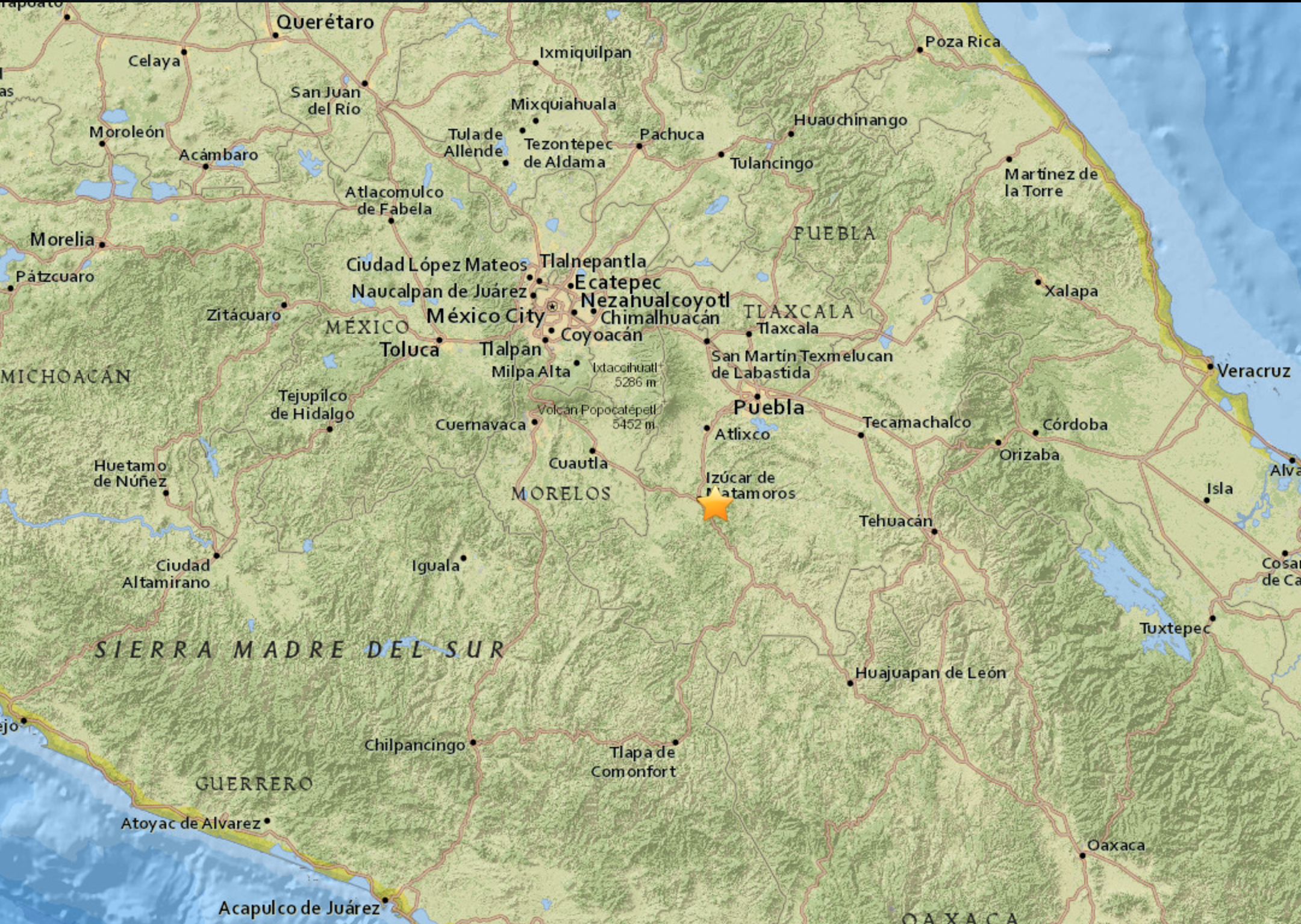
Following the 19Sep earthquake in Mexico City, MMMX airport sustained damage, and forced closure:
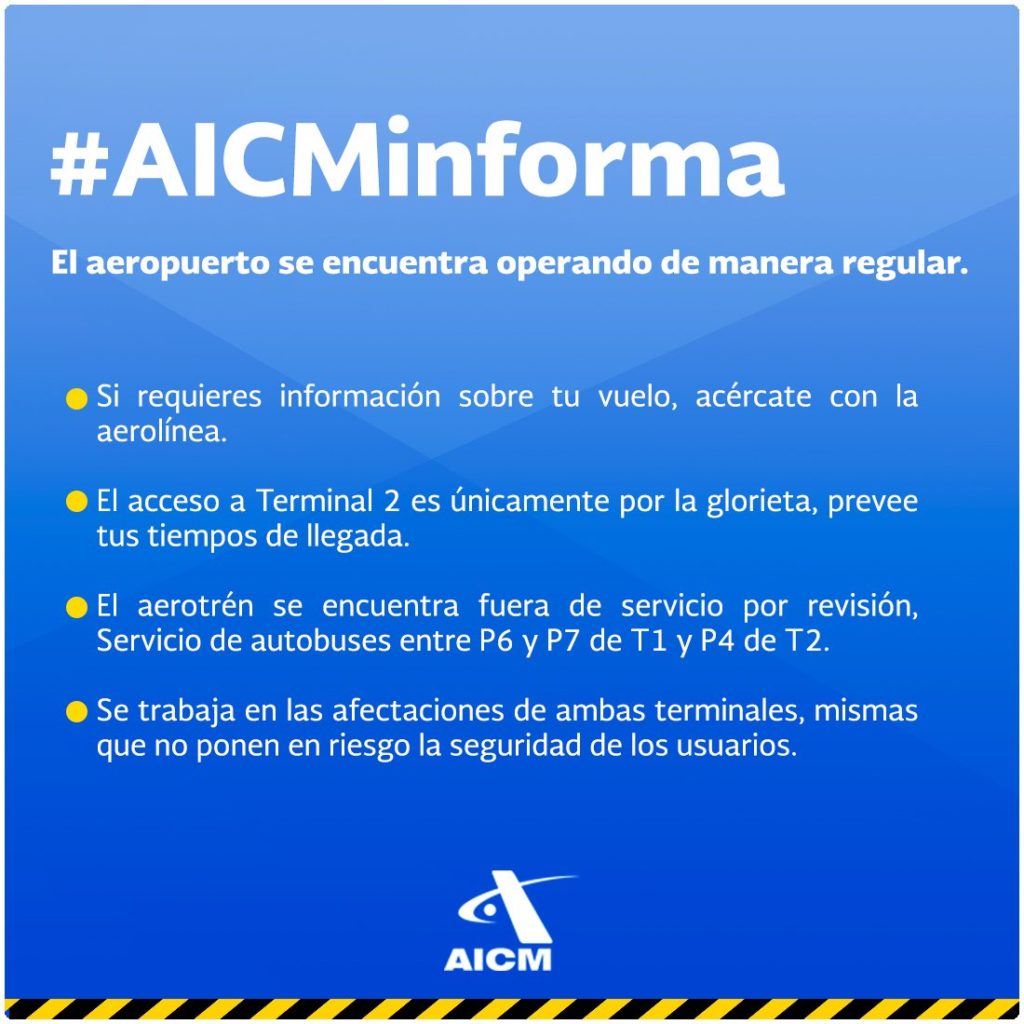
MMMX/Mexico City Operational again after the earthquake, since 1600EST yesterday. Terminal damage, airtrain not operating. Runways and Apron OK. No fuel issues reported.
If you require information about your flight, get in touch with your airline.
Access to Terminal 2 is only through the roundabout, plan ahead to arrive on time.
The airtrain is out of service. Bus service is available between P6 and P7 from T1 and P4 from T2.
AICM is currently working on fixing both terminals, and this work is not risking the security the customers.
MMTO/Toluca Remained operational, did not close, no issues reported.
Any updates to MMMX operations will be posted here.
Heavy rain affecting ops into VABB/Mumbai
written by Declan Selleck | 26 September, 2017
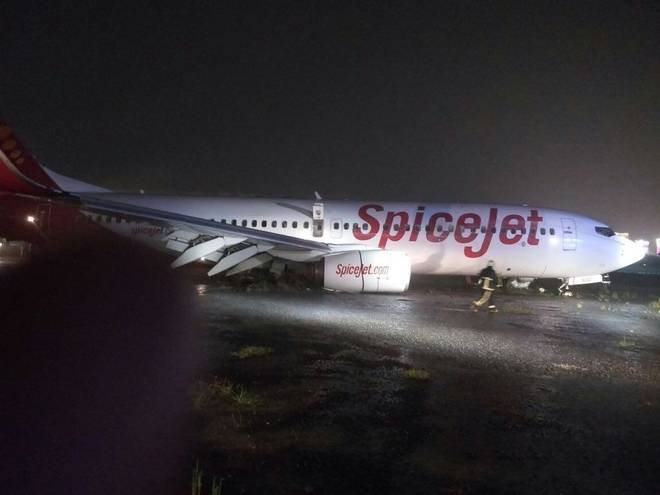
VABB/Mumbai Heavy rain is affecting flight ops at Mumbai airport for the second day in a row. The main runway (09/27) remains closed after a Spicejet aircraft skidded off last night and got stuck in mud, and it’s not expected to be open again until later today – once the aircraft can be recovered.
In the meantime, the other smaller runway is in use. Expect delays until the weather improves!
Hurricane Maria – Where is it going?
written by Declan Selleck | 26 September, 2017
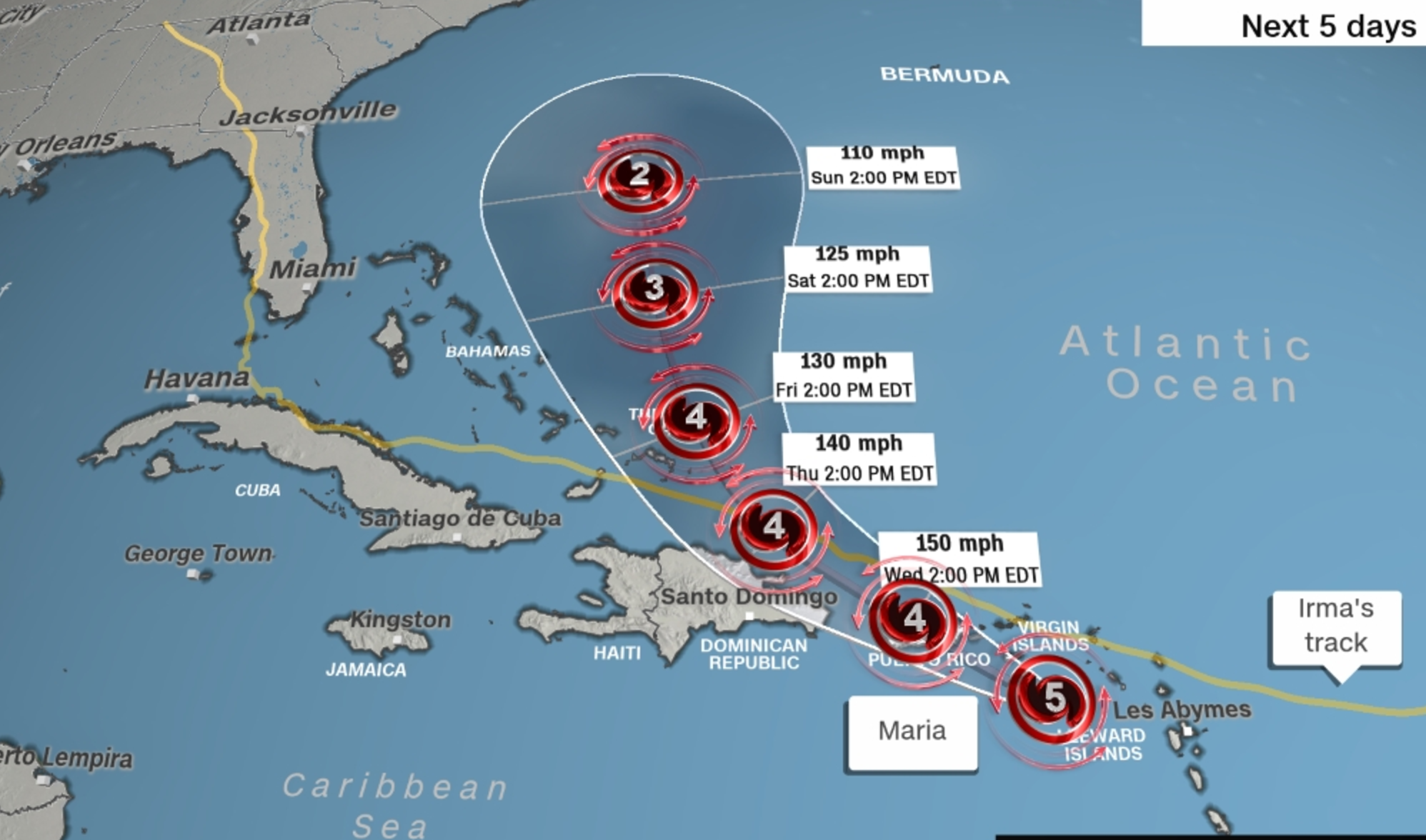
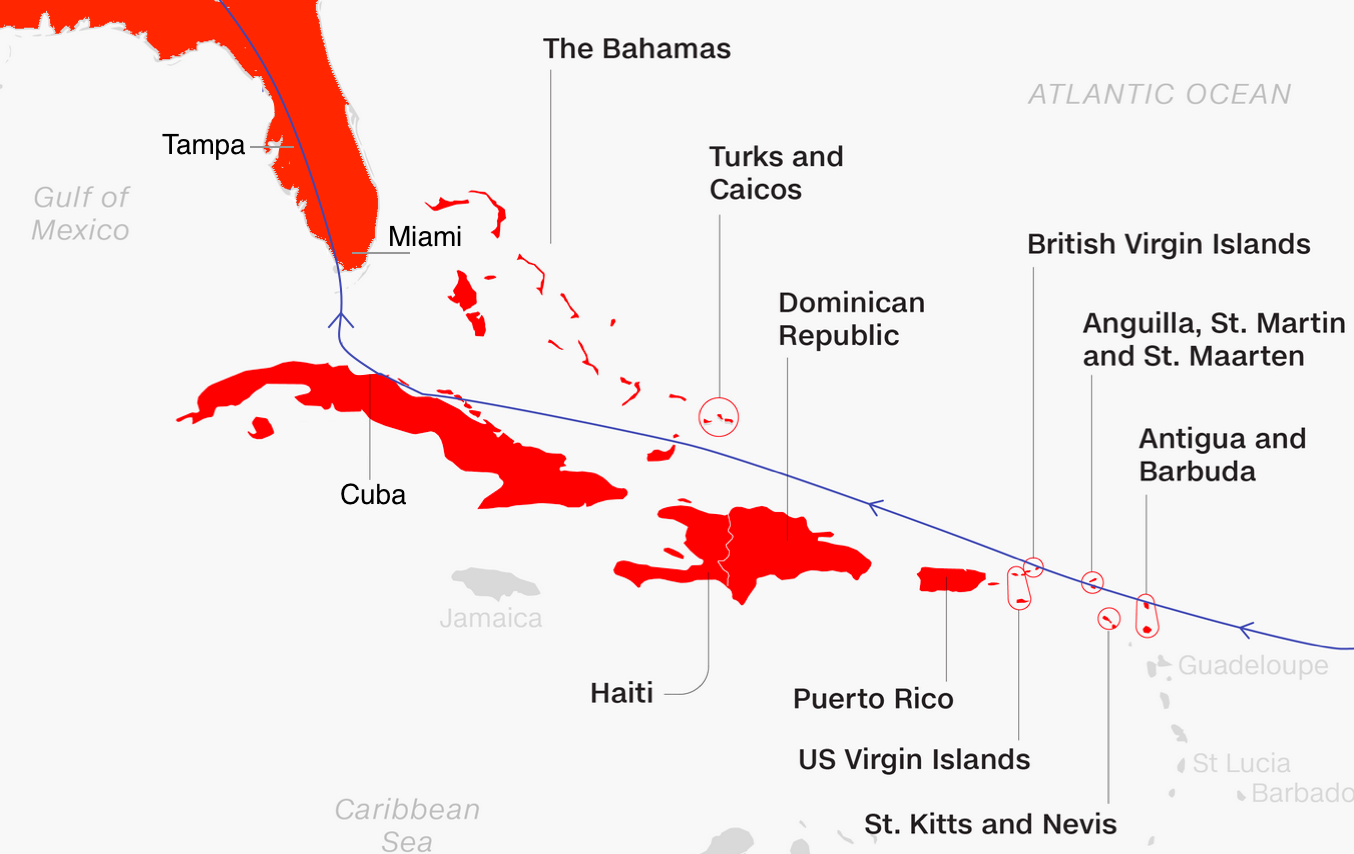
As of 2100Z today 19 September Hurricane Maria was located about 80 miles SE of the island of St. Croix and 175 miles SE of San Juan, Puerto Rico. The category 5 storm is slowly moving WNW at 10 mph. This movement and speed will place the cyclone right over the whole island of Puerto Rico by Wednesday 20 September at around 1800Z.
All Puerto Rican coastal areas are under hurricane warning and all airports in the island are expected to close at some point tomorrow. The East and North coasts of the Dominican Republic are expected to be hit by the storm in the early hours of Thursday 21 September; these coastal areas are also under hurricane warning mainly affecting Punta Cana (MDPC) and Puerto Plata (MDPP), which will most likely stop operations sometime tomorrow.
After Irma- Airport Status
written by Jamie Rose McMillen | 26 September, 2017
Last update: 20September at 2000Z
Note: some airports in the Caribbean are closing for the expected arrival of Hurricane Maria.
Due to damage and weather caused by Hurricane Irma below is the most recent information on Airports affected.
FLORIDA
KEYW/Key West: GA flights have resumed 18SEP with limited amenities in the area due to damage (Hotac, transportation, catering) Airline flights resume 20SEP with some cancellations. Advised only people who live or are assisting with relief should be traveling to the area for now
KMTH/Marathon: open and operating as normal
KMKY/Marco Island: Open and operating as normal
KTMB/Tamiami: Open and operating as normal
KMIA/Maimi: Open with minor delays
KFLL/Ft. Lauderdale: Open with minor delays
KFXE/Ft. Lauderdale Executive: Open and operating as normal
KPBI/Palm Beach: Open and operating as normal
KMLB/Melbourne: Open and operating as normal
KJAX/Jacksonville: Open and operating as normal
KTLH/Tallahassee: Open and operating as normal
KTPA/Tampa: Open with operating as normal.
KPIE/St. Petersburg: Open and operating as normal
KSRQ/Sarasota: Open and operating as normal
KRSW/Ft. Myers: Open with as normal
KFMY/Ft. Myers: Open and operating as normal
KAPF/Naples: Open with some limited services (monitor Notams) as of 18SEP.
KMCO/Orlando: Open and operating as normal
KSFB/Orlando Sanford: Open and operating as normal
Antigua & Barbuda
TAPA/St. Johns: Open and operating as normal from 0800-1700LCL as of 20 SEP
TAPH/Codrington: Closed until further notice due to serious damage to the airport. TAPA will be used as the hub and aid will be ferried by boat and helicopter to Barbuda
Anguilla
TQPF/The Valley: Closed for Hurricane Maria until 22SEP1000Z
British Virgin Islands
TUPJ/Roadtown: Closed for passage of Hurricane Maria until at least 20SEP 1800Z
TISX/St.Croix: Closed for passage of Hurricane Maria until 21SEP 1100Z
Cuba
MUHA/Havana: Open and operating as normal
MUVR/Varadero: Open and operating as normal
MUCM/Camaguey: Closed expected to open 28SEP due to extensive damage in the Camaguey Archipelago area.
MUCC/Cayo Coco: Closed until further notice due to extensive infrastructure damage
MUSC/Santa Clara: Closed until further notice
Dominican Republic
MDSD/Santo Domingo: Open and operating as normal
MDLR/La Romana: Open and operating as normal
MDPC/Higuey Punta Cana: Closed due to passing of Maria until 21SEP 1200Z
Guadeloupe
TFFR/Pointe-a-Pitre: Open but accepting Humanitarian, Military and State flights only. ATC is operational 20SEP
Dominica
TDPD/Roseau: Closed to all flights apart from relief/humanitarian. Runway and Apron have been determined usable, flights operate at their own risk. Unicom frequency active, no ATC – 118.9.
TDCF/Canefield: Open Emergency flights only as of 20SEP
Haiti
MTCH/Cap Haitien: Open and operating as normal
MTPP/Port-au-Prince: Open and operating as normal
Puerto Rico
TJSJ/San Juan: Closed for passage of Hurricane Maria as of 20SEP
TJBQ/Aguadilla: Closed for passage of Hurricane Maria as of 20SEP
TJPS/Ponce: remains closed until further notice
St. Kitts & Nevis
TKPK/Basseterre: Planned to open at 1600Z today, not yet confirmed operating
TKPN/Nevis Island: Closed for passage of Hurricane Maria until 20SEP
Turks & Caicos
MBGT/Grand Turk: Closed for passage of Hurricane Maria as of 20SEP. Due to flooding during Hurricane Irma the airport is expected to open 25SEP
MBPV/Providenciales: Closing for passage of Hurricane Maria as of 20SEP0230Z. Estimating to remain closed until 24SEP
St. Maarten
TNCM/ St. Maarten: Closed for passage of Hurricane Maria as of 19SEP. ATC is expect to be operational again by end of the month. Still no internet and water but electricity is slowly recovering. Flights will possibly start beginning of October or mid-October at the latest. Ship with fuel should arrive soon for local flights.
St. Thomas
TIST/St. Thomas: Closed for passage of Hurricane Maria until 21SEP
St. Barthelemy
TFFJ/St. Jean: Open with daily charter evacuation services. No status update as of 20SEP
Montserrat
TRPG/Gerald’s: Closed for passage of Hurricane Maria as of 20SEP
Save
Cayenne FIR: ATC gives up
written by Declan Selleck | 26 September, 2017
SOOO/Cayenne FIR: French Guiana ATC has finally given up the ghost – they’ve now implemented their contingency plan for their airspace, due to continued strike action.
If you want to cross this bit of airspace, there are now very specific routes and levels you have to fly at. Once you’re inside the airspace, don’t change your sped or level. All the details have been published in the Notams – check these carefully!
North Korea: Another launch, extended range.
written by Cynthia Claros | 26 September, 2017
Just the Facts:
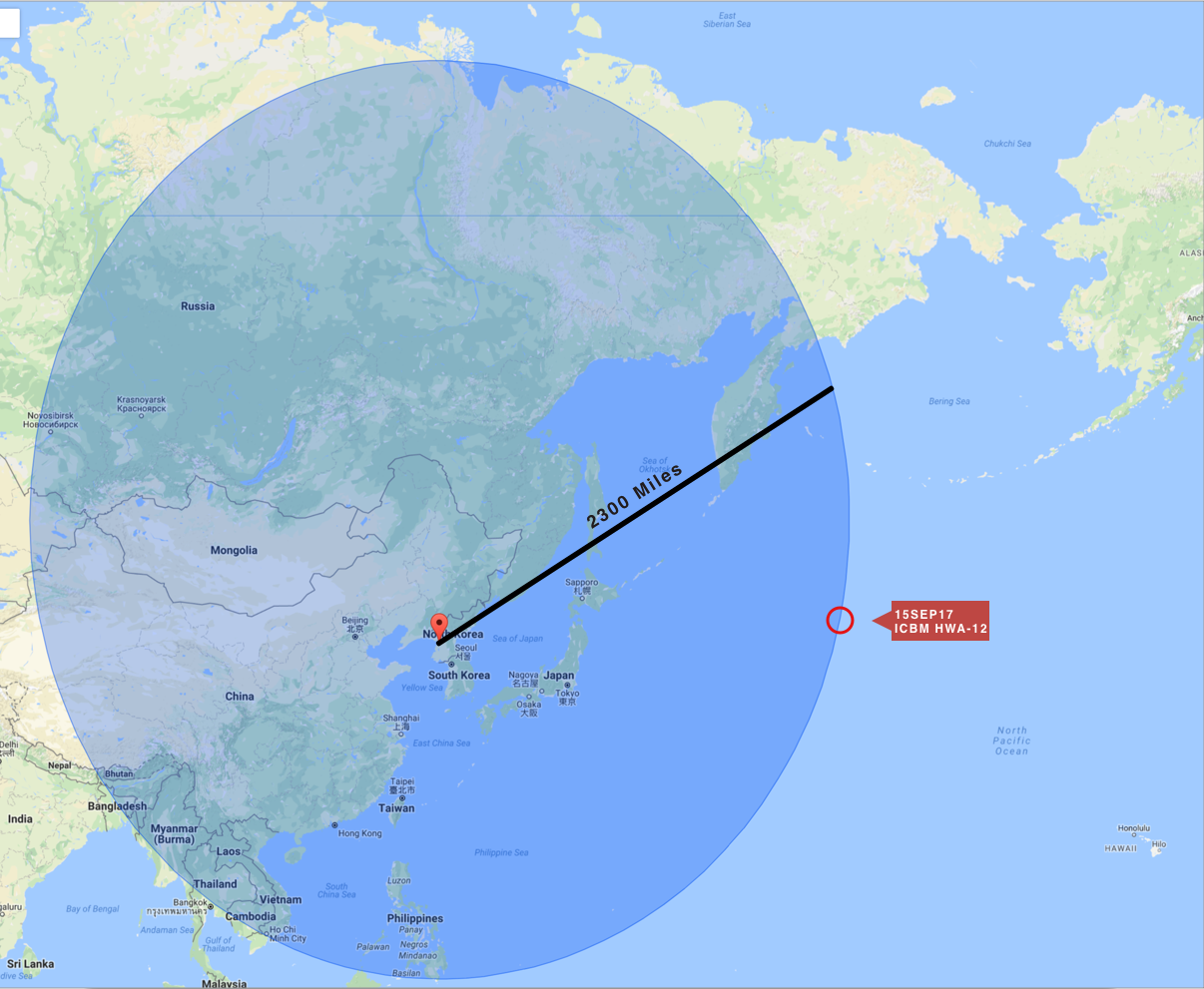
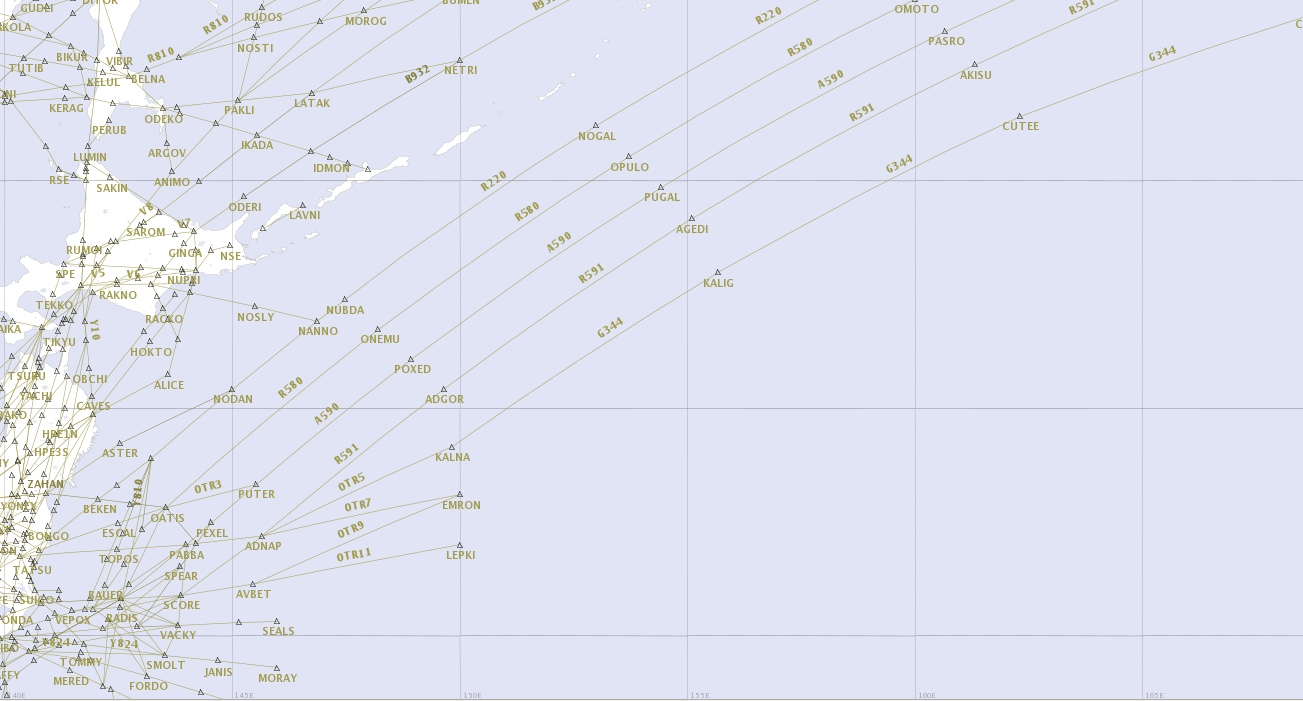
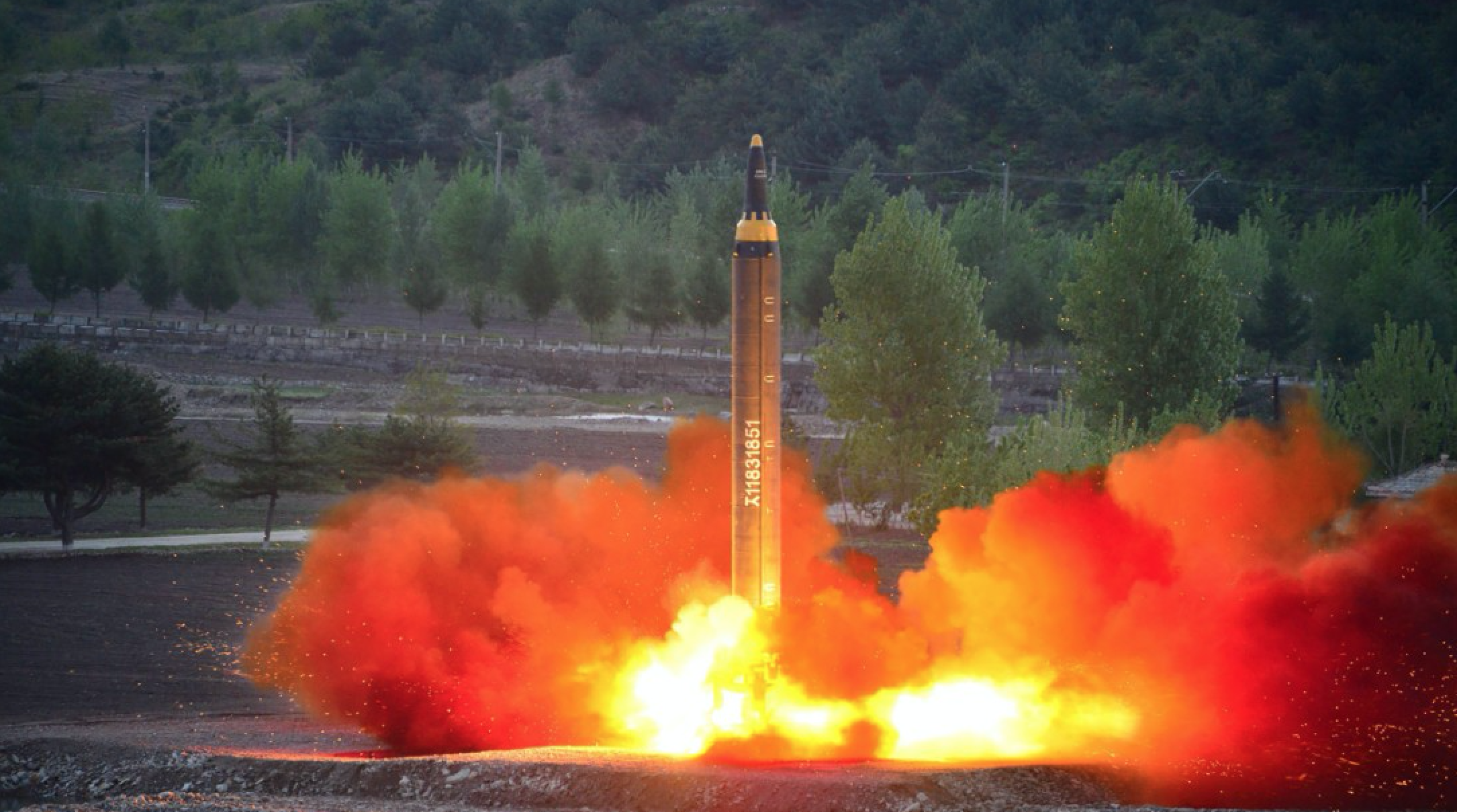
On September 15th, North Korea launched another missile, for the first time crossing over Japanese landmass. This one flew for 19 minutes, flew 2300 miles, and was likely a variant of the Hwasong-12 missile.
With the extended range, it puts more airspace at risk from debris fields. Once can reasonably exclude quite a bit of this airspace, as all launches are easterly.
This launch passed over the airways below off the coast of Japan:
Continued caution should be taken in oceanic airspace west of North Korea.
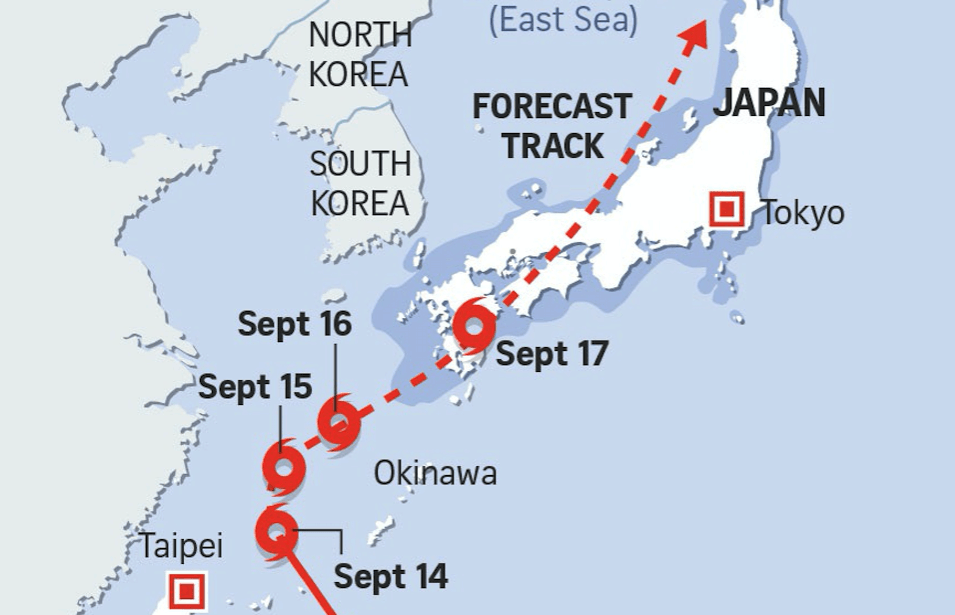
Typhoon Talim, the equivalent of a category 4 hurricane, is now headed straight for Japan.
On Miyako-Jima Island in Okinawan island chain in the far south-west of Japan, Talim has already brought destruction: winds of over 100mph, power cuts, and the highest recorded rainfall in more than 50 years. The typhoon its expected to progress up towards the Japanese mainland over the weekend.
Forecasters had previously predicted it would pass over Taiwan’s northern cities before continuing on towards the Chinese coastline. A few flights were cancelled, more than 200,000 people were evacuated from Fujian and Zhejiang provinces, and flow restriction Notams were issued for both countries airspace (RCAA/Taipei FIR & ZSHA/Shanghai FIR) – although airports in the region remained open as the typhoon’s progress was closely monitored.
However, now it seems likely that Japan will bear the worst of the impact. If you’re operating anywhere in this region over the next few days, best keep an eye on the Japanese Met Agency’s dedicated webpage for Typhoon Talim… just in case it decides to change course again.
14SEP: Airport Status after Irma, Getting out of Beijing – International Ops Bulletin
written by Jamie Rose McMillen | 26 September, 2017
Weekly International Ops Bulletin published by FSB for OPSGROUP covering critical changes to Airports, Airspace, ATC, Weather, Safety, Threats, Procedures, Visas. Subscribe to the short free version here, or join thousands of your Pilot/Dispatcher/ATC/CAA/Flight Ops colleagues in OPSGROUP for the full weekly bulletin, airspace warnings, Ops guides, tools, maps, group discussion, Ask-us-Anything, and a ton more! Curious?See what you get. Rated 5 stars by 125 reviews.
TIST/St. Thomas Airport is closed except for military and hurricane relief ops until 16SEP at the earliest. A contingency ramp has been set up to support hurricane Irma disaster response and recovery missions. All flight operations requiring services from this contingency ramp must get prior permission and a slot from the Irma flight operations coordination center (IFOCC) at 001-850-282-0236. [more in Aireport]
VIDP/Delhi Delays likely as one of the longer runways (RWY28) will be closed for landings until mid-October. [more in Aireport]
EINN/Shannon The overnight closures at Shannon will be extended until at least 01OCT. [more in Aireport]
EIDW/Dublin The long runway (RWY 10/28) will be closed for repair again this week overnight from 2200-0400z. The other shorter runway will remain open though (RWY 16/34, 2702m). [more in Aireport]
LBSF/Sofia Starting at the end of September, any aircraft code B or above will not be able to park at Sofia for more than 72hrs.
LOWW/Vienna Want to remind operators that they need to put their arrival and departure slot ID numbers in section 18 of their filed ATC flight plans. If you don’t do it in the proper format, your flight plan will be automatically rejected by CFMU. See Austrian AIP SUP 019/13 for full details of how to do it! [more in Aireport]
EPWW/Poland No data link services will be provided in Polish airspace between now and next FEB, as they will be testing their systems during this time.
TNCM/St. Maarten Airport is non-operational, probably the worst hit of all airports in the path of Hurricane Irma. [more in Aireport]
UZZZ/Russia Eruption of Volcano Shiveluch in Kamchatka, East Russia. Ash cloud reported from SFC to FL330.
RJZZ/Japan According to information emerging on 5 September 2017, the Japanese government is working to establish a four-tier emergency evacuation plan in preparation for a potential escalation in the situation with North Korea. Each tier will escalate according to the severity of the situation; the tiers include discouraging unessential travel to South Korea, discouraging all travel to South Korea, urging Japanese citizens to evacuate South Korea, and urging Japanese citizens to shelter in place. Cited as an example in the implementation of the plan, if skirmishes were to occur between the two Koreas, the Japanese government would discourage all new travel to South Korea and urge citizens to evacuate using commercial flights. Japan would implement the fourth tier in the event an attack prompted the closure of South Korean airport facilities. South Korea has reportedly agreed to give Japanese nationals access to safe zones — such as subway stations — in the event of a shelter-in-place directive. Japan is also coordinating with U.S. forces to transport evacuees by sea from Busan in the event of an evacuation.
OIZZ/Iran Iranian FARS news agency has reported that Iran has now banned US and Saudi aircraft (including commercial airlines) from entering its airspace. Still no official statement from the CAA or Notam yet…
UIBB/Bratsk Prior permission required until the end of September, due to limited fuel availability.
LDZA/Zagreb Airport’s only runway closed to all traffic (including emergency diverts) at various different times overnight until 17SEP. [more in Aireport]
UMMS/Minsk Airport closed most nights throughout September from 2100-0200z.
SOCA/Cayenne Take note when flying here, lots going on between 0000-0300 and 0630-1100 daily from now and 30NOV. Issues with staff shortages. The lower space FIR of SOCA will be unavailable to IFR traffic except state and emergency flights and you cannot file as an alternate unless you are based in SOCA, a state flight or emergency. [more in Aireport]
EGCC/Manchester You should uplift additional fuel before departing for Manchester. With Runway 05L/23R closed there is a high potential for holding delays. [more in Aireport]
EDDH/Hamburg Airport is closed from from 2159-0330 daily from 13-16SEP. [more in Aireport]
GVBA/Boa Vista Aerodrome Closed on Wed 1700-1900 and Thurs 0900-1000 from now until 31OCT due to runway works.
HEAX/Alexandria Only available to domestic flights for private aircraft, Helicopters, Petroleum Air Service and Egyptian Air Force from now until 28NOV. [more in Aireport]
USHH/Khanti-Mansi Check before flying here. The airport is closed sporadically right through September.
WSSL/WSSS/Singapore Formula 1 Grand Prix is on soon, making Singapore busy and slots difficult to obtain. Arrange well in advance. Busiest dates expected 13-19SEP. [more in Aireport]
OMAE/United Arab Emirates All traffic routing M318 leaving the Emirates FIR towards MEVDO, plan on exiting VIA M550 – RIBOT
EGZZ/United Kingdom The UK has added North Korea to airspace warnings in their AIP ENR 1.1. They are warning of the area between 1200000E and 140000E due to the unannounced missile tests in the area of the Sea of Japan. See NOTAM V0012/17 for full text.
SPJC/Peru Strikes are taking place in the historic centre of Lima and some other parts of the country, leading to temporary transport disruption. You should monitor the news and follow local advice. [more in Aireport]
ESMX/Kronoberg PPR required for all non-scheduled ops MON-FRI, 0500-1600 unitl 27October, and again from 30-31Oct.
TKPK/St Kitts All Private pax must process through the YU lounge, not through the main terminal. Use a handler to get access to the lounge.
ORBB/Baghdad 20 aircraft per hour accepted into Baghdad FIR from TASMI and RATVO.
Weekly International Ops Bulletin published by FSB for OPSGROUP covering critical changes to Airports, Airspace, ATC, Weather, Safety, Threats, Procedures, Visas. Subscribe to the short free version here, or join thousands of your Pilot/Dispatcher/ATC/CAA/Flight Ops colleagues in OPSGROUP for the full weekly bulletin, airspace warnings, Ops guides, tools, maps, group discussion, Ask-us-Anything, and a ton more! Curious?See what you get. Rated 5 stars by 125 reviews.
ZBAA/Beijing: New departure rules
written by David Mumford | 26 September, 2017
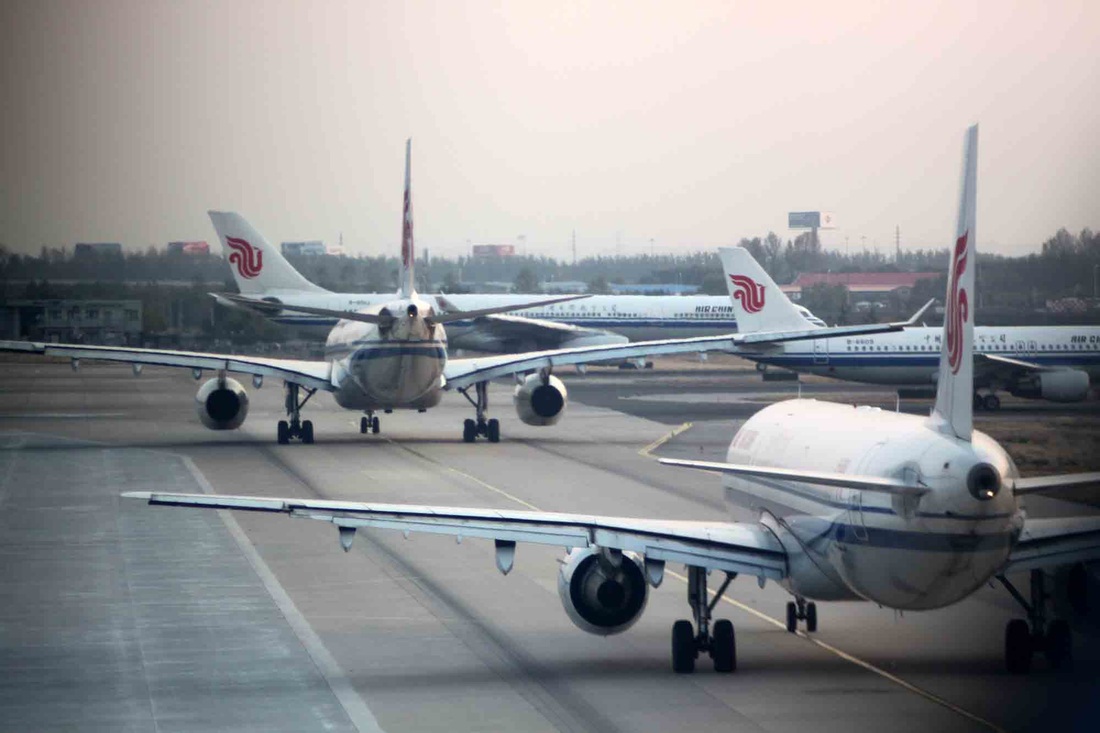
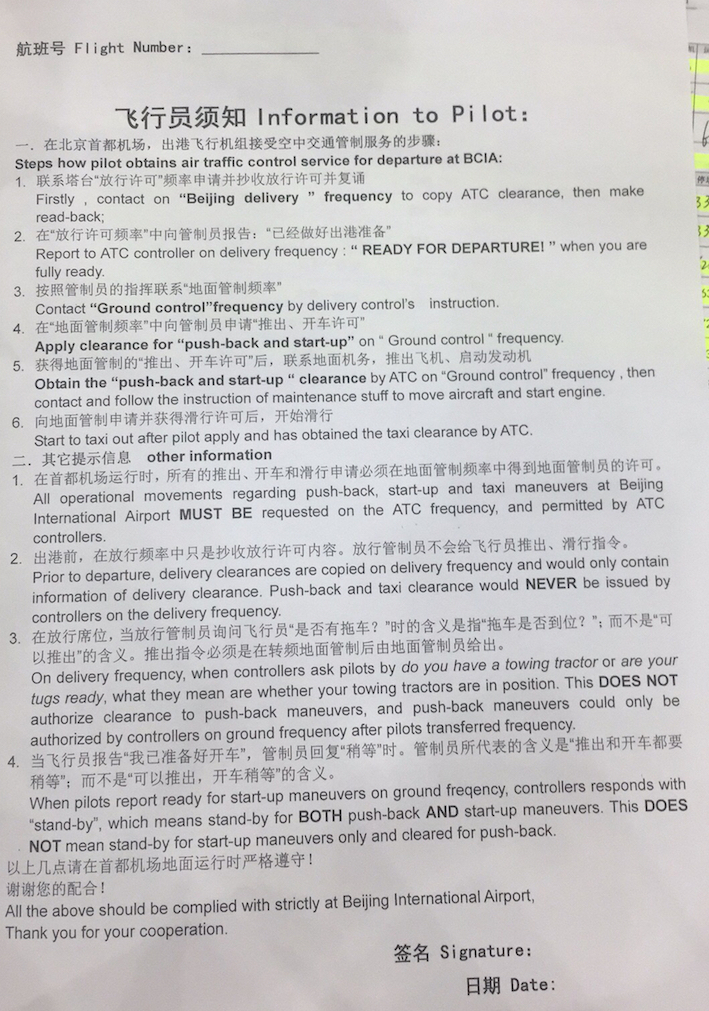
There are some new rules at ZBAA about how to go about getting clearance to depart. The new guidance doesn’t seem to have been officially published anywhere yet, but ground handling agents have been handing out a bit of paper translated from Chinese. Check out the image below for original version, which shows what you need to do. Here’s the short version:
Make sure your tow tug is in position.
Contact the delivery frequency for ATC clearance. Tell them you’re ready to go.
Next, contact the ground frequency to apply for clearance to push-back and start-up. (This clearance can only be given by controllers on the ground frequency, not the delivery frequency.)
Also, it’s been reported by an Opsgroup member that if you do not then push-back within 5 minutes of getting your clearance, you will get bumped to the bottom of the pile. Same thing happens if your EOBT is more than 15 minutes early or late from the filed time in the FPL.
Remember, slots are required at ZBAA, and GA aircraft are not permitted to arrive/depart between peak hours 0700-0900 local. There’s also only 24 hours maximum parking time allowed at ZBAA for foreign GA.
EUROPE: Third Country Operators (TCO)
written by Declan Selleck | 26 September, 2017
A TCO is an authorization issued by EASA to any third-country operator wishing to perform commercial air transport in any of the following European countries:
Should EASA deem the application in order the operating authorization process is completed in approximately 30 days. Some flights can avoid this requirement, such as Air Ambulance or Humanitarian flights.
Please note:
Overflights of the above states do not require a TCO permit.
EU member states cannot issue a permit for their country if the operator does not already hold a TCO operating authorization.
If you plan to operate to these areas, we’d suggest getting your TCO right away, even if you don’t have a planned flight at the moment. They can take some time to obtain.
24AUG: Typhoon Hato, Hurricane Harvey – International Ops Bulletin
written by Cynthia Claros | 26 September, 2017
Weekly International Ops Bulletin published by FSB for OPSGROUP covering critical changes to Airports, Airspace, ATC, Weather, Safety, Threats, Procedures, Visas. Subscribe to the short free version here, or join thousands of your Pilot/Dispatcher/ATC/CAA/Flight Ops colleagues in OPSGROUP for the full weekly bulletin, airspace warnings, Ops guides, tools, maps, group discussion, Ask-us-Anything, and a ton more! Curious?See what you get. Rated 5 stars by 125 reviews.
ZZZZ/Worldwide One of our primary missions at FSB is to monitor the world’s airspace and report on new risks to civil aviation. When enough changes occur, we update our “Unsafe Airspace Summary“ (PDF download). Last week, we published a new summary effective 16AUG2017 – version “INDIA” … Read the article.
KZZZ/USA Operating under Part 119 and performing operations under part 121 and/or part 135 under the jurisdiction of the FAA? If that’s you then you need to know that you can no longer rely on the FAA to provide flight or engineer examiners. There is a requirement for those organisations operating under this rule part to have a training and checking program. It looks like this requirement hasn’t been enforced in the past. That will be changing. Expect your local inspector to be in touch in the next few weeks.
HAZZ/Ethiopia On 21 August, the opposition Oromo Federalist Congress called for a general strike throughout the Oromo region, which surrounds the capital Addis Ababa, for the next five days. Travelers should expect disruptions to business activities throughout the region during the strike.
KASE/Aspen The FAA recently published a letter to airmen outlining a VFR climb procedure at Colorado’s Aspen/Pitkin County Airport (ASE) that may enable business aircraft crews to avoid delays following suspension of the “Wrap” departure procedure from ASE’s Runway 33 earlier this year. More from NBAA. While ATC will not ask pilots to depart under VFR climb, crews may request the procedure. More here.
OLZZ/Lebanon On Monday Lebanese military forces announced that they had uncovered a cache of anti-aircraft missiles among other arms caches abandoned by militants in Ras Baalbek. The other weapons include anti-personnel mines, mortars and machine guns. There were no reports indicating that the anti-aircraft weapons were connected to any terror plot; rather, they were likely for battlefield use, given that they were seized along with other weapons.
MMZZ/Mexico The US updated its travel warning for Mexico yesterday, warning about the risk of traveling to certain parts of Mexico due to the activities of criminal organizations in those areas. Travelers been the victims of violent crimes, including homicide, kidnapping, carjacking, and robbery in various Mexican states.
TXKF/Bermuda radar is out of action Thursday 4-10Z, usual advice – operate above FL320, or avoid the airspace. See Notam KZNY A0231/17 for the details.
BIKF/Keflavik Tower continues to have some staffing issues, keep an eye on their Notams the day of your operation, and consider another NAT fuel stop if needed.
LLZZ/Israel National Holiday Sept 18-19. They shut up shop at 1100 on the 18 Sep, and aren’t back at work until over 32 hours later at 1930 on the 19 Sep. First departure won’t be until 2030. It’s an important religious holiday in Israel. This is in addition to the closure for works on 7 Sep from 1500-1955, and the daily closures and block outs of GA aircraft due congestion. If you are planning a stop in Tel Aviv pick your time carefully. The FIR (LLLL) has the same closure on the 18-19 Sep.
MUCF/Cienfuegos will have no tower controller at 26th – 31st Aug, if you need to operate and require ATC, they say a controller can be arranged with 24 hrs notice.
EGAE/Derry is open again after flooding closed the terminal building on Tuesday night.
LPZZ/Portugal All airports – Immigration officers are planning strike action for 24th and 25th, high potential for delays.
FQZZ/Mozambique Visa on arrival is now available as an exception only. If visas are available from your home country they should be applied for prior to travel.
UUZZ/Russia On 21 August, the U.S. Embassy in Moscow announced that U.S. missions across Russia would suspend non-immigrant visa operations starting on 23 August. These operations will resume on 1 September but on a significantly smaller scale. The U.S. cited Russia’s decision to drastically reduce U.S. diplomatic staff in Russia as the reason for the reduction in non-immigrant visa operations. Beginning 1 September, non-immigrant visa interviews will be conducted in Moscow only.
VVZZ/Vietnam There has been a sharp increase in the number of Dengue fever cases from Vietnam. The only form of prevention for Dengue is to avoid being bitten by mosquitos.
DFZZ/Burkina Faso Updated travel advisory, following the recent terrorist attack on a restaurant in the capital Ouagadougou which killed 19. “Avoid non essential travel due threat of terrorism.” Multiple sources.
PLCH/Christmas Island Fuel is listed as available only for scheduled flights until mid-October due to supply issues.
EGMC/Southend Airport closed overnight between 2200-0500 04-08 Sept for all but scheduled flights.
LDPL/Pula Congestion going on, you’ll need PPR until August 27th. Email them at operations@airport-pula.hr
ZSXX/China Couple of airports here are publishing daily not to file them as an alternate. So check before filing if you are looking to use any of these airports ZGGG, ZGHA, ZHCC, ZSXZ.
Weekly International Ops Bulletin published by FSB for OPSGROUP covering critical changes to Airports, Airspace, ATC, Weather, Safety, Threats, Procedures, Visas. Subscribe to the short free version here, or join thousands of your Pilot/Dispatcher/ATC/CAA/Flight Ops colleagues in OPSGROUP for the full weekly bulletin, airspace warnings, Ops guides, tools, maps, group discussion, Ask-us-Anything, and a ton more! Curious?See what you get. Rated 5 stars by 125 reviews.
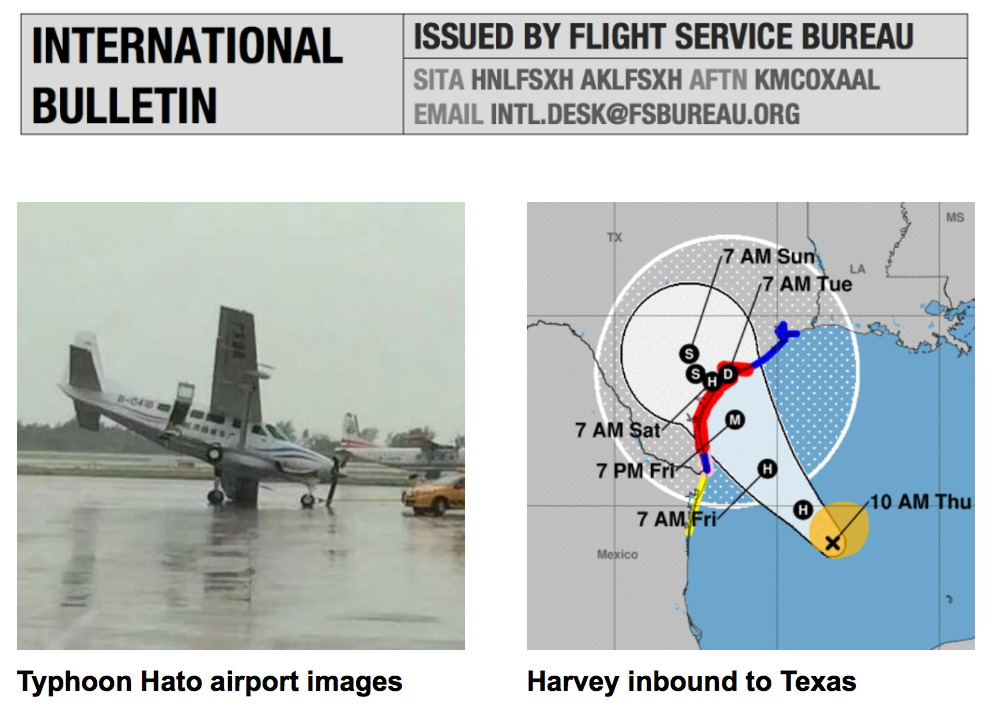
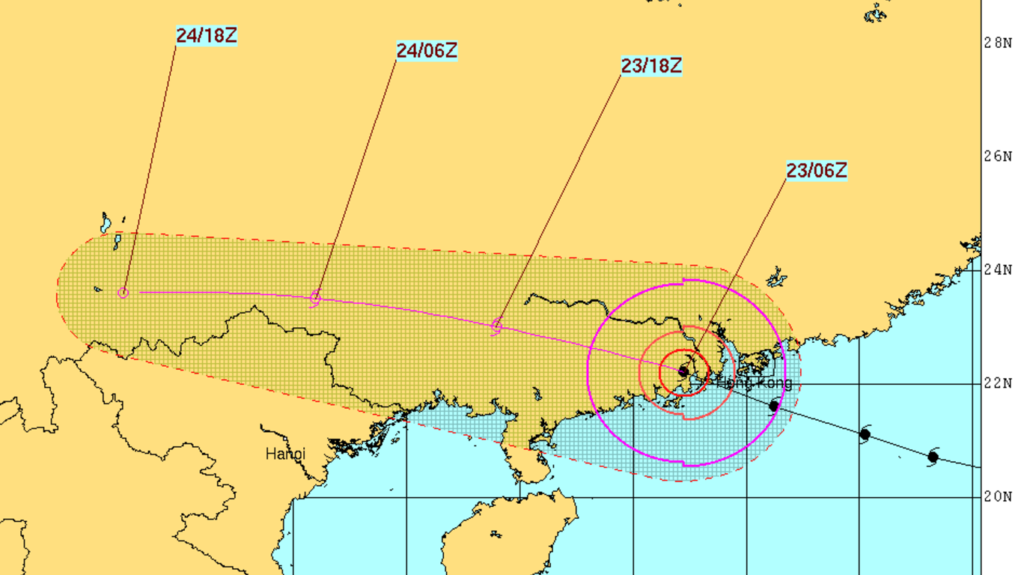
Typhoon Hato affects Hong Kong, Macau, Zhuhai
written by Declan Selleck | 26 September, 2017
With the worst of Typhoon Hato now past the Pearl River Delta, some incredible footage has been seen showing the storm in action.
The worst affected airports were VHHH/Hong Kong, VMCC/Macau, and ZGSD/Zhuhai, with winds up to 105 knots.
Hato is now tracking away to the west.
The mystery of the missing Russian Weather
written by Declan Selleck | 26 September, 2017
A little while ago, Russia stopped sending out METAR and TAF weather updates on the international wires for a whole bunch of airports.
This made life difficult for international operators, especially airlines and business jet operators that use Siberian alternates. If you don’t have the weather reports, you can’t use it.
In OpsGroup, one of our members reported that they now had issues getting weather for places like
UHHH/UHMA/UHMM/UHPP/UIBB/UIII/ULAA/ULLI/UNAA/UNKL/UNNT/USCC/USNN.
Then, another member pointed us at this official site – http://metavia2.ru/index.php?lng=en. But to register, you need to send an email, and nobody got replies.
So, the mystery remains unsolved. What do you know? Comment below, or email us at bulletin@fsbureau.org.
Think twice before entering this airspace. Overflight Risk areas in August 2017.
written by Declan Selleck | 26 September, 2017
One of our primary missions at FSB is to monitor the world’s airspace and report on new risks to civil aviation. When enough changes occur, we update our “Unsafe Airspace Summary“.
Today, we published a new summary effective 16AUG2017 – version “INDIA”.
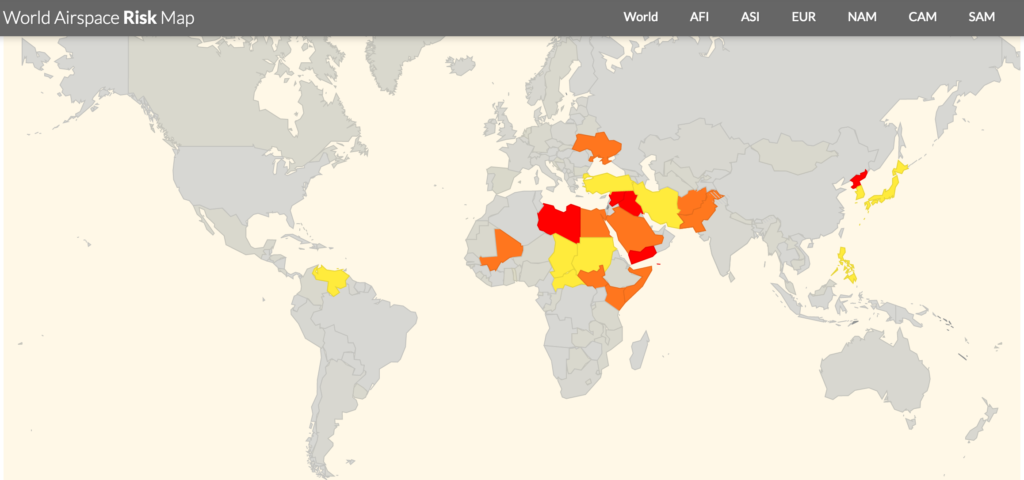
First up, the map as things stand:
Red is Level 1 – Avoid this Airspace Orange is Level 2 – Assessed Risk Yellow is Level 3 – Caution.
A live version of this map is always updated at safeairspace.net
What’s changed since the last summary?
Somalia is downgraded to Level 2, so there are now five Level 1 – Avoid countries: Libya, Iraq, Syria, Yemen, and North Korea.
Saudi Arabia is upgraded to Level 2, due to assessed risk in the southwestern portion of the FIR (Yemen border area)
French Guyana no longer a threat as strikes and airspace closures have ended
Addition of Japan, Venezuela and South Korea at Level 3 – Caution advised
If you have ops to any of these countries, make sure to have a read of the risk information. A full library is at safeairspace.net.
Download the latest summary
Latest summary available at safeairspace.net– click download PDF there.
OPSGROUP members check your inbox, you will already have received it to your email.
10AUG: Is Japanese airspace at risk? New North Korea missile threat to civil aviation – Weekly Ops Bulletin
written by Cynthia Claros | 26 September, 2017
Weekly International Ops Bulletin published by FSB for OPSGROUP covering critical changes to Airports, Airspace, ATC, Weather, Safety, Threats, Procedures, Visas. Subscribe to the short free version here, or join thousands of your Pilot/Dispatcher/ATC/CAA/Flight Ops colleagues in OPSGROUP for the full weekly bulletin, airspace warnings, Ops guides, tools, maps, group discussion, Ask-us-Anything, and a ton more! Curious?See what you get. Rated 5 stars by 125 reviews.
LEBL/Barcelona Security staff at Barcelona airport have announced Industrial action for Fridays, Sundays and Mondays starting from 4th August, with the following time schedule: 0330-0430, 0830-0930, 1430-1530, 1630-1730 UTC.
HAZZ/Ethiopia The government lifted on Aug. 4 a state of emergency that has been in place since last October, AP reported.
DISP/San Pedro, Ivory Coast is closed for two weeks since August 2 to renovate the runway, which is in urgent need of repair, according to Ivorian authorities. The runway has been renovated in the past; however, past repairs were insufficient to prevent the runway from deteriorating to its current state of disrepair.
KZZZ/USA The eclipse is coming! As the moon moves in front of the sun on August 21st, a “path of totality” will develop in portions of Oregon, Idaho, Wyoming, Nebraska, Kansas, Missouri, Illinois, Kentucky, Tennessee, Georgia and South Carolina. This rare event has created intense demand for airport services in these areas, and operators should expect delays to ground support, parking and possibly even approach sequencing to busier airports. NBAA has published some useful guidance for business operators in the US.
DFFD/Ouagadougou is reporting some capacity issues, and would prefer not to be filed as an alternate until August 19th.
EDDK/Cologne is PPR for non-scheduled traffic, apply 72 hours prior to flight: +49 2203 40 4310, flightinfo@cgn.de.
VTBD/Bangkok On August 7th, authorities stated that they were conducting an investigation into Bangkok’s Don Mueang International Airport (VTBD/DMK) following reports that approximately 5,000 passengers were forced to stand in lines for four to five hours at the facility’s immigration checkpoints. The 4 August incident occurred when several delayed flights resulted in increased passenger traffic at the facility. Heightened security measures in place at the airport — resulting in extended immigration screening — exacerbated the security processing delay. Several passengers required medical attention due to poor ventilation in the immigration checkpoint area and lack of available food or water. An airport official stated that the facility would open more immigration counters in response to the incident, which will allow authorities to process at least 1,800 visitors per hour.
YZZZ/Australia Further details have emerged about the foiled attack targeting commercial aviation in Australia, which authorities first revealed on July 30. An Australian Federal Police (AFP) official stated that two Lebanese-Australian nationals plotted to place an improvised explosive device (IED) on an Etihad Airways flight departing Sydney Airport (YSSY/SYD) on 15 July. One of the suspects brought the luggage containing the IED to the airport but then left before reaching the check-in counter. Officials have not yet established why he abandoned the attempt. The man intended to give the luggage to his brother, who boarded the aircraft. Officials stated, however, that the passenger was likely unaware of the contents of the luggage, and therefore have not charged or arrested him. The components used to manufacture the IED, which officials described as a “high-end military-grade explosive,” originated in Turkey and were transported to Australia via air cargo. This development prompted officials to enhance security measures employed to screen cargo aircraft.
LPZZ/Portugal Planned strike action by Portuguese immigration officers on 24 and 25 August 2017 may cause delays entering/exiting.
OTZZ/Qatar It had been reported that Bahrain and UAE authorities had lifted the ban on Qatar registered aircraft using their airspace, but this has been denied by both authorities and the ban still exists. Qatar aircraft have been using airspace above international waters which is managed by GCAA UAE but not airspace above their territory.
KTEB/Teterboro has a new RNAV SID – The Ruudy 6 – effective from August 17th, in response to ATC concerns over pilot deviations – 112 reports filed – on the previous version of the SID.
KZZZ/USA The FAA has issued a Notice of Proposed Rulemaking (NPRM) – operators with aircraft equipped with ADS-B out systems and meeting specific altitude equipment requirements may no longer need to go through the lengthy and challenging RVSM approval process. Comments due by 06SEP. ADS-B will be mandatory in most US Airspace by Jan 2020.
WIHH/Jakarta Halim The Indonesian government has announced it has decided to transfer all Jakarta outbound Hajj flights from Jakarta Halim to Jakarta Soekarno-Hatta Airport effective immediately. A statement issued by the Ministry of Transportation said it had taken the decision after a departing B777 ripped a hole measuring 3x2x0.25m in Halim’s runway on Friday last week. The aircraft was the first of three such flights scheduled to depart from Jakarta Halim during the first day of charters. Repairs to the affected strip took three hours to complete resulting in light delays to other departing flights.
RKSI/Seoul is introducing High Intensity Runway Ops (HIRO) at Incheon, new procedures, review the related AIC here.
VHHH/Hong Kong is now doing the CDM thing (Collaborative Decision Making), so have a read of AIC 12/17 for the details if you’re operating in there and want to know what TOBT and TSAT mean.
Weekly International Ops Bulletin published by FSB for OPSGROUP covering critical changes to Airports, Airspace, ATC, Weather, Safety, Threats, Procedures, Visas. Subscribe to the short free version here, or join thousands of your Pilot/Dispatcher/ATC/CAA/Flight Ops colleagues in OPSGROUP for the full weekly bulletin, airspace warnings, Ops guides, tools, maps, group discussion, Ask-us-Anything, and a ton more! Curious?See what you get. Rated 5 stars by 125 reviews.
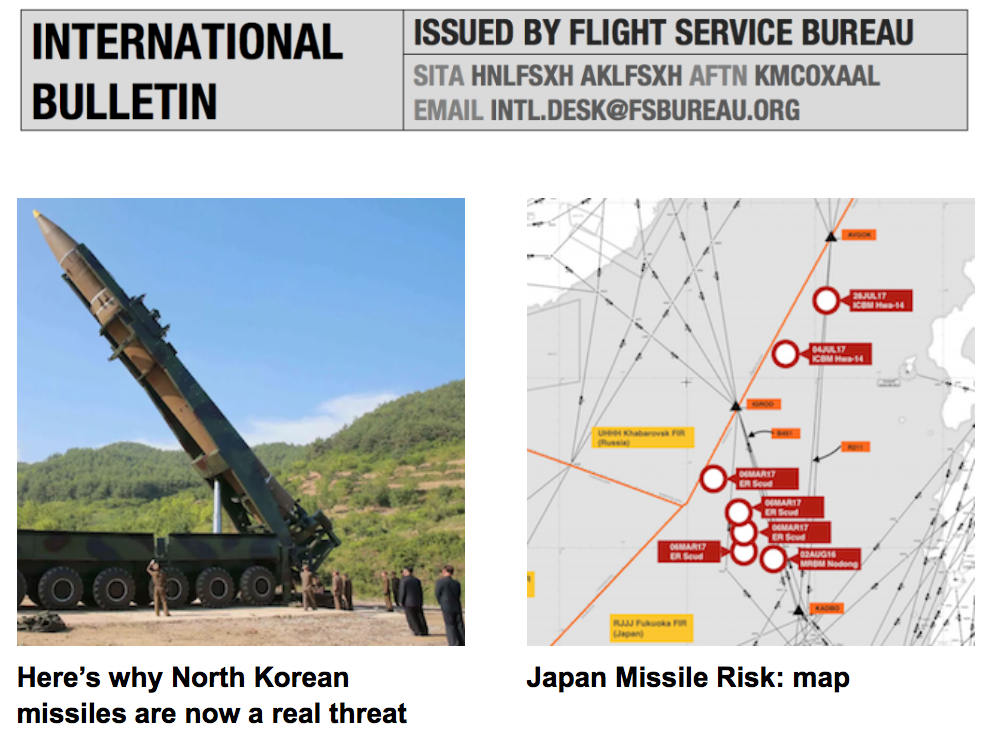
Here’s why North Korean missiles are now a real threat to Civil Aviation
written by Mark Zee | 26 September, 2017
July 2017: First launches of ICBM’s from North Korea
Western portion of Japanese airspace is a new risk area
The North Korean game has changed. Even if aircraft operators stopped flying through the Pyongyang FIR last year, nobody really thought there was much of a tangible risk. The chances of a missile actually hitting an aircraft seemed slim, and any discussion on the subject didn’t last long.
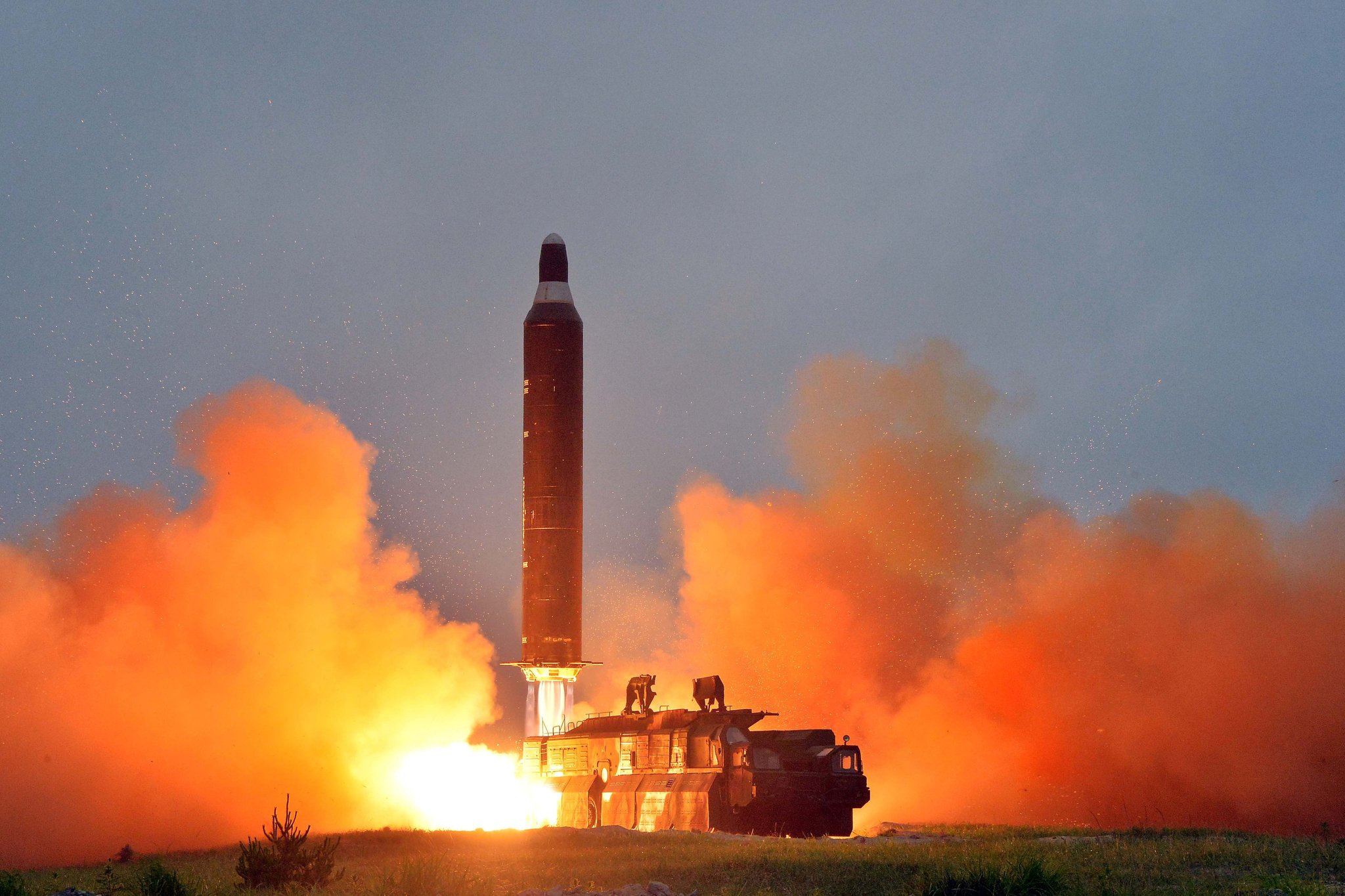
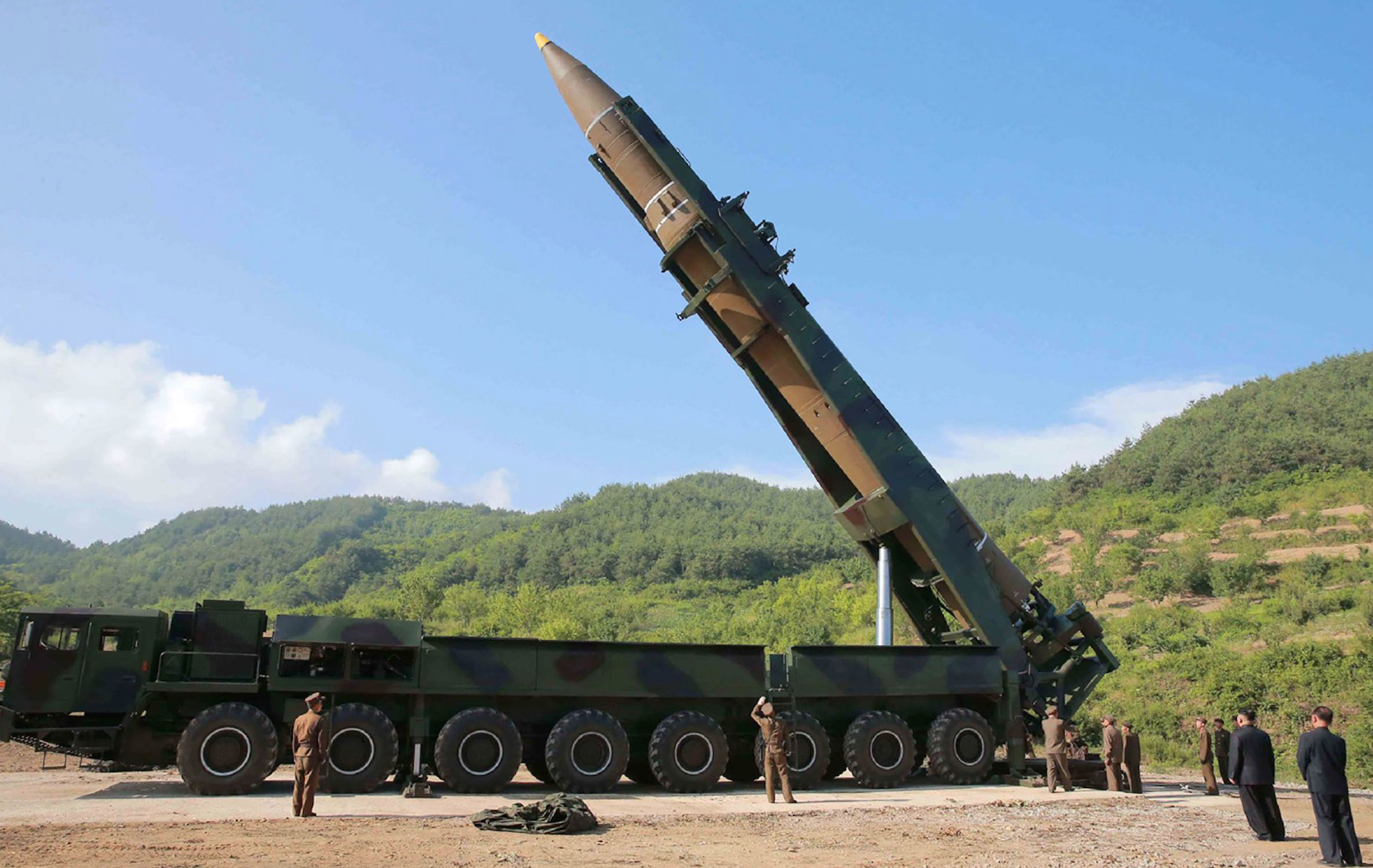
Things look different now. In July, the DPRK tested two Hwasong-14 Intercontinental missiles (the July 4th one is above), the first ICBM’s successfully launched from North Korea. ICBM’s are larger, and fly further, than the other missiles we’ve previously seen. Both of these landed in the Sea of Japan, well inside the Fukuoka Flight Information Region (Japanese airspace), and significantly, at least one did not re-enter the atmosphere intact – meaning that a debris field of missile fragments passed through the airspace, not just one complete missile.
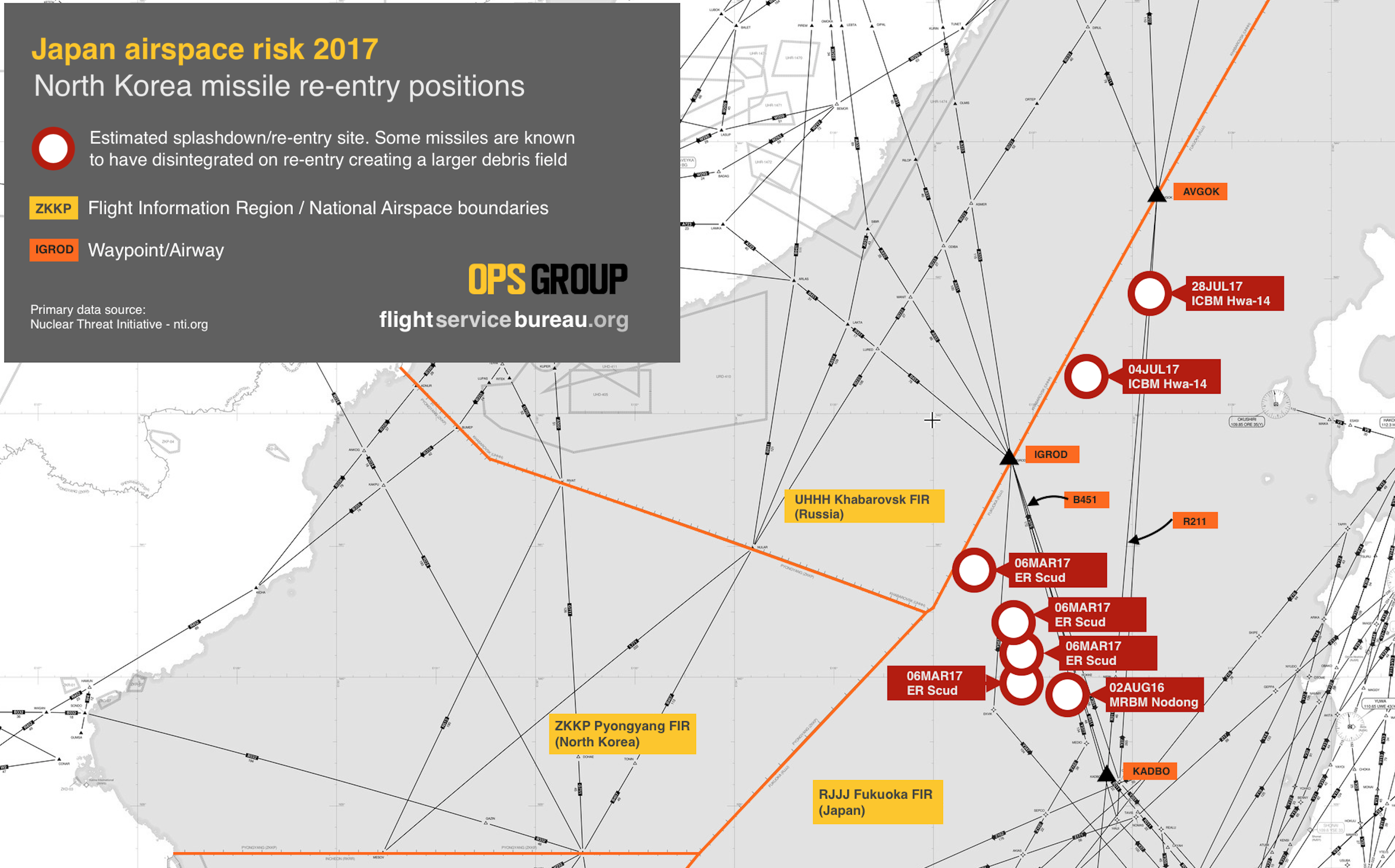
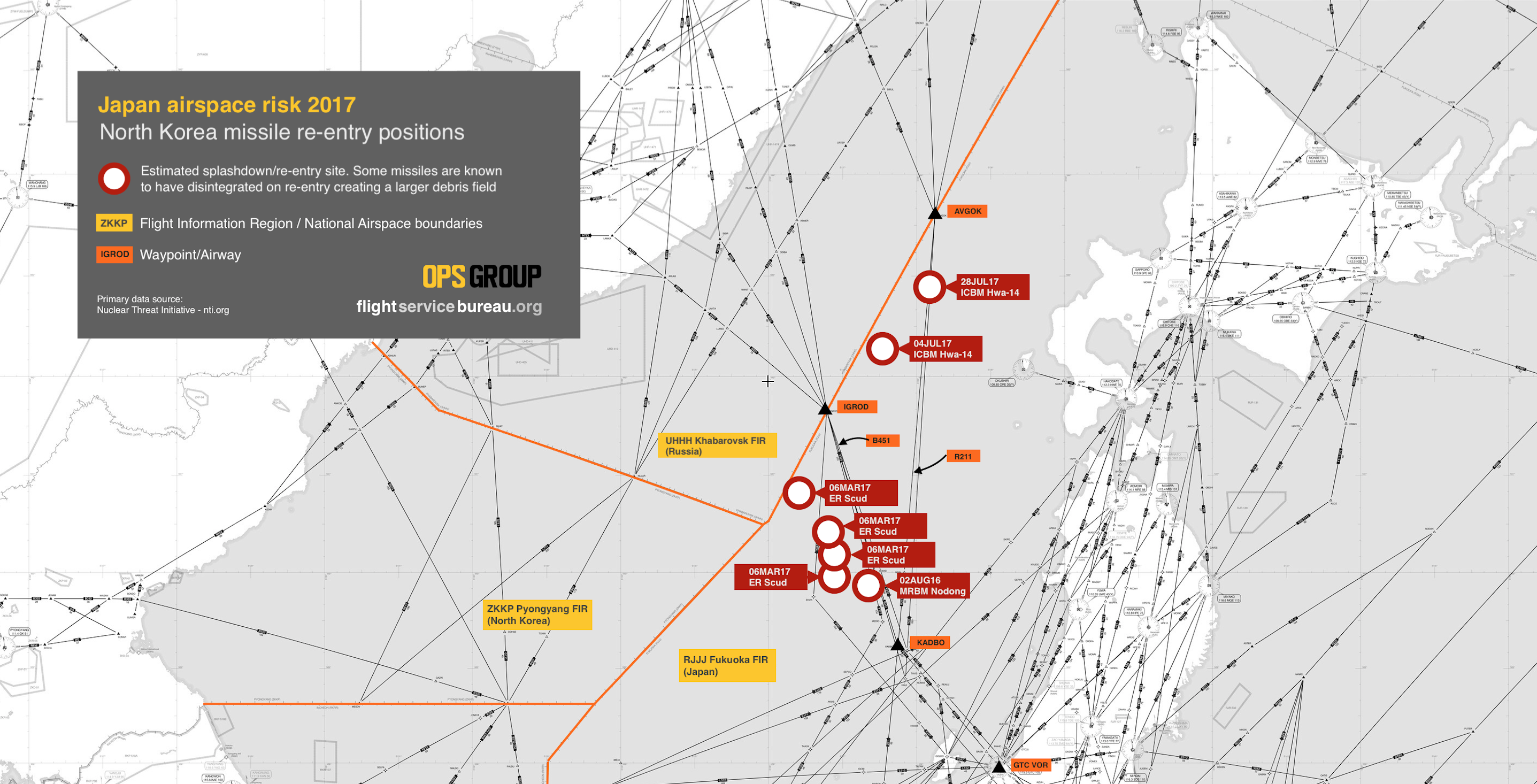
We drew a map, with our best estimates of the landing positions of all launches in the last year that ended in Japanese airspace. The results are quite clear:
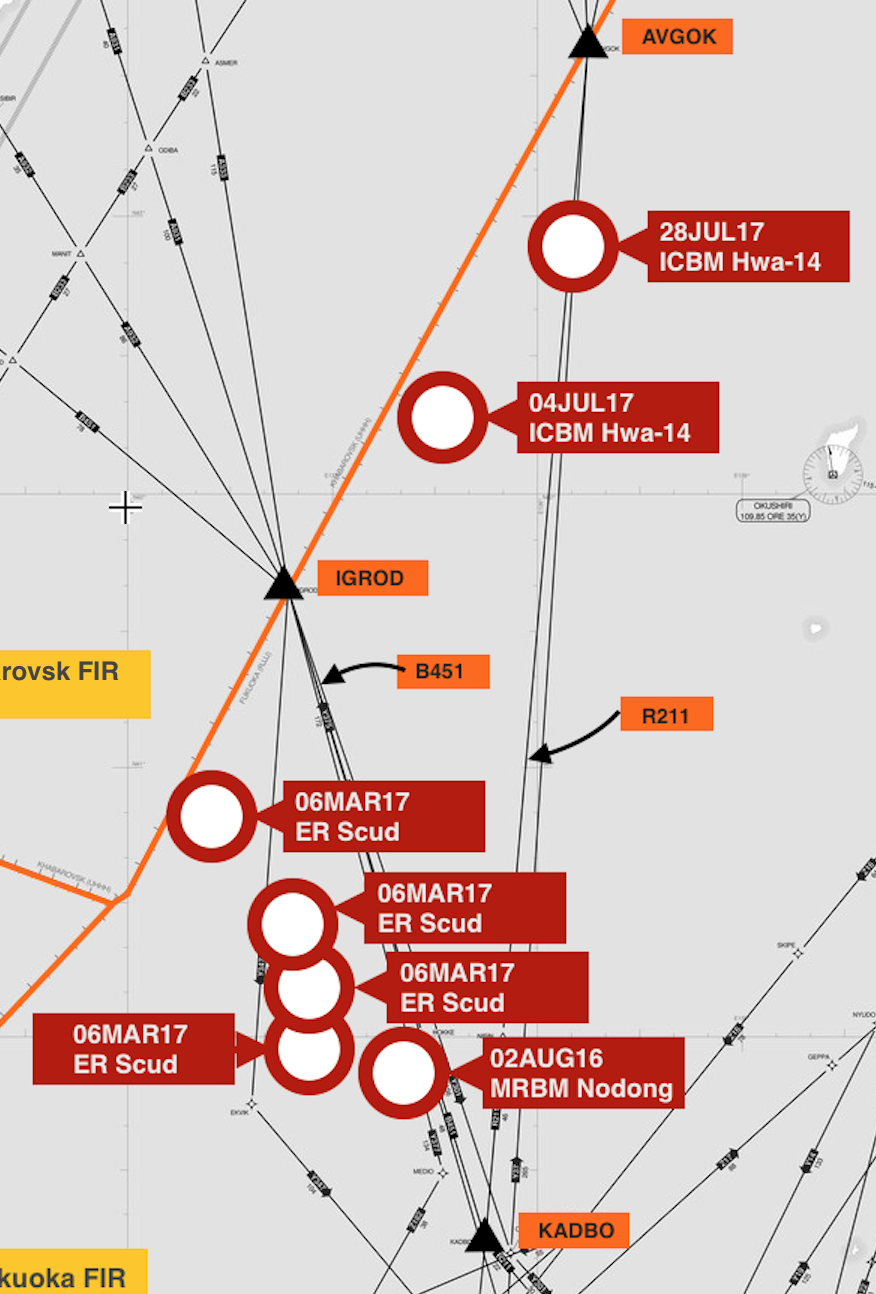
Zooming in even further, we can see each of the estimated landing sites. It is important to note that the landing positions vary in the degree of accuracy with which it is possible to estimate them. The highest accuracy is for the 28JUL17 landing of the Hwasong-14 ICBM, thanks to tracking by the Japanese Defence Force and US STRATCOM, as well as visual confirmation from land in Japan. The remaining positions are less precise, but in an overall view, the area affected is quite well defined – south of AVGOK and north of KADBO. In 2017, there have been 6 distinct missile landings in this area. The primary airways affected are B451 and R211, as shown on the chart.
So, in a very specific portion of Japanese airspace, there have been regular splashdowns of North Korean missiles. As highlighted by the Air France 293 coverage, this area is crossed by several airways in regular use, predominantly by Japan-Europe flights using the Russia route.
Determining Risk
The critical question for any aircraft operator is whether there is a clear risk from these missiles returning to earth through the airspace in which we operate. Take these considerations into account:
– The regularity and range of the launches are increasing. In 2015, there were 15 launches in total, of short-range ballistic and sub-launched missiles. In 2016, there were 24 launches, almost all being medium-range. In 2017, there have been 18 so far, with the first long-range missiles.
– In 2016, international aviation solved the problem by avoiding the Pyongyang FIR. This is no longer sufficient. The landing sites of these missiles have moved east, and there is a higher likelihood of a splashdown through Japanese airspace than into North Korea.
– Almost all launches are now in an easterly direction from North Korea. The launch sites are various, but the trajectory is programmed with a landing in the Sea of Japan. From North Korea’s perspective, this provides a sufficiently large area to avoid a missile coming down on land in foreign territory.
– The most recent ICBM failed on re-entry, breaking up into many fragmented pieces, creating a debris field. At about 1515Z on the 28th July, there was a large area around the R211 airway that would have presented a real risk to any aircraft there. Thankfully, there were none – although the Air France B777 had passed through some minutes before.
– Until 2014, North Korea followed a predictable practice of notifying all missile launches to the international community. ICAO and state agencies had time to produce warnings and maps of the projected splashdown area. Now, none of the launches are notified.
– Not all launches are detected by surrounding countries or US STRATCOM. The missile flies for about 35 minutes before re-entry. Even with an immediate detection, it’s unlikely that the information would reach the Japanese radar controller in time to provide any alert to enroute traffic. Further, even with the knowledge of a launch, traffic already in the area has no avoiding option, given the large area that the missile may fall in.
Can a falling missile hit an aircraft?
What are the chances? Following the AFR293 report on July 28, the media has favoured the “billions to one” answer.
We don’t think it’s quite as low.
First of all, that “one” is actually “six” – the number of North Korean missiles landing in the AVGOK/KADBO area in 2017. Considering that at least one of them, and maybe more, broke up on re-entry, that six becomes a much higher number.
Any fragment of reasonable size hitting a tailplane, wing, or engine as the aircraft is in cruise at 450 knots creates a significant risk of loss of control of the aircraft. How many fragments were there across the six launches? Maybe as high as a hundred pieces, maybe even more.
The chances of a missile, or part of it, striking the aircraft are not as low as it may initially appear. Given that all these re-entries are occurring in quite a focused area, prudence dictates considering avoiding the airspace.
What did we learn from MH17?
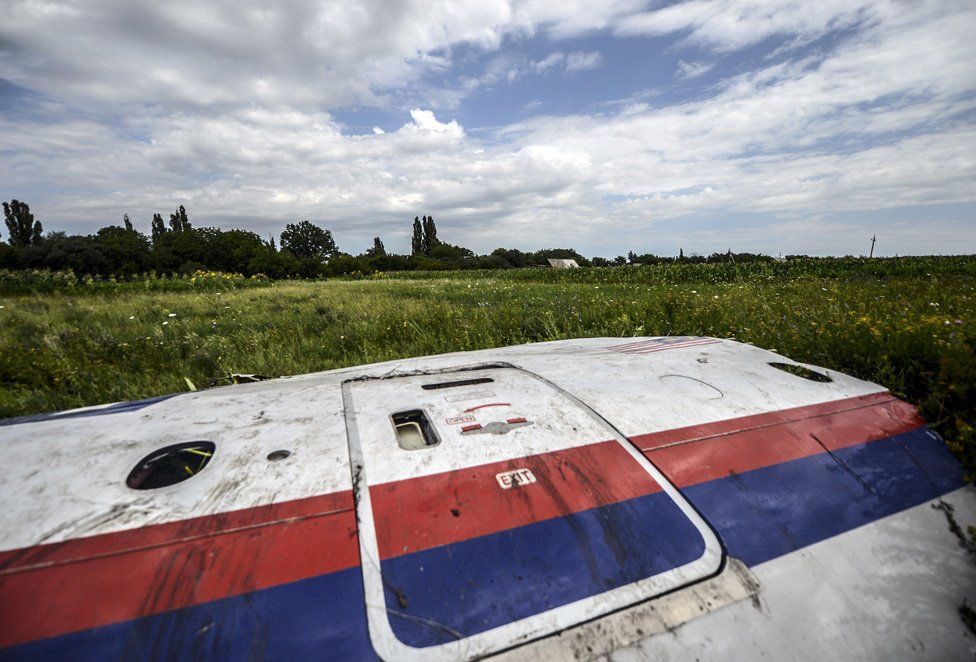
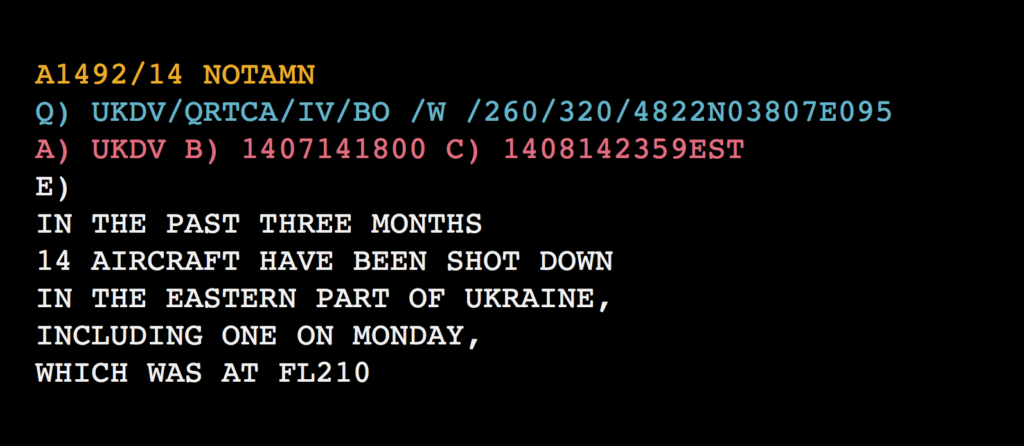
Whenever we discuss missiles and overflying civil aircraft in the same paragraph, the valuable lessons from MH17 must be remembered. In the weeks and months leading up to the shooting down of the 777 over Ukraine, there were multipleclues to the threat before the event happened.
Of greatest relevance was that State Authorities did not make clear the risk, and that even though five or six airlines decided to avoid Ukrainian airspace, most other operators did not become aware of the real risk level until after the event.
Our mission at Flight Service Bureau is to make sure all aircraft operators, crews, and dispatchers have the data they need to make a fully informed decision on whether to continue flying western Japan routes, or to avoid them.
– Review the map above to see the risk area as determined by the landing sites in 2017.
– Consider rerouting to remain over the Japanese landmass or east of it. It is unlikely that North Korea would risk or target a landing of any test launch onto actual Japanese land.
– Check routings carefully for arrivals/departures to Europe from Japan, especially if planning airways R211 or B451. Consider the previous missile landing sites in your planning.
– Weekly International Ops Bulletin published by OPSGROUP covering critical changes to Airports, Airspace, ATC, Weather, Safety, Threats, Procedures, Visas. Subscribe to the short free version here, or join thousands of Pilot/Dispatcher/ATC/CAA/Flight Ops colleagues in OPSGROUP for the full weekly bulletin, airspace warnings, Ops guides, tools, maps, group discussion, Ask-us-Anything, and a ton more.
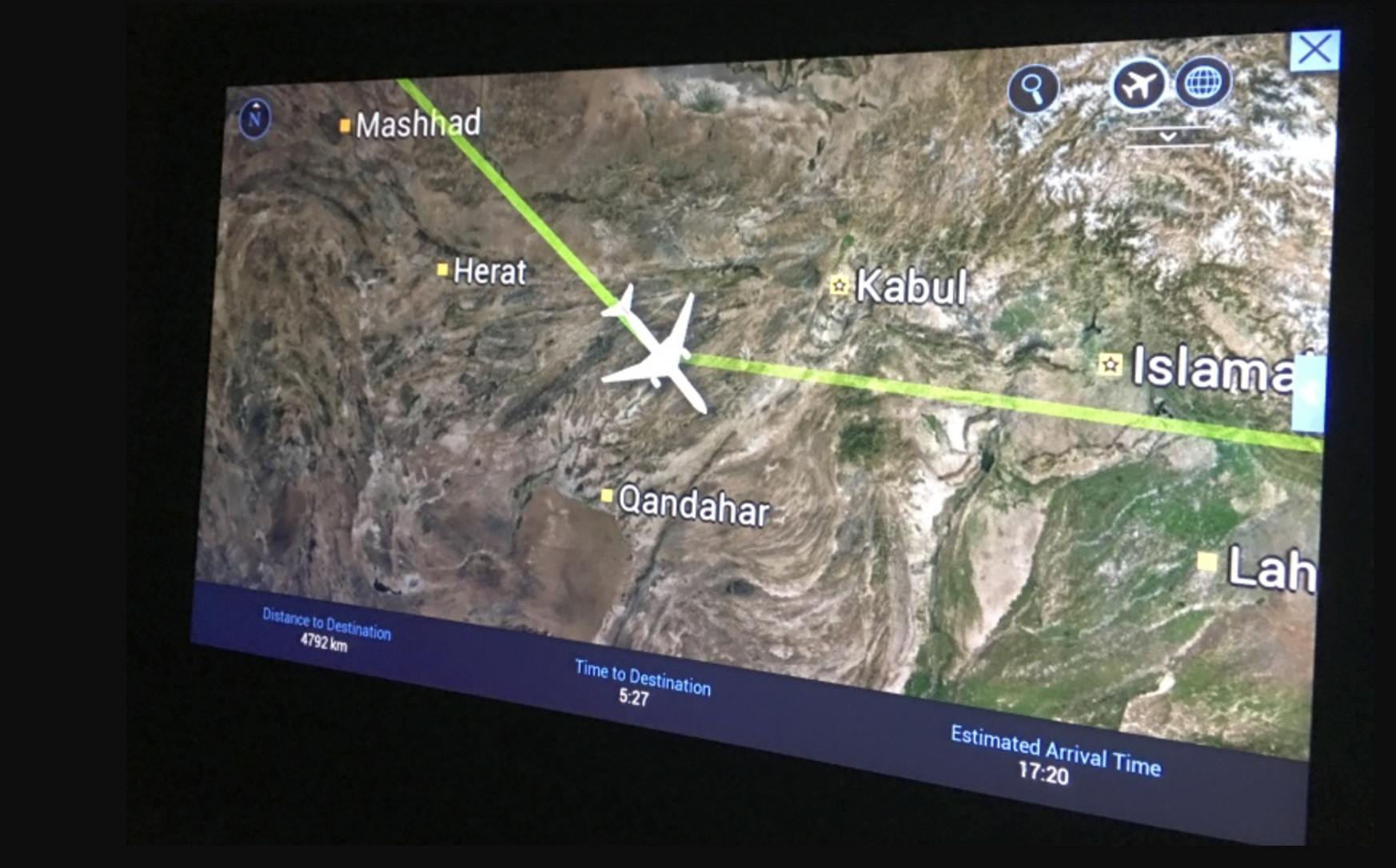
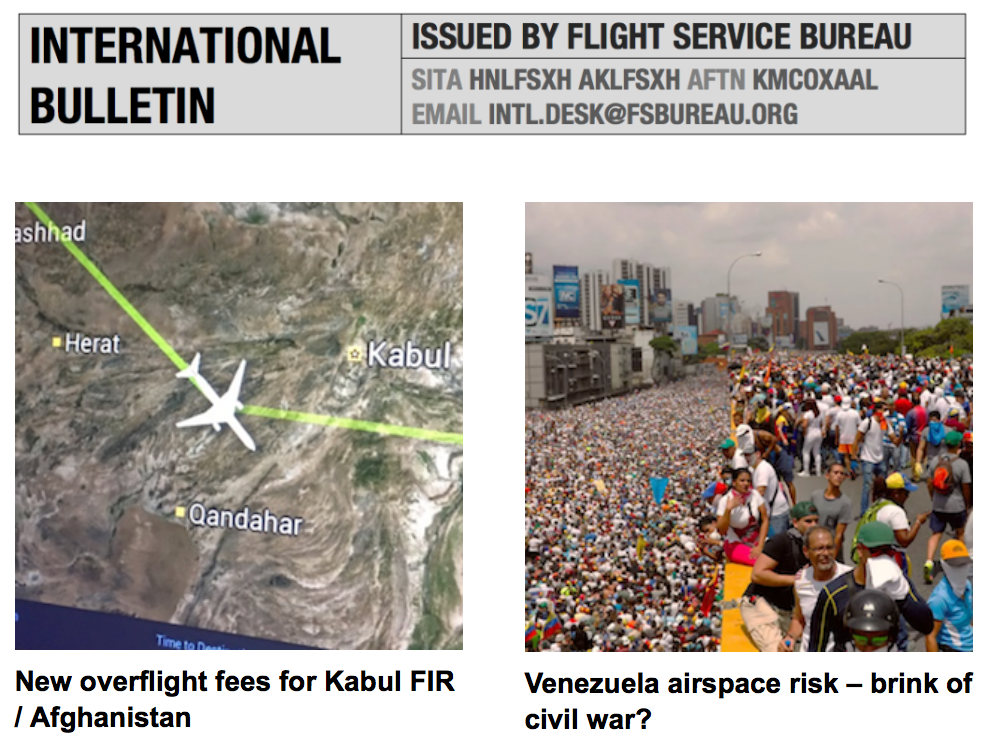
Effective August 1st, the new charge for overflying the Kabul FIR is a flat fee of $700 USD.
Previously, the charge was $400 USD. The Afghanistan Civil Aviation Authority (ACAA) has determined the increase was necessary to support the additional infrastructure costs now that it manages its own ATC.
The fee applies to all civil flight operations using the FIR to transit enroute, regardless of aircraft size or distance flown.
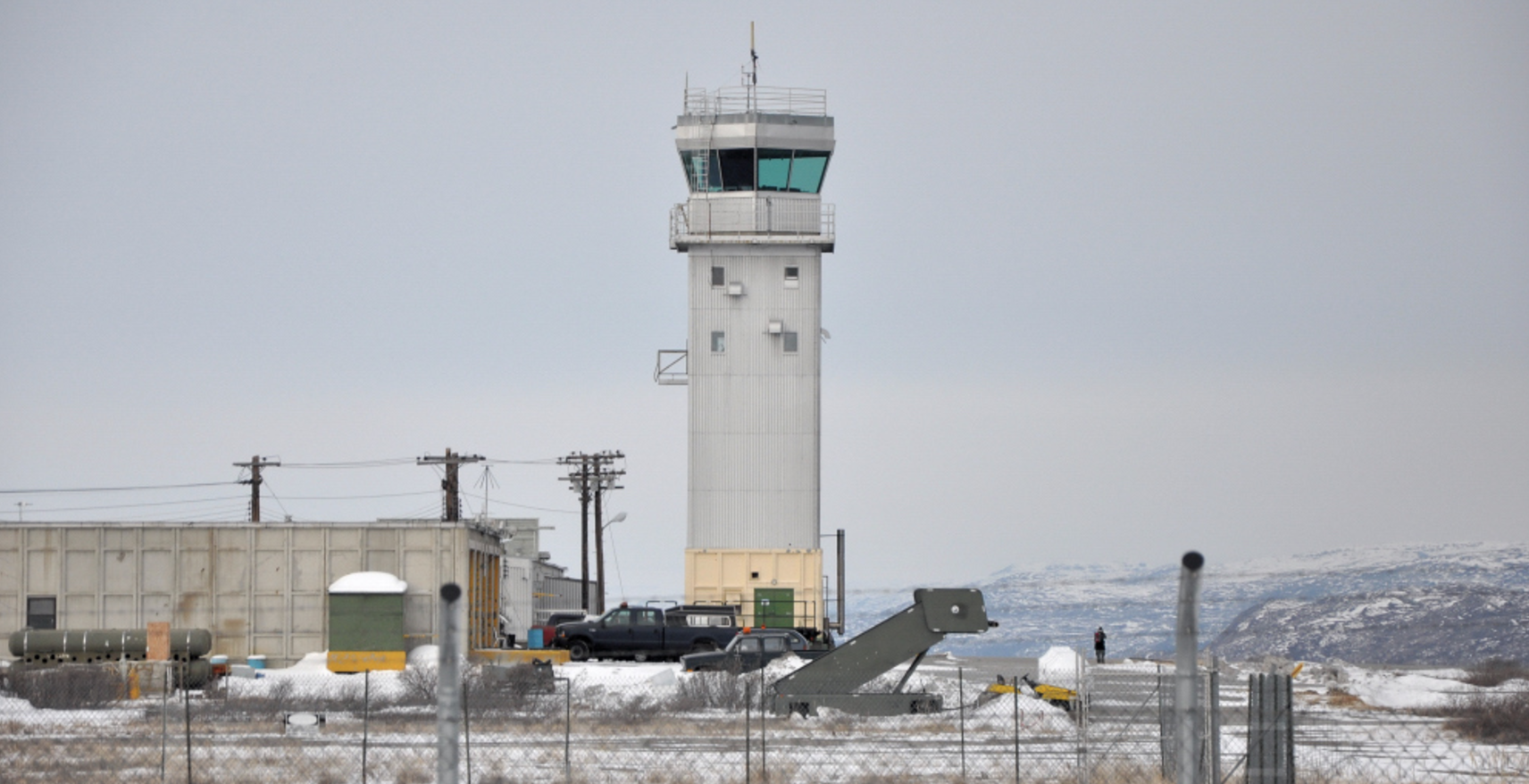
BGSF/Sondrestrom to shut on August 27th
written by Declan Selleck | 26 September, 2017
For NAT Ops on Sunday August 27th, note that BSGF/Sondrestrom will be closed to all traffic, as they are upgrading infrastructure. Sundays in Greenland see most airports closed in any case, but the option of paying $1000 or so to have them open for you is normally there. On this date, BGSF won’t be, which may affect your diversion options.
They do say that if there’s an emergency, call them on +299 52 42 27 to determine availability.
03AUG: New overflight fees Kabul FIR, Venezuela airspace risk – brink of civil war? Weekly Ops Briefing
written by Cynthia Claros | 26 September, 2017
Weekly International Ops Bulletin published by FSB for OPSGROUP covering critical changes to Airports, Airspace, ATC, Weather, Safety, Threats, Procedures, Visas. Subscribe to the short free version here, or join thousands of your Pilot/Dispatcher/ATC/CAA/Flight Ops colleagues in OPSGROUP for the full weekly bulletin, airspace warnings, Ops guides, tools, maps, group discussion, Ask-us-Anything, and a ton more! Curious?See what you get. Rated 5 stars by 125 reviews.
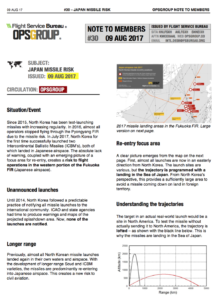
RJZZ/Japan The frequency of North Korean missile launches that end with a splashdown in the Fukuoka FIR is of concern. Last weekend, one such missile came close to civil traffic, and this is not the first such event. We are preparing a summary for operators, and would request wider reader input on this. Has your operation/airline/authority made any changes recently to operations in the western portion of the Fukuoka FIR in Japan? Talk to us at bulletin@fsbureau.org.
BGSF/Sondrestrom For NAT Ops on Sunday August 27th, note that BSGF/Sondrestrom will be closed to all traffic, as they are upgrading infrastructure. Sundays in Greenland see most airports closed in any case, but the option of paying $1000 or so to have them open for you is normally there. On this date, BGSF won’t be, which may affect your diversion options. They do say that if there’s an emergency, call them on +299 52 42 27 to determine availability.
RJZZ/Japan As of 1800 local time (0900 UTC) on August 3, Typhoon Noru was located approximately 350nm east-northeast of Kadena Air Force Base, Japan, and was moving in a northwesterly direction at a speed of approximately 8 knots. At that point, Noru was posting maximum sustained winds of 80 knots with gusts up to 105 knots. Noru is expected to make landfall after 48 hours in southern Japan. Southern parts of South Korea, including the port city of Busan, will also likely experience torrential rainfall, which could trigger flooding and landslides.
LFLL/Lyon has some fuel supply issues ongoing, advising tankering where possible.
FAZZ/South Africa The U.S. Mission to South Africa advises travellers to exercise caution when arranging ground transportation from OR Tambo International Airport in Johannesburg to hotels, guest houses, and residences. Numerous U.S. citizens and other travellers have been robbed at gun point while traveling from the Airport to their place of lodging in what are known as ‘follow home’ robberies. In some instances, U.S. citizens have been injured or shot at during these robberies.
RPLL/Manila Increasing levels of reports of laser lights within 10nm of the airport. [more in Aireport]
ZYHB/Taiping No overnight parking for Business or General Aviation due to parking until 30SEP. [more in Aireport]
SPIM/Lima Volcano eruptions from Mount Sabancaya continue to create airspace warnings up to FL250.
FOOL/Libreville Will be closed overnight 2300-0900Z until August 12th. [more in Aireport]
LIZZ/Italy Baggage handlers at Milan’s Malpensa Airport (LIMC/MXP) and Linate Airport (LIML/LIN) staged a last-minute strike on August 1. The handlers apparently warned the airport operator the day prior, although airport officials claim they did not know ahead of time. The strike caused significant delays for passengers.
UMMS/Minsk, Belarus Will be closed for runway maintenance at various times overnight until the end of August.
LGGG/Athens FIR Strike action planned for Air Traffic Safety Personnel (ATSEP) until 05Aug. Emergency frequencies will remain uninterrupted, although the authorities advise caution as “problems to systems may arise affecting communication, navigation and surveillance (CNS) services” during this period. Probably not too much effect.
LTBA/Istanbul Ataturk The airport is balancing “Supply and Demand.” Here’s the rundown:
– New seasonal charter and cargo flights to land will not be accepted.
– Technical landings and diversions will not be accepted (unless you’re stationed there).
– Business flights are allowed, as long as the hourly flight limits haven’t been exceeded.
– Flights for MX are allowed to LTBA, but you’ll need to get your slot well in advance.
– Make sure you have a valid slot, they’ll reject your plan if not.
– If you have a permit prior to 24JUL, you’ll be accepted. [more in Aireport]
KZZZ/United States The TSA has announced that travelers will be required to separate more electronic devices from their carry-on baggage when passing through security screening points at U.S. airports. Currently, travelers are only required to take out laptop computers from their carry-on luggage for separate screening; under the new regulations, all devices larger than a mobile phone — including tablets and e-readers — will need to be placed in their own bins to be screened separately. The regulations are already in effect as part of a pilot program at 10 U.S. airports and are expected to be rolled out to facilities across the country in the coming months. The enhanced measures will not affect travelers who are enrolled in pre-check security programs.
FOZZ/Gabon New phone numbers for ANAC- +241 1 44 56 54, and +241 1 44 56 58.
ZKZZ/North Korea On August 2, the U.S. Department of State issued a Travel Alert for North Korea, which reads in part as follows: “The Secretary of State published a Notice on Wednesday, August 2, 2017 that will restrict the use of U.S. passports to travel into, in, or through North Korea/the Democratic People’s Republic of Korea (DPRK), effective Friday, September 1, 2017. The Secretary has authorized the restriction due to the serious and mounting risk of arrest and long-term detention of U.S. citizens under North Korea’s system of law enforcement. Persons who wish to travel to North Korea on a U.S. passport must obtain a special passport validation under 22 C.F.R. 51.64, and such validations will be granted only under very limited circumstances. The Department of State will publish information on how to apply for a passport with a special validation on travel.state.gov when OMB approval is effective. Persons currently in North Korea on a U.S. passport should depart North Korea before the travel restriction enters into effect on Friday, September 1, 2017”
EISN/Shannon FIR The introduction of direct routings in the lower FIR was planned for 14SEP but has been delayed to 12OCT (maybe longer).
YZZZ/Australia Security procedures at Australian airports have been tightened, with pictures of huge lineups in the media. This follows a foiled attack plot last week. Sydney is the largest delay location.
Weekly International Ops Bulletin published by FSB for OPSGROUP covering critical changes to Airports, Airspace, ATC, Weather, Safety, Threats, Procedures, Visas. Subscribe to the short free version here, or join thousands of your Pilot/Dispatcher/ATC/CAA/Flight Ops colleagues in OPSGROUP for the full weekly bulletin, airspace warnings, Ops guides, tools, maps, group discussion, Ask-us-Anything, and a ton more! Curious?See what you get. Rated 5 stars by 125 reviews.
Venezuela airspace risk – brink of civil war?
written by Declan Selleck | 26 September, 2017
All operators, in particular those with an N-reg on the tail, should be aware of the rapidly deepening crisis in Venezuela. The more tabloid news sources will say that “Venezuela is on the brink of civil war”; while that’s not quite the case (yet), it does give you a good indication of the level of concern. In OPSGROUP Note to Members #29 we will summarise the current situation.
Sanctions On July 31, the US government imposed sanctions on Venezuela, specifically on President Maduro. This creates an uncertain situation for US registered aircraft operating in Venezuelan airspace. Retaliatory sanctions, even as far as grounding a US aircraft, are not out of the question.
Embassy withdrawals On August 1st, the UK Foreign Office followed the US in withdrawing family of personnel from their respective embassies. This is a common precursor to a deeper security risk, and in the last 5 years we’ve seen this pattern in Libya, Syria, and Yemen.
Flight Ops See below on overflight. There have been interruptions to Notam and Metar service throughout 2017. At one point it appeared that SV** had lost its connection to the international AFTN system.
Aireport The most recent OpsGroup member reports are not encouraging. The top report on SVMI is titled “Hazardous in Caracas“. “The operating conditions in Caracas have deteriorated to a new level. New ATC controllers that have been installed in the last few months do not speak English very well, if at all, and in some cases and they are issuing clearances not appropriate for IFR or terrain clearance. Tremendous caution should be exercised especially when moving internally within Venezuela. SVMI authorities are now demanding to see the complete insurance policy for the aircraft, not just proof of insurance. We had Spanish speaking personnel with us and when we questioned a local SVMI controller about not using English, his response was that we should all be speaking Spanish! “. More in Aireport. If you’ve been through recently, add your report.
Threats SVMI/Caracas Simón Bolívar airport is located in an extremely high-risk area for armed robbery and kidnappings. The US describes the greatest current risks as social unrest, violent crime, and pervasive food and medicine shortages.
Travel advice Western countries are all now recommending against “all but essential travel”. A large majority of airline carriers have now stopped operating to Venezuela, for a mix of reasons – primarily the fact that onward payment of ticket monies have been stopped by the Venezuelan government. There are frequent violent protests.
Overflight Operations through Venezuelan airspace do not require an overflight permit, and so there have been no incidences recorded of US aircraft being denied a permit. However, on several occasions in the last month, Venezuela has for short periods arbitrarily closed its airspace to overflying aircraft. A common problem with Venezuelan overflight is the denial of airspace entry due to unpaid navigation fees, which is why checking this in advance is recommended. This may be a tool used to deny US aircraft entry in the future. Plan operations through the SVZM/Maiquetia FIR with caution. To be clear, we do not assess any risk to enroute aircraft, but be mindful of the fact that if you do enter SVZM airspace, you may end up diverting to an SV** airport. Right now, that’s not ideal.
Avoiding Venezuela If you elect to avoid SVZM airspace, to the west will be via Colombia – permit required for all overflights, and to the east will be via the SYGC/Georgetown FIR (Guyana) – permit not required, or via the Paramaribio FIR (Suriname) – permit required. Finally to the east, if you use the SOOO/Rochambeau FIR (French Guyana) – permit required unless operating a GA aircraft under 12.5k lbs.
If you need a tech stop and previously used/considered SVMI, then look at alternatives like TNCC, TTPP, SBEG, SMJP. Use the OpsGroup planning map to figure your best alternate options.
Published August 2nd, 2017 :
The full Note to Members is available to OPSGROUP Members as Note to Members #29 in your OPSGROUP dashboard.
We recommend you review this in full before operations in the northern half of South America.
You can request membership of OPSGROUP to receive the full International Ops Bulletin delivered every Wednesday, along with all OPSGROUP member benefits: Members Questions, Group Discussions, Slack, free maps and charts (normally $25), Full access to aireportfor group reviews of handlers and airports, regular alerts for critical international ops info, complimentary Airports Database (normally $375), Full access to safeairspace.net including updated risk alerts, and guidance and help when you want it on any International Operations topic (that last one is really useful!). Read 125 different member reviews.
Weekly International Ops Bulletin published by FSB for OPSGROUP covering critical changes to Airports, Airspace, ATC, Weather, Safety, Threats, Procedures, Visas. Subscribe to the short free version here, or join thousands of your Pilot/Dispatcher/ATC/CAA/Flight Ops colleagues in OPSGROUP for the full weekly bulletin, airspace warnings, Ops guides, tools, maps, group discussion, Ask-us-Anything, and a ton more! Curious?See what you get. Rated 5 stars by 125 reviews.
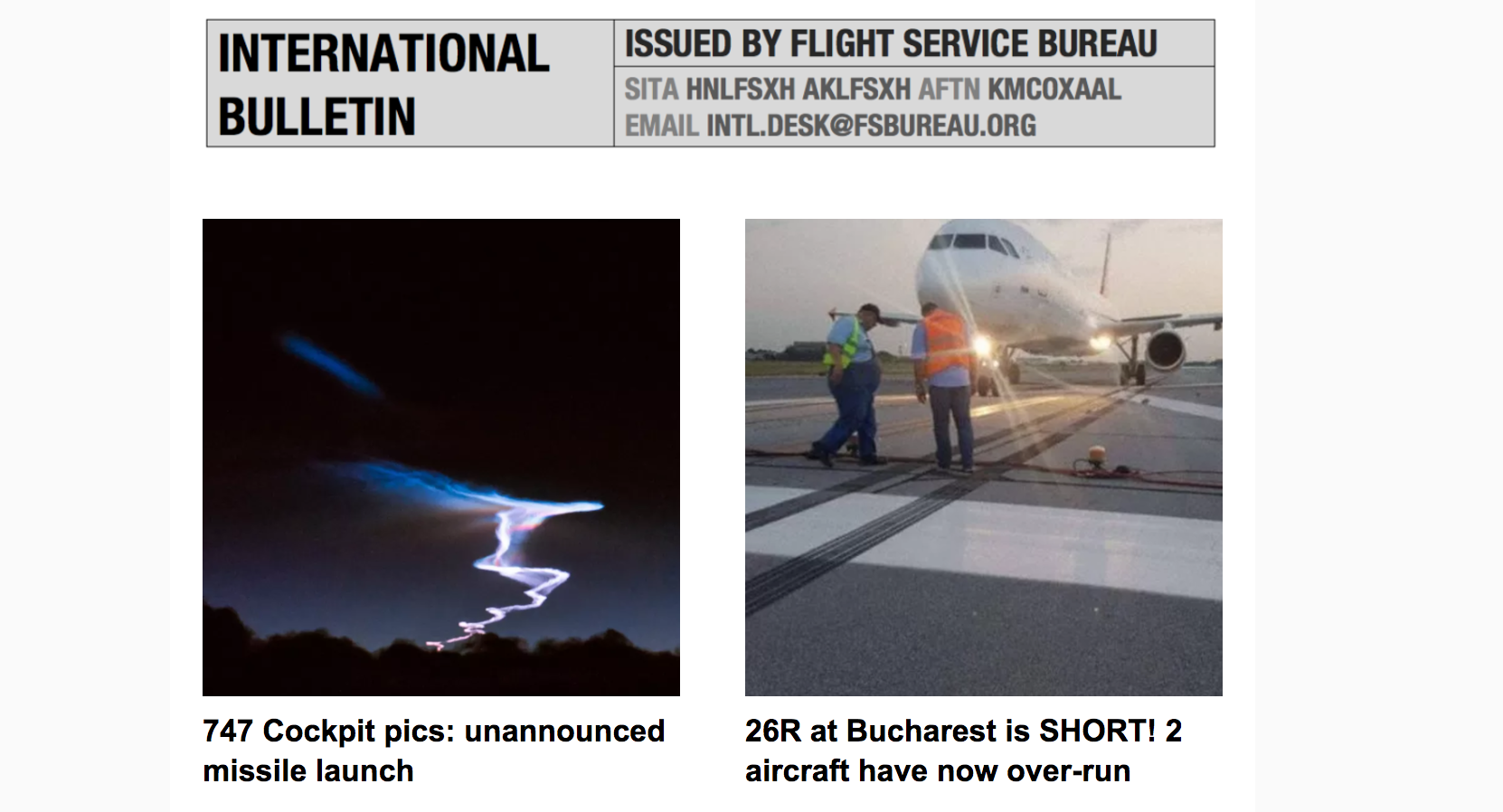
747 Cockpit pics: unannounced missile launch
28JULZKZZ/North Korea Another ballistic missile was fired by North Korea today, landing in Japanese waters. Earlier this week, a B747 crew enroute to Baku captured a series of images of an unannounced missile launch close to their aircraft, over China. Read the article.
26R at Bucharest is SHORT! 2 aircraft have now over-run
28JULLROP/Bucharest Runway 26R is shortened by about 1250m/4000 feet, and on Tuesday a Ryanair 737 became the second aircraft to run off the end in a couple of weeks: on June 22, a Turkish A321 did the same thing. Word on the street is that there isn’t much in the Notams to remind you of this. Read the article.
SVZZ/Venezuela The U.S. Department of State has updated its travel warning for Venezuela, warning against travel due to social unrest, violent crime, and pervasive food and medicine shortages. On July 27, the Department ordered the departure of family members and authorized the voluntary departure of U.S. government employees from the U.S. Embassy in Caracas. For flight ops to Venezuela, it’s highly recommended to avoid tech stops or unnecessary visits to any SV** locations.
RCZZ/Taiwan The Ministry of Foreign Affairs has granted visa-exempt status to nationals of 11 Latin American countries. Effective immediately, nationals of El Salvador, Haiti, Honduras, Nicaragua and Paraguay are granted visa-exempt stays of up to 90 days while nationals of Belize, the Dominican Republic, Guatemala, Saint Vincent and the Grenadines, Saint Christopher and Nevis, and Saint Lucia are granted visa-exempt stays of up to 30 days.
EGCC/Manchester Night ops into Manchester? Carry extra holding fuel due WIP until August 17. [more in Aireport]
FEFF/Bangui has had a few interruptions to ATC service due to power cuts – not the only issue in Bangui, but another reason to think twice about travel to the Central African Republic.
OEZZ/Saudi Arabia On 27 July, Saudi air defences shot down a Houthi ballistic missile in the sky over Taif. Reports indicate that the Yemeni-based Houthi rebels fired the missile from northern Yemen; however, the precise target is unclear. The interception did not result in any casualties or damage on the ground.
VTBB/Bangkok Extra holding fuel into Bangkok is recommended for the monsoon season until end of October.
HCSM/Mogadishu FIR HF is unreliable. Here are the alternate contact details, if you do insist on flying through their FIR (and we think you shouldn’t): SATCOM INMARSAT 466601. ATC/FIC Telephone: +254202365679, +254207622774, +254207626028 or +254202445632.
UUZZ/Russia Volcanic activity advisory ongoing for the Sheveluch volcano (56 38 N 161 19E) on the Kamchatka Peninsula, Russia.
OPKC/Karachi The United States Consulate General in Karachi has resumed the movement of U.S. government personnel traveling to and from Jinnah International Airport in Karachi (KHI). Local security forces have increased security measures at the airport and in the city of Karachi. Movement of U.S. government personnel within Pakistan remains severely restricted due to the overall security environment. The consulate general canceled all travel of U.S. government personnel to and from the airport on 25 July, citing an elevated threat of violence “at or near this location.” The consulate general did not release further details on the nature of the threat.
EDDK/Cologne Don’t use this as an alternate overnight – at their request – that is, from 2000Z-0400Z. [more in Aireport]
LFMP/Perpignan Air show on, check for arrival slot and parking availability if you’re planning to use it between 28-30 July.
LDZZ/Croatia Several hundred taxi drivers are staging protests throughout Croatia on 28 July against the ride-sharing service Uber. Reports indicate that the protests have disrupted traffic in Dubrovnik, as well as around the airports in Split and Zagreb. Thus far there have been no reports of associated violence.
LHDC/Debrecen Limited hours of service, 48 hrs prior notice required if intending to use outside normal hours of service until end of July.
MMMX/Mexico City They’re planning on building a new airport near Mexico City. The outlines of the runway have already been painted onto the surface of a dry lake in the exact position it will be built, including full markings. These are all clearly visible when departing from the existing Mexico City Airport (MMMX) RWY 05 and approaching on RWY 23. These painted lake bed surfaces are not intended for use as a runway!
CYYZ/Toronto Pearson Ground crew workers launched a strike on 27 July over a labor dispute with their employer, Swissport. Reports indicate that approximately 700 workers — including baggage handlers, cargo handlers and cabin cleaners – are participating in the strike. Swissport serves 30 airlines at Pearson.
KZZZ/USA Qualifying citizens of India are now eligible to apply for Global Entry membership. Applicants who meet program requirements and pass a background check can benefit from expedited entry to the United States at designated airports.
UBBB/Baku If you’re headed down Baku way – be aware that they are pretty much out of fuel. Check latest.
EYVI/Vilnius is closed from 14 July – 17 August due to the reconstruction of the runway. The most suitable alternate is EYKA/Kaunas, but also consider EYSA, EYPA, EVLA, EVRA.
MMPR/Puerto Vallarta has overnight closures at present, check Notams.
CYFB/Frobisher Bay has multiple closures and restrictions on going, check before using this as your NAT enroute alternate or tech stop.
FAOR/Johannesburg Another robbery occured on July 8 in a process that is becoming common here: Armed robbers followed a couple from the terminal and forced the victims to stop their vehicle in Centurion, on the corner of Rietvlei Dam Street and Delmas Road, and proceeded to steal belongings. The victims were not injured.
ENGM/Oslo From July 17-August 2, if you’re bringing your 777, 787, 330, or other Code E or larger aircraft to Oslo, plan on not getting fuel there, due to work on fuel pits and pipes – carry onwards fuel.
Weekly International Ops Bulletin published by FSB for OPSGROUP covering critical changes to Airports, Airspace, ATC, Weather, Safety, Threats, Procedures, Visas. Subscribe to the short free version here, or join thousands of your Pilot/Dispatcher/ATC/CAA/Flight Ops colleagues in OPSGROUP for the full weekly bulletin, airspace warnings, Ops guides, tools, maps, group discussion, Ask-us-Anything, and a ton more! Curious?See what you get. Rated 5 stars by 125 reviews.
Security Alert: Papua New Guinea Airports
written by Declan Selleck | 26 September, 2017
AYZZ/Papua New Guinea – affecting AYPY/Port Moresby, AYMH/Mt. Hagen
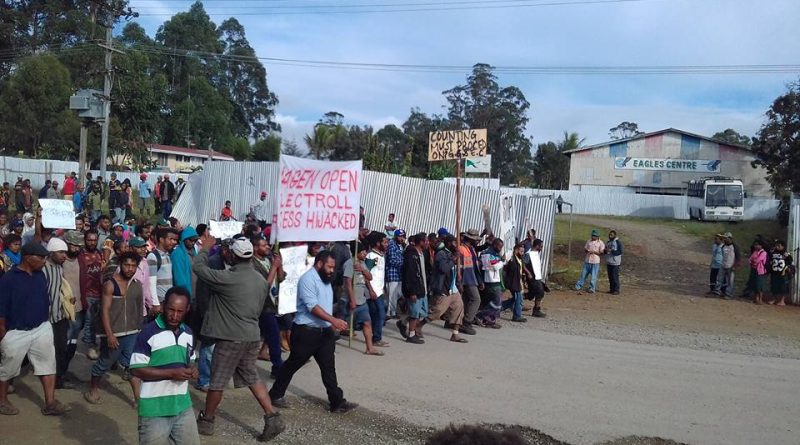
The elections today and tomorrow in Papua New Guinea have created civil unrest. Counting irregularities in the highlands city of Mt Hagen sparked violent protests that have gone for several days, and led to the burning of buildings on July 27. The city’s airport has been closed, residents were warned roads were blocked and there were reports of gunfire. MPs from the Opposition National Alliance party clashed with police and members of the governing People’s National Congress (PNC) party at the Port Moresby airport.
As many operators use AYPY as a tech stop in the Pacific, please check the latest before operating.