


Key Points:
- Iran remains highly unstable, with elevated risk to civil aviation.
- Severe internet disruption has been in place since Jan 8, with broader communications affected.
- The OIIX/Tehran FIR was closed at short notice for several hours on Jan 14, with no public explanation.
- EASA recommends avoiding Iranian airspace at all levels due to misidentification risk.
Situation in Iran
Beginning in late December, large-scale political protests spread across major cities due to a worsening economic crisis.
These escalated in recent weeks, with many demanding a change of political leadership. The Government has responded with a violent crack-down. Large numbers of casualties have been reported amid arbitrary arrests and severe internet disruption since Jan 8, with wider communications also affected.
Several countries (including the US) have urged their citizens to leave the country immediately.
Potential for US Military Intervention
In response to humanitarian concerns, the US Government has implied military intervention remains a possibility should violence against protesters continues.
If this were to occur, Iran has repeatedly warned it will retaliate by targeting US military bases and other assets throughout the region.
Some effects of this threat have already been felt, including the partial removal of personnel as a precautionary measure at Al-Udeid Air Base in Qatar – the largest US military base in the Middle East. Although the threat level has reportedly been downgraded in the past few days.
Airspace Risk
The current crisis has further increased risk to aircraft operating in or near Iranian airspace (the OIIX/Tehran FIR).
On Jan 14, the following Notam was issued unexpectedly closing the OIIX/Tehran FIR for several hours overnight, with no public explanation from Iranian authorities:
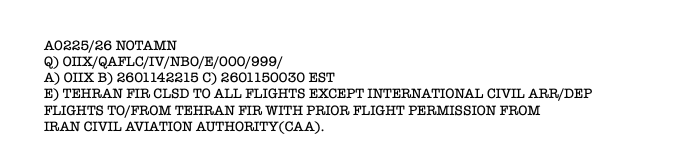
Previous events have shown that these types of closures can occur when security or military activity is taking place including a risk of missile launches or air defence operations.
Then on Jan 16, EASA upgraded its warning for Iranian airspace by publishing a new Conflict Zone Information Bulletin (CZIB) for Iran and neighbouring airspace. It suggests that recent events (including the possibility of foreign intervention) have likely placed air defence systems at a heightened sense of alert. Civil aircraft are at increased risk of misidentification.
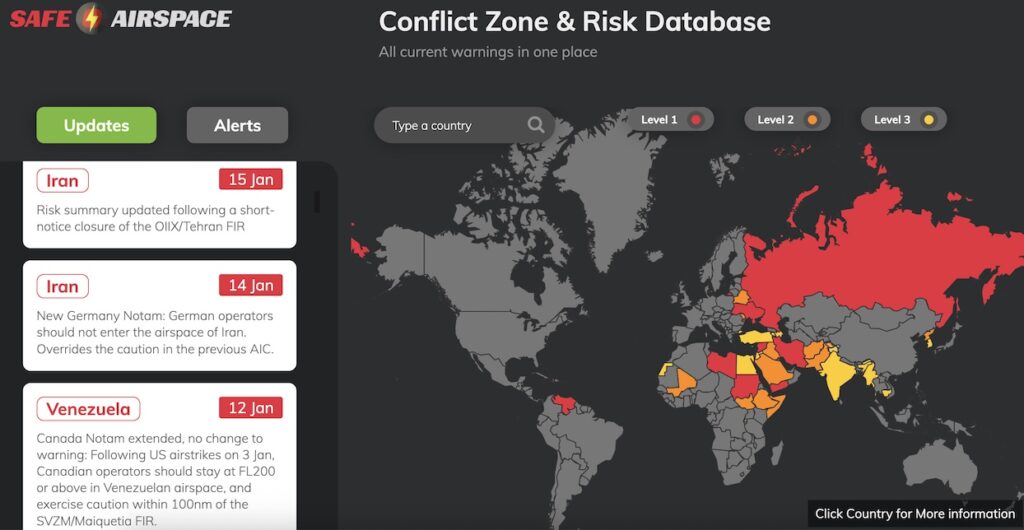
It’s worth noting that most operators already avoid Iranian airspace. Several states (including the US, UK, France, Canada and Germany) either actively prohibit or at least strongly advise against entering. At safeairspace.net, we maintain a ‘Level 1 – Do Not Fly’ warning.
However, when referencing adjacent airspace, things become a little more ambiguous. EASA’s CZIB advises caution when overflying neighbouring countries where US military assets are present. This notably includes Qatar, Bahrain, Kuwait, the UAE, Saudi Arabia, Jordan, Iraq, Syria and Turkey.
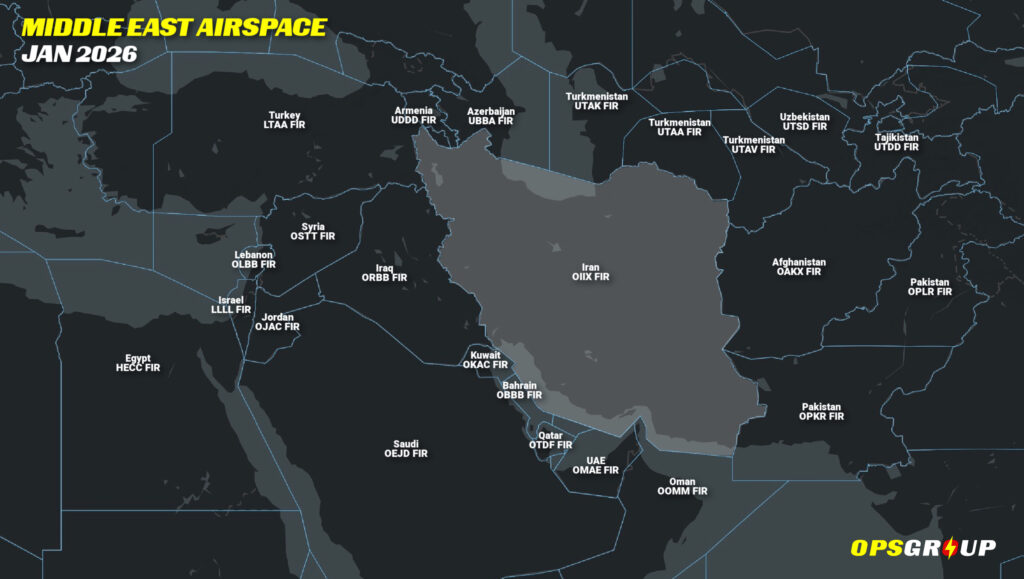
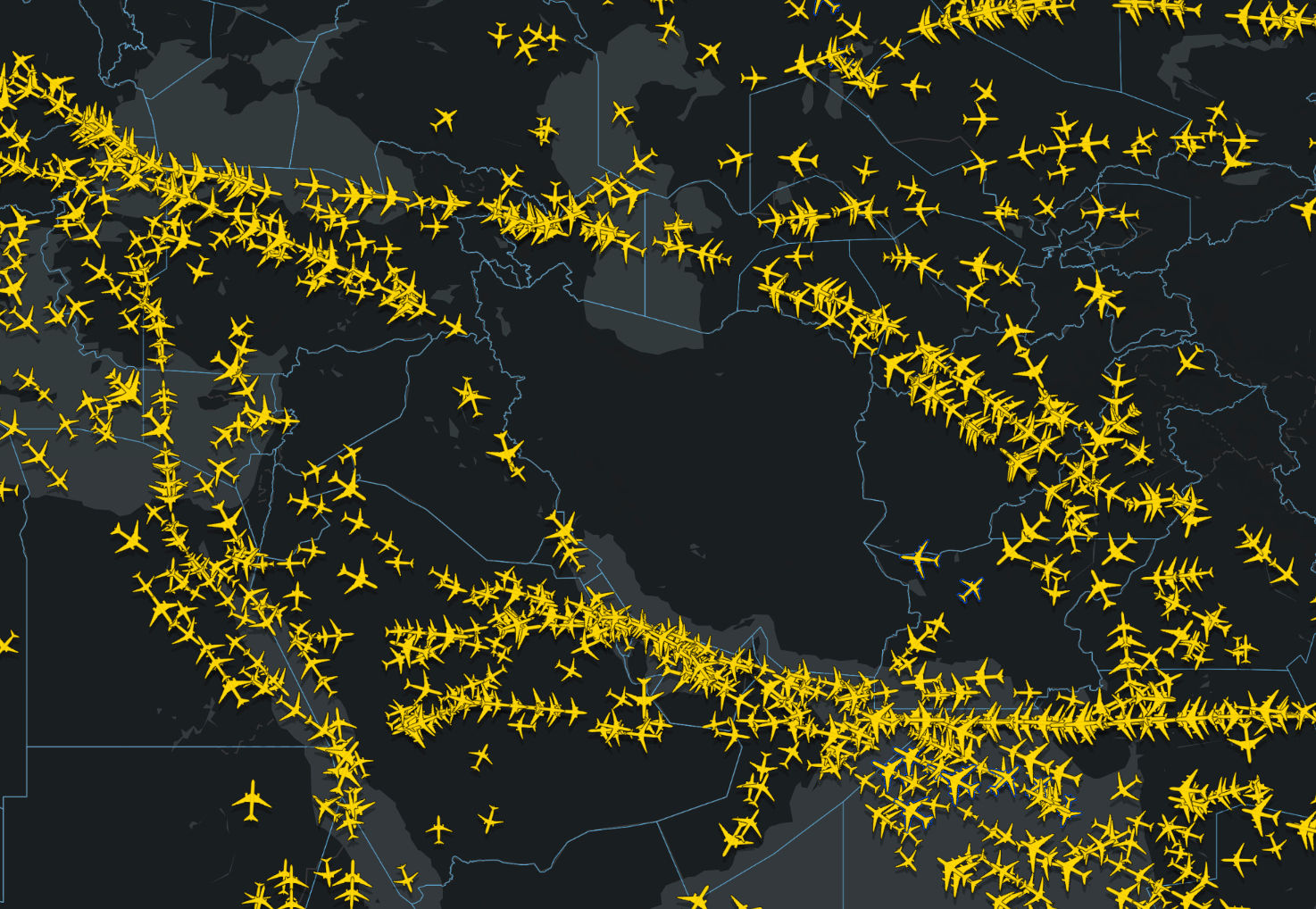
Special care should be used on the major air corridor that skirts the western boundary of Iran via Iraqi airspace (airways UL602, UM860 and UM688) where GPS interference (including the more insidious spoofing) is prevalent.
We know of at least one incident in the past where an aircraft almost inadvertently strayed into Iranian airspace without a clearance while suffering from navigation error.
From a broader perspective, EASA are also alluding to the possibility of regional escalation should the situation deteriorate – especially in the event of retaliatory strikes against military targets.
Continue to monitor the situation
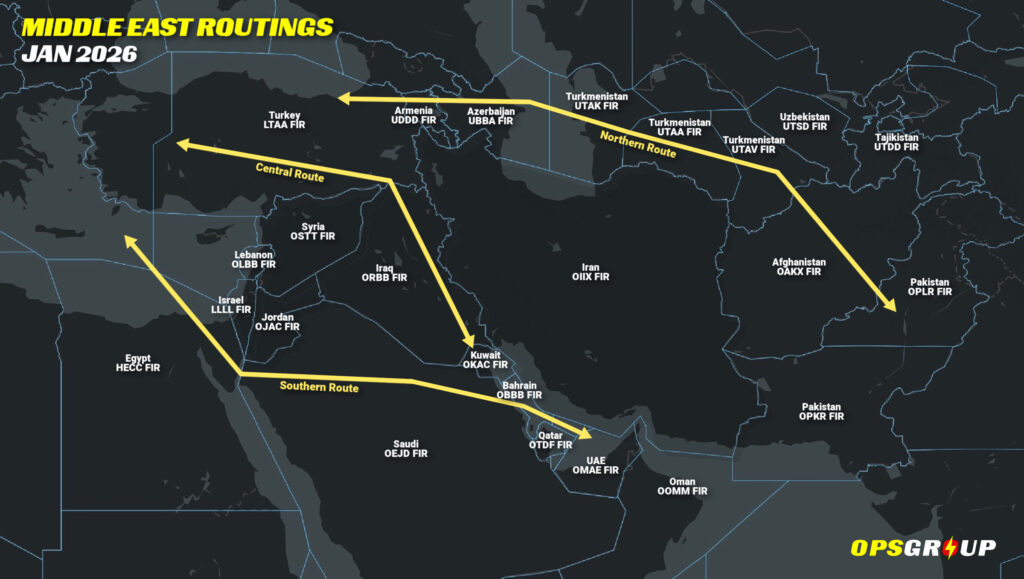
Iran sits alongside the main Europe-Middle East transit corridor via Iraq/Kuwait/Bahrain, and the June 2025 Israel-Iran missile exchange showed how quickly events inside Iran can trigger widespread airspace closures and warnings across the region.
If further military activity involving Iran escalates, expect little warning – for Europe-Middle East flights, the longer routing via Egypt/Saudi has been the more stable option and keeps you further clear of Iranian airspace.
We’ll continue to issue any updates via Opsgroup and Safeairspace.net. You can also reach us at blog@ops.group if you have any info to share.
More on the topic:
- More: Middle East Airspace – Current Operational Picture
- More: EASA Removes CZIBs: Middle East Risk Gets Harder to Read
- More: Why EASA has Withdrawn Airspace Warnings for Iran and Israel
- More: Dodging Danger: The Three Routes Through the Middle East
- More: April 2024: Israel/Iran Situation, All Call active
More reading:
- Latest: Paris Ramp Checks: Illegal Charters and Tax Avoidance
- Latest: Middle East Airspace – Current Operational Picture
- Latest: Greenland NAT Alternates: March 2026 Update
- Safe Airspace: Risk Database
- Weekly Ops Bulletin: Subscribe
- Membership plans: Why join OPSGROUP?



 Get the famous weekly