Wake Turbulence: See You On The Flip(ped over) Side
We last wrote about this back in 2017, after the en-route wake of an A380 flipped a Challenger 604 upside down over the Arabian Sea. But as the skies start to grow busier again it’s worth having a think about how to avoid wake turbulence or deal with it when you come across it.

If you are going to run into wake turbulence, there is a good chance it will happen near the ground. Not the ideal place to suddenly find yourself banking sharply without warning.

The levels of traffic operating in close proximity (and in configurations specifically designed to produce lots of lift which is what basically leads to wake) can make the approach, departure, takeoff or landing a gauntlet of swirling vortices of doom. Added to that, aircraft are generally operating at low speed with lower controllability margins.

A study in Australia looked at the vortices of an A380 and in 35 knot winds, at 2,400ft, it took 72 seconds for the vortices to cover 1300m. They move, and they take a while to dissipate. This study took place after a Saab 340B temporarily lost control, dropping 300-400ft in altitude and rolling 52 degrees left and 21 degrees right. 

An ILS calibration aircraft crashed in OMDB/Dubai after breaching minimum separation distances from commercial traffic. Hitting wake is not fun and can lead to catastrophic consequences.

Thankfully, wake turbulence is taken seriously. In fact, in 2016, wake turbulence categories were rethought.

They used to just be based off MTOWs:

  • Super (the A380 held this spot)
  • Heavy (anything with a MTOW more than or equal to 136 tons) 
  • Medium (7 tons to 136 tons)
  • Light (anything under 7 tons)

Nowadays, the categories are a little more complex and consider both weight and wingspan, because wing design is a big contributor to what sort of vortices roll off the tips. Now we have 7 categories: G-A. Ultimately, the important thing to remember is the distance you need from each depending on what you are in.
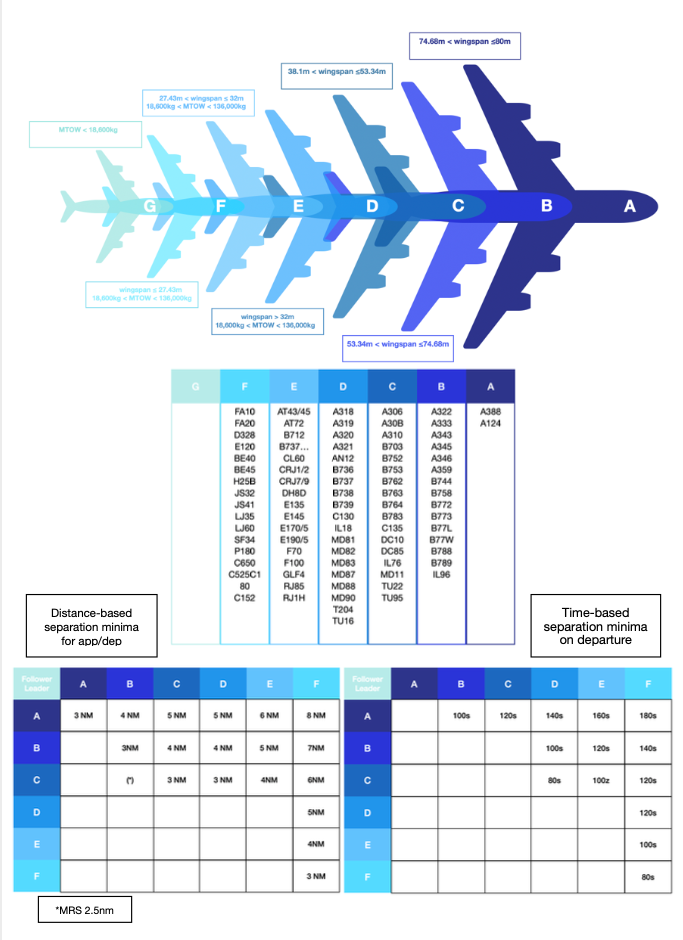
Here’s one we made earlier

Get woke about wake.

So, we have our 7 categories, and we have our distance based separation (which ICAO allows to go as low as 2.5NM).

Something to remember – these have been designed to allow maximum runway capacity and operational efficiency. You won’t be ATC’s favorite pilot if you ask for more separation (you might even lose your spot in the sequence) but safety is ultimately up to you.

If you need more space, say something.

There are a few other things you can do to help avoid wake in the airport area:

  • Consider requesting a SLOP on arrival – yes, this is possible. Except where they have super strict NABT routes.
  • Consider asking for an extended holding pattern, or opposite direction hold – just check where that might fly you (if you’re close to the border with another airspace you might run into another sort of trouble).
  • Try and remain above the flightpath of the preceding aircraft, and avoid long level sections by flying a CDA.
  • Watch those speed margins – if you think you might meet some wake, think about taking some flap a little earlier so you have more margin.
  • If you are a ‘heavy’ or a ‘super’ then ATC might not want you to fly a CDA, especially in high density airspace. JFK are one such spot.
  • Look at what the wind is doing – if it’s light or variable then those vortexes are going to sit there, waiting for you to fly into them…

Is there any technology to help?

There is indeed. In fact, there are several interesting projects and technologies being tested to help with wake.

Vortex modelling is playing a major part in the EU’s Single European Sky ATM Research and has led to some rather clever folk in Germany discovering that if you build a “plate line” (basically a wall of large wooden boards) this effectively cancels out most of the wake. This is being tested at EDDF/Frankfurt and EDDM/Munich airport using smoke and lasers.
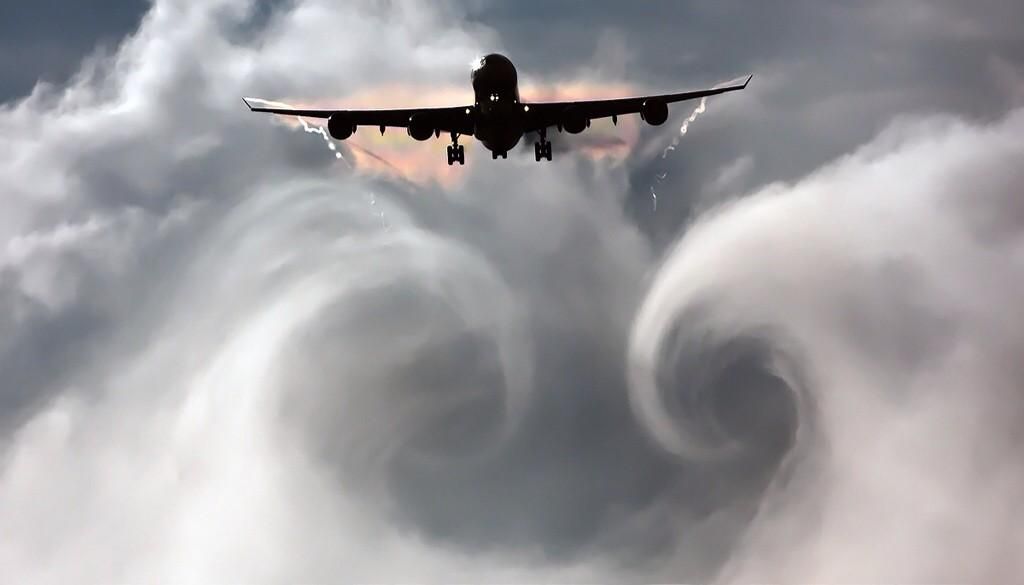
Not so clear air turbulence

Turbulence can really CAT-ch you out.

Going back to the 2017 Airbus 380 vs Challenger 604 battle – the Challenger came off a lot worse.

The big takeaway from this: the risk of wake in cruise is a pretty big one as well. So what can you do about it?

  • SLOP – It is one of the things it was designed for.

But use a bit of common sense here – if the wind is from the left (and slopping to the left is not available), then flying to the right of track just means when you get to abeam where the aircraft in front was, their wake has probably been blown right of track as well. Maybe ask them to SLOP!
Don’t play Chicken, be a chicken and SLOP

Of course, severe turbulence isn’t only caused by wake. Weather, mountains, atmospheric stuff are all to blame as well.

There are technologies out there to help with this as well. Lidar is just such a thing. The Japanese Aerospace Exploration Agency and Boeing have discovered that if you stick one of these onto the side of an airplane then it can detect aerosols on the air. These are tiny particles, such smaller than water droplets so a conventional radar won’t detect them. The Lidar system does though, and can provide up to around 70 seconds warning (about 10 miles).

This might not always be enough to avoid, but it’s enough to switch the seatbelt sign on and warn everyone down the back.

So, sometimes there are warning signs, but sometimes there aren’t. We aren’t going to bore you with a science lesson on Clear Air Turbulence or how to check your shear rates. What we do think is worth talking about is what ICAO, EASA, the FAA et al. have say about what to do when you have inadvertently come across something that has really upset your airplane.

UPRT

Upset Prevention and Recovery Training. This is a big (and very good) thing. Since the AF447 accident it has become mandatory for crew to be trained in UPRT.

But what actually is it?

Well, it is one answer which is hoping to solve the issue of LOC-I incidents amongst other things. Loss of Control in flight is the biggest cause of fatal accidents over the last two decades (on commercial jet aircraft), having led to 33% of fatal accidents.

It is designed to solve the “startle” factor by giving a clear, defined method of what to do if you don’t really know what is going on. Basically, when you experience an “unusual attitude” (with the airplane, not with a strange co-pilot).
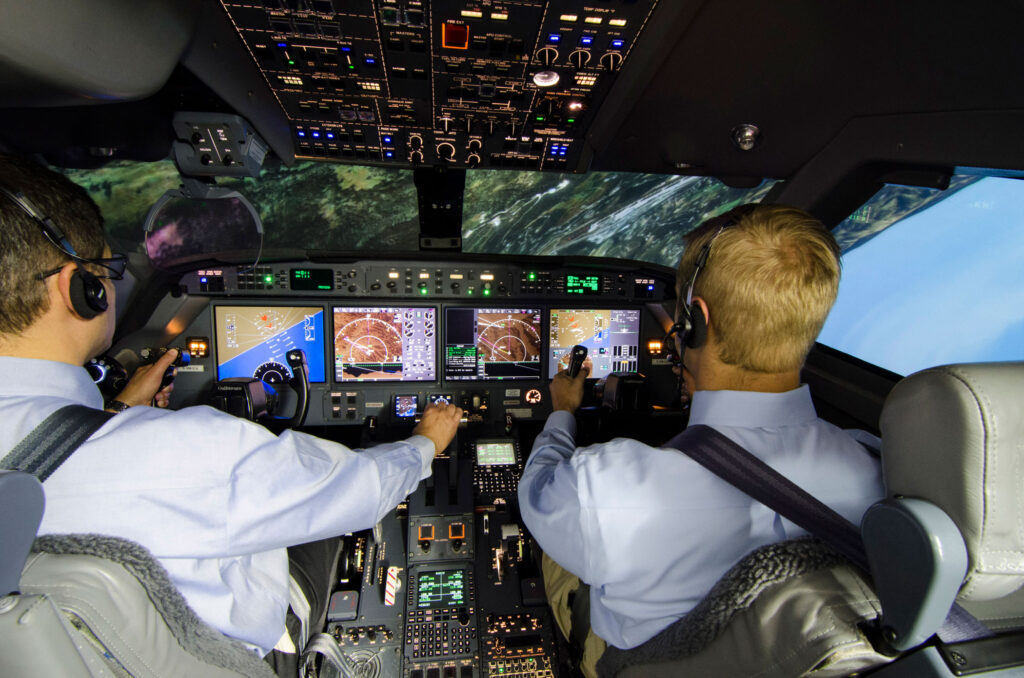
Not what you want be seeing

An unusual attitude is anything outside your aircraft’s normal limits. For a large transport category aircraft we are probably talking nose up more than 25 degrees of pitch, or down more than 10, a bank angle greater than 45 degrees or any flight within these parameters but with airspeeds “inappropriate for the conditions”.

What has changed here from the old-school stall recovery type training?

Well, the big change is what we are really learning during the training. Upsets are not “some aerodynamic phenomenon lurking in the atmosphere to grab pilots following well structured procedures” – they happen when things have gone very, very wrong and procedures have flown out the window.

So, UPRT is about training to deal with the startle and the confusion – giving a method to right the airplane when that startle and confusion is likely preventing you from doing so. It is also about learning how to recognize a potential threat that might lead to an upset, and it is about better monitoring to prevent the startle.

Tell me how to do it.

Probably more for a trained instructor, but the general gist is this:

  • Push
  • Roll
  • Power
  • Stabilise

(Sometimes Roll and Power might want to go in the opposite order.)

Pushing does not mean ramming the stick forward. It means unloading the wings. And once they are unloaded you want to stop the push, but that doesn’t mean yanking the nose back up into a negative-G maneuver. You are going to have to trade some height for speed (and safety) here. When the aircraft is back under control, that means gently returning it to the horizon.

Roll is similar – it is all about giving the wings the best chance of performing, and that means getting them level and not barrel-rolling around the sky. But… if your nose is mega high, and you have power on, then pushing forward is going to be tough to do. So adding some roll can also help us out here, getting the nose to drop, and giving us control of, well, the controls.

UPRT is about monitoring, recognizing and handling.

Fancy some further reading?


The 511 on the Nov 5th ICAO changes

A whole bunch of procedural stuff will be changing from 5 Nov 2020, with the release of a new amendment to ICAO’s Procedures for Air Navigation Services document. There will be changes to Oceanic Contingency and Weather Deviation Procedures, Wake Turbulence Separation, SLOP Procedures, and how the FAA defines Gross Navigation Errors.

What is the PANS-ATM (ICAO Doc 4444)?

Procedures for Navigation Services – Air Traffic Management. In other words, the ‘go to’ manual for aircrews who operate internationally. It explains in detail the standard procedures you can expect to be applied by air traffic services around the world, and what they expect in return.

Here is a summary of the most important changes coming on 5 Nov 2020. Thanks to Guy Gribble at International Flight Resources for this update.

Oceanic Contingency Procedures

Basically, what you should do if you need deviate from your flight path without a clearance. Weather avoidance, turbulence, depressurisation, engine failure – you get the picture. Published procedures are changing: there will be one standard set of Contingency and Weather Deviation Procedures for all oceanic airspace worldwide.

If you’ve been flying in the North Atlantic Region over the past year and a half, you’ll be familiar with how it works – the new procedures were introduced there back in March 2019, and now they’re being rolled out everywhere.

The main change here is that Contingency offsets which previously were 15 NM are basically now all 5 NM offsets with a turn of at least 30 degrees (not 45 degrees).

For more on this, check out our article.

Wake Turbulence

Flight Plan Category
There will be a new wake turbulence category for flight plans:

No longer will ‘Heavy’ rule the skies. ‘Super’ is about to be added, which will cover the largest aircraft including the A380-800, and Antonov 225. You will even get to say it after your callsign on initial contact with ATC.

ICAO Doc 8643 will shortly include all aircraft which qualify for the category.

You’ll need to tell them your category in Flight Plan Item #9 too. For Super, the letter ‘J’ is what you’ll need to include.

Here’s the new line up:

J – SUPER (Check Doc 8643 to see if you qualify)
H – HEAVY (Max take-off weight greater than 136,000kg/300,000Lbs)
M – MEDIUM (Max take-off weight greater than 7,000kg/15,500Lbs)
L – LIGHT (Max take-off weight less than or equal to 7,000kg/15,500Lbs)

Wake Turbulence Separation Categories
Countries may choose to use the ICAO wake turbulence codes above to determine how much room to give you from preceding traffic, or they can elect to use a grouping.

Currently, ICAO groupings are based simply on weight and there’s only three of them. The problem with that approach is that sometimes the separation provided is excessive which slows down the flow of traffic and creates unnecessary delays.

The US and Europe were on to it when several years ago the FAA and Eurocontrol joined forces to look at the wake characteristics of aircraft in more detail. They came up with a better system – it was a process known as Aircraft Wake Turbulence Re-Categorization or simply, RECAT.

Turns out that when you take into account factors such as approach speeds, wing characteristics and handling abilities of various aircraft it is possible to safely reduce separation.

As a result, six new categories were created. You can read about those in FAA SAFO #12007 and EU-RECAT 1.5 if you would like to know more.

The point is, ICAO is now adopting those categories.

So why does it matter?
Because the separation applied when following smaller aircraft may be reduced to as low as 2.5nm on approach. Closer than you may be accustomed to.

Out with the old, in with the new. Here’s what you can expect to see in November:

Old:
HEAVY (H) – aircraft of 136,000kg or more
MEDIUM (M) – aircraft less than 136,000kg but more than 7,000kg
LIGHT (L) – aircraft of 7,000kg or less

New:
GROUP A – ≥136,000kg and a wingspan ≤80m but >74.68m
GROUP B – ≥136,000kg and a wingspan ≤74.68m but >53.34m
GROUP C – ≥136,000kg and a wingspan ≤53.34 m but >38.1m
GROUP D – <136,000kg but >18,600kg and a wingspan >32m
GROUP E – <136,000kg but >18,600kg and a wingspan ≤32m but >27.43m
GROUP F – <136,000kg but >18,600kg and a wingspan ≤27.43m
GROUP G – <18,600 kg or less (no wingspan criterion)

Separation standards will soon be published accordingly.

Strategic Lateral Offset Procedures (SLOP)

Wait, what?
As a result of extremely high levels of accuracy in modern navigation systems, if an error in height occurs there is a much higher chance of collision. It is also greatly increases the chance of an encounter with wake turbulence.

In some airspace, when the lateral separation applied or the distance between adjacent parallel routes is greater than 6nm, aircraft can deviate up to 2nm right of track without a clearance. This is what is known as SLOP.

The way in which it is applied is changing
Where the lateral separation minima or spacing between route centerlines is 15NM or more; offsets to the right of the centerline will allowed up to 2nm.

When the lateral separation minima or space between route centrelines is less than 15nm (but more than 6nm), you will be able offset up to 0.5nm right of track.

So, it is important you are familiar with what kind of lateral separation is being applied in the airspace you are operating.

The FAA will change their definition of GNE’s

On 5 Nov 2020, the US FAA will change their definition of Gross Navigation Errors to mean anything more than 10nm (down from 25nm), to align with ICAO’s 10nm definition that currently exists on the NAT HLA. So after this date, the FAA will require you report all lateral errors, 10nm or greater worldwide.

More on this from Guy Gribble at International Flight Resources:

“Keep in mind that ATC does not always advise a crew that it files a report; therefore, the FAA inspector will try and contact the crew as soon as possible so the crew will remember details of the event. ATC keeps voice and communications records for between 30-45 days. New York Radio and San Francisco Radio keep voice communications for 30 days. The FAA directs that oceanic error investigations should be complete within 45 days of the incident.”


Airbus 380 flips CL604 – full report is now published

  • Interim report finally released by the German BFU
  • Flight Service Bureau version of events confirmed
  • New pictures released by the investigators

Back in March, FSB covered a major wake turbulence upset experienced by a Challenger 604 after passing an A380.  After our initial story was published, it was covered in various versions in The Times of London, Flying magazine, AIN Business Aviation News,  Deutsche Welle, and NBC. The picture on the Flight Service Bureau facebook page was viewed 1.1 million times.

From the interim report, these facts are confirmed:

  • The incident was caused by the wake from an Airbus A380 at FL350
  • The Challenger 604 passed directly underneath the A380 at FL340
  • The wake encounter occurred 48 seconds after the cross – when the two aircraft were 15nm part
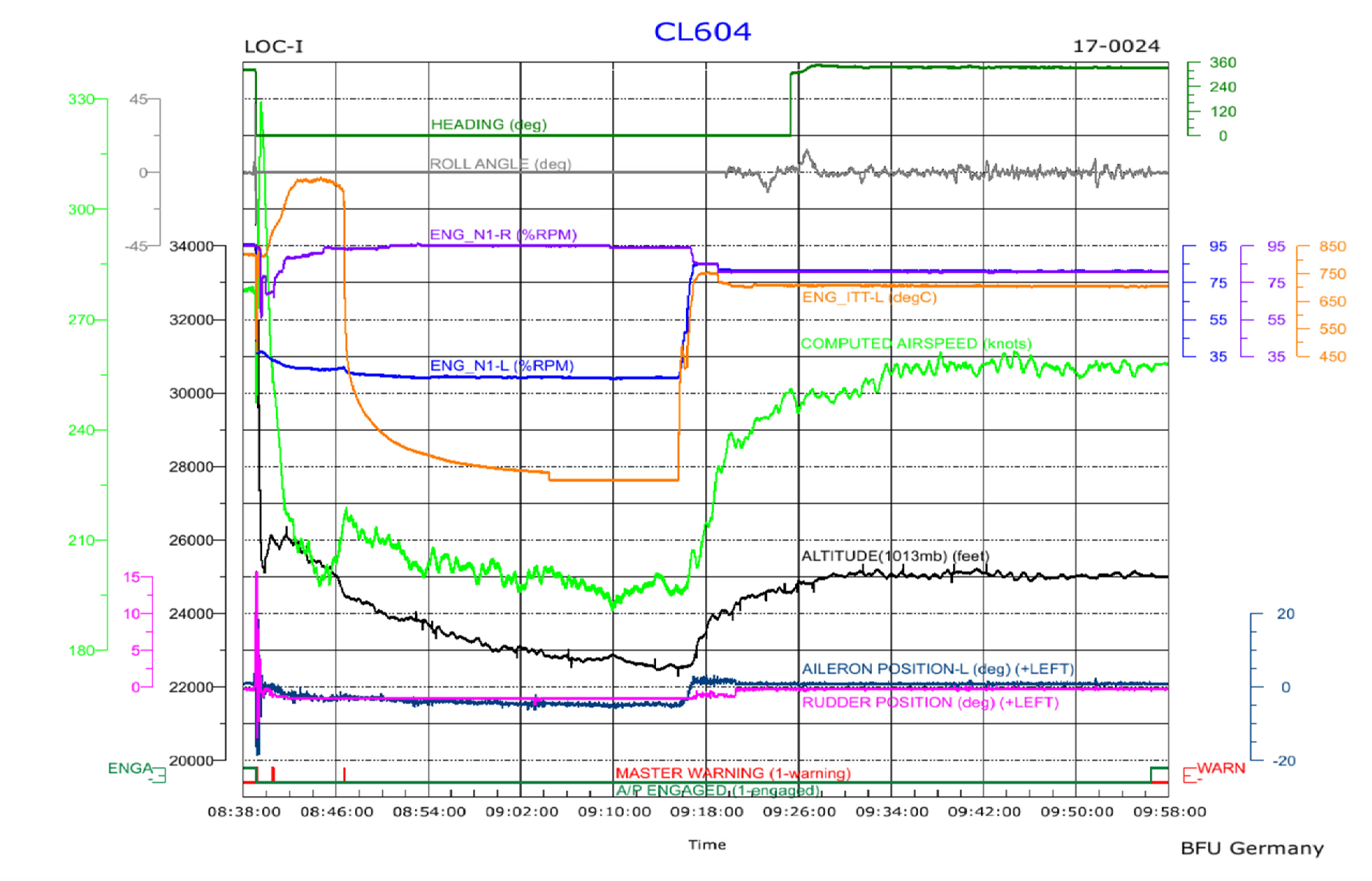
  • The Challenger initially rolled 42 degrees to the right, then 31 degrees left, and experienced G-Loads of 1.6g positive followed 1 second later by -3.2 g.
  • It lost altitude from FL340 to FL253 over a 2 minute period – loss of 8700 ft.

In an interview, the crew said:

The airplane shook briefly, then rolled heavily to the left and the autopilot disengaged. [We] actuated the aileron to the right in order to stop the rolling motion. But the airplane had continued to roll to the left thereby completing several rotations. Subsequently both Inertial Reference Systems (IRS), the Flight Management System (FMS), and the attitude indication failed”

“… since the sky was blue and the ocean’s surface almost the same colour [I] was able to recognise the aircraft’s flight attitude with the help of the clouds

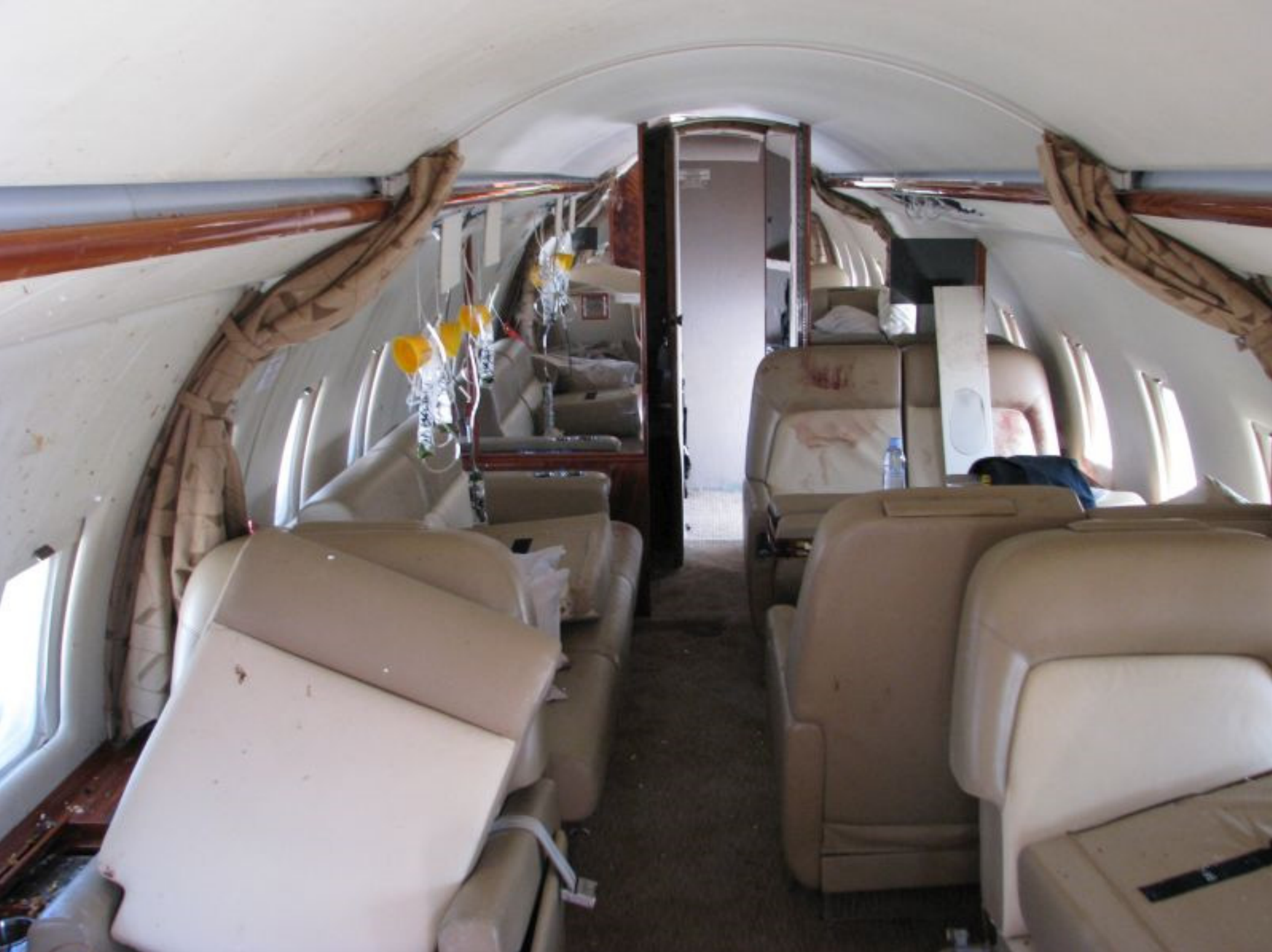
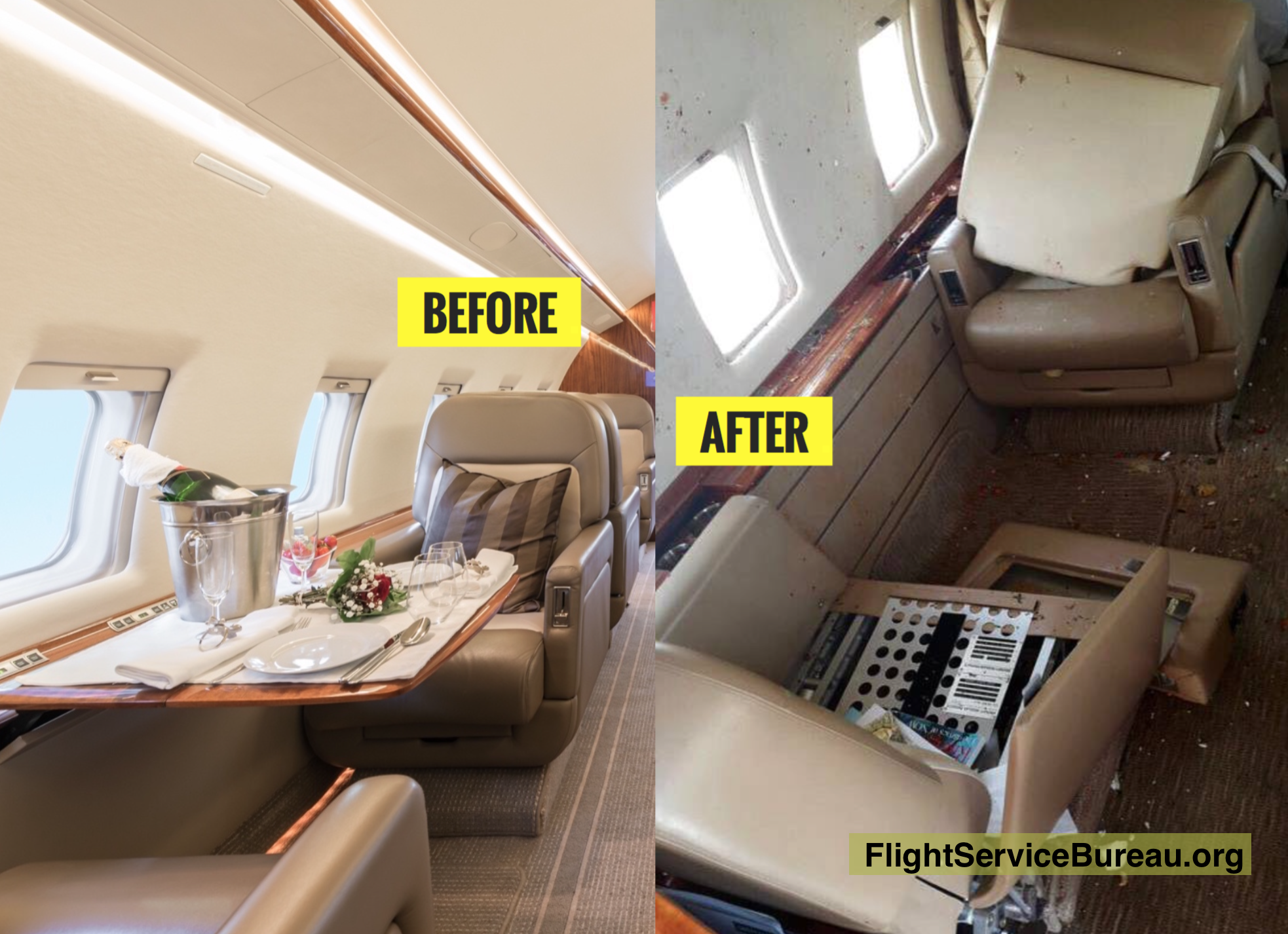
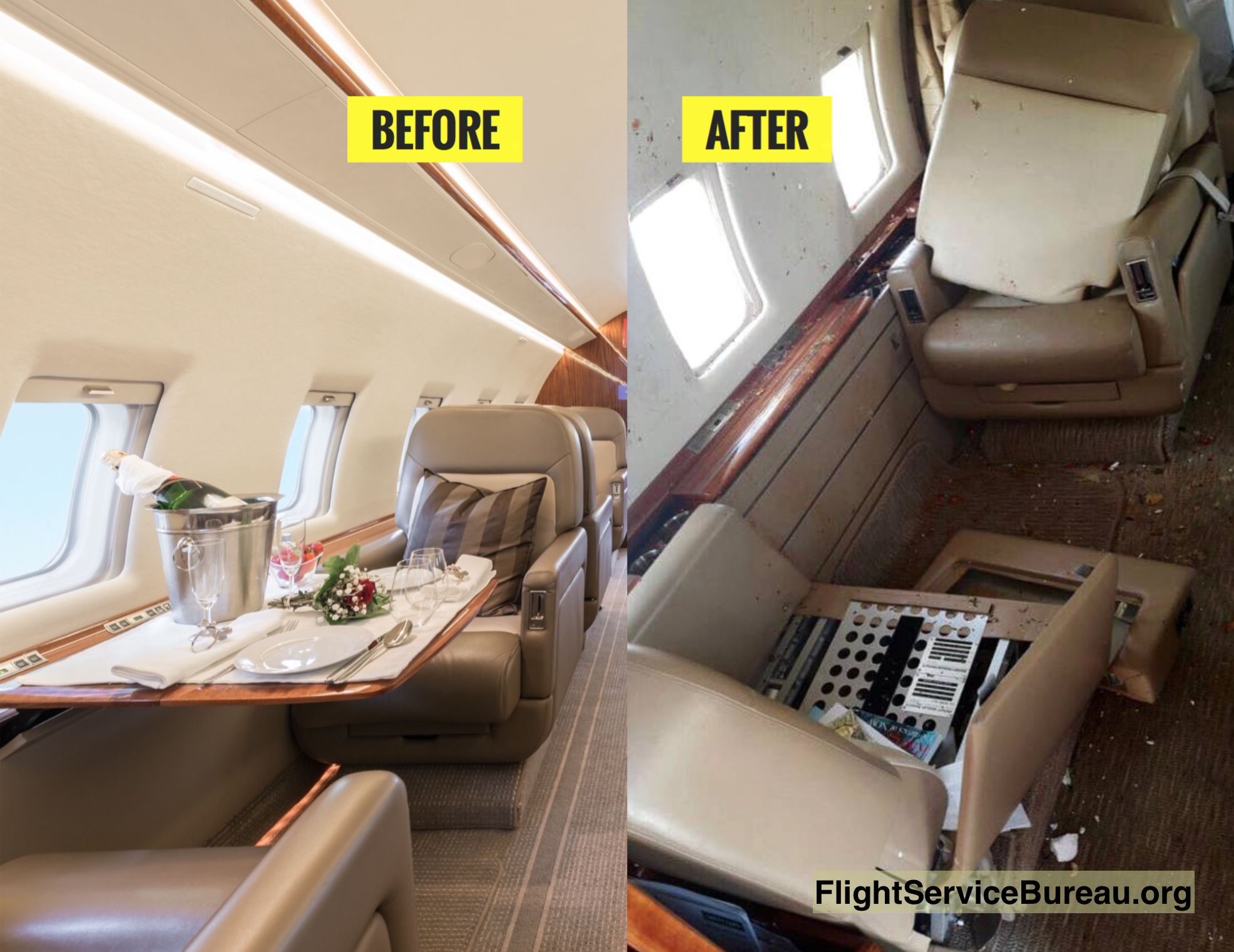
The BFU published the FDR excerpt above, and a full interior picture of the cabin, post event.


Flight Service Bureau has issued guidance to OpsGroup members, in Note to Members #24 (March 19th, 2017), which can be downloaded publicly here. The highlights are:

  • As Aircrew, use SLOP whenever you can.
  • As Controllers, be mindful of smaller aircraft passing underneath A380’s.
  • Avoid flying the centreline if you can. SLOP 0 is not an offset. Choose 1nm or 2nm.
  • Note the new SLOP rules from ICAO in the 16th edition of Doc 4444.
  • Expect guidance from EASA and the FAA to follow

With very recent updates to both NAT Doc 007 and ICAO Doc 4444, the rules for SLOP are a little different than before.


References:


Inside the cabin – before and after the wake turbulence encounter

The Challenger 604 vs Airbus 380 story has gone once around the world.

But is it even true? Some have asked. Let’s do a reality check.

After our initial story was published in last weeks International Operations Bulletin, which we first monitored thanks to the great work of the Aviation Herald, it was republished in various versions in The Times of London, Flying magazine, AIN Business Aviation News,  Deutsche Welle, and NBC. The picture on the Flight Service Bureau facebook page was viewed 1.1 million times.

First, the picture.

The incident happened. This has already been confirmed by the German BFU, who have responsibility for investigating accidents. The Canadian TSB have assigned an accredited representative to the investigation, and Bombardier have assigned a technical advisor.

So to the cause. The crew reported that 1-2 minutes before the loss of control, at about 0840 UTC, an Airbus A380-800 had passed overhead, slightly to the left. The Aviation Herald’s reporting is of the highest standard, and we trust their source.

Like the Aviation Herald, we also deal in facts. Joining the dots to form the bigger picture doesn’t require Colombo on the job.

  • The incident happened on January 7th, since which time the German BFU have been aware of the case.
  • The story has been out in the aviation community since February 7th, when it was posted that: “A CL604 enroute Male to Europe, upset by opposite direction, 1,000′ above, A380’s wake. Several rolls, large G excursions. Diverted into Muscat.”


Since the authority, manufacturer, and operator are all aware of the story, it is reasonable to deduce that were a material part of the widely reported incident not true, then that would have been stated rather quickly.

The ultimate confirmation will come from the Germany BFU, hopefully on this Interim Reports page.


The Boeing 757 parallel

On Sunday, we reported the similarity between this A380 story, and the 10 years it took to determine that the Boeing 757 had a wake 1.5 times stronger than other similar aircraft.

Our primary interest here at Flight Service Bureau is keeping the International Flight Operations community safe and informed. Consider this opening line from the New York Times on Dec 23rd, 1993:

Nearly a year after being alerted to the problem, the Federal Aviation Administration has ordered air-traffic controllers to warn aircraft flying behind Boeing 757 jets of the potential for dangerous wake turbulence.

In the last year, two crashes that together killed 13 people have been attributed to turbulence caused by Boeing 757's. In the more recent crash, on Dec. 15, five people were killed when their private jet went down in Orange County during a landing approach" 

Wake Turbulence Enroute

The entire topic of wake turbulence is not fully understood by any of us. There is much more to learn. Truly innovative studies were last done back in the 1970’s. Some experienced crews have even questioned whether enroute wake turbulence even exists.  Flight school drills into us as pilots, that wake lives around the airport. “Heavy, clean and slow” are the dangerous ones. But “slow” means about about 150 knots for aircraft like the 380. In the cruise, that goes up to about 250 knots IAS at the higher altitudes. If 150 knots is slow, then 250 knots isn’t really “fast”.

Before the crash of a Delta Tristar at DFW in 1985, we didn’t know much about windshear and microbursts.  Maybe we have to learn the same lesson with enroute wake.

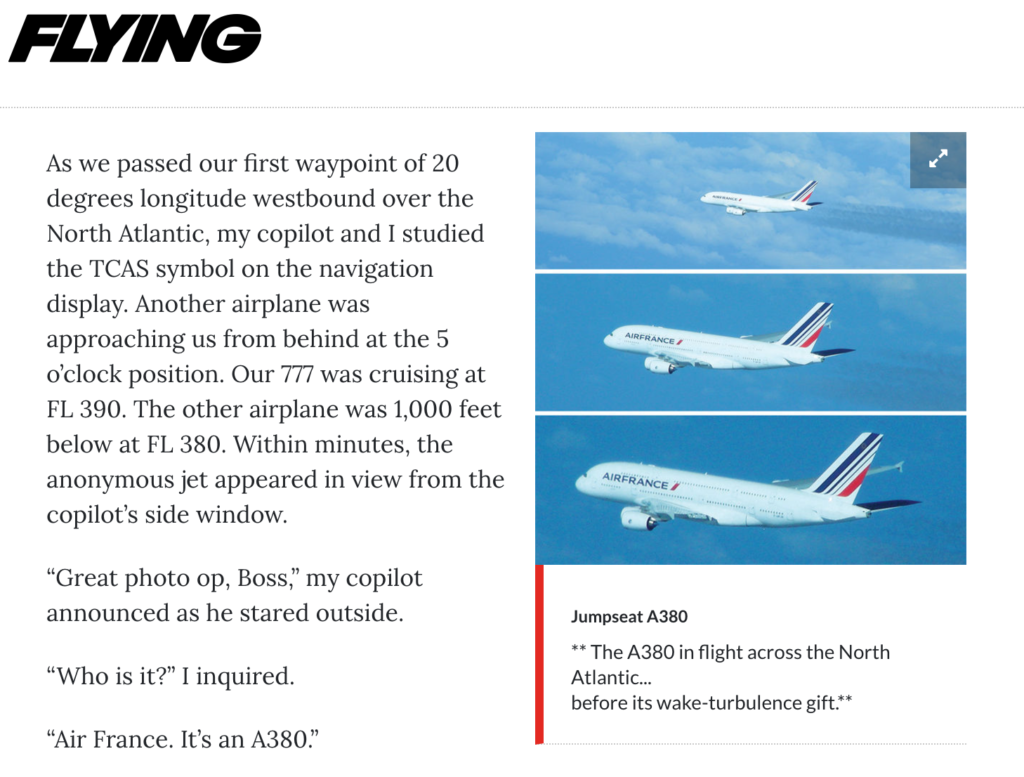
In Flying magazine, Les Abend has a very readable example of enroute wake in this article.


And here are some other examples of enroute wake turbulence encounters:

  • Air Canada, FL370, 55 degree roll at FL370 – wake from Boeing 747
  • Virgin Australia, FL350, 45 degree bank – wake from A380
  • American Airlines, FL220, bang – wake from B777
  • Air France, FL360, 25 degree bank – wake from A380
  • United Airlines, FL240, severe turbulence – wake from MD11
  • British Airways, FL320, 30 degree roll – wake from A380
  • Antonov 124, FL320, 15 degree roll, altitude loss – wake from A380
  • Vueling, FL320, sudden 40 degree right bank – wake from A340
  • Japan Airlines, E170 – uncommanded increasing roll to left – wake from A340
  • Armavia, A320 – A/P disconnect, steep banks – wake from A380

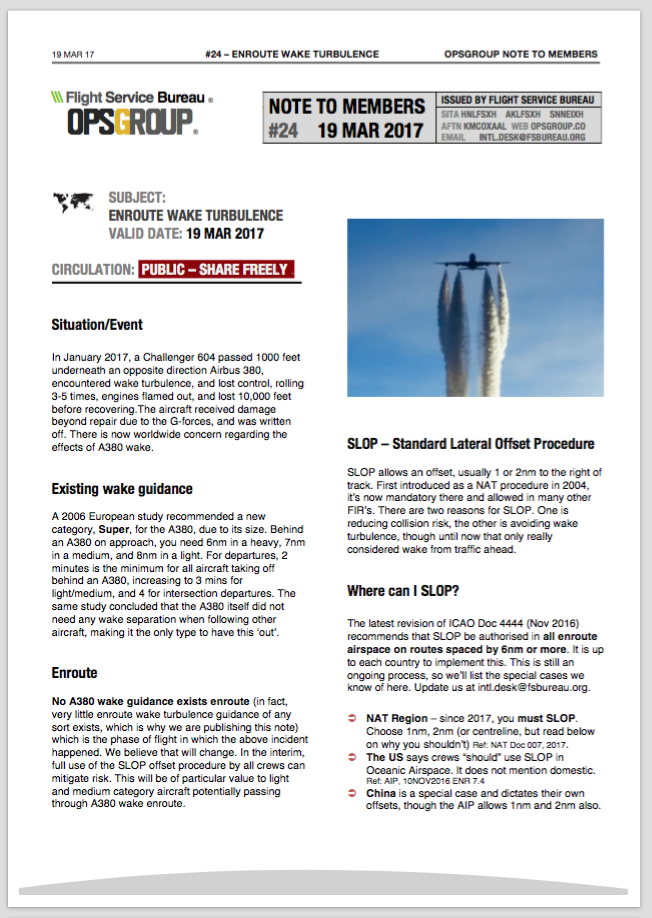
Note to Members #24 – Wake Turbulence Enroute

While the industry awaits further guidance from the authorities, Flight Service Bureau has made public its Note to Members #24 (normally restricted to OpsGroup circulation). Revised 22MAR2017.

Key points from our Note:

  • We might be wrong! Like we said above, there is much still to learn about enroute wake. Read the note, but make up your own mind.
  • Consider the wind. The danger point is roughly 15-20nm after the crossing point, as this is when the wake will have drifted down 1000 feet. In stronger winds, the wake may have drifted well away from the centreline. A turn away may not be necessary.
  • SLOP where possible. It may not prevent all situations, especially crossing traffic, but if you’re 2nm right of track you’re a lot less likely to be directly underneath another aircraft.
  • Read the note for the full guidance, and tell us if you have any further thoughts.


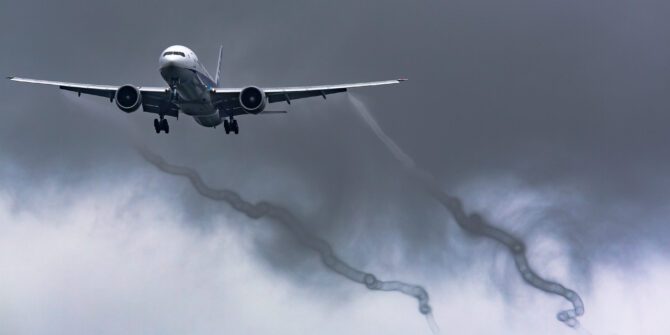
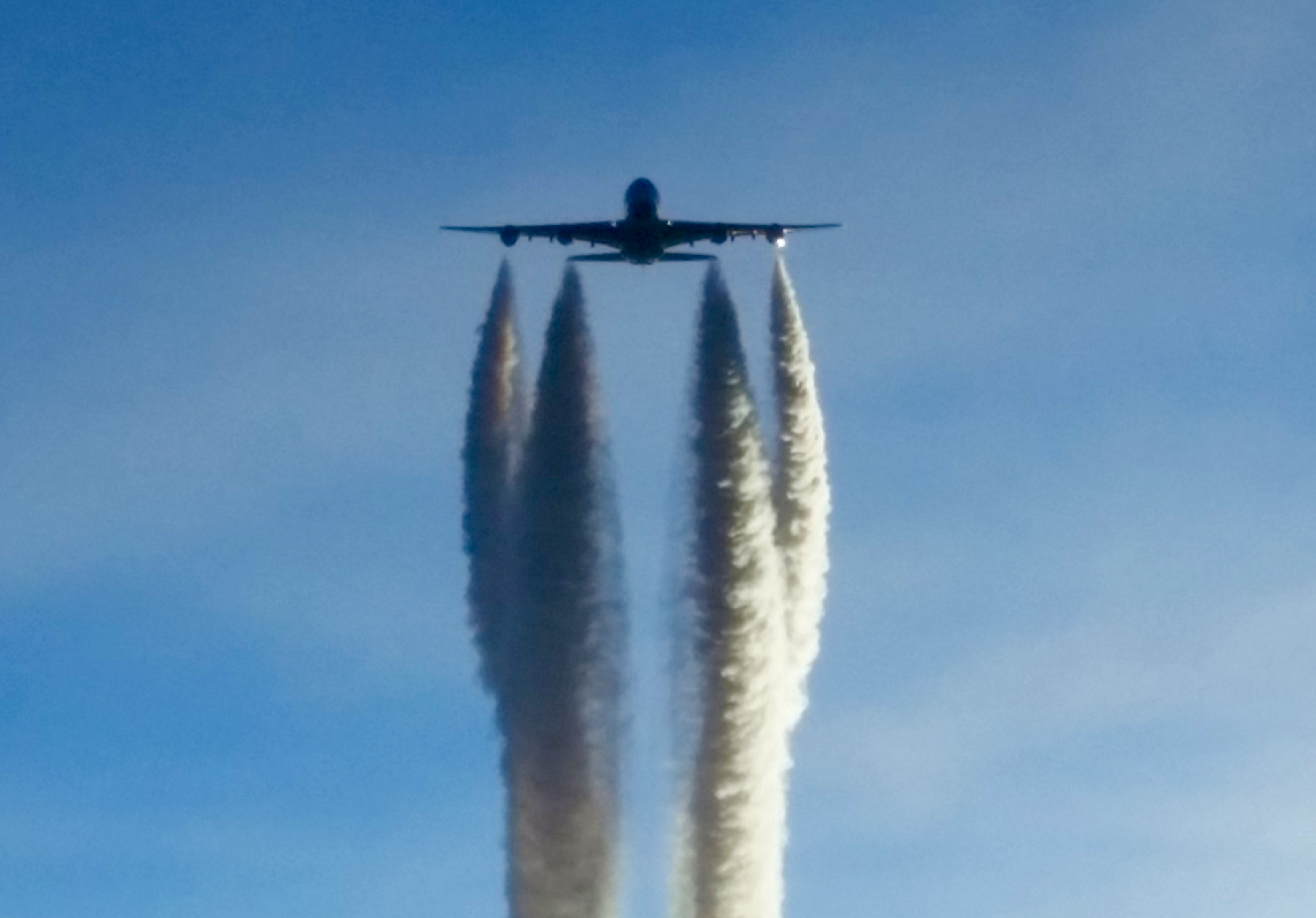
This is what an Airbus 380 looks like when it’s coming to get you

  • New guidance issued to OpsGroup by Flight Service Bureau
  • New warnings to be issued by Air Traffic Controllers – EASA SIB to follow
  • Updated 2017 SLOP offset procedures


With the A380 vs Challenger 604 incident,
there is now growing concern amongst aircrews about the effects of the A380’s wake turbulence.

In this incident, reported by the Aviation Herald, a Challenger 604 at FL340 operating from Male-Abu Dhabi passed an A380 opposite direction at FL350, one thousand feet above, about 630nm southeast of Muscat, Oman, over the Arabian Sea. A short time later (1-2 minutes) the aircraft encountered wake turbulence sending the aircraft into an uncontrolled roll, turning the aircraft around at least 3 times (possibly even 5 times), both engines flamed out, the aircraft lost about 10,000 feet until the crew was able to recover the aircraft, restart the engines and divert to Muscat. The aircraft received damage beyond repair due to the G-forces, and was written off.

This is a recovery that is in the same category as the ‘Miracle on the Hudson’, and the DHL A-300 recovery in Baghdad. Envision the alternate scenario, which was far more likely: Challenger 604 business jet missing in remote part of the Indian Ocean. Last contact with was a HF radio check with Mumbai. No recent satellite logons. Position uncertain. Search and Rescue attempt called off after 15 days. Nothing found. Probable cause: flew into CB.

Thanks to the remarkable job by the crew, we don’t have to guess. We know what happened. And now, there are questions.

We’ve seen this story before

Back in 1992/3, two back-to-back fatal crashes (a Citation, and a Westwind) were attributed to the unusual wake turbulence pattern of the Boeing 757. In fact, at the time, NOAA said it was the most intense wake they had ever seen. In December 1993, the FAA told controllers to increase the separation, and warn aircraft following a 757 of its presence.

This was 10 years after entry into service of the 757, which had its first revenue flight in 1983.

Sound familiar? The A380 had its first revenue flight in 2007. We are 10 years down the track, and it’s very tempting to apply the logic that because this degree of incident hasn’t happened before, it’s a one-off. An outlier. That the crew reacted erroneously to a small wake upset at the limit of their flight envelope. This is both unlikely, and, given the potential threat to other crews, a dangerous perspective.

The last review of A380 wake turbulence was done in 2006, primarily by Airbus. As a result, a new category was required – “Super“, in addition to the existing Light, Medium, and Heavy, for use by controllers when applying the minimum separation on approach and departure. However, no additional considerations were applied for enroute wake turbulence.

Most pointedly, the review concluded that the A380 did not need any wake turbulence separation itself, because of its size. The A380 is the only aircraft in the world to have this “out”. It’s a beast. Even an Antonov 124 or Boeing 747 needs 4nm from the traffic ahead.

New guidance

Given the incident, the similarity to the B757 story, and that quiet pointers towards a bigger risk, Flight Service Bureau has issued guidance to OpsGroup members, in Note to Members #24 (March 19th, 2017), which can be downloaded publicly here. The highlights are:

  • As Aircrew, use SLOP whenever you can.
  • As Controllers, be mindful of smaller aircraft passing underneath A380’s.
  • Avoid flying the centreline if you can. SLOP 0 is not an offset. Choose 1nm or 2nm.
  • Note the new SLOP rules from ICAO in the 16th edition of Doc 4444.
  • Expect guidance from EASA and the FAA to follow

With very recent updates to both NAT Doc 007 and ICAO Doc 4444, the rules for SLOP are a little different than before.

Download the OPSGROUP Note to Members #24 – Enroute Wake Turbulence.


Caution Wake Turbulence: New Rules for the EU

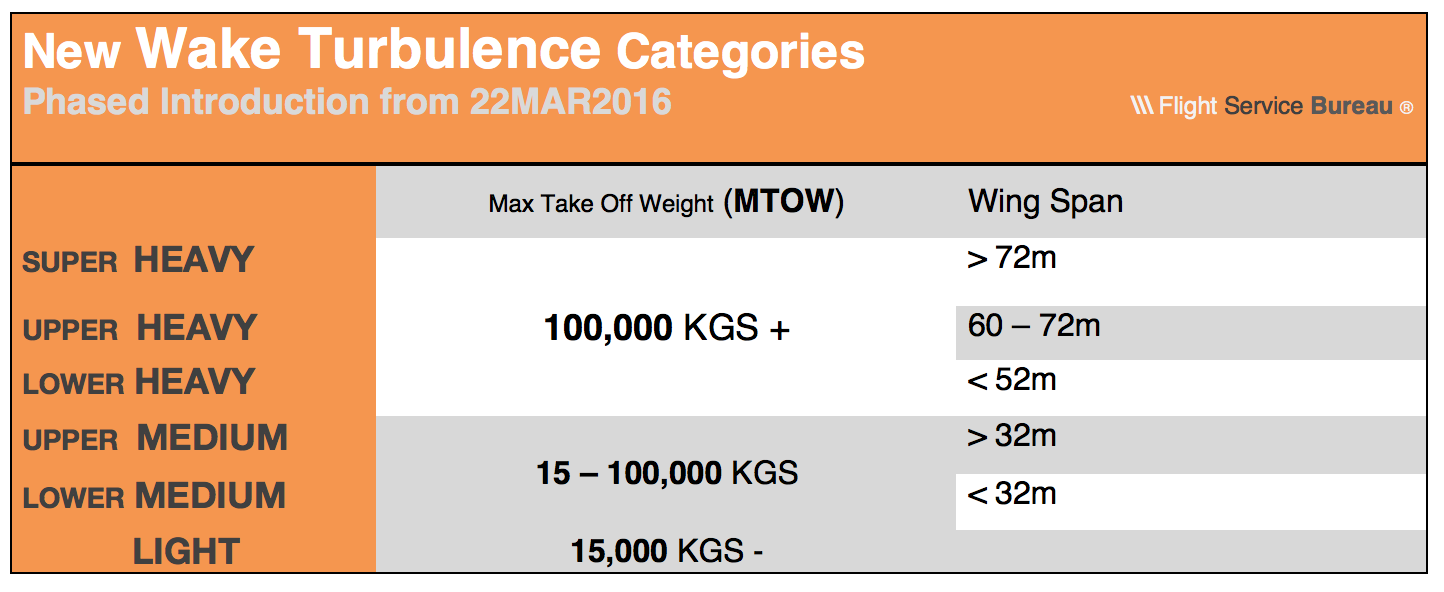
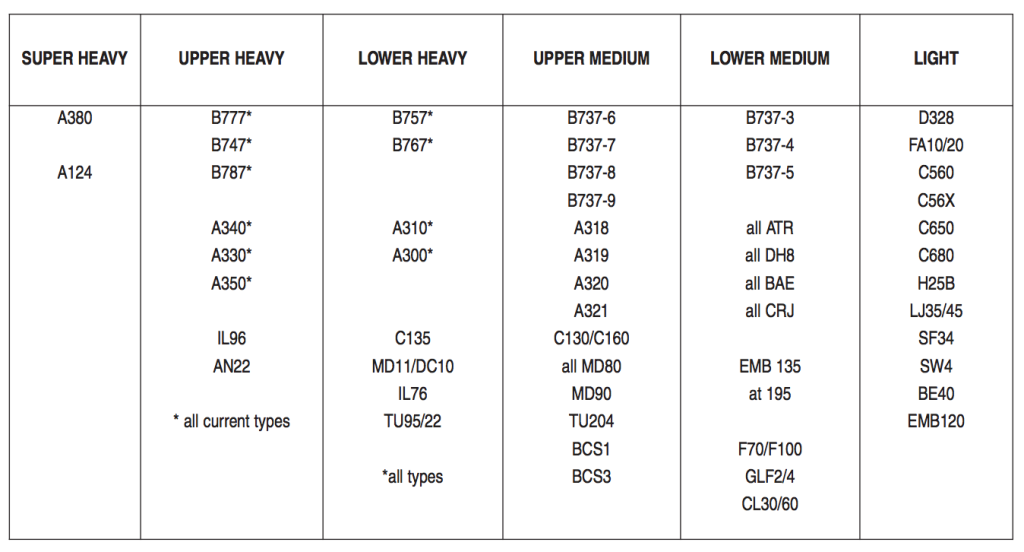
What Wake Turbulence Category is a B757? That long favoured question by Dispatch Trainers and ATC Instructors will become a thing of the past under new rules slowly being introduced in Europe, where the current four (Light, Medium, Heavy, Super) will become six. The first place you will see this happening is at LFPG/Paris Charles de Gaulle and LFPB/Paris Le Bourget, from 22 MAR 2016.

Those six new categories are Light, Medium (with Lower and Upper), and Heavy (with Lower, Upper and Super). The rules are part of the RECAT-EU project, with the intention of squeezing more traffic into busy European Airports by applying more precise turbulence separation rules.

The separation minima are determined specific to each Aircraft Pair. For example, at the moment, an A330 following a B777 (Heavy behind heavy) requires 4 miles in trail. With the new rules, that is reduced to 3nm. An A320 can now follow 4 miles behind a B777, instead of the current 5nm.

There are no Flight Planning Changes (continue to use /L,M,H,J for the ICAO Category). For crews, you’ll notice the smaller separation, but there are no changes to callsigns or pilot obligations – for now.

New-Wake-Turbulence-Categories-RECAT-EU


Sample-Aircraft-Categories-RECAT EU

 
References: