Shanwick’s Tango Routes – 2021 changes
When the French Controllers go on strike, the airspace surrounding France becomes of high interest to international operators, especially the north-south Tango routes within Shanwick’s airspace.
With Phase 2C of the North Atlantic Datalink Mandate effecting February 2021, CPDLC is required between FL290-FL410 throughout the entire NAT region. Some Tango routes stay exempt: T9, and a new route T290. The other Tango routes (T213, T13, T16) will all require datalink.
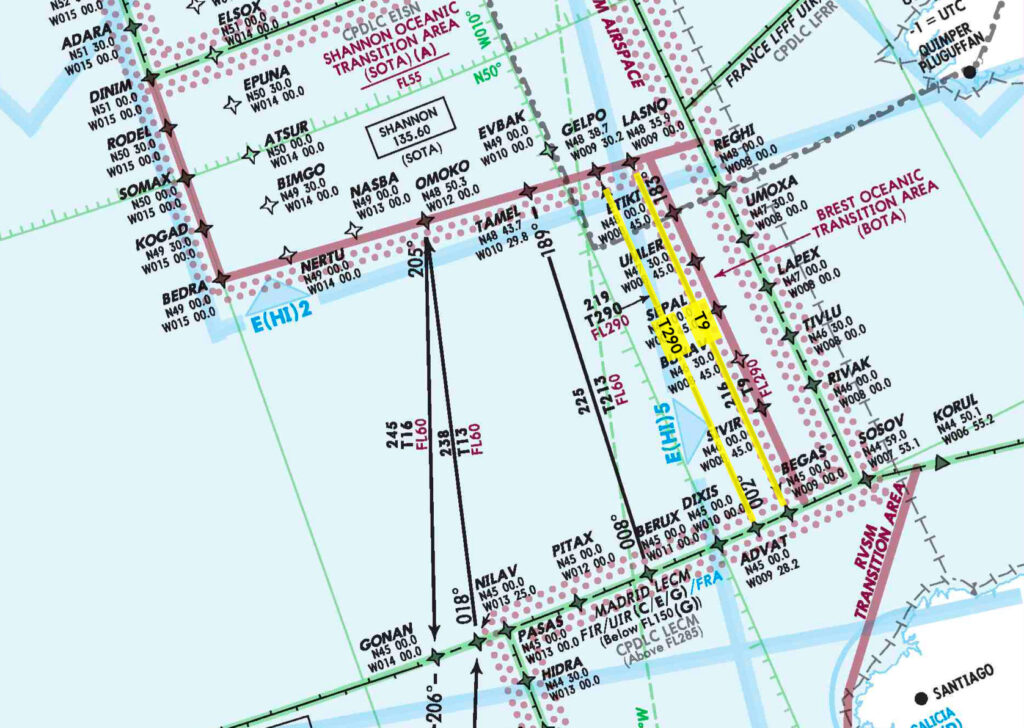
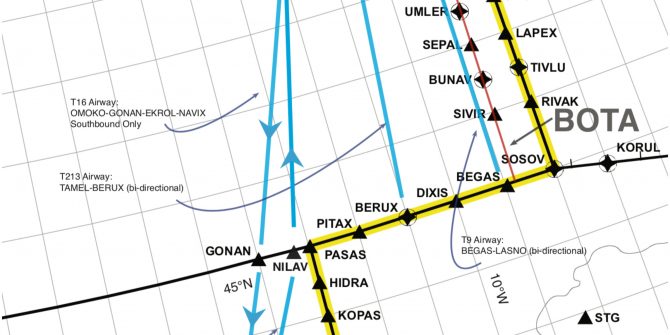
Map of the Tango Routes prior to 30 Jan 2020:
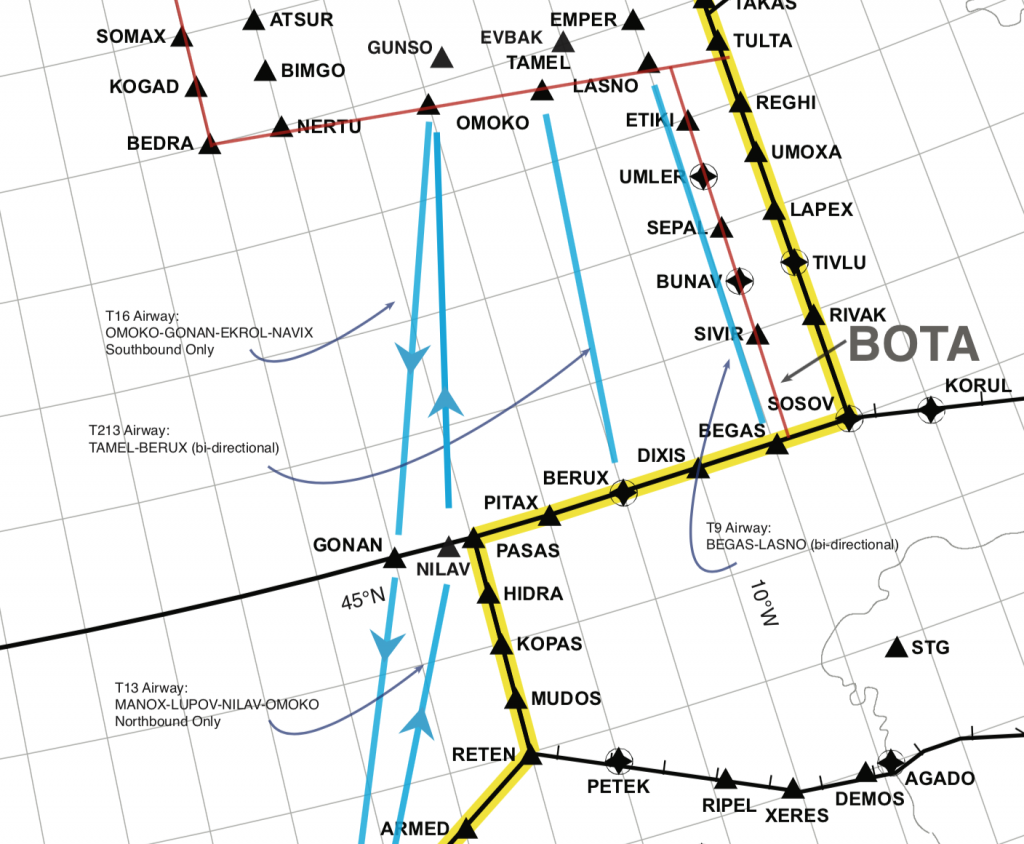
Tango 9 LASNO-BEGAS
The most popular of the Tango routes – often chock full of holiday traffic between Northern Europe and the Canaries. Requirements:
- HF Radio. One is sufficient.
- An Oceanic Clearance. Get it from Shanwick at least 30 minutes before you arrive at the boundary, 60 minutes is the best target time.
- At least one LRNS/Long Range Nav System
- HLA Approval if you want to fly above FL290 and above.
Tango 213 TAMEL-BERUX
- HF Radio. One is sufficient.
- An Oceanic Clearance. Get it from Shanwick at least 30 minutes before you arrive at the boundary, 60 minutes is the best target time.
- Two LRNS/Long Range Nav Systems
- HLA Approval if you want to fly above FL290 and above.
Tango 16 OMOKO-NAVIX
- HF Radio. One is sufficient.
- An Oceanic Clearance. Get it from Shanwick at least 30 minutes before you arrive at the boundary, 60 minutes is the best target time.
- Two LRNS/Long Range Nav Systems
- HLA Approval if you want to fly above FL290 and above.
Tango 13 MANOX-OMOKO
- HF Radio. One is sufficient.
- An Oceanic Clearance. Get it from Santa Maria at least 30 minutes before you arrive at the boundary, 60 minutes is the best target time.
- Two LRNS/Long Range Nav Systems
- HLA Approval if you want to fly FL290 and above.
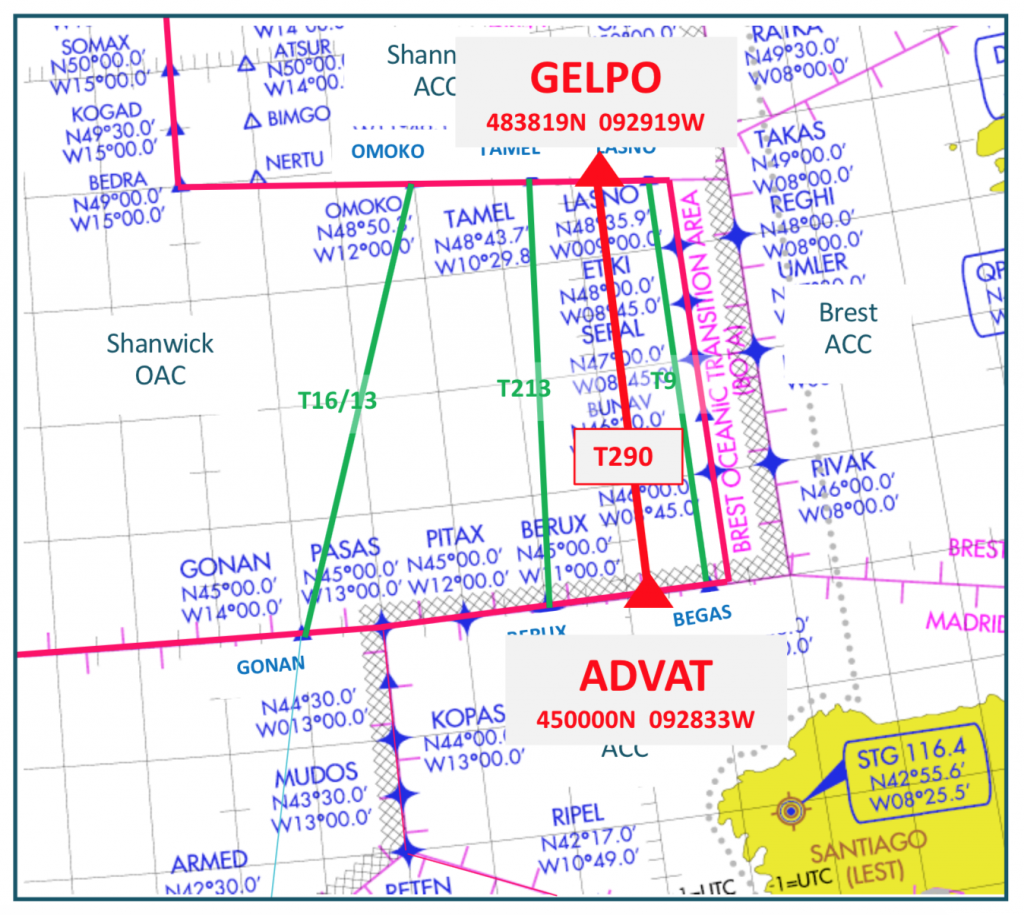
T290 to be added from 30 Jan 2020:
Key Points:
- T290 will be 20NM to the west of T9, in order to support the NAT Contingency 5NM offset procedure. T290 will go from new boundary points GELPO in the north to ADVAT in the south.
- Both T9 and T290 will be classed as RNP2 continental offshore routes (the UK AIP says to make sure you include NAV/RNP2 in Field 18 of your FPL). Both will require: 1 LRNS, 1 HF, and ADS-B. The other Tango routes (T213, T13, T16) will all require datalink between FL290-410.
- T9 will become southbound only, even levels between FL300-400. T290 will be northbound only, odd levels from FL290-410.
- For T9 and T290, there will be a new VHF frequency: 128.360, which will be introduced on 30 Sep 2019. Pilots must monitor this frequency, but it’s only to be used for intervention and emergency – in other words, don’t use it unless something’s going badly wrong! You’ll still need to monitor and broadcast on 121.5 for in-flight contingencies.
- For more info on the Tango routes, check out the UK AIP ENR 3.5 due to take effect from Jan 30.
- You need a HF radio to enter Shanwick FIR, period. There are no exceptions.
- You need HLA Approval to use any of the Tango routes at FL290 and above.
Operating Tips
- You probably won’t get the level that you want – either because the airway itself is busy, or because you’re crossing a bunch of East-West NAT Traffic. If the rest of your Flight Plan shows FL380, plan FL320 for most of the Tango portion – especially T9.
- You can make an Oceanic request by Data-link (ACARS), Clearance delivery – 127.65 VHF, 123.95 VHF or via HF (Frequencies vary on the day, but 5598 is normally a safe bet).
- If you get a low Flight Level for the Oceanic Route, Shanwick are happy for you to check in again closer to the boundary and see if higher is now available.
- Entering the Oceanic Airspace, make a full position report: Position and time / Flight level / Next position and estimate for that point / Following position.
- Don’t make a full exit position report when you enter domestic airspace, just callsign and “Approaching LASNO, FL370”. Exception: Santa Maria likes one.
- No contact on HF? Relay on 123.45, or Sat Phone EGGX 423201 or EIAA 425002.
NAT HLA Approvals
- If you have an existing MNPS approval, it’s good until 2020.
- If you need a new HLA approval, then you’ll need RNP4/RNP10.
- Individual Crew need training in international procedures and HLA, as part of the process.
From Shannon ATC
Thanks to Shannon ATC for adding this useful information for crews operating on the Tango Routes:
- EICK Departures via T9/T213/T16 should get their Oceanic clearance prior to departure – ask the Tower 45 minutes ahead of time.
- All other EI/Irish departures can request clearance when airborne. For info, the earlier crews request their clearance the better, as it means they are more likely to get a better level and it allows ATC to plan for getting the aircraft to that level.
- Important: Due to the risk of two aircraft using the same squawk leading to a mis-ident, Northbound traffic entering SOTA via T9, T13, or T213 should squawk 2000 at least 10 minutes prior to the Irish boundary.