Ops Planning for the 2022 Singapore Airshow

The Singapore Airshow is back, and taking place from Feb 15-18 at WSSS/Changi airport.

As one of the largest aviation events in Asia, things are going to get busy.

If you’re flying in, here is a rundown of everything you’ll need to know before you get there.

Airport Closures

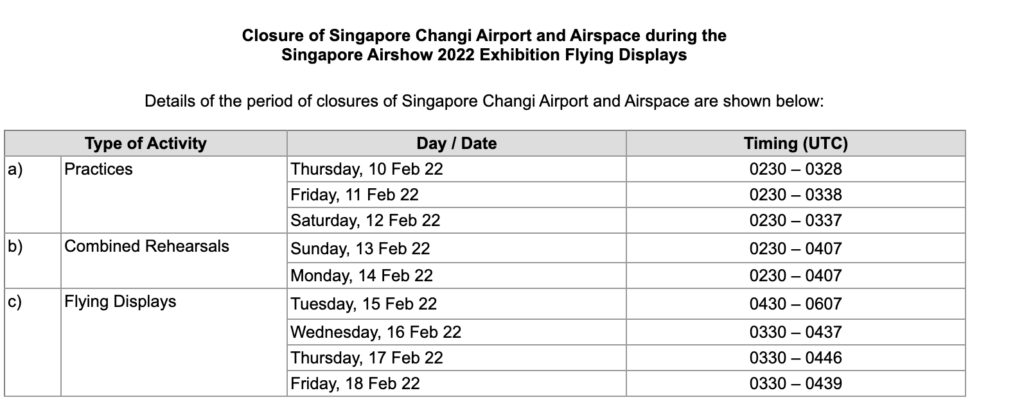
From Feb 10-18 Changi will close to all arrivals and departures for over an hour in the middle of each day. This is to allow for practice displays and then the main event.

The closures all commence late in the morning and vary slightly each time. You can find the exact timings below – Singapore’s time zone is UTC + 8.

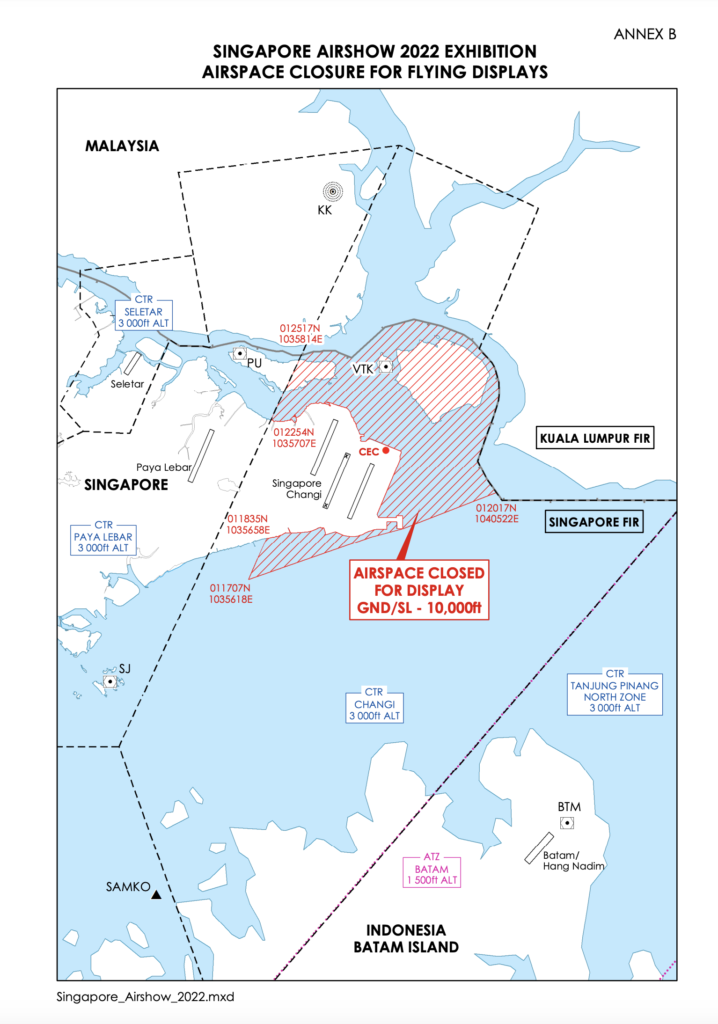
The restricted airspace covers a large portion of Changi’s CTR and will apply from surface to 10,000 feet.

Here’s a picture:

Nearby WSSL/Seletar will not be affected by the closures.

Rush Hour

Avoid planning to take-off or land on either side of the closure windows. There will likely be a back log of traffic and extensive delays. Arriving aircraft are advised to plan for at least an extra twenty minutes of holding fuel.

If you’re arriving from a major airport in the Asian region, also be aware of Singapore’s ground delay program which may be activated. Here’s the relevant page from Singapore’s AIP, but if you are departing an affected airport for Changi, you may need to stick to a calculated take off time (CTOT). The allowance is -5/+10 min. Outside of this window you’ll need to ask for a new CTOT.

Once airborne, if you get held up by more than 15 minutes make sure you let them know. Their AFTN address is WSJCZQZX.

Permits

Both private and commercial operators need a landing permit for Singapore. Commercial ones reportedly take a number of working days to process so apply early. You can speak to the CAA directly on +65 65 42 1122 or caas_atlas_admin@caas.gov.sg. If you’d prefer the help of a local agent, we’d suggest SG World Aviation Services. You can reach them on +65 85 774830 or ops@sgworld.net.

Weather

Singapore is found just one degree north of the equator, and so convective thunderstorms are common all year round, and can be quite severe. The worst times are in the afternoon and evenings. Expect to use additional fuel for deviations or holding.

Covid Entry Rules

The rules for foreigners to enter Singapore are tight. But there are ways they can enter with no quarantine. The most common is via the ‘Vaccinated Travel Lane,’ which most travellers are eligible for. There’s a bunch of boxes to tick here, so we recently put together this article that should help.

Crew have two choices. You can enter under the standard rules which don’t require a vaccination or Covid test. But you’ll be stuck isolating in the hotel until departure. If you want to get out (and enjoy the show) you can also apply for the VTL above if you follow the same requirements as your passengers.

Seletar

If you’re planning on flying into nearby WSSL/Seletar, the biggest issue is likely to be parking. If you haven’t already, make sure you get in touch with your agent to make sure you reserve a spot as the airport can quickly fill up.

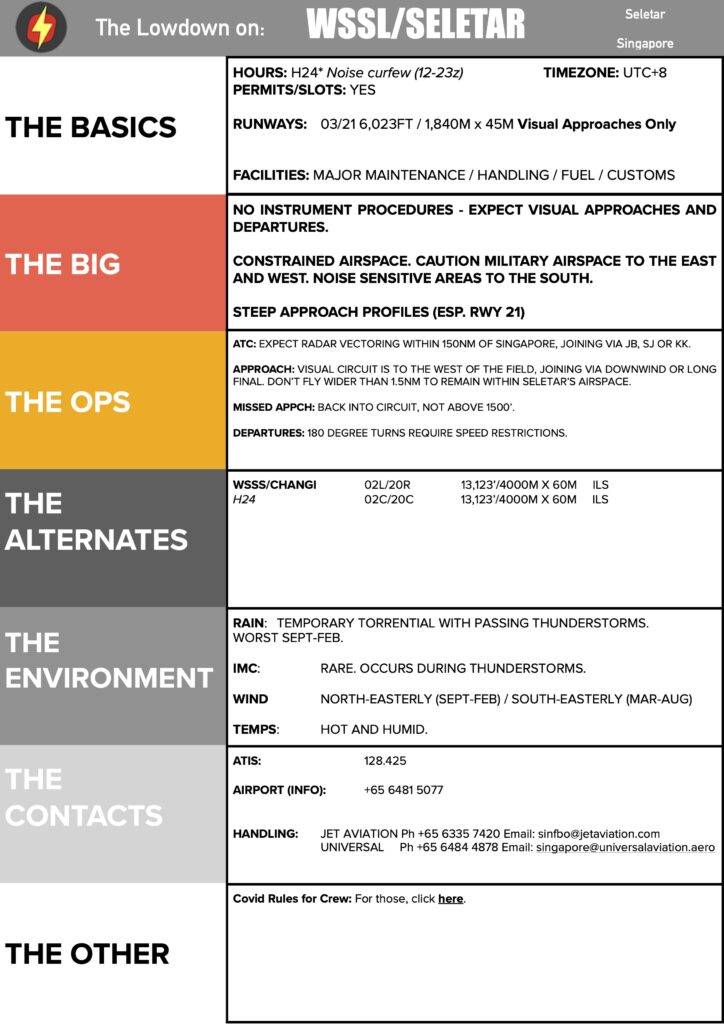
The airport itself can be operationally challenging – there are no instrument approaches, and it is in close proximity to military airspace. Click here for a full briefing on what to expect.

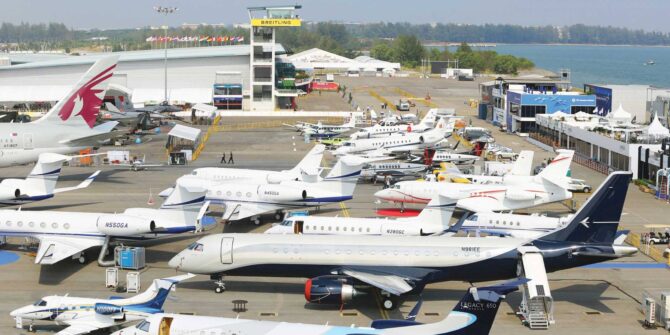
WSSL/Seletar – 8nm west of Changi. Parking can be very limited.

The Official Word

You can find the official Singapore AIP Supp (026/2022) for the event here.


Surviving Seletar: Singapore’s Second Airport

Update Oct 2025

OPSGROUP members can access an updated version of this guide, effective Oct 2025, on the members Dashboard here.

Original Article from Sep 2021

If you’re planning to operate a business jet into Singapore, there’s a good chance you won’t be bound for WSSS/Changi Airport at all. Instead you may be headed for the lesser known WSSL/Seletar – Singapore’s secondary commercial airport, and it can be a lot more challenging.

Here’s a basic rundown of just what to expect to keep you ahead of the game next time you are flying into Seletar.
The Basics

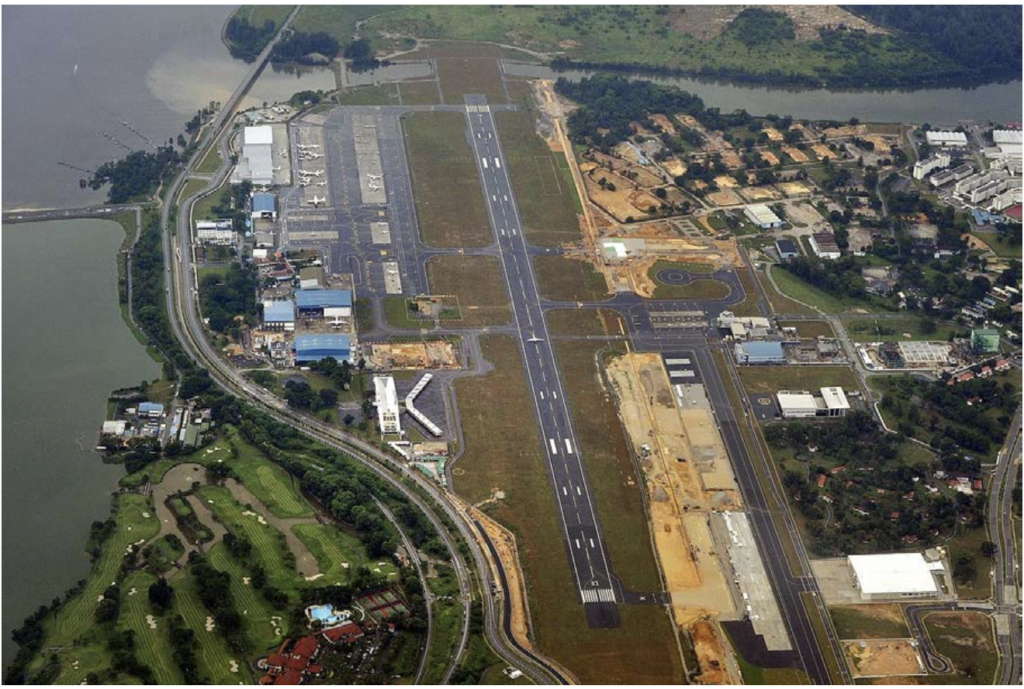
Seletar is a stone’s throw (8nm) northeast of WSSS/Changi. It has a single 6020ft/1840m long runway and serves predominantly turbo prop and corporate jet traffic. It has fuel and good facilities for business ops.

Just getting in there at all can be a pain – the airport is surrounded with prohibited and restricted airspace, noise abatement areas, training areas, military airports; as well as a bunch of buildings, cranes, boats, and other obstacles to the north of the airport on the Malaysian side – just across the Strait of Johor.

And since Malaysia effectively killed the plans for ILS at Seletar back at the start of 2019, there are no available instrument approaches at all, requiring visual approaches to be flown onto both runways.

The Airspace Picture

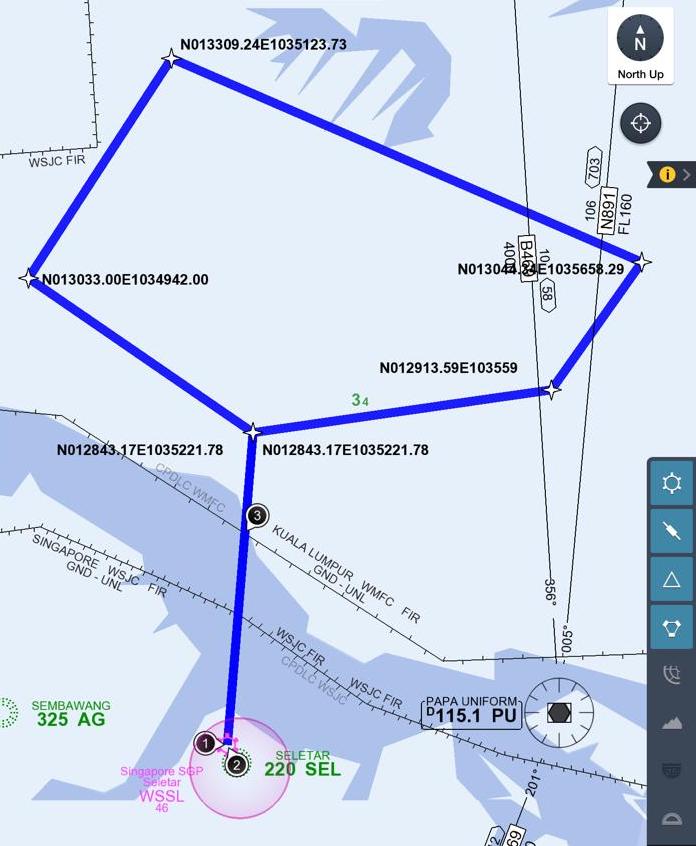
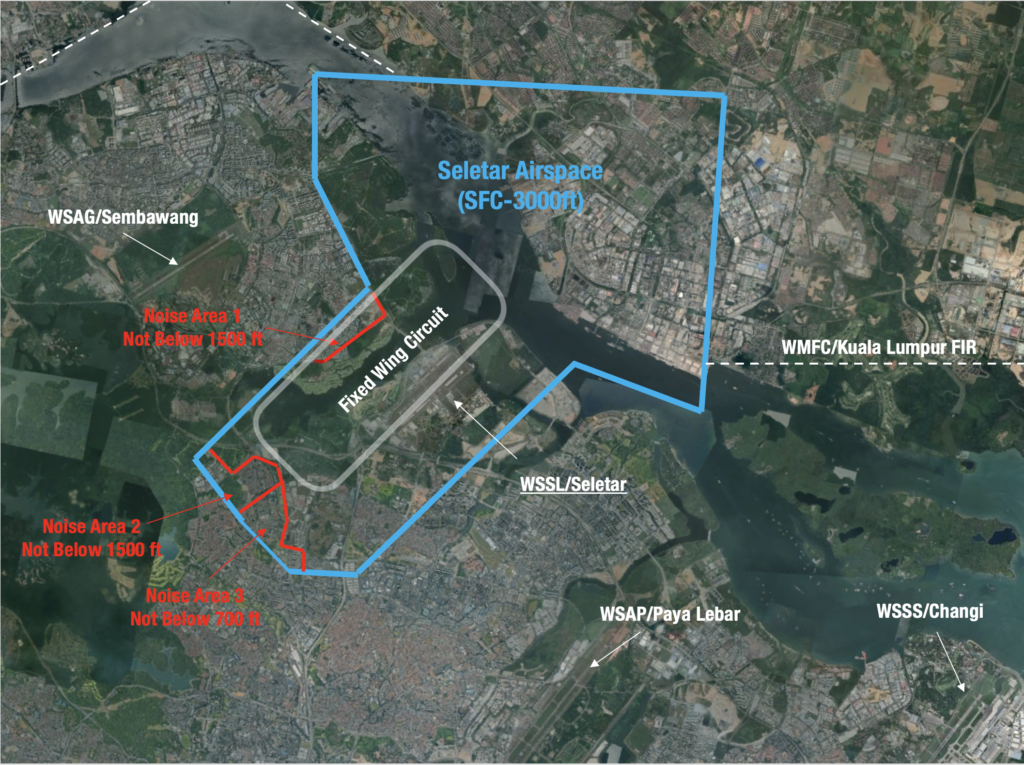
Operations at Seletar are difficult because of the complicated airspace that surrounds it, and it is the reason why there are no instrument approaches. There just isn’t enough room.

Seletar is literally boxed in by a variety of restricted airspace. To the west lies the Sembawang airbase, and to the east the Payar Lebar airbase. Both are strictly military.

Then just a smidge to the north is the boundary with Malaysian airspace, the WMFC/Kuala Lumpur FIR. South of the airport is highly noise sensitive, with three noise abatement areas where hefty fines await.

Throw these things together and you have the Seletar ‘Fish Bowl’ – a small bubble of airspace where there is precious little room to manoeuvre. Here’s a picture of what this all looks like.
Arrival Procedures

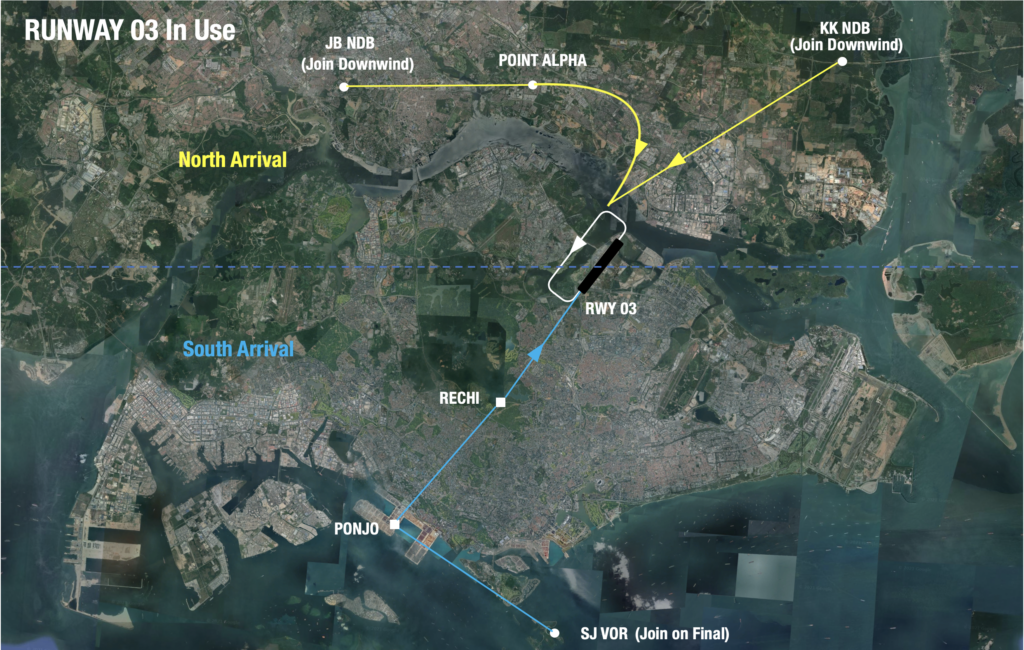
To keep things simple, the end game is to join the circuit and fly a visual approach, without busting any airspace. To help you with this there are a number of visual arrivals that require you to be in VMC conditions. If you can’t get visual, you’ll need to hold or divert to nearby Changi.

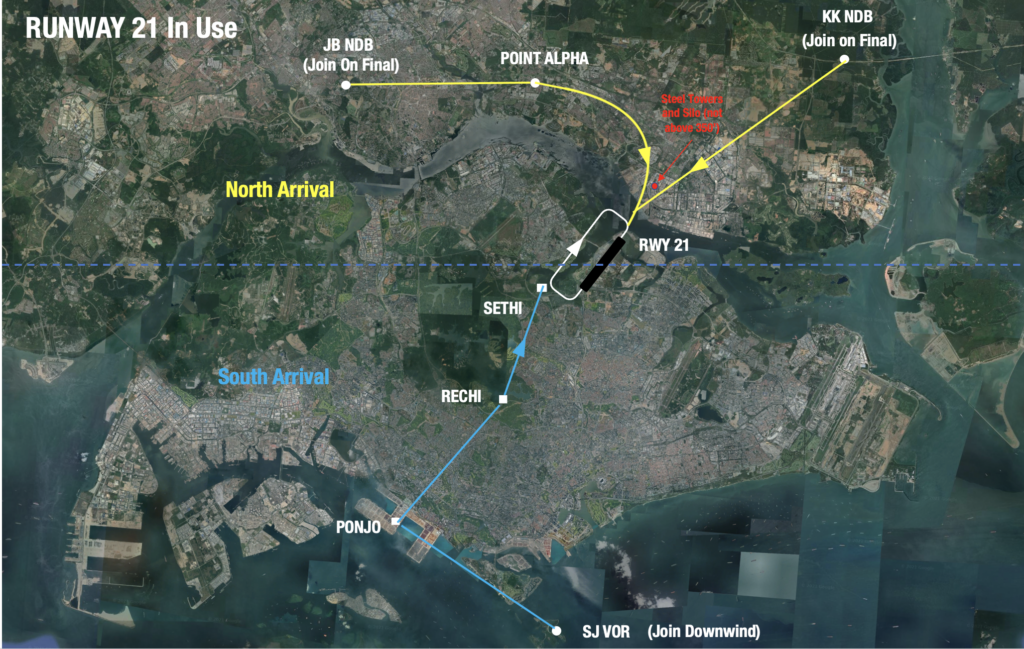
There are essentially two arrival procedures – North and South. And all arriving aircraft will join them through one of three feeder points – Jaybee NDB (JB), Sinjon VOR (SJ) or Kong Kong NDB (KK). From there you will either join downwind, straight in or even overhead if you need the extra track miles.

You can view the current plates for those procedures in the Singapore AIP online. But to make it easy, here’s a couple of pictures.
Things to look out for

Day and night closures: The airport is closed every night between 22-07 local time except for medevac and SAR. And then during the daytime, there are several infuriating closures to accommodate training flights. So essentially, GA/BA flights can only operate to Seletar at these times : 0700-0930, 1030-1200, 1300-1500, 1600-1700, 1800-2200 local time.

The circuit is tight. It is always on the western side of the airport and you cannot fly your circuit wider than 1.5nm due to Sembawang’s airspace. Which means the turn onto final is also going to be tight.

The profile is steeper than normal. 3.2 degrees on Runway 03, and 3.5 degrees on Runway 21. Which means you will need higher rates of descent than a standard visual circuit ‘outta the book’.

You need to be visual. If you’re not VMC, you can’t land at Seletar. Thunderstorms are common in Singapore with heavy rain, and they tend to be slow moving. The worst times are afternoons and evenings.

‘Steel Structures and Silos’  – You’ll hear it on the ATIS, and you need to report you have them in sight if arriving on Runway 21. They’re on the Malaysian coastline north of Seletar. Spot them early and you’ll get an earlier approach clearance from ATC which will make your job easier.

Mistaken Identity: Both nearby Sembawang and Paya Lebar airports have similar runway orientations to Seletar and it is easy to line up with the wrong one. Tune up Seletar’s NDB (220) – the needle doesn’t lie!

Missed Approaches. Expect to re-enter the circuit for both runways – which means a prompt turn downwind and not above 1500ft.

Ops on the Ground

You’ll be pleased to know, pretty straight forward. Parking can become limited, and so it always pays to book a spot with your handling agent well in advance.

Departures

Both runways have noise abatement. Just the standard stuff here – NADP 1 or 2. Your call.

There are published visual departure procedures for both runways. Essentially they involve a climb straight ahead to 1000ft, followed by a turn onto a radar heading.

For departures downwind, the challenge is to stay within the ‘Fish Bowl.’ Which means keeping your turn tight, and your speed down. Ironically the noise abatement procedures help here.

Your Layover

Assuming Covid isn’t still ruining the party, Singapore is famous for food. Three words: Chilli Mud Crab. Jumbo Seafood Restaurant in Clarke Quay is the place to go. And if you’re beer inclined, Tiger is the perfect accompanying drop. For the time being, you may need to rely on Uber Eats. Don’t worry though, Jumbo also delivers.

Handling

 There’s a few good options to choose from. Here are some contacts:

Other options?

Technically, bizav operators are still allowed to go to WSSS/Changi, but will normally only be allowed quick turnarounds subject to runway/bay availability, and then you’ll have to go elsewhere for parking.

Another option is WMKJ/Johor Bahru, on the Malaysian side, around 25nm north of Singapore. It’s open from 06-00 local time, with extensions possible with prior notice. It has a separate FBO with its own VIP lounge and hangars with maintenance support, and has no slots or parking restrictions for bizav ops. Check out the brochure!
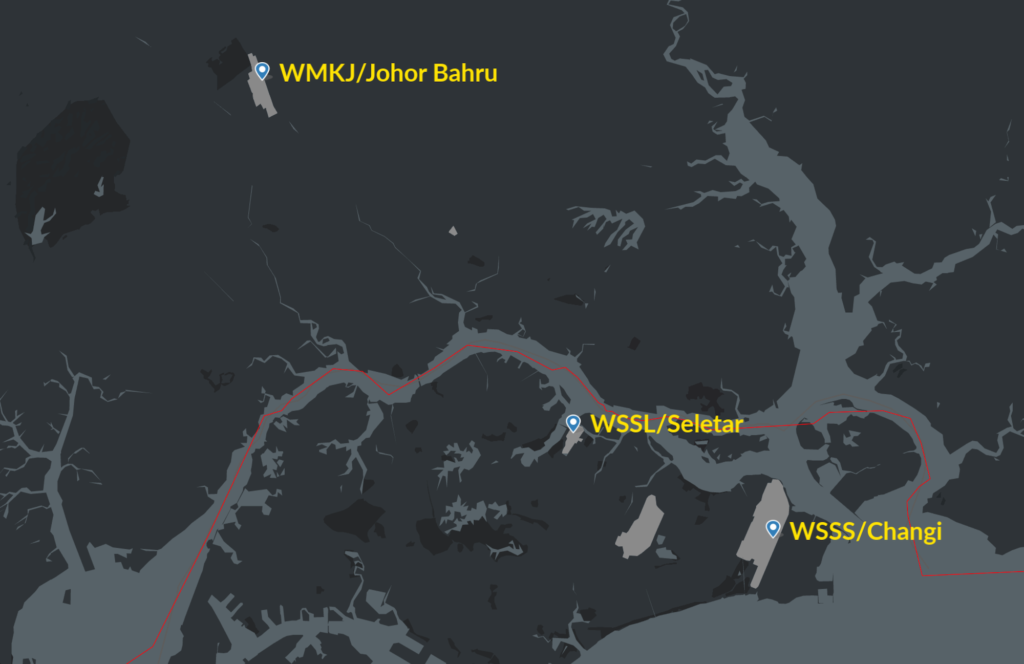
The only downside in WMKJ is that it can sometimes take a bit of time for immigration when you cross the road border heading south into Singapore – sometimes 2-3 hours during busy travel periods.

Opsgroup members can read reports on all these airports in Airport Spy.

Permits and stuff

If you’re operating as a private flight to either Changi or Seletar, things don’t get too complicated, as permits are not required for private flights. Just make sure you have parking arranged, and file your inbound ATC flight plan 12 hours in advance, being sure to copy in the Singapore ATC AFTN address WSJCZQZX.

If you’re doing a charter flight on the other hand, you’re going to need a landing permit, which means you’re going to have to jump through a few hoops.

For this, you’ll need to get an Operations Permit from Singapore CAA, which is basically a blanket approval to conduct revenue flights to Singapore, valid for up to one year. You’ll then need to get an Air Transport Permit, which is required for every individual charter schedule into Singapore (Changi or Seletar). Save yourself some hassle and get a local handler to help arrange these for you.

Airport Lowdowns

Have you heard of them? We make a bunch, especially if you ask for one! They’re what you need to know from crew who have been there. And they’re on one small, simple piece of paper. You can read more about them here.

We’ve got you covered. Check out Seletar’s here.

Malaysia and Singapore agree truce over Seletar airspace closure

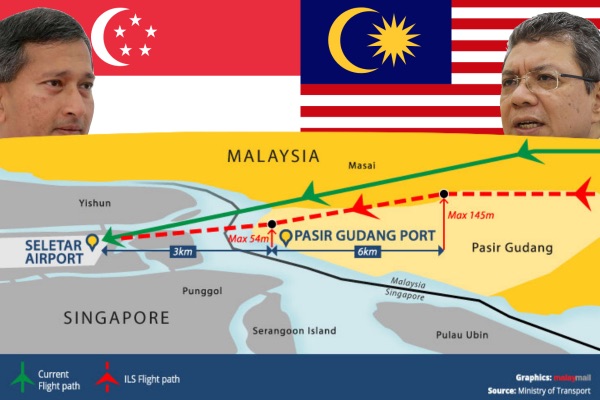
Update Apr 6: The Malaysian authorities have now lifted the airspace closure north of Seletar again, and in return Singapore will abandon plans for ILS at the airport – and will now draw up plans for GPS approaches instead. The new agreement brings an end to days of disruption, with operators having to take off and circle overhead to 6000ft before being cleared enroute; it will also allow Malaysian airline Firefly to commence planned flights to Singapore, which had been postponed since Dec 2018 due to the dispute.

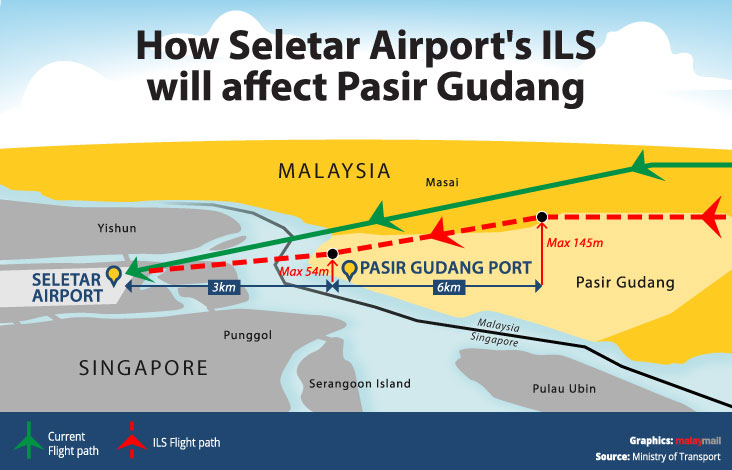
The new ILS approach on RWY 21 at WSSL/Seletar airport was due to take effect on 3rd Jan 2019, but Malaysia effectively killed it.

They claimed that the ILS approach –most of which lies within Malaysia’s airspace to the north of the airport– would impose height restrictions around the Pasir Gudang industrial area, and would stunt growth in the area.

Malaysia decided to create a no-fly-zone across an entire chunk of airspace just across the border from Singapore, up to 6000ft. This ultimately would have made RWY 21 ILS approaches at WSSL/Seletar impossible.

Singapore and Malaysia’s foreign ministers have met multiple times this year to discuss the issue, eventually resulting in Malaysia agreeing to cancel the restricted airspace they imposed, and in return Singapore agreeing to abandon the ILS procedures.

Discussions are set to continue regarding a wider ongoing dispute over airspace sovereignty, with Malaysia saying it wants to take back airspace delegated to Singapore under an agreement in 1974.

In other news: The night curfew at Seletar is now in effect. AIP SUP 86/2018 confirms that with effect from 1st Jan 2019, the airport will be closed to all flights (except medevac and emergency diverts) nightly from 22-07 local time.


Seletar launches new terminal

As WSSL/Seletar prepares to open its new $80 million terminal on Nov 19, the authorities have announced that WSSL is now a “schedules facilitated” airport.

Don’t panic – at least, not yet. This basically just means that because demand is now getting close to the airport’s capacity, all airline and charter flights must confirm their schedules with the airport in advance  – BA/GA flights don’t need to do this.

It does not mean that the airport has become slot coordinated, although that might happen at some point in the future if congestion continues to be a problem.

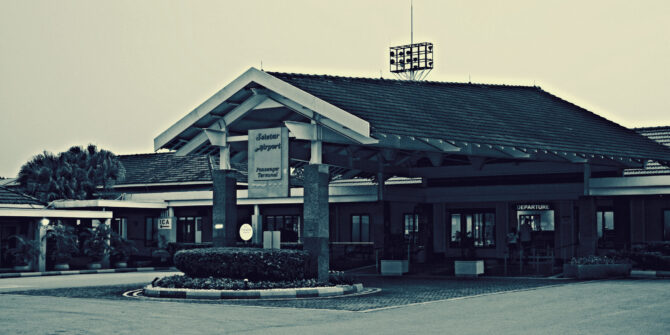
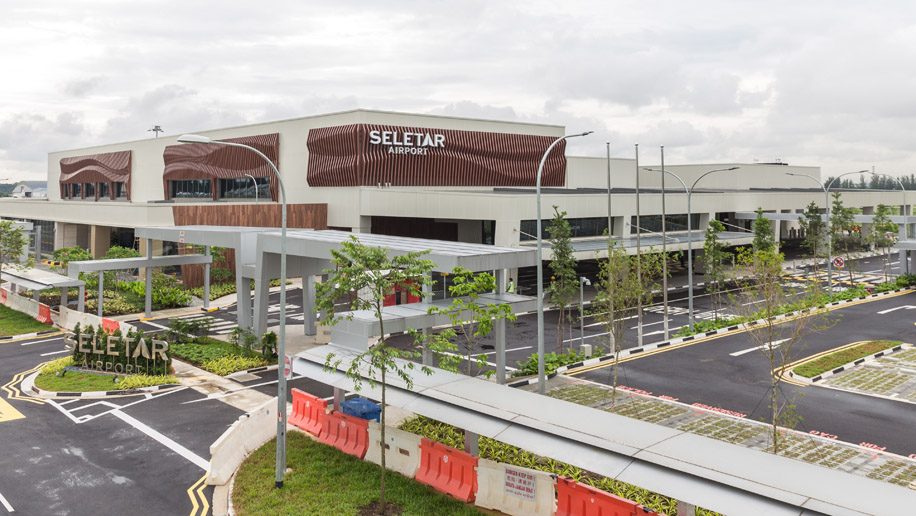
As for the new terminal, it looks like it will be a decent improvement on the old one…

The new facility – six times bigger than the old terminal – will be split in two, with one large section for airline flights, and another separate section dedicated for GA/BA.

Here’s a video of what the new terminal looks like!

The idea is to free up capacity at WSSS/Singapore by moving all scheduled turboprop flights to WSSL/Seletar when the new terminal opens. At the moment, the only airline that falls into this category is Malaysia’s Firefly – which currently operates 20 daily flights at WSSS – to and from WMSA/Subang, WMKI/Ipoh and WMKD/Kuantan.

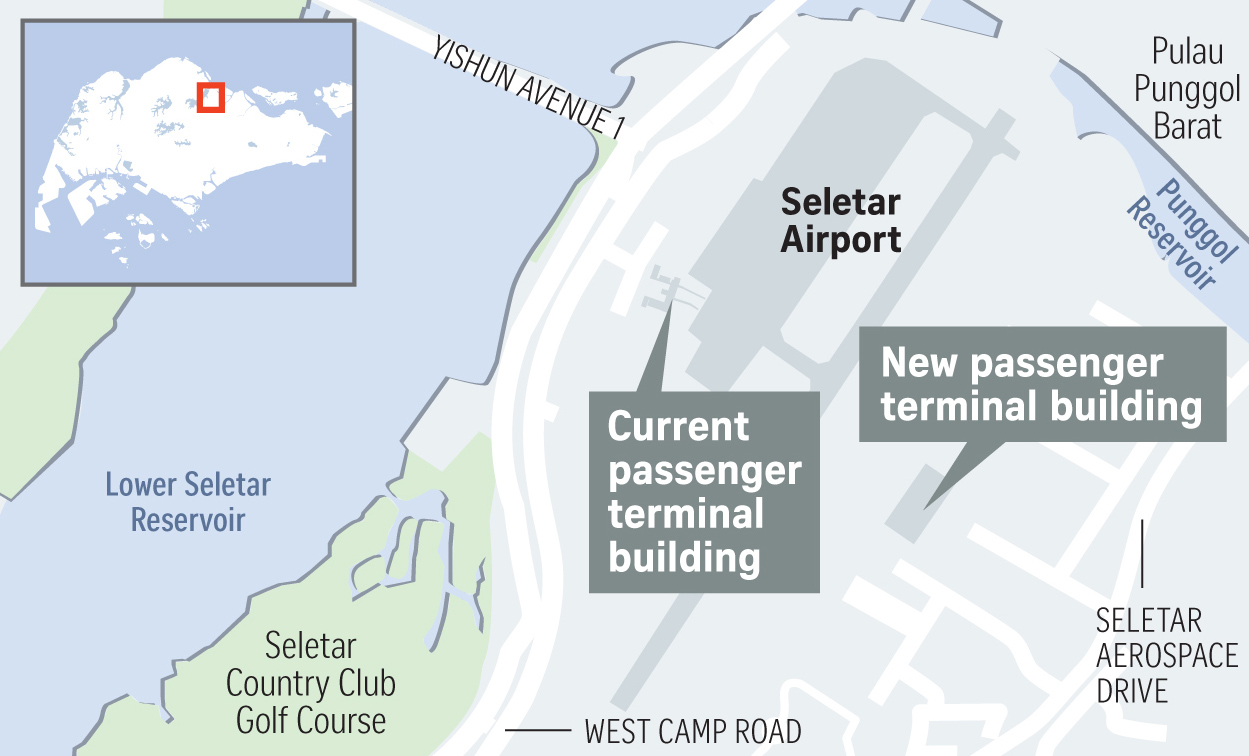
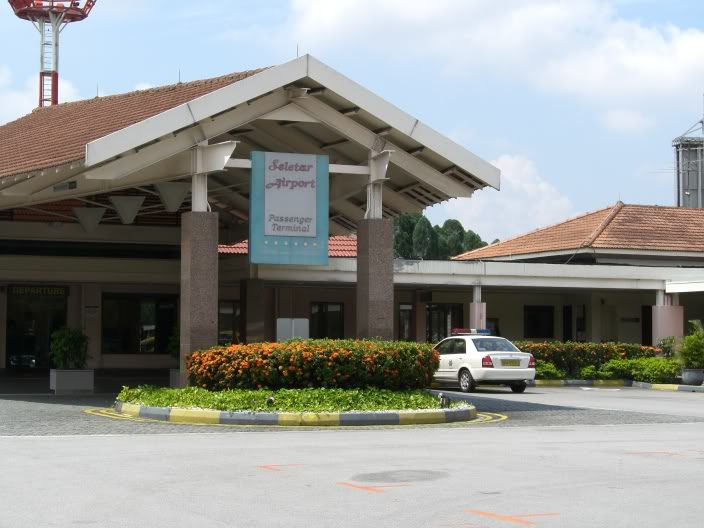
Important to note – all BA/GA traffic must switch to using the new terminal when it opens on Nov 19 at midnight local time. Jet Aviation have provided a handy printout which tells you all you need to know about using the new terminal. Note that the new terminal is on the other side of the runway from the old terminal!


Sorry, you gotta go to Seletar: Ops to Singapore

Singapore Changi Airport has been named the best airport in the world by Skytrax for the past four years running.

It already has a butterfly garden, free 24-hour cinema, rooftop swimming pool and spa, but soon it’s going to become even more awesome – work is currently underway on the new ten-storey ‘Jewel Terminal’, scheduled for completion in 2018, with a gigantic ‘rain vortex’ waterfall cascading from the ceiling, indoor rainforest park, playgrounds, shopping mall and hotel complex. If it ends up looking anything like the pictures in the brochure, it will be pretty spectacular…

Unfortunately, if you’re operating a business jet to Singapore, you probably won’t be allowed to go there!

The Singapore authorities will not allow overnight parking at Changi for charter flights under any circumstances, and parking for private flights is limited to a maximum of 48 hours. Slots are required, and with the amount of scheduled traffic currently in place, unless you’re planning to do a really quick turn at super off-peak times (ie. the middle of the night), your request will probably be denied.

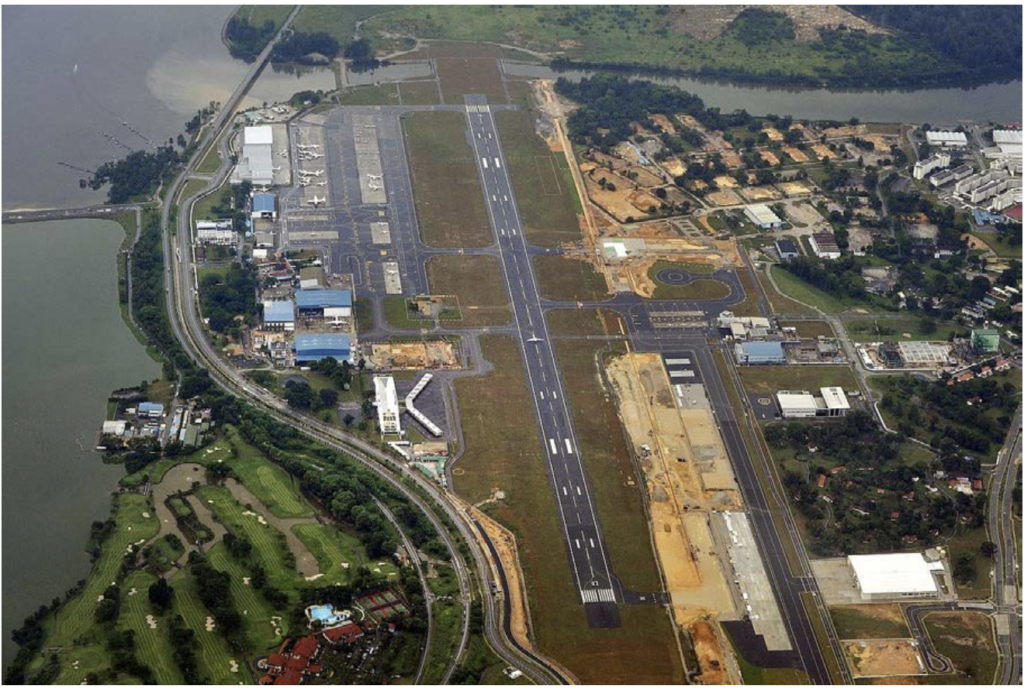
This is where the authorities would like all corporate flights to go instead:

Seletar Airport. Doesn’t look quite as fantastic, does it?

The good news is that unlike Changi, at Seletar there is much less congestion, no parking time limits, and much lower handling costs. However, it does only have a 6024 ft runway and is not due to have ILS installed until some time next year. Added to that, fuel is around $1 per US gallon more expensive than at Changi.

Whether you end up going to Changi or Seletar, if you’re operating as a non-scheduled commercial flight you’re going to need a landing permit, which means you’re going to have to jump through a few hoops.
Here’s a quick breakdown of how to organise that non-sked flight:

Step 1: Get an ‘Operations Permit’ (OP)

You will need to open an ATLAS Account with CAAS and then log in to appoint a handling agent. Then either you or the handling agent will be able to liaise with the authorities to obtain the Operations Permit (OP).

This is basically a blanket approval for that operator to conduct revenue flights to Singapore, and you may have up to 20 aircraft on this permit.

Once this permit is approved, CAAS will advise the validity period which may be up to one year, although the OP will only remain valid for as long as the other aircraft documents are valid for. The OP usually takes 3 working days for approval by CAAS if all paperwork submitted is in order.


Step 2: Get an ‘Air Transport Permit’ (AT)

After securing the OP, it means CAAS have in principle approved you as an operator to carry out charter flights to Singapore.

With the OP in place, you can then apply for an Air Transport Permit (AT) which is required for every individual charter schedule into Singapore (WSSS or WSSL). The AT Permit for WSSS usually takes around 3-5 working days for approval by CAAS, although they will often reject your request and demand that you operate to WSSL instead. The AT Permit for WSSL usually takes around 3 working days for approval.

For the OP and AT permits, you should register an account here:
https://appserver1.caas.gov.sg/ATLAS/welcome.do


Step 3: Slots –  but only if you’re going to Changi!

Remember, slots are only required at Changi, and not at Seletar. You can only obtain slots after you’ve obtained an OP and an AT. Slots will likely take several hours to obtain, and available slot times may differ from what you’ve requested, due to other scheduled traffic. You can only submit requests for slots a maximum of 7 days prior to ops, and a minimum of 24 hours prior. And you will nearly always need to change your schedule in order to match available slot options!

For more information than you could ever possibly need about slot requests at Changi, check the Singapore AIC 2/13:
http://www.caas.gov.sg/caasWeb2010/export/sites/caas/en/Regulations/Aeronautical_Information/AIC/AIC_PDFs/2-13.pdf

For requesting Changi airport slots, if you already have an account then you should use the online system:
https://www.online-coordination.com

Or if you don’t have an account then just send an email with your request in the standard SCR format to:
csc@changiairport.com

Other things to consider…

  • If you’re operating as a private flight to Singapore (instead of non-scheduled commercial), life suddenly gets considerably easier, as permits are not required for private flights! Just make sure you have parking arranged, and file your inbound ATC flight plan 12 hours in advance, being sure to copy in the Singapore ATC AFTN address WSJCZQZX. You’ll still need slots if operating to Changi, but at least you don’t have the added hassle of having to obtain the OP/AT.
  • Permits are not required for Singapore overflights either. The only exception to this is for special airworthiness flights, where for both overflights and landings you basically follow same process – apply for a Singapore Permit To Fly. To do that, complete the form at the following link: http://www.caas.gov.sg/caasWeb2010/export/sites/caas/en/PDF_Documents/Others/aw101.doc
  • It’s also worth noting that in the Singapore FIR, ADS-B is now mandatory for aircraft wishing to fly at or above FL290.