US issues Emergency Order – No Fly Zone for Civil Aircraft – Iran

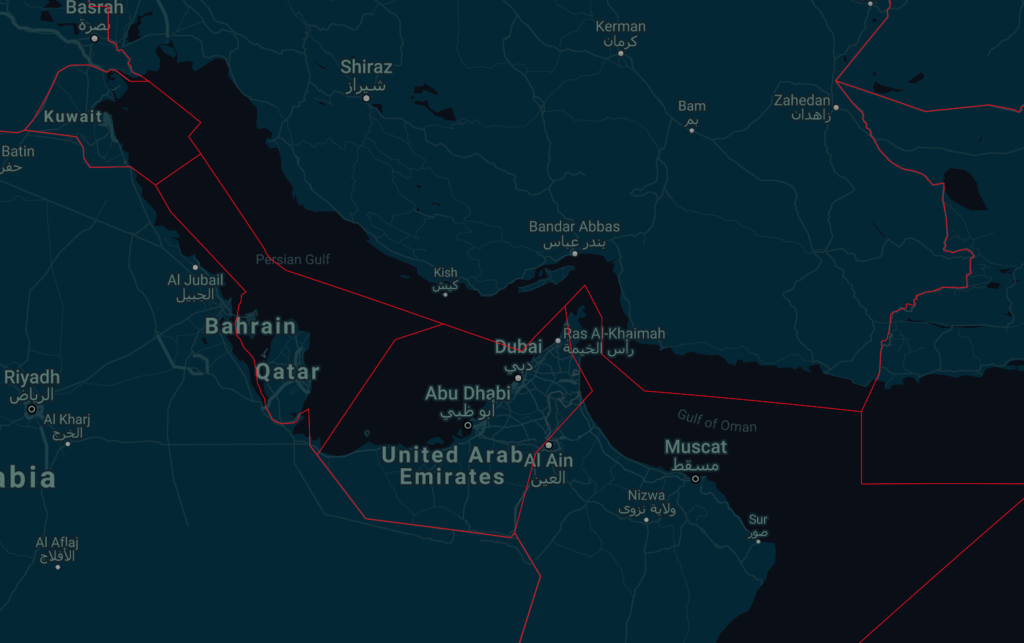
The FAA has issued an Emergency Order to US Civil Aircraft, prohibiting all American aircraft operators from entering the Tehran Flight Information Region (OIIX) FIR in the area above the Persian Gulf and Gulf of Oman.

Notam A0019/19 was issued at 0148 UTC, June 21st.

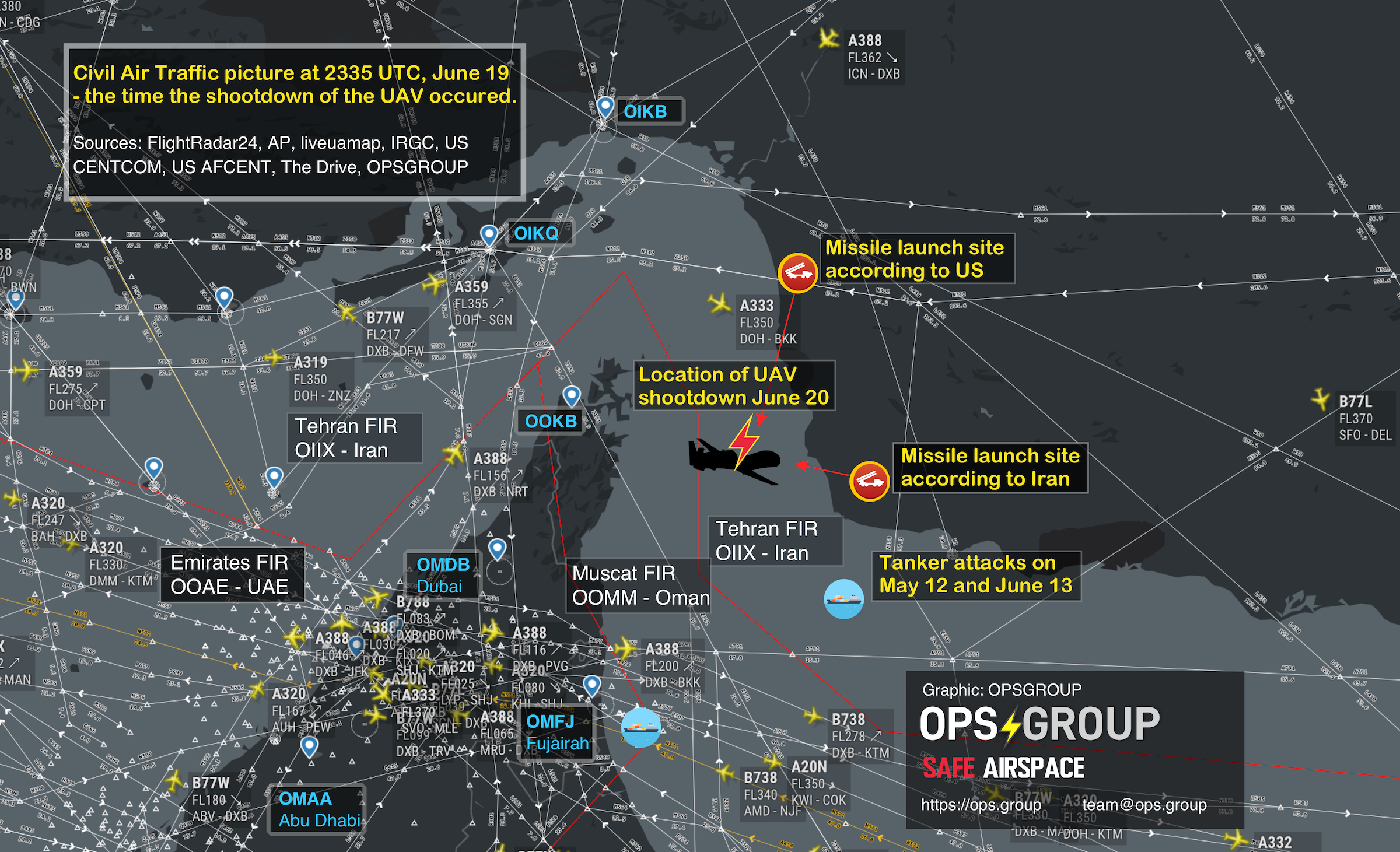
The Notam specifically prohibits any airline or aircraft operator from flying within Iranian airspace in the region that the US drone was shot down in on June 20th.

Some airlines had already reported suspending operations in Iranian airspace. This Notam ensures that US operators cannot operate in the area. Although the official applicability is to US aircraft only, since MH17 all countries rely on advice from the US, the UK, France and Germany to highlight airspace risk.

The full Notam follows (bolded parts by OPSGROUP):
A0019/19 NOTAMN Q) KICZ/QRDLP/IV/NBO/AE/000/999/
A) KICZ PART 1 OF 2
B) 1906210148
C) PERM
E) SECURITY..UNITED STATES OF AMERICA PROHIBITION AGAINST CERTAIN FLIGHTS IN THE OVERWATER AREA OF THE TEHRAN FLIGHT INFORMATION REGION (FIR) (OIIX) ABOVE THE PERSIAN GULF AND GULF OF OMAN ONLY.


ALL FLIGHT OPERATIONS IN THE OVERWATER AREA OF THE TEHRAN FLIGHT INFORMATION REGION (FIR) (OIIX) ABOVE THE PERSIAN GULF AND GULF OF OMAN ONLY ARE PROHIBITED UNTIL FURTHER NOTICE DUE TO HEIGHTENED MILITARY ACTIVITIES AND INCREASED POLITICAL TENSIONS IN THE REGION, WHICH PRESENT AN INADVERTENT RISK TO U.S. CIVIL AVIATION OPERATIONS AND POTENTIAL FOR MISCALCULATION OR MIS-IDENTIFICATION.THE RISK TO U.S. CIVIL AVIATION IS DEMONSTRATED BY THE IRANIAN SURFACE-TO-AIR MISSILE SHOOT DOWN OF A U.S. UNMANNED AIRCRAFT SYSTEM ON 19 JUNE 2019 WHILE IT WAS OPERATING IN THE VICINITY OF CIVIL AIR ROUTES ABOVE THE GULF OF OMAN.


A. APPLICABILITY. THIS NOTAM APPLIES TO: ALL U.S. AIR CARRIERS AND COMMERCIAL OPERATORS; ALL PERSONS EXERCISING THE PRIVILEGES OF AN AIRMAN CERTIFICATE ISSUED BY THE FAA, EXCEPT SUCH PERSONS OPERATING U.S.-REGISTERED AIRCRAFT FOR A FOREIGN AIR CARRIER; AND ALL OPERATORS OF AIRCRAFT REGISTERED IN THE UNITED STATES, EXCEPT WHERE THE OPERATOR OF SUCH AIRCRAFT IS A FOREIGN AIR CARRIER.


B. PERMITTED OPERATIONS. THIS NOTAM DOES NOT PROHIBIT PERSONS DESCRIBED IN PARAGRAPH A (APPLICABILITY) FROM CONDUCTING FLIGHT OPERATIONS IN THE ABOVE NAMED AREA WHEN SUCH OPERATIONS ARE AUTHORIZED EITHER BY ANOTHER AGENCY OF THE UNITED STATES GOVERNMENT WITH THE APPROVAL OF THE FAA OR BY A DEVIATION, EXEMPTION, OR OTHER AUTHORIZATION ISSUED BY THE FAA ADMINISTRATOR. OPERATORS MUST CALL THE FAA WASHINGTON OPERATIONS CENTER AT 202-267-3333 TO INITIATE COORDINATION FOR FAA AUTHORIZATION TO CONDUCT OPERATIONS.


C. EMERGENCY SITUATIONS. IN AN EMERGENCY THAT REQUIRES IMMEDIATE DECISION AND ACTION FOR THE SAFETY OF THE FLIGHT, THE PILOT IN COMMAND OF AN AIRCRAFT MAY DEVIATE FROM THIS NOTAM TO THE EXTENT REQUIRED BY THAT EMERGENCY.
THIS NOTAM IS AN EMERGENCY ORDER ISSUED UNDER 49 USC 40113(A) AND 46105(C). ADDITIONAL INFORMATION IS PROVIDED AT: HTTPS://WWW.FAA.GOV/AIR_TRAFFIC/PUBLICATIONS/US_RESTRICTIONS/

Earlier today, we published an article summarizing the risk to Aircraft Operators in the Gulf region – “The Threat of a Civil Aircraft Shootdown in Southern Iran is Real


In addition to the Notam, the FAA Threat Analysis Division have also published background information on the current situation (download that PDF here )


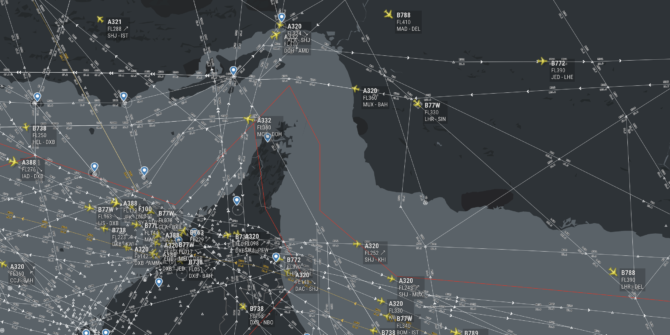
In that document, the FAA says: “Although the exact location of the attack is not yet available, there were numerous civil aviation aircraft operating in the area at the time of the intercept. According to flight tracking applications, the nearest civil aircraft was operating within approximately 45nm of the Global Hawk when it was targeted by the Iranian SAM. FAA remains concerned about the escalation of tension and military activity within close proximity to high volume civil air routes and the Iran’s willingness to use long-range SAMs in international airspace with little to no warning. As a result, there is concern about the potential for misidentification or miscalculation which could result in the inadvertent targeting of civil aviation.”

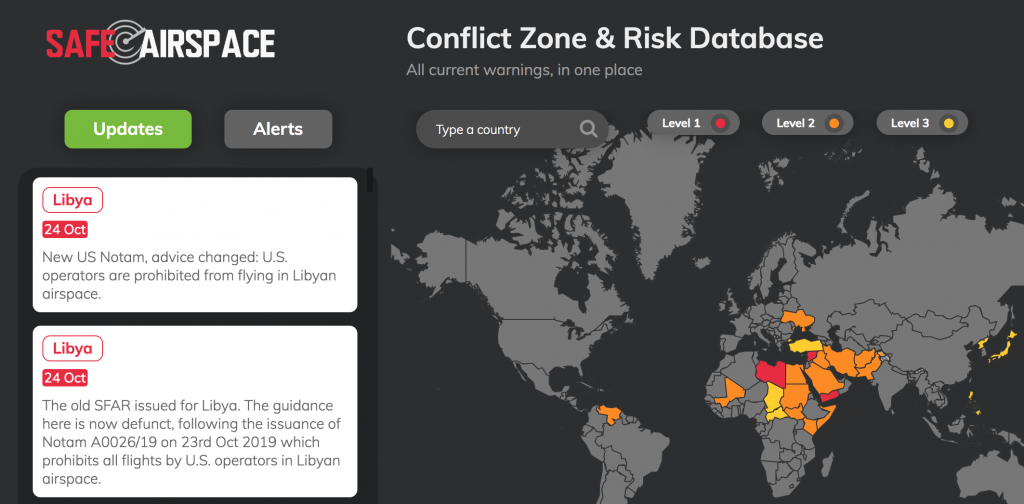
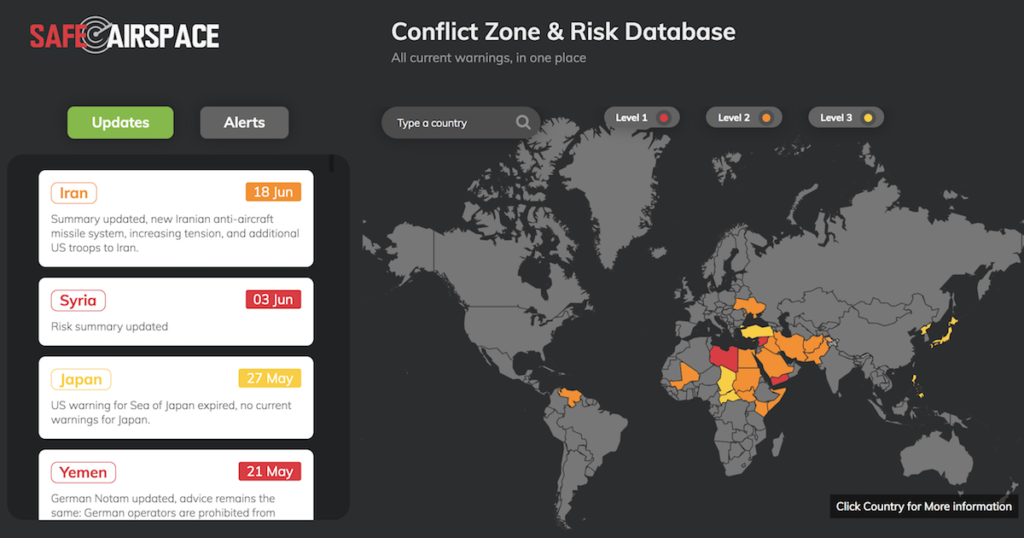
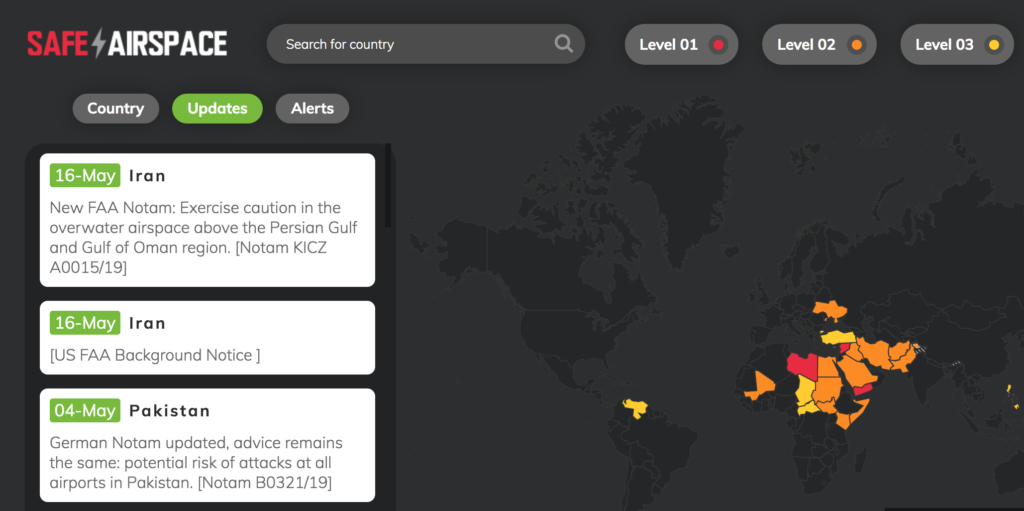
The Iran risk is being monitored at Safe Airspace – the Conflict Zone & Risk Database. The Iran country page also has more information on further overflight considerations in other parts of the Tehran FIR.


What’s going on in the Strait of Hormuz?

Amid rising tensions between the US and Iran, on 16th May the US FAA issued a new Notam and Background Notice advising operators to exercise caution in the overwater airspace above the Persian Gulf and Gulf of Oman.

The US has deployed warships and planes to the region, and withdrawn embassy staff from Iraq in recent days, and Iran has allegedly placed missiles on boats in the Persian Gulf.

In their Background Notice, the US FAA say that “Iran has publicly made threats to US military operations”, and are concerned about “a possible risk of miscalculation or misidentification, especially during periods of heightened political tension and rhetoric.” They also warn of increased GPS jamming by Iran throughout this region.

The US published another airspace warning for Iran back in September 2018, but that was mainly focussed on the risks of overflying Iran itself due to missiles fired from sites in the far west of the country against targets in Syria. That warning only made passing reference to the Gulf region – the only tangible risk at that time being due to Iran’s “test launches” in the area between Iran and Dubai, where the Iranian military regularly fire missiles during drills to practise blockading the Strait of Hormuz. 

In May 2018, the US pulled-out of the Iran nuclear deal, and re-imposed sanctions. Since then, the relationship between the two countries has rapidly gone downhill. This week, the White House Press Secretary said that Washington would continue its “maximum pressure” campaign on Iran, adding the US would like to see “behavioural change” from the country’s leadership. 

With the military build-up in the Gulf region, the US government has been quick to defend its actions, but the message seems to be clear: we don’t want war, but we’re ready for one.

As National Security Adviser John Bolton said in a statement this week: “The United States is not seeking war with the Iranian regime… but we are fully prepared to respond to any attack, whether by proxy, the Islamic Revolutionary Guard Corps or regular Iranian forces.”

The full FAA Notam and Background Notice text is below. SafeAirspace.net is now updated with the new information.

KICZ NOTAM A0015/19 
SECURITY..UNITED STATES OF AMERICA ADVISORY FOR OVERWATER AIRSPACE ABOVE THE PERSIAN GULF AND GULF OF OMAN. 

THOSE PERSONS DESCRIBED IN PARAGRAPH A BELOW SHOULD EXERCISE CAUTION WHEN OPERATING IN OVERWATER AIRSPACE ABOVE THE PERSIAN GULF AND THE GULF OF OMAN DUE TO HEIGHTENED MILITARY ACTIVITIES AND INCREASED POLITICAL TENSIONS IN THE REGION, WHICH PRESENT AN INCREASING INADVERTENT RISK TO U.S. CIVIL AVIATION OPERATIONS DUE TO THE POTENTIAL FOR MISCALCULATION OR MIS-IDENTIFICATION. ADDITIONALLY, AIRCRAFT OPERATING IN THE ABOVE-NAMED AREA MAY ENCOUNTER INADVERTENT GPS INTERFERENCE AND OTHER COMMUNICATIONS JAMMING, WHICH COULD OCCUR WITH LITTLE TO NO WARNING. 

A. APPLICABILITY. THIS NOTAM APPLIES TO: ALL U.S. AIR CARRIERS AND COMMERCIAL OPERATORS; ALL PERSONS EXERCISING THE PRIVILEGES OF AN AIRMAN CERTIFICATE ISSUED BY THE FAA, EXCEPT SUCH PERSONS OPERATING U.S.-REGISTERED AIRCRAFT FOR A FOREIGN AIR CARRIER; AND ALL OPERATORS OF AIRCRAFT REGISTERED IN THE UNITED STATES, EXCEPT WHERE THE OPERATOR OF SUCH AIRCRAFT IS A FOREIGN AIR CARRIER. 

B. PLANNING. THOSE PERSONS DESCRIBED IN PARAGRAPH A PLANNING TO OPERATE IN THE ABOVE-NAMED AREA MUST REVIEW CURRENT SECURITY/THREAT INFORMATION AND NOTAMS; COMPLY WITH ALL APPLICABLE FAA REGULATIONS, OPERATIONS SPECIFICATIONS, MANAGEMENT SPECIFICATIONS, AND LETTERS OF AUTHORIZATION, INCLUDING UPDATING B450. 

C. OPERATIONS. EXERCISE CAUTION DURING FLIGHT OPERATIONS DUE TO THE POSSIBILITY OF INTERRUPTIONS TO INTERNATIONAL AIR TRAFFIC DUE TO HEIGHTENED MILITARY ACTIVITIES AND INCREASED POLITICAL TENSIONS IN THE REGION. POTENTIALLY AFFECTED OVERWATER AIRSPACE ABOVE THE PERSIAN GULF AND THE GULF OF OMAN INCLUDES PORTIONS OF THE TEHRAN FIR (OIIX), BAGHDAD FIR (ORBB), KUWAIT FIR (OKAC), JEDDAH FIR (OEJD) , BAHRAIN FIR (OBBB), EMIRATES FIR (OMAE), AND MUSCAT FIR (OOMM). THOSE PERSONS DESCRIBED IN PARAGRAPH A MUST REPORT SAFETY AND/OR SECURITY INCIDENTS TO THE FAA AT +1 202-267-3333. 

SFC – UNL,16 MAY 23:11 2019 UNTIL PERM. CREATED: 16 MAY 23:17 2019

FAA Background Information Regarding U.S. Civil Aviation – For the Overwater Airspace Above the Persian Gulf and Gulf Of Oman Region.

Due to increased political tensions and heightened military activities in the region, there is an increasing inadvertent risk to U.S. civil aviation operating in overwater airspace above the Persian Gulf and Gulf of Oman. As a result, on 16 May 2019, the FAA issued Notice to Airmen (NOTAM) KICZ A0015/19, advising U.S. civil flight operations to exercise caution when operating in the above area. 

Iran has publicly made threats to U.S. military operations in the Gulf region. In addition, Iran possesses a wide variety of anti-aircraft-capable weapons, including surface-to-air missile systems (SAMs), man-portable air defense systems (MANPADS) and fighter aircraft that are capable of conducting aircraft interception operations. Some of the anti-aircraft-capable weapons have ranges that encompass key international air routes over the Persian Gulf and the Gulf of Oman. Additionally, Iran recently conducted a military exercise in the region, demonstrating their unmanned aircraft system (UAS) capabilities. Although Iran likely has no intention to target civil aircraft, the presence of multiple long-range, advanced anti-aircraftcapable weapons in a tense environment poses a possible risk of miscalculation or misidentification, especially during periods of heightened political tension and rhetoric. 

There is also the potential for Iran to increase their use of Global Positioning System (GPS) jammers and other communication jamming capabilities, which may affect U.S. civil aviation operating in overwater airspace over the Persian Gulf and the Gulf of Oman. 

The FAA will continue to monitor the risk environment for U.S. civil aviation operating in the region and make adjustments, as necessary, to safeguard U.S. civil aviation.


No change to Iran airspace warning despite new US sanctions

The US reimposed sanctions against Iran on Nov 5. Despite this, so far there has been no change to the FAA guidance to US operators issued on 9th September 2018: flights to Iran are not prohibited, but operators should “exercise caution” when flying in Iranian airspace.

However, with the reimposed sanctions comes a new problem if you’re a US operator: you’re allowed to overfly Iran, but you’re not allowed to pay for all the things needed to make that happen – things like overflight permits, and nav fees.

The rule is simple: no US person or business can pay for services in countries with sanctions against them (like Iran), unless that person or business has a licence to do so, issued by the Office of Foreign Assets Control (OFAC).

And you’re not allowed to get an agent to do it for you either; it’s illegal to skirt the OFAC laws by using a 3rd party company (unless, of course, they’ve been approved by OFAC).

So the big question we have now is this: if you’re planning to overfly Iran, have you figured out the legalities of paying for services? How are you making that work? Know someone who’s got an OFAC licence for Iran? Let us know!

And one other thing to watch out for – operators with US based insurers should double-check their policies, as you may now no longer be covered for flights to Iran, due to the new sanctions. This is worth checking, even if you’re only planning on overflying the Tehran FIR, as any unplanned landing (decompression, medical, engine fire) may force you into Tehran or another airport – it’s a big chunk of airspace.

Further reading:


Why are we still flying airline passengers over war zones?

Here’s the level of inconsistency we’ve reached in international air transport: we take each passenger, scrutinize their booking, check the no-fly-list, watch them on CCTV, pull them apart at TSA, remove anything sharper than a pen, question them, x-ray the bags, run Explosive Trace Detection tests, screen the hold baggage, background check every member of the crew, and then, once they’ve all boarded, fly this ultra-secure airplane straight into a war zone.

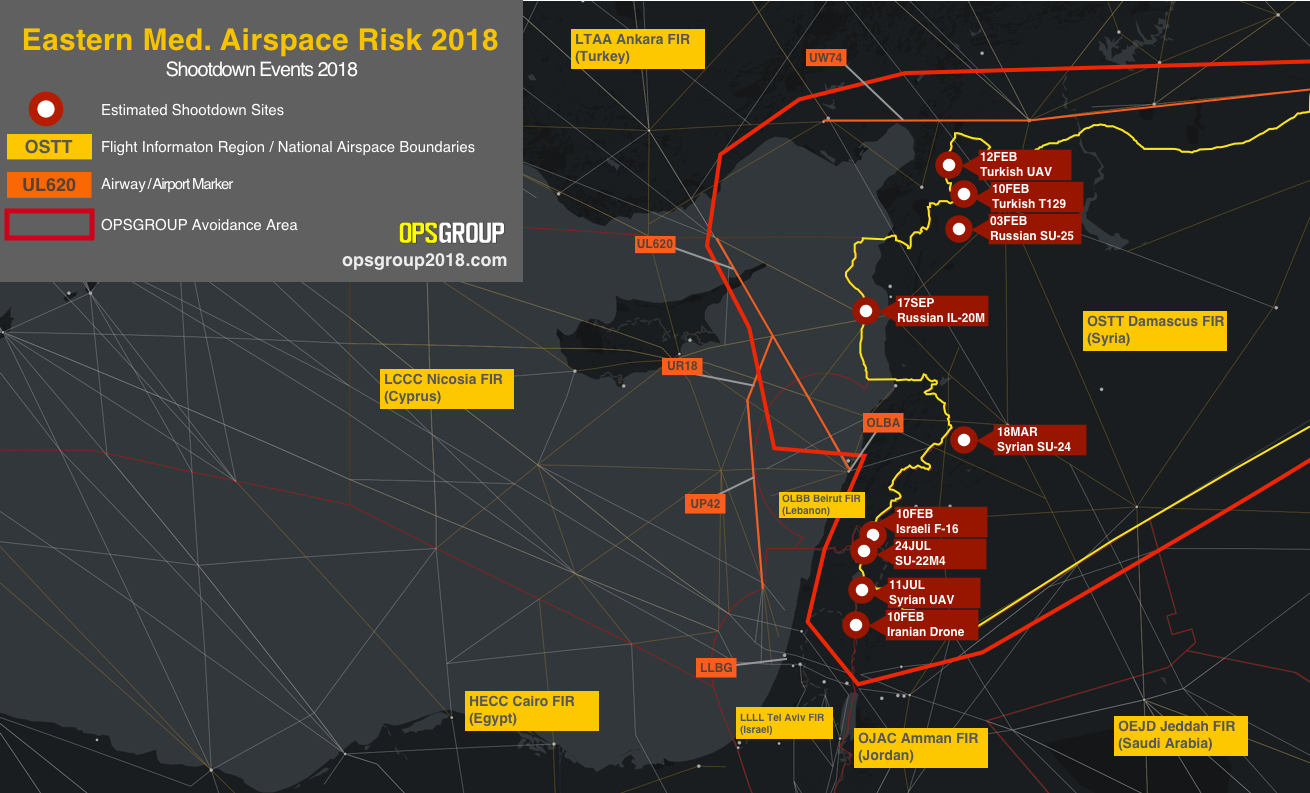
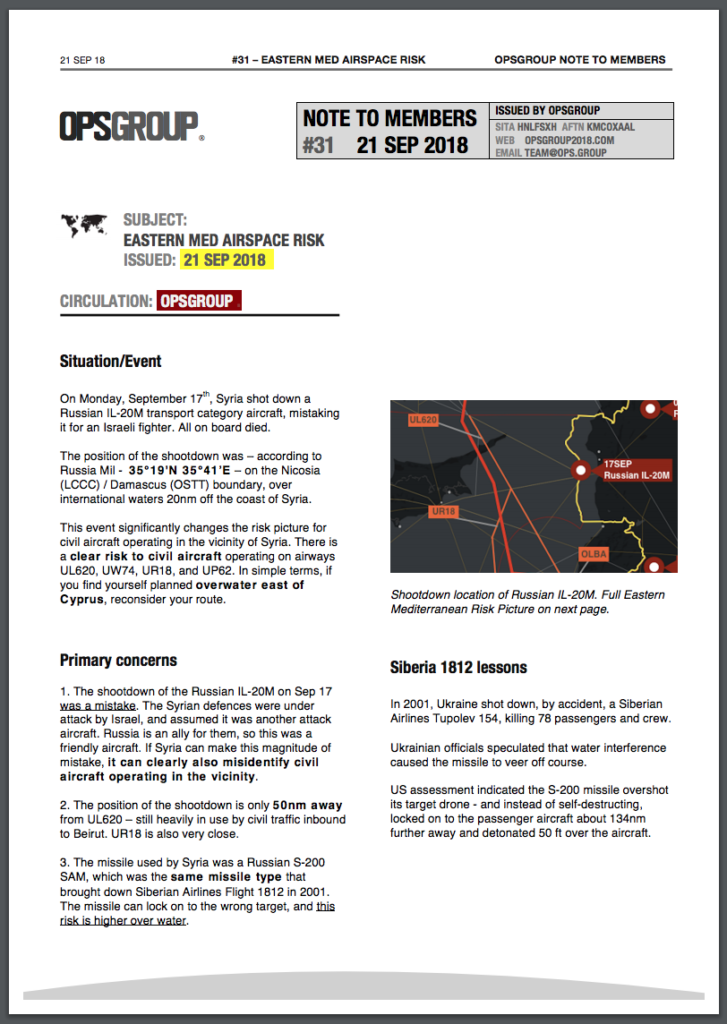
Welcome to the Eastern Mediterranean. It’s an active conflict zone. The Russian naval build up there this month is the largest since Moscow’s intervention in Syria began in 2015. Over Syria, 9 aircraft have been shot down this year.

The most recent was on Monday night this week, when Syria came under attack from Israel fighter jets, and started firing indiscriminately at anything off the coast that looked like a threat. They wanted to shoot something down, and they did — except it was a friend, not foe. They took out a Russian Ilyushin IL-20M transport category airplane. Even on the worst radar, that doesn’t look anything like an Israeli F-16.

50 miles away from where the Russian aircraft plunged into the sea on Monday night is the international airway UL620, busy with all the big name airline traffic heading for Beirut and Tel Aviv. If Syria can mistakenly shoot down a Russian ally aircraft, they can also take out your A320 as you cruise past.

And yet, most airlines continue to operate. Are we really so comfortable with operating in conflict zones again?

The lessons of MH17 seem to be fading fast. It’s a little over four years since 298 people lost their lives over Ukraine one summer afternoon, thanks to an errant missile fired during a civil war at an aircraft that they thought was a military threat. “Why were they over a war zone”, everyone cried afterwards.

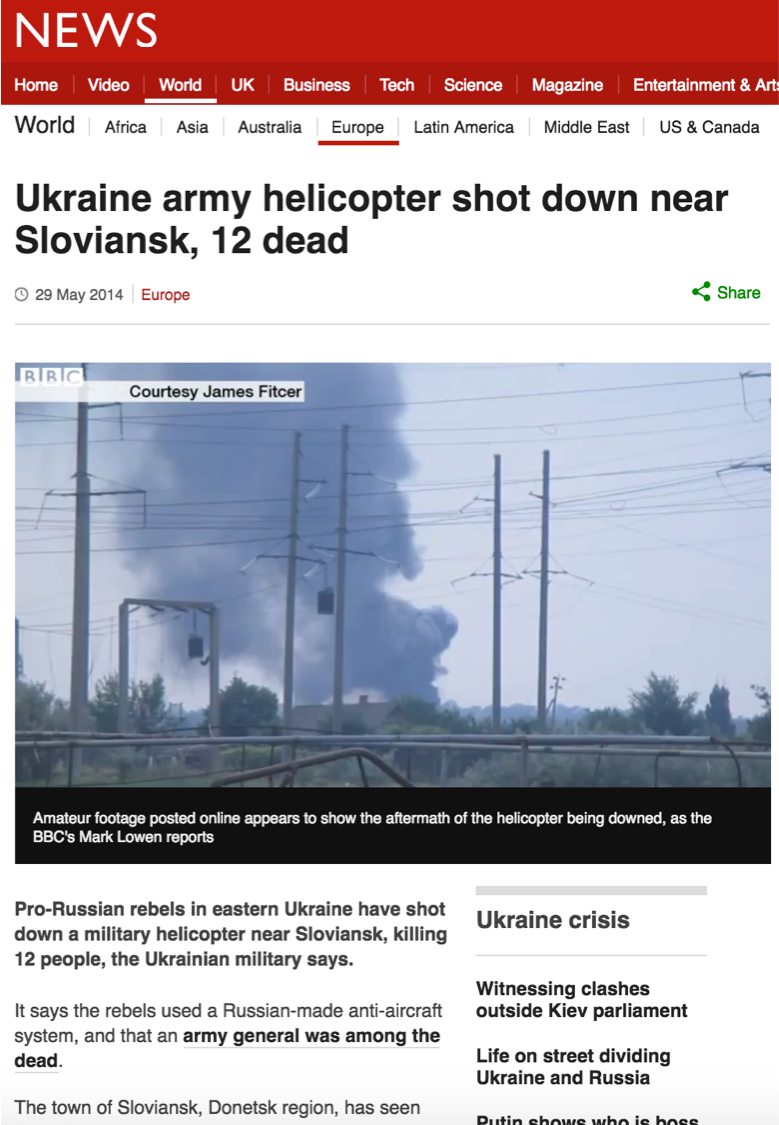
Well, we all were. Me too. I was a pilot for Austrian Airlines at the time. I recall one morning in Vienna, some months before MH17. Boarding the last of the passengers, my BBC news app flashed up a story about a helicopter being shot down in eastern Ukraine .

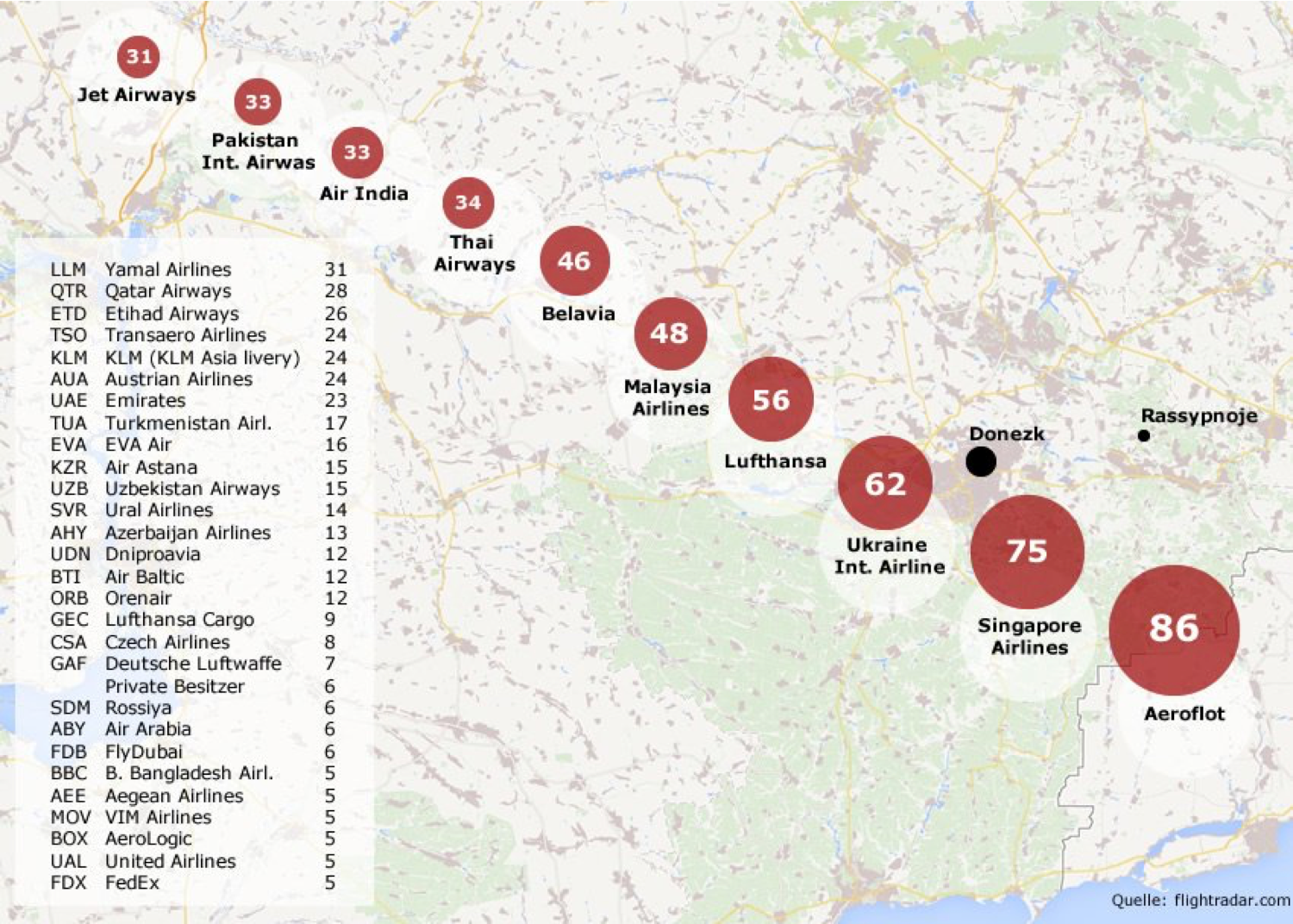
As we were headed east, with my colleague in the cockpit, we quickly plotted the position on our enroute chart, and noted that it was really close to our route. Maybe 30 miles north. “We might see something interesting!”, we said, and pushed back. We didn’t, nor did we think much more about it.

Do you see the thought process though? Before MH17, we didn’t consider the risks to our aircraft from war zones. Especially being so high. Helicopters might be getting shot down, but we’re at 35,000 feet. No problem.

This is why all of these airlines — mine, at the time, included — operated on the route.


Image: Der Spiegel

And then it happened, and none of us could quite believe it.

But we learned. “Conflict Zone” became a buzzword. We had task forces and committees, whitepapers and promises, and — myself included — talked at length about how this happened, why, and how to avoid it in the future.

And yet, here we are flying unsuspecting passengers along the Syrian border. If you’re unsuspecting enough, and buy a SkyTeam codeshare ticket — you’ll actually overfly Syria on the Honey Badger airline of the region, Middle East Airlines.

Here we are flying passengers in the Eastern Mediterranean war zone. Why is this happening?

My guess: because we don’t think anything bad is going to happen, because the airspace boundary lines on the charts make that little bit of sea near Cyprus feel different from that little bit of sea near Syria, but mainly because there is no clear guidance from Aviation Authorities.

Let’s start with Cyprus. The Nicosia FIR has a big chunk of unsafe airspace. The Russian aircraft on Monday was shot down on the Nicosia FIR boundary. What do the Notams say? Take a look. There are 97 of them. Mostly about fireworks at local hotels. Critical stuff indeed. Then there are 20 or 30 about “Russian naval exercises”. A clue, perhaps, but where is the black and white “An Aircraft was Shot Down on our Border on Monday?” . Or, since we are still using teletype to communicate Notams to crews, “AN AIRCRAFT WAS SHOT DOWN ON OUR BORDER ON MONDAY”. Wait, we have to abbreviate that, and use codes, for some reason. “ACFT SHOT DOWN ON FIR BDY 17SEP”. That’s better.

What about Turkey? Anything on the Eastern Mediterranean risk? Let’s have a look. Nope, just 132 Bullshit Notams, and something about an AWACS aircraft. See you back here in 30 minutes when you’ve read them all.

Remember, I’m being a pilot, an airline, a dispatcher, trying to find information on the Risk in the Eastern Mediterranean. And this is how hard it is.

EASA (European Aviation Safety Agency), how are you doing? Let’s start here, at the “Information on Conflict Zones”. Paragraph 2 tells us that ICAO have a Central Repository on Conflict Zones, launched in 2015.

No, they don’t. That died — quite a long time ago. This is where it used to live. So, there is no ICAO Central Repository on Conflict Zones. There is a new ICAO document with guidance on managing Conflict Zone risk (and it’s a bloody good one, too) — but where is the picture of current risk?

Let’s plough on through the EASA site. Aha! Seems we have a Conflict Zone alerting system, and Conflict Zone bulletins. Here they all are: https://ad.easa.europa.eu/czib-docs/page-1

The last one on Syria was issued on April 17th. But it seems to be just a list of Notams issued by other states. And these are out of date. The German Notam has expired, the French AIC has been replaced.

And there’s no guidance. No Map. No routes to avoid. Nothing about Cyprus, or Beirut. No mention of the Russian shootdown. No mention of the 9 aircraft shot down this year.

How am I supposed to know, as an operator, or pilot, what the risks are and where to avoid. We’re getting closer to the point here. You’re not supposed to rely on the Aviation Authority. That is their message. You must conduct your own risk assessment. You must research and find out about the risks yourself.

You are on your own.

If you’re a big airline, that’s probably fine. You’ll make your own decisions about where to fly, anyhow. But what about everybody else?

While OpsGroup works hard to get information out to our members — and we spend a lot of time researching risk — I would greatly prefer that we didn’t have to.

Aviation Authorities must issue better guidance for the aircraft entering their areas.

Let me remind you. Airlines are operating 50 miles from a position where an airplane was shot down at night, by a missile type that’s already taken out a passenger airliner by mistake, fired by a beleaguered Syrian defence post, at a friendly aircraft that they did not take time to identify.

And the guidance to operators from Authorities: NIL.


Opsgroup has now published Note 31: Airspace Risk in the Eastern Mediterranean. There is a clear risk to civil aircraft operating on airways UL620, UW74, UR18, and UP62. In simple terms, if you find yourself planned overwater east of Cyprus, reconsider your route.

Further reading:


Dubai to London – which way is best?

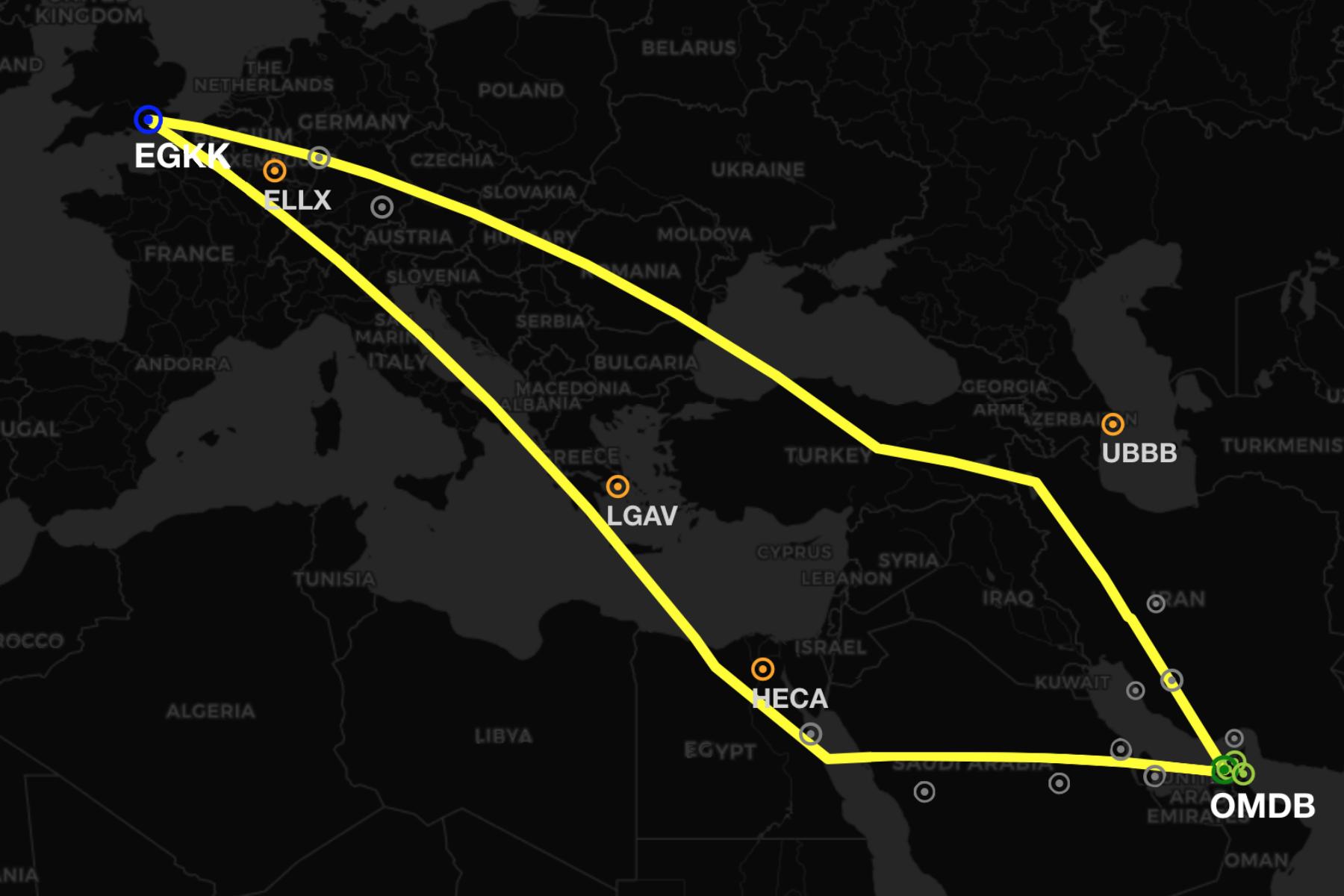
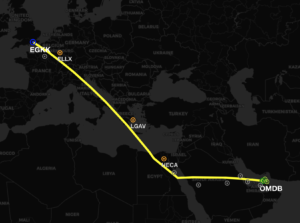
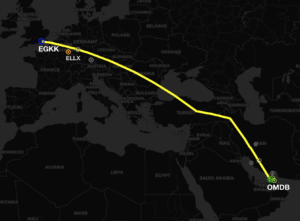
In Short: Two main options, via Saudi and Egypt (safer, cheaper but longer) or via Iran and Turkey (shorter, busier and geo-politically more unstable). It’s a complicated planning climate at present. Review regularly based on latest risk factors.   

There are more business aviation operators flying between the Middle East and Europe than ever before. So we took the time to look over the route options between the two regions. For our example we will be using a flight from Dubai to London, but similar operational considerations are valid for the plethora of route combinations through this whole region.
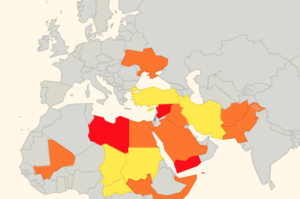
Firstly, we are sure you are a frequent visitor to our safe airspace website. Updated all the time with the latest notes and risk recommendations based on the latest intel. So, first things first, we want to avoid Syria, Libya and the Sinai Peninsula. As you can see however, this is a complicated geo-political region for flight planning. The direct great circle route would take us through Syria and would be around 3125nm. But that isn’t going to work. So, what else we got?

We will look at the two ways to head over the region. One is via Iran, Turkey and onwards to Europe. The other over Saudi Arabia and Egypt towards Europe.

Option 1: Iran/Turkey

Safety: Both Iran and Turkey are FSB Risk Level: Three – Caution. Iran is involved in the ongoing conflict with Syria and several Russian missiles crossed the Tehran FIR and several busy international routes. There are also increased tensions between the USA and Iran at present – if you had to divert in an N-reg aircraft, Iran would not be the friendliest of places to do so. Turkey borders with Syria and we have received multiple reports of GPS interference in the area.

Distance: an extra 100nm.

Time: About 15 minutes longer than great circle route.

Ease and Cost: Iran has higher overflight costs and for US based operators a reminder of the sanctions for dealing directly with Iran, or agencies in Iran. You’ll want to use an approved agent if you’re from the US (i.e.–not an Iranian company). Iran doesn’t work on Fridays, so be aware there. Turkish overflight costs are reasonable and remember that Turkish authorities require the use of an agent to apply for permits.

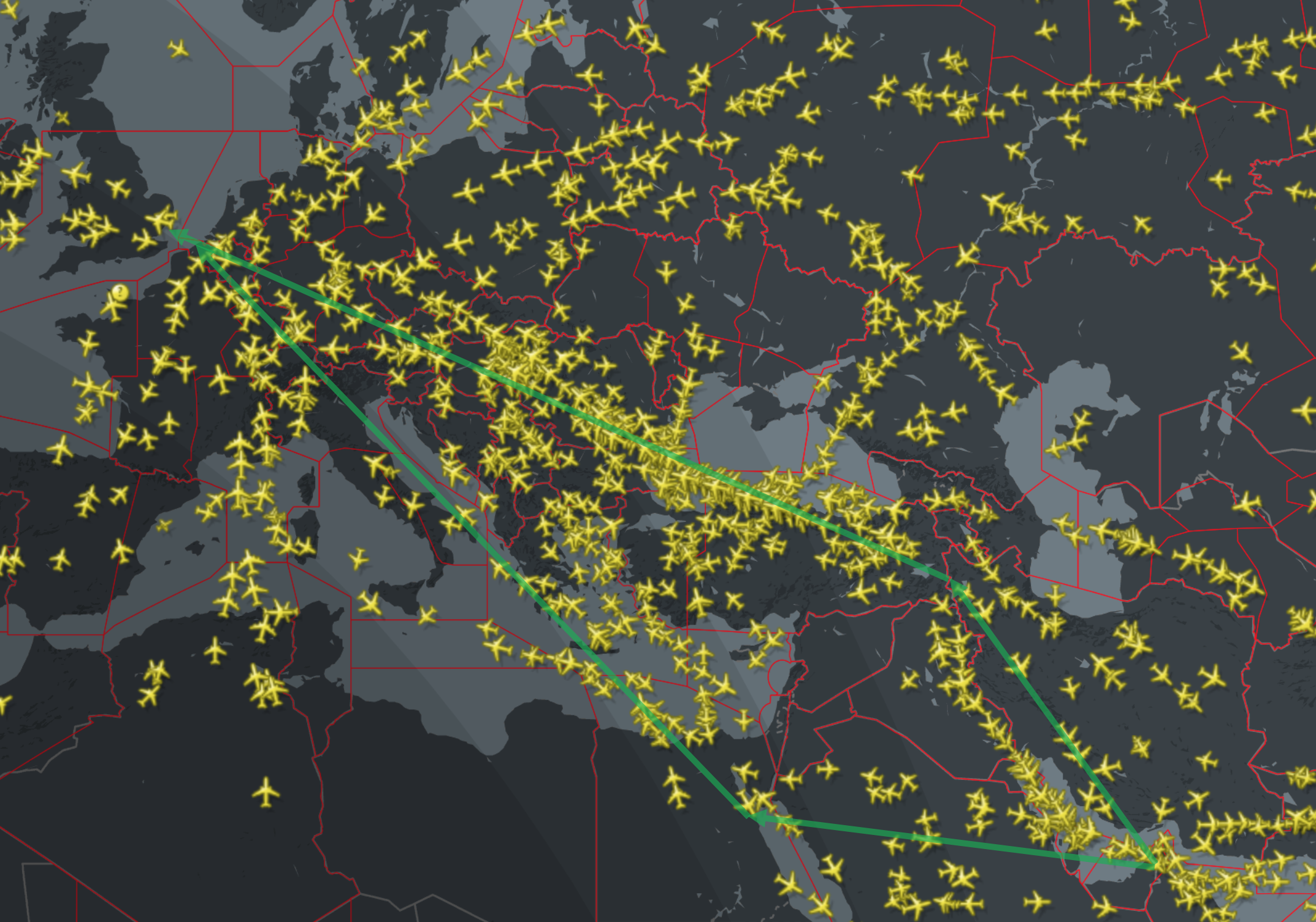
Traffic: The biggest issue with this route is that everyone is using it! It’s congested with a lot of airline traffic. It’s a major corridor for Asia-Europe flights also. So, getting the levels you want, and off route deviations are more complicated. Things get busy, as you can see!

Option 2: Saudi/Egypt

Safety: In terms of airspace warnings and risk, this route is slightly better. We have rated Saudi and Egypt airspace as FSB Risk Level: Two – Assessed Risk. Beyond the Sinai Peninsula and the Saudi/Yemen border, generally there is less of a chance of airspace security risks at present.

Distance: An extra 300nm from the great circle.

Time: Around 45 minutes longer.

Ease and Cost: Saudi and Egyptian airspace are generally a cheaper option ($1,000USD+). In Egypt, by law you have to get your permit through an Egyptian agent, but it’s a straight forward process. In Saudi, again, using an agent is best; they normally have three-day lead time – so keep that in mind. Also remember that the CAA only work Sun-Wed during office hours.

Traffic: For most of the day, much less of a traffic bottle neck.


Bottom line

Of the two options, routing via Saudi/Egypt is cheaper, and safer (as long as you steer clear of Egypt’s Sinai Peninsular and Saudi’s border with Yemen), but it’s going to take slightly longer.

What about Iraq?

We don’t think it’s a good idea. There’s a lot of information out there saying certain airways are ok but only at higher levels. But if you needed to get down fast, or even make an unexpected landing, Iraq isn’t the place you would want to go at present. Treat with caution.

Which one is your favourite choice? Let us know!

Further reading: