(No More) Danger in Denver
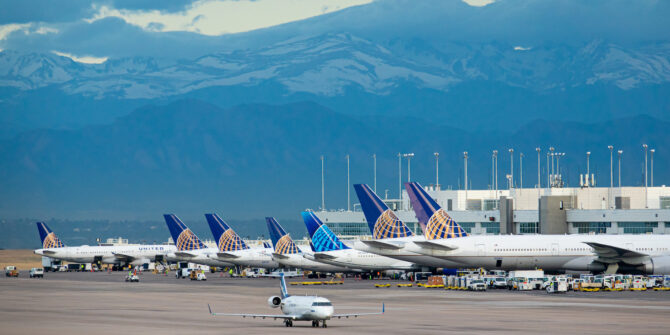
Back in 2022, the FAA issued a Safety Alert (SAFO) for KDEN/Denver, after a high number of TCAS RA events were recorded between aircraft landing on the parallel runways (16L/16R).

This was compounded by a number of factors:

  • High elevation
  • Reduced separation
  • Controller workload
  • Possible complacency caused by regular nuisance TAs.

It was a moody brew leading to the FAA becoming concerned about potential for a midair collision. If you’re like to know more, here’s an article we wrote at the time.
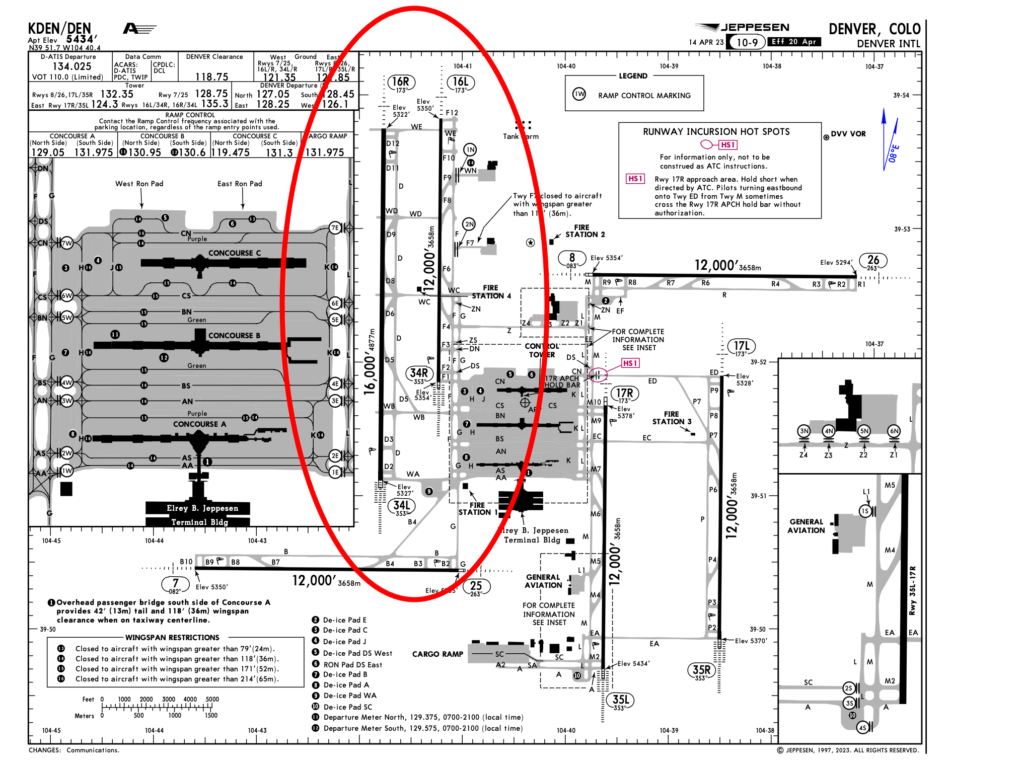
The trouble runways.

The good news is that last month, new approaches were introduced to alleviate the risk. Here’s an update on what has changed.

Offset Approaches

On November 30, Runway 16R received two new approaches (offset by 3 degrees) – the RNAV (Y) and RNP (Z).
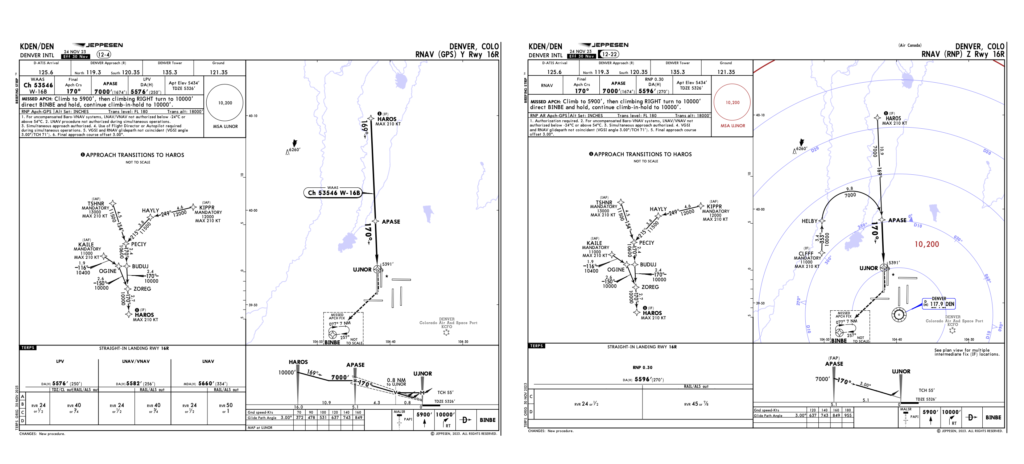
The two new offset approaches to Runway 16R

It was previously determined that 3-degrees would be enough to mitigate nuisance TCAS activations and allow operators to continue using full TA/RA mode throughout their approach and landing.

Along with these offset approaches, the FAA has published new procedures for their use found in this Information Note for Operators.

The procedures will be in use anytime Runways 16L and R are operating simultaneously, and visual approaches are in use on at least one of the runways.

New Procedures

Listen out for the following phrase on the ATIS:
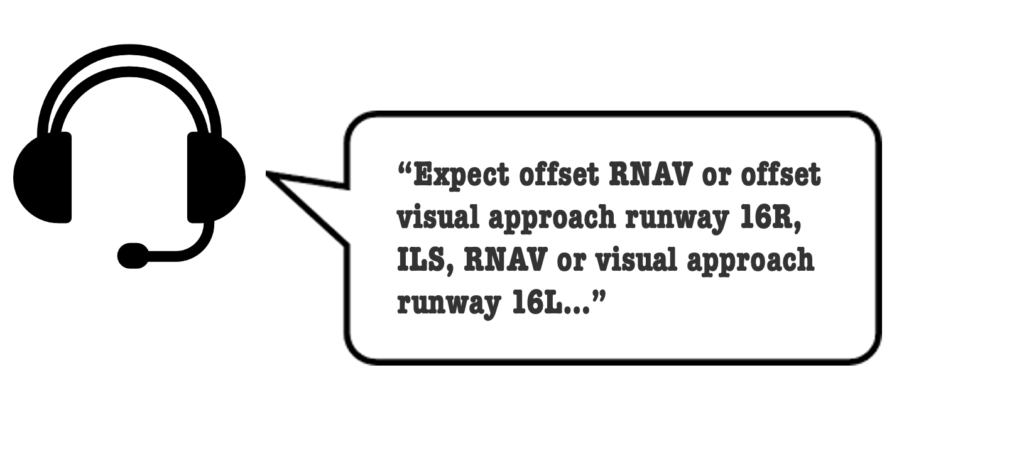
 

If you’re landing on 16R, there are effectively now two scenarios:

Instrument Approach – Follow the RNAV (Y) or RNP (Z) charted procedure. Easy.

or

Visual Approach – Here’s where things get a little more complicated. Even though the FAA regs say that an aircraft on a visual approach does not need to follow a specific track or vertical profile, in the case of KDEN, the FAA strongly suggests you do.

Aside from assuring you stay inside Class B airspace, it will also mitigate nuisance TCAS RA’s that can lead to unstable approaches, go-arounds and level busts.

In their Info Note the FAA goes even further and says don’t fly a straight-in approach to 16R (including via the existing ILS) unless specifically cleared to do so.

So when can we line up with the runway?

Whether you are on an instrument approach, or a visual, the FAA says don’t break off the offset until you can see the runway and have crossed the FAF.

Look out for these chart notes…

Because the above procedure will only be used when conditions permit a visual approach on at least one of the two parallel runways, technically the whole deal doesn’t fall within the realm of ‘simultaneous IFR operations.’

So, you can disregard the following two chart notes:
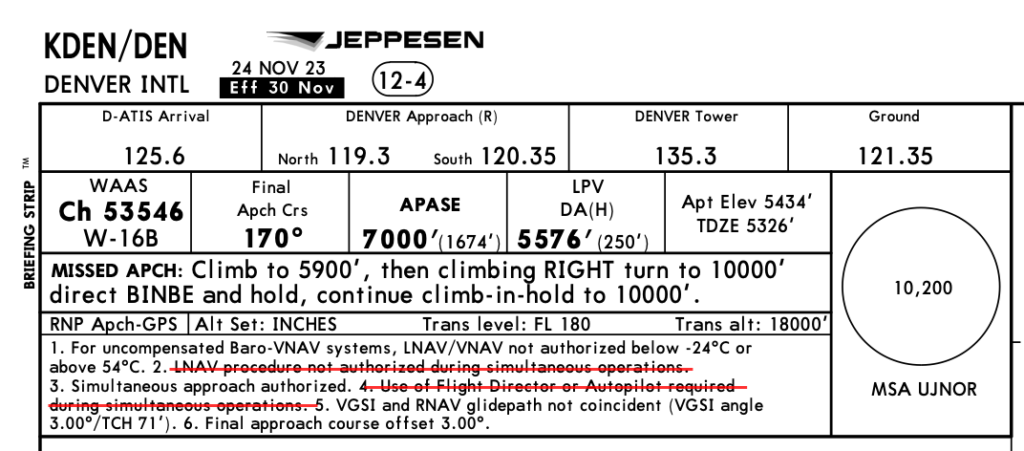
…although the last one is still recommended by the FAA.

Still have questions?

You can get in touch with the folk at the Flight Technologies and Procedures Division at 9-AWA-AVS-AFS-400-Flight-Technologies-Procedures@faa.gov (yes, that’s the real address) or on the phone via (202) 267- 8790.

Or talk to us! team@ops.group. We’d love to hear from you.
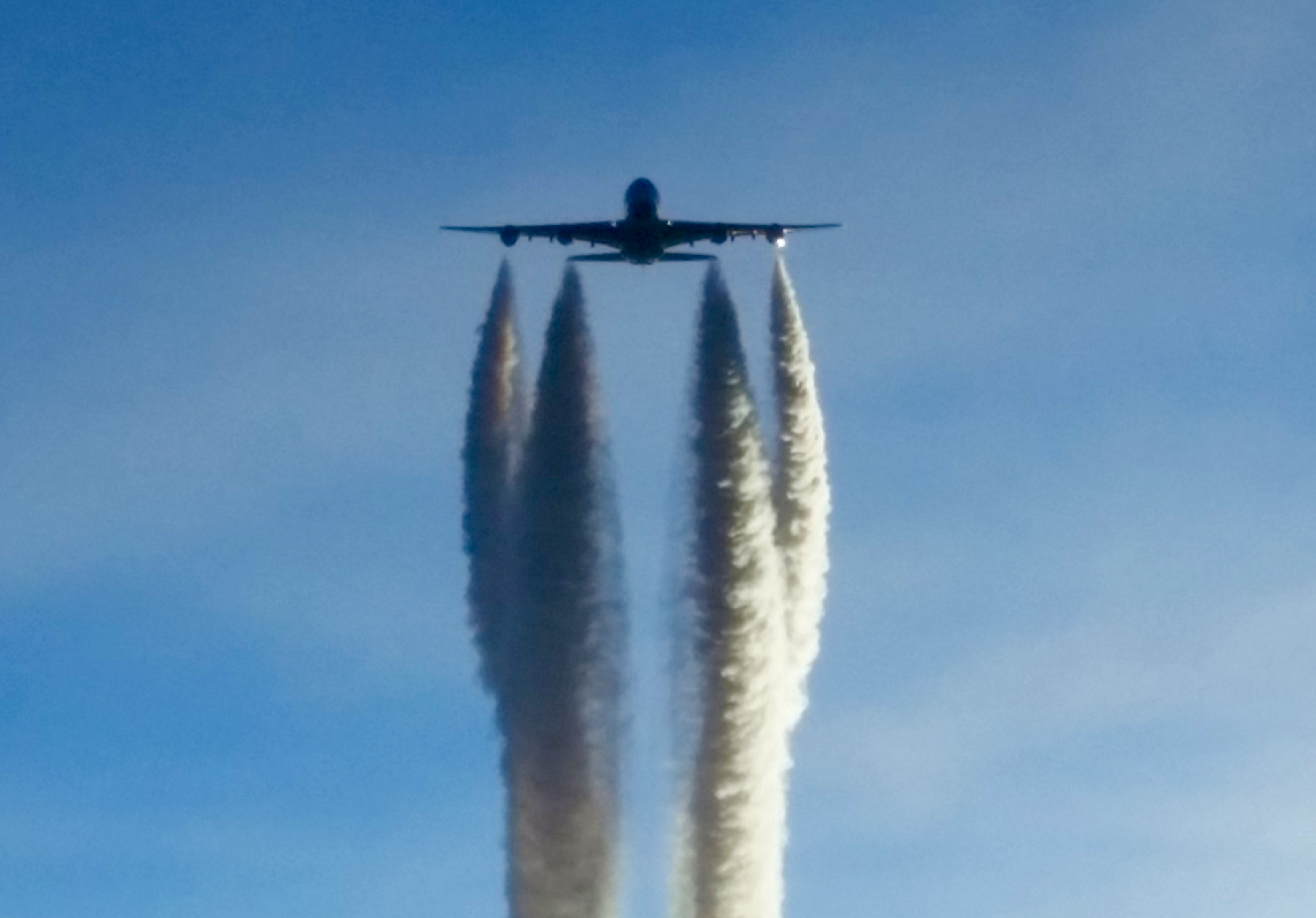

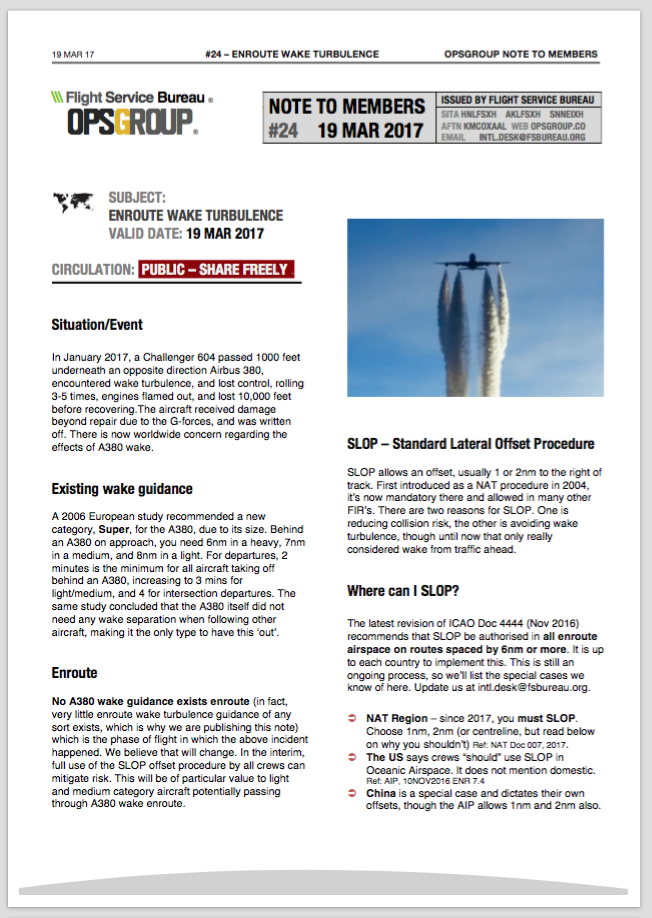
This is what an Airbus 380 looks like when it’s coming to get you

  • New guidance issued to OpsGroup by Flight Service Bureau
  • New warnings to be issued by Air Traffic Controllers – EASA SIB to follow
  • Updated 2017 SLOP offset procedures


With the A380 vs Challenger 604 incident,
there is now growing concern amongst aircrews about the effects of the A380’s wake turbulence.

In this incident, reported by the Aviation Herald, a Challenger 604 at FL340 operating from Male-Abu Dhabi passed an A380 opposite direction at FL350, one thousand feet above, about 630nm southeast of Muscat, Oman, over the Arabian Sea. A short time later (1-2 minutes) the aircraft encountered wake turbulence sending the aircraft into an uncontrolled roll, turning the aircraft around at least 3 times (possibly even 5 times), both engines flamed out, the aircraft lost about 10,000 feet until the crew was able to recover the aircraft, restart the engines and divert to Muscat. The aircraft received damage beyond repair due to the G-forces, and was written off.

This is a recovery that is in the same category as the ‘Miracle on the Hudson’, and the DHL A-300 recovery in Baghdad. Envision the alternate scenario, which was far more likely: Challenger 604 business jet missing in remote part of the Indian Ocean. Last contact with was a HF radio check with Mumbai. No recent satellite logons. Position uncertain. Search and Rescue attempt called off after 15 days. Nothing found. Probable cause: flew into CB.

Thanks to the remarkable job by the crew, we don’t have to guess. We know what happened. And now, there are questions.

We’ve seen this story before

Back in 1992/3, two back-to-back fatal crashes (a Citation, and a Westwind) were attributed to the unusual wake turbulence pattern of the Boeing 757. In fact, at the time, NOAA said it was the most intense wake they had ever seen. In December 1993, the FAA told controllers to increase the separation, and warn aircraft following a 757 of its presence.

This was 10 years after entry into service of the 757, which had its first revenue flight in 1983.

Sound familiar? The A380 had its first revenue flight in 2007. We are 10 years down the track, and it’s very tempting to apply the logic that because this degree of incident hasn’t happened before, it’s a one-off. An outlier. That the crew reacted erroneously to a small wake upset at the limit of their flight envelope. This is both unlikely, and, given the potential threat to other crews, a dangerous perspective.

The last review of A380 wake turbulence was done in 2006, primarily by Airbus. As a result, a new category was required – “Super“, in addition to the existing Light, Medium, and Heavy, for use by controllers when applying the minimum separation on approach and departure. However, no additional considerations were applied for enroute wake turbulence.

Most pointedly, the review concluded that the A380 did not need any wake turbulence separation itself, because of its size. The A380 is the only aircraft in the world to have this “out”. It’s a beast. Even an Antonov 124 or Boeing 747 needs 4nm from the traffic ahead.

New guidance

Given the incident, the similarity to the B757 story, and that quiet pointers towards a bigger risk, Flight Service Bureau has issued guidance to OpsGroup members, in Note to Members #24 (March 19th, 2017), which can be downloaded publicly here. The highlights are:

  • As Aircrew, use SLOP whenever you can.
  • As Controllers, be mindful of smaller aircraft passing underneath A380’s.
  • Avoid flying the centreline if you can. SLOP 0 is not an offset. Choose 1nm or 2nm.
  • Note the new SLOP rules from ICAO in the 16th edition of Doc 4444.
  • Expect guidance from EASA and the FAA to follow

With very recent updates to both NAT Doc 007 and ICAO Doc 4444, the rules for SLOP are a little different than before.

Download the OPSGROUP Note to Members #24 – Enroute Wake Turbulence.