Holidelays are Coming!

The NBAA recently did a very helpful podcast episode on preparing for the holiday season traffic.

What they are saying (the short version)

Watch out for increased traffic volumes during the holiday season. This will more than likely mean more traffic flow management initiatives and ground delay programs. Plan ahead.

What they are saying (the slightly longer version)

The weekends before and after major holidays seem to be the busiest, and this year is expected to be no different. Numbers are already looking higher than the pre-pandemic figures (2019) for the same season. So pre-planning and thinking about what might impact you, your flight or the airspace and airports in general is important.

The two main busy spots

  • Any popular ski resort airport
  • Any airspace that is usually busy and which is a route to or from popular holiday destinations – so areas like the NY metros, NE coast and routes to/from Florida and the Caribbean.

What they are saying (in much more detail)

The bits that are always busy

The north east coast and around New York commercial terminals get busy. It is already up to 80-90% normal volumes and the return of international flights means the remaining 10-20% is filling up fast. The same goes for the Florida and Caribbean to the north east routes, partly because all the airports and airspace along that region tends to be busy anyway.

How busy this all gets increases “just a little” during holiday season which means you are probably going to experience more traffic flow management, initiatives and ground delays. These mean you need to pre-plan more, particularly in terms of where you are filing to fly, and the fuel you are counting on needing to use.

There is an added complication in that the Presidential TFR in Wilmington, DE might get activated – and when it does, it has a further knock on effect on this already quite busy area. We wrote about that here if you want a read.
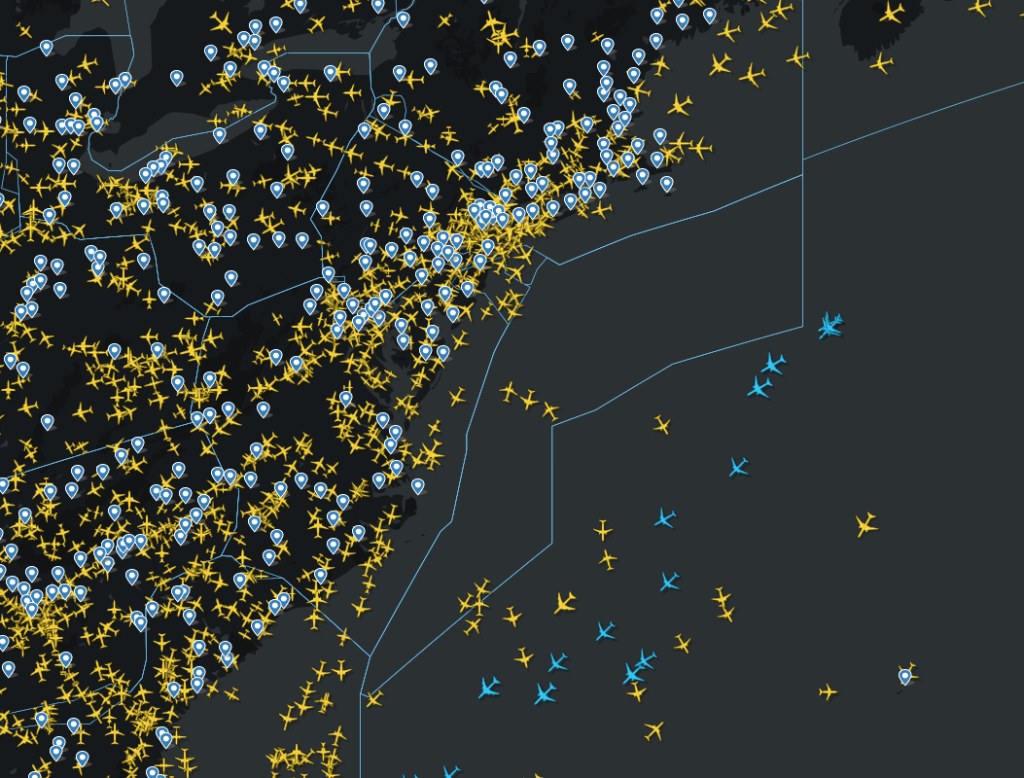
The NE coast and around the POTUS TFR are busy at the best of times.

The weather

The weather is a variable that can be hard to predict and the knock-on effect of it can be pretty far reaching. There are three things with the weather to really think about during the busy holiday season:

  • Ski resort airports tend to be tough to operate into anyway. When the weather gets rough this adds to the challenge, and to possible delays – particularly as they often have limited ramp capacity. 
  • Major snow storms and other wintery weather at the large, busy airports can result in a backlog of traffic across the airspace as aircraft hold for the weather to clear or divert. This puts extra pressure on the surrounding Centers. Additionally, aircraft on the ground can see long de-icing queues, and this fills up ramp space with delayed departures which means arrivals might be delayed as well.

Delays due de-icing, clearing runways, of storms will have a knock on effect across the NAS.

The ski spots

Traffic volumes operating into places like Colorado, Wyoming, Utah, Idaho (particularly KASE/Aspen, KEGE/Eagle, KJAC/Jackson Hole, KSUN/Friedman Memorial) will be on the up during ski season and particularly over the holidays. 

Again, the fact these are often difficult anyway, have logistic and operational challenges and limited ramp space, means disruptions can build up pretty quickly. If they fill up then ATC will put on a stop on GA flights routing to them and you might be airborne when that happens so plan your diversions or holding fuel!

Staff shortages

A final thing to think about is staff shortages – you might not care that the big airlines are lacking pilots, but if you use these big airlines to move yourself or your own pilots around then you might start caring a little more. Delays for them also mean disruption to other aircraft needing to use the airport (ramps) so avoid planning flights or crew through the major airports if you can.

What are they saying to help with it all.

When to fly

Think about whether you really need to fly on that Sunday after the holiday. If you can wait until Monday or Tuesday then do. The same actually goes for flying out – if you can avoid the peak times (generally the Thursday or Friday before) then you will avoid a lot of the traffic and a lot of the possible disruption.

Where to fly

Try to avoid the big, busy connection terminals like JFK, Newark, La Guardia where commercial volume is already high – both as a place for you to head to, or a place to send your crew through. Also have a think about your alternates and the traffic volumes at those.

Filing your flight plans

Get your flight plans in early – that way they are ab for the FAA and they will be included in the planning of traffic flow initiatives. File them short notice and on the day you will be an unknown and that can make it harder for ATC to accommodate you.

Know what’s going on

Check the FAA re-routes tab in advance. You’ll find info on current traffic management initiatives here as well. You can also take a look at the overall status of the NAS and make sure you have that big picture view before you fly.

Check the preview for the following day as well – the ops preview is posted after the 9pm planning call. You’ll find it on the advisory database and can use it to make a provisional Plan A and B if you are heading out the next day.
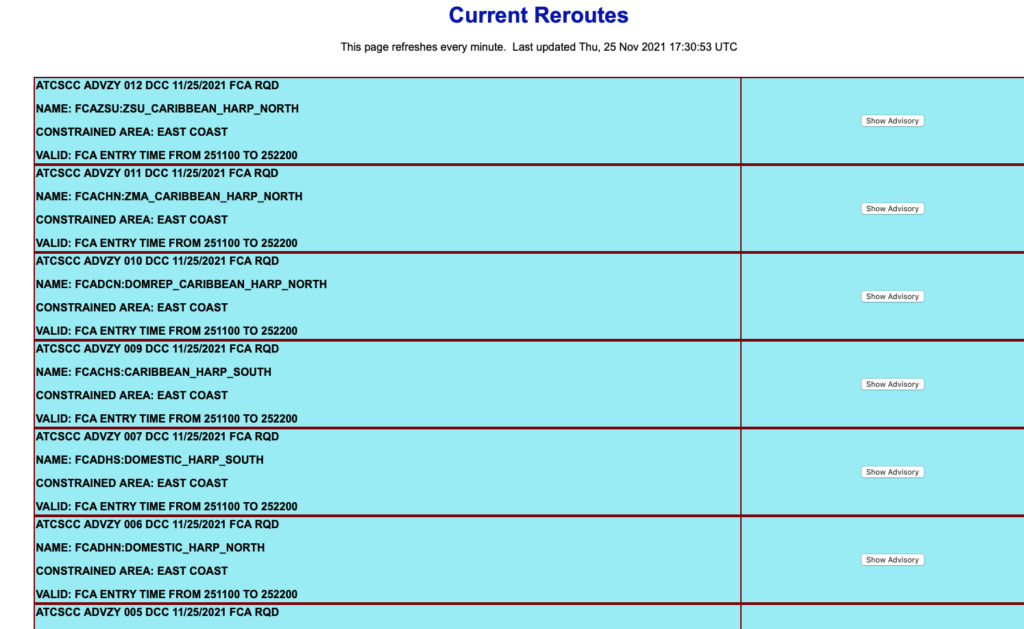
The Reroutes tab links to advisories and shows HARPs in force as well.

Check the weather

Pay attention to weather ahead of time and have those diversions planned out in advance. Also watch out for weather at larger airports because this can cause a ripple effect through the airspace. If Runway 11/29 at Newark closes then you’re going to see ground and air delays because of it…

But don’t assume no weather means no disruption. Even if its VFR along the east coast, if the volume is high there will be traffic management and airspace flow programs in place which might mean ground delays at Westchester or Teterboro…

Talk to your FBOs

Check with your FBOs in advance to confirm ramp space – even just prior to departure to see what’s happening on the day. Most of the Ski Resorts operate on a first come first served basis with no reservations, which can be great but can also lead to sudden capacity issues. Again, last minute stops for GA traffic might occur while you’re airborne and that could mean holding or diverting so check and plan in advance.

What else is going on out there?

Look out for HARP initiatives

Military airspace is often opened up to help ease congestion, particularly on Caribbean routes. In the past they have allowed access to airspace off the Mid-Atlantic which helps with the East Coast volumes, particularly in Jacksonville, Florida and Washington and DC Centers.

In previous years we’ve seen HARP routes between NY Metros/Philadelphia and Florida, as well as Boston Centers and Florida, and several in the Caribbean. Again, the great folk at the NBAA post some handy info on this so keep an eye out for their 2021/2022 info.

The routes are published in the FAA advisories as well so be sure to check these and file for them.

AZEZU

If operating between the Northeast and Florida then you probably know about the deep-water AZEZU route that keeps you out of the high volumes. Here is the section from the FAA playbook in case you aren’t familiar with it.

This route is changing from December 2nd and will become the WATRS deep-water route. There is actually no change to the routings, just the name, so the Playbook info remains more or less the same.
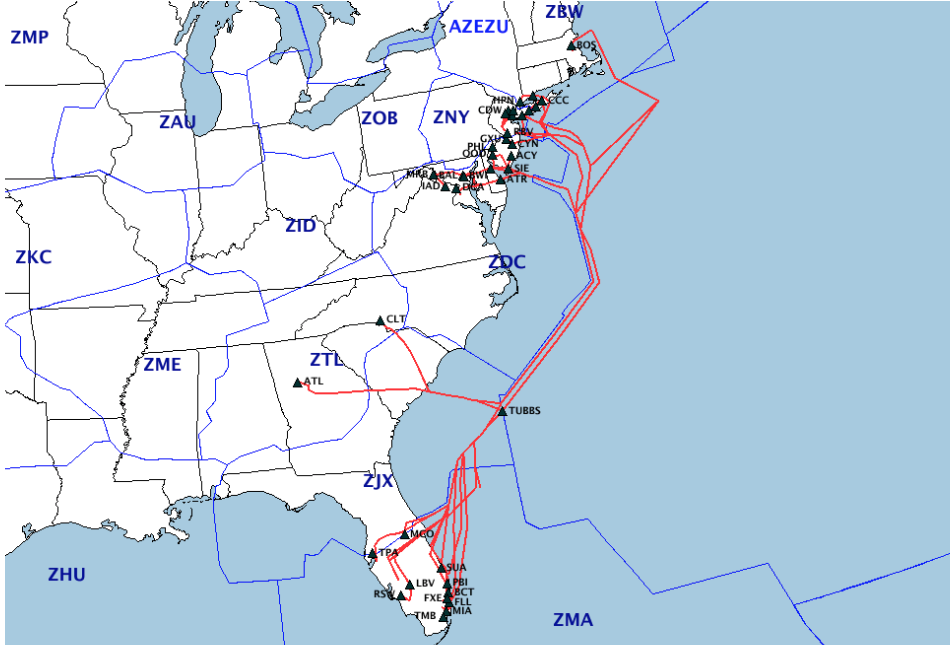
FAA Playbook AZEZU graphic

Our favourite page

We like this page where the NBAA post useful info on issues in regional airspace. It’s another one worth keeping an eye on.

Happy Holidays!


GPS U/S in the US

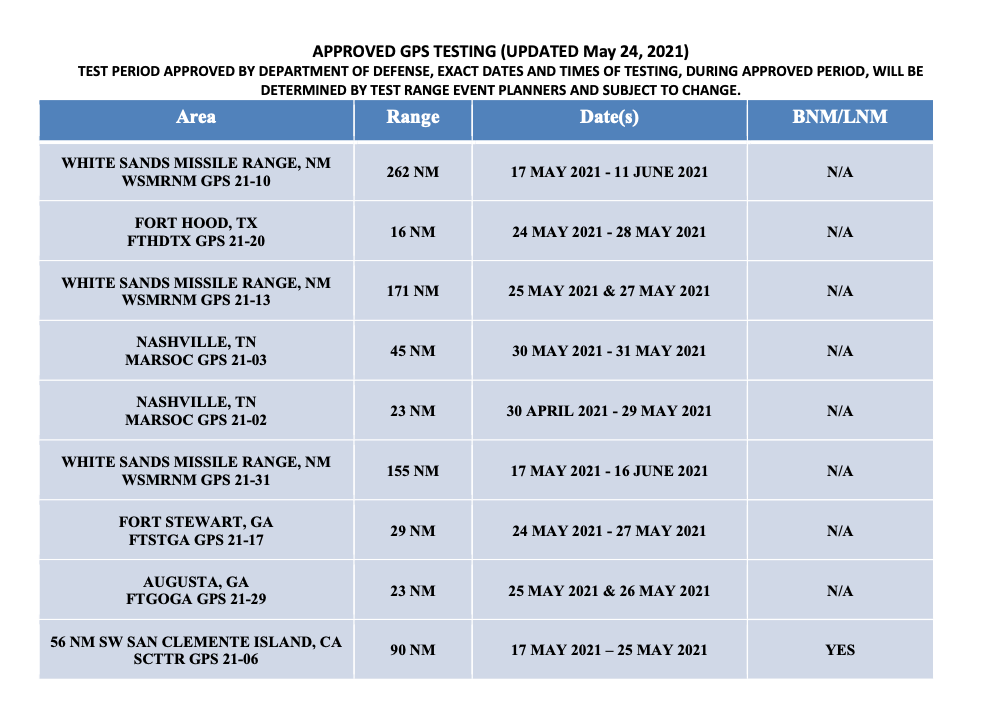
We have written a fair amount on worldwide GPS Jamming issues. Here is what we said about it in ‘GPS Jamming: All the Wrong Signals’. But there is another GPS problem though which is a little closer to home (if your ‘aviation’ home is in the US anyway).

What’s the deal?

Let’s take a step back to 2017, when the NBAA and a bunch of other stakeholders took part in the 2017 RTCA tactical operation committee. That’s the Radio Technical Commission for Aeronautics and they are great – they try and help find compromises amongst the competing interests on critical aviation modernization issues.

One of these very issues is with GPS.

The FAA’s NextGen modernization program is using more and more GPS ‘stuff’. Stuff that is critical for commercial flight operations safety and efficiency. The US Department of Defense on the other hand is sort of doing the opposite – they are running GPS Jamming tests which are critical for National Security and the big problem with this is that the jamming tests often interfere with the GPS signals civil aircraft are using.

What was the 2017 outcome?

After they talked about it in 2017, the compromise was that the DoD will notify the FAA at least 120 hours before any planned tests. This should give the FAA time or put out Notams to warn crew and operators.

Problem solved?

Unfortunately not. The 120 hours notification is given, but the information which filters down to the pilots and operators who need to know about it often not sufficient. One of the difficulties is that the Notams have to provide information on different outage locations and this means loooooooong Notams filled with lots of Lat and Longs and times and dates. And this means critical information can sometimes get buried inside and makes it difficult or confusing for the crew to find it, extrapolate it (or even be aware of it in the first place).

What’s the plan now?

Well, the NBAA have reported on this, and say that the FAA are taking their concerns onboard. They plan to revisit the idea of producing visual representations of the outage areas. These will be much easier to digest than lines of lat and longs, and would hopefully enable crew to use them in conjunction with planning apps in the future.

There has also been a reminder issued to crew asking them to report outages and issues. If you find yourself in a jammy area, let ATC know. Tell them what you have lost so that they can warn other aircraft in the immediate area. The reminder has been sent to ATC as well because in the past, when aircraft have made these reports, the information has not always been shared out to other operators in the near vicinity.

What do you need to look out for?

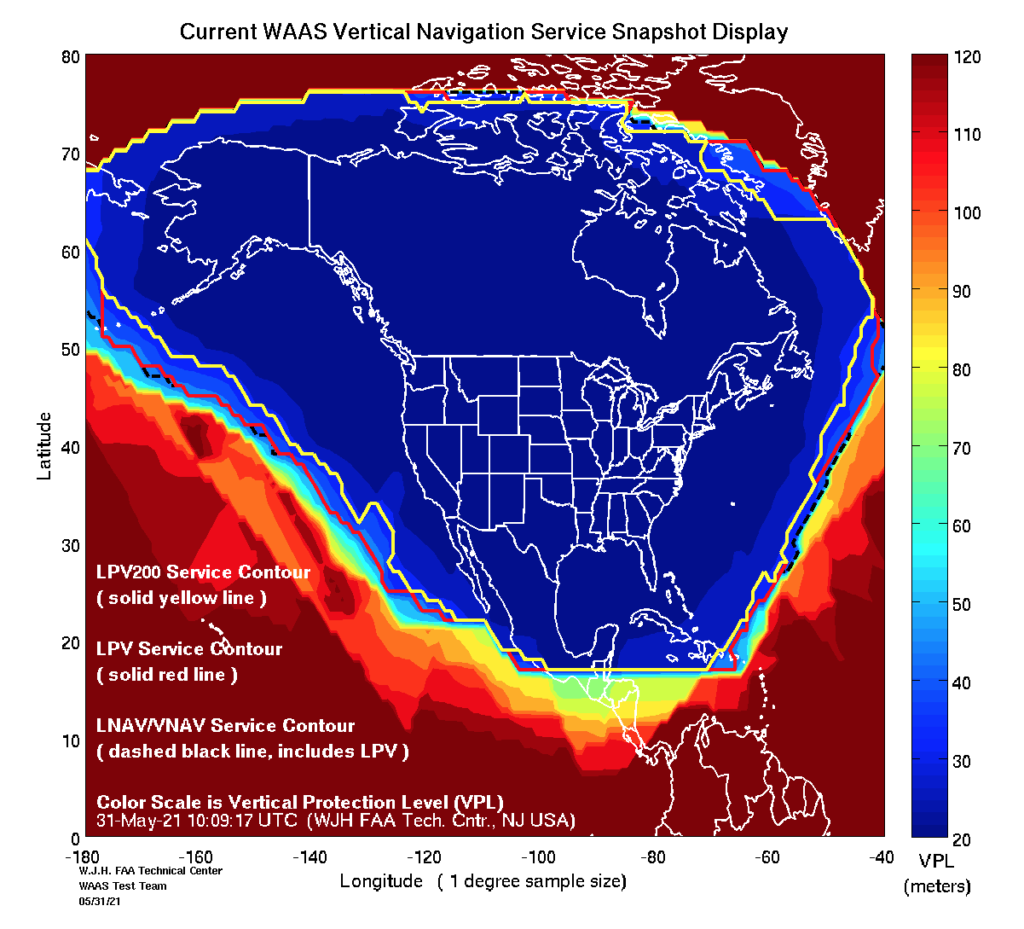
What an outage means, practically, is interference to the GPS signals which your navigation system is using. The result can be a degradation in accuracy, or a full loss of the system (GPS primary).

If you are enroute, let ATC know your capability has been degraded so you can get the support you need to continue navigating safely.

Some aircraft are particularly sensitive to disruption in the GPS signals, and it can lead to you losing that system until it is reset on the ground. This means RNAV/RNP approaches might not be flyable anymore. Having an awareness of what this means for your aircraft is important. Think about your plan B for approaches in case you do loose GPS navigation capability.

Notams are out there and it might be frustrating picking out the areas which could impact you, but knowing about the outage spots in advance will help.

Where can you look for info?

The 5G Update

We thought we’d throw in a little update in on this as well.

Last year we saw increasing concerns about possible interference from 5G networks because they operate on the same slice of radio spectrum usually reserved for Radio Altimeter signals (the 3.7-3.98 GHz band).

The big concern here is that interference could result in degradation of accuracy from spurious emissions, or outright failures in the radio altimeters. Not sure how much of a risk that means? Well, Turkish Airlines TK1951 crashed in EHAM/Amsterdam Schiphol in 2009 and one of the primary factors was attributed to a malfunctioning radio altimeter which sent an erroneous -8ft reading to the autothrottle system, commanding it to idle.

The NBAA are fronting a campaign here as well. Twenty organizations have joined forces to send the FAA a letter raising their concerns over this, in response to a report issued on March 3 that they don’t feel addresses the threat with enough analysis.

You can read the letter here.

Military aircraft and UAVs are also at risk here. Their radio altimeters use the same C-band frequencies, but they tend to fly a lot nearer the ground a lot more often. A very good summary of the issue can be found here.


“Operation: Paperwork Misery” – new US rules on pilot data reporting are coming soon

The FAA has launched “Operation: Paperwork Misery” – a Notice of Proposed Rulemaking which will require operators to submit a whole bunch of additional pilot data to the agency via a new Pilot Records Database.

Here’s the plan, according to the FAA:

The FAA is proposing to require the use of an electronic Pilot Records Database (PRD) and implement statutory requirements. The PRD would be used to facilitate the sharing of pilot records among air carriers and other operators in an electronic data system managed by the FAA. Air carriers, specific operators holding out to the public, entities conducting public aircraft operations, air tour operators, fractional ownerships, and corporate flight departments would be required to enter relevant data on individuals employed as pilots into the PRD, and this would be available electronically to those entities. In addition, this proposal identifies all air carriers, fractional ownerships, and some other operators or entities that would be required to access the PRD and evaluate the available data for each pilot candidate prior to making a hiring decision.

Here’s a translation of how that may work in real life, from the NBAA:

The FAA’s PRD proposal would subject many business aviation operators to a substantial pilot-data reporting burden not previously applied to non-commercial operations. This proposed rule also amounts to a complete overhaul in the way commercial operators access information about a pilot before hiring and the way certificate holders will provide FAA historical and future records. It expands the types of operations required to give the FAA records documenting an individual’s compliance with FAA or employer required training, checking, testing, currency, proficiency, or other events related to pilot performance, including check pilot comments. Due to the extensive nature of the reporting requirements, the proposed rule has the potential to impose significant new burdens on Part 91 operators of all sizes.

“This is really regulatory overreach at its worst,” said Doug Carr, NBAA’s vice president for regulatory and international affairs. “We have a situation where our community will see no safety benefits as a result of compliance with this program, and the creation of a definition solely for the purpose of satisfying paperwork is not in the best interest of our community.”

Although the FAA’s new rule was issued on March 30, they have so far resisted calls from the industry to extend the comment period beyond June 29 – meaning many operators now don’t have enough time to trawl through the 200-page NPRM document to work out just how brutal the onerous new requirements are going to be, nor get much of a chance to provide any objections to the plan.

“It is exasperating that the FAA has given industry just 90 days to unpack a complicated plan amassed over nine years, and released as the aviation community fights for its survival during COVID-19,” said Koester. “It would not seem unreasonable to allow another 30 days for discussion, so we are pursuing other means to encourage the FAA to provide for this minimal, reasonable accommodation.

The NBAA are now encouraging affected operators to review the NPRM and submit comments providing as much detail as possible about the impact of these proposed changes to their operations. To do that, click here:


Alternatively, you can submit your comments via the tool NBAA has launched to assist with this. Click here for that.

For more info on the specific impact of this proposed NPRM, here is what the NBAA have compiled, which we’re sharing here with their permission:

Concerns for all operators

Check pilot comments
The NPRM would require operators to include check pilot comments from training events in the pilot record database. As unflattering comments may cost pilots future job opportunities, this may leave check pilots or their employers open to liability and diminish the opportunity to improve safety by focusing additional training on check pilot comments.

Overly burdensome and inconsistent reporting requirements
Both the draft advisory circular and the NPRM contain language requiring operators to report a pilot’s aeronautical experience, flight time, and flight maneuvers performed to maintain privileges of their certificate. These burdensome reporting requirements could reasonably result in a need for certificate holders to log every flight hour, instrument approach, and landing in the pilot record database.

Language within the NPRM also contains many contradictory statements leaving operators unclear on the intent of the proposal and the actions required by the rule. Most notably, 111.220(b)(3) states no person may report records documenting aeronautical experience, yet 111.220(a)(2) requires air carriers to report records related to currency and proficiency.

Concerns for Part 91 operators

Definition of Corporate Flight Department
For the first time, this NPRM would codify a definition of a “corporate flight department”. The definition crafted solely for compliance with record keeping requirements does nothing to enhance other elements of our industry and excludes a substantial portion of business aviation that considers itself part of the community.

New recordkeeping and reporting requirements
This NPRM results from Public Law 111-216 (Airline Safety and Federal Aviation Administration Extension Act of 2010), which indicates operators must report training and employment records already maintained by operators. The proposed rule would require Part 91 operators to undertake new record keeping and reporting burdens. Some operators already use sophisticated software systems for managing and tracking pilot training, checking, testing, currency, and proficiency. However, many operators use simple tracking systems that will require manually reporting these records to the FAA.

Concerns for Part 125 and Part 135 operators

The FAA will charge operators a $110 fee any time they pull records for a pilot candidate.

Part 125
The NPRM requires Part 125 operators to report historical records dating back to August 1, 2010. Operators will be required to upload employment, training, checking, testing, currency, proficiency, and disciplinary records for every pilot under their employment over the last ten years. Operators will be able to upload records in XML or manually.

Part 135
The NPRM requires Part 135 and 121 operators to report historical records dating back to August 1, 2005. Operators will be required to upload employment, training, checking, testing, currency, proficiency, and disciplinary records for every pilot under their employment over the last 15 years. Operators will be able to upload records in XML or manually.

NBAA’s Perspectives

While the NPRM contains some potential efficiency improvements for the Part 125 and Part 135 communities, we believe that a substantial number of these proposals would burden the part 91 community far beyond the intent of Congress. For certificated operators currently required to comply with the Pilot Records Improvement Act (PRIA), the NPRM may streamline record reporting and requesting processes, expedite response times, and allow for more informed hiring decisions.

The NPRM would also require reporting more information than under PRIA by more segments of the aviation community, including corporate flight departments and 91.147 air tour operators. The proposal would require these constituencies to report not just training and checking events, but also any event that leads to proficiency or maintains currency, such as day or night landings, flight hours, and instrument approaches. This process will be burdensome and provide little information that enhances hiring decision making abilities.

NBAA encourages affected members to review the NPRM and submit comments to the public docket providing as much detail as possible about the impact of these proposed changes to their operations.

Read the NPRM on the regulations.gov website.

Download the NPRM (PDF)

Comments should be submitted no later than 11:59 p.m. EDT on June 29, 2020.

Submit comments