Finished: The FAA Northeast Corridor Improvements

It’s finally done. On April 20, the last phase of the FAA’s Northeast Corridor Atlantic Coast Routes Project crossed the finish line, officially ending (well almost) the biggest change to the US NAS in decades.
And April was perhaps the largest update yet – here’s a summary of exactly what went down.
Wait, the what?
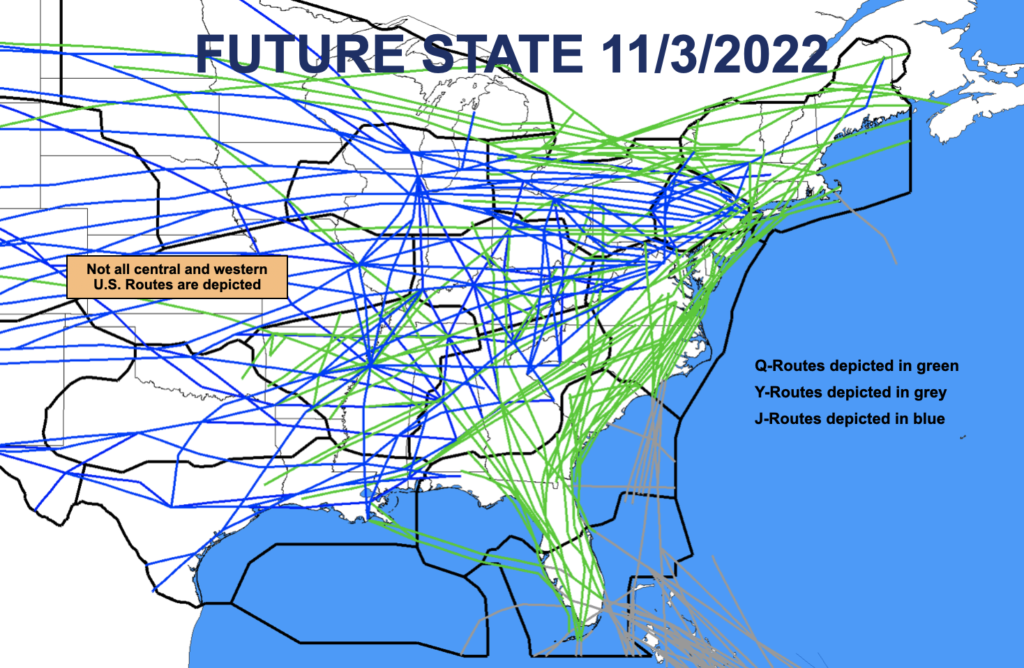
If you haven’t heard of it, our previous article may be a good place to start. But in a nutshell, over the past few years the FAA has been introducing new and amended Q and Y-routes to replace the high-altitude route structure running north and south along the US East Coast.

….Asking for a friend, what are J, Q and Y routes again?
J-routes (or jet routes) are high altitude airways (FL180 – 450) that rely on VOR or VORTAC fixes back on ol’ terra firma. Q and Y-routes are based off RNAV (GPS) navigation.
It’s not that the existing airways were broken, but they were showing their age. The project has been part of a larger transition away from ground based NAVAIDs and towards PBN-centric US skies – i.e. satellite based navigation, the good stuff.
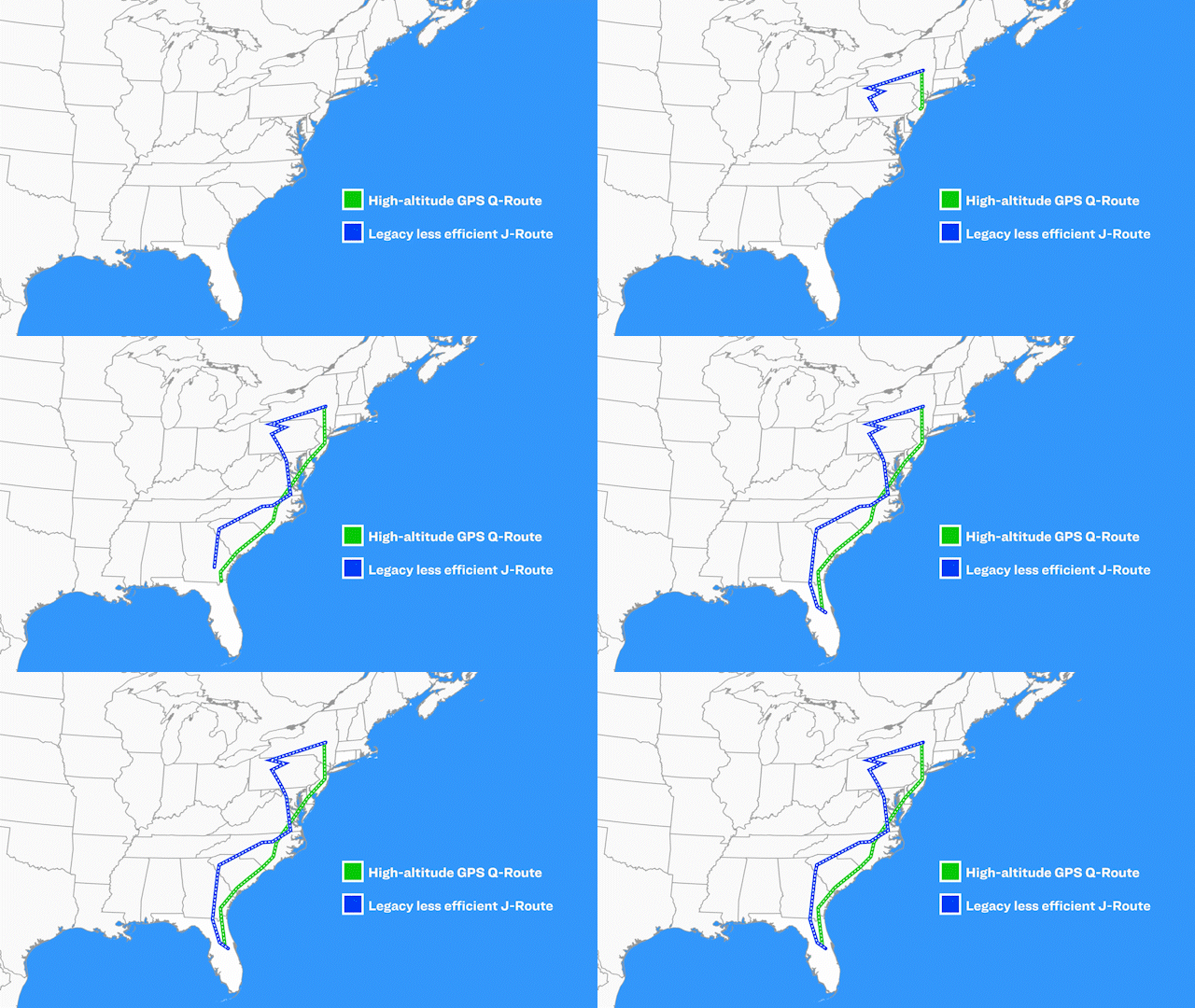
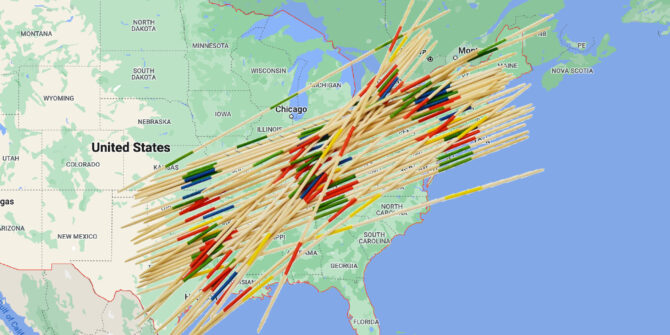
The legacy J-Routes are far less efficient than satellite based ones. Courtesy: FAA
Rome wasn’t built in a day – and neither was this project it seems. In fact, changes first appeared back in October 2019 – then the world caught the flu. Since then the roll-out has been delayed several times with staggered changes spanning the past three years.
If you’d like to see a complete list of those 160+ changes, the FAA has produced this handy slide. For the ones that came into effect on April 20, read on…
The April 20 Update
The final seven J-routes on the chopping block were axed (J37, J55, J79, J121, J174, J191, and J209), along with a number of their associated fixes. In their place twenty Q-routes were either introduced or amended.
To make sure all these new routes were set up and ready to use, most were published last year. However there were a stack of ‘not authorised’ Notams in the system that have now been removed – essentially raising the barrier for traffic to actually use them.
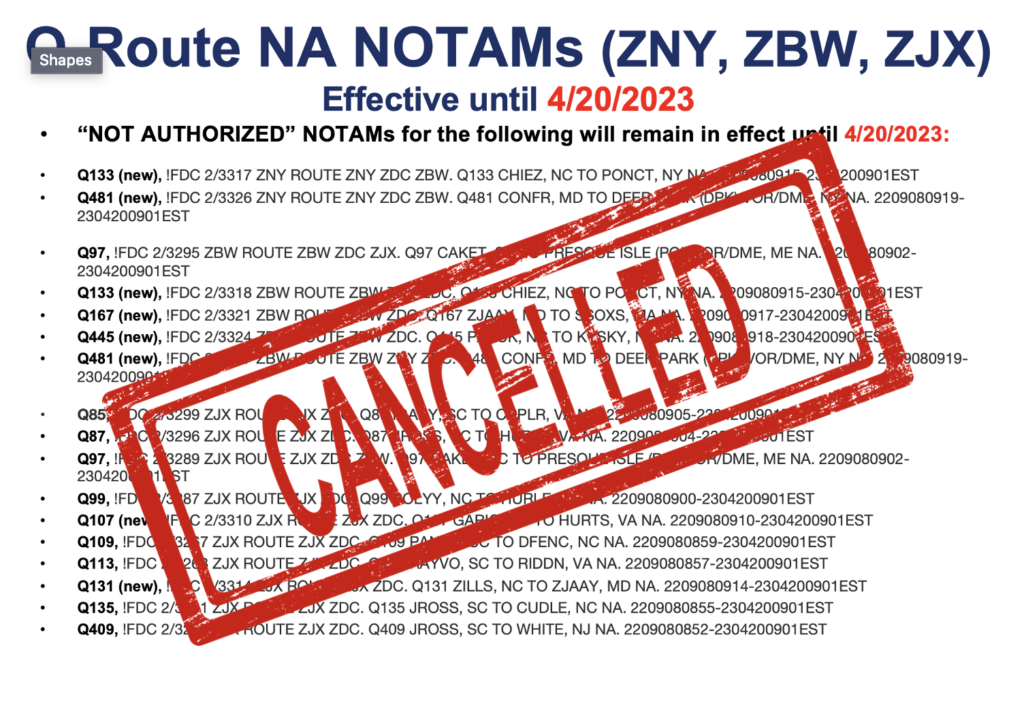
A bunch of ‘not authorized’ Notams have now been cancelled.
On the East Coast, STARs at three major airports were amended to remove ground-based transitions. At KPHL/Philadelphia, look out for new ones on the JIIMS 4 and PAATS 4 arrivals. At KEWR/Newark, the PHLBO 4 has been updated along with the JAIKE 4 over at KTEB/Teterboro. The good folk over at the Teterboro User’s Group have published some additional information on the latter.
The Goal Posts
Let’s address an elephant in the room. There’s a small chance someone will call us on the ‘finish line’ statement – fair game. There are some small changes still to come on June 15 – one more Q-route is being updated (Q101). There will also be a new STAR at KCLT/Charlotte along with some deletions. But the big changes are now done and dusted.
There’s Been A Little Trouble
Since the changes on April 20, news from the Boston ARTCC has been that foreign operators inbound from the NAT have not always been filing the new preferred IFR routes. This is causing a bit of headache at the boundary for pilots and controllers while traffic is ‘re-jigged.’ To see the preferred ones, click here.
The worst is likely over already, but the FAA has also advised airborne delays are possible while the system gets used to the changes. ATC may apply traffic management procedures to help keep the flow orderly. Consider a little more contingency fuel while things settle down.
Still have questions?
There are couple of FAA contacts provided in the official briefing:
Reggie Davis FAA Management Co-Lead reginald.e.davis@faa.gov
Joey Tinsley NATCA Co-Lead joseph.b.tinsley@faa.gov