Middle East Airspace – Current Operational Picture
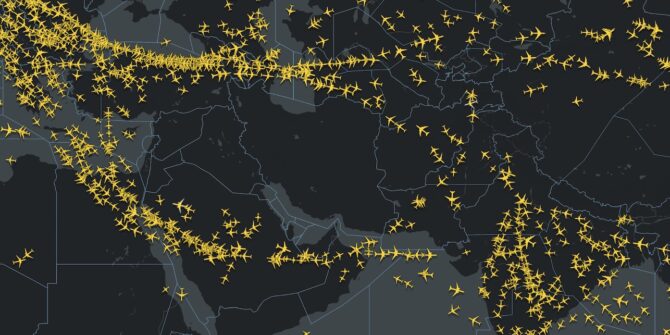
Key Points – June 20 update
- Most Gulf FIRs are now open to overflights again, although many are still using tactical routes and flow management.
- Kuwait remains the exception – overflights through the OKAC/Kuwait FIR are still prohibited.
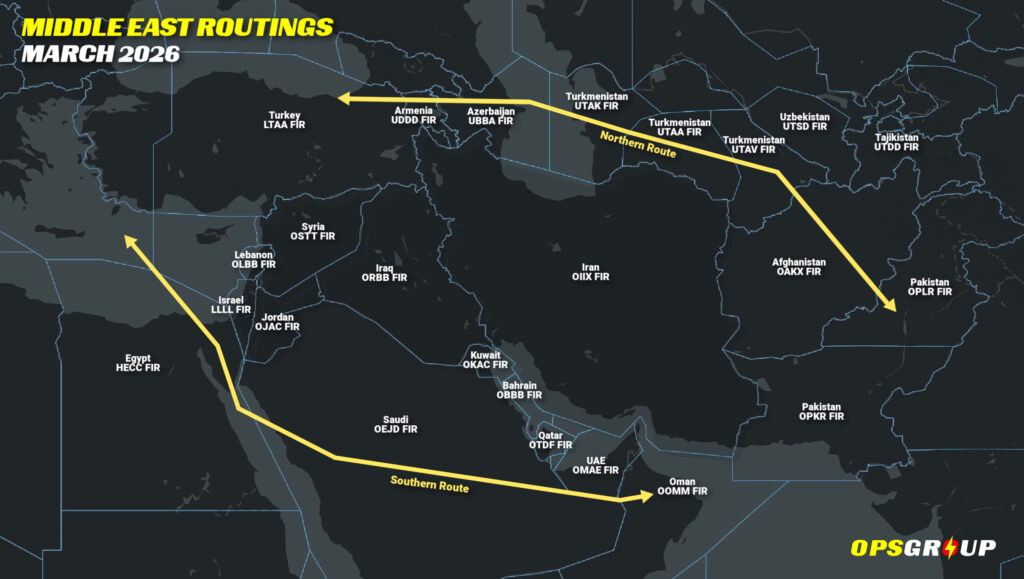
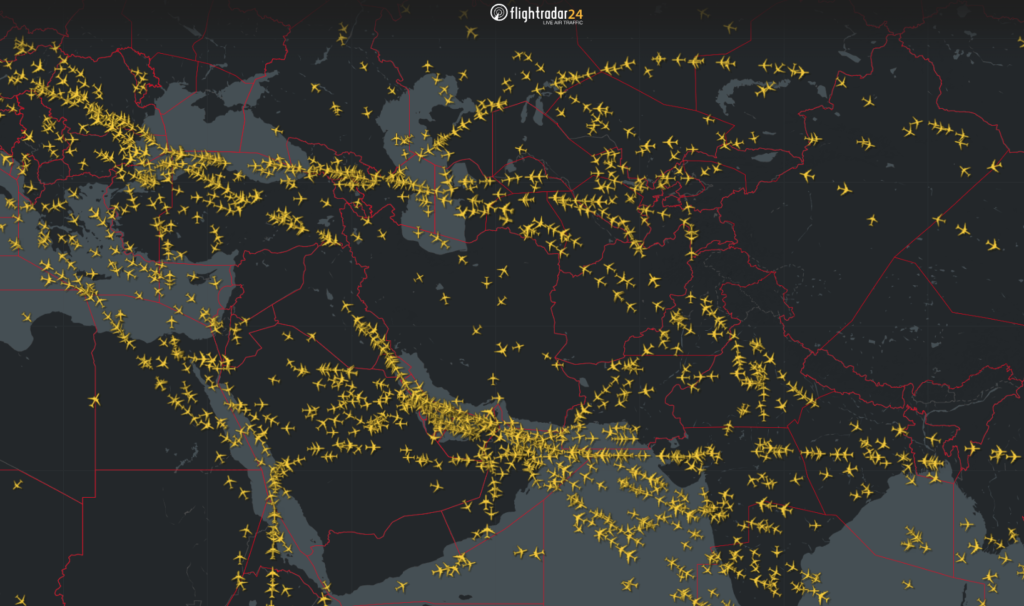
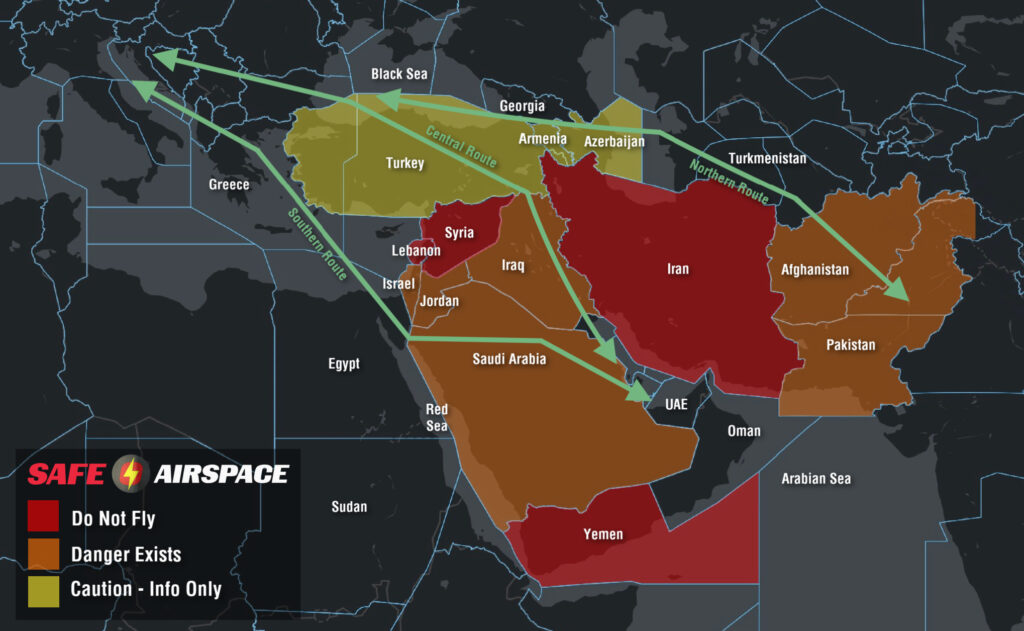
- The main Europe-Asia routings remain south via Egypt-Saudi-Oman/UAE or north via the Caucasus/Afghanistan.
- GPS jamming/spoofing remains one of the biggest operational issues across the region.
- ATC congestion and tactical routing procedures remain common, especially on the southern bypass.
The Gulf airspace picture has improved a lot over the past few weeks, but the central Middle East corridor still isn’t quite back yet.
Most Gulf FIRs have now reopened to overflights in some form, including Iraq, Bahrain, Qatar and the UAE. But Kuwait continues to prohibit overflights, meaning many of the most direct Europe-Middle East routings still aren’t available.
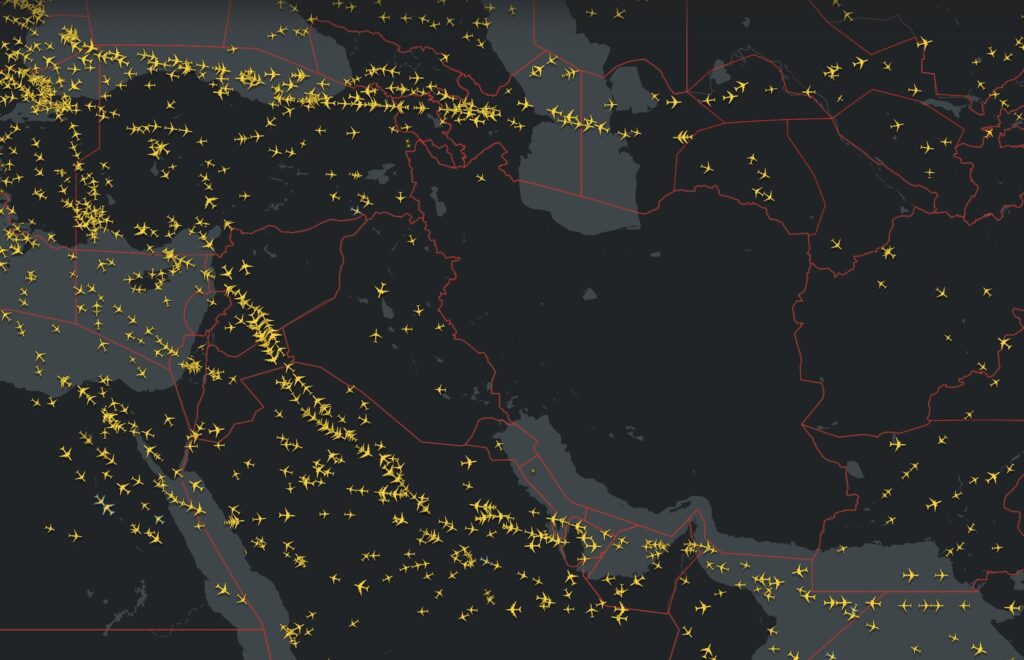
Here’s a quick lowdown on what’s going on in each little bit of airspace…
Syria
Yes, unbelievably we’re starting this list with Syria! It seems to have quietly become part of the regional routing picture again after years of almost no international overflight traffic.
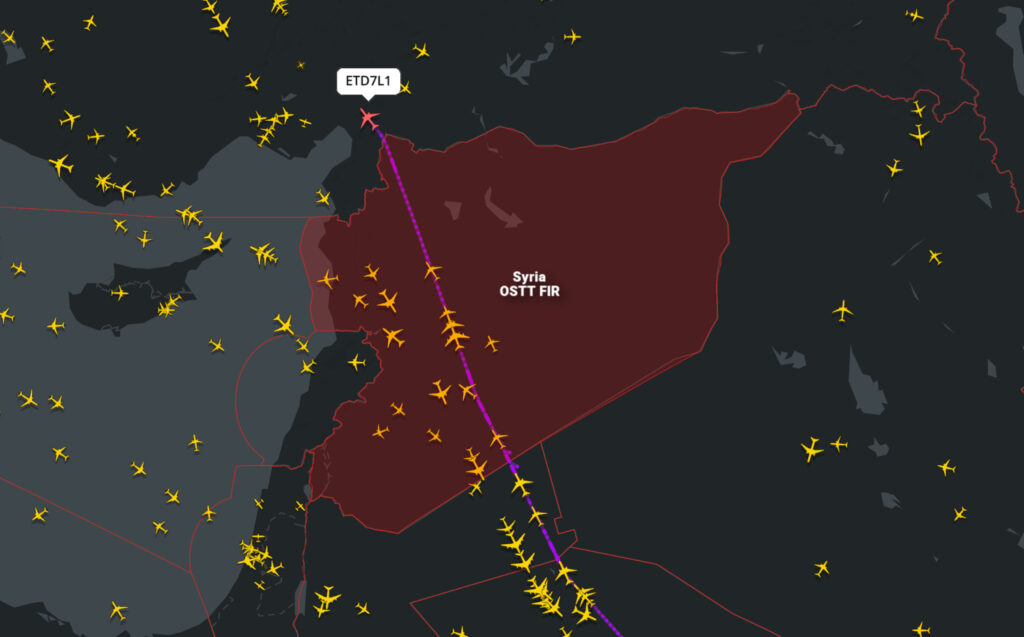
May 27: Lots of little naughties sneaking through!
The OSTT/Damascus FIR reopened in early 2025 and some regional carriers are now using Syrian airspace again as an alternative to the more restricted Iran/Iraq option. Most of the traffic currently appears to be Middle East carriers rather than major US or European airlines, which largely continue to avoid the FIR.
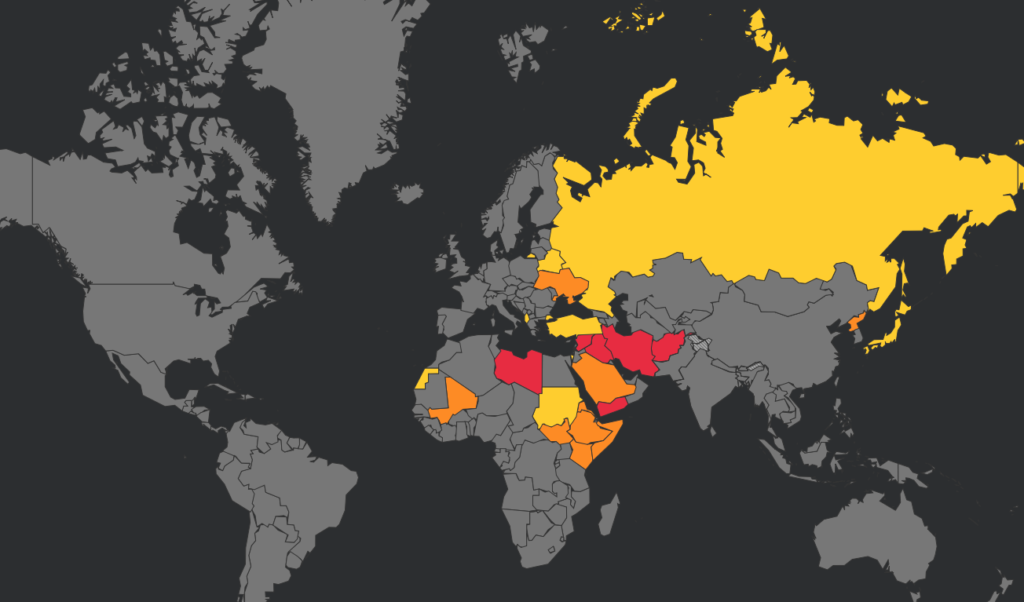
The airspace remains high risk. Israeli airstrikes in Syria continue periodically, several countries still prohibit or strongly discourage their operators from entering the OSTT FIR, and ATC capability remains limited. Check safeairspace.net for more info on the airspace risk side of things.
We also spoke to a local Syrian agent (First Aero Services – seemed very helpful! contact info: ops@fasaero.com) about how overflights currently work here in practice. Operators generally need to apply through a local handling/permit company, which coordinates with the Syrian authorities and handles nav fee payments. Current charges are reportedly:
- EUR 70 overflight permit handling fee per leg
- EUR 455 fixed navigation charge per flight
- extra charges for urgent processing or permit revisions
At the moment, the Syria routing still looks more like a temporary workaround being used by regional operators than a mainstream replacement for the old central Middle East corridor.
Kuwait
Kuwait has extended its airspace restrictions until at least Aug 4. Overflights through the OKAC/Kuwait FIR are still not permitted – only flights arriving to or departing from OKKK/Kuwait are allowed, with prior approval.
That makes Kuwait the remaining gap in the middle of the Gulf routing structure. While neighbouring Iraq, Bahrain, Qatar and the UAE have all reopened to overflights in some form, operators still need to route around Kuwait, either via the southern Egypt-Saudi-Oman corridor or further north.
Iran
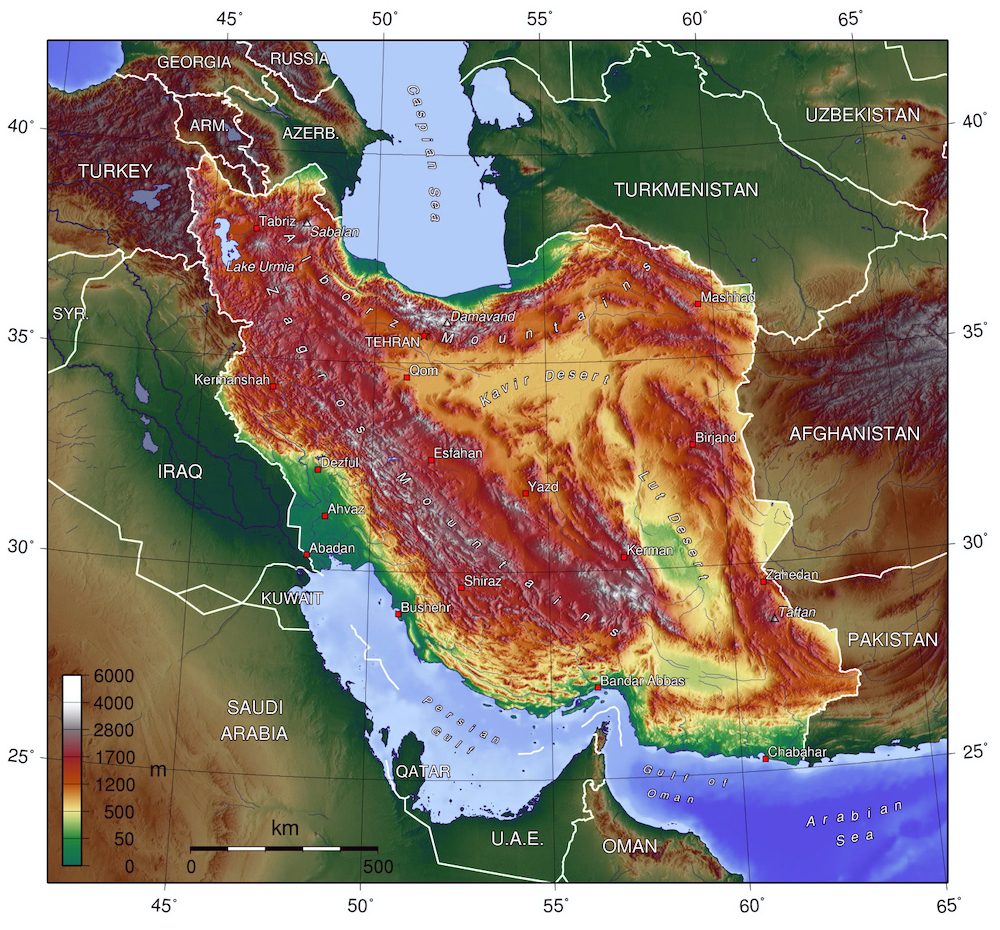
Iran is still operating in what it calls a “recovery period” rather than normal ops. Some overflights above FL285 are possible via specific temporary routes linking Oman/UAE with Central Asia, the Caucasus and Turkey, but western Iran remains heavily restricted. Several radar systems remain degraded, many western airports are still closed or daytime-only, and pretty much everyone continues avoiding the airspace.
Qatar
Qatar has now reopened to overflights. The earlier restrictions on waypoints and arrival/departure route segments have been withdrawn, although some temporary restricted areas and military activity remain. OTHH/Doha and the Doha FIR seem to be almost back to normal again.
UAE
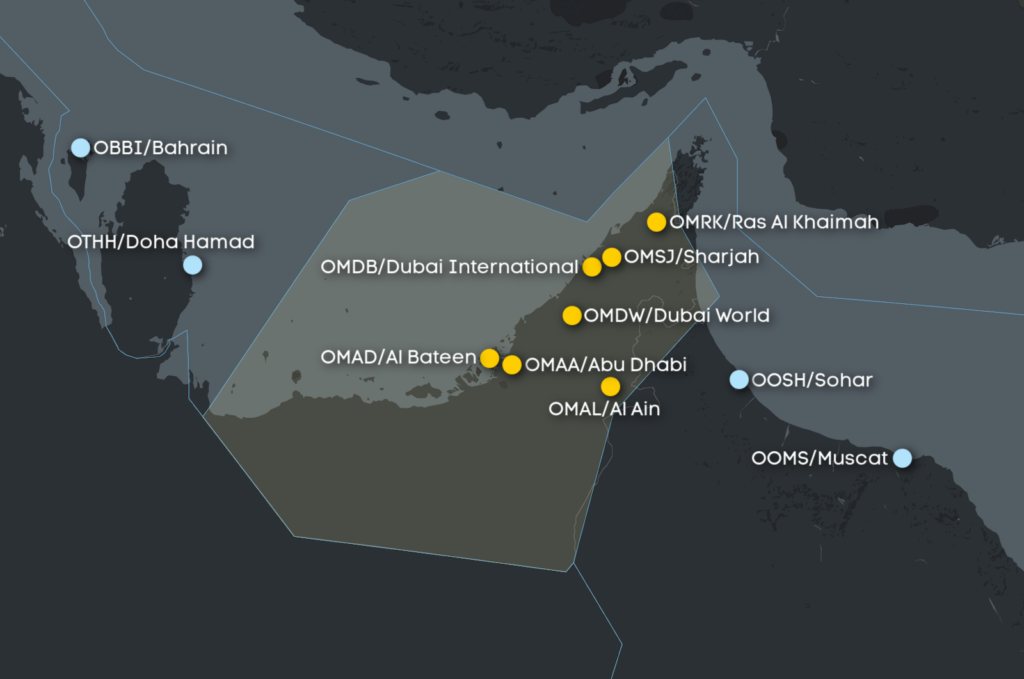
The UAE remains open to overflights, with traffic managed through a mixture of normal ATS routes and temporary RNAV corridors. GPS interference continues to be one of the biggest operational issues across the FIR.
Bahrain
Bahrain is open to overflights again and things are mostly back to normal. Just keep in mind that nearby airspace, especially Kuwait, is still restricted and can affect your routing.
Iraq
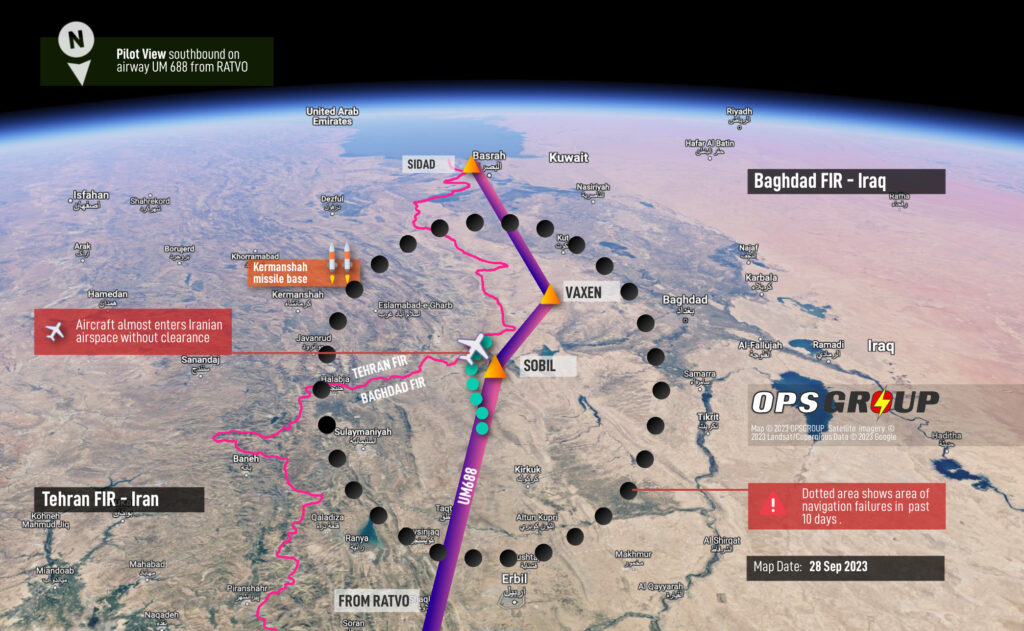
Iraq is open for overflights again, but it still doesn’t really bring back the old Europe-Asia corridor because western Iran remains restricted and most operators still consider the ORBB/Baghdad FIR too high risk. Some airlines are using Iraq, but the main flows still seem to be north via the Caucasus/Afghanistan or south via Egypt/Saudi/Oman.
Saudi Arabia
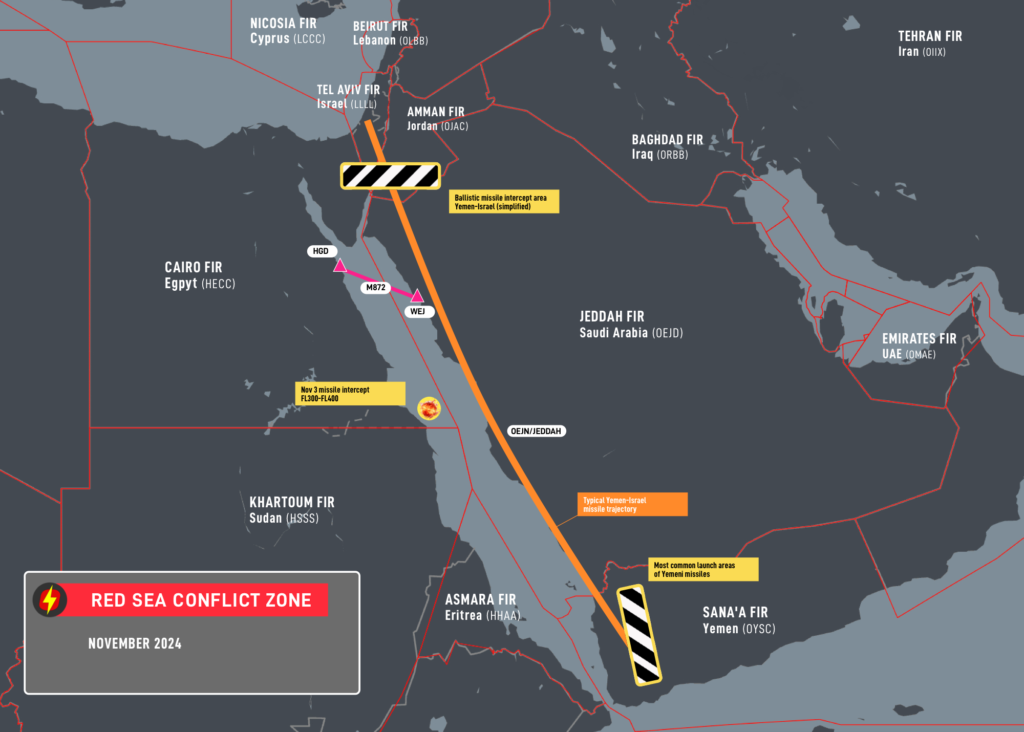
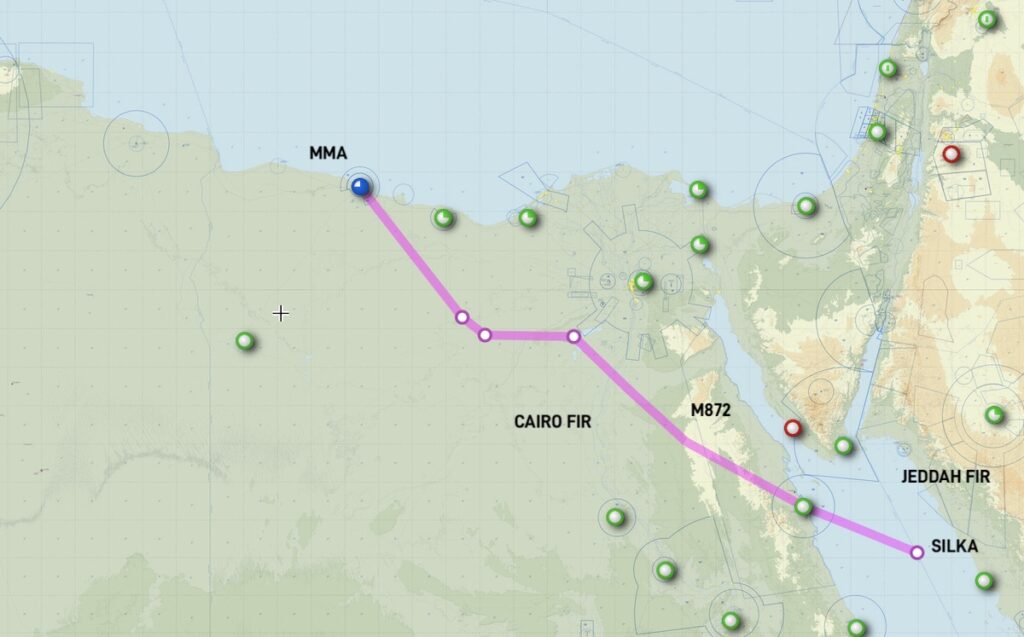
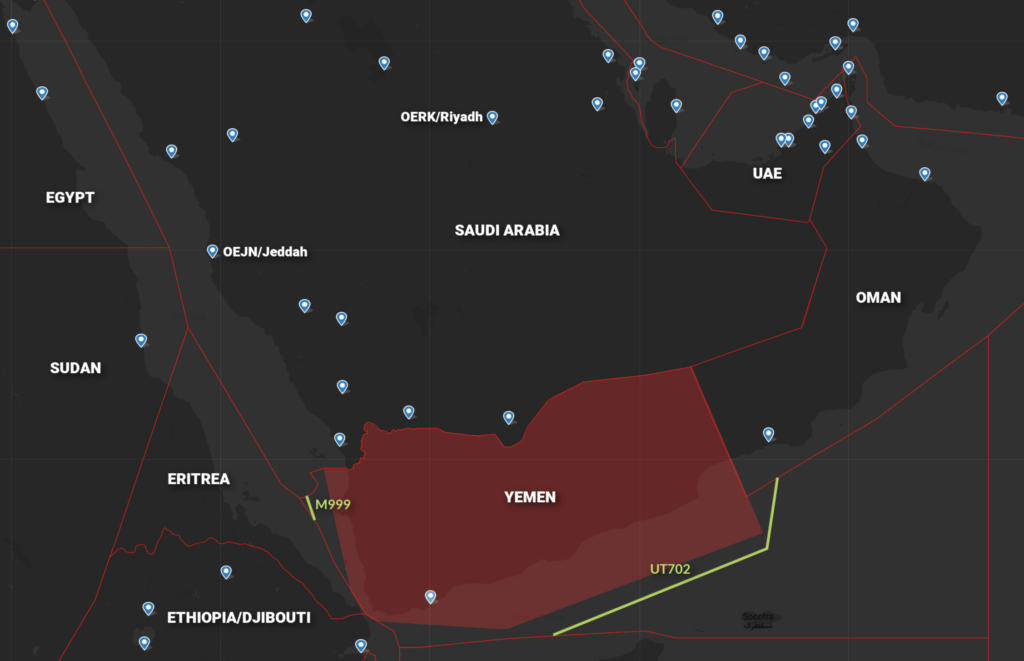
Saudi remains open and is still the main southern bypass link. Traffic levels through the OEJD/Jeddah FIR remain very high, especially between the Gulf and Egypt, with flow measures and tactical routings now a normal part of ops. Opsgroup members are also reporting heavy ATC congestion and blocked transmissions in some sectors (more on that below!)
Oman
Oman remains one of the most useful FIRs in the region, especially for the southern bypass. It is open, but still part of the managed corridor system, with flow measures and ongoing GNSS interference reports.
Jordan
Open and operating normally. In practice, it’s still not a major transit route for Europe-Asia traffic. Most operators continue to route via Egypt and Saudi Arabia, as they did before the conflict.
Israel
Israel is open again in a limited way, but ops still aren’t anywhere near normal. Some foreign airlines are returning, but most major US/European operators are still cautious.
Armenia/Azerbaijan/Afghanistan
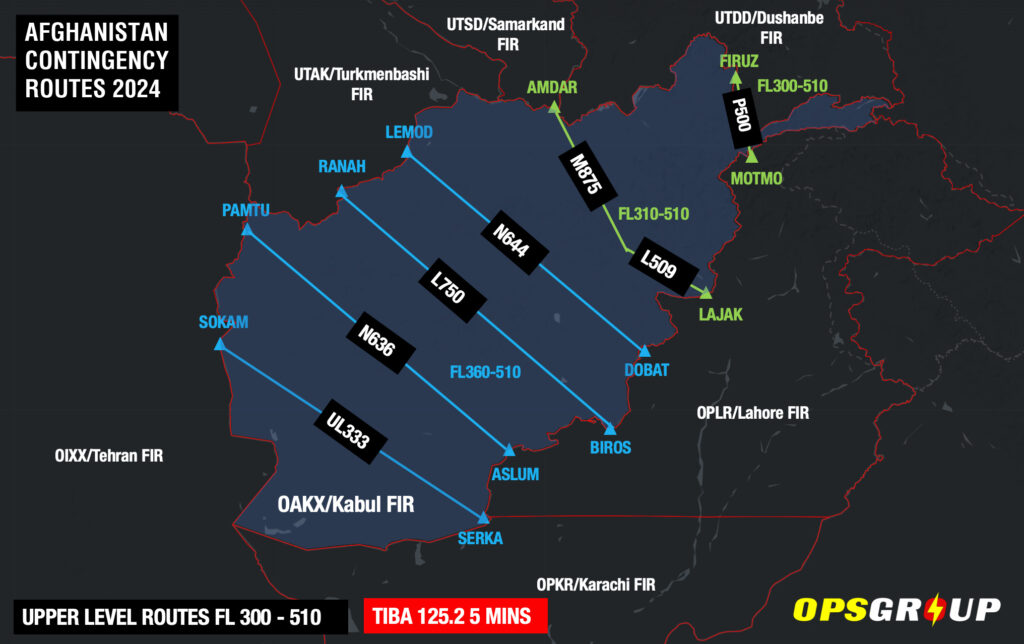
Armenia and Azerbaijan remain important parts of the northern bypass, with steady overflight demand. The main issue is still Afghanistan – the OAKX/Kabul FIR remains Class G with no normal ATS service, so crews still need to use the published contingency routes and operate with TIBA procedures.
So for Europe-Asia traffic or Gulf positioning, the two real options are still the same as we reported before back in March – north via the Caucasus then Afghanistan, or south via Egypt then Saudi then Oman:
Airport Spy reports
We’ve had a lot of useful Airport Spy reports recently from Opsgroup members operating into several Middle East airports: OBBI/Bahrain, OTHH/Doha, OMSJ/Sharjah, OMAD/Abu Dhabi and OEDF/Dammam.
Big theme across all of them is the scale of the GPS jamming/spoofing currently happening around the region. Several reported complete GPS loss on arrival or departure, and interference continuing well into neighbouring FIRs. ATC seems very used to it now, with lots of runway heading departures and radar vectors being issued.
Reports also mentioned fuel delays, extra towing/hangar time, and slower ground handling at some airports. We’ve also had reports of heavy ATC congestion in the OEJD/Jeddah FIR as traffic continues concentrating on the southern bypass via Egypt and Saudi Arabia. Opsgroup members can check Airport Spy in their dashboard for the full reports.
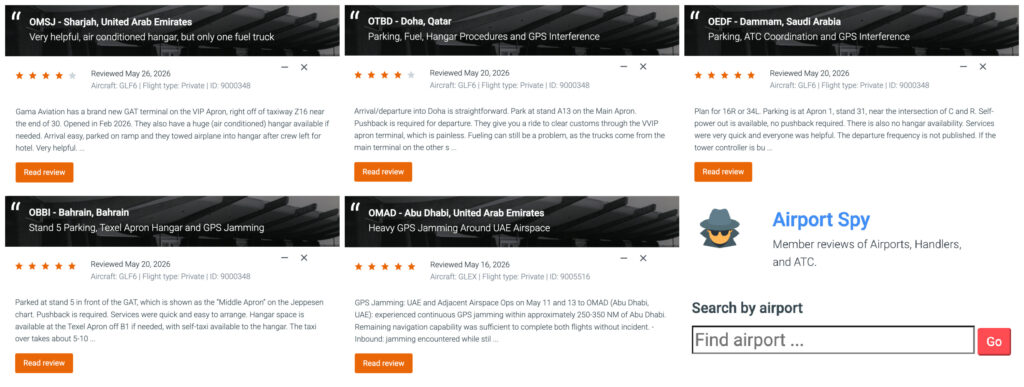
Access latest Airport Spy reports here.
Recent developments
May 27 – EASA updates Middle East CZIB again
EASA has updated its Middle East Conflict Zone Information Bulletin (we’re now on revision #11!) reflecting the shift from active conflict towards what it describes as a “state of heightened tension” across the region.
The new version says the ceasefire between the US and Iran is currently holding, and that the overall level of risk has decreased since the peak of the conflict in March and April.
For Iran, Iraq and Lebanon: they recommend operators do not operate in the airspace at any altitude.
For Bahrain, Kuwait, Israel, Jordan, Qatar, Oman, UAE and Saudi Arabia: the advice has softened slightly to “exercise caution” and maintain updated risk assessments etc.
Also, the previous Saudi/Oman “safe corridor south of a line” wording has now disappeared entirely from the bulletin.
May 27 – Most Gulf FIRs reopened
Most Gulf FIRs have reopened in some form, but things are still far from normal. Most Europe-Asia traffic is still routing south via Egypt-Saudi-Oman/UAE or north via the Caucasus and Afghanistan, with very little using the old Iran/Iraq corridor.
GPS jamming/spoofing is now one of the biggest operational issues in the region. Opsgroup members reported complete GPS loss, and interference extending well into neighbouring FIRs. ATC across the Gulf seems very used to it, with runway heading departures and radar vectors now common.
May – Ceasefire holding but tensions remain high
The ceasefire between Iran, Israel and the US does seem to be holding for now, which has allowed most Gulf FIRs to reopen in phases. But this definitely doesn’t mean things are back to normal yet. Military activity is still happening in parts of the region, restrictions are still changing quite often, and several FIRs are still operating under contingency procedures.
April 24-26 – Kuwait and Iran begin phased reopening
Kuwait has reopened its airspace and resumed limited operations after nearly two months of closure, while Iran has restarted some international flights from Tehran and expanded access in the eastern part of its FIR. Both are reopening cautiously and in phases, and neither restores a normal central Middle East routing yet. Most international airlines are still avoiding Iran, with only limited use of Iraq airspace.
April 23 – Opsgroup member reports on OEJD/Jeddah FIR congestion
OPSGROUP members report comms congestion in the southeastern sector of the Jeddah FIR (towards the Muscat boundary, up to ITRUX). Frequencies are saturated with blocked transmissions and delayed check-ins, with ATC sometimes instructing extended “standby” and calling aircraft individually. Guard (121.5) has occasionally been used to pass frequency changes. Crews report being held around FL300-330 until handoff. This reflects the increased traffic using the southern bypass route and may cause delays in the area.
OPSGROUP members can check Airport Spy for more info.
April 21 – Iran reopens east part of Tehran FIR
Iran has reopened the east part of Tehran FIR to overflights above FL285 under recovery-period procedures, while the west part remains closed. This is the biggest airspace change since our last update, but it does not restore a normal central corridor.
April 20-22 – Qatar and Bahrain move further into controlled reopening
Qatar’s current Notams now say OTHH is available to all airlines via dedicated corridor entry and exit points, while Bahrain remains open with prior approval only and fixed OBBI entry and exit points. Both are more usable than they were in early April, but neither is back to normal hub operations.
March 30 – Missile intercepted over Turkey
Another Iranian ballistic missile was intercepted over southern Turkey, with debris reported near the Syrian border. Turkish airspace remains open with no operational impact, but the incident again shows how far west some of the missile activity is extending.
March 24-30 – UAE short-notice closures continue
The UAE continued to briefly close its airspace during new missile and drone threats, reopening shortly afterwards. This reinforced the risk of sudden disruption even when the FIR was technically open.
March 24 – OKKK/Kuwait airport fuel tank hit
A drone strike hit a fuel storage tank at OKKK/Kuwait, causing a fire. No casualties were reported, but this was another direct strike on airport infrastructure and highlighted the ongoing risk to ATC and fuel systems.
March 17 – UAE airspace closure
The UAE briefly closed its entire airspace overnight on March 16-17 as an “exceptional precautionary measure” during new missile and drone threats.
It lasted about two hours before reopening, but caused fresh disruption to already limited ops into OMDB/Dubai and OMDW/Al Maktoum.
This came just one day after the drone strike near OMDB, and showed how quickly the situation can change – even FIRs that are technically open can shut with little or no warning.
March 16 – LLBG/Tel Aviv BizAv ban appears to ease
Earlier this week we reported that BizAv flights were not being approved at LLBG/Tel Aviv, based on guidance from the Israeli CAA and multiple Opsgroup member reports. That restriction did not appear in the Notams at the time.
A local handler at QAS Executive Aviation (pvt@qasisrael.co.il) later advised that BizAv operators could again apply for PPR approval through the airport ops center. Slots remained extremely limited and priority was still being given to emergency and state flights, so approvals could be difficult to obtain. Check with your handler before planning any BizAv ops to LLBG.
March 16 – OMDB/Dubai drone strike halts flights
A drone strike hit a fuel storage tank near OMDB/Dubai, causing a large fire and forcing a temporary suspension of operations. At least 65 flights diverted to airports across the region, including OMDW/Al Maktoum, while others held or turned back as emergency services dealt with the blaze.
March 14 – Drones strike OKKK/Kuwait airport radar
Kuwait authorities reported that multiple drones targeted OKKK/Kuwait airport, damaging part of the airport’s radar system. No casualties were reported, but the incident highlighted the potential for ATC capability to be degraded if radar infrastructure is damaged.
March 11 – Opsgroup member reports
OMDW/Al Maktoum turn: One member reported a recent turn at OMDW/Al Maktoum with generally smooth operations despite the regional situation. Arriving from the north, the only operational issue was GPS jamming beginning near Riyadh. The airport itself was quiet and well organised. Departure was delayed by about five minutes due to military activity. The permit process was more involved than usual, requiring a risk assessment before approval as part of the current UAE corridor procedures (see this section below for more info).
OERK/Riyadh rescue flight: Another member operating a Part 121 rescue flight reported smooth ops on a routing Germany-Riyadh-Germany. The permit process and UAE GCAA No Objection Certificate were issued without problems. Ground handling at OERK/Riyadh was efficient, with fuel uplift starting immediately on arrival and a two-hour ground time. The western routing via Saudi-Egypt-Greece worked without issues. They also reported that insurance applied a premium for the trip, and the flight required a Safety Risk Analysis including FAA considerations.
March 7 – OMDB/Dubai drone incident
OMDB/Dubai Airport briefly suspended operations on March 7 after a drone struck near Terminal 3, causing minor damage and smoke near the terminal area. Flights were halted while authorities checked the airport and several arrivals aborted or held. Operations resumed later the same day, though delays continued across the airport.
March 6 – Israel
Ops at LLBG/Tel Aviv were briefly disrupted when an El Al repatriation flight had to abort its landing after missile sirens sounded across central Israel during an Iranian attack wave. The aircraft entered a holding pattern before returning for a second approach once the alert was lifted.
March 6 – OOMS/Muscat “scheduled flights only” Notam
Some media reports said Muscat was restricting BizAv flights due to congestion from evacuation traffic. A Notam appeared to support this: OOMS airport accepts scheduled flights only, all diversion flights subject to prior approval. However, a local handler at Jetex OOMS advised that normal BizAv operations were continuing, and operators should not expect any practical impact from this Notam for now. Contact them at: fbo-mct@jetex.com for more info.
March 6 – UAE airports operating limited flights
Airlines started operating more flights from UAE airports using the restricted corridor system, though capacity remained well below normal levels.
A local handler advised that to use the repatriation corridors into UAE airports, operators first had to obtain a No Objection Certificate (NOC) from the GCAA Foreign Operators Affairs Department (FOA). Operators reportedly submitted a short risk assessment to foa@gcaa.gov.ae, after which a NOC was issued. This then had to be provided to the handler for the landing permit request. Response times were typically less than 60 mins, and a single NOC could cover multiple flights for the same aircraft during the recovery period. You can find an example of a completed risk assessment here.
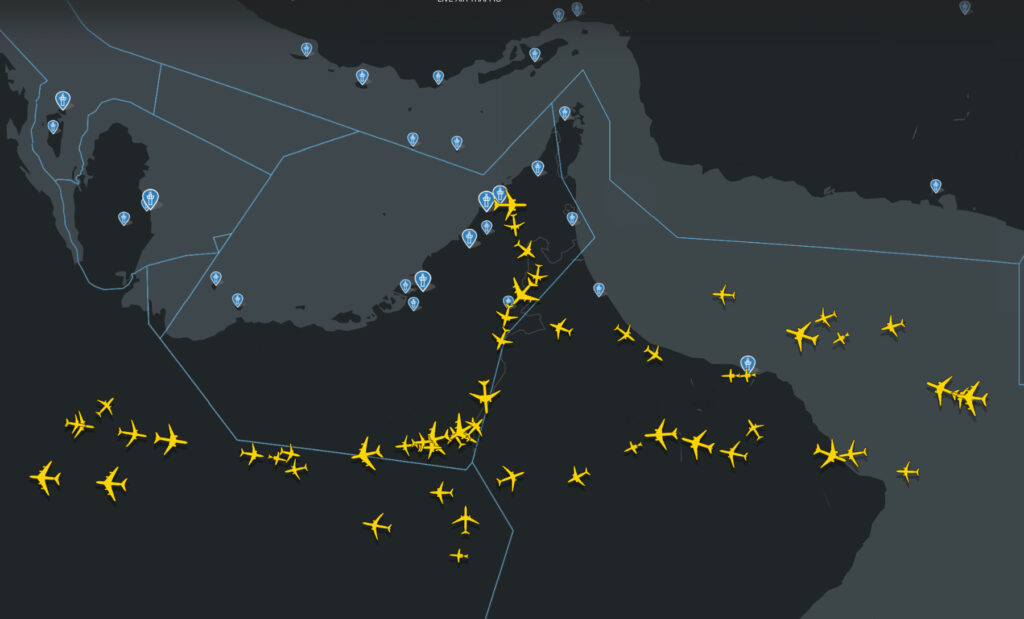
March 6 – Oman becoming a staging point
Flightradar24 reported that OOMM/Muscat was becoming a staging point for evacuation and repositioning flights. Airline and private aircraft were using the airport to position for repatriation flights, as it sits just outside the most restricted Gulf airspace while still providing access to the southern bypass route via Saudi Arabia and Egypt.
March 5 – Azerbaijan drone strike
Iranian drones crossed the Iran-Azerbaijan border early on March 5 and one struck the terminal building at UBBN/Nakhchivan airport. Damage appeared limited to the terminal area with no confirmed runway impact. This was the first time the current Iran conflict spilled into the Caucasus, close to the Armenia-Azerbaijan overflight corridor used by traffic avoiding the Middle East airspace closures. No impact was reported to UBBB/Baku airport or the main overflight flows.
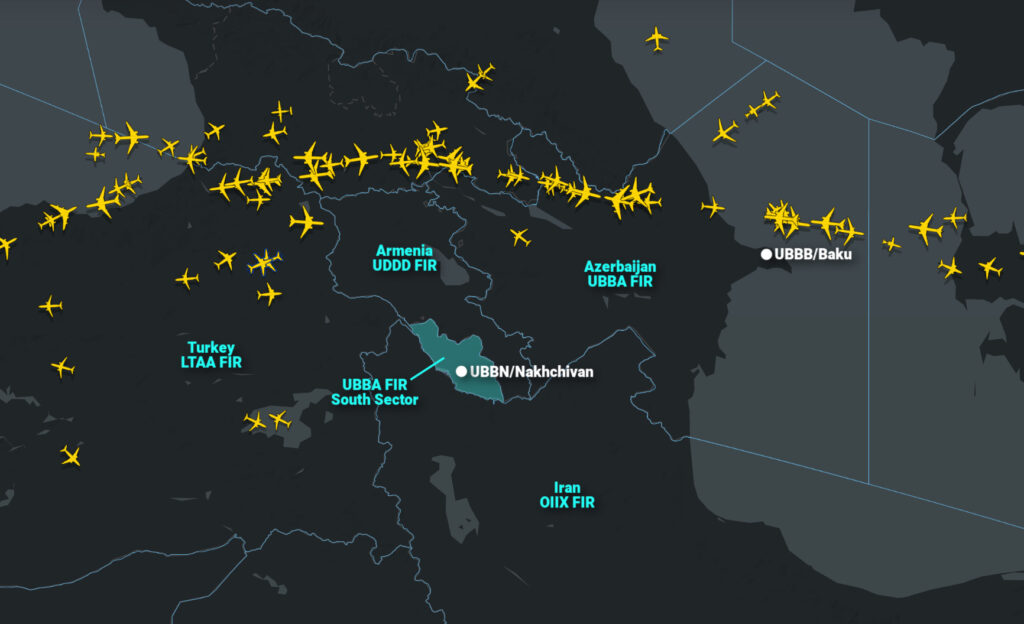
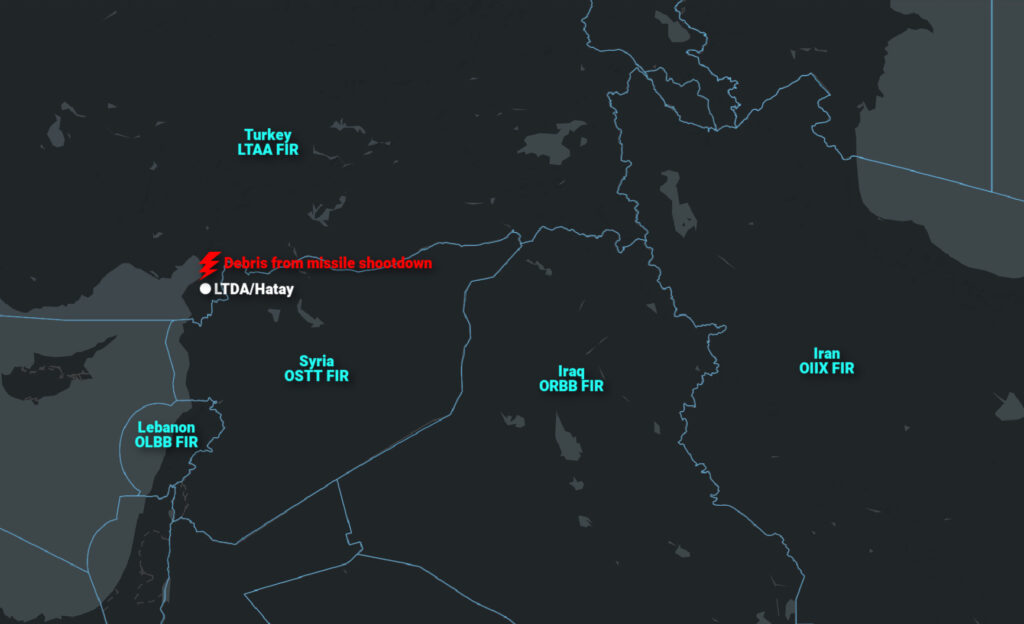
March 4 – Missile interception over Turkey
On March 4, a ballistic missile launched from Iran travelled west and was intercepted over southern Turkey by NATO air defence systems. Debris was reported to have fallen in the Hatay region near the Syrian border. Turkish airspace remained open and there was no operational impact reported, but the incident highlighted how far west some of the missile activity associated with the conflict was extending.
March 3 – Riyadh, Saudi Arabia
Iranian drones struck the US Embassy area during overnight attacks on Saudi Arabia. Damage was reported in the area, though Saudi air defences intercepted several other drones targeting the city.
March 1-2 – Cyprus
A drone strike caused minor damage at RAF Akrotiri, a major UK airbase used for regional military operations. Nearby LCPH/Paphos airport was briefly evacuated after radar detected a potential aerial threat approaching the island.
Since Feb 28 – Israel and Iran
US and Israeli strikes on Iranian military targets triggered ongoing Iranian missile and drone retaliation across Israel and several Gulf states. Multiple waves of attacks targeted military bases and infrastructure across the region, leading to widespread airspace closures and disruption to normal Middle East flight routes.
If you have operated in the region recently and could share your experience, send us an anonymous Airport Spy report or email us at team@ops.group.



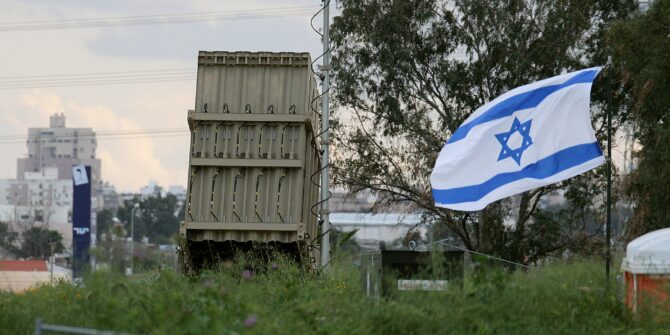
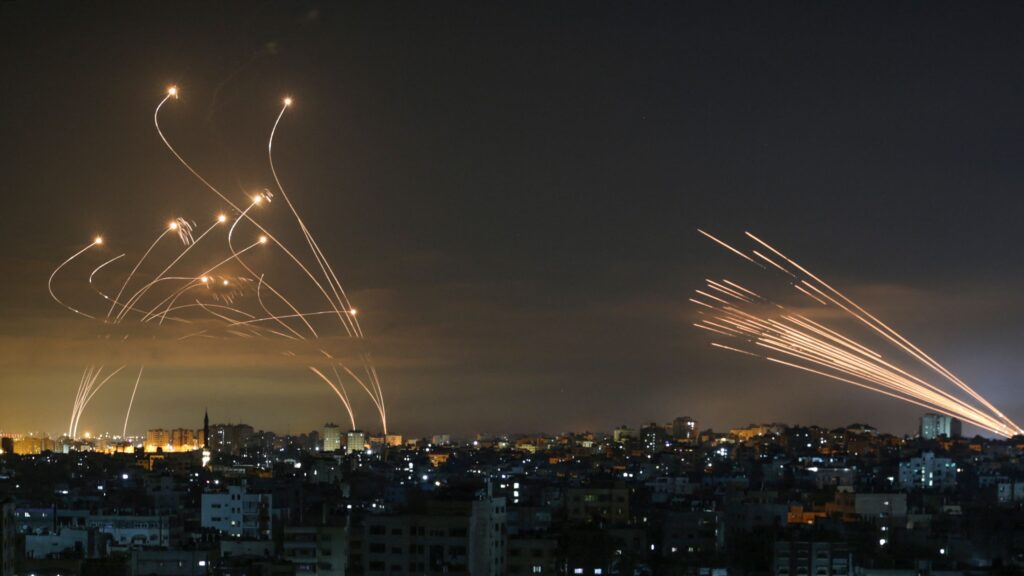 Israel has an Air Defense System – “Iron Dome” which protects populated areas of Tel Aviv from rocket attacks by launching interceptor missiles to ensure rockets detonate prior to reaching the ground, minimizing damage. However, the sheer number of rockets launched resulted in several impacting the city.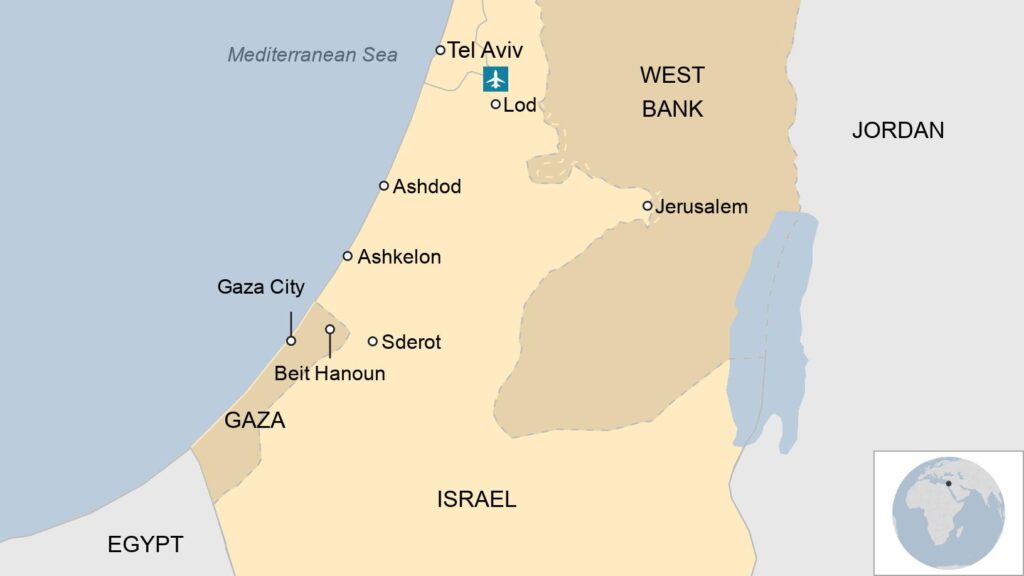
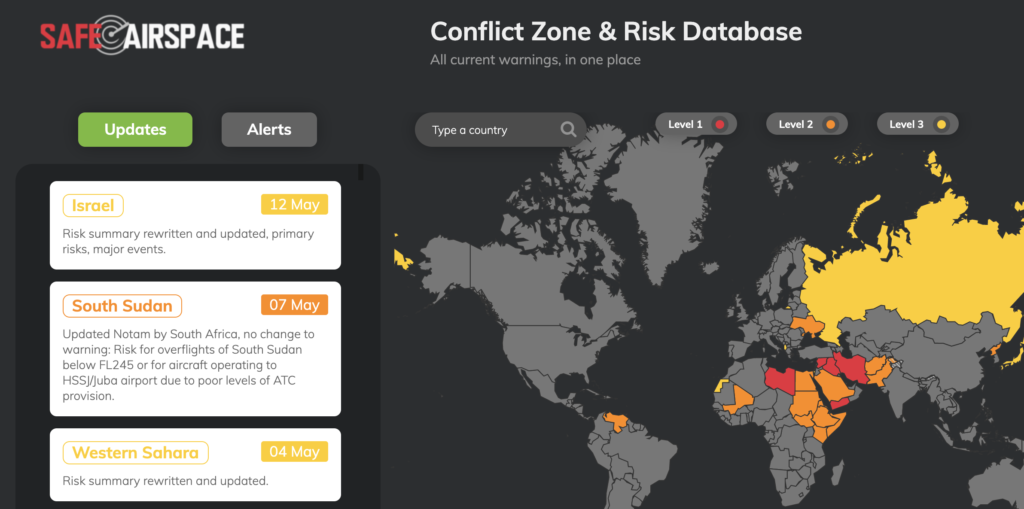

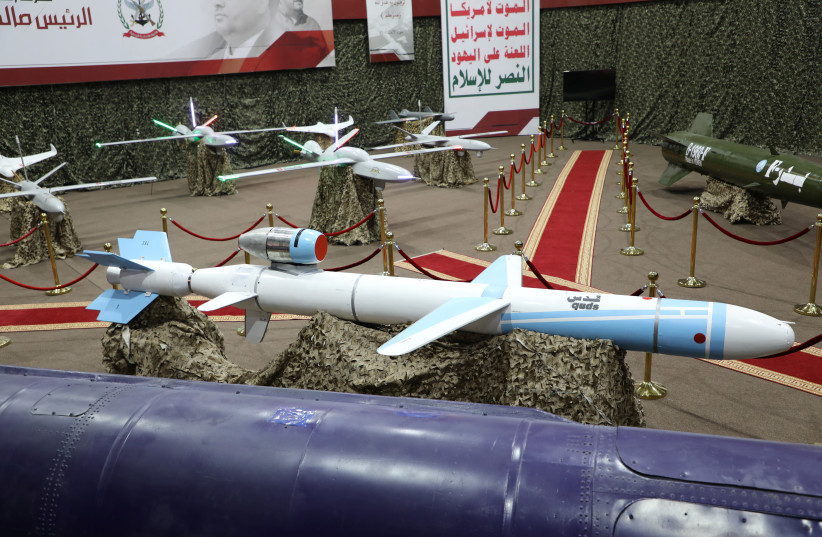
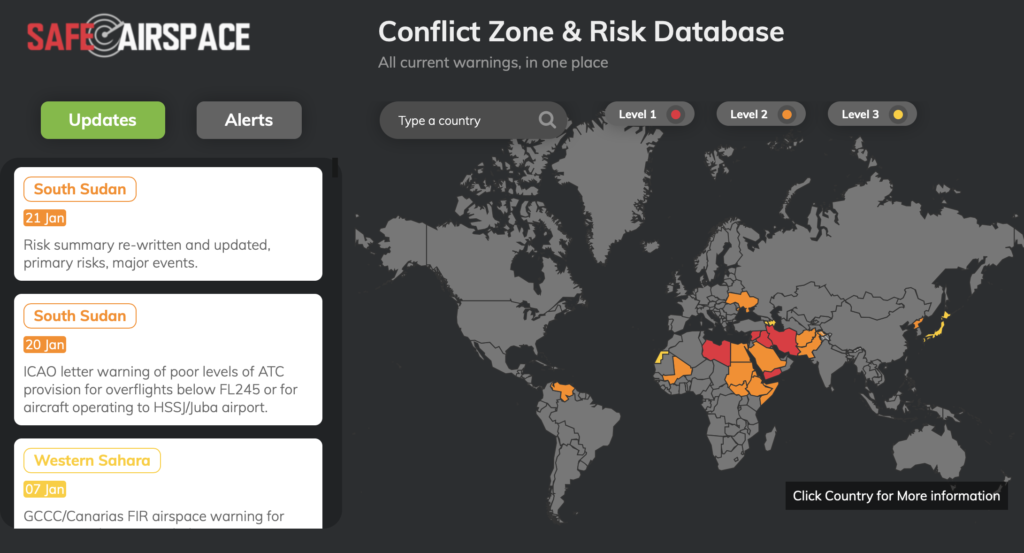
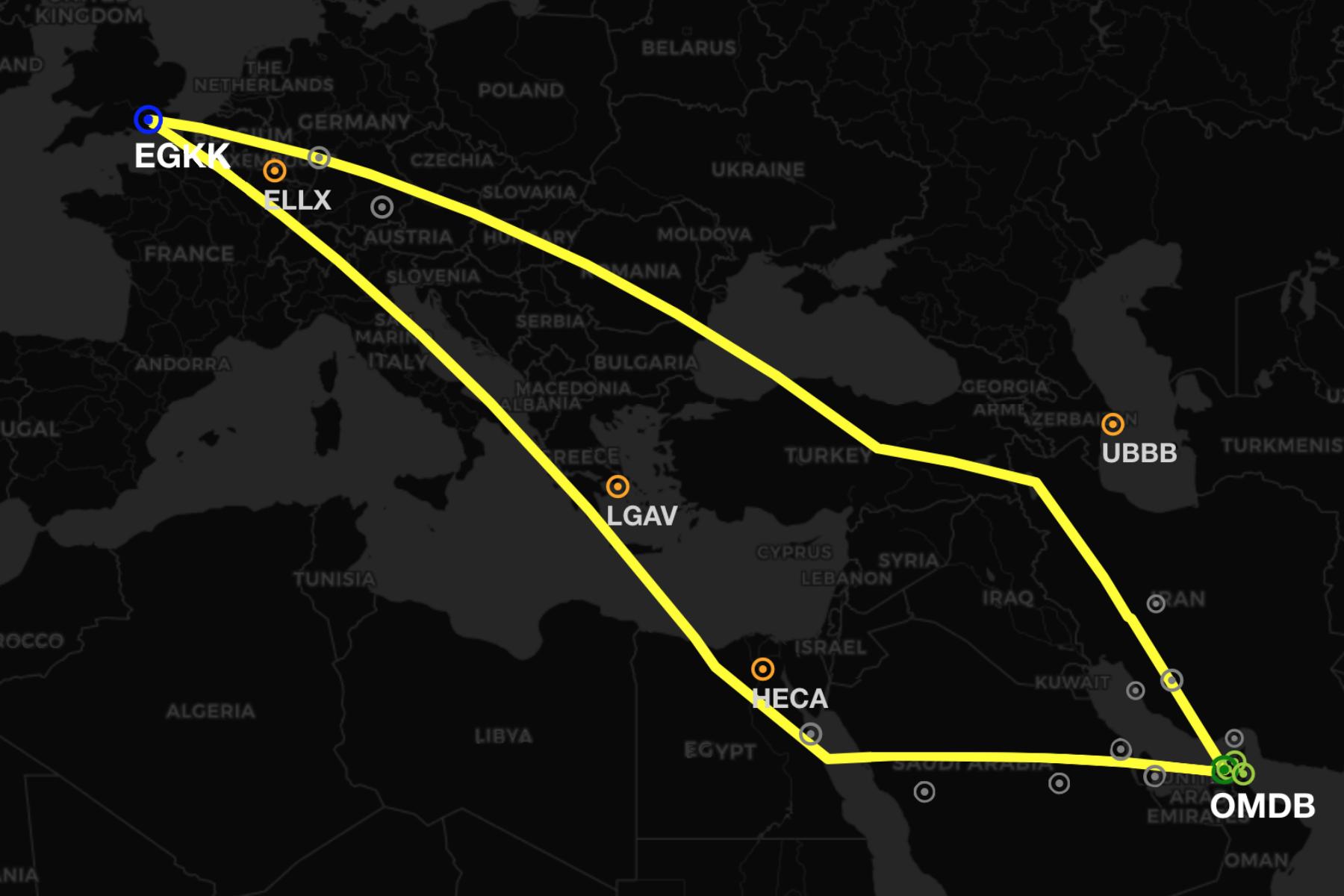
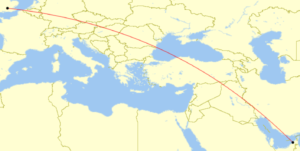 There are more business aviation operators flying between the Middle East and Europe than ever before. So we took the time to look over the route options between the two regions. For our example we will be using a flight from Dubai to London, but similar operational considerations are valid for the plethora of route combinations through this whole region.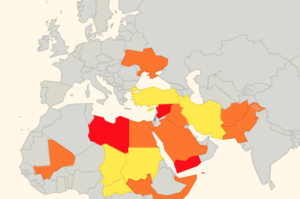
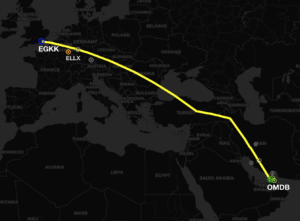 Safety: Both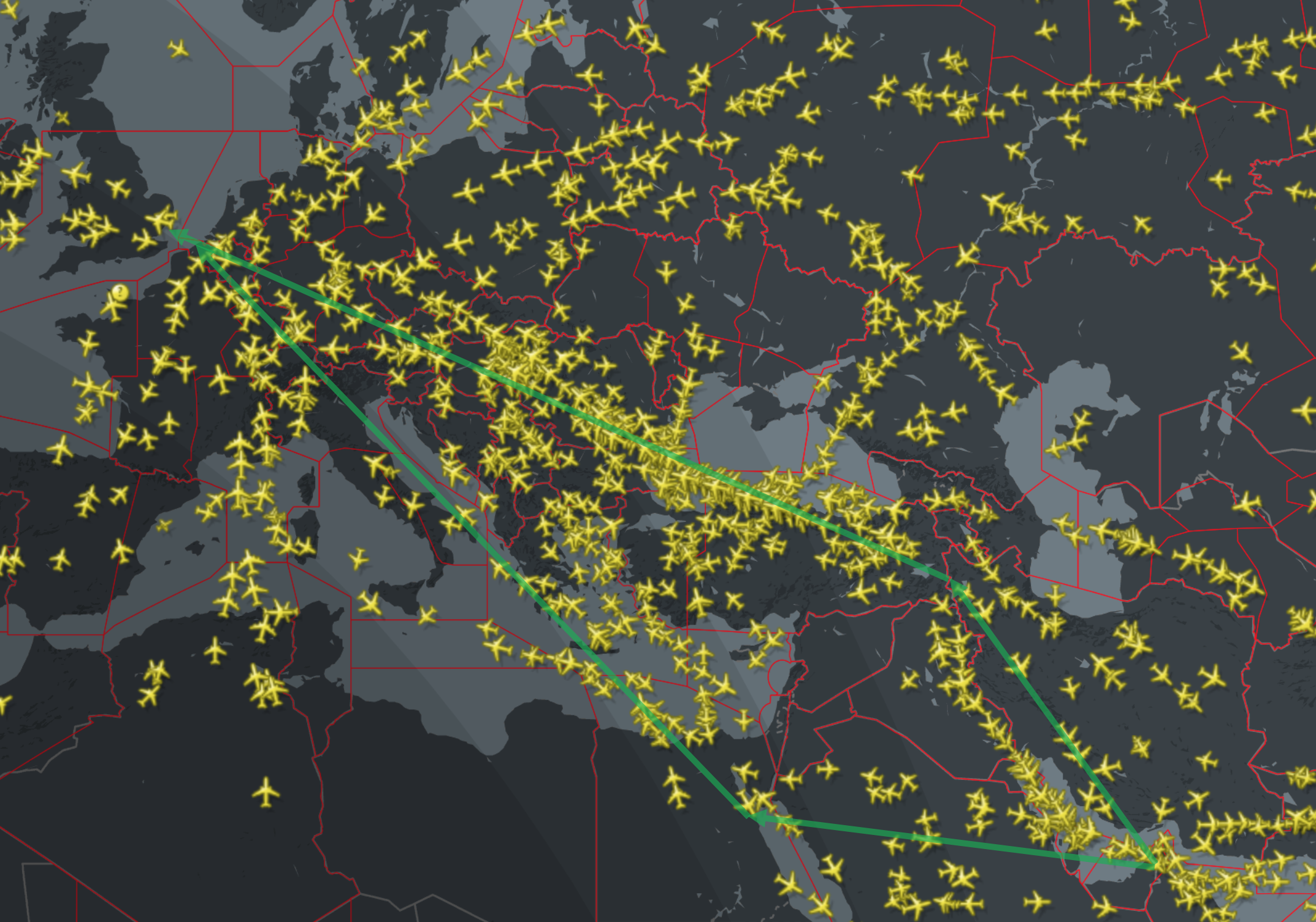
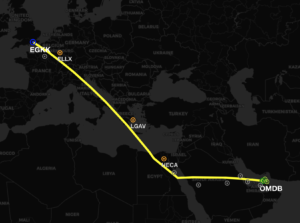 Safety: In terms of airspace warnings and risk, this route is slightly better. We have rated