Regulatory deadlines on the horizon

Regulatory compliance – nothing quite warms the heart like reading those two words, side by side. This year has seen quite a few changes in this department already (thank you, NAT HLA!), but here is a list of some other regulatory deadlines on the horizon…

Dec 31, 2019 – Operations in North Atlantic

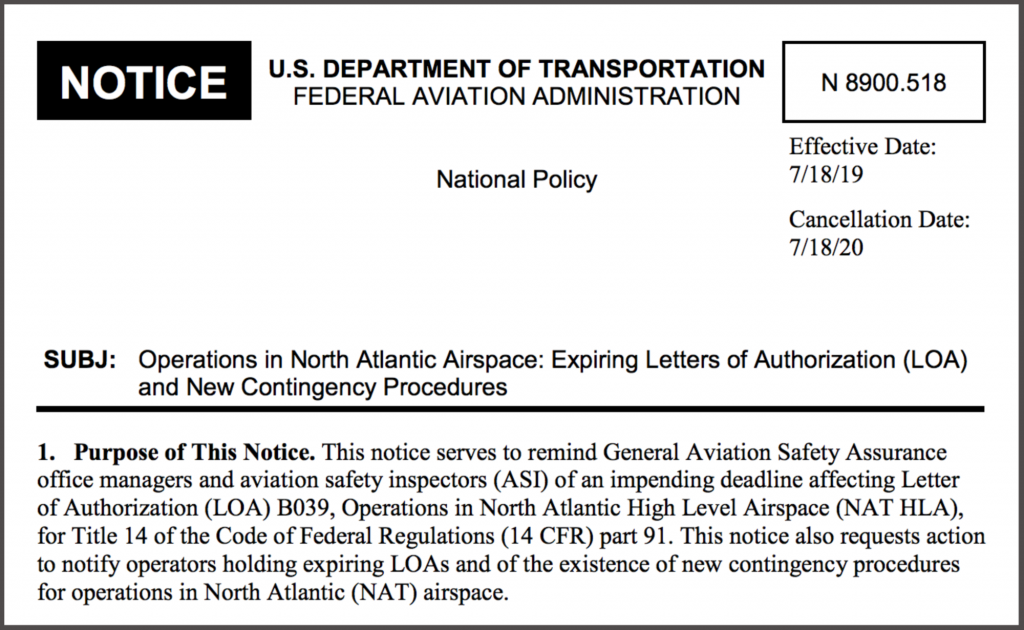
  • U.S. operators must have the revised LOA BO39: “Operations in North Atlantic High Level Airspace (NAT HLA)”. Operators holding the old MNPS LOA BO39 will not be permitted to fly in the NAT HLA beyond this date. Requirements include: RNP10, crew training and new contingency procedures incorporated in company operating handbooks. Read our article here.
Jan 1, 2020 – US ADS-B Out Mandate

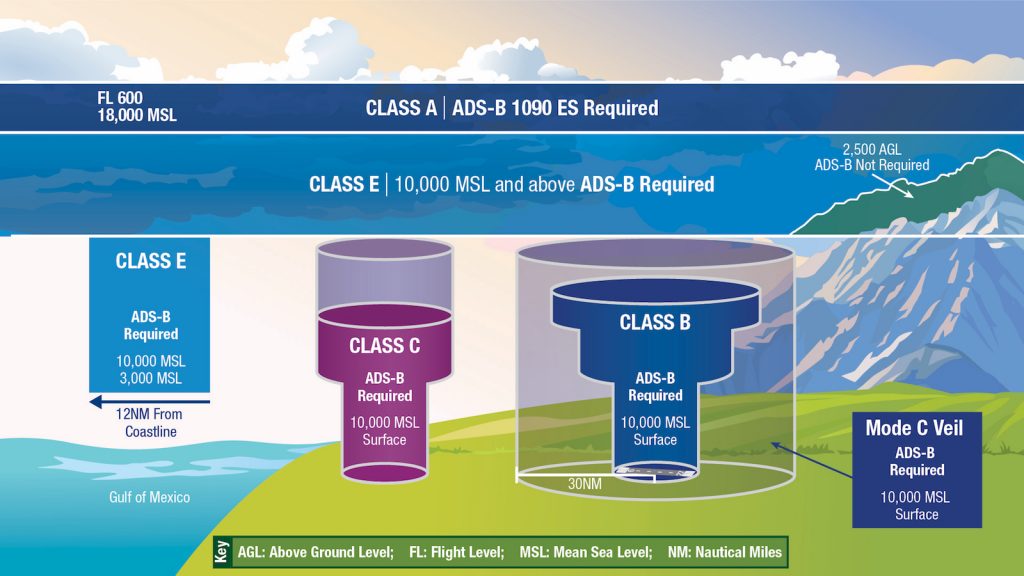
  • ADS-B Out will be required where Mode C is required AND:
  • Class A, B and C airspace, Class E at or above 10,000’ MSL (but not below 2,500’ AGL).
  • Within 30nm of Class B (Mode C veil).
  • Above the ceiling and within lateral boundaries of Class B and C up to 10,000’.
  • Class E over Gulf of Mexico, at and above 3000’ MSL within 12 nm of US coast.
Jan 30, 2020 – Expansion of Datalink Mandate in the North Atlantic

  • Phase 2C of North Atlantic Datalink Mandate. FANS 1/A CPDLC and ADS-C will be required between FL290-FL410 throughout the entire NAT region (previously FL350-390). Read our article here.

Feb 5, 2020 – European Datalink Mandate

  • Initially legacy aircraft flying above FL290 in European airspace were to be equipped with CPDLC capability by Feb 2015. But due to equipage requirements and technical issues the mandate was delayed to Feb 2020, AND, even better, most GA/BA aircraft will be exempt from this. Read our article here.

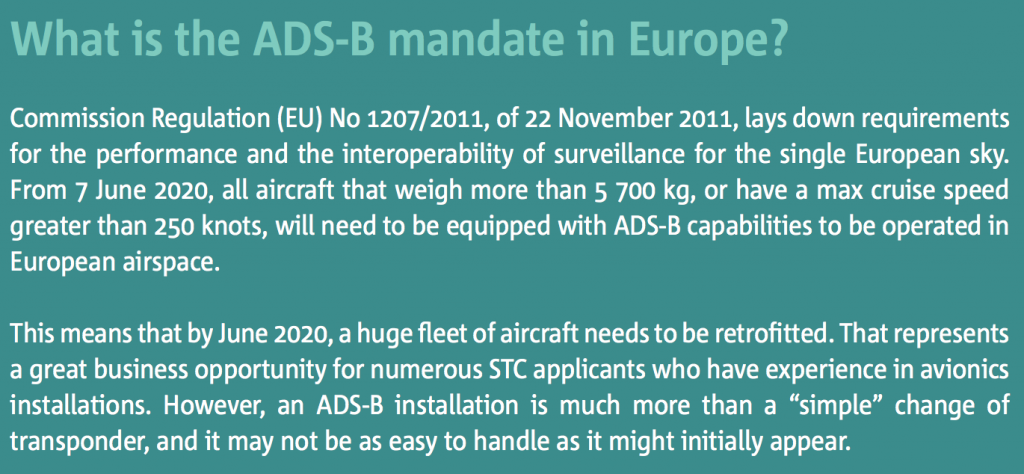
June 7, 2020 – European ADS-B Out Mandate

  • Aircraft flying IFR in Europe with max certified takeoff weight of more than 5700kg (12,566lbs) OR max cruising TAS of more than 250kts must be equipped with ADS-B. GPS sensor with at least WAAS accuracy coupled to a 1090 Extended Squitter transponder required.

DELAYED:

Canada: ADS-B Out Mandate

  • This was planned to be implemented in Class A airspace from Feb 2021, and Class B airspace from Jan 2022. But Nav Canada has now postponed this mandate. They still plan on using ADS-B for surveillance, and this will be used on a priority basis for suitably equipped aircraft starting in 2021, but they say – “non ADS-B Out equipped aircraft will be accommodated within the airspace until a performance requirements mandate can be implemented.”

ALSO ON THE HORIZON:

August 14, 2020 – EU: SAFA Ramp Checks & Pilot Mental Health

  • EASA regulations requiring alcohol testing during ramp checks will take effect across all SAFA participating countries (although some countries have already started doing this: Austria, Belgium, Czech Republic, France, Germany, Greece, Iceland, Ireland, Italy, Netherlands, Portugal, Spain, Switzerland, UK, and Singapore). Tests may also be carried out by local police at any time.
  • All pilots working for European airlines will have access to mental health support programs.
  • European airlines will perform a psychological assessment of their pilots before the start of employment.

Any other biggies that we missed? Let us know!

July 2019 North Atlantic Update

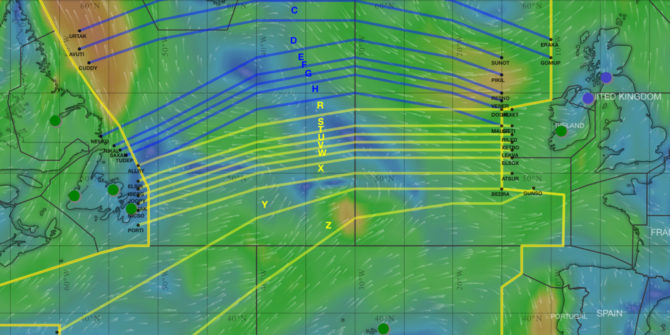
There are four new things to tell you about the North Atlantic, following the flurry of new and updated NAT Bulletins that ICAO issued last week. Get ready for some acronyms! Here’s a summary:

1. OWAFS

Operations Without an Assigned Fixed Speed
ICAO NAT Bulletin 2019_001

We wrote about this before. This Bulletin just formalises the practice that has already been in place since April 2019 in the Shanwick, Santa Maria, and New York Oceanic FIRs (not WATRS).

Here’s how it works: You’ll get a normal oceanic clearance, with a fixed Mach Number, like you always did. But then somewhere after the Oceanic Entry Point, you may get a CPDLC message saying RESUME NORMAL SPEED. You should reply with WILCO. What that means is: Fly ECON, or a Cost Index with Variable Mach. You can fly within 0.01 up or down of your cleared Mach, but if it varies by 0.02 or more you must advise ATC.


2. ASEPS

Advanced Surveillance Enhanced Procedural Separation
ICAO NAT Bulletin 2019_002

ASEPS was another trial that started in April 2019 – this time in the Shanwick, Gander and Santa Maria FIRs.

So far it has only been for longitudinal separation, which can be brought down to as close as 14NM for compliant aircraft (RVSM/HLA approval, ADS-B, and fully PBCS compliant – which means meeting the specifications of RNP4, RCP240 and RSP180).

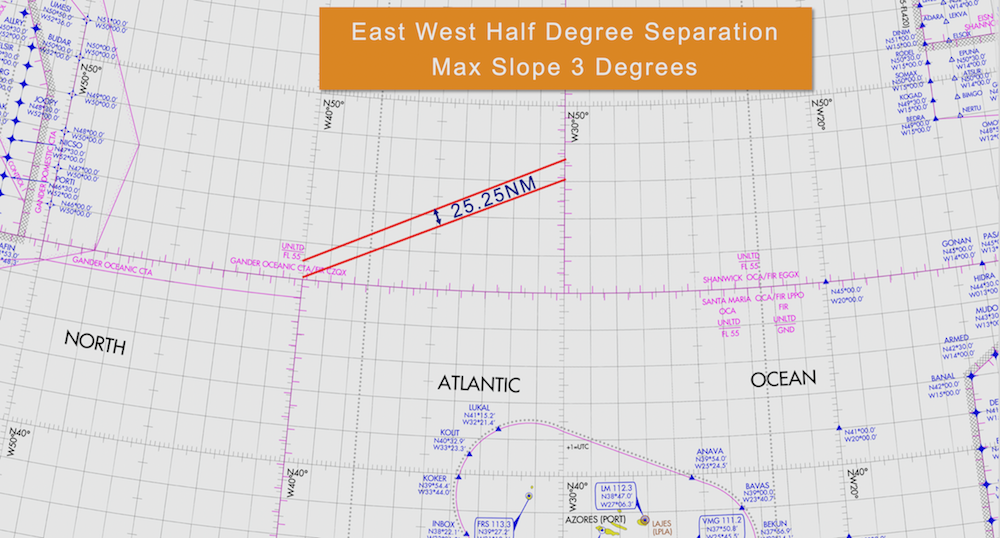
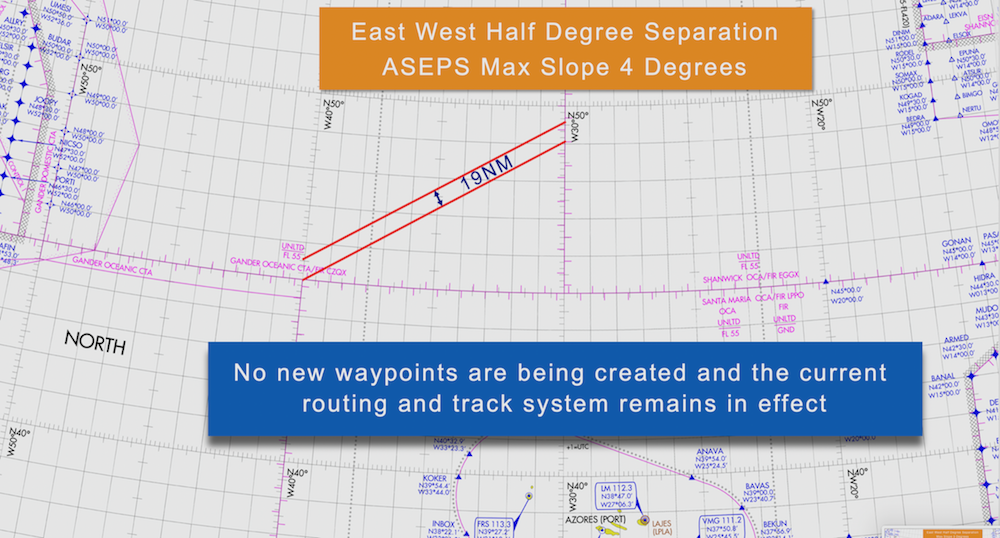
But in the new Bulletin, from October 2019 they plan to reduce lateral separation for compliant aircraft as well – down to 19NM from the previous limit of 25NM.

There are no plans to change the design of the NAT Tracks, which will continue to be spaced 25NM apart. The initial benefit of the 19NM lateral separation will basically just be that steeper route angles will now be available for pairs of aircraft flying parallel routes outside of the NAT Track system – the current “gentle sloping turn” limitation is 3 degrees latitude between 10 degrees of longitude, but on 10th October 2019 that will change to a limitation of 4 degrees latitude between 10 degrees of longitude. The result of this will be a lateral separation of 19NM on the steeper turning routes.

Images courtesy of 30WestIP


3. Data Link Performance Improvement Options

ICAO NAT Bulletin 2019_003

Nothing to worry about, this is just a list of common datalink errors and what to do about them.

Two key take-aways:

  1. Update your aircraft avionics software as soon as updates are available.
  2. Answer your messages within 60 seconds or send a Standby message (recent data indicates Business Aviation operators are very bad at this).


4. NAT DLM – The North Atlantic Data Link Mandate

ICAO NAT Bulletin 2017_001_Revision 04

This one is just a slight revision to the plans for the datalink mandate. Datalink is currently required between FL350-390 in the NAT region, and from 30th Jan 2020 this mandate will be extended to between FL290-410.

So with this revised Bulletin, the change is that they have decided they will cap it at FL410 – whereas previously there were no plans for any upper limit at all. This will basically match the NAT HLA and RVSM vertical limits and makes sense. This will allow non-compliant aircraft to continue to operate at FL430 and above – mostly GA/BA operators.


Further reading:

Special thanks to Mitch Launius at 30WestIP.com for help with this post. For assistance with international procedures training for business aviation crews worldwide, check out the website.