Lebanon Risk Update

- Overflights risks of the OLBB/Beirut FIR are increasing. The outbreak of a larger scale conflict between Israel and Hezbollah is increasingly likely.
- Several airlines (Air France, Eurowings, Lufthansa, Swiss, Transavia and Middle East Airlines – the Lebanese flag carrier) have temporarily suspended flights to OLBA/Beirut airport.
- Canada has issued a new Notam (July 30) advising operators to avoid Lebanese airspace at all levels.
- Surface-to-air weaponry may be present capable of reaching aircraft at all altitudes.
Risk to aircraft operating over Lebanon is increasing
There was a significant escalation in hostilities between Israel and Hezbollah in Lebanon over the weekend.
On July 27 a suspected Hezbollah rocket attack caused Israeli casualties in the Golan Heights region – although Hezbollah has been uncharacteristically quick to deny their involvement.
This was quickly followed by Israeli airstrikes well inside Lebanese territory.
The US Embassy has since issued an alert to citizens that scheduled flights to/from Beirut may change or be cancelled at short notice. They’re also recommending anyone there develop a ‘crisis plan’ to leave if the current situation escalates.
There is widespread concern that the two sides could imminently be drawn into a full-scale conflict. In which case the risk picture for aircraft in both the LLLL/Tel Aviv and OLBB/Beirut FIR could change dramatically.
Here is a brief summary of the situation.
Why are Israel and Hezbollah fighting?
The two have fought in several wars – the latest was in 2006. The background to these hostilities is beyond the scope and intent of this article – but you can read more about that here.
The most recent cross-border fighting began almost immediately after the Hamas assault in Southern Israel which sparked the current war in Gaza.
The situation in Gaza has mobilised Iranian-backed militants across the region to act, and Hezbollah is widely considered one of the most powerfully equipped.
Hezbollah has said they will not stop hostilities against Israel until there is a cease-fire in Gaza.
So Far…
Since the start of the war in Gaza, sporadic fighting across the Israeli/Lebanese border has been almost a daily occurrence. It is not immediately obvious in existing airspace warnings just how frequent these skirmishes have become.
Here is a statistic that may cause alarm to traffic regularly overflying – as of the end of June, the media reported 7,400 cross-border attacks between Israel and Hezbollah in the preceding nine months.
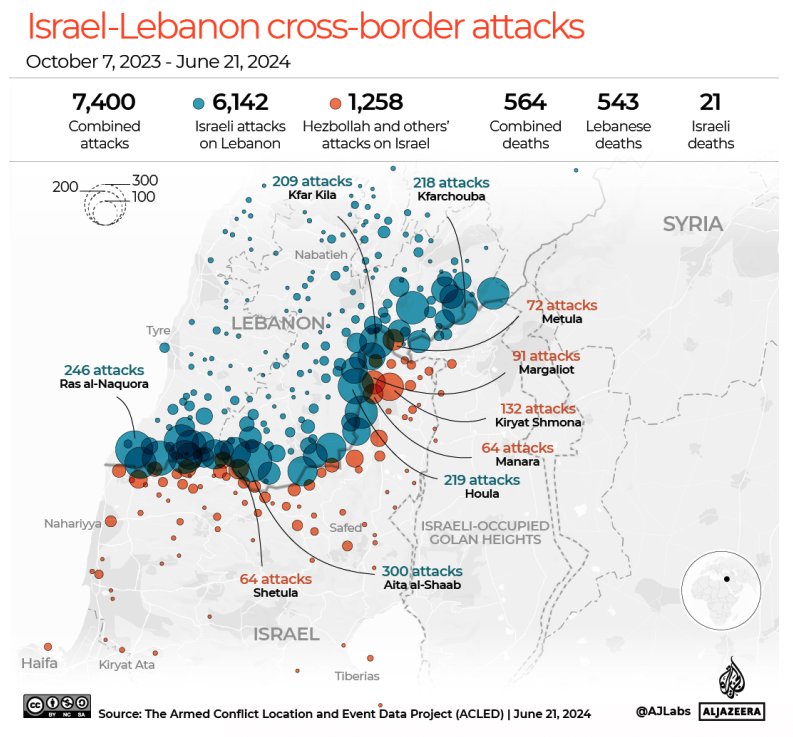 This has included artillery firing, rocket attacks, missiles, drones, and of most concern – air defense activations on both sides. Various instances of false identification have been reported.
This fighting has mostly been constrained. If a full-scale conflict develops as feared, things may get a lot worse.
In the skies
Just last month, Hezbollah reported targeting Israeli fighter jets using surface-to-air missiles for the first time. Existing airspace warnings for the OLBB/Beirut FIR do not any mention level restrictions.
There has been some credible concern recently that Hezbollah might possess more sophisticated surface-to-air weaponry. One report speculates this includes mobile Iranian made radar-guided SAMs which are capable of targeting aircraft as high as 90,000 feet with range of up to 100kms (depending on the variant).
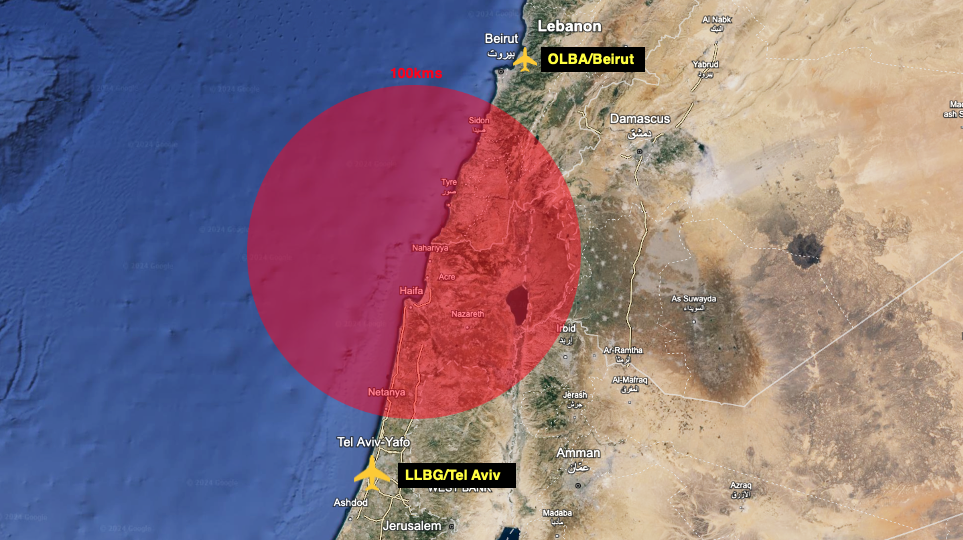
Advanced surface-to-air missile range (100kms), as seen from a point along the Lebanese border.
The Wall Street Journal have also suggested another system may be present with similar capabilities supplied by Wagner Group mercenaries.
It is possible we have just not seen these types of weapons used by Hezbollah in this conflict to date.
While the LLLL/Tel Aviv FIR has arguably been a masterclass in how to maintain safe and informed overflights near a conflict zone in recent month, should a larger conflict arise it is unlikely the safety of civil aircraft in the OLBB/Beirut FIR will be protected to the same extent.
Existing Airspace Warnings
We maintain a Safe Airspace Risk Level of Two (Danger Exists) for the OLBB/Beirut FIR.
Here is a summary of existing state-issued airspace warnings for Lebanon:
- Canada Operators should not enter the OLBB Beirut FIR at all levels due to risk of military activity. CZQX Notam H3476/24. New, July 29.
- US FAA Exercise caution within 200nm of the Damascus FIR due to military activity. Possibility of GPS interference, communication jamming, and long-range surface to air missiles in the area. KICZ Notam A0009/18.
- United Kingdom Caution to UK operators in the OLBB/Beirut FIR due to potential risk from military activity. EGTT Notam V0025/24.
Why have these warnings not been upgraded?
History has taught us that we need to be more responsive to airspace threats – a danger may exist or develop before states publish official airspace warnings or restrictions. And all of that takes time.
The events of the past days have happened quickly, and extensive diplomatic efforts are now underway to prevent a larger-scale conflict in the Middle East, but it remains to be seen if one can be avoided. We’re monitoring the situation closely – keep an eye on safeairspace.net for updates.