French ATC Strike: Sep 18

Update 17 Sep 2025
  • France’s main ATC union SNCTA has called off its Sep 18 strike, but other unions are still striking.
  • The strike will run 0400z Sep 18 to 0600z Sep 19 (per LFFF Notam F1302/25).
  • Morning will be worst affected, especially LFMM/Marseille ACC east sectors, with delays expected to improve later in the day. LFFF/Paris ACC will see some regulations, but no major network-wide disruption expected there.
  • LFSB/Basel will have very limited capacity. LFBL/Limoges will be closed all day. LFBE/Bergerac and LFTW/Nimes may partially close depending on staffing levels.
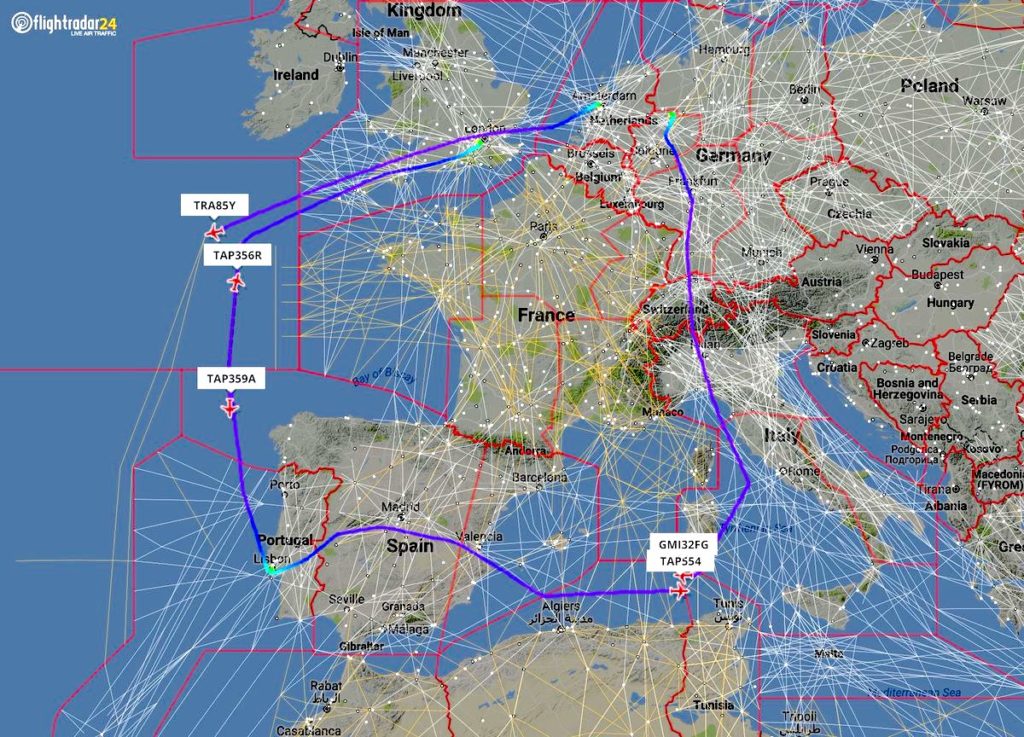
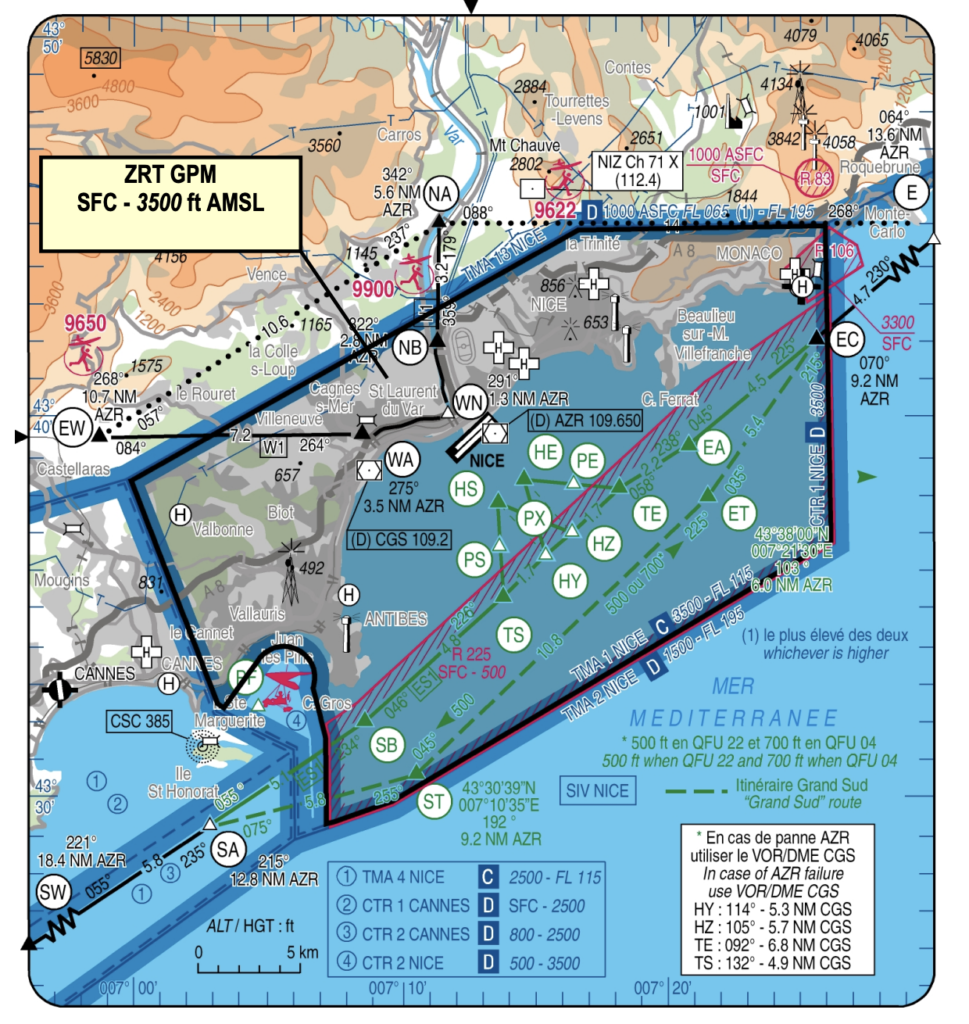
  • Eurocontrol has disabled certain route restrictions and opened additional routings to help manage traffic flow, including via Italy for LFMN/Nice departures and arrivals, and special routings over DTTC/Tunis and DAAA/Algeria FIRs. Check Eurocontrol’s Mitigation Plan for more info.
  • The next planned French ATC strike is Oct 7-10, expected to cause major disruption.

How to survive a French ATC strike

Each French ATC strike is different, but there are some things that are pretty much the same every time. Here is what you need to know, in order to survive!

What happens?

There’s a normal pattern to French ATC strikes – controllers who are unhappy about a range of issues (mainly salaries and labour reforms) announce they plan to go on strike, Eurocontrol puts a plan in place to mitigate the disruption as best as possible, and airlines start cancelling flights – sometimes voluntarily, other times under the instruction to reduce their schedules.

So let’s break that down a bit…

How do strikes get announced?

Often on the Notams, to start with. And the Notams that get published prior to these strikes are often fairly similar, and tend to be a bit vague. That’s because they never know exactly how many staff will go on strike until the day itself, when they look around the control room and count the number of empty seats.

Then what happens?

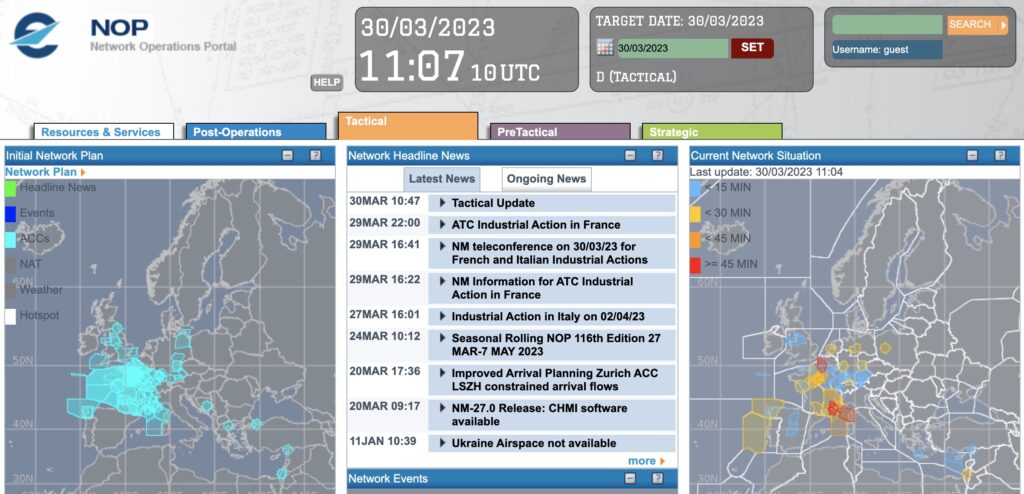
Eurocontrol tell us about the Notams – in the “Network Headline News” section at the top of the NOP website.

strike fest

Then they start figuring out what they think the impact will be. They normally host a teleconference or two, where a bunch of their ATC personnel jump on a call with airlines and other interested parties to discuss what they think will happen.

Then they publish a “Mitigation Plan”. This tells you:

  • Their best guess of how bad the strike is going to be
  • What to expect for flights to France
  • How best to avoid French airspace.

The big day arrives… it’s strike time!

Smaller airports – These tend to have the harshest restrictions applied, often with periods where no ATS services are provided at all.

Bigger airports – During the really big strikes, the larger airports can get hit pretty hard too, and when Notams start getting published saying “MINIMUM SERVICE”, that’s when you know that things are getting serious – as that basically means that only 50% of FPLs are being accepted (the absolute minimum allowed under French law, regardless of whether or not a strike is taking place).

Impact – The airlines will often be told to cut their schedules at the big airports. For the rest of us, expect delays if flying to airports in France as well as for French overflights – because unlike most other countries in Europe, when French ATC goes on strike, there’s no special exemption for overflights!

French ATC strikes may also impact French overseas territories – so keen an eye on the Notams at the likes of NTAA/Tahiti, SOCA/Cayenne, TFFF/Martinique, TFFR/Pointe a Pitre, FMEE/La Réunion, and FMCZ/Mayotte airports as well as those in France.

Where to look for live updates?

For real-time updates of any airspace issues once the strike has started, keep an eye on the “Tactical Update” section of the NOP, as well as this French ATC webpage: https://cdm.dsna.fr/

For smaller airports, best check the Notams directly, as they might get forgotten about in the deluge of information that gets published and endlessly updated for the other larger airports.

Routing around French airspace

The Mitigation Plan should be your first port of call here. Make sure you’re checking the latest version. It will tell you what to do!

Here’s what it normally says, every time:

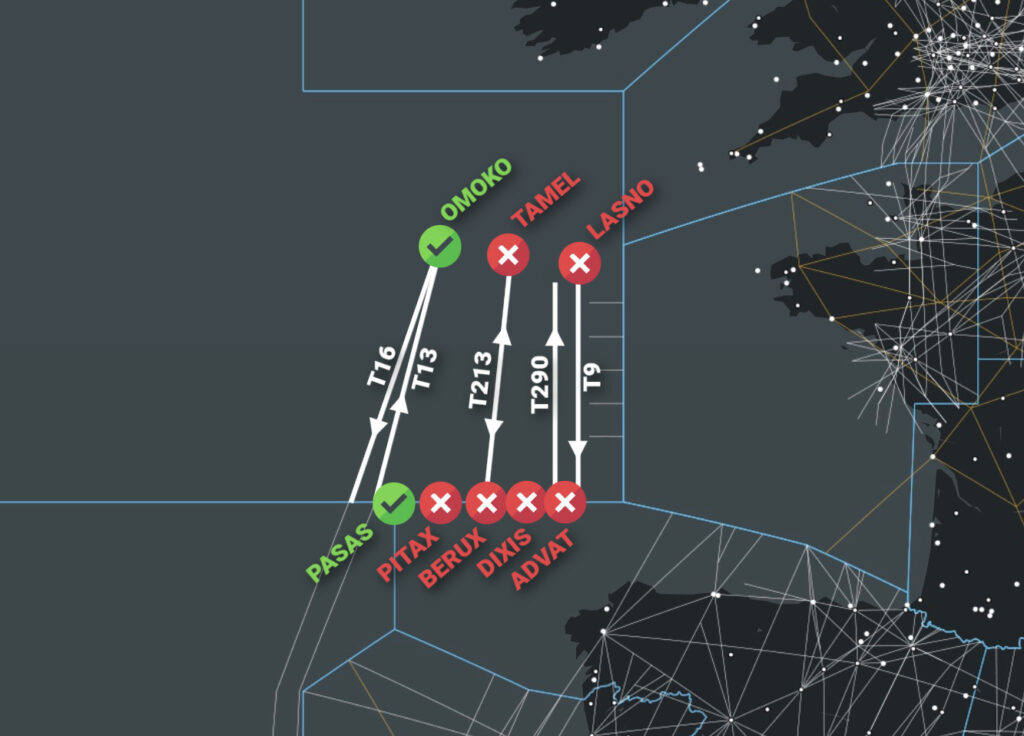
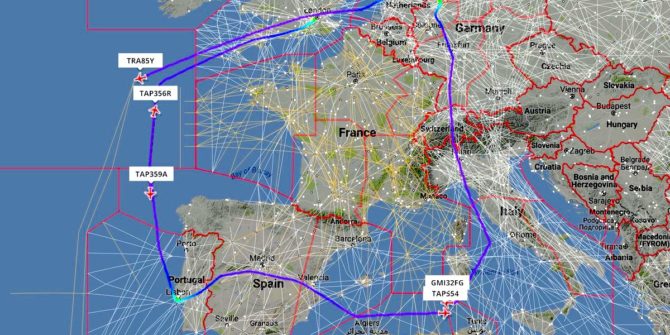
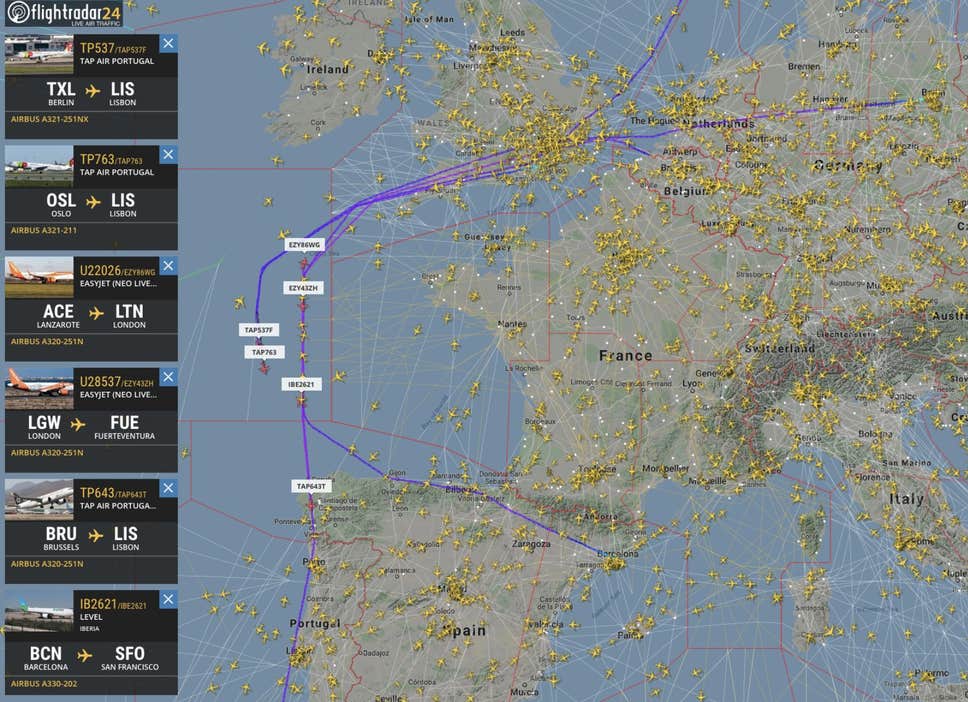
  • Tango Routes are subject to higher than normal demand when strikes are on. Flights intending to route to/from Canaries, Madeira and mainland Portuguese and Spanish destinations via the Shanwick Oceanic Control Area (OCA) are usually requested to flight plan via published routes T9, T213 or T16. During the strike period, ATC normally won’t let you cross from one Tango Route to another.
  • Tunisia allow overflights without the need for an overflight permit.
  • Algeria allow scheduled commercial flights to overfly its airspace without a permit, but all other flights must have one.
  • For routes through Tunisia/Algeria, check the Mitigation Plan for the permitted routings. And make sure to add the right AFTN codes on flight plans! That means as well as filing your FPL to the normal Eurocontrol addresses, you must also include those for Algeria (DAAAZQZX) and Tunisia (DTTCZQZX and DTTCZRZX) – and make sure these are included for any subsequent DLA messages as well.
  • Shanwick always publish something on the NOP telling us what entry points to use for NAT crossings. For westbound NAT crossings heading over the central Atlantic (rather than the NAT Tracks up north), they normally want us to file via OMOKO (or west of) or PASAS in order to best avoid all the extra traffic on the Tango routes. If you’re entering the Shanwick OCA, you must have HF radio. And for oceanic clearance during the strike, you need to make sure you request your oceanic clearance 40 minutes before entry to the ocean.


France Summer BizAv Parking Tips

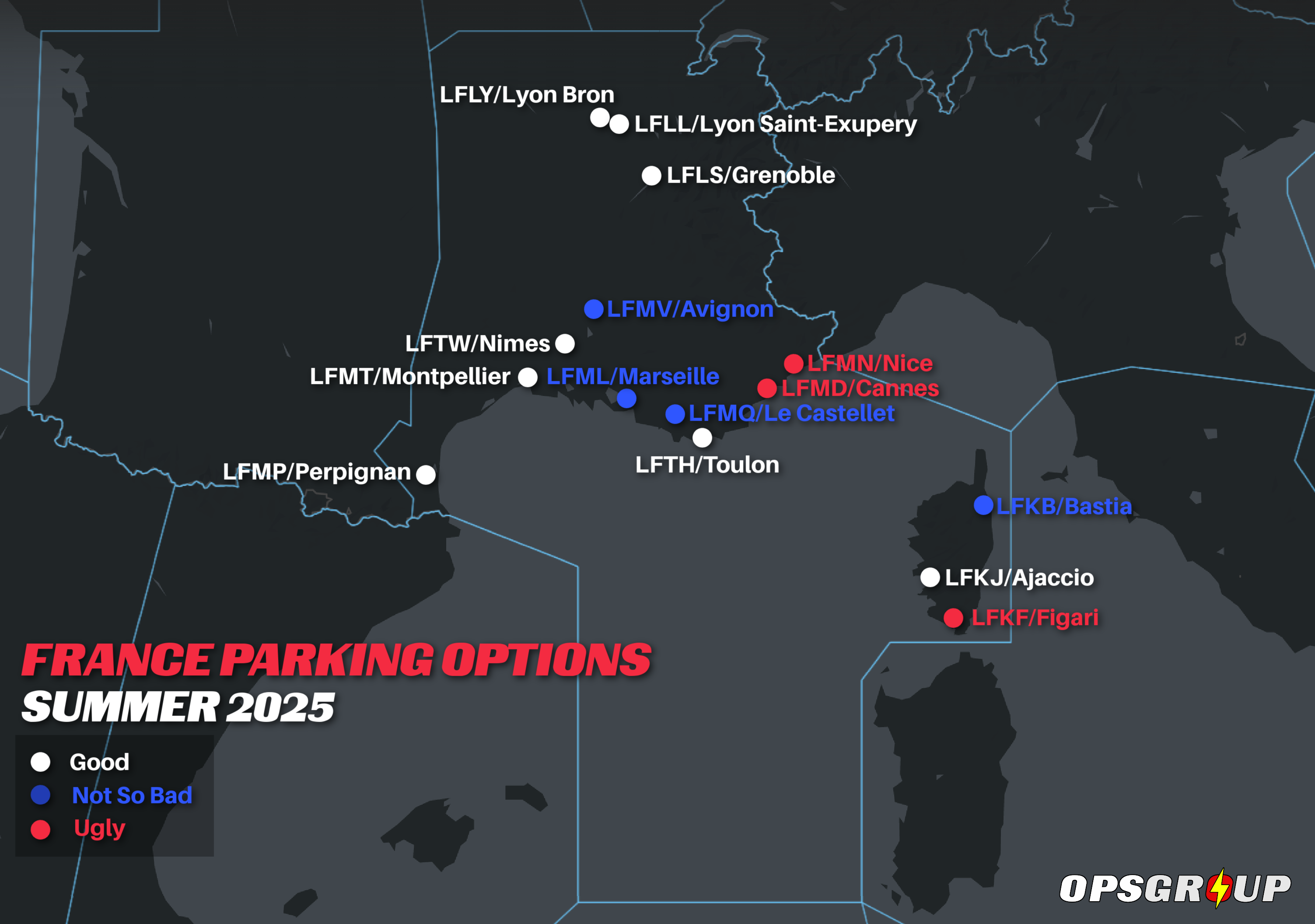
France is facing the same summer congestion we’ve seen in Spain and Greece: packed ramps, limited slot availability, and strict parking rules – both for location and duration. From the Côte d’Azur to Corsica and key inland airports, space is tight. But there are still some options if you know where to look. Here’s what we’ve found so far.

Common Themes Across France
  • Plan ahead. Most airports require advance notice for parking and handling – anywhere from 24 to 72 hours – usually via MyHandling.
  • Customs and Gendec: For international arrivals, most airports expect crew and pax lists to be submitted 24 hours ahead, even for Schengen flights.
  • Slots or PPR? It depends. Some airports like LFML/Marseille are slot- and PPR-free but limited by physical stand space. Others have strict PPR or slot rules, and some impose restrictions based on Schengen/non-Schengen status.
  • Nothing is guaranteed. Even with advance requests, parking isn’t always available – especially for longer stays. At LFMN/Nice, approval often comes just 7 days out. LFML/Marseille has only a few stands for 48h+ parking, and LFKF/Figari doesn’t allow overnight stays at all.
Riviera Airports – Busy, Tight But Accessible

LFMN/Nice

Nice has been very busy since May, and according to local FBOs, things aren’t getting any easier. If you’re planning to stay on the ground for more than 4 hours, expect a bit of a process. The airport is fully slot-controlled, and parking only gets confirmed once airport authorities approve your request – often just 7 days out.  Submitting a full schedule early gives you the best shot.

Slot tolerance is tight (+/–10 min arrival, –10/+15 min departure), and even small schedule changes can mean losing both slots and parking. Once confirmed, the slot ID needs to be in Field 18 of your FPL.

APU use is also limited to just 10 minutes before TSAT, and only after towing. Until then, it’s ground power only. But several OPSGROUP members have reported issues with GPUs and overheating, especially in high temps. For a deeper look, check out our article on heat damage in Nice.

Fuel delays are common too. Airline traffic takes priority, and BizAv can end up waiting. Crews must be onboard during refueling, so best to show up early before ETD just in case. Multiple fuel providers operate at LFMN, and availability can vary depending on the day and time.

FBO contacts:

LFMD/Cannes

Cannes may be scenic, but it’s not built for bigger jets. The airport has strict aircraft restrictions: no jets over 35T MTOW, and no turboprops over 22T. Slots are mandatory from May 12 – Sep 15, when the airport is fully coordinated for the summer season. The control tower is active from 0800 LT to sunset +30 minutes. Handling services may operate on a different schedule, so check with your local FBO directly. 

FBO contacts:

LFML/Marseille

Marseille offers a more relaxed entry point to the region, with fewer restrictions. The airport and customs are both H24. There’s no need for slots or PPR, and short-turn parking is usually available without much hassle. 

That said, longer stays are tricky – only four stands are available for 48h+, and they fill up quickly on a first-come, first-served basis. One or two nights might still be possible depending on traffic, but anything beyond that is unlikely in peak season.

FBO contacts:

Southern Coastal Options – Mixed Rules

LFTH/Toulon-Hyeres

Toulon is getting busier in the summer, but parking is still possible if you’re organized. The airport is open daily from 0800-2000 LT until Oct 28, with the possibility to arrange extensions. Customs hours are slightly different – available daily from 0800-1800 LT.
As a joint civil-military airport, LFTH has additional restrictions: according to the local FBO, flights before 0900 LT are currently not allowed due to military operations.

FBO contacts:

LFTZ/La Mole Saint-Tropez

The airport has restricted-use status, so only operators with special approval can use it. Pilots must meet specific training requirements depending on the aircraft.

If you’re thinking about flying into LFTZ, be ready for a bit of admin. The airport website and their AIP explain exactly what’s needed – from how to request access to the paperwork and pilot qualifications required. 

PPR is required and operations are permitted daily 0800-1900 LT in summer, with extensions available until sunset. Non-Schengen flights are only allowed July 1 – Oct 15, 0700-1700 LT, and any schedule changes must be re-approved.

FBO contacts:

Western Provence – Quieter Alternatives Inland

LFMT/Montpellier

Montpellier stands out as a dependable inland choice, even for heavier jets. While the airport can get busy at times, especially in peak summer weeks, it’s still worth considering if coastal airports are full. All non-based BizAv must request PPR at least 72 hours in advance. Handling is charged in full if cancelled less than 3 days before arrival and not charged if cancelled earlier.

FBO contact: Avia VIP: lfmt@aviavip.com 

LFTW/Nimes

Nimes is often overlooked, but can be a smart alternative if you plan ahead. The airport operates daily until 2000 LT. ATC is available until 1900 LT on weekdays and until 1600 LT on weekends. CIQ services are available daily from 0900-1800 LT.

FBO contact: Jetex: france@jetex.com 

LFMP/Perpignan

Perpignan is another inland option worth considering this summer. Local FBO confirms that parking is currently not congested and that the airport can accommodate larger bizjet like the G650. Parking availability is confirmed once a full schedule is submitted.

FBO contact: G-OPS: executive@g-ops.com

LFMV/Avignon

Avignon gives operators a welcome level of flexibility during the peak season. No PPR is required. The airport is open Mon-Fri from 0700-2130 LT, Sat until 1900 LT, and Sun from 0800-2000 LT. CIQ services are available daily until 2300 LT.

FBO contacts:

LFMQ/Le Castellet

Castellet remains a niche but functional option for those who can work with the limitations. Customs is available for Schengen traffic only – international (non-Schengen) flights are not permitted.

The airport operates daily 0900-1800 LT during summer. Extensions must be requested by 1600 LT the day before. Slots are required.

FBO contacts:

Corsica – Few Airports, Fewer Options

BizAv parking on Corsica is tricky during the summer too. LFKF/Figari is the most restrictive option with only quick turnarounds allowed and no long-term parking.

LFKB/Bastia may offer a bit more flexibility with some limits, but no PPR is required.

The best recommendation from local handlers goes to LFKJ/Ajaccio. Parking is more feasible here and while a slot and PPR are mandatory, availability is currently good.

FBO contact (covers LFKF, LFKB, and LFKJ): G-OPS: executive@g-ops.com 

Looking Inland – Reliable Summer Parking

If the Riviera is full, heading inland could be a smart move. LFLL/Lyon Saint-Exupery usually has parking available, even during peak summer, and can handle larger jets with ease. Just be aware of night noise restrictions between 2200-0600 LT for louder aircraft.

Nearby LFLY/Lyon Bron is smaller but also reports good availability for BizAv during the summer.

Further south, LFLS/Grenoble may be the most straightforward of the three. The airport is open daily from 0900-1800 LT, and services like handling, customs, and fuel are all available during this window. Extensions are possible upon request, but need to be arranged at least 8 days in advance.

FBO contacts:

Watch Your FPL Alternates

One final thing to note here for ops to the south of France – watch out for a common issue with flight plan alternates, as some airports cannot be used unless specific conditions are met, according to the AIP or Notams. We’ve had several reports over the years from members who have had this flagged on SAFA ramp checks.

Common ones to watch out for:

LFTH/Toulon – can’t be used as alternate without PPR.

LFMD/Cannes – can’t be used as alternate except for flights to LFTZ/La Mole.

LFMQ/Le Castellet – this sometimes gets used as an alternate for LFMN/Nice and LFML/Marseille. But LFMQ rarely publishes TAF/METAR reports, so if you want to use this, you need to make sure you select at least one other alternate with a weather report!

Do you know of any more? Let us know!

Help Us Keep This Info Fresh

Things can change fast at French airports in the summer – what worked last week might not work today. If you’ve recently operated to any of these airports, let us know! A quick Airport Spy Report helps everyone stay ahead. It’s like sending a postcard with your notes, so others know what to expect next time.


Heat Damage in Nice: When APU Rules Damage Aircraft

Key Points
  • APU use is limited – only allowed 10 minutes before TSAT, and only after towing.
  • GPU reliability is shaky – some units failed or had to be replaced during operations.
  • Heat may be damaging systems – OPSGROUP member reports of aircraft experiencing electrical failures, suspected to be caused by overheating while waiting without APU or proper cooling.

Recent reports from OPSGROUP members highlight growing concerns over the strict APU restrictions at LFMN/Nice.

Like many French airports, LFMN restricts APU use – aiming to cut noise and emissions. But as summer peaks on the Riviera, enforcement remains rigid despite the operational challenges this creates in high heat.

Beyond hot cabins, new concerns have emerged: potential electrical damage linked to the airport’s fixed ground power units (GPUs). Reports submitted to the airport remain unanswered. Here’s what we know so far.

A Little Context

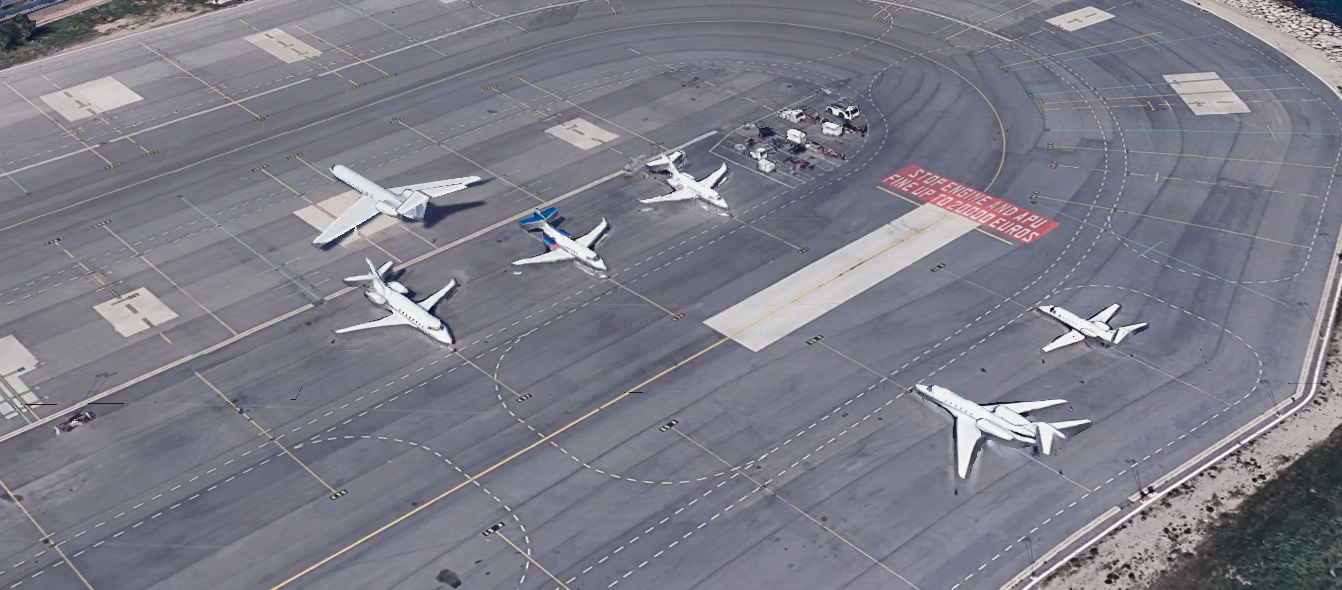
Private jet flights at LFMN primarily use the ‘Kilo Apron.’ This is the designated parking area for BizAv close to FBO facilities.

The rules for APU usage are found under the airport briefing in the French AIP. Specific guidelines apply to the Kilo Apron:

  • Arriving flights must stop on a designated line labelled ‘STOP ENGINE AND APU.’ From there towing to your parking spot is mandatory.
  • Departing flights must be towed to start-up stands fitted with 400Hz/28v ground power units, along with air. APU usage is limited to 10mins prior to TSAT (Target Start-up Approval Time).

Exemptions are very limited. You either need to be operating a medivac, state or cargo flight (carrying temperature sensitive payload). Or if the plug isn’t compatible with your aircraft.

Recent Member Reports

Here are three recent member reports received from OPSGROUP members there.

Report 1:

After towing to Stand 35, the crew connected to the fixed GPU. CAS messages flickered, followed by complete electrical failure and aircraft blackout. Despite heatwave conditions and an overheated crew, APU start was denied. A portable GPU was brought in – but it was dead. When permission to start the APU was finally granted, it was too late: navigation and communication systems had already failed. The aircraft departed under MEL and required expensive repairs at the next stop. The ramp agent advised us to file a report, which we did. According to them, this wasn’t the first time such an event had happened.

Report 2:

Another crew experienced a similar issue. One of two FMS units failed after GPU connection. While the cause wasn’t immediately clear, the symptoms matched those described in the earlier report. The unit was removed for repair.

Report 3:

The GPU caused a fault on our GVII upon disconnect. Our FA that understands French overheard ground personnel stating “it’s too hot” in reference to the GPU. Surface temp at time was 24C so it was the equipment. Had to shut down aircraft to dark and restart to clear fault and get a new CTOT 40 mins later.

Potential GPU Issues

While we can’t confirm the GPUs are the direct cause, it’s plausible. Aircraft systems are sensitive, and power issues — including frequency drift, incorrect voltage, poor grounding, or surges — can trigger serious failures.

Heat may be a compounding factor. Ground air units often underperform in high temperatures, especially if hoses are blocked or airflow is weak. Aircraft may exceed thermal limits before crews can start APUs or get adequate air.

The GPUs themselves may also struggle in heat – output may sag or drift, or thermal protection systems may shut them down.

All of this increases operational risk – especially when APU use is restricted with no flexibility for safety.

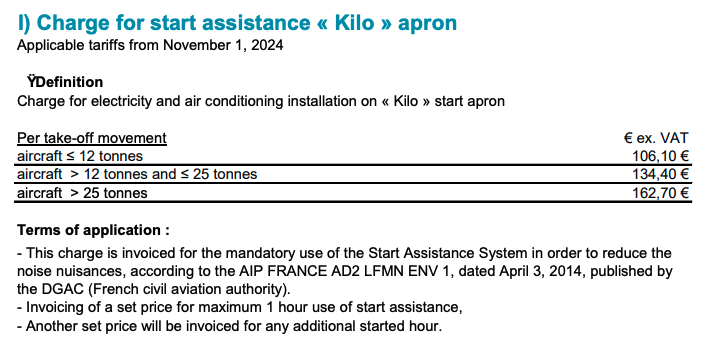
And, despite being mandatory, GPU usage at LFMN comes with a charge.

If you’re going to enforce the rules on APU usage in summer there needs to be some flexibility for the operational safety of multi-million dollar aircraft and their crews. Quiet airports are great, but it’s easy to forget we are customers. In fact, Nice is the second busiest airport for business aviation in France, second only to Paris Le Bourget.

Mitigators

Following an alert issued to the group regarding these reports, another member (also a fully qualified pilot and aircraft engineer) got in touch with some practical advice to operators.

Here is what he had to say:

I thought it would be prudent to post some operational hints and tips to avoid problems like this event in the future. Not just with LFMN, but with any hot weather destination with restricted APU use (i.e. most  of Europe).

Most biz jet hydraulic pumps demand very high KVA from the GPU’s – avoid/delay applying hydraulic power to test systems and parking brake until APU start is approved.

Keep all the shades/sun shields drawn until packs are available.

Dim all the display units in the cockpit until air conditioning is available.

Open cargo and main door to allow air flow throughout the cabin. Small fans can run off the GFI plugs.

Open gear doors on some models as the exhaust for the avionic cooling fans use the wheel wells as the exit point.

Has this happened to you here, there, or elsewhere?

Please get in touch with us via blog@ops.group. We’d love to hear from you.

For ops at LFMN, if you identify a GPU issue (malfunction, incorrect configuration, electrical hazard, emissions), report it via your handling agent to the airport’s operations or safety department, or directly to Aéroports de la Côte d’Azur: +33 4 08 20 42 333, or via this contact form.


France Hates Planes – it’s official

Key Points – updated 5 March 2025
  • France have massively hiked their passenger air tax rates, effective 1st March 2025, which also now extend to commercial BizAv flights – private flights are exempt.
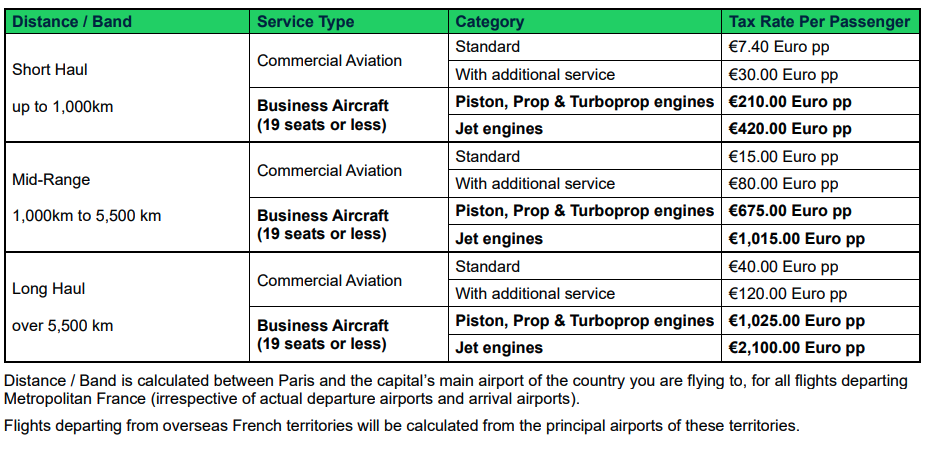
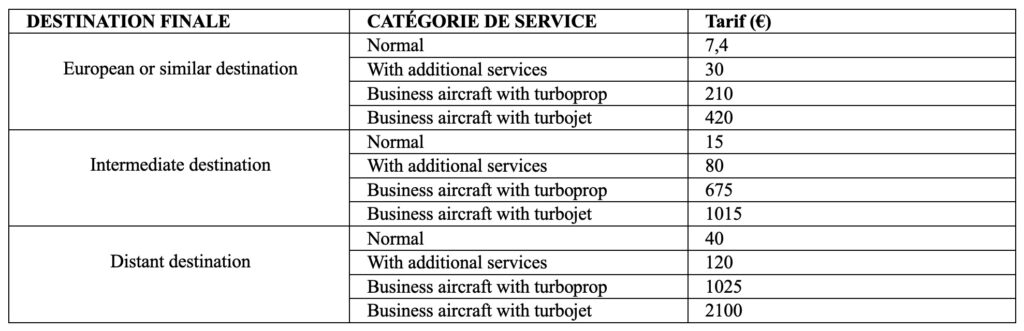
  • These new rates will mean operators must pay anywhere from €420 to €2100 per passenger, depending on where you’re flying!
  • The tax applies to flights departing from both mainland France and most French overseas territories – but with some exceptions.

France has just passed its annual budget, which includes some eye-watering adjustments to the Air Passenger Transport Tax (Taxe de Solidarité sur les Billets d’Avion, or TSBA), which now extends to commercial BizAv flights (aircraft with 19 seats or less).

The new rates are due to take effect from 1 March 2025, and vary depending on destination. For BizAv departing from French airports, the new rates per passenger will be:

  • €420 for European destinations
  • €1015 for intermediate destinations (everywhere else up to 5500km)
  • €2100 for long-distance destinations (beyond 5500km).

And yes, those rates are per passenger! Domestic flights within France will have to pay an extra 10% VAT on top of these rates.

The airlines are getting hit too. The budget includes a rise from €2.63 to €7.40 for an economy ticket heading anywhere within Europe, and more if you’re going somewhere farther away or are traveling in business class.

There’s a weird way they calculate the distance flown here. The new law specifies that the distance used to determine the tax will be calculated from LFPG/Paris Charles de Gaulle airport (what they call the the “national reference aerodrome of the metropolitan territory”), rather than the actual distance between departure and destination airports.

For example, if you’re flying from LFMN/Nice to KTEB/Teterboro, the tax calculation will actually use the distance from LFPG/Paris to KTEB/Teterboro instead. The idea with this weird method is that it helps give a consistent and simplified way of calculating the distance for tax purposes.

Do private flights have to pay this too?

We’re almost 100% sure they don’t.

The new tax rules list a few exemptions, including: “flights undertaken by a physical or legal person for the purposes of leisure aviation or on their own behalf.”

That sounds very much like private flights.

Also, the French tax authority has an entire website where they try to answer questions like this. The best answer comes in the March 1st FAQ which clarifies three points:

“Own-account” (ie. private) flights are not subject to the tax:

“In the case of own-account flights (i.e. private flights) involving employees or managers of the operator, or employees/managers of a company that owns 100% of the operator, these are not subject to the TS.”

Non-commercial flights are not taxable:

“Article L. 422-5 of the CIBS specifies at national level the definition of commercial flight established at European level. Under these conditions, an aircraft flight that does not fall within the definition of a commercial flight is not taxable… The economic activity criteria is not met if the activity is not carried out for valuable consideration.”

Fractional/shared ownership flights are generally considered private and not subject to the tax:

“With regard to the criteria of carrying out transport on behalf of third parties: shared/fractional ownership models are part of own-account transport…”

The doc also says that even if a flight is filed as “General Aviation” (G) in the flight plan, this does not automatically mean it is tax-exempt. It sounds like the authorities pretty much ignore how the flight plan is filed – they’re more interested in determining whether the flight truly meets the definition of non-commercial private transport or commercial transport under tax law.

What about flights from French overseas territories?

This is where it gets even more complicated! The tax applies to flights departing from both mainland France and most French overseas territories – but with some exceptions.

Flights departing from these places are exempt:

  • TFFJ/Saint Barthelemy and TFFG/Saint-Martin
  • New Caledonia and French Polynesia
  • LFSB/Basel-Mulhouse Airport (flights operated under Swiss traffic rights from here are exempt).

The tax applies to flights departing from:

  • Guadeloupe
  • Reunion
  • Martinique
  • Mayotte
  • French Guyana

For flights from these places, here’s how they calculate what rate of tax you should pay:

“European or similar destination” (€420):

  • Flights within the same French overseas territory.
  • Flights to mainland France and Corsica.
  • Flights to EU, EEA, Switzerland, or within 1000 km of the departure airport.

So for example, a TFFR/Guadeloupe to LEMD/Madrid flight would qualify for this (because it’s going to an airport in the EU). 

“Intermediate destination” (€1015):

  • Flights to any airport 1000-5500km away, not covered by the above criteria.

For example, a TFFR/Guadeloupe to KTEB/Teterboro flight (approx 2000km).

“Distant Destination” (€2100):

  • Flights to any airport more than 5500km away, not covered by the above criteria.

For example, a TFFR/Guadeloupe to KSFO/San Francisco flight (approx 5530km).

How should operators pay these taxes?

The new tax rules say that operators have to work out how much they owe, and declare it using an online portal: https://taxes-aeronautiques.sigp.aviation-civile.gouv.fr/

Until 31 Dec 2025: Operators must submit declarations by the last day of the month following the reporting period (monthly or quarterly).

From 1 Jan 2026: The deadline changes to the 20th of the following month.

There’s also some text saying that if an operator fails to declare or underreports passengers, the DGAC may use aircraft seating capacity to estimate tax liability!

We have had some local reports saying that some FBOs/Handlers have been collecting these taxes from operators, and paying on their behalf. But some others have reported that they’re not doing this as it’s technically illegal. So we’re not sure we would recommend this option at the moment!

Why is France doing this?

The French government have projected these new tax rates to generate €800-€850 million in additional revenue. The country’s new Minister for Public Accounts has given a 👍 to the tax increase –

“I am in favour. It is a measure of fiscal and ecological justice,” she told Le Parisien on Jan 5. “The 20% of the population with the highest incomes are responsible for more than half the expenditure on air travel.”

So there you have it, friends. France hates planes – it’s official.


France Wants Your Cash

Key Points
  • You must make a customs declaration when entering or leaving the EU with €10,000 or more in cash or its equivalent in other currencies – this rule has been around forever.
  • But watch out for this gotcha in France – if you’re planning on bringing in cash over this threshold and leaving it on the aircraft, you need to declare it in advance, or else you might get fined.
  • Both reports we have received relate to LFPB/Paris Le Bourget airport. It’s not yet clear whether this issue is just limited to this airport, or affects other airports in France.

OPSGROUP member report

On arrival at LFPB/Paris Le Bourget recently, we were met by a team of customs officials who asked us if we carried aircraft cash on board. We were told that we should have declared any amount over €10,000.

As we had not attempted to take any cash into the country we asked if we could file at that time. The answer was that we have to file before departure online and that failure to do so was counted as attempting to bring in undeclared cash from outside of the EU. Unaccompanied cash must be declared online before entry and before departure.

There is no limit to the amount of cash that you can declare, and once declared any amount can be taken into the country and spent. I would imagine that there may be a requirement to account for any difference between the amount declared inbound and the amount declared outbound, but have not tested this.

We were fined a substantial sum, put on a EU watchlist for 5 years and told that any repeat violations will be subject to a sliding scale of sanctions up to complete confiscation of the funds. We have flown in the area for many years, but have never been notified of the this rule.

ANOTHER member report

We had Customs officials board our aircraft in LFPB/Paris Le Bourget for a “routine pre-departure check” and they were exclusively focused on declared/undeclared cash.

We had not declared (we were not carrying anything close to the qualifying amounts of cash), so they asked questions about our onboard safe. They knew most Global models had one, and they knew exactly where it was. We never use it, so we didn’t even take the key on the trip and were unable to open it for inspection.

That made them suspicious, so we were delayed 20 minutes while they phoned supervisors to decide if we were grounded or not. They even discussed bringing in a team to physically break into the safe to verify contents, but supervisors decided to forego that option.

They cautioned us to have the key with us next time we entered France. Needless to say, it is onboard now.

Bottom line: They know about safes and want to inspect their contents. Be able to open it.

What are the rules?

These are all in EU Regulation 2018/1672, which got updated in 2021, and are basically as follows:

  1. You must lodge a cash declaration to customs when entering or leaving the EU with €10,000 or more in cash or its equivalent in other currencies (banknotes, coins, cheques, traveller cheques, promissory notes, money orders without a named beneficiary, and all manner of gold coins/bars/nuggets etc).
  2. If customs think you’re bringing in cash over this threshold in any kind of “unaccompanied way” they can tell you to lodge a “disclosure declaration” – which you have to have to then do within 30 days.

So, nothing about having to tell them in advance.

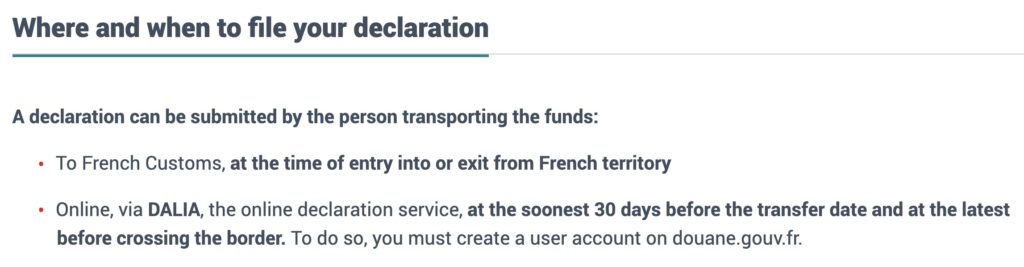
Even on the French customs website, there’s no mention of having to declare or disclose anything in advance. It says you either do it on arrival, or use their DALIA website to declare it online.

How to make the declaration?

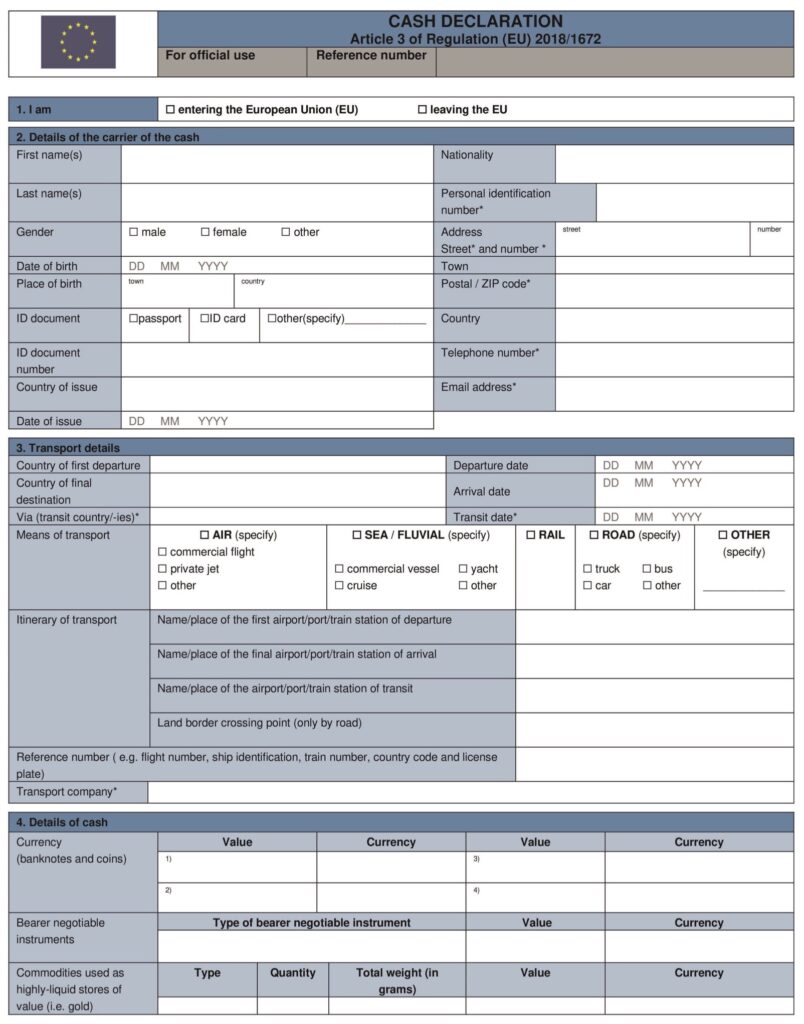
As of 2021, there’s now a standard form that the EU have published for this.

This is available in other languages, if you’re headed somewhere in the EU and they want a copy in something other than English.

Why the weird rule in France about having to do it in advance?

As far as we can tell, it’s an incorrect reading and application of the EU Regulation.

Both reports we have received relate to LFPB/Paris Le Bourget airport. It’s not yet clear whether this issue is just limited to this airport, or affects other airports in France. If you have experienced similar at LFPB or other airports in the country, please let us know: news@ops.group.

We did reach out to some local agents at LFPB, one of whom told us that from their understanding the principle is to do the declaration online before arrival, or if you are already on ground – go spontaneously to the customs advising that you have something to declare before they make any check!


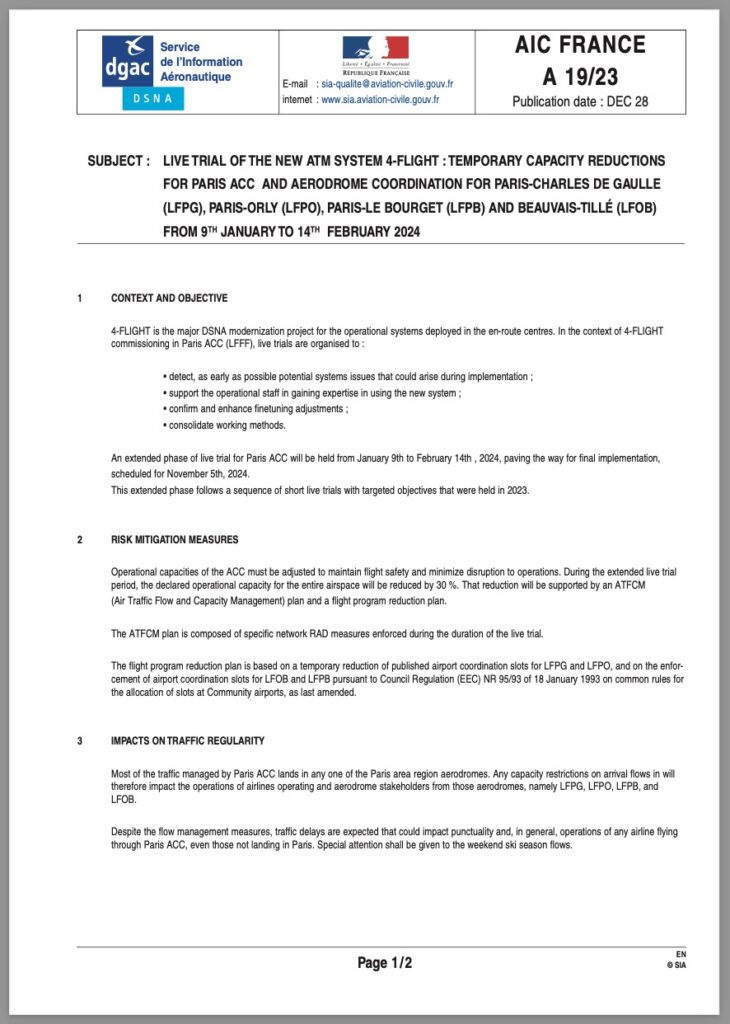
Slots required at all Paris airports until mid-Feb

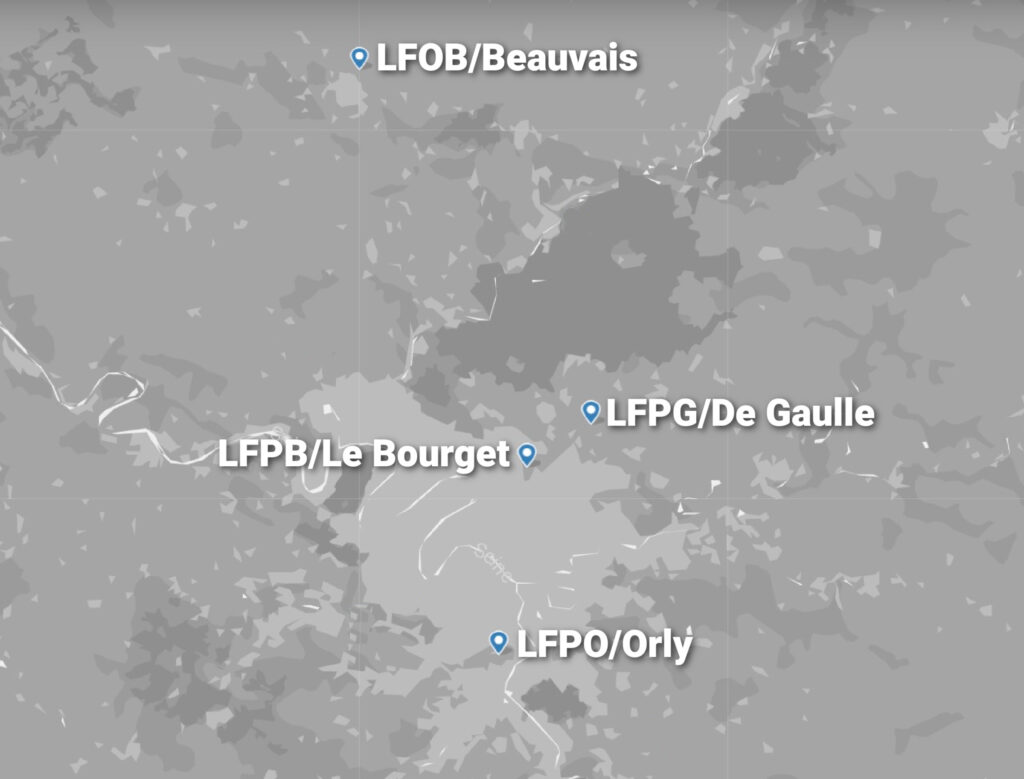
France is slowly rolling out a new ATC system called 4-Flight, and from Jan 9 to Feb 14 there’s a live trial happening which is going to cause delays at all four airports in the Paris area: LFPB/Le Bourget, LFPG/De Gaulle, LFPO/Orly and LFOB/Beauvais.

During this period, the operational capacity for the entire airspace will be reduced by 30%. The real-world result of all this is that LFPG and LFPO will have fewer slots available, and LFPB and LFOB will require slots (normally they don’t).

For GA/BA flights headed to any of these airports, you should request slots via your handling agent, and you need to make sure you add the slot ID number to your flight plan, in a very specific format:

RMK/ASL directly followed by the 14-character authorization number, 
the first 4 of which are the ICAO code for the aerodrome for which 
the slot has been issued :
RMK/ASL (14 CHARACTER AIRPORT SLOT ID).

Example :
RMK/ASLLFPBA123456789 (arrival) or RMK/ASLLFPBD123456789 (departure) 
for Paris-Le Bourget.

There may also be some impact to overflights through the Paris ACC – especially at weekends when it’s busy with ski flights heading south to the Alps.

Check AIC 19/23 for more info.


New Datalink Mandate in France

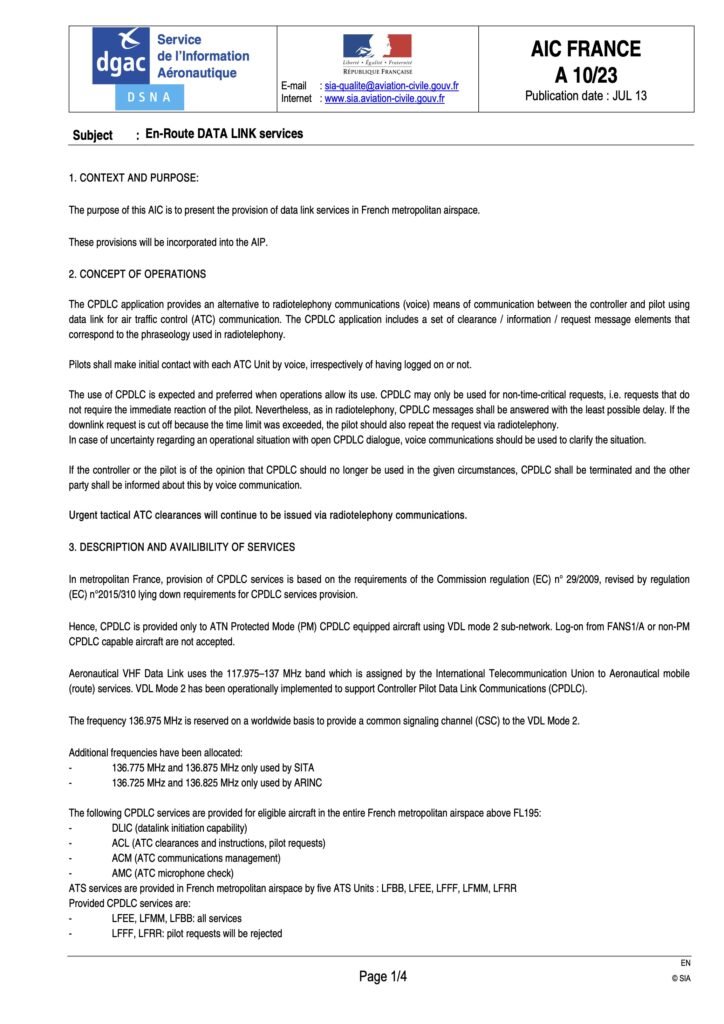
Effective July 13, if you’re flying in France above FL195 and you have ATN CPDLC – you must use it!

Following the recommendation of the Eurocontrol Operational Focus Group (OFG), France is the first European country to mandate CPDLC logon in their airspace after Karlsruhe UAC (EDUU), Maastricht UAC (EDYY), and Cyprus (LCCC). The OFG recommendation is the result of the review of several incidents by ATCOs from 22 ANSPs.

What do you mean by “France”?

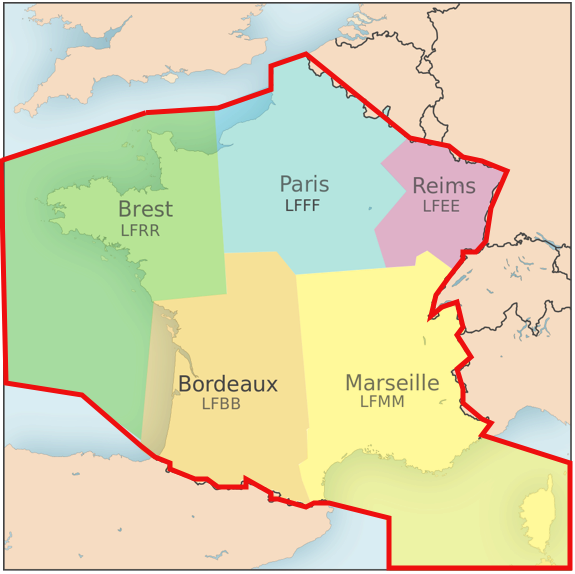
Anywhere in the LFFF, LFEE, LFMM, LFBB, or LFRR FIRs.

Where have they announced this?

In AIC 10/23.

The AIC says the mandate only applies if you’re “capable and eligible”. What does that mean?

You’re capable and eligible if all of the following three things apply:

  • You have ATN CPDLC
  • Your equipment is not broken
  • The crew is trained on how to use datalink

If you don’t tick all three boxes, you can still fly above FL195 in France – they won’t restrict you. They’re just saying that you must logon if you can.

What if I only have FANS datalink?

This new rule in France only applies to aircraft with ATN CPDLC – those with FANS 1/A (or with no datalink at all) will continue to supported by conventional VHF. Dual-stack aircraft should be reconfigured to logon via ATN

Do I have to register my aircraft on the Logon List?

No. You don’t have to sign up to the Logon List to use CPDLC in France. France doesn’t use the Logon List yet. The only places where you need to be on this list is for flights in Switzerland, Germany, and Maastricht-UAC controlled airspace (i.e. the upper airspace above FL245 over Belgium, the Netherlands and Luxembourg). France plans to join from 2026.

Is this new rule in France the same thing as the European Datalink Mandate?

No. The European Datalink mandate is for CPDLC equipage for flights above FL285 throughout Europe. This new French mandate applies not on the carriage but on the logon for flights above FL195.

Another important distinction – none of the European Datalink exemptions apply for aircraft which are equipped with CPDLC, as this new French rule has nothing to do with the Datalink mandate! (i.e. the exemptions we detail here do not apply, such as aircraft with 19 seats or less and a MTOW less than 100,000 lbs).

Where else in Europe do I have to logon to CPDLC?

Provided you’ve got ATN CPDLC, here are the places in Europe where logon is mandatory:

  • Maastricht UAC (EDYY) and Karlsruhe UAC (EDUU) above FL285 (source: Eurocontrol)
  • Cyprus (LCCC FIR) above FL285 (source: AIP GEN 3.4.5)
  • France (LFFF, LFEE, LFMM, LFBB, LFRR FIRs) above FL195 (source: AIC 10/23)

Know of anywhere else that should be in this list? Let us know.

And for everything you need to know about the European Datalink Mandate and how it affects your flight, check our article. 


The Curious Case of the Bonus French ATC Strike

Update 29 Jun 1130z: The bonus French ATC strike is underway. Remember, this only affects secondary and GA airports – not the big hubs or overflights. Eurocontrol report that worst affected airports today, with high delays, are as follows: LFOB/Beauvais, LFPB/Paris Le Bourget, LFPM/Paris Villaroche, LFOP/Rouen, and LFST/Strasbourg. And poor old LFRB/Brest is essentially closed until tonight. The strike ends June 30 at 04z.


There’s an ATC strike planned in France from the evening of June 28 to the early morning of June 30.

But this is a strange one, because major airports and enroute ACCs are not on strike – so overflights will not be affected.

It’s only secondary and general aviation airports that are striking – around 60 airports in total.

Notable ones that are popular bizav stops include:

  • LFLB/Paris Le Bourget
  • LFLB/Chambery
  • LFOB/Beauvais
  • LFLY/Lyon Bron
  • LFLP/Annecy
  • LFKJ/Ajaccio
  • LFKB/Bastia

You can check LFFF Notam F1038 for a full list of airports affected.

LFOB/Beauvais north of Paris is cutting flights by 50 percent, but there are no similar restrictions at any other airports so far…

What happened to the mass ATC strike in France?

This upcoming strike isn’t the same thing as the endless French ATC strike that’s been happening these past few months. That one affected major airports and the enroute ACCs (i.e. overflights), along with various different French overseas territories.

That mass strike was part of nationwide strike action and protests over pension reforms which have been trundling on since mid-Jan. The last day of mass ATC strike action was on June 6. Unions met on June 13 to discuss what they might do next, but they haven’t made any announcement on the outcome of those talks yet.

If and when they do schedule further action, ATC will probably get involved again and we’ll see more of the mass ATC strikes like before. If that happens, you’ll need to read this for guidance on what to do.

Other strikes in Europe to watch out for

Spain:

ATC strikes are set to continue at sixteen airports through to the end of July. These may lead to delays and other disruption, to coincide with the busy summer season, but the impact of these strikes has only been minor so far. The airports impacted are: LECO, LEAL, LECH, GCHI, GCFV, LEIB, LEJR, GCRR, GCLA, LEDA, LEMI, LELL, LEZL, LEVC, LEVX, LECU.

Italy:

There’s a nationwide 24hr ATC strike planned on July 15 (postponed from June 4). There’s no Notam for this yet, and so details are slim, but we know that overflights won’t be impacted, and there will likely be two time windows when flights to airports in Italy will be guaranteed: 7-10 and 18-21 local time. A few days beforehand, expect to see a Notam get published with more info.

Sweden:

Security staff are planning to strike at several major airports – on July 3 at ESGG/Gothenburg-Landvetter and ESSB/Stockholm Bromma, and on July 5-6 at ESSA/Stockholm Arlanda. There are various other dates potentially planned beyond these initial ones, but they’re hoping to negotiate a deal to avert more strikes.

LSGG/Geneva:

There might be a ground staff strike on June 29. Unless an agreement is reached, workers plan to strike from 12pm that day. If it goes ahead, the union has said that all flights would be grounded – possibly a bit of an ambitious claim, but there would still likely be significant disruption.

EGLL/Heathrow:

Finally, some good news! The upcoming strikes by security staff have been called off! More than 2,000 staff were due to strike for 31 days this summer, affecting Terminals 3 and 5. But they’ve accepted a pay deal now, so the strike has been cancelled.


Movie Stars and Racing Cars: Special Flight Ops in Southern France

The sun’s back out in Southern France, and so are the high rollers, race car drivers and movie stars.

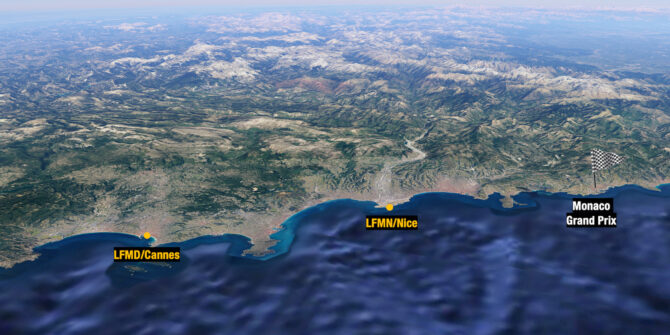
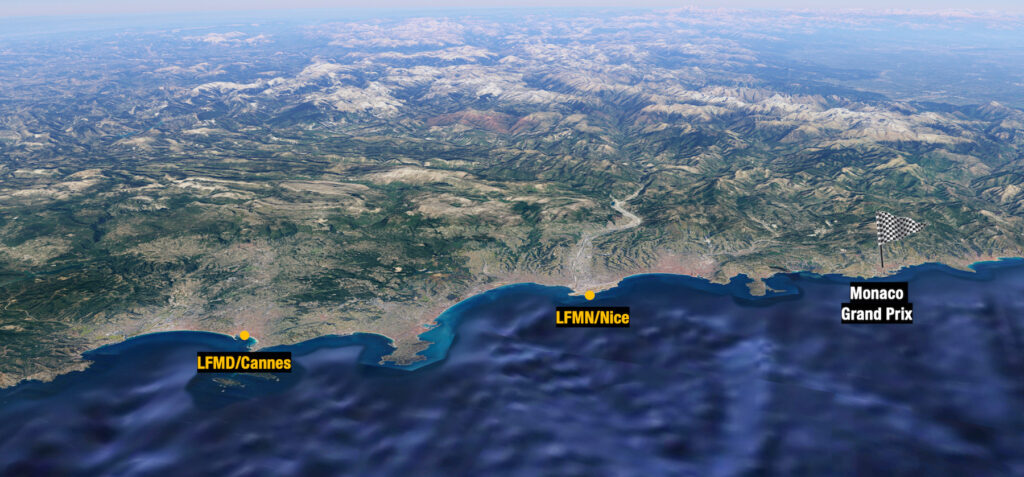
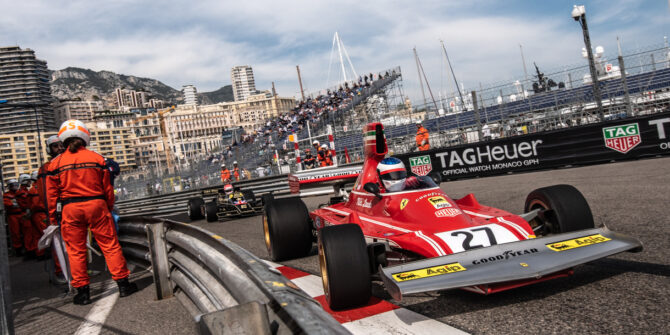
That’s right – it’s that time of year again, with two major events stacked back-to-back – the Cannes Film Festival (May 16 – 27) and Monaco Grand Prix. It’s the jewel of the F1 calendar (May 25-28).

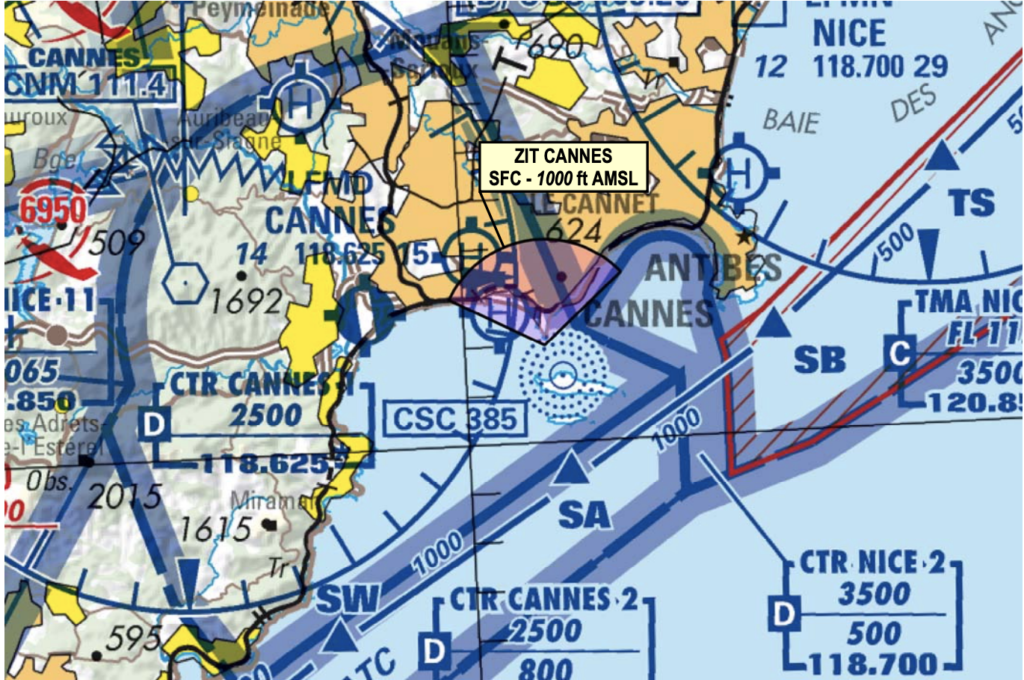
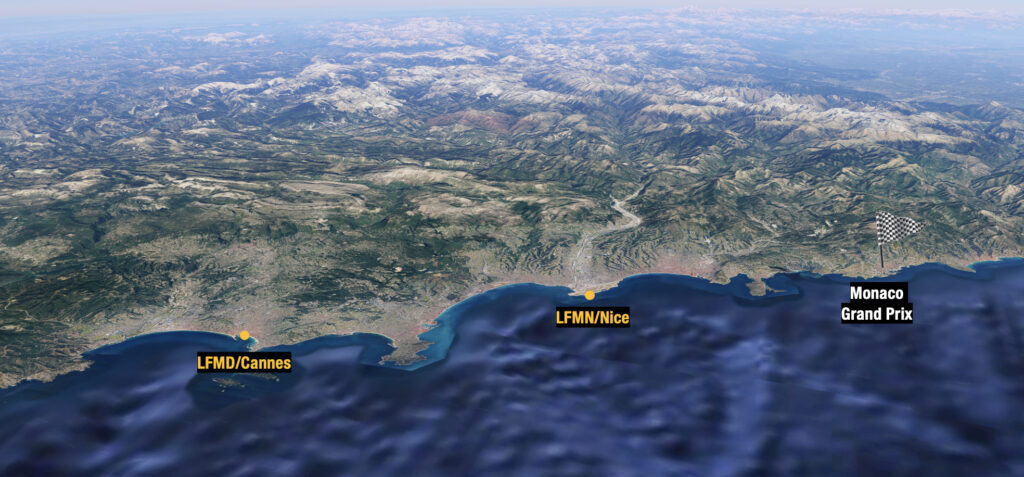
This means an influx of business jet traffic to two major airports – LFMD/Cannes and LFMN/Nice, where some of the world’s wealthiest will come out to play.

It’s not all caviar and roulette though – you’ll still need to be able to land there first. Three AIP SUPs have been published to help that happen. Here’s what you need to know about them.

LFMD/Cannes

AIP SUP 30/23 has the deets here.

The airport itself isn’t normally co-ordinated, but you’ll need a slot to go there between May 16 – 29. That info is found on this website. The apron is going to be chock-a-block too – a word of warning, you won’t be allocated a slot unless you have confirmed parking too.

If you like to manage things yourself on the ground, you’re out of luck. Handling services will be mandatory during this period, and it seems there’s only port-of-call:

AEROPORT CANNES MANDELIEU / SKY VALET
https://cy.myhandlingsoftware.com
E-mail: operations-acm@cote-azur.aeroport.fr
Phone : +33 (0) 4 93 90 41 10

You may not get your requested slot, so a little flexibility may help here. When you get an authorisation number, this will need to go into Item 18 of your flight plan. Without it, EUROCONTROL will likely refuse it.

Don’t be tempted to fly the hop between Cannes and Nice either, in either direction. These flights will be banned between May 26 – 29.

LFMN/Nice

AIP SUP 27/23 is the one to check out here.

Nice is co-ordinated year-round, so there’s less of a surprise. As above, you’ll need to co-ordinate a slot to arrive or depart.

Once again, hiring ground handling services will be mandatory. This time there is a little more choice though. According to the AIP SUP, roll the dice and pick between:

AVIAPARTNER EXECUTIVE
https://www.aviapartnerexecutive.com/nice
E-mail: nce.executive@aviapartner.aero
Phone: + 33 (0) 4 93 21 37 37

DC AVIATION G-OPS
https://www.dca-gops.com/
E-mail : nice.ops@dca-gops.com
Phone: +33 4 93 21 58 12

Monaco

Monaco itself doesn’t have an airport. In fact, it is the second smallest country in the world and is found on France’s Côte d’Azur – its south-eastern coast. Inside Monaco is the district of Monte Carlo, where the F1 race is taking place. Most fans and participants will enter via Nice.

If you’re looking for crew accommodation there, book early. Things fill up, and it becomes astronomically expensive – if it isn’t already.

Restricted Airspace

Info on this is published in yet another SUP – this one: AIP SUP 076/23.

From May 16 – 28, unless you are special traffic you will not be able to overfly the city of Cannes at low level.

Keep an eye out for intensive helicopter traffic. For IFR traffic departing on a SID, it is important to follow published climb gradients and altitude requirements. If you don’t think you’ll make it – let ATC know with your start request. You may get hit with a delay, but it’s better than the alternative..

We’re expecting another AIP SUP to be published closer to the F1 Grand Prix which may be more restrictive, and so we’ll keep this article updated.


Operation Orion: French Airspace Closures

France are worried about “the deterioration of the international context”. Basically, they are worried about the state of the world. So, they have decided to run a fairly major crisis management readiness, preparedness sort of a thing over a 3 year period.

As they put it, it will “consider the hypothesis of a major engagement of high intensity as possible” and help the armed forces prepare for it by practicing a whole bunch of exercise.

Or as we put it – “a great big load of military mayhem in French airspace to look out for”.

Sounds big?

It will be. The biggest in 30 years in fact, involving a whole load of NATO members. But the main impact is going to be within French airspace.

Orion is the first of the 3 exercises which are planned over the next 3 years. It consists of 4 phases, expected to take place on the following dates:

  • Phase 1 & 3 (computer assisted exercises, so no impact to ops)
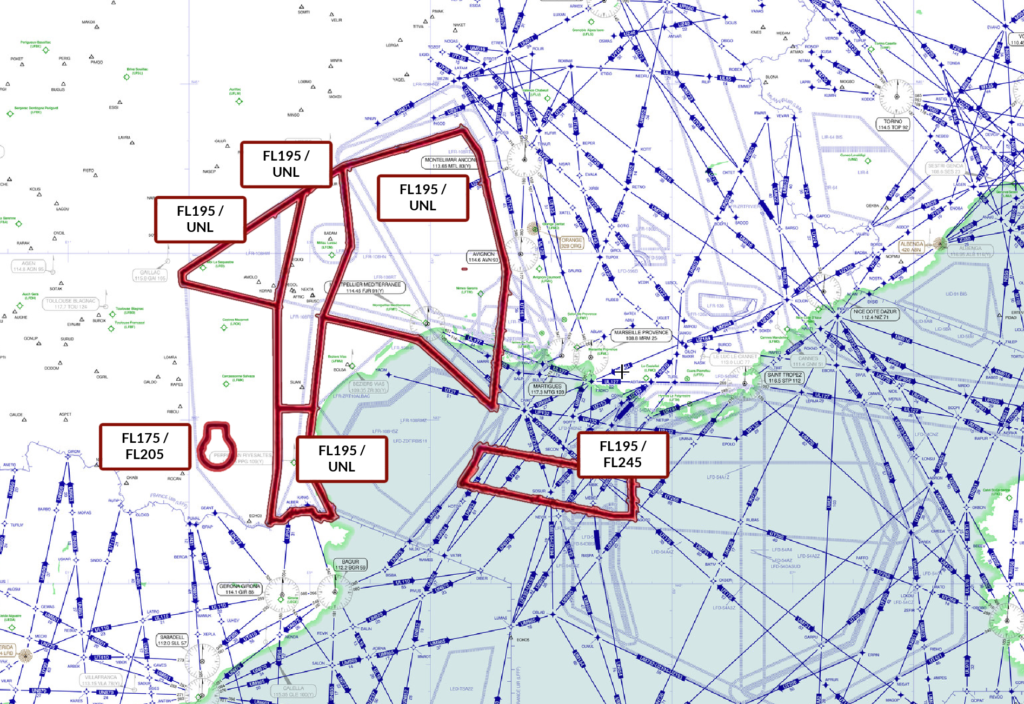
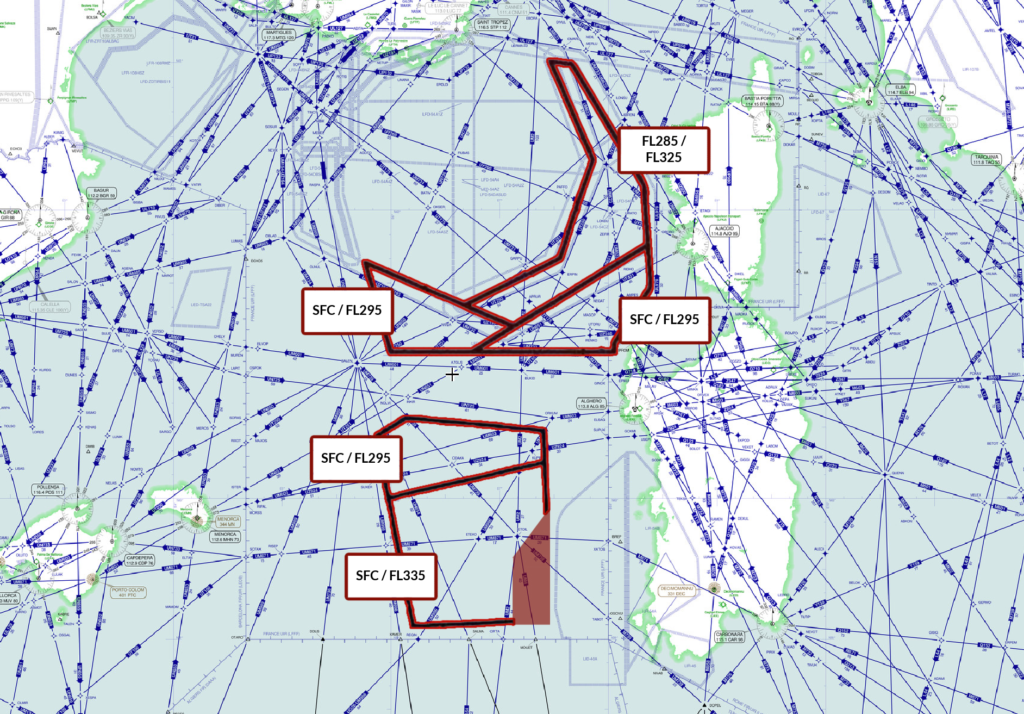
  • Phase 2: from 21 Feb to 10 March (taking place in the southern part of France)
  • Phase 4: from 17 April to 5 May (taking place in the north-eastern part of France)

What does that mean for flight ops?

We heard someone say it will have a “huge impact on the network” with numerous flights impacted through re-routes, delays and probably cancellations because of airspace capacity reductions.

So, what do we need to worry about?

Phases 1 and 3 are computer assisted, but phase 2 involves real people and real military stuff including real military airplanes in real bits of airspace we normally really like to fly in.

The ramp up for this will start on Feb 16 so you can expect disruption from them, through to March 10 when the phase finishes.

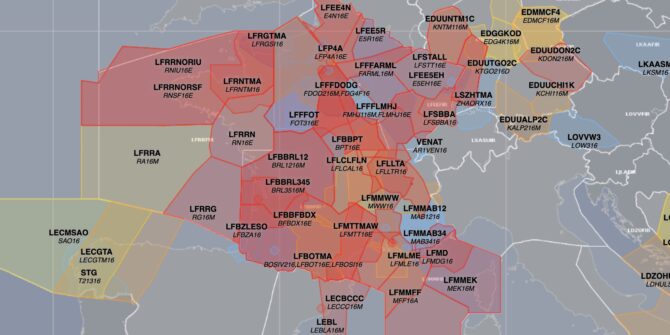
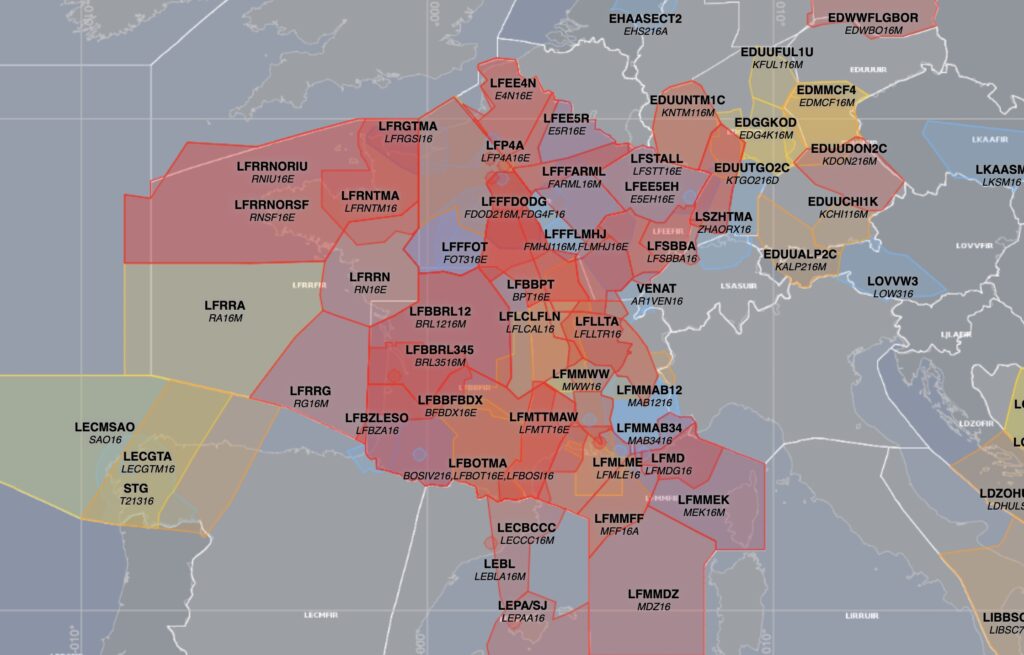
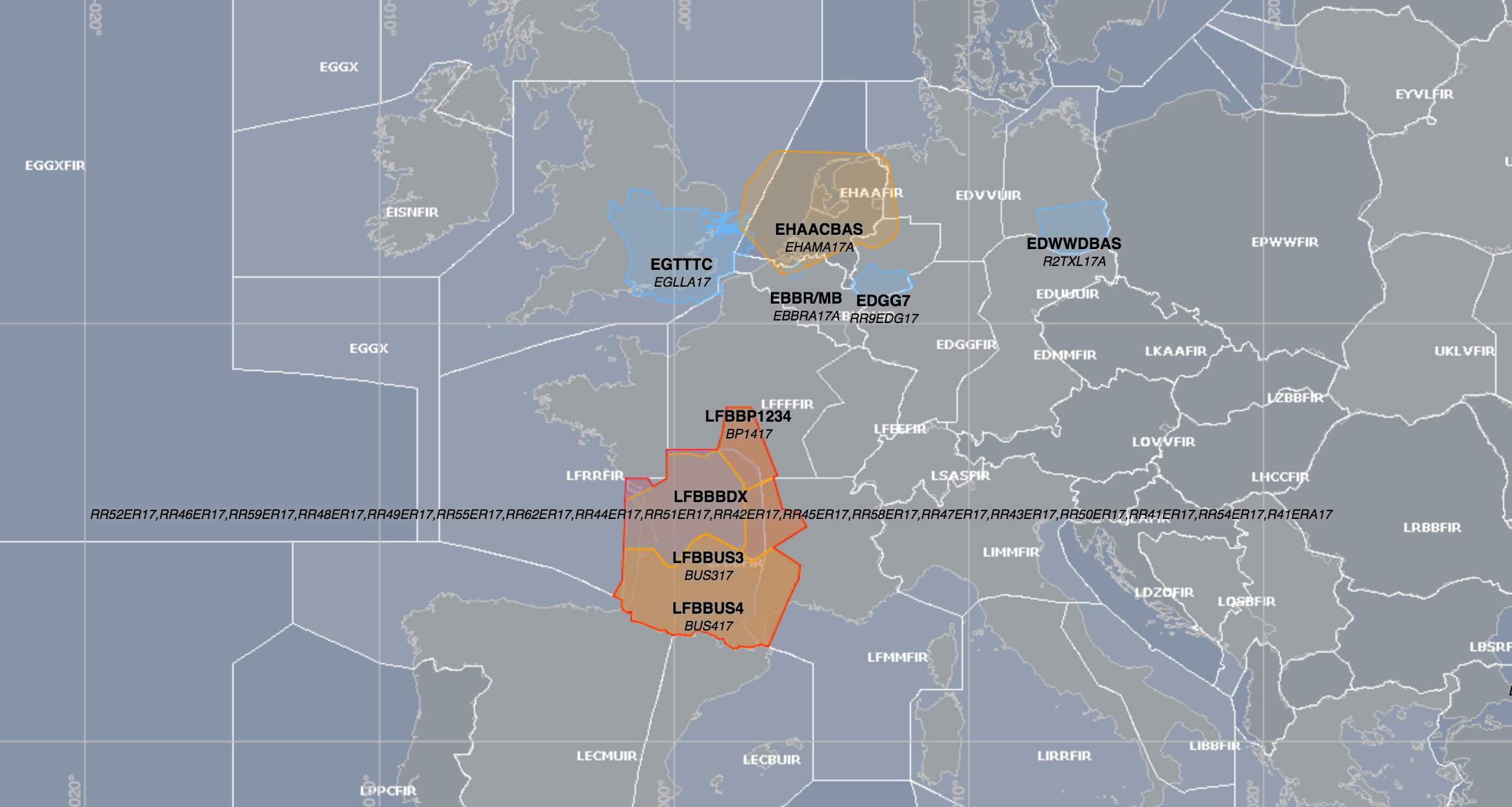
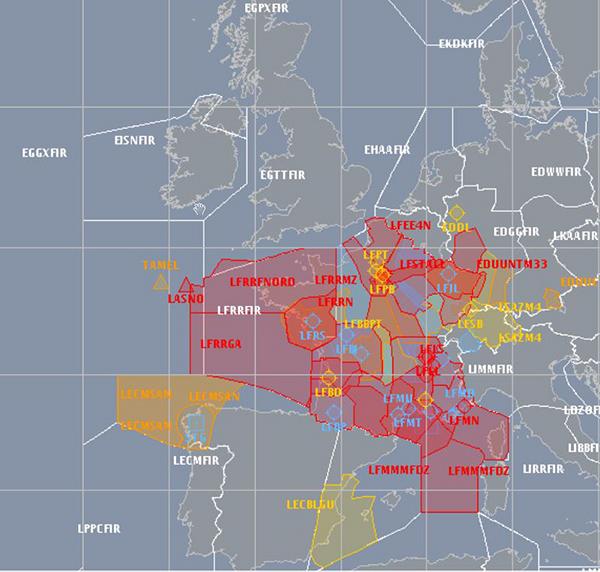
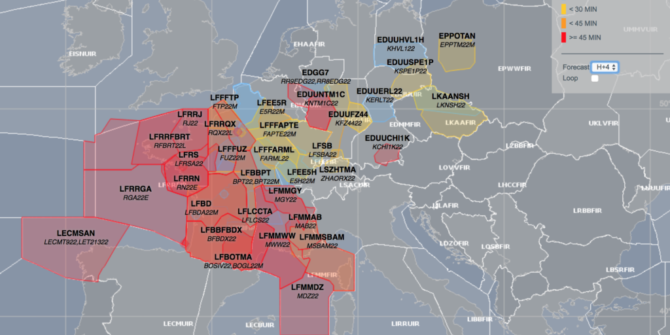
The maps aren’t the best quality but you can view them in the document here. We have recreated the two main upper level ones for you below.

Because there are various different areas scattered across the region, flights may be disrupted in the areas between resulting in significant re-routes for overflights, with the impact felt across France and into UK airspace with NATS managing the routings that end.

A summary of possible threats:

  • Re-routes and inflight delays
  • Congested airspace resulting in slots and disruption, possibly cancellations
  • Reduced diversion options in France during exercises
  • Military traffic to watch out for
  • Complex danger and prohibited areas across multiple levels and regions to be aware of

There will be more information though right?

Yes, plenty hopefully:

  • AIP SUP is due out imminently.
  • Eurocontrol are expected to run some conferences on this which will be announced by their Network Operations Portal here.
  • The specific danger and prohibited areas will have notams issued closer to the dates.

You can find a calendar of NATO planned exercises here to give a heads-up on future plans (and AIPs and Notams to look out for).

So, watch this space and be prepared for some frustrating planning and routing disruptions through Feb and March, and again in April.


France says take trains not planes

France have implemented their ban on short-haul domestic flights, with it going into effect on December 2, 2022.

So what, and who, does this apply to?

The What.

It applies to short-haul domestic flights. In France.

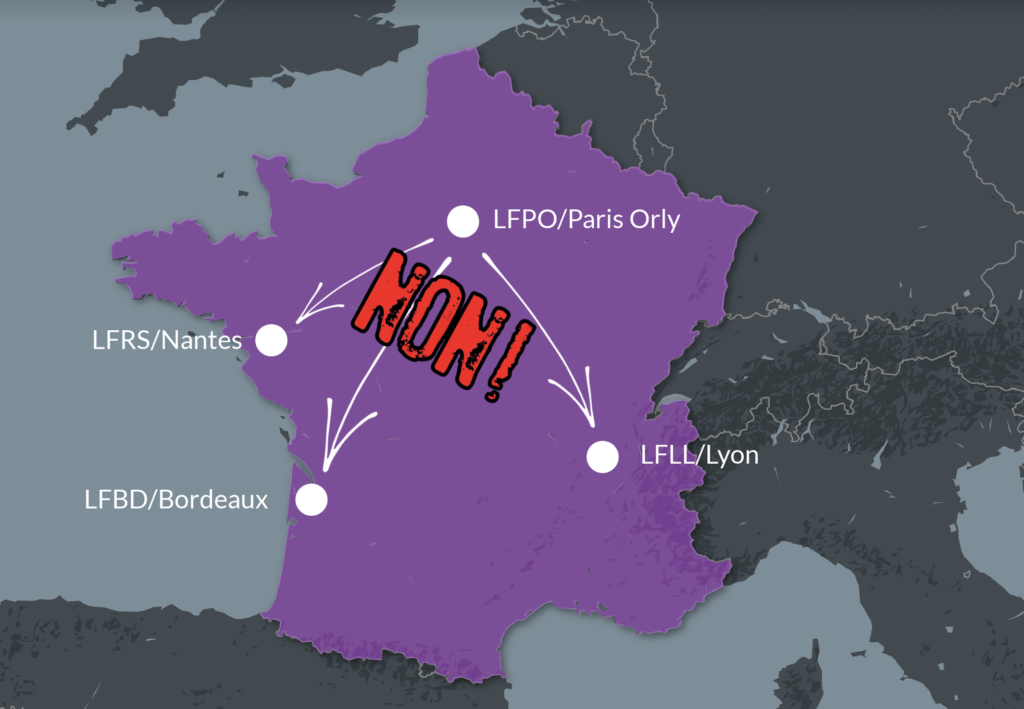
Basically any route that can be reached by train within 2.5 hours is now a no-go for flights.

There are three initial scheduled routes that meet the criteria, and they’re all from LFPO/Paris Orly:

  • LFPO/Orly to LFBD/Bordeaux
  • LFPO/Orly to LFRS/Nantes
  • LFPO/Orly to LFLL/Lyon 

Originally there were 8 proposed routes which also included LFPG/Charles de Gaulle to LFBD/Bordeaux and LFRS/Nantes, LFPG/Charles de Gaulle to LFRS/Rennes and LFLL/Lyon, and also LFLL/Lyon to LFML/Marseille.

However, the train services aren’t quite there yet in terms of frequencies and timings. As soon as they are though… expect these to be reviewed as well.

The Who.

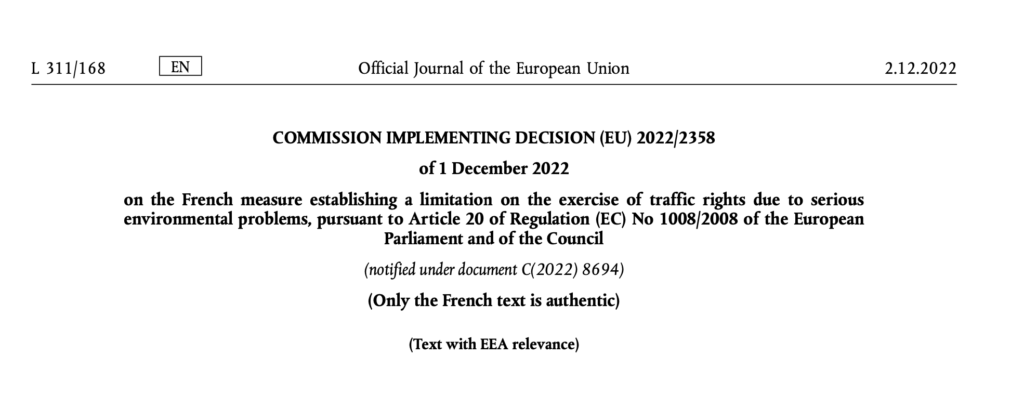
The official notice? Treaty? Regulation? Amendment to a treaty? Journal of the EU… We’re not actually sure what to call it, but the official thing says (and before we forget, here it is for you to read yourself), that the routes are “prohibited for any carrier”.

Which means, we guessed, all flights including BizAv. But, this is the EU, and we all remember the misery of working out what they meant by the term “carrier” for all things EU-LISA related…

And of course, there is the big question of whether this applies to non-French registered ‘carriers’ as well?

So, who else?

Well, we had a little re-read and what it actually says is this:

  1. Article 145.I of the Law prohibits, on the basis of Article 20 of the Regulation, scheduled public passenger air transport services on all air routes within French territory for which there are several direct rail connections per day of less than two and a half hours.

Phew, ok, that is actually not so bad.

So, we figure it means this:

  • It only applied to scheduled services.
  • It only applies to public (so not your private) flights.
  • It might apply to any EU registered (not just French registered) aircraft though.
  • They have specifically listed routes with connections that make this ruling applicable.

So if you are heading to France (and have some cabotage deal), and want to fly internally, then chances are you are still fine to do it. If you are an EU registered aircraft then you might want to have a closer look at what it means for you on these specific routes though.

And while they do say “scheduled public service” if there is a sudden uptick of private services on these routes it probably won’t go down very well, so perhaps don’t go having a cunning plan about setting up a ‘private’ route.

Still fine… for now…

France has the highest number of private aircraft movements of any country in Europe (over 120,000 at the last proper count in 2019), and there is a plan to crackdown on this too.

What this means right now is that if you regularly fly private jets into France, have a think about how to reduce this because it is being monitored and could have a big impact in the future.

The Why.

Well, for environmental reasons mostly.

The prohibiting of these three routes alone will lead to a reduction of around 55,000 tonnes of CO2 emissions from air transport. Using more trains on them is still calculated to lead to an overall reduction of around 50% (worst case) and as high as 98% (in a really best case world).

The impact on BizAv.

The impact on BizAv is not big now. In fact, the reduction of scheduled services into LFBD/Bordeaux, LFLL/Lyon and LFRS/Nantes might mean some additional space for your private flights. Not so much LFPO/Orly because its a fairly busy airport and 3 routes probably won’t mean much extra space. But this might also mean an increase in charges as the airports look to reduce the loss in revenue from having these routes cancelled.


Formula 1 & Movie Stars: Special Procedures in Southern France

In Southern France, two of the biggest events of the year are taking place almost simultaneously – and it’s the perfect storm for an influx of private jet traffic to the region’s main airports.

The Cannes Film Festival has just started, and will run until May 28. This is followed by the Formula 1 Monaco Grand Prix on May 29.  As one of the most famous events in motorsport, it attracts huge crowds. Both these events are happening within 50nm of each other.

As a result, the nearest major airports, LFMD/Cannes and LFMN/Nice will see much higher traffic volumes than normal – and both airports are heavily restricting operations.

Three AIP SUPs have been issued for the events . Don’t feel like delving into all of them? We don’t blame you. Here’s a quick summary of what they cover.

LFMD/Cannes

AIP SUP 052/22 has the deets here.

The apron is going to be full. The airport isn’t normally coordinated, but you’ll need a slot if operating in or out between May 17 – 30. You’ll get a slot ID that needs to go into Item 18 on your ICAO flight plan.

Even if you like to manage things yourself, the use of handling agents will be mandatory during this time.

Also, if you’re planning on a short hop to LFMN/Nice on May 28-30, no bueno. More on that below.

Monaco

Monaco itself doesn’t have an airport. In fact, it is the second smallest country in the world and is found on France’s Côte d’Azur – its south-eastern coast. Inside Monaco is the district of Monte Carlo, where the race is taking place.

The majority of passengers for the Grand Prix will enter via LFMN/Nice which is found around 20nm further west along the coast.

LFMN/Nice

AIP SUP 058/22 is the one to check here.

  • All arriving and departing aircraft operating at Nice from May 24 -30 will also need to co-ordinate a time slot. You can either request one directly, or ask your handling agent to get one for you.
  • You won’t be eligible for a slot unless your handler has guaranteed you a parking space when you get there – so make sure there is room for your ride first.
  • When filing your flight plan, commercial operators won’t need to include their slot ID number. But if your arrival or departure time is outside your allocated slot, your plan will bounce back.

Restricted airspace.

Info on this is published in yet another SUP – this one: AIP SUP 107/22

  • From May 28 – May 30, special restrictions will apply to all traffic.
  • All VFR ops will be banned, and IFR flights will not be allowed between LFMN/Nice and LFMD/Cannes, which is a little further west along the coast.
  • There will be intensive low level helicopter traffic to look out for. For IFR traffic departing on a SID, it is important to follow published climb gradients and altitude requirements.
  • If you don’t think your ride will make it, you’ll need to let ATC know with your start up request. In that case you may get hit with a delay, but don’t spring it on them at the last minute.
  • A temporary restricted area will be in effect which will primarily affect traffic over the event, and at LFMN/Nice airport, and will apply from surface to 3,500’.
  • If you’re operating on a valid flight plan, the impact will pretty minor. Just make sure you are in contact with Nice Tower on 122.375, and follow their instructions. You’ll need permission to enter it.

The big question, who will win?

Not only is he the championship leader, but Ferrari driver Charles Leclerc is also a local to Monaco. He’s the home favourite to top the podium on race day.

Some useful contacts.


LFMD/Cannes Airport Authority +33 (0) 4 89 88 98 28.

Handling

Skyvalet  +33 (0) 4 93 90 41 10, operations-acm@cote-azur.aeroport.fr


LFMN/Nice Airport Authority +33 (0) 4 93 17 21 18. If you’re looking to get a slot approval directly from them, email nice-caz-agta-ld@aviation-civille.gouv.fr.

Handling

Menzies +33 (0) 4 83 76 26 02, Florence.augustyniak@johnmenzies.aero

Signature +33 (0) 4 93 21 82 18, NCE@signatureflight.fr

Swissport  +33 (0) 4 93 21 58 12, nce.operations@swissportexecutive.com


France switches to ‘ATC by Notam’ only

In a move that industry analysts have declared ‘revolutionary’, France has flipped the table on the provision of Air Traffic Control services.

With a new guide published on the topic, instead of issuing Strike Notams, France will now ‘activate ATC service’ by Notam only, on specific dates.

When ATC is available in French airspace, and when airports are running normally, France will issue an A-series Notam with the specific wording ‘Warning: Full ATC service available‘. Officials have been tight-lipped on when the first day of routine French service can be expected in 2020.

Speaking after the decision made in Paris earlier this month, a DGAC spokeswoman told us “We’re unhappy that France is only responsible for about 30% of the delays in European airspace over the last 15 years. Although commendable, we can only be truly proud of a number in excess of 50%, to ensure we retain the #1 spot for years to come.”

Adjoining ATC Centers have applauded the move, saying that the new system will bring an end to the endless Eurocontrol NOP warnings about French strikes. “It’s a much more sensible system”, said a Eurocontrol Network Manager staffer in Brussels. “With this new method, we only have to occasionally highlight a Notam that is issued when French airspace is operating normally. We anticipate this being a rare occurrence, so the workload for us is much lower and more manageable.”

Airlines too have welcomed the new plan. “We really enjoy the banana routes“, said a pilot at Easyjet. “Too often these days we get long, straight, direct clearances from these boring, efficient controllers in Shannon, London, Maastricht, and Madrid. That means you’re just following a magenta line several hundred miles into the distance, and it’s so dull. With the French closures, we get to see parts of Europe we normally don’t. Extreme Flight Planning is fun. And there’s much more time to relax in the cockpit.”

Shanwick, too, are enjoying the extra traffic on the Tango Routes between Ireland, the UK, and Spain. A controller in the Oceanic Center at Prestwick told us, “It’s not like the North Atlantic is busy these days. Year on year we’ve seen declining traffic, there’s so few aircraft crossing east to west, so this additional boost from the French shutdowns is really a positive for Shanwick. The Tango routes are keeping us nice and busy, and the controllers here are thrilled.”

Speaking during a fuel stop in South Sudan, a Ryanair First Officer highlighted the positives of the French reroutes. “I mean, this is Africa, it’s wonderful! Who would have thought that a Stansted – Zurich flight could be such an adventure. Everyone here in Juba has been so welcoming.”

Algerian and Tunisian tourism agencies have also added to the support for the new French move, seeing an increase in travel to their countries, after passengers have experienced the beauty of their coastlines from FL350 during the reroutes around France.

Others however, are more cautious.

Representatives from Greece and Turkey are concerned about the additional strain on the Notam system, with the upcoming annual Notam Battle scheduled for late February. “Historically, we have reserved the right to use the Notam system for our border disputes. It’s essential that these can continue, and we would urge the French authorities to keep the text of these new Notams to a minimum, and keep the AFTN lines clear so we can use them.”

With so few days of routine French ATC service, we think Greece and Turkey don’t need to worry.

TL;DR: All joking aside, we’re getting another French ATC strike on Thursday 20th Feb – this will be the tenth French ATC strike since they started having them pretty much every week at the start of Dec 2019. You probably know the drill by now, but if not, check out this post on how to survive a French ATC strike!


Nationwide French ATC strike on Jan 9

This week’s nationwide French ATC strike looks to be going ahead as planned. It will run from 1800z on Weds Jan 8, until 0530z on Friday Jan 10; but the worst of the delays will happen during the day on Thurs Jan 9.

At LFBO/Toulouse, airlines have been requested to reduce their scheduled flights by a third from 0500-2300z on Thurs Jan 9; but that’s the only airport which has issued this kind of restriction so far.

Eurocontrol’s Mitigation Plan can be found here.

We expect this strike will be much the same as the five French ATC strikes we had in December – big delays at the major airports and for overflights, busy Tango Routes with traffic avoiding French airspace in the west, and Algeria/Tunisia will most likely let you fly through their airspace without special permission if you want to avoid French airspace in the south.

For the latter, just make sure to add the right AFTN codes on flight plans! That means – as well as filing your FPL to the normal Eurocontrol addresses, you must also include those for Algeria (DAAAZQZX and DTTCZQZX) and Tunisia (DTTCZQZX and DTTCZRZX) – and make sure these are included for any subsequent DLA messages as well.

For real-time updates of any airspace issues once the strike has started, keep an eye on this handy French ATC webpage: http://dsnado.canalblog.com/

And check out our article for everything else you need to know about how to survive French ATC strikes!


Three-day French ATC strike this week

French ATC strike alert! And this one’s going to be a MONSTER!! Notams have now been published confirming this week’s strike will last for three whole days, from 1800z on Wednesday Dec 4 until 0500z on Sunday Dec 8. 

It’s part of a nationwide strike which will also impact ground handling services at airports nationwide. Initially called by public transport unions opposed to the government’s pension reforms, various other unions have since pledged to join the strike, including public sector workers, teachers, postal workers, hospital staff, firefighters and lorry drivers. Many unions have warned that strikes might run until Christmas, but for now, air traffic controllers have only planned strike action for three days this week.

In the Eurocontrol teleconference on Monday Dec 3, managers said they expect en-route regulations will be applied across all sectors – which means big delays pretty much everywhere. If you can avoid France during this period, do so.

The situation at the airports is slightly more complex. The worst staff shortages are expected to happen at the ACC level, rather than at the local airport level. However, there are some airports which are expected to have some issues:

LFPG/Paris Charles De Gaulle: On the morning of Thursday 5th Dec, there will be an airport firefighter strike between 07-12 local time (06-11z). As a result, only one runway will be available for this period, so significant delays are expected all morning, particularly if weather conditions aren’t so great.

LFBO/Toulouse & LFBD/Bordeaux: High delays expected all three days

LFBP/Pau, LFBT/Tarbes, LFBZ/Biarritz, LFMD/Cannes, LFOP/Rouen, LFQQ/Lille: Smaller airports mean possible closures, particularly at night. For these and other smaller airports, ATS services may not be provided at all at certain times – and you’ll probably need to check the airport’s own Notams for any signs of that.

Additionally, the government has stepped in and decided to request the airlines to reduce their schedules by 20% between 05-23z on December 5th at these airports: LFOB/Beauvais, LFPG/Paris Charles De Gaulle, LFLL/Lyon, LFML/Marseille, LFBO/Toulouse, LFBD/Bordeaux. The Notam confirming that can be found here.

As usual with these French strikes, Algeria and Tunisia have both said their airspace can be used by flights trying to route around French airspace, without having to obtain overflight permits. But operators need to make sure they add their AFTN codes on flight plans! That means don’t just file your FPL to the normal Eurocontrol addresses, but include those for Algeria (DAAAZQZX and DTTCZQZX) and Tunisia (DTTCZQZX and DTTCZRZX) – and make sure these are included for any subsequent DLA messages as well.

For real-time updates of any airspace issues once the strike has started, keep an eye on this handy French ATC webpage: http://dsnado.canalblog.com/

And check out our article for everything else you need to know about how to survive French ATC strikes!


Paris Le Bourget – New Requirement to list parking in Flight Plan

In the recent France AIP August update a new requirement was added for all aircraft inbound to LFPB/Paris Le Bourget to list their parking position and handler on Field 18 of their flight plan.

Mentioned twice in the local traffic regulations (the translation is a little iffy but you get the idea):

Mandatory assistance by approved based companies. The name of the assistant society must be stated in field 18 of the FPL as a remark (RMK).

and

It is required to the crews to indicate in field 18 of the flight plan, the traffic area of destination and the name of the handling provider.

We understand that this came about due to “much confusion” of the parking stand locations after aircraft land.

Remark 18 should include

  1. Handler Name
  2. Your parking stand location (e.g. HANDLER ABC T1 APRON FOXTROT 2)
    • For heavy aircraft (A330/A340/A350/B747/B787/B767/C130) apron Golf, Sierra or Foxtrot 3 will suffice. Your local handler should give you confirmation ahead of your expected flight.
  3. Your handlers phone number.

So it should look something like this:

(FPL-FGTRY-IG

-C525/L-SDFGRWY/S

-LFMD0610

-N0360F340 OKTET UM733 GIPNO UT26 LOGNI UN854 DJL

-LFPB0120 LFPN

-PBN/A1B2D2S1 DOF/180903 IFP/MODESASP ORGN/KBLIHAEX RMK/HANDLER ABC TERMINAL 1 APRON FOXTROT 2 TEL : +3312345678)

Do you know more? Feel free to comment or drop us a line!

Also- here is a video of a Beech Bonanza flying under the Eiffel Tower 


Aircraft security search now a requirement departing France

Update July 20th: Looks like this is not only happening in France, but some other EU countries too: we’ve had reports of the same procedure being required at some airports in Italy, Greece, and the Netherlands. If you have any further knowledge or recent experience to share, please let us know!

According to various reports we’ve had from Business Aviation aircrew and handlers, as of July 16, all aircraft departing specific French airports are now required to have completed a security search before departure, and to complete a form to be left with the handler. This applies to all aircraft unless the previous departure point was one of the following:

  • 28 countries of the European Union + Norway / Iceland / Switzerland / Lichtenstein
  • USA
  • Canada
  • Isle of Man
  • Montenegro
  • Faeroe Islands
  • Guernsey and Jersey

This new rule applies to all aircraft, no matter the country of registration or status (private, commercial or charter).

The security search is basically to check that no “prohibited articles” are on board (the usual things – guns, explosives, etc.). It’s common practice amongst airlines, but seems until now not to have been enforced as a rule for business aviation or private operations.

Once completed, this form must then be given to the ground handler, who will store it, in case the French authorities want to see it at some point.

It seems this new procedure is governed by an EU directive that was published in 2015, namely: the European decision (UE) C (2015) 8005 (Appendix 3-A) and the regulation (UE n°2015/1998 (Appendix 3-B32). Who would have thought that a new rule with such a tantalising name as this could go unnoticed until now ?

So it seems that all EU countries should be implementing this new procedure, but so far only certain French airports have done so – the ones we know about so far are:

LFMN/Nice
LFMD/Cannes
LFPB/Paris-le-Bourget

(Quite possibly the reason that it’s only French airports which have implemented the new procedure is that it was something that was cited in a French national audit conducted in Nov 2017!)

Can the handler provide the crew with a “security search” form?
Answer – Probably not. As the security search is done by the crew, it’s down to the operator to provide the form – the only responsibility of the handler is to receive it signed from the Captain and store it, that’s it.

What about flights that have arrived from the United Kingdom ?
Answer – You won’t need to do the search, as the UK is still part of the EU… for now! We will wait and see what their status will be once the “Brexit” happens, but until then, no worries 🙂

If a flight is operating PART 135 Air Ambulance, would they be subject to this search as well ?
Answer – Yes, if they arrived in from somewhere other than those countries mentioned above. The procedure is linked to where the aircraft came from, not to the aircraft reg or its status (be it commercial, private, charter, cargo, air ambulance, quick-turn, night-stop, fuel stop, transit flight, etc).

What kind of info should be in the form?
Answer – This kind of info:
Flight Information: Flight number / Date / Aircraft Number / Airport of Origin / Airport of Destination
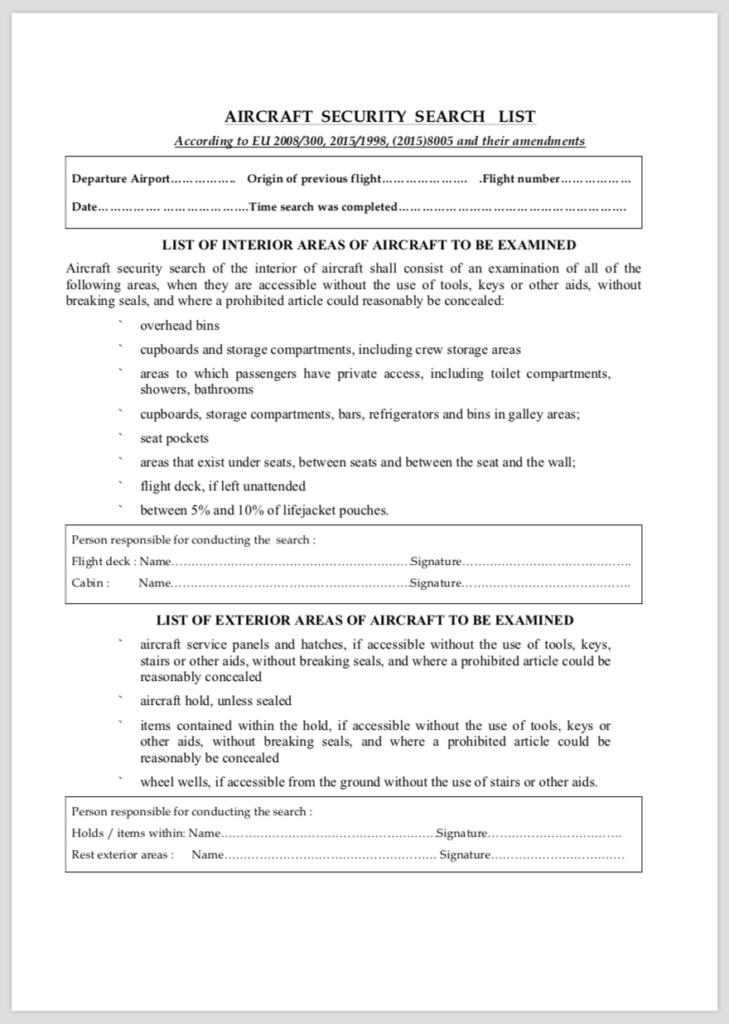
Aircraft Interior: Flight Deck / Storage Area in the Galleys / Lavatories / Catering Trolley and Containers / Seat Pockets / Area Under the Seats / Area Between Seats / Area Between Seats and Bulkheads/ Jump Seats / Trash Bins / Overhead compartments / Pax and Crew Storage Compartment.
Between 5 and 10% of the life vest bags are to be checked as well.
Aircraft Exterior: Aircraft Holds / Service Panels / Bays / Wheel Wells / Fuselage / Engines / AOG Spare in Hold
Search Information : The search must be performed by a member of the cockpit crew. The name of the Captain must appear on the form as well as the date and a place for him/her to sign the document.

You probably have a standard form in your OEM for something like this. But if not, then fear not! The good folks at Signature have provided us with a standard template. Click the image below to download!

If you have any further knowledge or recent experience to share, please let us know!

Further reading:


French ATC strike 22 May – this one’s looking bad

Impact from todays ATC French strike is looking worse than usual.

As things stand at 0600Z, there are a total of 400,000 delay minutes attributed to ATC Industrial Action in the ATC system for Europe,  an average of 20 minutes for every flight in Europe. That average is calculated for all 22,000 aircraft that will operate today in Europe, so assuming at most 2000 flights would operate through French airspace, it works out at around 220 minutes delay for every aircraft. And yep, finishing off the maths, that’s about 4 hours.

Those figures are pretty fluid because the good people at NM (CFMU) work really hard to reroute flights around the worst of it, but it’s safe to say, if you are operating in, over, near, or thinking about France today, you will have a pretty decent delay.

See below for the best places to get updates on todays strike.

Further reading:


French ATC strike updates

Several ATC unions have called for a national strike, affecting French airports and airspace from Monday evening at 1700UTC (Oct 9) through Wednesday at 0400UTC (Oct 11).

All FIRs are experiencing high delays.

Impact expected to the FIR’s per current  (10OCT) information are as follows:


LFRR/Brest Experiencing high delays

LFFF/Paris All sectors experiencing delays with highest delays in the west. Situation is starting to show signs of improvement.

LFEE/Reims All sectors experiencing delays with highest delays in the East and North

LFBB/Bordeaux Some high delays and with no ease forseen

LFMM/Marseille High delays all around. Regulations will be in place until a least 2359UTC

The following routes are available:
Tango 9 Global and Tango 213 Global, UM30 and UZ180 are fully available.
T9 is still dealing with alot of delays.

Airports:

LFPG/Paris DeGaulle and LFPO/Paris Orly are experiencing delays and there is a 30% capacity reduction in both airports plus at the following airports:

LFOB/Beauvais, LFLL/Lyon, LFML/Marseille, LFMN/Nice, LFBO/Toulouse and LFRS/Nantes
LFSB/Basel – unconfirmed as of yet but may be used as an alternate
LFPB /Paris-Le Bourget will not be affected.


Expect high impact. Ops over or to France are best avoided today.

We will continue to post any further information here as soon as received.


Week-long ATC Strike announced: France

This is different to last years Summer of Strikes – where we had 12  French ATC strikes, but almost all were for 48 periods. This new strike is posted for a Monday-Friday, starting at 6am on Monday 6th March and running through to Friday evening, taking out the LFRR/Brest and LFBB/Bordeaux FIR’s.

Brest and Bordeaux FIR’s cover the west of France, meaning this will squeeze the offloaded traffic into Paris, Reims, and Marseilles FIR’s. As usual, our advice is to avoid overflying France if possible. We look forward to the day we can announce French Strikes are over (like the joy that Iceland brought us) but for now … no end in sight.

So, if you want some different options for getting around the Bordeaux FIR:

  • For north-south flights The Tango Routes – via Shanwick
  • For east-west flights try to file further north, into Belgian/Eurocontrol/German airspace, or come south into Barcelona/Marseilles
  • Read the Eurocontrol NOP for any relief routes accepted by other ACC’s
  • And, here’s a map :

Reroutes via Tunisia, Algeria

Tunisia and Algeria regularly open up their airspace to reroutes during French ATC action – and will likely do so again for this strike.

  • Tunisia (DTTC FIR): Overflight permit is required (AFTN direct DTTVYAYX)
  • Algeria (DAAA FIR): Overflight permit not required during this strike but copy FPL to DAAAZQZX and DTTCZQZX

Reroutes via Shanwick Airspace

Read our earlier post on this: https://ops.group/blog/the-three-sisters-shanwicks-tango-routes/

A teleconference will be held by DSNA (in French) on Wed 1st March at 1400 UTC.

Login details:
Call: +33 1 48 50 50 80
Pin Code: 34835821#

Keep an eye on the Eurocontrol NOP for updated info.


Reroutes over France … not because of an ATC strike, this time

You’ll see lots of new acronyms being bandied about, like ERATO, EEE, a new DSNA ATM system in LFBB in accordance with SESAR … but in simple terms (our favourite words): France is changing from using paper strips to electronic strips for separating enroute aircraft, from November 17th, 2016.

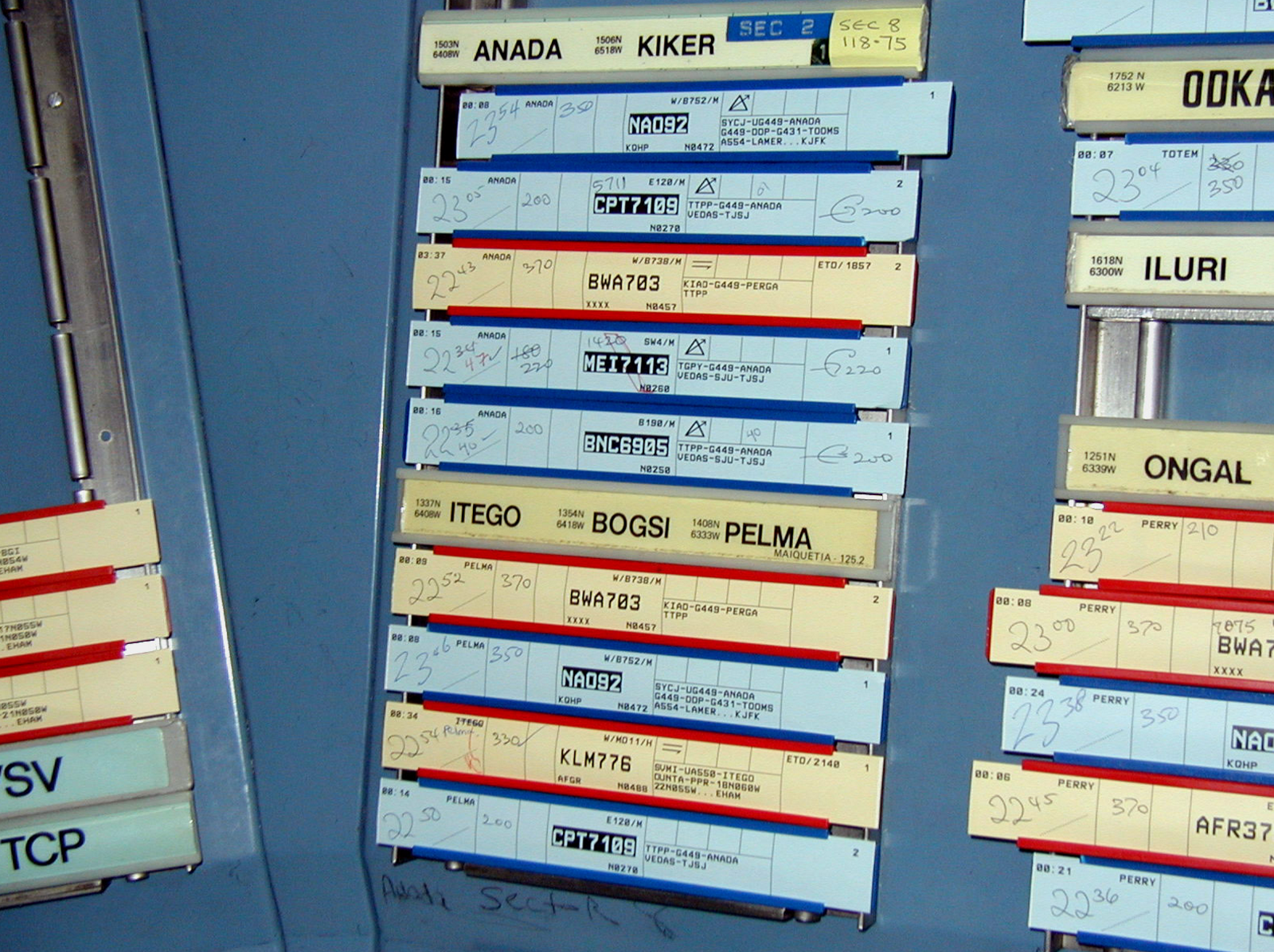
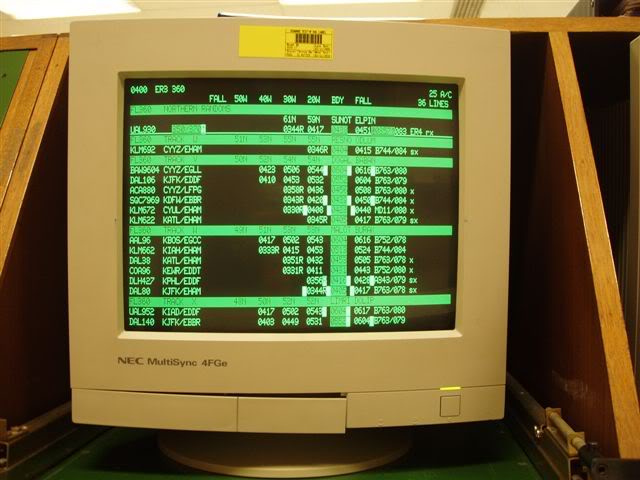
Since more or less day one of Air Traffic Control, paper has been used to record where the airplane is, and then placed somewhat geographically in relation to the other airplanes that might affect it. Changes are written on the strip by hand, with a pen.

Like the picture above.

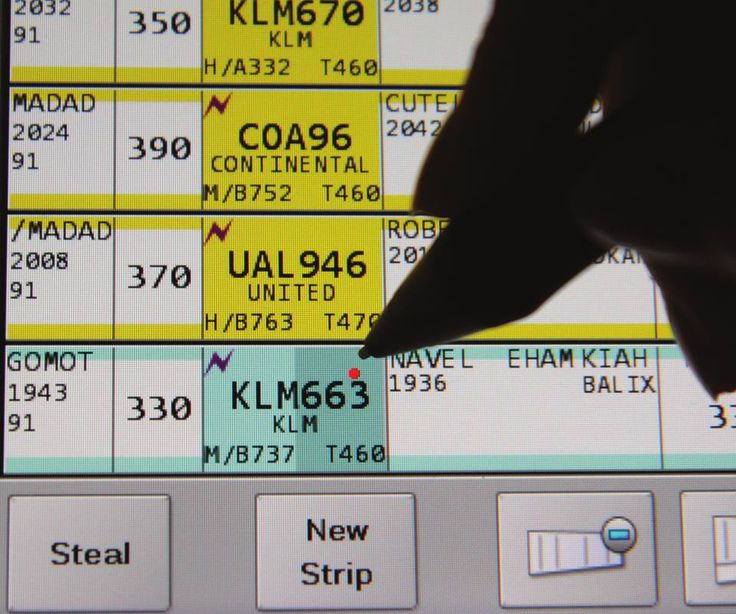
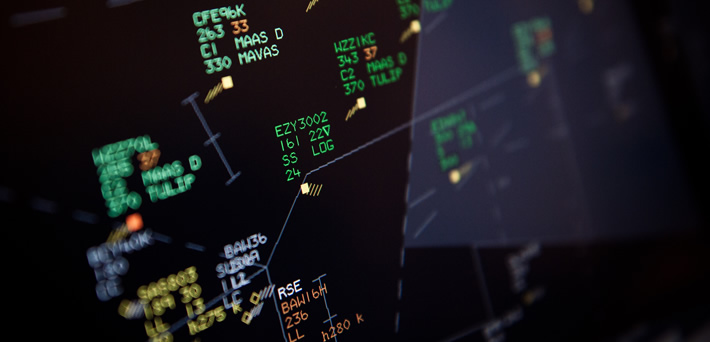
Because getting rid of any paper whatsoever is the most important thing in the world right now, there is a new electronic version of the same thing (and France is calling theirs ‘ERATO‘). Which looks a little like this:

elecboard


So, Bordeaux (LFBB) Center is first … starting today, November 17th. And because nobody is entirely sure how well this is all going to work, a whole bunch of traffic has to be rerouted away from Bordeaux, so that there aren’t too many aircraft per controller – both to allow them to learn, and in case it goes feet up.

Which means mass reroutes, and delays. There are contingency routes – which have become very familiar to operators after this years “Summer of Strikes” – the Tango Routes will be popular again.

Looking ahead, the plan calls for two weeks of fairly heavy reroutes, and then another two weeks of lower impact restrictions. They have said though, that normalisation won’t occur until after Christmas.

So, if you want some different options for getting around the Bordeaux FIR:

  • For north-south flights The Tango Routes – via Shanwick
  • For east-west flights try to file further north, into Belgian/Eurocontrol/German airspace, or come south into Barcelona/Marseilles
  • Read the Eurocontrol NOP – especially on the Tactical page on the ATFCM Measures (Scenarios) portlet -and selecting the link Scenario List: ID RR*ERA
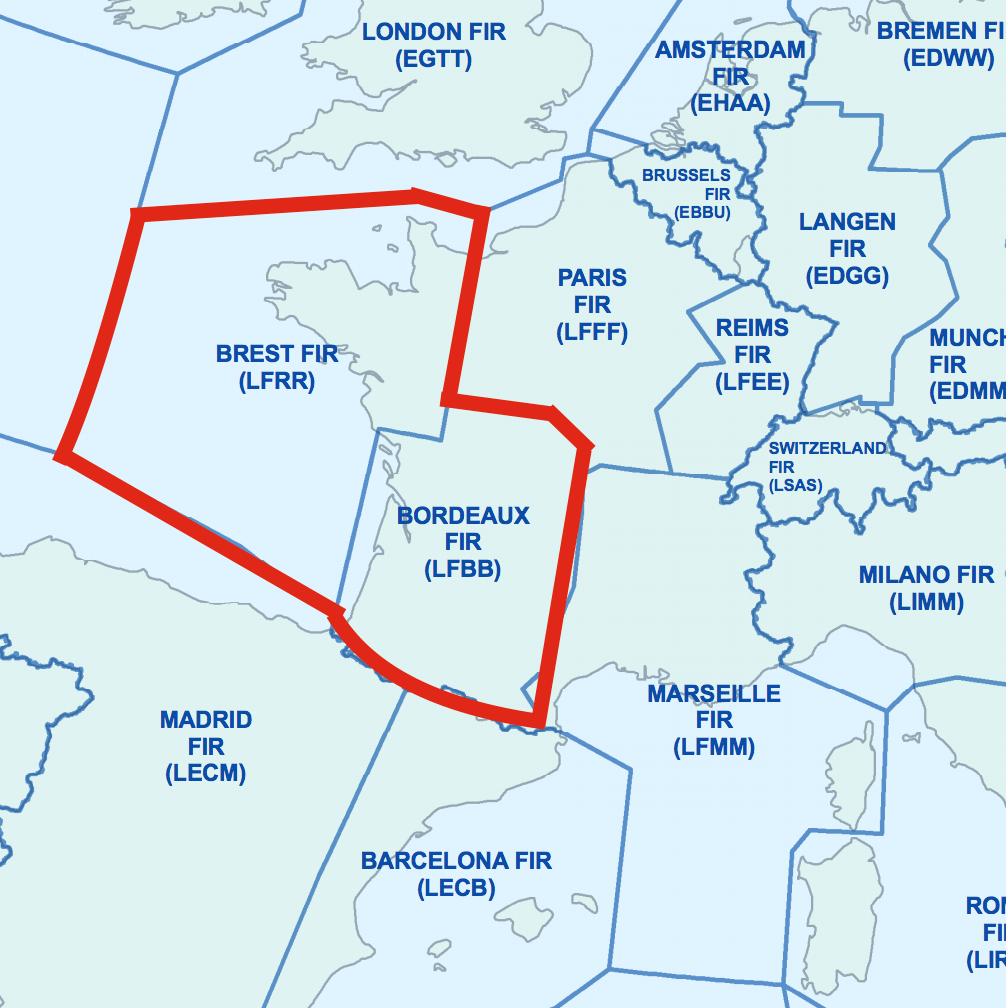
  • And, here’s a map – the red part is LFBB/Bordeaux FIR – don’t file through here:

lfbb-erato-map

The transition from paper to paperless has been going on for a while: Shanwick went ‘electronic’ in the mid 1980’s: this is what the enroute controllers’ screen looked like.

fdpssmall


Finally, here’s the ‘official version’:

DSNA, France’s air navigation service provider, is carrying out an in-depth modernisation of its en-route air traffic management system to cope with the increase of air traffic in France.

From November 17, 280 air traffic controllers at the Bordeaux Area Control Centre (ACC) will handle flights with a new-generation, stripless ATC system called ERATO Electronic Environment (EEE).

The EEE programme based on a SESAR solution has been co-financed by the European Union. EEE provides a modern work environment and innovative control assistance tools.

Nevertheless, as a prelude to any major ATC system implementation, capacities have to be temporarily reduced to allow each air traffic controller to master in real time operations all the new capabilities.

Delays in the south-west of France are therefore to be expected during two weeks. No flight cancellations have been requested by DSNA.

To minimise the impact on flight punctuality, DSNA, has developed a transitioning plan in close cooperation with the Network Manager (Eurocontrol), neighbouring air navigation service providers, and the most affected airlines and airport operators.

Eurocontrol traffic simulations shown that for this transition period, up to 500 flights will need to be rerouted each day to avoid the airspace under the responsibility of Bordeaux ACC.

Moreover, military activities in high altitude training areas will be limited. Regional airports will be impacted along with all flights from or to Paris from the south.

ERATO2Maurice Georges, CEO of DSNA, said: “DSNA staff is totally mobilised with the implementation of this major project. I appreciate the efforts made by the entire aviation community to ensure a successful commissioning of the Electronic Environment ERATO in Bordeaux.

“The transitioning phase ahead of us relies on high predictability for all flights and trustworthy collaborative processes with our customers and partners”.
This major technological step will enable DSNA to deliver a high level of performance. Within the framework of the FABEC and in line with our Single European Sky commitments, DSNA will thus meet new challenges ahead for safe and sustainable air transport.”


France ATC Strike #11

We’ve been notified of an ATC strike planned for France on 14 and 15 September – that is, Wednesday and Thursday this coming week. This follows the normal pattern, where ATC and Area Control Centres and Airports will see union members striking, thereby preventing most flights from arriving and overflying in France during this period.

This is shorter notice than usual for a French ATC Strike, and no confirmation is likely until Monday, but we’d put the likelihood of this going ahead at around 50% at present.


Summer of ATC Strikes: This weeks update

European Air Traffic Controllers are striking in a fight against changes emanating from labour reform and the Single European Sky initiative. Curiously, Greece – normally a big fan of ATC strikes during the summer – has remained off the radar.

Here’s the latest, and it’s a growing list:

France
– Ongoing ATC Strikes – the latest ended on 06JUL at 0400Z. Nothing else on the horizon – for now.
– French overseas territories are also included in these strikes – so Tahiti, New Caledonia, Martinique, Guadeloupe have all joined in the action when it takes place.

Italy
– Strike announced for 23JUL, affecting Area Control Centre’s and Airports in Italy. Normally Italian strikes permit overflying traffic without restriction.

Iceland
– Ongoing sporadic strike action affecting BIKF, BIRK airports, and BIRD Oceanic FIR. Occasional entire closures of the airspace except for Emergency and scheduled flights. Eastbound Traffic from the US/Canada to Europe not accepted during these closures unless destination is in Scandinavia, the Baltics, or Russia.
– Since first week of July, westbound traffic is also not accepted in BIRD during strike periods. Check BIRD Notams.

Portugal
– Strikes announced for every Friday in July were cancelled last week

We’ll keep this page updated as we get updates.


Midweek Briefing 22JUN: Iceland ATC strike – end in sight, Israel FPL changes

Iceland ATC strike – end in sight 22JUN Operators on both sides of the Atlantic have been frustrated over the last 6 weeks with continual sporadic ATC Industrial action. And end may be in sight, but in the meantime keep a close eye on BIRK, BIKF and BIRD Notams. Read the article.

FPL changes: Israel 22JUN Current Flight Planning procedures for flights across Europe from Israel will change in light of a new agreement signed between Israel and Eurocontrol. Read the article.


LFZZ/France ATC Strike Number 9 gets underway today until 24JUN at 0400Z, usual disruption and restrictions apply. Avoid France where possible. NOTAM F1171/16 refers.

EGGX/Shanwick is having an 80’s party on the 28th of June at 1600Z. For engineering work, all the new technology is being taken offline for three hours, so no CPDLC, ADS-C or OCL. Instead we have Voice Reports, HF, Manual Clearance Requests (123.95 or 127.65), and so on; just like the good old days. When you hit 30W log on to Gander manually.

UMZZ/Belarus The Minsk FIR has updated its table of cruising levels and altitudes below Transition; view the AIC.

Gambia The UK FCO issued updated travel advice for The Gambia : “Demonstrations took place in April and May 2016 in Banjul. Demonstrations could occur at any time in any part of the country prior to presidential elections planned for 01DEC. You should be vigilant, avoid all demonstrations”

LPZZ/Portugal is joining the International ATC Strike Club and will begin with industrial action, for two hours daily on: June 30th, and July 8th,15th, 22nd and 29th.

KCXO/Houston Regional will be opening a new customs facility mid July. KCXO serves the Metro-Houston area and is 46 miles outside of town. The new CBP facility adds more choice to international operators over the already saturated Houston area airports.

KZZZ/United States The U.S. Navy has scrubbed the planned military GPS interference testing across the U.S. Southwest that was supposed to happen this month.

LWSS/Skopje is implementing Free Route Airspace in the Skopje ACC above FL245, effective 23JUN. FRA is available H24 with DCT limit unlimited. The ATS network above FL245 is withdrawn. Additional info is available in the Republic of Macedonia AIP AMD 58/16. New RAD measures can be found in the increment file and will become part of Annex 4 on AIRAC 1608.

LWZZ/Macedonia Late on 20JUN, tens of thousands of anti-government protesters gathered in central Skopje, Macedonia’s capital, to conduct another demonstration. The protesters gathered outside the Special Prosecution building before then marching to the Ministry of Justice building, where they broke some of its windows and threw red paint at its exterior.

EZZZ/Scandinavia Another Free Route Airspace update is happening in the two Functional Airspace Blocks NEFAB and DK/SE FAB. NEFRA Phase 1 will be implemented as of AIRAC 1607 on 23JUN, to implement H24 cross border Free Route Airspace between DK-SE FAB and NEFAB, except Norway, above FL285. ATS routes will be kept. Norway plans to implement cross-border Free Route Airspace spring 2017.

CYZZ/Canada has introduced “No Drone Zones” around airports that includes fines for offenders caught operating drones in the restricted areas. They are also drafting new legislation to strengthen rules regarding drone operations.

LEMD/Madrid may have industrial action on 28JUN, the Apron controllers are making noises about a strike. Not confirmed.

WAZZ/Indonesia FIR Ujung Pandang FIR has a couple of radar outages from 19-27JUN. Reroutes or delays are not likely, but strong potential for lower than optimum Flight Levels.

HECC/Cairo FIR If for some reason you are operating flights to or from Libya, then A: You’re probably not reading this bulletin carefully enough, and B: Be aware that you are required to obtain PPR from  Egypt via AFTN to HECAYNYX, at least 48 hours before the flight, in order to overfly Cairo FIR.

EGAA/Belfast ILS 25 out of service along with other ongoing runway and taxiway closures until 11AUG16. Please check EGAA NOTAM’s for specific closures.

EGLF/Farnborough Temporary restricted airspace will be in effect for the annual Farnborough Airshow 16-17JUL. AIC M 033/2016.

France The French authorities have extended the document checks at their borders, these measures will apply to all airports in France and also to Basel airport. Especially during the period of the European Football Championships, passengers travelling to/ from French airports are asked to ensure they have a valid identity document (passport or identity card) with them whilst travelling. A drivers license is not an acceptable document.

VTBB/Bangkok FIR Monsoon season runs July-September. Big potential for holding and airport closures in the region, taking extra fuel is recommended.

OEZZ/Saudi Arabia FIR is introducing new Navigation Charges on 01JUL. All the maths is here.

LSZA/Lugano will close 10-19OCT due to heavy maintenance work on the main runway. No traffic will be able to operate. The airport operator has said 20OCT should be the reopening day but risk that this may be extended.

WMZZ/Malaysia Following a directive by the Malaysian Immigration Department, all foreign nationals travelling on all domestic flights will be required to produce passports upon passing through Immigration control, effective immediately.

Azerbaijan An online e-visa issuing system, called ASAN Visa, will be established that should streamline the visa application process. Eligible foreign nationals will be able to obtain supporting documents, submit their visa applications and receive an e-visa within three days of submission through the portal. The list of eligible nationals is expected to be available soon on the Foreign Ministry website.

EGPK/Prestwick has ongoing overnight closures due to ATC staffing problems, keep an eye on NOTAMs.

EIDW/Dublin will closed for 15 minutes at 1500Z on 23JUN due to a VIP departure.

NWWW/New Caledonia The South Pacific is not exempt from ATC strikes either; overnight closure of the NWWW airspace means no enroute traffic accepted in the FIR tonight – and sporadically ongoing. Note that the Fire Service also has reduced RFF category at specific times. Check Notams.

SKED/Bogota FIR NOTAM of the month award: Colombia Notam A1947 issued on 17JUN. Be aware of the potential for your Cabin Crew to request a change to the SID from ATC, unbeknownst to you. In full: “CHANGES TO STANDAR (sic) INSTRUMENT DEPARTURE (SID) COULD BE DONE BY RADIOTELEPHONY BETWEEN CABIN CREW AND THE CORRESPONDING ATS DEPARTMENT WHILE COMMUNICATION INTERCHANGE, IN ACCORDANCE WITH AERODROME OPERATIONS REF. AIP ENR 1.10”.

We actually have no idea what they mean. Let us know, and keep an eye out for those sneaky flight attendants.

LEPA/Palma has a bunch of outages, and runway and taxiway closures at present that will create restrictions and delays. Take a close look at your arrival and dep times before operating.

Suriname Immunisation checks for Yellow Fever are being carried out throughout June at all border check points, ports and international airports in Suriname; make sure you have a valid yellow fever certificate if required.

RJZZ/Japan On 22JUN heavy rains caused building damage and fatalities in southwestern Japan. At least six people died, as a result of the rain and mudslides across the island of Kyushu. Emergency personnel evacuated several hundred people due to the threat of further mudslides.

Uzbekistan has increased security due to a major summit, from 23-34JUN which may result in changes to flight departures and lengthy check in and security clearance at airports across the county.

View the full International Bulletin 22JUN2016


Midweek Briefing 08JUN: Unsafe Airspace, New China ADIZ

Unsafe Airspace – new summary issued 08JUN Today Flight Service Bureau published International Ops Notice 02/16 – “Unsafe Airspace”.

New China ADIZ – South China Sea 08JUN There have been several media reports this week that China is preparing to set up a new ADIZ in the South China Sea. Read the article.


KCLT/Charlotte New SIDS and STARS for aircraft arriving and departing to the Northeast have been added to CLT as of May 31. Also, construction of a new ATC tower has also broken ground, the new tower will be equipped with NextGen systems that include STARS (Standard Terminal Automation Replacement System), ADS-B (Automatic Dependant Surveillance – Broadcast) and AEFS (Advanced Electronic Flight Strip System.

CZZZ/Western Canada has been experiencing fuel shortages due to recent wildfires in the oil patch. Please check with local handlers for any fuel constraints.

KZMA/Miami FIR NASA is planning on launching a Delta IV rocket on 09JUN. Please check KZMA FIR NOTAMS for restrictions.

KZZZ/USA Tropical Storm Colin has passed Florida, Georgia, South Carolina and North Carolina before moving out over the Atlantic.

CYQY/Sydney, Nova Scotia has added 2 fire trucks and increased staffing levels to provide ARFF CAT 6 or 7, time of day pending. CYQY has issued NOTAM 1A3425/16 covering those hours.

LLZZ/Israel has signed an agreement with Eurocontrol and will allow the country and it’s users to benefit from the services that Eurocontrol provides. This is excellent news for filing out of LLBG and transiting to or over Europe as this will help streamline the process significantly and coordination will only have to be with Eurocontrol for any changes.

RCTP/Taipei has resumed operations on June 3 after operations were suspended due to flash flooding. The airport has also lost power numerous times due to the unstable power supply following days of severe flooding. While the power cuts rendered the terminal’s air conditioning system inoperable, the airport experienced only minor delays.

VNKT/Kathmandu has been experiencing problems with the VHF ATC equipment. Aircraft on approach and Area Control freqs may experience increased squelch and at times leaving ATC without comms.

HSZZ/Sudan has warned it will shoot down any aircraft that infiltrates it’s airspace that has not obtained the proper permission and/or following proper procedures. If you need to transit this airspace please make sure you have all the required documentation.

FHSH/St Helena has reportedly delayed the airport opening indefinitely, due to safety concerns – severe turbulence and windshear were commonplace during testing trials by a B737-800.

China Beijing – The Mainland Affairs Council (MAC), which supervises relations across the Taiwan Strait, on Friday issued a yellow travel alert for Beijing after the first H7N9 flu infection case for this year was confirmed in the Chinese capital.

Malaysia Malaysian officials fired several officials on charges connected to a security breach at Kuala Lumpur International Airport (WMKK/KUL). Security officials stated that airport security officials collaborated with human trafficking syndicates to bypass the airport’s passport verification system. The investigation discovered that, since 2010, airport officials purposely disrupted the immigration system at certain times of the day on several occasions. Malaysian officials will publish a report with the full findings.

Angola The World Health Organization (WHO) reported on 27 May 2016 that 301 people have died in Angola’s yellow fever outbreak, which began in December 2015. The number of suspected cases is now 2,536. The outbreak began in Luanda and has since spread to areas throughout the country, particularly along the coast and in the central regions, despite a large-scale vaccination program. Cases linked to the Angolan outbreak have also been reported in the Democratic Republic of Congo (DRC), Kenya and China.

Jamaica is now charging a $35 US departure tax for all air passengers.

Uzbekistan British FCO cautions when travelling with medicines; you can be detained on arrival if you’re in possession of certain medicines, including codeine; you should always carry a doctor’s prescription with you.

France – the Air France pilots’ union announced a work stoppage for 11-14 June, coinciding with the first week of the Euro 2016 soccer championship. The strike has been planned in protest over pay disputes, and the union has stated that it may observe further strikes. Further details are likely to emerge, as the situation is developing.

Yemen On 28MAY, approximately 20 gunmen stormed Aden International Airport (OYAA/ADE). A 90-minute gunfight followed the attack, during which one civilian was killed by a stray bullet. Authorities regained control of the situation and detained the gunmen’s suspected leader.

Nepal A nationwide general strike is planned on Thursday 09JUN2016 across the county. Protest can occur at short notice anywhere. Stay cautious and stay away from these areas.

View the full International Bulletin 08JUN2016