July 2019 North Atlantic Update
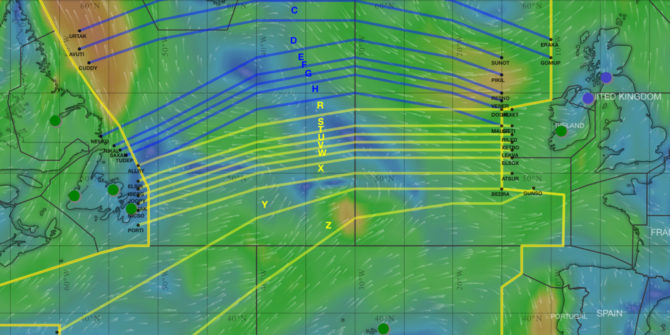
There are four new things to tell you about the North Atlantic, following the flurry of new and updated NAT Bulletins that ICAO issued last week. Get ready for some acronyms! Here’s a summary:
1. OWAFS
Operations Without an Assigned Fixed Speed
ICAO NAT Bulletin 2019_001
We wrote about this before. This Bulletin just formalises the practice that has already been in place since April 2019 in the Shanwick, Santa Maria, and New York Oceanic FIRs (not WATRS).
Here’s how it works: You’ll get a normal oceanic clearance, with a fixed Mach Number, like you always did. But then somewhere after the Oceanic Entry Point, you may get a CPDLC message saying RESUME NORMAL SPEED. You should reply with WILCO. What that means is: Fly ECON, or a Cost Index with Variable Mach. You can fly within 0.01 up or down of your cleared Mach, but if it varies by 0.02 or more you must advise ATC.
2. ASEPS
Advanced Surveillance Enhanced Procedural Separation
ICAO NAT Bulletin 2019_002
ASEPS was another trial that started in April 2019 – this time in the Shanwick, Gander and Santa Maria FIRs.
So far it has only been for longitudinal separation, which can be brought down to as close as 14NM for compliant aircraft (RVSM/HLA approval, ADS-B, and fully PBCS compliant – which means meeting the specifications of RNP4, RCP240 and RSP180).
But in the new Bulletin, from October 2019 they plan to reduce lateral separation for compliant aircraft as well – down to 19NM from the previous limit of 25NM.
There are no plans to change the design of the NAT Tracks, which will continue to be spaced 25NM apart. The initial benefit of the 19NM lateral separation will basically just be that steeper route angles will now be available for pairs of aircraft flying parallel routes outside of the NAT Track system – the current “gentle sloping turn” limitation is 3 degrees latitude between 10 degrees of longitude, but on 10th October 2019 that will change to a limitation of 4 degrees latitude between 10 degrees of longitude. The result of this will be a lateral separation of 19NM on the steeper turning routes.
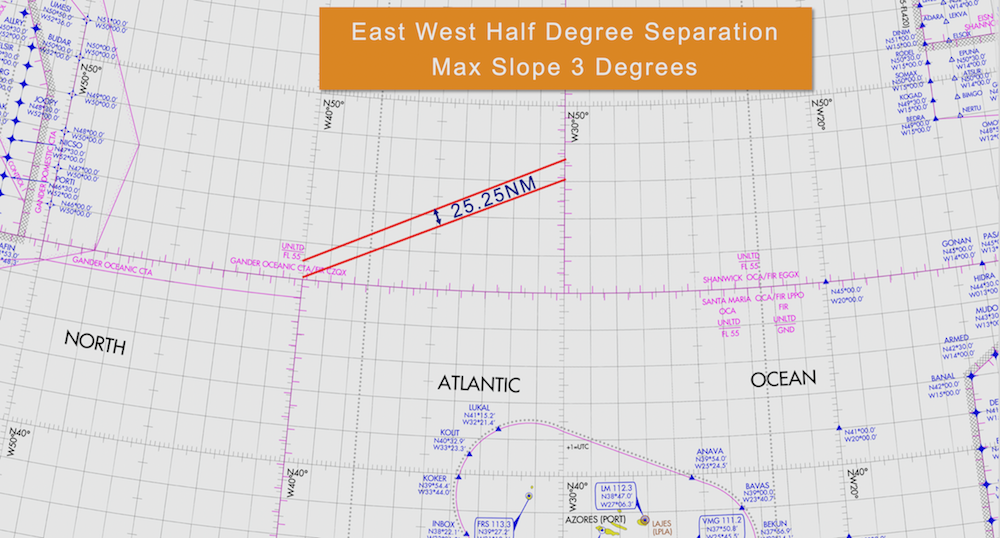
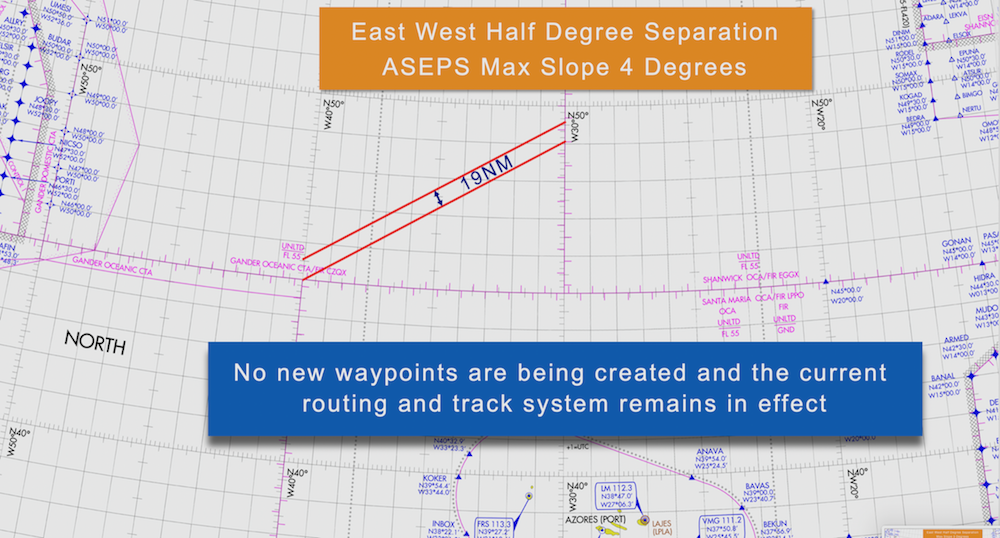
Images courtesy of 30WestIP
3. Data Link Performance Improvement Options
Nothing to worry about, this is just a list of common datalink errors and what to do about them.
Two key take-aways:
- Update your aircraft avionics software as soon as updates are available.
- Answer your messages within 60 seconds or send a Standby message (recent data indicates Business Aviation operators are very bad at this).
4. NAT DLM – The North Atlantic Data Link Mandate
ICAO NAT Bulletin 2017_001_Revision 04
This one is just a slight revision to the plans for the datalink mandate. Datalink is currently required between FL350-390 in the NAT region, and from 30th Jan 2020 this mandate will be extended to between FL290-410.
So with this revised Bulletin, the change is that they have decided they will cap it at FL410 – whereas previously there were no plans for any upper limit at all. This will basically match the NAT HLA and RVSM vertical limits and makes sense. This will allow non-compliant aircraft to continue to operate at FL430 and above – mostly GA/BA operators.
Further reading:
- OPSGROUP members can watch the replay of Member Chat #9, where we discuss all these changes in more detail.
- The last round of important changes on the NAT went into effect on 29th March 2019: the PBCS tracks were expanded; real-time Space-Based ADS-B surveillance and reduced longitudinal separation standards were introduced; and the contingency and weather deviation procedures were changed.
- Check out our NAT Plotting & Planning Chart – updated for July 2019.
Special thanks to Mitch Launius at 30WestIP.com for help with this post. For assistance with international procedures training for business aviation crews worldwide, check out the website.