Datalink in Europe: What Are The Rules?

Update – 29 Sep 2025

Eurocontrol has confirmed that from 4 Nov 2025, the IFPS (Integrated Initial Flight Plan Processing System) will automatically reject any flight plans filed above FL285 unless CPDLC is filed correctly.

IFPS is the central system that processes and validates all flight plans in European airspace. If your plan is filed incorrectly, it will be rejected, and you won’t be able to depart until the error is fixed.

To avoid rejection:

  • If equipped:
    – Field 10a: J1
    – Field 18: CODE/XXX (Mode S hex code)
  • If exempt from the mandate or CPDLC is unserviceable:
    – Field 10a: Z
    – Field 18: DAT/CPDLCX

Important: Do not file both J1 and DAT/CPDLCX together, and do not leave both out. Either scenario will result in automatic rejection by the IFPS system.

Also important: You don’t need to file either J1 nor CPDLCX if your requested level is below FL285.

Also also important: Eurocontrol has also advised separately that if CPDLC is unserviceable, you may continue to operate above FL285 for up to 10 days under MEL relief, provided the flight plan is filed correctly using DAT/CPDLCX. After this period, you must either fix the issue or operate below FL285.

Also also also important: On 4 Nov 2025, IFPS will be unavailable between 2100-0000 UTC for a system upgrade. The outage is expected to last about one hour, but up to two hours if a rollback is needed. During this time, no flight plans can be filed or validated, so submit plans in advance.

For the full Eurocontrol notes on this latest update, check here.

Original Story – Key Points
  • There is a mandate for datalink EQUIPAGE for flights above FL285 throughout Europe. There are various different exemptions for this.
  • This mandate only applies to aircraft with ATN datalink. If your aircraft only has FANS 1/A, you don’t need to comply – but you also won’t be able to get CPDLC across most of Europe.
  • There are also some places where datalink LOGON is mandatory.

Datalink in Europe can be bamboozling – multiple chunks of airspace, all in close proximity to each other, all with varying levels of operating capability when it comes to CPDLC. Plus there’s a Logon List to consider. And a Datalink Mandate. And different considerations depending on what kind of datalink you’ve got onboard…

So here’s a simple guide on how it all works, and what the rules are.

Explain it to me in three sentences
  • You need ATN datalink for flights above FL285 in Europe (i.e. you need to have equipped aircraft and trained crews).
  • If you don’t have ATN datalink, but are exempt from the Mandate (as per one of the categories below), then you can still fly above FL285.
  • If you don’t have ATN datalink, but are not exempt from the Mandate, you can’t fly above FL285.
Is there a Datalink Mandate in Europe?

Yes. The European Datalink Mandate is for ATN datalink equipage for flights above FL285 throughout Europe. (Equipage – not necessarily for logon! More on that later…)

Is my aircraft exempt?

Quite possibly – many aircraft are exempt from the equipage mandate:

  1. Aircraft with a certificate of airworthiness first issued before 1 January 1995.
  2. Aircraft with a certificate of airworthiness first issued before 1 Jan 2018 and fitted prior to this date with FANS 1/A.
  3. Aircraft with 19 seats or less and a MTOW of 45359 kg (100000 lbs) or less, with a first individual certificate of airworthiness issued before 5 Feb 2020.
  4. Aircraft flying for testing, delivery or for maintenance purposes or with datalink temporarily
    inoperative (under MEL exemption).
  5. Aircraft in this list (Annex I).
  6. Aircraft in this list (Annex II) with a CofA issued before 5 Feb 2020.

You can find these rules and exemptions in this EU doc (updated in Sep 2023).

The Logon List

This is what you need to get registered on to get CPDLC service when flying in:

  • Switzerland
  • Germany
  • Maastricht UAC (i.e. the upper airspace above FL245 over Belgium, the Netherlands and Luxembourg – one of Europe’s busiest and most complex airspace areas.)
  • Poland
  • France (6 March 2025 for LFEE, LFMM, LFRR, LFBB / November 2025 for LFFF)
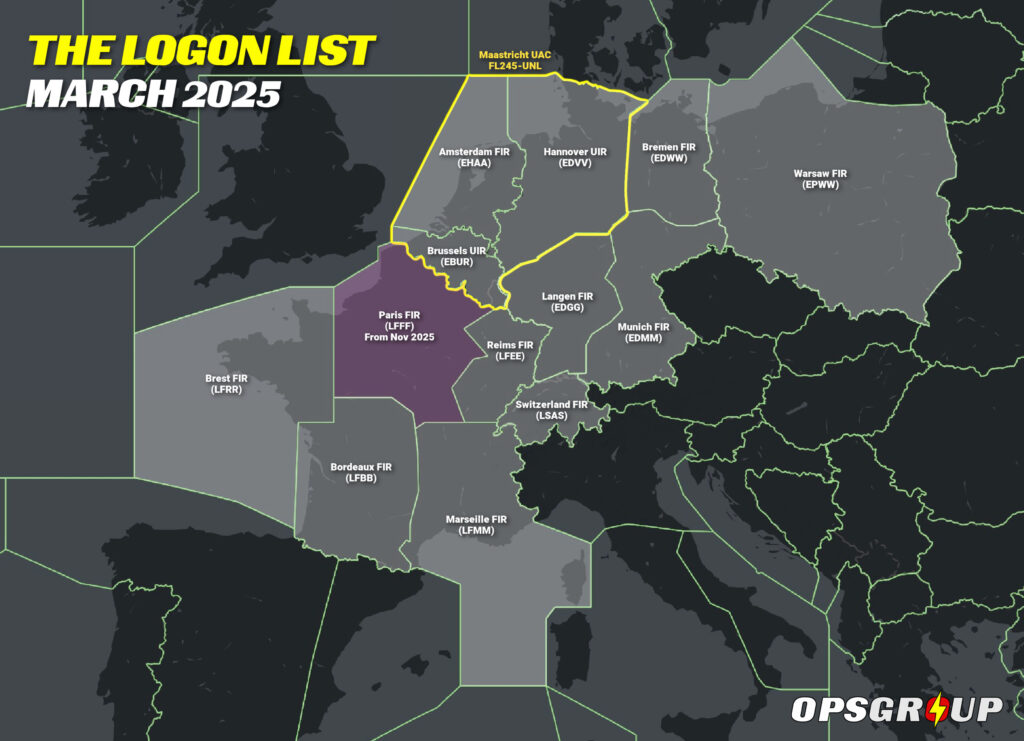
If you get your aircraft added to the Logon List, that means you’ll be able to use CPDLC in these areas and will probably get better directs and faster climbs. However, if your avionics are not eligible to be on the Logon List, ATC will not currently restrict you to the flight levels below FL285.

The Logon List is basically to ensure that aircraft with buggy avionics don’t ruin the network for everyone else – including ATC.

For more info, including details of how to get your aircraft registered on the Logon List, check Eurocontrol’s dedicated page here.

Important to note: the Logon List only applies to aircraft with ATN datalink – not FANS 1/A. So essentially, if your aircraft only has FANS 1/A, you don’t need to register – but you also won’t be able to get CPDLC across most of Europe (more on that below…)

Where can I get CPDLC in Europe?

As of June 2024, these places:
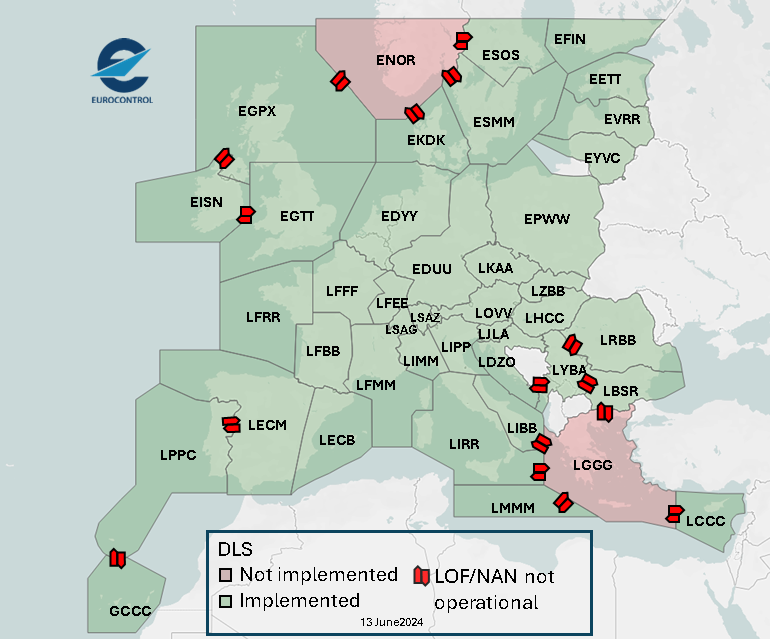
For more info about which FIRs provide datalink, and at what flight levels, check here.

Is CPDLC logon mandatory?

The European Datalink Mandate is for CPDLC equipage, not for logon.

But yes, provided you’ve got ATN CPDLC, there are some places where logon is mandatory ⬇️

Here’s a running list of the places we know where logon is mandatory, in chronological order of when they implemented the rule:

  • Maastricht UAC [EDYY] above FL245 (source: Eurocontrol) and Karlsruhe UAC [EDUU] above FL285 (source: Germany AIP GEN 3.4)
  • Cyprus [LCCC Nicosia] above FL285 (source: AIP GEN 3.4)
  • Hungary [LHCC Budapest] above FL285 (source: AIP GEN 3.4)
  • Finland [EFIN Helsinki] above FL095 (source: AIP GEN 3.4)
  • Denmark (EKDK Copenhagen] above FL285 (source: AIC 5/23)
  • Sweden [ESMM Malmo, ESOS Stockholm] above FL285 (source: AIP GEN 3.4)
  • Romania [LRBB Bucharest] above FL285 (source: AIP GEN 3.4)
  • Serbia and Montenegro [LYBA Belgrade] above FL205 (source: AIP GEN 3.4)
  • Czech Republic [LKAA Prague] above FL195 (source: AIP GEN 3.4)
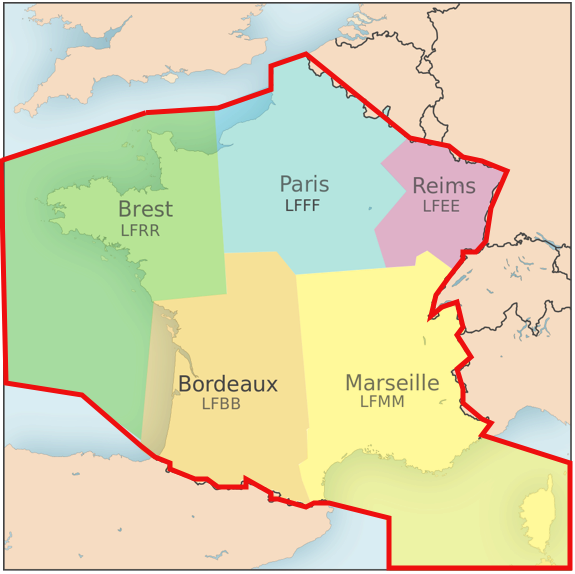
  • France [LFFF Paris, LFEE Reims, LFMM Marseille, LFBB Bordeaux, LFRR Brest] above FL195 (source: AIC 10/23 and AIP GEN 3.4)
  • Switzerland [LSAG Geneva, LSAZ Zurich] above FL145 (source: AIP GEN 3.4)
  • Slovakia [LZBB Bratislava] above FL285 (source: AIP GEN 3.4)
  • Croatia [LDZO Zagreb] above FL285 (source: AIP GEN 3.4)
  • Bulgaria [LBSR Sofia] above FL215 (source AIRAC AMDT 5/24)
  • Slovenia [LJLA Ljubljana] above FL285 (source: AIP GEN 3.4)
  • Poland [EPWW Warsaw] above FL285 (source: AIP GEN 3.4)
  • Spain & Canaries – coming at some point soon!

Recent News: Some Logon and FPL Filing stuff to watch our for! ⬇️

From Nov 2025: Flight plans in Europe above FL285 without J1 or DAT/CPDLCX will be rejected. This was advised by Eurocontrol in their Feb 27 webinar on datalink guidance for aircraft operators (you can watch the replay here).

From Oct 2024: MUAC have started reporting to the relevant NSAs those aircraft which don’t comply with the requirement to file either J1 or DAT/CPDLCX in the FPL if filed above FL285. We heard this issue is especially true for bizjets – around half of which are capable but don’t log on.

From July 2024: Eurocontrol started checking correct flight plan filing regarding CPDLC. Flight plans indicating J1 capability, but missing CODE/XXX in Field 18 will be rejected.

From Feb 2024: After some issues with the new LYBA logon code for Serbia and Montenegro which you can read about here) Eurocontrol started asking operators to make sure their aircraft avionics ATN addressing database is up to date, to include all the right codes as per the latest version of ICAO EUR Doc 028.

So what do I put in my FPL?

Got ATN datalink? Put J1 in field 10a of the flight plan. Also put CODE/XXX in Field 18 – instead of the XXX you need to put your Aircraft/Mode S address in hex (e.g. CODE/A519D9).

Exempt from the Mandate? Put Z in field 10a and DAT/CPDLCX in field 18 of the flight plan. If you don’t, ATC won’t know you’re exempt, and you may struggle to fly above FL285! (And remember – you should either file J1 or DAT/CPDLCX, not the two together. Flight plans with this wrong filing will be rejected).

Only got FANS 1/A? Read the section below! ⬇️

My aircraft only has FANS 1/A. What do I do?

Assuming you qualify for the first exemption to the Datalink Mandate we mentioned at the top of this post (aircraft with a certificate of airworthiness first issued before 1 Jan 2018 and fitted prior to this date with FANS 1/A), you don’t need to comply with the Datalink Mandate, but you also won’t be able to get CPDLC across most of Europe – ATC will talk to you on the radio instead.

The only bits of airspace in Europe where you can still get CPDLC using FANS 1/A are:

  • EGTT/London, EGPX/Scottish, EISN/Shannon FIRs. But be aware that in EGTT there is no automatic logon transfer from FANS1/A to ATN – ie. if you’re flying from EGTT to EDYY and you are connected via FANS1/A to EGTT then you will have to log on again with EDYY.
  • GCCC/Canarias FIR.
  • LRBB/Bucaresti FIR.

Everywhere else in Europe is only capable of working with ATN datalink. Note that in Maastricht Upper Airspace (MUAC) they say that dual-stack aircraft must be reconfigured to logon via ATN, and aircraft with only FANS 1/A will continue to supported by conventional VHF.

So if you’ve only got FANS 1/A, here’s what you put on your FPL:

In field 10a:
Put Z and one of the following –
J5 – If using SATCOM (Inmarsat) for CPDLC
J7 – If using SATCOM (Iridium) for CPDLC

In field 18:
DAT/CPDLCX 

Download the Europe Datalink Quick Reference PDF

One page PDF of pretty much everything you need to know. Just click here.
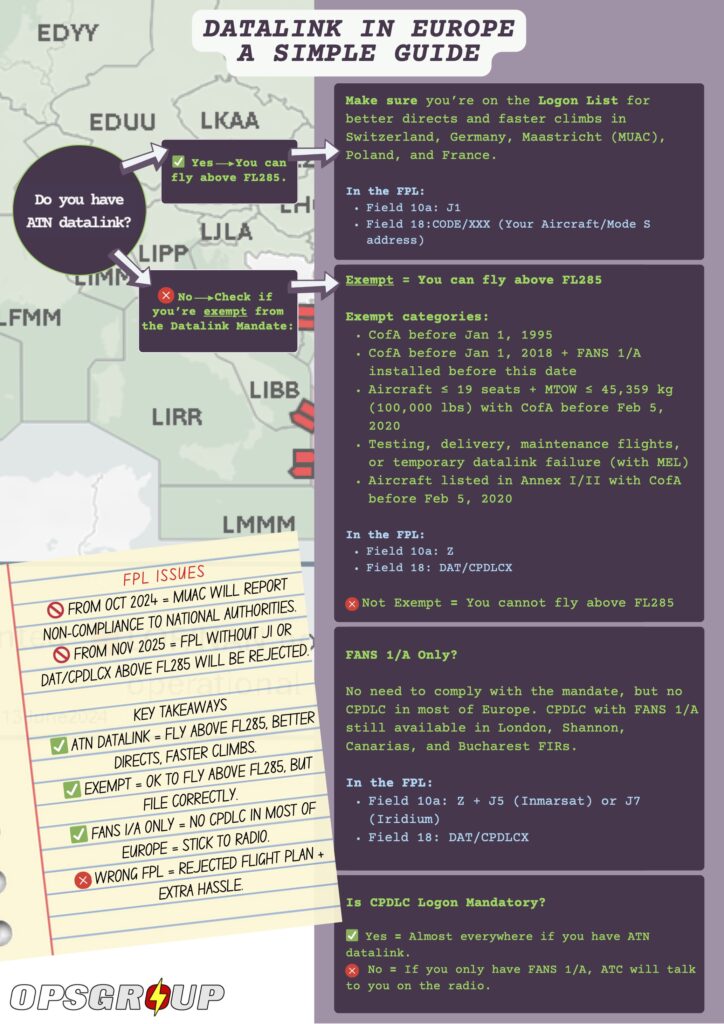
Click for PDF.

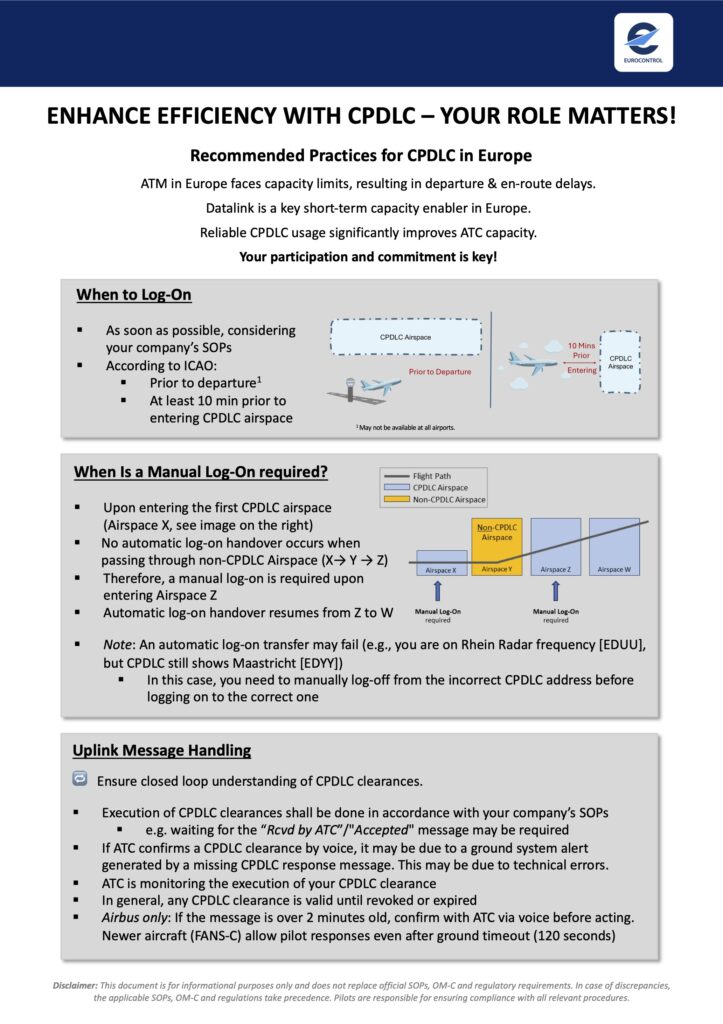
Download the Eurocontrol CPDLC guidance docs

Eurocontrol’s Operational Focus Group has published some new Datalink guidance docs for pilots, effective March 2025. These include tips on when and how to log on, uplink message handling, and other good CPDLC practices. There are separate docs with specific guidance depending on whether you’re using Jeppesen, Lido, or Navblue EFBs. Download the PDFs below.
Jeppesendownload PDF.

Lidodownload PDF.

Navbluedownload PDF.

Any more questions?

This EASA Q&A site is a good place to try.

Failing that, send us an email at news@ops.group, and we’ll do our best to get it answered for you!

US expands CPDLC coast-to-coast

Update 4 Sep 2023:
  • The FAA had planned to allow GA/BA aircraft to use enroute CPDLC from Aug 31, but this is being delayed to sometime towards the end of Sep.
  • So until then, the status quo continues – you can only use enroute CPDLC if you’re already registered as part of the trial, as per KFDC Notam A0171/22.
  • When it gets rolled out to everyone in Sep, there will be green/yellow/red lists drawn up for aircraft depending on their avionics – but only “red” category aircraft (those with serious avionics issues) will be unable to use CPDLC.
  • More info available from our friends at NBAA here.
Original story from 28 Mar 2023:

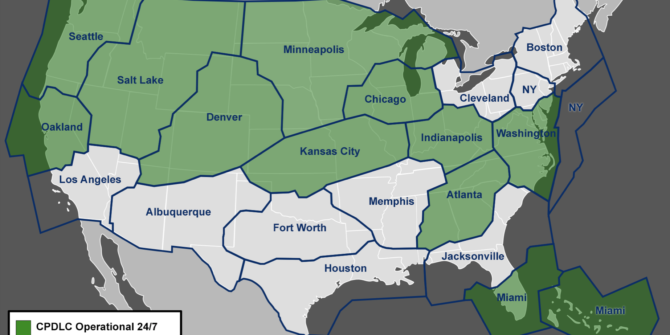
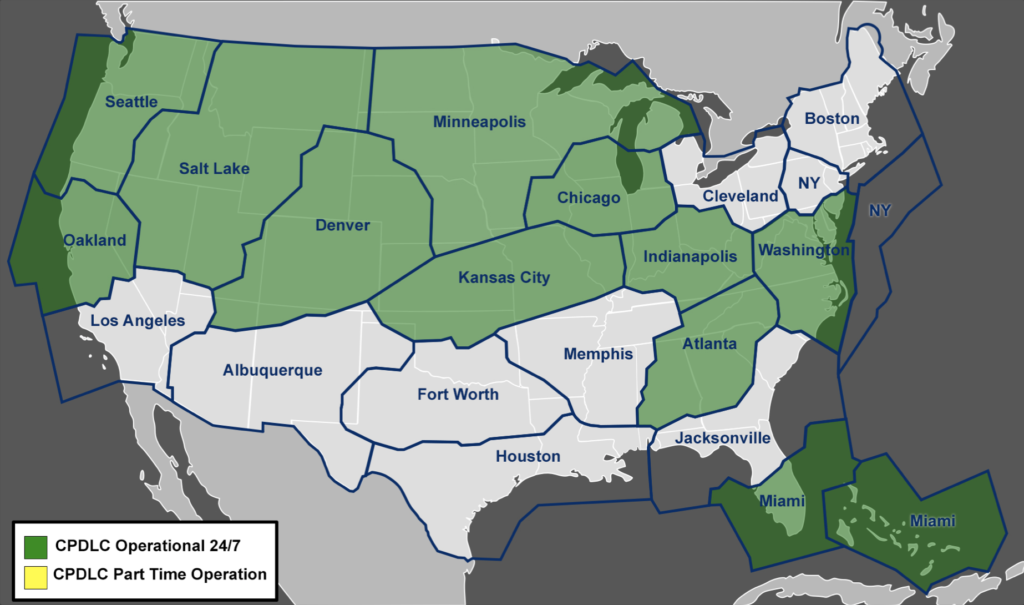
The US has recently implemented en-route CPDLC in more centers across the country. So now, for the first time ever, you can fly coast-to-coast using CPDLC.

And what’s more – KUSA is the one and only code you need.

Who is KUSA?

For those of you who aren’t so familiar with the US, KUSA is the CPDLC logon code.

You might know KUSA from getting your clearances. The US actually gives two types of departure clearance via KUSA – a DCL or a PDC. DCL is the one where you don’t have to read it back. PDC technically requires a voice read back (but in the US they don’t seem to).

If you are flying across the NAT then this clearance usually includes your entry clearance too – so you get this when you get your departure clearance.

KUSA is the one and only logon code you need, all the way across.

So do I need CPDLC now?

US domestic datalink is not mandated. In fact, they are not currently allowing any GA aircraft to use enroute CPDLC unless they are a part of the “US Domestic En Route CPDLC Avionics Trial”. And currently, they are also not allowing any new operators to join this trial!

You can check all that out here on the L3 Harris site. They have a whole load of information on there about DCL stuff too so definitely worth a look.

What if I’m flying into the US internationally?

To make us of US domestic enroute CPDLC, foreign operators must have FAA approval (J4 on their A003). L3Harris also need to have confirmed that your aircraft avionics configurations meet the compatibility requirements per the Recommended and Required Avionics Version List (RAV-E). If in doubt about any of this, contact them at DCIT@L3Harris.com for any eligibility questions.

For eligible aircraft inbound to the US, there are some differences in logon guidance depending on whether a CPDLC connection is already established from the previous data authority, and whether the aircraft is entering via active or non-active US domestic enroute airspace.

Ultimately, all the answers can be found here. This doc lists all the inbound/outbound scenarios, and how CPDLC will work in each situation.


New Datalink Mandate in France

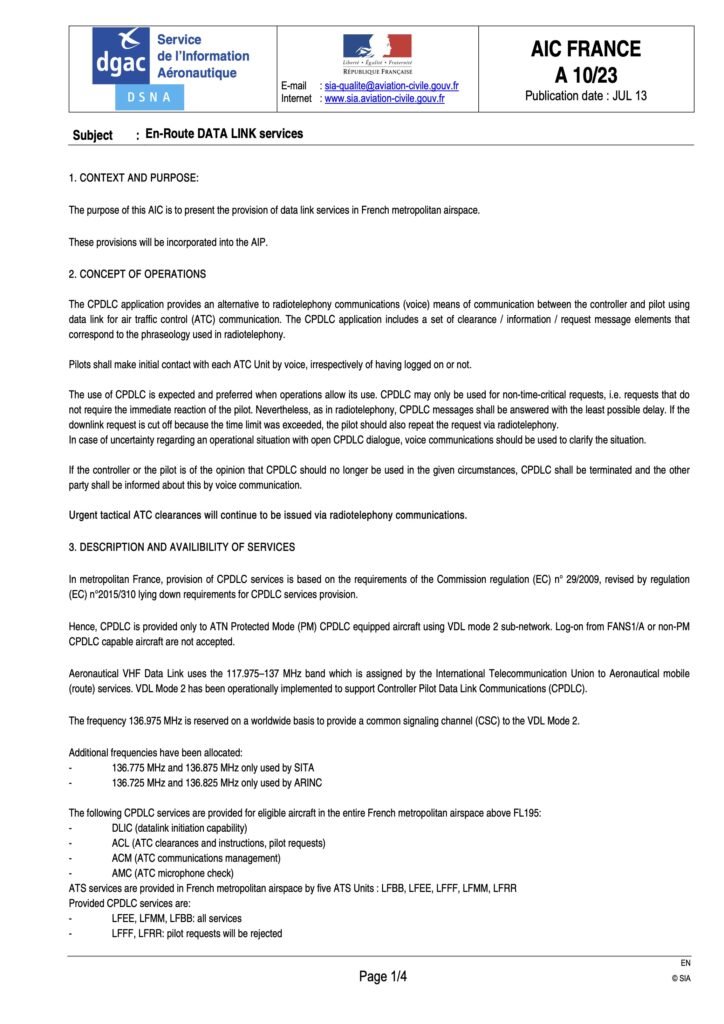
Effective July 13, if you’re flying in France above FL195 and you have ATN CPDLC – you must use it!

Following the recommendation of the Eurocontrol Operational Focus Group (OFG), France is the first European country to mandate CPDLC logon in their airspace after Karlsruhe UAC (EDUU), Maastricht UAC (EDYY), and Cyprus (LCCC). The OFG recommendation is the result of the review of several incidents by ATCOs from 22 ANSPs.

What do you mean by “France”?

Anywhere in the LFFF, LFEE, LFMM, LFBB, or LFRR FIRs.

Where have they announced this?

In AIC 10/23.

The AIC says the mandate only applies if you’re “capable and eligible”. What does that mean?

You’re capable and eligible if all of the following three things apply:

  • You have ATN CPDLC
  • Your equipment is not broken
  • The crew is trained on how to use datalink

If you don’t tick all three boxes, you can still fly above FL195 in France – they won’t restrict you. They’re just saying that you must logon if you can.

What if I only have FANS datalink?

This new rule in France only applies to aircraft with ATN CPDLC – those with FANS 1/A (or with no datalink at all) will continue to supported by conventional VHF. Dual-stack aircraft should be reconfigured to logon via ATN

Do I have to register my aircraft on the Logon List?

No. You don’t have to sign up to the Logon List to use CPDLC in France. France doesn’t use the Logon List yet. The only places where you need to be on this list is for flights in Switzerland, Germany, and Maastricht-UAC controlled airspace (i.e. the upper airspace above FL245 over Belgium, the Netherlands and Luxembourg). France plans to join from 2026.

Is this new rule in France the same thing as the European Datalink Mandate?

No. The European Datalink mandate is for CPDLC equipage for flights above FL285 throughout Europe. This new French mandate applies not on the carriage but on the logon for flights above FL195.

Another important distinction – none of the European Datalink exemptions apply for aircraft which are equipped with CPDLC, as this new French rule has nothing to do with the Datalink mandate! (i.e. the exemptions we detail here do not apply, such as aircraft with 19 seats or less and a MTOW less than 100,000 lbs).

Where else in Europe do I have to logon to CPDLC?

Provided you’ve got ATN CPDLC, here are the places in Europe where logon is mandatory:

  • Maastricht UAC (EDYY) and Karlsruhe UAC (EDUU) above FL285 (source: Eurocontrol)
  • Cyprus (LCCC FIR) above FL285 (source: AIP GEN 3.4.5)
  • France (LFFF, LFEE, LFMM, LFBB, LFRR FIRs) above FL195 (source: AIC 10/23)

Know of anywhere else that should be in this list? Let us know.

And for everything you need to know about the European Datalink Mandate and how it affects your flight, check our article. 


NAT Conundrums Volume III: To GOTA and beyond!

Ah, NAT conundrums! We love them so much, we’re into our third Volume already!

Volume I covered the following three conundrums:

1. To SLOP, or not to SLOP?
2. What’s the difference between the NAT Region and the NAT HLA?
3. Can I fly across the North Atlantic without Datalink?

Volume II covered these additional three:

4. Do you need to plot on Blue Spruce Routes?
5. Do we still fly Weather Contingency Procedures on Blue Spruce routes?
6. When can we disregard an ATC clearance and follow the contingency procedure instead?

And this post, Volume III, looks at GOTA airspace. It’s such a juicy topic, it gets an entire Volume all of its own.

So here goes…

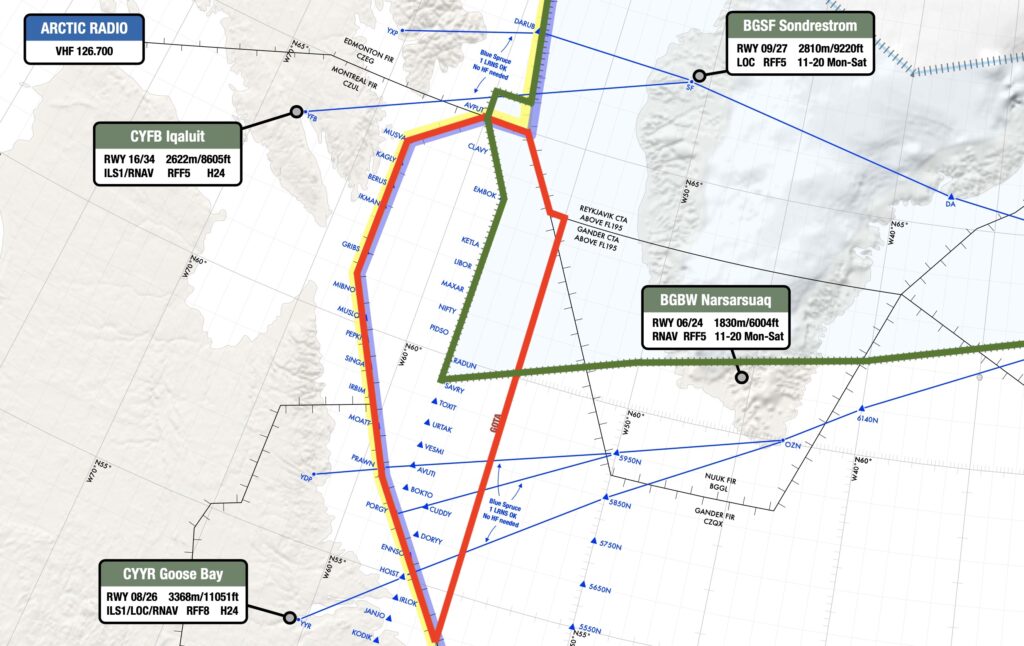
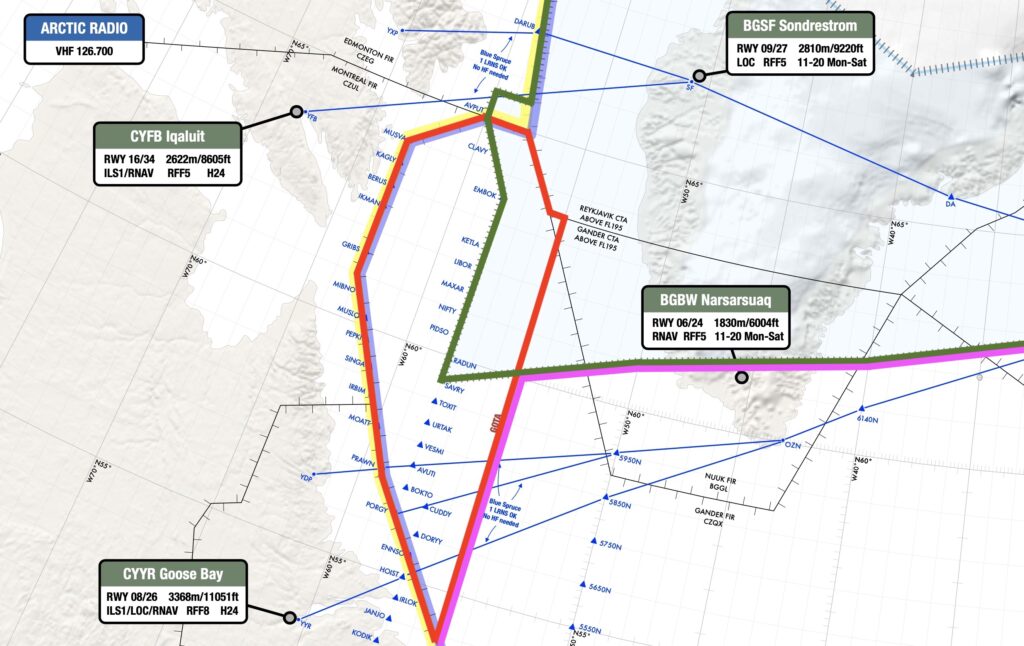
Where is GOTA airspace?

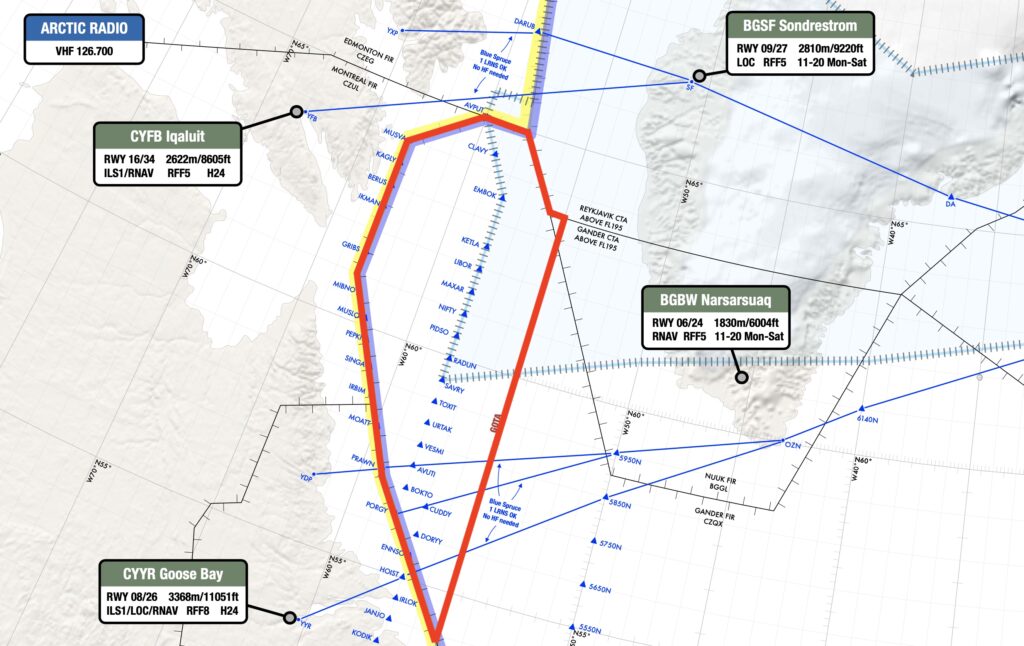
This section of airspace is found off the coast of North-eastern Canada, FL290 to FL600 inclusive.

Here it is, outlined in red:

Why are we talking about it?

Because lots of aircraft transit this area when flying across the North Atlantic. Also because the requirements here were very tricky for us to track down on “paper” (i.e. the Canada AIP, NAT Doc 007, etc), and were only really made clear after speaking with a real human being at Transport Canada. We like human beings!

So here’s what we discovered…

You don’t need datalink in GOTA airspace

No, you don’t. We thought you did, but we were wrong.

When we sat down to update our North Atlantic Plotting chart last year, we wanted to draw nice clear lines on the map to show where datalink was required. But we were bamboozled by GOTA.

The ICAO NAT Doc 007 says that you don’t need datalink in:

“Airspace where an ATS surveillance service is provided by means of radar, 
multilateration and/or ADS-B, coupled with VHF voice communications as depicted 
in State Aeronautical Information Publications (AIP), provided the aircraft is 
suitably equipped (transponder/ADSB extended squitter transmitter).”

It then says to check in State AIPs to see if any of their airspace fulfils this criteria.

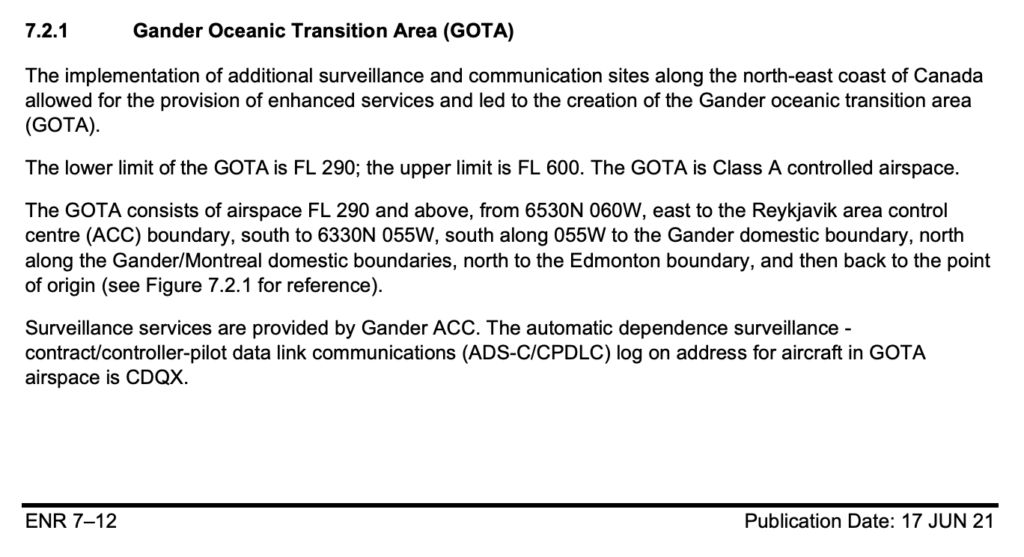
So that’s what we did. But checking in Canada’s AIP brought up this for GOTA:

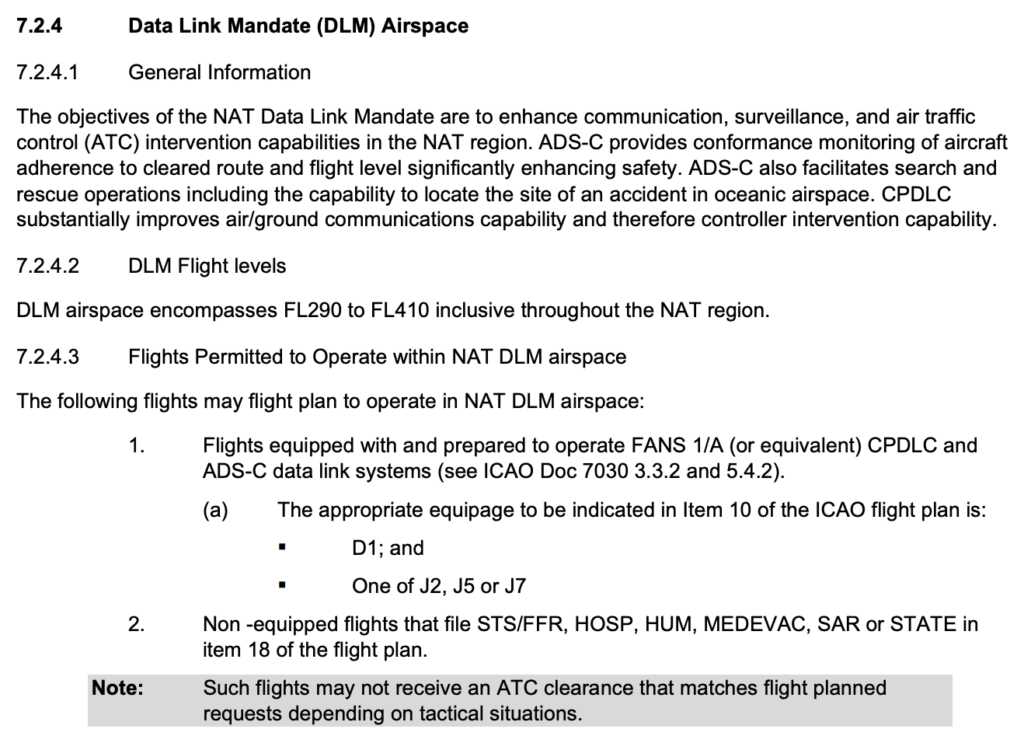
And this for Data Link Mandate (DLM) Airspace:

So none of that really answered our question of whether or not you need datalink in GOTA airspace. The trail went cold…


via GIPHY

Our chat with Transport Canada in 2021:

Deep in the doldrums of lockdown, we sent Transport Canada (TC) some emails asking them the question directly. Here’s a massively paraphrased transcript of that email exchange:

Us: We have been trying to determine if the GOTA requires datalink? It appears to meet the definition of ATS Surveillance Airspace but we can’t identify anywhere in the Canadian AIP which specifically states this.

TC: The GOTA is in fact DLM airspace.

Us:  Really? So operators without datalink must cap their flight below FL290 through the GOTA airspace until they reach that datalink exempt airspace over Greenland, at which point they can climb to the higher levels?

TC: Yes. Well… flights equipped with ADS-B may operate at DLM levels within the GOTA.

Us:  Oh. Now we’re confused. Oh well, it’s Christmas now. Chat next year!

TC: Merry Christmas.

Our chat with Transport Canada in 2022:

Us: We have been trying to determine if the GOTA requires datalink? It appears to meet the definition of ATS Surveillance Airspace but we can’t identify anywhere in the Canadian AIP which specifically states this.

TC: Didn’t you ask this exact same question last year?

Us: Yep. But then… you know… Christmas…

TC: Ah yeah. Ok. As long as you are HLA Certified (MNPS & RVSM) and you have ADS-B, transponder and VHF you wouldn’t require all the DLM equipage. GOTA is technically Gander Oceanic airspace (NAT HLA airspace), but as they have Ground based Radar sources, space-based ADS-B and VHF coverage in the area it has been delegated to Gander Domestic. Due to this, the airspace is considered Class A surveillance airspace and follows the similar regulations as you would in other Canadian domestic Class A airspace.

Us: What about that ADS-B requirement?

TC: Well, technically ADS-B isn’t required as it is considered class A surveillance airspace. So lack of ADS-B wouldn’t prevent you from entering the GOTA area. That said, ADS-B equipage is preferred by many of the controllers. This is because the ground based radar isn’t always guaranteed to the outer limits of the GOTA airspace. This makes identification and separation easier for the domestic controllers when the aircraft have ADS-B.

Us: So tell us again, what do you need in GOTA airspace?

TC: Required equipment for GOTA airspace is transponder, automatic pressure-altitude reporting equipment and VHF. As soon as you leave that airspace you would need other equipment depending on what airspace you enter.

“As soon as you leave that airspace…”

Yes indeed, a good point, worthy of further investigation! Because no-one just zips around solely in GOTA airspace, do they?

So here’s a look at the airspace adjacent to GOTA, and what you need where…

Datalink Exempt airspace over Greenland, Iceland, and a bit of Gander Oceanic

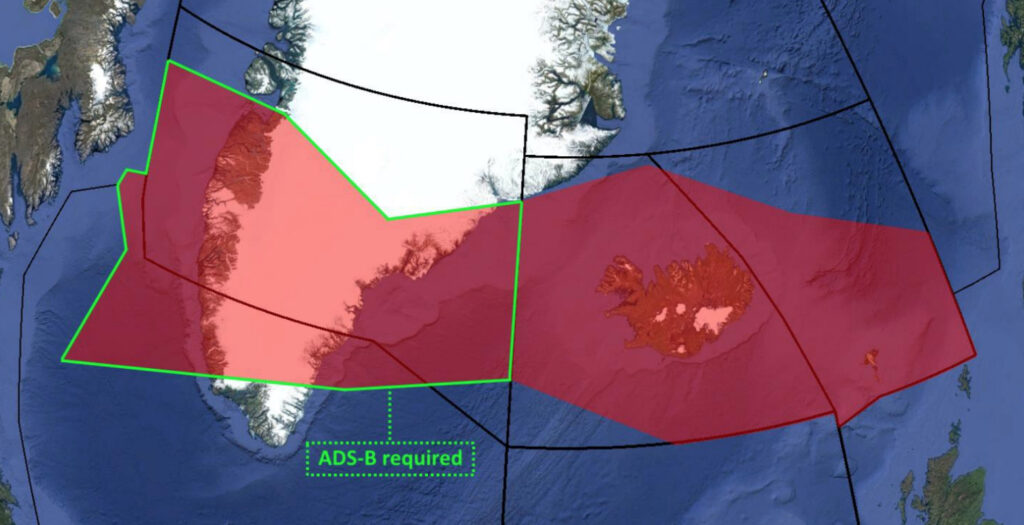
There’s an interesting picture in the NAT Doc 007 doc that looks like this:

This the datalink exempt ATS Surveillance airspace over Greenland, Iceland, and a bit of Gander Oceanic where you can still fly if you don’t have datalink.
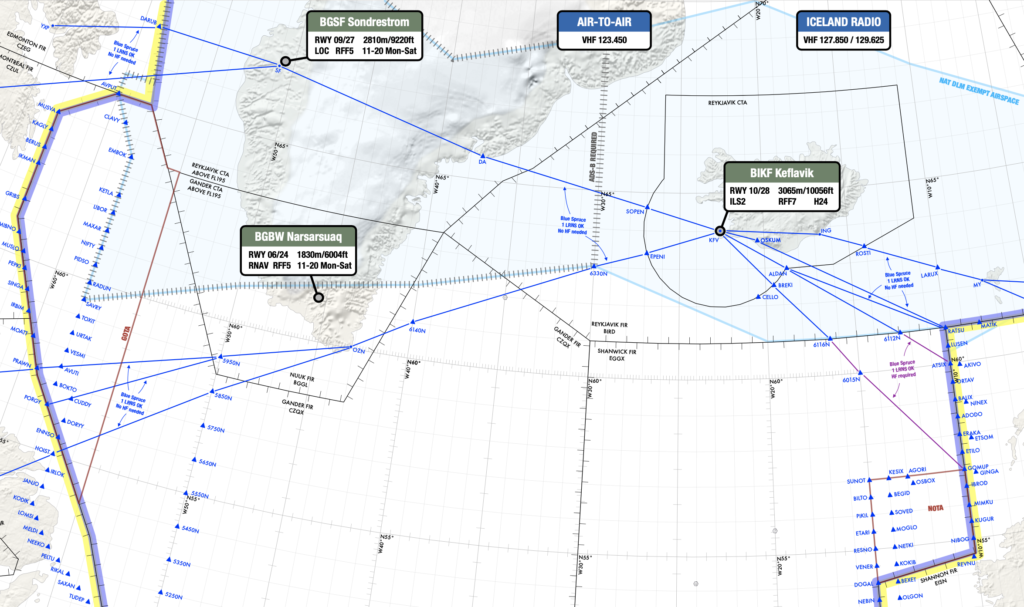
This area is bounded by the following:

Northern boundary: 65N000W – 67N010W – 69N020W – 68N030W – 67N040W – 69N050W – 69N060W – BOPUT.
Southern boundary: GUNPA – 61N007W – 6040N010W – RATSU – 61N020W – 63N030W – 62N040W – 61N050W – SAVRY

So, putting that on our nice NAT Plotting Chart, it looks like this (outlined in green):

Us: What are the requirements for this airspace?

TC: HLA Certification (MNPS & RVSM), ADS-B & VHF.

Us: Nice.

HLA airspace

So now we’re talking about the bit to the south of the datalink exempt airspace, outlined here in fruity pink:

Us: What are the requirements for this airspace?

TC: HLA Certification and full DLM certification, FANS 1/a (ADS-C(D1) & CPDLC(J2, J5 or J7)). Depending on the route of flight and the tracks that day there may be other requirements as well (ie. PBCS Certification for PBCS tracks).

The Blue Spruce Routes

So here’s what we said in a previous post on these…

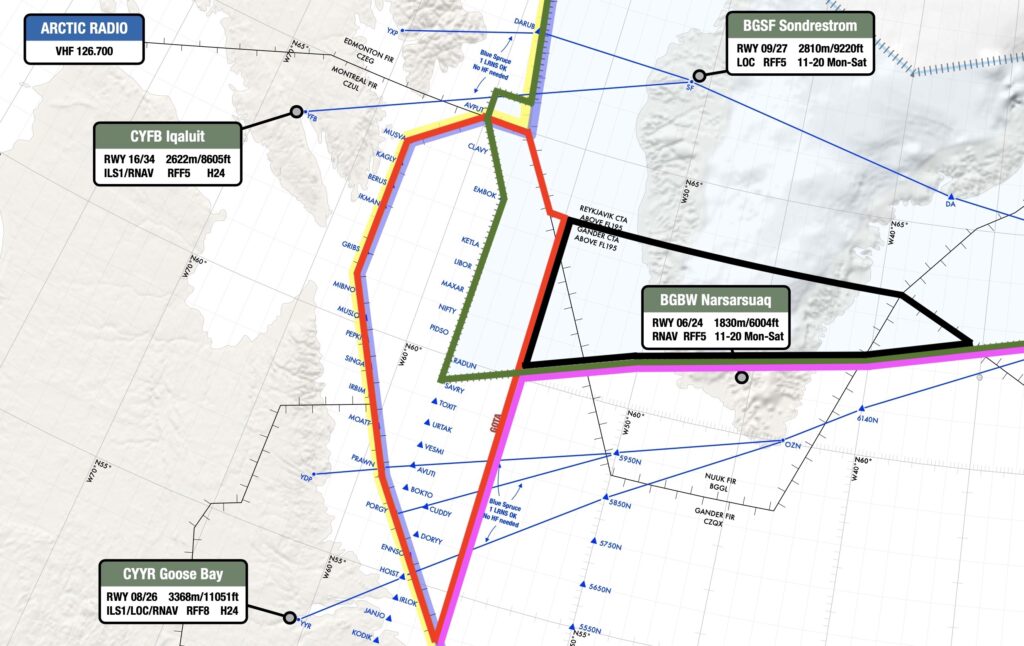
The Southerly ones: These go over Greenland linking Canada with Iceland via waypoint OZN, and are not fully contained in the exempted airspace. So if you’re flying these southerly Blue Spruce routes you will have to meet the NAT DLM requirements or fly outside of the vertical parameters of DLM airspace (i.e. below FL290 or above FL410). In other words: you need datalink to fly on the southerly Blue Spruce routes between FL290-410.

The Northerly ones: These are the ones going overhead BGSF/Sondrestrom airport. These do fall within the exempted area of airspace – so datalink is not mandatory if you’re flying here.

Us: All that stuff we told people in our previous post… did we get that right?

TC: Yeah, pretty much. The primary purpose of Blue Spruce routes is for aircraft with only one long range navigation system. This would normally exclude them from the exemption area anyway, as they are usually kept below HLA airspace (FL280 or below) as they would normally need state HLA approval to fly a blue spruce route with one long range navigation system at FL290 and above.

Gander’s datalink exempt airspace won’t be datalink exempt for much longer!

You: Hold on… which bit of airspace are we talking about now??

Us: This bit, outlined in black. It’s the bit of airspace in the datalink exempt area which is controlled by Gander Oceanic.

So, this is where the plot thickens!

Us: Can you tell us why the plot has thickened, exactly?

TC: Yes, we can. Do you guys actually know anything, or do just come to us for all your answers?

Us: We only know how to massively paraphrase email exchanges.

TC: Okay. So here’s the deal. As we are decommissioning the VHF and ground based ADS-B sites in southern Greenland we will no longer have the datalink exempt area in the northern portion of Gander oceanic HLA airspace. At that point, all Gander oceanic airspace will become DLM airspace. Although GOTA will stay datalink exempt.

Us: Decommissioning VHF and ground based thingies, you say?

TC: That’s right. Nav Canada put out a circular last year and updated it again this year advising that the ADS-B and VHF sites in that area will be decommissioned. The current circular is AIC 15/22. The tricky part is, it discusses just the ADS-B and VHF sites, but many people don’t make the connection from that to the exemption area. When the VHF sites are decommissioned we won’t have the equipment to qualify for DLM exemption in that area. Nav Canada is keeping one frequency until December 29, 2022 to enable users to continue to use the area for this year, but that final one will be decommissioned at that time. The 127.9 frequency will continue to be used by Gander IFSS for the Blue Spruce Routes. When it gets closer to that date, there should be an ICAO NAT Ops Bulletin out and NAT Doc 007 will be amended. So just to clarify, barring any major unexpected changes, that airspace will become strictly DLM airspace on December 29, 2022. At that point it will follow the same regulations as the rest of the NAT DLM airspace.

Us: Bonza.

So, to recap…

  • Datalink Airspace: Remember, NAT DLM airspace only applies from FL290-410. Below or above that, you don’t need datalink in the North Atlantic.
  • If you have full datalink (CPDLC and ADS-C): You can go where you like, and you didn’t really need to read this post.
  • For GOTA airspace: You need a transponder, automatic pressure-altitude reporting equipment and VHF. If you have ADS-B, that’s helpful for ATC.
  • For the Blue Spruce Routes: You need datalink for the southerly ones, but not the northerly ones. (If you’re flying on these then you’re probably doing so below FL290 anyway, in which case you’re below NAT DLM airspace and don’t need datalink).
  • For the datalink exempt airspace over Greenland, Iceland, and a bit of Gander Oceanic: You don’t need datalink, but from 29 Dec 2022 you will do in the bit controlled by Gander.

Questions

Just send us an email at news@ops.group and we’ll try to find out the answer.


July 2020 North Atlantic Ops Update

July 2020: There’s a bunch of new things to tell you about the North Atlantic this month! Here’s a summary:
– Two new ICAO NAT Ops Bulletins
– An updated NAT Doc 007 from ICAO (aka the North Atlantic “Ops Bible”)
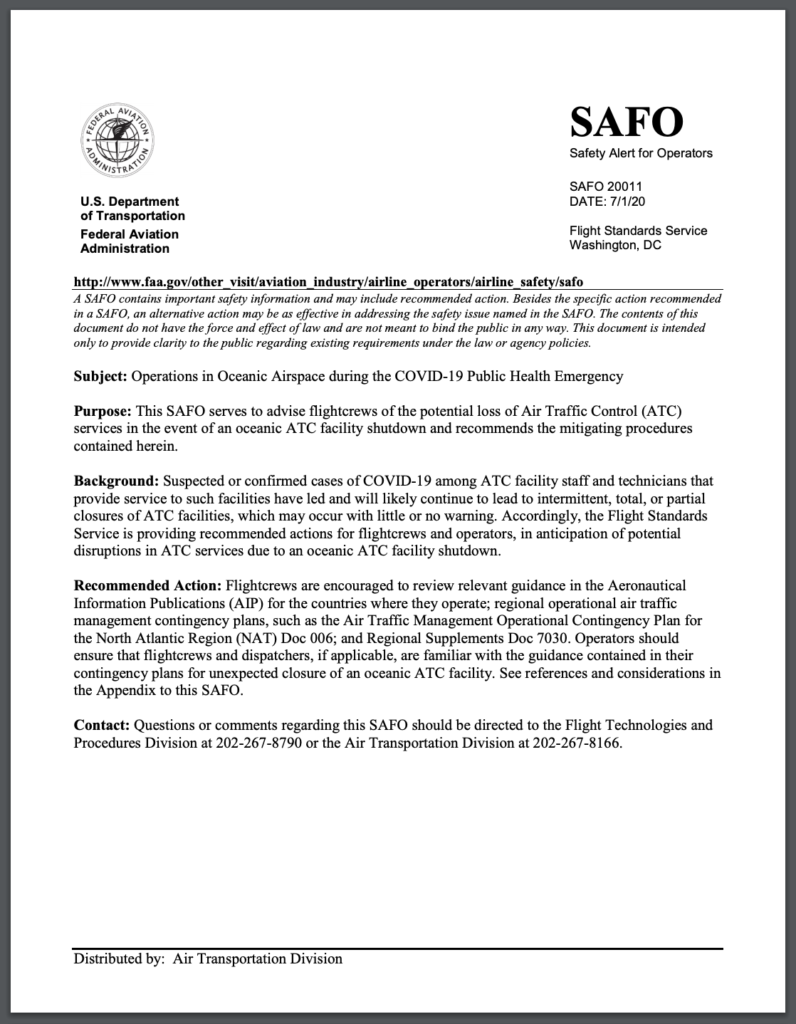
– A guide for pilots from the FAA about what to do if ATC suddenly has to suspend services
– Some juicy Notams from all the NAT FIRs extending the relaxation of the North Atlantic datalink mandate rules until the end of September.

ICAO NAT Ops Bulletins

Two new ICAO NAT Ops Bulletins have been published this week, but it looks like there’s no need to panic.

First up, there’s 2019_003 Rev 2: Data Link Performance Improvement Options, which is just an updated list of common datalink errors and what to do about them.

Second, there’s a new Bulletin called 2020_002: Surveillance Service in the NAT Region / Flight Crew Operating Procedures. This is a strange one. The message seems to be this: back in the old days, you used to get a call from ATC saying “radar service is terminated” or “surveillance service is terminated” when heading out into the NAT, or when crossing from one oceanic control centre to the next. But nowadays, with improved SSR equipment and ADS-B more widely implemented, you might not get this message anymore.

ICAO NAT Doc 007 (2020, Version 2)

ICAO has published an updated version of the NAT Doc 007, applicable from July 2020. There are only some minor changes from the previous version, concerning the Tango Routes:

  • There’s now a specific note saying that state approval is required to operate on these.
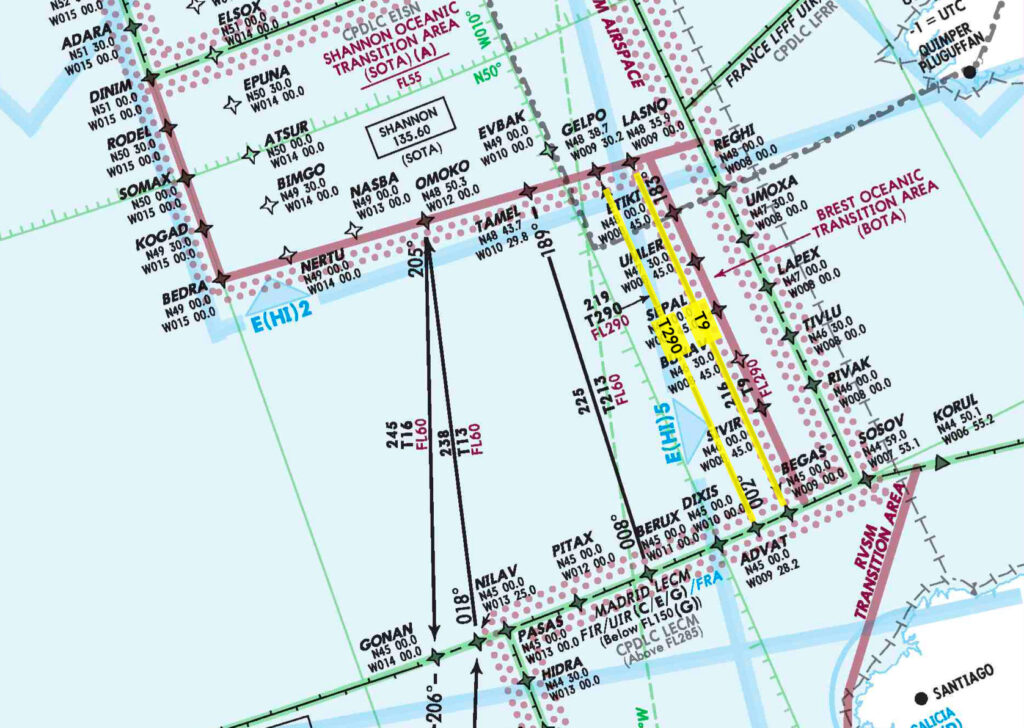
  • There’s also a change to the transponder procedures when using T9 or T290: normally you change transponder code to 2000 30mins after NAT entry, but because of the limited time spent in the NAT HLA when flying on T9 and T290 you should instead make this change 10mins after joining either of those routes.

T9 is southbound only, even levels between FL300-400. T290 is northbound only, odd levels from FL290-410. For more info on the Tango Routes, check out our article here.

What to do during “ATC Zero” events

You’re halfway across the Atlantic when ATC declares that they are suspending all services. TIBA procedures are now in effect. Would you know what to do next? As Covid infections impact ATC facilities, short notice closures are currently a constant risk.

The FAA has published a safety alert for international flight crew with contingency procedures in the event of loss of ATC services in Oceanic airspace. It’s a good one to have in your flight bag. Dispatchers and flight crew are reminded to be thoroughly familiar with AIP specific procedures and traffic management contingency plans for the regions they are operating in. You can read the FAA’s alert here.

They have also published another one for ATC Zero events in Terminal airspace, which you can read here. There have been multiple ‘ATC Zero’ events at major air traffic control centres due to Covid prevention and the subsequent cleaning required. The alert contains important information regarding instrument approach selection, TCAS use, alternate minima, aerodrome lighting and other CTAF procedures at unattended airports. There are also important considerations applicable to Part 121 operations discussed.

NAT Datalink Mandate

EGGX/Shanwick, BIRD/Reykjavik, CZQX/Gander, KZWY/New York Oceanic West and LPPO/Santa Maria have all published Notams extending the relaxation of the North Atlantic datalink mandate rules until the end of September. This is due to the fact that there’s still significantly less traffic because of all the Covid restrictions. Non-datalink mandate compliant aircraft may therefore continue to flight plan and operate across the North Atlantic between FL290-410 until Sept 30. For more info on the NAT Datalink Mandate, check out our article here.

In addition, ICAO are saying that due to the decrease in traffic, there is a significantly higher chance of flights being cleared as requested, and are encouraging operators to file and request their optimal profiles at all stages of the flight. Read ICAO’s guidance here.


For a brief history of the most significant North Atlantic-related ops changes, check out our dedicated article here.


Most GA/BA aircraft now exempt from Europe’s 2020 Datalink Mandate

Europe’s datalink mandate takes effect today – 5th Feb 2020!

The original plan was that datalink would be required for all aircraft operating in Europe above FL285 from this date, but then the EU announced that this would not be required for several categories of aircraft, the main two being:

  • Aircraft with a certificate of airworthiness first issued before 1 Jan 2018 and fitted prior to this date with FANS 1/A.
  • Aircraft with 19 seats or less and a MTOW of 45359 kg (100000 lbs) or less, with a first individual certificate of airworthiness issued before 5 Feb 2020.

In other words – most GA/BA aircraft! (You can read the rule here – latest version in 2023).

Added to that, in early Decemebr 2019 the EU Commission approved plans to pass an additional resolution that makes a bunch of other aircraft exempt too:

Aircraft permanently exempt:

  • Aircraft in Annex I
  • Aircraft in Annex II with a CofA issued before 5 Feb 2020

Aircraft which have up to 5 Feb 2022 to do the avionics retrofit:

On Feb 3, EASA issued a Bulletin which says that operators who are exempt from the mandate should include the letter “Z” in Field 10 and the indicator “DAT/CPDLCX” in Field 18 of their flight plan. If you don’t, ATC won’t know you’re exempt, and you may struggle to fly above FL285!

Bottom line, for operators who are exempt from the mandate, these flights should not be restricted to the lower flight levels below FL285. Logged-on traffic might just get better directs and faster climbs, that’s all.

It should be noted that the Datalink Mandate is not the same thing as the Logon List. The Logon List is the thing you need to get registered on if you want to get CPDLC when flying in Maastricht, France, Switzerland and Portugal. And it only applies to ATN CPDLC aircraft. If you’ve only got FANS1/A, Maastricht will let you log on, but France, Switzerland and Portugal will not.


The Backstory…

This mandate was actually supposed to come into force back in Feb 2015, but got delayed to Feb 2020 due to technical issues with the system, particularly disconnections, known as ‘provider aborts’ – which is where an aircraft loses datalink connection with the ground for more than six minutes.

The high amount of these provider aborts has led some sectors (Maastricht UAC, France, Switzerland, and Portugal) to implement the Logon List (formerly known as the “White List”), which effectively means that CPDLC is only provided to those aircraft with avionics that are known to suffer a lower provider abort rate. The Logon List only applies to ATN B1 equipped aircraft, not those with FANS1/A – Maastricht are planning to introduce a similar list for FANS1/A aircraft at some point in the future, to ensure that only aircraft that have the latency timer feature will be able to log on.

In their original postponement of the mandate back in 2015, the EU said the following:

“This excessive rate of random provider aborts causes a degradation in the network performance potentially presenting aviation safety risks by increasing the pilots and controllers’ workload and creating confusion leading to a loss of situational awareness.”

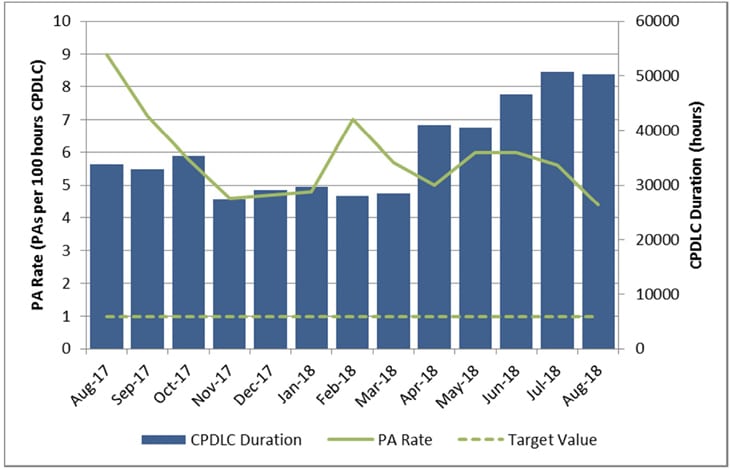
Their goal was to get the number of provider aborts down to 1 per 100 flight hours. By mid-2018, the number had dropped to a rate of 4.4 per 100 flight hours, and data from this year has that figure down to 3.9 per 100.

Added to that, they wanted to get at least 75% of flights across the network filing with datalink. Current data suggests this is still lingering at around the 40% mark. So if the datalink mandate had been implemented as planned in Feb 2020 without these new exemptions, that would have meant that approximately 60% of the traffic would have been restricted to below FL290!

As the EU make clear in their new ruling, that is ultimately why the new raft of exemptions has now been brought in, ahead of the Feb 2020 mandate:

“Acknowledging the ongoing data link implementation issues and corrective actions taken and recognising the objective that at least 75 % of the flights should be equipped with data link capability, the criteria for exemptions should be amended. Those criteria should remain effective, without placing an undue economic burden on specific operator categories which contribute significantly less to the overall number of flights. Such categories should include operators of aircraft with Future Air Navigation Systems (FANS) 1/A systems installed, operators of older aircraft, and of aircraft designed to carry 19 passengers or less.”

Ultimately, when the datalink mandate comes in on 5 Feb 2020, it now looks like most GA/BA aircraft will be exempt from this, meaning that those without CPDLC will be able to continue to operate above FL285.


Thanks to the European Business Aviation Association for their help with this article!

Article header photo by @Zelgomat


No Room for Error – GNE’s and the North Atlantic

Advances in technology mean that aircraft in the North Atlantic High Level Airspace (NAT HLA) are flying laterally, longitudinally, and vertically closer than ever before. But North Atlantic gross navigational errors (GNE’s), which are lateral off-track deviations of 10nm or more, still occur regularly, and jeopardise the safety of you and the traffic around you. So don’t leave it up to Air Traffic Control (ATC) to discover your GNE! In this article, let’s look at some common human slip up’s that lead to GNE’s, and what we can do to prevent them.

[heading]Pre-Flight[/heading]Operating to the highest standards of navigational performance demands the tedious and careful monitoring of aircraft systems. Unfortunately, humans are by nature not the best monitors. During the long quiet of an oceanic crossing, we can fall victim to cognitive traps such as change blindness, expectation bias, and complacency.

But the potential for error on Atlantic crossings begins well before the first coast-out waypoint. In fact, it begins before take off. The following four areas are where strategies in mitigating a GNE begin.

1) Data Entry

Via ACARS:

Many pilots now use ACARS to automatically downlink the entire flight plan and winds aloft directly to the FMS. But an over-reliance on automation can lead to complacency, and so the more reliable the system, the more complacent we become as monitors. In one incident, a Boeing 747 suffered a GNE of 120nm. The flight plan downlink from ACARS unfortunately contained one bad coordinate that went unnoticed. Once lured into complacency by such reliable technologies, there can be a temptation to omit cross-checking.

What can we learn from this? Always verify the full coordinates in an ACARS downlinked flight plan. Similarly, if several different flight plans were run, ensure that you request your downlink using the most current and filed flight plan number.

Manually:

A manual entry means a pilot inserts the flight plan’s waypoints directly into the aircraft’s flight management system (FMS). But no matter how meticulously one may be, manual data entry can still produce errors. Then how do we guard ourselves against these errors?

Firstly, avoid using ARINC 424 shorthand for programming oceanic points. This has been a factor in many GNE’s, given how easy it is to misplace the letter as a prefix or suffix. For instance, consider how simply misplacing the “N” could cause a drastic lateral deviation:

  • 50N60 = 50N 160W
  • 5060N = 50N 060W

If you have the capability on your aircraft, use the full coordinates, including minutes.

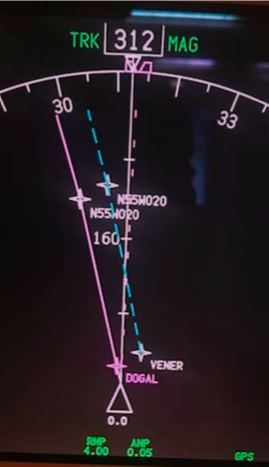
For the last few years, use of half degrees of separation has been on the rise in an attempt to enhance airspace efficiency. But on flight displays units that only show 7 digits, these half degree coordinates are misleadingly displayed as full coordinates. For instance, the half coordinate N55°30’ W020° will display as N55°W020° (see image below, which shows identical waypoint labels for points separated by half a degree!). In this case, it is imperative to view the expanded version of coordinates (degrees and minutes).

Another frequent error leading to GNE’s is transposing numbers during data entry. This commonly occurs when you complete almost the entire crossing along one degree of latitude, then fly the last waypoint at a different latitude. For example, with a cleared route of 57°N 050°W, 57°N 040°W, 57°N 030°W, 56°N 020°W, one can accidentally enter 57°N 020°W. This will put you 60nm off course.

But there is good news! These errors are easy to recognize and avoid by having a specific method of waypoint verification.

2) Waypoint Verification

Whether entered via ACARS or manually, both crew members must come together to perform a thorough cross-check. The following method recommended by ICAO in Doc007 seems to work the best:

  • One pilot reads the waypoint/coordinates, bearing and track from the FMS.
  • On the master document, the other pilot will circle the waypoint to signify the insertion of the correct FULL coordinates in the navigation computers
  • The circled waypoint number is ticked, to signify the relevant track and distance information matches
  • (In flight) The circled waypoint number is crossed out, to signify that the aircraft has overflown the waypoint.

[fancy_box box_style=”default” icon_family=”none” color=”Accent-Color” border_radius=”default” image_loading=”default”]

Cognitive Traps:

Expectation Bias is when your perception is influenced by your preconceptions. It is vital that the second crew member crosschecks from the FMS/CDU to the master document – and not vice versa – thereby increasing the chance of spotting an error.


Pop-up trip hustle – It’s one thing reading about waypoint verification, but it’s another thing actually sitting down and taking the time to do it. Do not be tempted to crosscheck your own work because you’re in a time crunch – it requires at least two separate sets of eyes.[/fancy_box]

3) Initialisation of navigation systems

The navigational integrity of your entire flight is predicated on an accurate starting position. Even a small error with on the ground can translate into a gross error later down the line in flight.

The FMS GPS position and your current parking coordinates (found on the 10-9 pages) must match. Avoid using “last position” function in the FMS – if you were towed overnight, the “last position” will be your previous location, not your current one! Sounds obvious, but mistakes happen.

Inertial systems, once aligned, must also complement the GPS coordinates. Initialisation of inertial navigation systems can take between 6-15 minutes, and errs on the longer side at more northerly latitudes – so be patient! Moving the aircraft during alignment will cause an alignment error. Bottom line: avoid repositioning/towing the aircraft during alignment, even it is to a nearby spot on the same ramp area. Position errors like this cannot be corrected once in flight.

4) Your Master Clock – (iPhones not authorised!)

Since our ETAs for oceanic waypoints must be accurate within +/- 2 minutes, it is vitally important that, prior to entry into the NAT HLA, your master clock is accurately synchronised to UTC. ICAO Doc007 has a list of approved sources from which you can set your aircraft master clock (and your iPhone isn’t one of them!). You are approved to use the GPS time which can be found in the FMS.[fancy_box box_style=”default” icon_family=”none” color=”Accent-Color” border_radius=”default” image_loading=”default”]

Cognitive Trap:

Close to the E/W Greenwich line or close to the equator, you’ll just be on the fringes of the opposing segment. So, take a close look at the E/W or N/S letter coordinates, especially if you are usually accustomed to flying from one particular geographic area.[/fancy_box][heading]Clearances & Communication[/heading]With a move away from spoken communications and towards datalink procedures, requesting, copying and verifying a clearance becomes a much simpler task! But it is still important to know your own limitations in the rare instance that you need to copy a clearance via voice.

Casual radiotelephony should be avoided

Casual radiotelephony can be the source of misunderstanding coordinates or clearances, and so all waypoint coordinates must be read back in detail, adhering strictly to standard ICAO phraseology. An example of standard ICAO phraseology requires enunciation of every individual digit. 52 North, 030 West would be read back as “Fife two north, zero tree zero west” as opposed to “fifty-two north thirty west”. Have no doubt about it, Shanwick can be the most strict in this regard.


Distractions and workload

If your departure airport is close to the oceanic boundary, e.g. Shannon or Miami, the benefit is that you will copy your oceanic clearance on the ground. Unencumbered by distractions typically associated with being in flight, you can focus almost fully on the task at hand. However, most flights pick up an airborne clearance, and it is important to prioritise this for a period of low workload.

Take the example of a Bombardier Global Express crew that narrowly avoided a GNE after copying a clearance. While they were in the midst of crosschecking the clearance with the FMS and climbing to their initial altitude, the flight attendant approached them with an issue. Instead of waiting, one of the pilots attended to the problem. A new waypoint wasn’t entered, and it was later caught by ATC in a position report. Try to avoid non-vital tasks until ALL the steps regarding copying, verifying and inputting a clearance are complete.

Following these simple standard operating procedures (SOPs) step-by-step will guard against clearance errors. If the steps are interrupted for any reason, start again from the beginning.

  • Two pilots monitor and record the clearance. The Pilot Monitoring (PM) will contact clearance delivery, while Pilot Flying (PF) monitors both the primary ATC frequency and the clearance delivery frequency.
  • The PM then records the clearance on the master document. The PF also copies down the clearance separately.
  • Clearance is read back to ATC. Any disparities between both pilots’ interpretations of the clearance must be clarified with ATC.
  • A deliberate cross check of the clearance to the filed flight plan and the FMS is made.

Re-Clearance

According to ICAO Doc007, “In the event that a re-clearance is received when only one flight crew member is on the flight deck…changes should not be executed…until the second flight crew member has returned to the Flight Deck and a proper cross-checking and verification process can be undertaken.” Sorry, they just don’t trust you to do this by yourself, and neither should you!

Errors associated with re-clearances, re-routings and/or new waypoints continue to be the most frequent cause of GNE’s. Therefore, a re-clearance or amended clearance should be treated virtually as the start of a new flight and the procedures employed should all be identical to those procedures employed at the beginning of a flight.

  • Both crews note the re-clearance
  • Reply to ATC via ACARS or voice
  • Amend the Master Document
  • Load the new waypoints into the FMS from the updated Master Document
  • One pilot verifies the input of the new waypoints reading from the FMS
  • Verify the new tracks and distances, if possible
  • Prepare a new plotting chart/re-plot in Jeppesen EFB

With datalink, you might have the capability to load the new route directly from the ATC message into your FMS flight plan. This will eliminate a transcription error on your part, but you cannot always count on the FMS to load this seamlessly. Oftentimes, if a revised coast-in waypoint doesn’t connect with your originally planned domestic airspace airway, it might cause a discontinuity. Worse, some crew have experienced their entire domestic flight plan drop out, left with only the oceanic portion.

Conditional Clearances – There’s always a catch!

A conditional clearance is an ATC clearance given to an aircraft with certain conditions or restrictions, such as changing a flight level based on a time or place. Conditional clearances add to the operational efficiency of the airspace, but are commonly misinterpreted by flight crews.

Shannon has been known upon first VHF contact to provide lateral conditional clearances on coast-in. For example: “N135AC, after DINIM, direct ELSOX”. Often, crew have been known to read back the correct transmission, but then execute the wrong procedure by proceeding directly to ELSOX.

Why is this happening? In studies of linguistics, verbs (such as ‘direct’) have been noted as having a perceptual priming effect, that more easily grabs our attention at the expense of weaker prepositions (such as ‘from’ or ‘after’). Listen carefully for prepositions. Similarly, in aviation vernacular, the word ‘direct’ means to proceed now to the specified waypoint. As pilots, we can distinguish this meaning with very little effort, and most of the time can expect to proceed present position direct. Thus, we are primed to go direct.

While this isn’t a complex sentence, research indicates that transmissions involving serial recalls (such as “proceed here then here…”) are susceptible to distortion, with the last word or item more commonly interfering with recall of the previous item.

A really simple way to prevent this is to write down clearances as they are being read to you, then read-back the transmission. You can also call attention to a conditional clearance by prefixing their read-back with the word “Verify” or “Confirm” over the radio. Via datalink, sufficient care always must be taken when factoring in all the contents of a clearance before acknowledging the message. The initial phrase “MAINTAIN FLIGHT LEVEL 300” is included to stress that the clearance is conditional. If the message is about to time out, and you need more time to process its contents, reply using “Standby”. Respond at your own pace![fancy_box box_style=”default” icon_family=”none” color=”Accent-Color” border_radius=”default” image_loading=”default”]

Cognitive Trap:

On the longer route segments between New York and Santa Maria, “when able higher” (WAH) reports might be solicited. ATC acknowledgement of a WAH report must not be misconstrued as a conditional clearance to climb. Any climb clearances will be issued separately from a WAH acknowledgement.[/fancy_box][heading]Miscellaneous[/heading]

10-minute Check – put the (Bad) Elf on the shelf for this

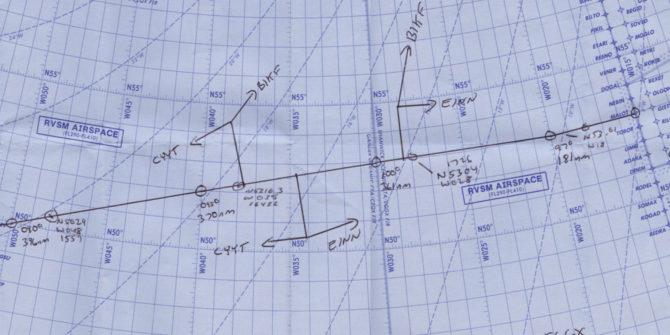
One of the best ways to capture a potential GNE and refresh your situational awareness is with the sublimely simple 10-minute check. Ten minutes after waypoint passage, you’ll use your current coordinates to plot your position on your plotting chart. If the coordinates don’t land on the plotted track line, an investigation into the source of the error must begin immediately. It doesn’t hurt to even make additional plots between waypoints too, but ICAO only requires the one 10-minute check.

Today, more pilots are carrying independent GPS units in their flight bags, providing crew with own-ship on their oceanic route map. Tempting though it may be to use this for present position information, it is currently not an approved source of navigation, and should NOT be used in lieu of a 10-minute check.[fancy_box box_style=”default” icon_family=”none” color=”Accent-Color” border_radius=”default” image_loading=”default”]

Cognitive Trap

It is easy to forget about the 10-minute check. Setting a timer once your waypoint passage tasks have been completed will help remind you to do so.[/fancy_box]

Autopilot mode – “Wait, are we supposed to be in heading?”

Incorrect autopilot mode selection has been known to be a factor in GNE’s. On an oceanic crossing, you can bank on being in NAV or LNAV most of the way across the Atlantic. But perhaps you used heading mode to deviate for weather or to intercept a SLOP. It is not uncommon among pilots to spare your passengers two steep banking turns (thanks LNAV!) by manually flying a SLOP intercept in heading mode. But if you forget to re-engage LNAV, you will continue drifting on your merry way, further and further off course.

Distraction, fatigue or complacency are common reasons for losing mode awareness, so the following simple tricks will help mitigate autopilot induced GNE’s.

  • It helps to verbally announce when you are transitioning temporarily into heading mode, to bring both pilots in the loop.
  • Employing sterile cockpit until you’re back in LNAV will help mitigate distractions.
  • In an abundance of caution, you can keep a finger on the heading button or heading dial until you are back in LNAV will serve as a reminder.

[fancy_box box_style=”default” icon_family=”none” color=”Accent-Color” border_radius=”default” image_loading=”default”]

Cognitive Trap:

The flight mode annunciators (FMA’s)  are the most reliable indicators of automation selection – more so than the flight guidance panel! Yet, a study found that pilots pay superficial attention to the FMA’s during critical mode changes. Don’t waste a valuable resource, and do consciously bring the FMA’s into your scan.[/fancy_box]Deliberate cross-checking and monitoring are a critical last line of defense for which we, as pilots, don’t get explicit training, but are nevertheless expected to perform effortlessly. But over the North Atlantic, there is little room for error. So, let’s recap what can be done!

  1. Allow sufficient time on the ground to set up
  2. Closely scrutinise data entry – whether the source is human or ACARS!
  3. Work together on waypoint verification
  4. Don’t work single pilot – always keep all crew in the loop
  5. Deal with clearances and re-clearances methodically

Understanding our vulnerabilities is key to the process of mitigating errors. Armed with an understanding of our own limitations, and an appreciation for the practices and habits mentioned above, a ‘would-be’ GNE can be averted.

Links

ICAO Doc 007 

Global Operational Datalink Document (GOLD)


Regulatory deadlines on the horizon

Regulatory compliance – nothing quite warms the heart like reading those two words, side by side. This year has seen quite a few changes in this department already (thank you, NAT HLA!), but here is a list of some other regulatory deadlines on the horizon…

Dec 31, 2019 – Operations in North Atlantic

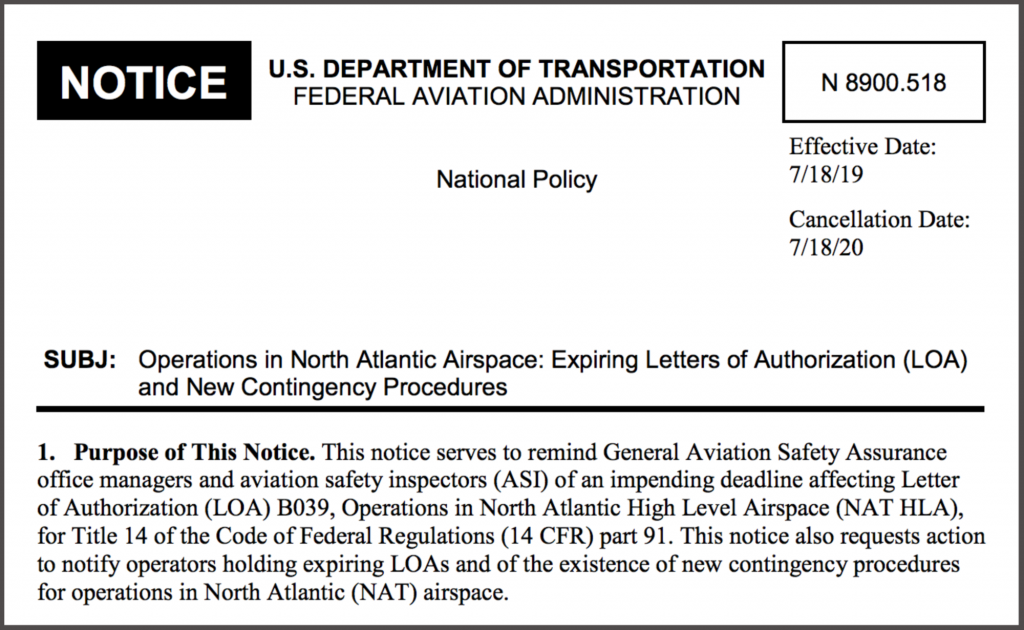
  • U.S. operators must have the revised LOA BO39: “Operations in North Atlantic High Level Airspace (NAT HLA)”. Operators holding the old MNPS LOA BO39 will not be permitted to fly in the NAT HLA beyond this date. Requirements include: RNP10, crew training and new contingency procedures incorporated in company operating handbooks. Read our article here.

Jan 1, 2020 – US ADS-B Out Mandate

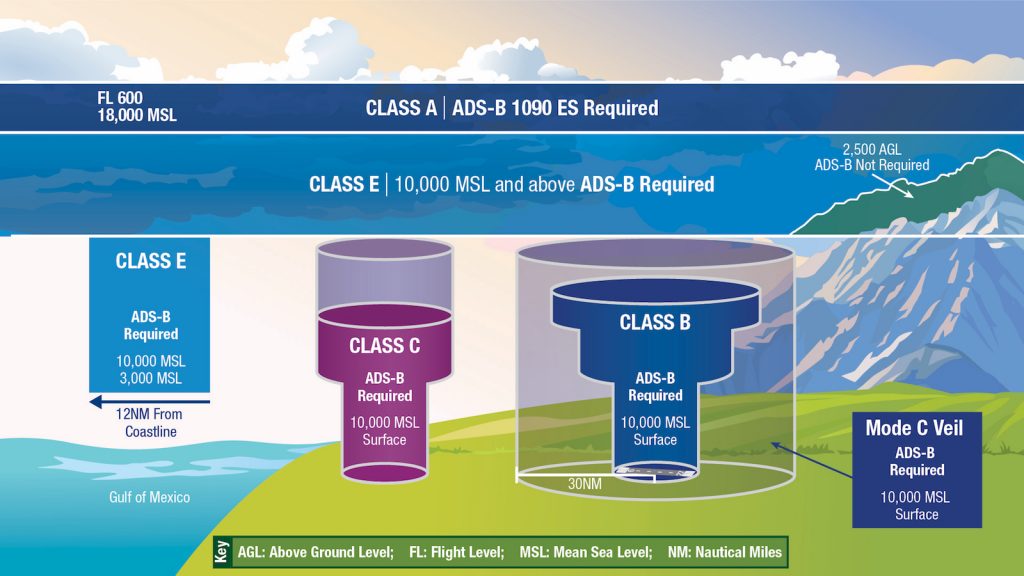
  • ADS-B Out will be required where Mode C is required AND:
  • Class A, B and C airspace, Class E at or above 10,000’ MSL (but not below 2,500’ AGL).
  • Within 30nm of Class B (Mode C veil).
  • Above the ceiling and within lateral boundaries of Class B and C up to 10,000’.
  • Class E over Gulf of Mexico, at and above 3000’ MSL within 12 nm of US coast.

Jan 30, 2020 – Expansion of Datalink Mandate in the North Atlantic

  • Phase 2C of North Atlantic Datalink Mandate. FANS 1/A CPDLC and ADS-C will be required between FL290-FL410 throughout the entire NAT region (previously FL350-390). Read our article here.

Feb 5, 2020 – European Datalink Mandate

  • Initially legacy aircraft flying above FL290 in European airspace were to be equipped with CPDLC capability by Feb 2015. But due to equipage requirements and technical issues the mandate was delayed to Feb 2020, AND, even better, most GA/BA aircraft will be exempt from this. Read our article here.

June 7, 2020 – European ADS-B Out Mandate

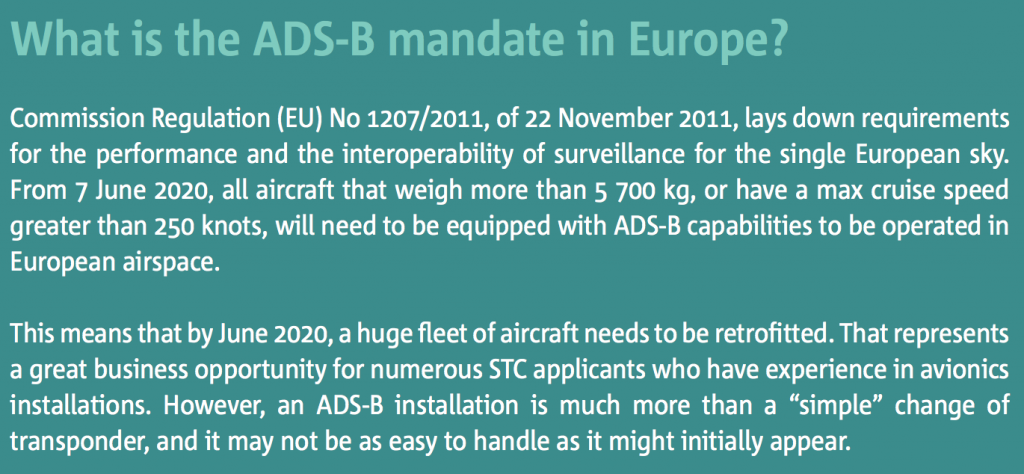
  • Aircraft flying IFR in Europe with max certified takeoff weight of more than 5700kg (12,566lbs) OR max cruising TAS of more than 250kts must be equipped with ADS-B. GPS sensor with at least WAAS accuracy coupled to a 1090 Extended Squitter transponder required.


DELAYED:

Canada: ADS-B Out Mandate

  • This was planned to be implemented in Class A airspace from Feb 2021, and Class B airspace from Jan 2022. But Nav Canada has now postponed this mandate. They still plan on using ADS-B for surveillance, and this will be used on a priority basis for suitably equipped aircraft starting in 2021, but they say – “non ADS-B Out equipped aircraft will be accommodated within the airspace until a performance requirements mandate can be implemented.”

ALSO ON THE HORIZON:

August 14, 2020 – EU: SAFA Ramp Checks & Pilot Mental Health

  • EASA regulations requiring alcohol testing during ramp checks will take effect across all SAFA participating countries (although some countries have already started doing this: Austria, Belgium, Czech Republic, France, Germany, Greece, Iceland, Ireland, Italy, Netherlands, Portugal, Spain, Switzerland, UK, and Singapore). Tests may also be carried out by local police at any time.
  • All pilots working for European airlines will have access to mental health support programs.
  • European airlines will perform a psychological assessment of their pilots before the start of employment.

Any other biggies that we missed? Let us know!


July 2019 North Atlantic Update

There are four new things to tell you about the North Atlantic, following the flurry of new and updated NAT Bulletins that ICAO issued last week. Get ready for some acronyms! Here’s a summary:

1. OWAFS

Operations Without an Assigned Fixed Speed
ICAO NAT Bulletin 2019_001

We wrote about this before. This Bulletin just formalises the practice that has already been in place since April 2019 in the Shanwick, Santa Maria, and New York Oceanic FIRs (not WATRS).

Here’s how it works: You’ll get a normal oceanic clearance, with a fixed Mach Number, like you always did. But then somewhere after the Oceanic Entry Point, you may get a CPDLC message saying RESUME NORMAL SPEED. You should reply with WILCO. What that means is: Fly ECON, or a Cost Index with Variable Mach. You can fly within 0.01 up or down of your cleared Mach, but if it varies by 0.02 or more you must advise ATC.


2. ASEPS

Advanced Surveillance Enhanced Procedural Separation
ICAO NAT Bulletin 2019_002

ASEPS was another trial that started in April 2019 – this time in the Shanwick, Gander and Santa Maria FIRs.

So far it has only been for longitudinal separation, which can be brought down to as close as 14NM for compliant aircraft (RVSM/HLA approval, ADS-B, and fully PBCS compliant – which means meeting the specifications of RNP4, RCP240 and RSP180).

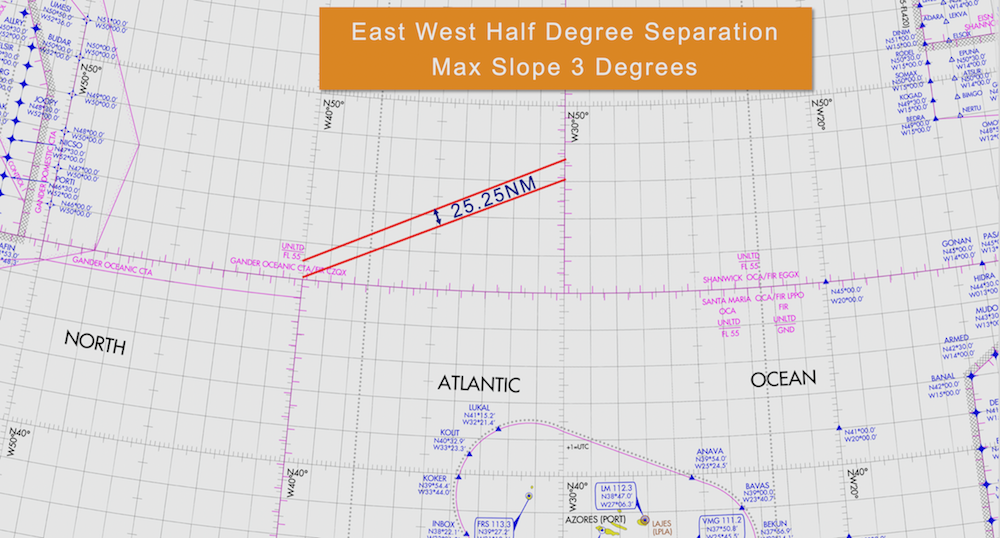
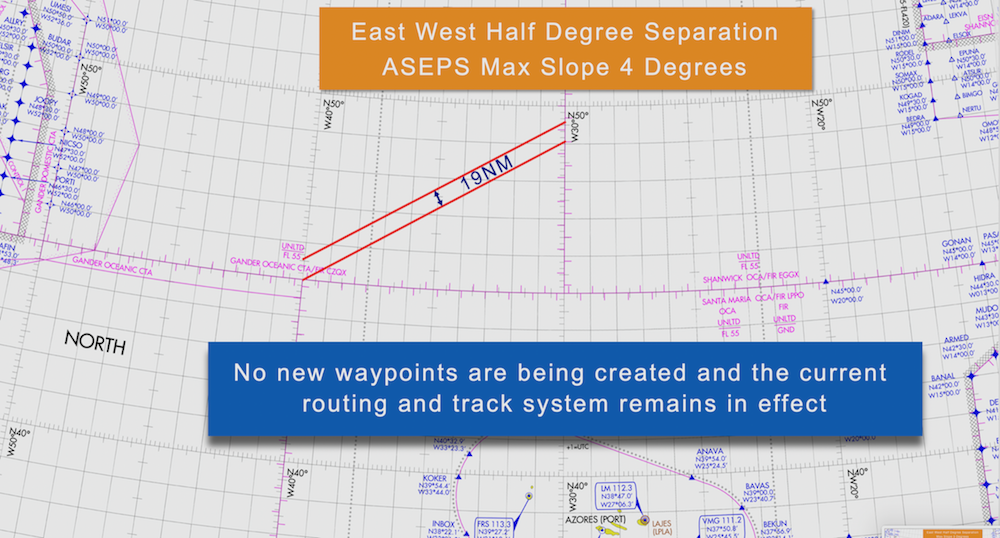
But in the new Bulletin, from October 2019 they plan to reduce lateral separation for compliant aircraft as well – down to 19NM from the previous limit of 25NM.

There are no plans to change the design of the NAT Tracks, which will continue to be spaced 25NM apart. The initial benefit of the 19NM lateral separation will basically just be that steeper route angles will now be available for pairs of aircraft flying parallel routes outside of the NAT Track system – the current “gentle sloping turn” limitation is 3 degrees latitude between 10 degrees of longitude, but on 10th October 2019 that will change to a limitation of 4 degrees latitude between 10 degrees of longitude. The result of this will be a lateral separation of 19NM on the steeper turning routes.

Images courtesy of 30WestIP


3. Data Link Performance Improvement Options

ICAO NAT Bulletin 2019_003

Nothing to worry about, this is just a list of common datalink errors and what to do about them.

Two key take-aways:

  1. Update your aircraft avionics software as soon as updates are available.
  2. Answer your messages within 60 seconds or send a Standby message (recent data indicates Business Aviation operators are very bad at this).


4. NAT DLM – The North Atlantic Data Link Mandate

ICAO NAT Bulletin 2017_001_Revision 04

This one is just a slight revision to the plans for the datalink mandate. Datalink is currently required between FL350-390 in the NAT region, and from 30th Jan 2020 this mandate will be extended to between FL290-410.

So with this revised Bulletin, the change is that they have decided they will cap it at FL410 – whereas previously there were no plans for any upper limit at all. This will basically match the NAT HLA and RVSM vertical limits and makes sense. This will allow non-compliant aircraft to continue to operate at FL430 and above – mostly GA/BA operators.


Further reading:

Special thanks to Mitch Launius at 30WestIP.com for help with this post. For assistance with international procedures training for business aviation crews worldwide, check out the website.


Singapore Changi (WSSS) Departure Clearance by Datalink

Starting April 23rd, 2018, Changi Airport (WSSS) will begin giving departure clearance (DCL) via datalink, on certain routes. The idea is to clear up voice communications when DCL can be used. Full details listed in CAAS AIP SUP 013/2018.

To use this, you’ll need ACARS, and be compliant with EUROCAE ED85-A. You’ll login to the ground system at WSSS.

The departures are as below:

– Destinations in Peninsular Malaysia via ATS Routes A457 and B466
– Destinations in Thailand via ATS Routes B466 and B469 / M751
– Destinations in Indonesia via ATS Route A457, R469 and B470
– Destinations in Australia and New Zealand via ATS Route B470
– Flights with allocated Calculated Take-Off Time (CTOT) under Bay of Bengal Cooperative Air Traffic Flow Management (BOBCAT)

A few other notes:

-The DCL message will not include requested crusing levels and final cruising levels. Your planned flight level in 15b will be used, and ATC will give cruise FL when airborne. Sounds like they won’t entertain any requests for a different FL while on the ground.

-No revisions allowed over datalink, all changes must be made by voice comms.

-Make your request with RCD message (see format in attached AIC) no more than 20 minutes before TOBT. If you’ve got a CTOT under BOBCAT, you’l need to put that in the message. If you’re routing via ANITO B470, list your FL at ANITO crossing.

If your DCL is rejected, you’ll get a “revert to voice procedures” message. A few auto-rejects:
-Flight routes not applicable.
-RCD message doesn’t comply with ED-85A or inaccurate data.
-Invalid TOBT
-When required due to flow restrictions.

Operating out of WSSS soon?  CAAS AIP SUP 013/2018 is worth a read.


New, single CPDLC logon for US airspace

In case you missed the several hundred Notams this week, KUSA is the new identifier for all datalink logons in the US, including CPDLC-DCL, and enroute, which came into use on October 22nd. Now, the only logon you need is KUSA.

For all you could possibly want to know about Datalink operations in the US, take a peek at the new AC90-117, ” an overview of data link communication operations for U.S. domestic
operations and in oceanic and remote continental airspace”, which we’ve uploaded here.

More readable is the FAA’s CPDLC-DCL guide, uploaded here.

There are some comments that it doesn’t work properly if you don’t have an active FPL in the box, let us know your experiences on that in the comment section below.


CPDLC for US Airspace: The Implementation Process.

Update 03Oct: The FAA has released AC_90-117, which is their updated overview of Data Link Communications.

  • The United States ATC system transition to a National Single Data Authority (NSDA) is here.
  • The changeover will take place on 22Oct at 0330Z
  • A single CPDLC logon ID (KUSA) will be provided for domestic US airspace.
  • The initial phase is set up to issue departure clearances only
  • En-route CPDLC communications within US airspace will be implemented at a later time.
  • More details about the transition process are found here NSDA – Data Comm Program
  • We’ll post further information as it becomes available