Cuba Ops Guide: Why Most Private Jets Can’t Go
Key Points
  • Private flights: Technically banned. US BIS requires a license for any US-built aircraft (or aircraft with more than 10% US parts), regardless of where it’s registered or where it’s flying from — and those applications for private flights are almost always denied.
  • Commercial flights: If there’s any US link to the flight (a US person, company, someone physically in the US, or a USD payment), then OFAC rules apply — meaning the trip must fit into one of 12 allowed categories. You’ll also need to use the BIS AVS license exception (max stay in Cuba 7 days), apply to DOT for route/frequency approval (if you’re a US operator). If you’re heading from Cuba to the US you’ll need to land at a CBP-designated southern airport of entry.
  • Overflights: Fine, but pay NAV fees or risk being blocked. US operators must use a third-party vendor to arrange both the overflight permit and payment of fees.
  • Landings: Relatively straightforward on the Cuba side of things: Cuban permit (3 days), local handler/sponsor, e-visa on arrival.
  • Insurance: Many policies exclude Cuba. US underwriters may not honour claims unless you’ve confirmed the trip in advance.

Thinking of flying to Cuba?

Here’s the part most operators miss — and honestly, we missed it too until we dug into the rules. Almost every modern bizjet in the world is either US-built or contains enough US technology (>10%) to fall under US export law. And under those rules, private flights to Cuba are technically banned. It doesn’t matter where the aircraft is registered, who owns it, or where it’s flying from — if it’s US-origin, the US government decides whether it can go. And for private flights, the answer is almost always “no.”

This guide explains why, who the US “gatekeepers” are, and what you need to clear if you want to operate to Cuba. We’ve split it into two parts – Legal Stuff and Operational Stuff – so you can see both the law and the logistics.

Legal Stuff

Are you even legally allowed to fly to Cuba? For most operators, the answer isn’t obvious — because three US agencies can have a say. Two of them are the real gatekeepers:

BIS (Bureau of Industry and Security): Decides whether your aircraft can go, under US export control law.

OFAC (Office of Foreign Assets Control): Regulates the people and the money — who’s onboard, who’s paying, and whether the trip fits into one of 12 legal travel categories.

The third one only matters if you’re a US airline or charter operator:

DOT (Department of Transportation): Controls which routes and how many flights US carriers can operate to Cuba. Foreign operators can ignore this.

So let’s take a look at these in a bit more detail…

Gatekeeper #1: BIS (US Bureau of Industry and Security)

BIS is why almost no private bizjets can legally fly to Cuba.

Under US export law, any aircraft that’s US-built or contains more than 10% US parts is treated as a US-origin item. Flying such an aircraft to Cuba — from anywhere in the world — counts as an export or reexport under the EAR rules.

It doesn’t matter where the aircraft is registered, who owns it, or who’s onboard — BIS only cares about the aircraft’s origin and content.

Here’s what that means in practice:

  • Private flights: Need a BIS license, and BIS applies a policy of denial. In other words, your application will almost never be approved.

  • Commercial flights (airline or charter): Can operate under the AVS license exception. You don’t apply for a license each time, but you must self-certify that the flight meets the AVS conditions:

    • The aircraft remains under your control (can’t be handed to a Cuban entity).

    • Stay capped at 7 days.

    • Records must be kept to prove compliance.

What BIS told us: Even we weren’t sure at first — so we asked them directly: what about a US-built, foreign-registered jet flying privately to Cuba from outside the US? Their answer: it’s still treated as an export/reexport. Unless AVS (commercial) applies, a license is required — and private-flight licenses are almost never approved.

Gatekeeper #2: OFAC (US Office of Foreign Assets Control)

If BIS decides whether the aircraft can go, OFAC decides whether the people and money are allowed. And like BIS, OFAC’s reach is global — if there’s a US link, it doesn’t matter where the flight starts or where the aircraft is registered.

What triggers OFAC: Any one of these is enough to put the entire flight under OFAC rules:

  • A US person (citizen, resident, company, or anyone physically in the US) is involved, or
  • The transaction touches the US financial system (eg. a USD payment).

Example: A French-registered Falcon flying Paris–Havana still needs OFAC compliance if a single US passenger is onboard or the payment is in USD.

What’s allowed: Tourism is banned. Instead, OFAC only permits travel under 12 specific categories (family visits, journalism, education, humanitarian work, etc).

How you comply: If your purpose clearly fits one of the 12 categories, you don’t apply in advance. You operate under a general license — but you must keep records proving the trip qualified. If the trip doesn’t fit a general license, you need a specific license. These are rarely granted outside humanitarian or official cases and can take months to obtain.

In short: Any US link brings OFAC into play, anywhere in the world — and if your purpose isn’t one of the 12 categories, you’re not going.

Gatekeeper #3: DOT (US Department of Transportation)

DOT controls which routes US airlines and charter operators are allowed to fly — and how many flights can operate.
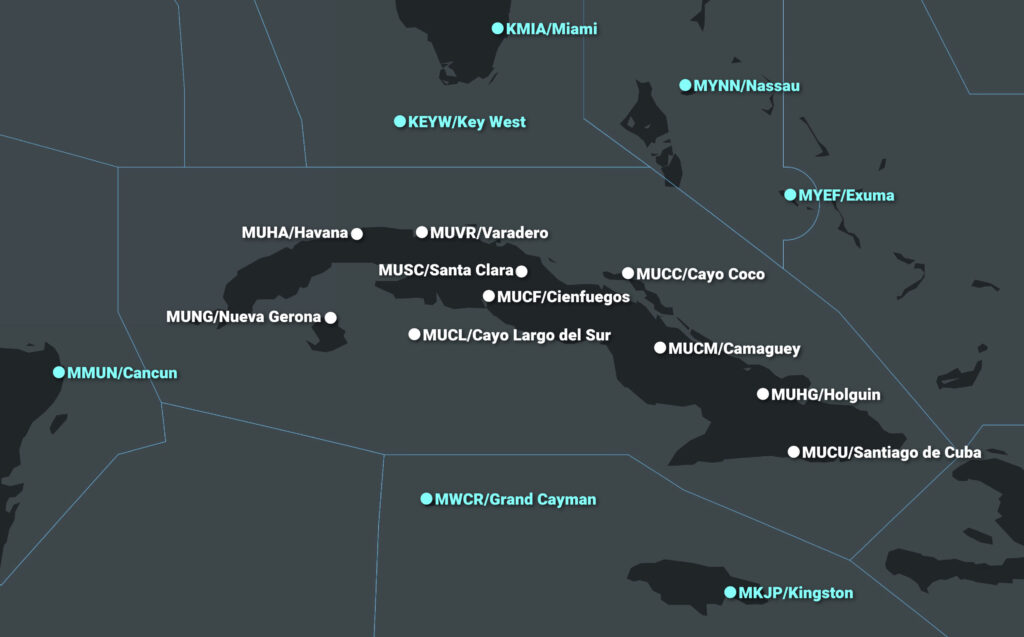
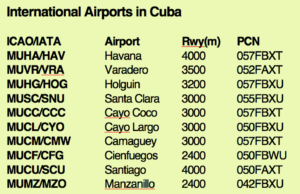
In 2020 they banned all US charter flights to Cuba except MUHA/Havana, but that ban was lifted in 2022. Today, US airlines and charter operators can apply for service to multiple Cuban airports, but only within the limits set by DOT. They decide both the destinations and the number of flights allowed.

DOT rules do not apply to foreign operators.

Gatekeeper #4: FAA (US Federal Aviation Administration)

Maybe surprisingly, for Cuba ops, the FAA isn’t in the gatekeeper role! The FAA’s focus is safety and air navigation, not sanctions or export rules.

If BIS and OFAC say a flight is ok, the FAA won’t block it just because the destination is Cuba.

The FAA issues airspace warnings for some countries, but not for Cuba — there are no FAA restrictions on flights heading here.

Operational Stuff

Goodness, wasn’t that tedious! Now for the slightly more interesting operational stuff to watch out for.

Cuba Overflights

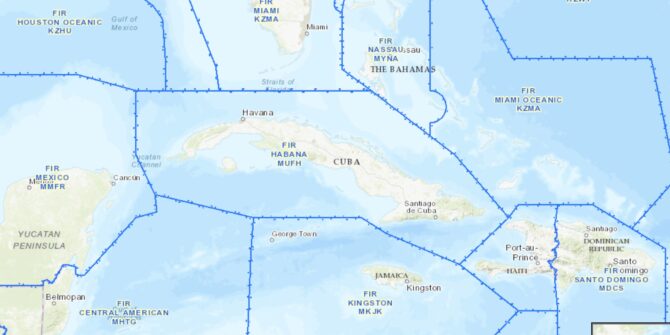
If your route passes through the MUFH/Havana FIR and enters Cuba’s inner ADIZ or overflies the island itself, you will need to get an overflight permit and pay the associated fees.

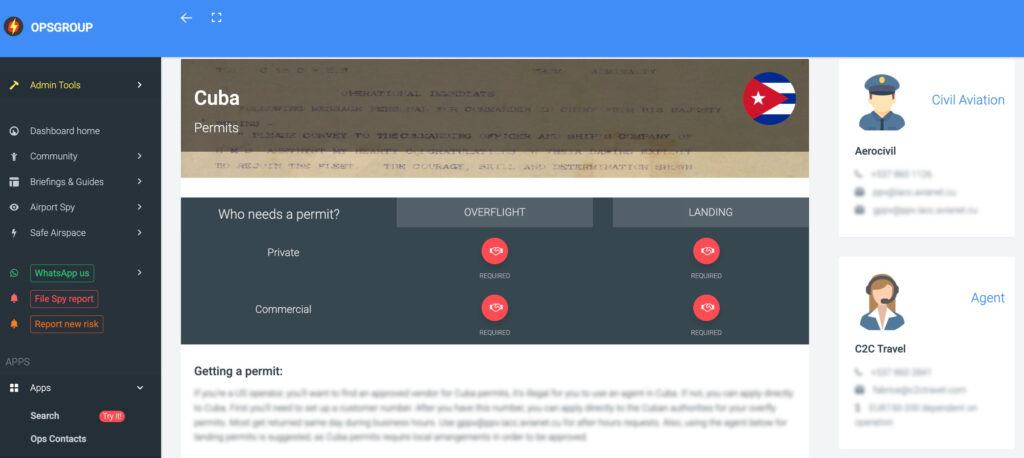
For non-US operators, the process is straightforward – set up a customer number with the Cuban authorities and apply directly, often with same-day turnaround if submitted during business hours. US operators will generally need to use an approved permit vendor.

There are several overwater routes in the northwest corner of Cuban airspace where a permit is not required: 
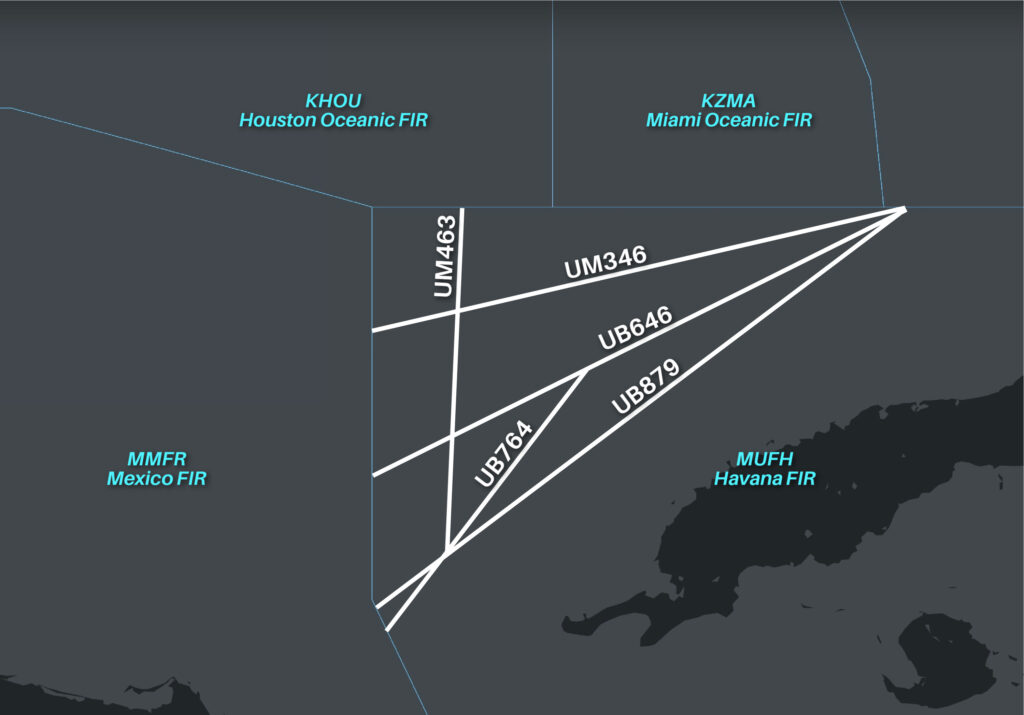
However, these still incur NAV fees, and if you don’t pay them it can result in your aircraft tail number being blocked from Cuban airspace in the future. NAV fees must be paid to ECNA in Euros, and unpaid fees can build up quietly until you are denied entry on a later flight.

For more info on Cuba overflights and how to sort all this out, check our briefing here.

Cuba Landings

Getting approval on the Cuba side of things is usually very straightforward – secure the landing permit, arrange handling, and off you go.

US BIS 7-day limit: Remember, under the US BIS rules, US-built aircraft operating under the AVS exception are only allowed to stay in Cuba for a max of 7 consecutive days.

Landing permit: All flights to Cuba need a landing permit, regardless of the aircraft’s registry or departure point. The Cuban CAA requires at least 3 working days’ notice to process the request.

Handling: You must have a local ground handler in Cuba. The CAA won’t issue a permit without proof of handling support. In the past we’ve worked with the handling agent C2C Travel in Cuba, who were extremely helpful with arranging all services. Contact fabrice@c2ctravel.com.

Local receiving party (“sponsor”): Permits are only granted if you list a local contact or business sponsor in Cuba. If you don’t have one, your handler may be able to provide this.

Visas: Pax and crew get an e-visa on arrival with the help of a handling agent. Everyone has to fill a form online before arrival at this site.

Insurance: Watch out here, as many aviation policies exclude Cuba entirely, leaving flights there uninsured. Even if covered, US underwriting or reinsurance can block payouts due to sanctions. Confirm Cuba is included and sanctions-proof — and get written confirmation from your broker.

Cuba-US Flights

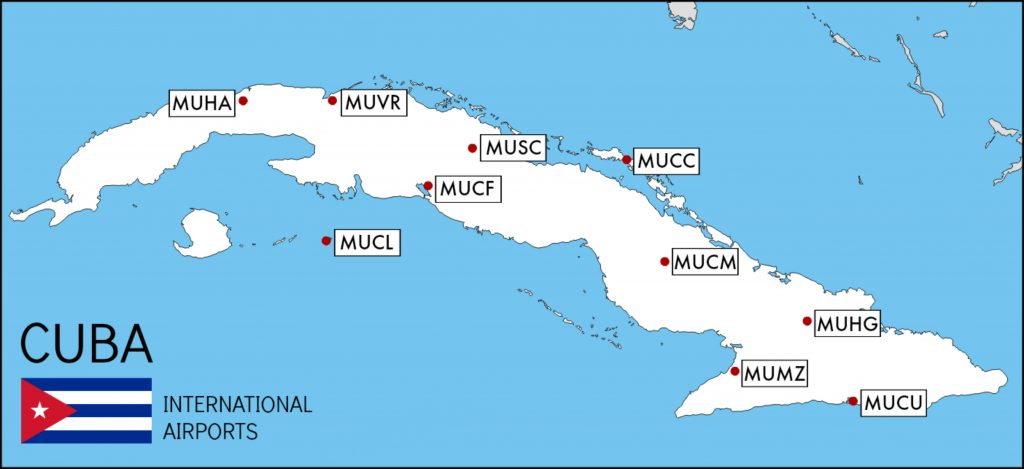
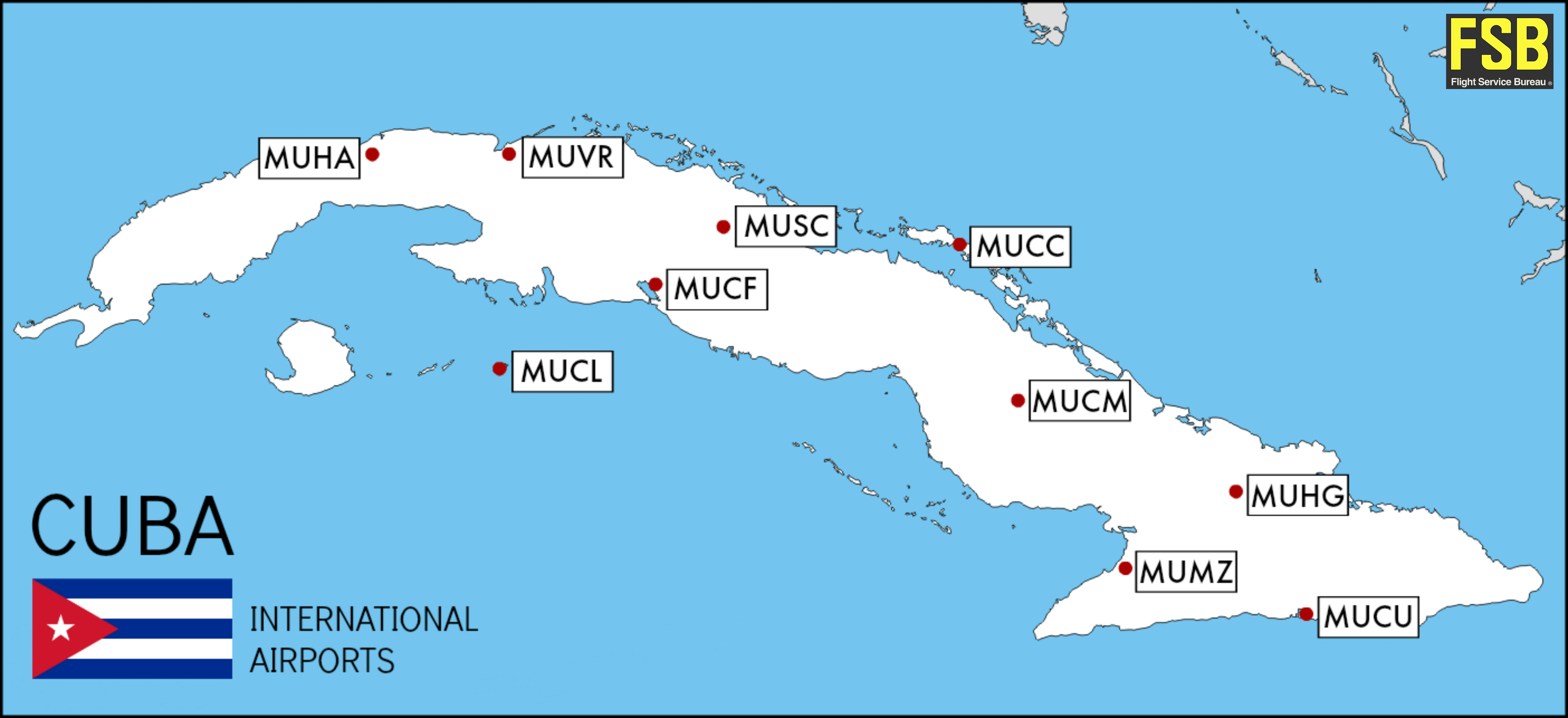
Commercial operators can depart for Cuba from any US customs-designated airport.

But on the return leg from Cuba, US CBP requires you to land at the first designated US airport of entry that is nearest to your point of crossing the US border or coastline (in some cases, there’s some flexibility here where you don’t actually have to land at the “first” airport — check our briefing for more info.)

If you want to land at a different airport instead, you will need a Border Overflight Exemption in advance.

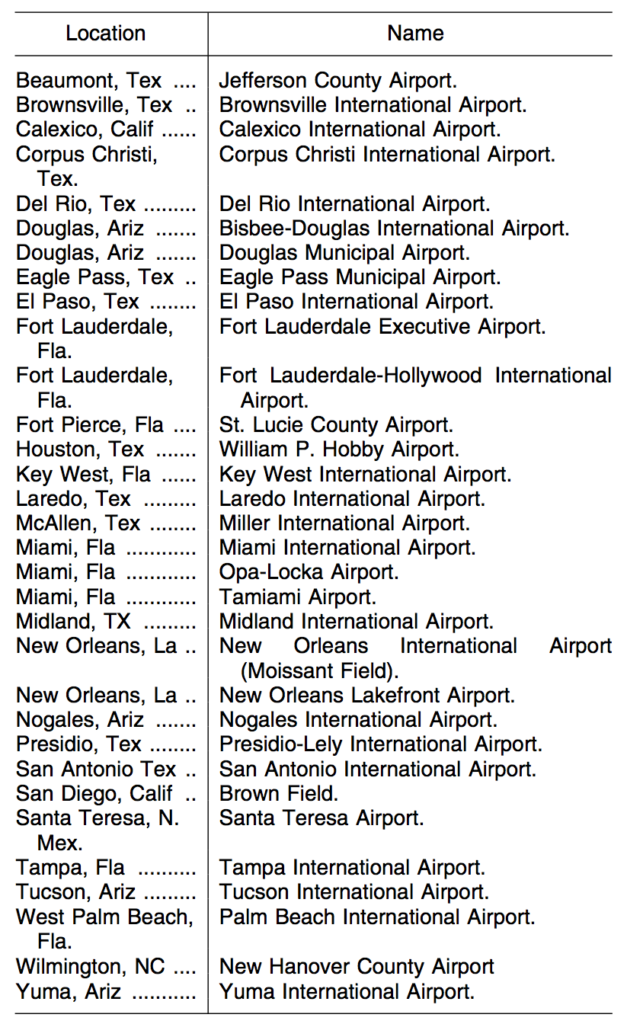
The current list of approved southern airports of entry is published by CBP and includes key gateways in Florida, Texas, and other southern states:
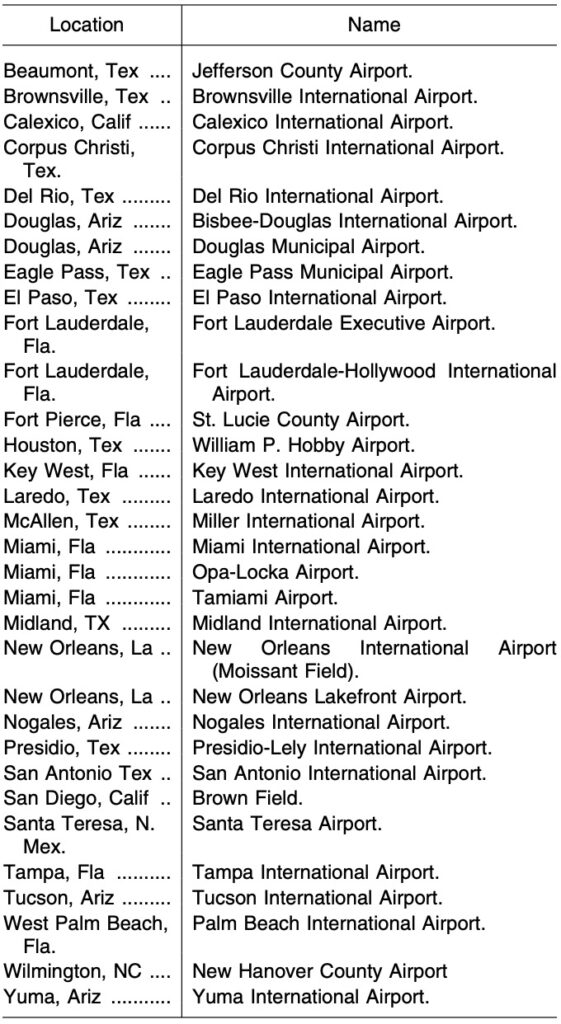
This rule applies to both US and foreign-registered aircraft arriving from Cuba, and CBP will enforce it strictly, so plan your routing and arrival airport accordingly.

Been to Cuba?

Please let us know! You can also reach us directly on news@ops.group, or file an Airport Spy report.

OPSGROUP members can access the full Airport Spy database via the members dashboard here.

Clarifying Cuba Overflight Permits and NAV Fees

Key Points
  • There are several overwater airways in the north-west corner of Cuban airspace where an overflight permit is not required.
  • If using these airways, you still need to pay NAV fees, otherwise you risk being denied entry to the airspace at some point.

For the longest time, we’ve been confused about the rules around Cuba overflight permits and NAV fees. Once upon a long ago, the requirements for these were contained in the MUFH/Havana FIR Notams, but alas, no more. We couldn’t find all the info we really wanted on them in the Cuban AIP either.

But thanks to CST Flight Services, we now have some answers in the report below. CST Flight Services provides a wide range of international trip support services in Mexico, Central and South America, The Bahamas and the Caribbean. You can contact them for more info at: customersvc@cstflightservices.com

Overflight Permits

For airways that go through Cuba’s MUFH/Havana FIR and penetrate Cuba’s inner Air Defense Identification Zone (ADIZ) or overfly the island, a Cuba overflight permit is required and a permit fee, plus NAV fees, will need to be paid to Cuba.

If you’re not a US operator, you can apply directly to Cuba for your overflight permit if you like. First you’ll need to set up a customer number. After you have this number, you can apply directly to the Cuban authorities for your permits. Most get returned pretty quickly – same day or next if you apply during business hours. OPSGROUP members can use the online Permit Helper tool in the members Dashboard to help with this, which includes email contacts.

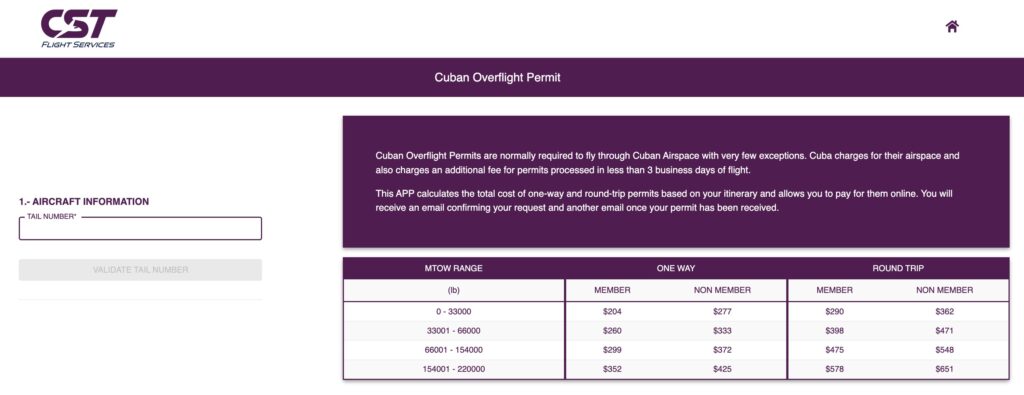
But if you’re a US operator, you’ll want to find an approved vendor for Cuba permits. CST have a service where you can apply for Cuba overflight permits online. The system determines whether you will need one, and calculates what the fee will be based on Cuba’s fee structure. You pay for it online, and CST get your permit for you.

However, there are several overwater airways in the north-west corner of Cuban airspace where an overflight permit is not required. These are:

  • B646/UB646
  • B764/UB764
  • B879/UB879
  • M346/UM346
  • UM463

But if you’re flying these airways and not paying any NAV fees, watch out! …

NAV Fees

Cuba overflight permits are issued by Cuba’s Civil Aviation Department IACC, while airspace fees are assessed by Cuba’s ECNA – a different agency of the Cuban government.

When an aircraft flies on an oceanic airway, an airspace fee is still assessed but as no permit was issued ECNA doesn’t know who to bill and the unpaid fees accumulate against that tail number.

Over time, and with enough flights, that tail number will be blocked and that information given to the IACC and to Cuba’s ATC which can result in that aircraft being denied entry into Cuban airspace.

Therefore, if you have been using these oceanic airways, and have not been paying Cuba NAV fees for those flights, you may be denied entry on your next attempt to fly through the airspace.

NAV fees need to be paid to ECNA in Cuba in Euros – which becomes a bit of a challenge for many operators! Again, CST can help with this. Contact them at customersvc@cstflightservices.com for more info.

Flights TO Cuba

Now we’re getting into murky legal and political waters. If you want to actually fly TO Cuba, rather than overfly it, the short story is this:

US Part 91 (Private) flights: these have been completely banned since June 2019. Applies to all N-reg aircraft flying directly or indirectly to Cuba (i.e. from the US or another country). This was a policy introduced by the US Bureau of Industry and Security (BIS), which meant that U.S. operators could no longer operate an N-reg aircraft privately to Cuba for any reason – it doesn’t matter if your passengers meet OFAC’s “permitted categories of travel” or not, it’s a no-go.

US Part 135 (Charter) and Part 121 (Airline) flights: these are allowed to operate to Cuba. However, it’s a tricky business to do these flights and stay within the rules. Policies introduced by the Office of Foreign Asset Control (OFAC) in 2017 mean that there are only a handful of categories of permitted travel between the US and Cuba.

Non-US operators: If you’re heading to Cuba from anywhere other than US territory, it should be fairly straightforward. Get a landing permit, arrange your ground handling, file your flight plan, and off you go. Just double-check your insurance policy – if it’s provided or underwritten by a US company, you might not be covered for ops to Cuba. Check out our article for more info.


U.S. cracks down on scheduled flights to Cuba

The U.S. has announced it will suspend scheduled flights to all airports in Cuba except for MUHA/Havana, in another attempt to limit cash flows going to the Cuban government. The affected airlines, including American, Delta and JetBlue, now have 45 days to wrap up their operations to those other destinations in Cuba, before the ban goes into effect on Dec 10.

This does not apply to Part 135 non-scheduled charter flights – these are still allowed to operate from the U.S. to any international airport in Cuba. However, it’s still a tricky business to operate these flights and stay within the rules. Policies introduced by the Office of Foreign Asset Control (OFAC) in 2017 mean that there are only a handful of categories of permitted travel between the US and Cuba.

As for Part 91 private flights from the U.S. to Cuba, these have been completely banned since June 2019. This was a policy introduced by the US Bureau of Industry and Security (BIS), which meant that U.S. operators could no longer operate an N-reg aircraft privately to Cuba for any reason – it doesn’t matter if your passengers meet OFAC’s “permitted categories of travel” or not, it’s a no-go.

For non-U.S. operators traveling to Cuba from anywhere other than U.S. territory, it should be a doddle. Get a landing permit, arrange your ground handling, file your flight plan, and off you go. Check out our article for more info.

If you’re headed to Cuba — even to MUHA/Havana — you should double-check with your insurance provider about your coverage. We received the following report, which suggests that with the new U.S. sanctions, many U.S. operators may no longer be covered:

“Being the insurance director of an Airline, I’m having the dilemma whether the insurance would cover any damages/losses/injuries may have occurred during Cuba flights. Because, when I raised the question, insurers simply replied with an aviation clause called AVN111/AVN111(R) which says insurers would verify each individual case with relevant sanction authority (in this case, OFAC) and do their best to grant permission to reimburse the losses. It can easily take years to get resolved which essentially means there is no actual protection against losses”…

In principle, U.S. operators with an insurance policy from a non-U.S. based insurer can get insurance cover for Cuban ops. However, in practice it may not be possible to even purchase this, as lots of these policies are underwritten by U.S. based insurers – especially for higher policy limits.


Total ban on US private flights to Cuba

Effective today, June 5th, no US private aircraft will be allowed to travel to Cuba. The rule comes from the BIS – the US Bureau of Industry and Security, part of a further clampdown on Cuba policy by the US government.

We spent the day here in OPSGROUP clarifying the new rules and what it means for US operators.

What happened? BIS issued a new rule today, June 5 called “Restricting the Temporary Sojourn of Aircraft and Vessels to Cuba”. [official copy here] [Guidance here]. 

This is tough to read and understand. Nothing new about that. So, we asked OPSGROUP, discussed it with a whole bunch of members, got some legal interpretation, and got some great help from the NBAA.

Here’s the plain English wrap up:

  • US Part 91 private flights: Effective June 5, you cannot operate an N-reg aircraft privately to Cuba for any reason. This includes Corporate. It doesn’t matter if your passengers meet the “category requirements (see later)”, it’s a no go. 
  • Part 135 Air Ambulance: You can go, and you don’t need a license. From the rules: “Air ambulances operating under 14 CFR part 135, may depart from the United States under its own power for any destination”. “Air ambulances will remain eligible for the license exception when destined to Cuba”.
  • Part 135 Charter: This was unclear because of the wording of the new rules. But you can go. We asked BIS specifically about this, and the wording of the new paragraph is meant to be read as a series of options that allow you to go to Cuba – 135 is covered under the “AOC holder” bit.
  • Part 129: You can go. Part 129 is foreign operators. An example would be Air Canada doing a charter from JFK-HAV. That’s allowed.
  • Part 121: No changes. Airlines can operate.

BIS vs OFAC

The first gatekeeper of Cuba rules is BIS. If they don’t prohibit your operation, eg. Part 91 – then you proceed to the second gatekeeper – OFAC, and look into whether you need a license, and what category your passengers are travelling under.

Categories of allowed travel

There were 12 categories – or “reasons” to be allowed to go to Cuba. There are now 11. The one removed was known as “People to people”. These are set by OFAC.

What does Cuba say?

Thanks to one of our members who called the Cuba CAA this morning, and got this:
In our country there is no regulation in this regard. They can fly over
and land registrations of any nationality without any distinction
provided they meet the requirements requested and that you know
all right
.”

As we would expect, none of the restrictions come from the Cuba side. So everyone continues to be welcome in Havana, it’s just the US government that is restricting matters for US operators.

A super simple FAQ

Can I fly my private C172 to Cuba?
No. 

Can I fly my owner to Cuba in a G550, if he passes the ‘category test’?
No. He can go, but has to go on a commercial service.

Can I operate a Corporate Jet to Havana, for business reasons?
No. Regardless of the reason the principles might want to go to Cuba, you cannot operate any aircraft under Part 91.

But I see in the rules that you can apply for an exemption from BIS?
Yeah, you can, but they will say no. “License applications for the temporary sojourn to Cuba of those vessels and aircraft are subject to a general policy of denial.”

Can I operate a charter flight to Cuba?
Yes. BIS rules don’t prohibit this. But you then need to look into the OFAC rules.

Can I go to Mexico first, and then to Cuba?
No. In their lengthy FAQ, “A license from the Bureau of Industry and Security (BIS) is required to fly private or corporate aircraft to Cuba, even if the aircraft stops in another country first.”. And y’all ain’t gettin’ no license.

I am a Canadian operator. Can I operate to Cuba?
Yep. This is all about US operators being restricted. You can fly direct to Havana like you always did, and under the Part 129 bit in the new rule, you can also operate from the US to Cuba. 

So, we think we have this all correct as the final version. If we don’t hear any objections, we’ll add this to the OPSGROUP databank, and make a blog post. From here, we will post this in the new Forum, and the discussion can continue there!

THANKS EVERYONE!

Great team effort today to get this into an understandable-by-humans format. Well done!


New rules for flying from the U.S. to Cuba

Update 5 June 2019: All US private flights to Cuba are banned, under a new BIS rule. No Part 91 operations are allowed any longer.

Update 9 Nov 2017: Effective today, the US has new rules for travel to Cuba as an individual. These restrictions will limit the ability of US citizens to undertake most personal travel to Cuba unless part of a licensed group. The new measures will also bar US citizens and companies from engaging in business activities with over 180 Cuban enterprises the US government has concluded are linked to the Cuban government in some way (check the full list here). The new policy will not affect travellers with existing bookings, such as a flight or hotel reservations. Upon their return, all US citizens will be required to maintain proof of all activities in Cuba, and must ascertain that no U.S. laws were violated during their trip. OFAC and CBP will enforce the new regulations, much talk of hefty fines.


If you’re traveling to Cuba from anywhere other than U.S. territory, it should be a doddle. Get a landing permit, arrange your ground handling, file your flight plan, and off you go.

If you’re trying to get to Cuba from the U.S. though, it’s a different story…

A tale of two Presidents…
In December 2014, President Obama announced plans to improve relations between the U.S. and Cuba, and in the July of the following year a lot of restrictions were lifted for N-registered aircraft operators wanting to do private and charter flights to Cuba.

However, the U.S. authorities (the Treasury Department, in this case) didn’t want to break with tradition and make the process completely straight-forward and misery-free, so their Office of Foreign Asset Control (OFAC) introduced a rule which means that only 12 categories of travel are permitted between the US and Cuba. This was then further complicated by legislation introduced by President Trump in June 2017! Here are the permitted categories of travel:

(1) family visits
(2) official business of the U.S. government, foreign governments, and certain intergovernmental organisations
(3) journalistic activity
(4) professional research and professional meetings
(5) educational activities or so-called “people-to-people” travel – it’s not possible to claim this category if you make your own travel arrangements; this is only possible for officially sanctioned group travel.
(6) religious activities
(7) public performances, clinics, workshops, athletic and other competitions, and exhibitions
(8) support for the Cuban people
(9) humanitarian projects
(10) activities of private foundations or research or educational institutes
(11) exportation, importation, or transmission of information or information materials
(12) certain export transactions that may be considered for authorisation under existing regulations and guidelines.

As you might have spotted, you cannot simply travel from the U.S. to Cuba for the purpose of general tourism! You have to match one of these 12 categories.

Applying for a licence to travel
Here’s the thing: you don’t actually have to do this.

Once you decide which category applies to you, you do not need to apply for any kind of licence to travel from OFAC – you will simply qualify under their rules for the so-called ‘General Licence’.

However, each one of these 12 categories for permitted travel is highly controlled and has specific requirements that must be met for the exemption to apply. If you want help in trying to work out which one of these categories might apply to you, read the FAQ section of the official guidance – it’s actually pretty good: https://www.treasury.gov/resource-center/sanctions/Programs/Documents/cuba_faqs_new.pdf

Once you’ve done that, you might want to read the extra little FAQ they put together, following the changes made by President Trump in June 2017 (basically this just says that no more individual travel for educational or “people-to-people” will be allowed – only group travel will be allowed in this category): https://www.treasury.gov/resource-center/sanctions/Programs/Documents/cuba_faqs_20170725.pdf

I don’t match any of those 12 categories – what do I do?
If you do not match any of the categories, things get tricky. In this case you would need to apply to OFAC for a ‘Specific Licence’ – although this process can take up to 3 months. You can do this online at the US Treasury Dept page: https://www.treasury.gov/resource-center/sanctions/Pages/licensing.aspx

Should I book a trip myself, or book through a tour agent?
If you really are going to Cuba to visit relatives, or for some kind of religious pilgrimage, you could probably get away with making your own travel arrangements.

If not though, the easiest way to make sure you qualify will probably be to just engage the services of a U.S. based company to help make your travel arrangements – they’ll book you on to some kind of tour and get you to a sign a “travel affidavit” to confirm that you really are going to Cuba for the reason you say you are!

If you decide to make your own arrangements, you’ll still need to make sure you carry one of these documents. You don’t need to submit it anywhere in advance, but you do need to keep it handy just in case anyone from CBP asks to see it. To get a sample of this form, click here.

Bear in mind that if you book through a tour company, you will be traveling under a specific, government-approved itinerary. That means that when you get to Cuba, officially, you can’t just go wandering off by yourself. Your tour company won’t be able to book you into Cuban hotels, rent cars or take buses at all, since the Cuban government owns them. You’ll most likely be booked into a bed-and-breakfast, or a homestay, and you will only be able to take part in pre-approved, pre-arranged activities.

All this talk of OFAC and categories and travel affidavits is hurting my brain. Isn’t there an easier way?
Technically, yes there is.

If you want to avoid all this bureaucratic misery, you could always fly to Cuba by way of Mexico or Canada. There are no restrictions from those countries regarding travel to Cuba, so U.S. citizens can fly straight in. Remember, Cuba doesn’t restrict U.S. citizens from entering – just get a visa in advance, and that’s all you need.

However, bear in mind that when you return back to the U.S. – if you get caught out trying to hide your trip to Cuba from U.S. Customs officers, you could face serious punishment.

Cuba landing permit
You’ll need one, regardless of where you’re flying from, or what country your aircraft is registered in. The official notice required by the Cuban authorities to process a permit request is 3 working days. No docs are required to obtain an overflight permit, but for a landing permit, the following is required: CoR, CoA, CoI, crew and pax information, reason for flight and receiving party in Cuba for landing approval. Which brings us neatly on to…

Receiving party
Cuba will only give you a landing permit if you provide the name and contact details of a local receiving party or ‘business sponsor’. If you’re trying to do it yourself and do not yet have a local receiving party arranged in Cuba, you should contact your ground handler to check if they can act in this role for you.

Landing fees
There’s actually a very simple way to work these out:

Handling
The Cuban CAA require all operators to obtain handling confirmation from a company based in Cuba. If you don’t have a copy of an ‘Airworthiness Review Certificate’ for your aircraft (N-registered aircraft, for instance), you have to show a copy of aircraft maintenance log book entries showing the recent work performed on the aircraft and confirming that the aircraft was returned to service in an airworthy condition. Also, any jet over 10,000 LBS MTOW must provide a noise certificate via their handling company.

Visas
If you’re flying to Cuba from the U.S. you’re going to need to get proper business visas (remember, you’re not a tourist!). Although it is possible to obtain these on arrival in Cuba, reports suggest that it takes ages to process, so it’s probably best to get these in advance.

Insurance
Make sure that your aircraft insurance does not specifically exclude travel to Cuba – many do!

Foreign passengers
If you’re flying between the U.S. and Cuba with foreign nationals onboard – they are subject to the exact same rules as U.S. nationals in terms of meeting OFAC licensing requirements. The only exception is for Cuban citizens present in the United States in a non-immigrant status – they can travel to Cuba without having to tick any of those 12 OFAC boxes.

Time on the ground in Cuba
U.S.-registered aircraft are allowed remain in Cuba for up to seven consecutive nights. If you want to go for longer then you will need to get an export licence – that gets complicated.

US Airports of Entry for your return flight
Recent policy changes mean that aircraft can now depart to Cuba from any customs designated airport in the U.S. (this applies to both U.S. and foreign-registered aircraft). However, when you return to the US, as you will be entering the from the south, you will need to land at the first designated airport of entry that is nearest to the point of crossing the U.S. border or coastline; if you want to land elsewhere you will need to get a Border Overflight Exemption.

Here is the list of southern airports of entry, from US Code of Federal Regulations 19 122.24

More information: There are a ton of reports on Cuba in Airport Spy, which is where all of us in OpsGroup tell each other about the airports we’ve been to – good ATC, bad handlers, rip-off fees… think of it as the TripAdvisor of airports. Also, if you want to know exactly how to get your Cuba landing permit, check out our Permit Book – this tells you how to get a permit for each and every country in the world!


Matthew – Airports update 1400LT Wednesday

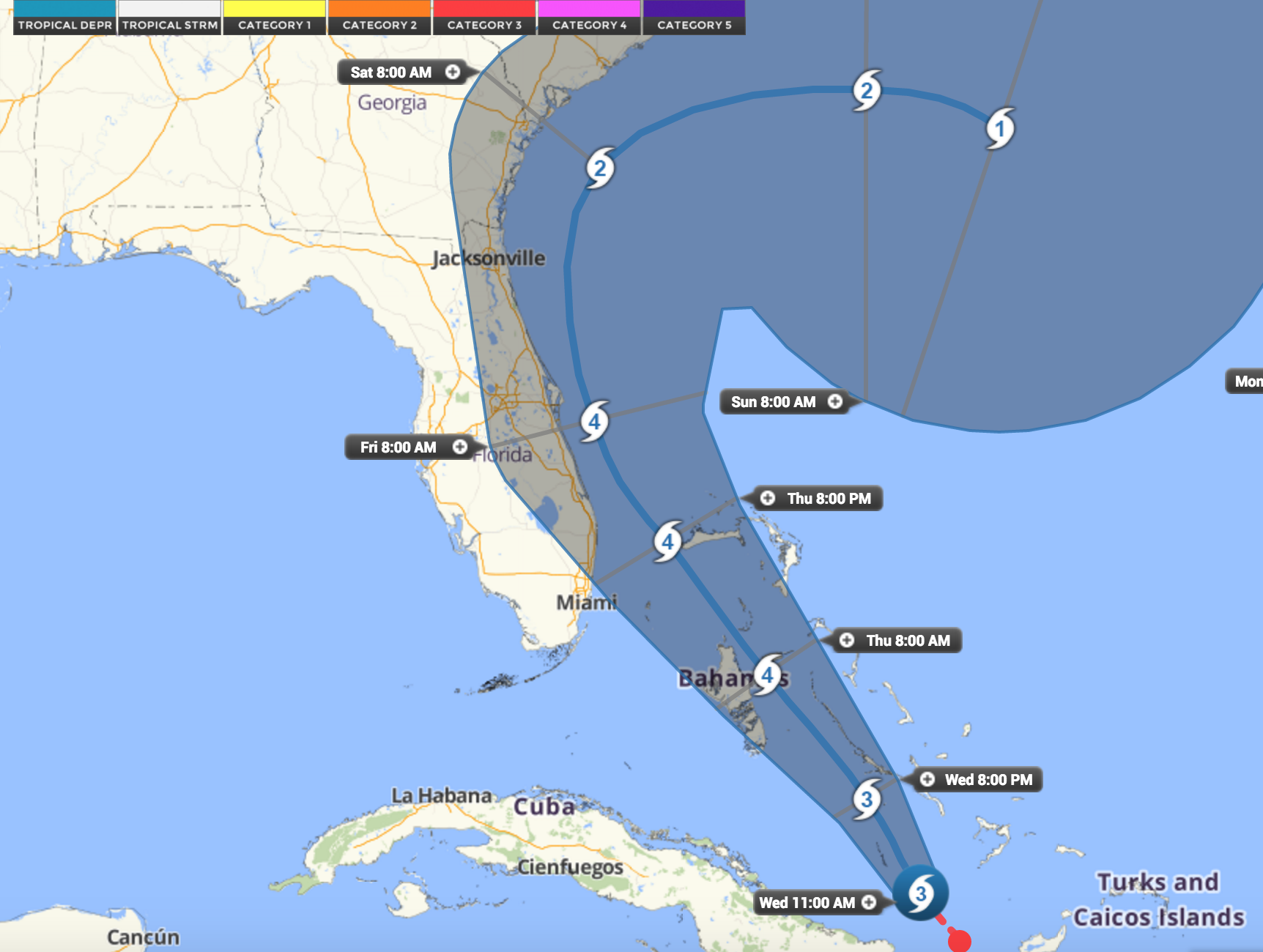
The next 24 hours will dictate the impact that Hurricane Matthew will have on Florida, as it leaves Cuba and begins to track north through the Bahamas.

Airports Update: for Haiti,  MTPP/Toussaint L”Ouverture International and MTCH/Hugo Chávez International are confirmed reopened and operating normally, by the National Airport Authority Haiti (as of 1200ET).

For the Bahamas – the hurricane will severely impact operations at all Bahamas airports. As of 1100LT Wednesday (this morning), ALL Airports in the Bahamas are closed, by order of the Department of Civil Aviation and the Airport Authority.

For the USA – the first state to be affected will be Florida. Tracking of the hurricane will determine by how much. A slight turn to the left, and hurricane force winds will impact the entire coast, hardest hit will be the area from KPBI/Palm Beach north to KJAX/Jacksonville.  KMCO, KMIA, KFLL are among the large airports that will be affected.

Projected timings for eye of Matthew:

0800LT Thursday: Abaco, Bahamas
0800LT Friday: Palm Bay, Florida
0800LT Saturday: Savannah, Georgia –

Monitor:

matthewtrack


Midweek Briefing: Residual Disinsection for Italy, New Moscow Airport

Italy  now requiring Residual Disinsection 17FEB In light of the spreading global coverage of Zika Virus cases, countries are rapidly changing rules related to Quarantine and Health. Italy is now requiring residual aircraft disinsection for every aircraft coming from any area, not only Zika affected ones.

Moscow Ramenskoye opens to civil traffic 17FEB UUBW/Moscow Ramenskoye, which previously served as a military airfield, is scheduled to open to civil traffic as an International Airport on 16MAR, becoming the fourth Moscow Airport. Read more … 


UUBW/Moscow Ramenskoye, which previously served as a military airfield, is scheduled to open to civilians as an International Airport on 15MAR2016. The airport will be Moscow’s fourth largest and is expected to serve approximately 1.9 million passengers per year. Russian Railways is planning on constructing a direct rail link between the facility and Moscow. Read the full article.

Worldwide As the mosquito-borne Zika virus spreads worldwide, some health and aviation authorities have begun targeting business aircraft to be treated with insecticide – similar to requirements that have been in place for commercial aircraft arriving from certain points of origin. The most prominent to date is Italy, which has reported several recent cases of the Zika virus affecting people who returned from trips to South America and the Caribbean. A “Certificate of Residual Disinsection” is now required for all aircraft operating in Italy, following recommended WHO and International Civil Aviation Organization Annex 9 procedures. Italy had originally limited the certificate requirement to aircraft arriving from Zika-affected countries, but “within 36 hours that changed” to all countries. Authorities in Costa Rica are requiring that aircraft arriving from affected countries be sprayed on arrival – with crew, passengers and luggage aboard – with an insecticide provided by the local agriculture department.

UADD/Taraz, Kazakhstan has been upgraded to RFF/Rescue Fire CAT9, and with regular international flights starting in June, should have customs available. Maybe become a useful Central Asian en-route alternate.

UKLV/Lviv FIR, Ukraine A new Notam (A0193/16) is issued to extend the ban in Ukrainian Airspace of any aircraft operator registered in the Russian Federation until 09MAY.

NWWW/Noumea has multiple runway (and therefore airport) closures until 25FEB, check Notams carefully if operating.

NZAA/Auckland Work is currently in progress on the threshold of RWY 23L with the threshold inset 2,270m.  The information is contained within AIP updates and not via NOTAM. Operators should note there is are no ILS approaches available at Auckland until 30MAR. While weather is usually very good during February and March operators can expect delays in poor wx.

NZQN/Queenstown is closed from 1800 each day until 31MAR for runway widening works.

AYPY/Port Moresby Telecoms outage continues. To contact ATC Centre
use (675) 325 8704 instead of published numbers. Multiple VHF freqs out of service, use HF 5565 as alternate.

RPHI/Manila has a radar outage on 18-19FEB meaning procedural control will affect the Luzon island area within the FIR, 10/15 minute enroute separation as standard.

Somalia A local terrorist organisation claimed responsibility for the bombing of a Daallo Airlines passenger aircraft on 02FEB shortly after it took off from Mogadishu’s Aden Adde International Airport (HCMM/MGO). The bombing forced the Airbus A321-111 to make an emergency landing at Mogadishu’s airport.

South Africa Refurbishment will affect Johannesburg’s OR Tambo International Airport (FAOR/JNB) beginning 13FEB when security and immigration will move from Terminal A to the Central Terminal. Slow processing expected until end March.

US and Cuba advance Air Service agreement US officials will travel to Havana to officially sign the agreement that will make the two countries a step closer for its first commercial flights. Once the  US-Cuba air travel pact that was agreed upon on 16DEC2015 will be finalized, airlines will have about two weeks to submit applications for US-Cuba routes with the US Department of Transport and get approval from Cuban authorities to obtain space at Cuban airports. Industry experts expect that the first Cuba-bound flights will be in the air sometime in 2016.

View the full International Bulletin 17FEB2016


Midweek Briefing: Chinese Airport Delays, Eurocontrol NOP Changes

Chinese Airport Delays 03FEB ZXXX/China This is the busiest travel week of the year in China, with millions travelling for the Chinese New Year on 08FEB. Winter storms are forecast to impose delays across central Chinese airports; those currently affected include ZWWW/Urumqi Diwopu, ZSNJ/Nanjing Lukou, ZGGG/Guangzhou, and ZHHH/Wuhan Tianhe.

Eurocontrol NOP Changes 03FEB There are some significant changes to the daily Eurocontrol Briefings effective this week. Network News is no longer, and the D-1 daily conference is also gone. Instead, an Initial Network Plan is published each day at 1700Z on the Network Operations Portal.


TTxx/Trinidad and Tobago The annual Carnival in Port of Spain will take place on 08-09FEB . Travel and tourism activities are expected to continue for up to two weeks after the celebration and will be busiest during weekends. 10FEB (Ash Wednesday) is expected to be the busiest day of the year at the Port of Spain airport.

EISN/Shannon FIR Correction ** Due to a number of flights deviating from clearances prior to exiting Shanwick OCA, flight crews are reminded that Eastbound route clearances issued by Shannon Control for aircraft exiting Oceanic Airspace apply from AGORI, SUNOT, BILTO, PIKIL, ETARI, RESNO, VENER, DOGAL, NEBIN, MALOT, TOBOR, LIMRI, ADARA, DINIM, RODEL, SOMAX, KOGAD, BEDRA, OMOKO, TAMEL AND LASNO. Flights shall not turn before these points. In other words: wait until you enter (** Thank you to Shannon ATC for pointing out the error in last weeks bulletin).

North Atlantic Effective 04FEB MNPS Airspace is replaced by HLA/High Level Airspace on the North Atlantic – extended with Bodø joining Shanwick, Gander, Reykjavik, New York, and Santa Maria. RNP4 or RNP10 now required. Read our International Ops Notice 01/2016 or our blog post: Did you know MNPS is over?

Eurocontrol NOP Changes There are some significant changes to the daily Eurocontrol Briefings effective 01FEB. Network News is no longer, and the D-1 daily conference is also gone. Instead, an Initial Network Plan is published each day at 1700Z on the Network Operations Portal.

FMMM/Madagascar CAA have issued a reminder to inbound operators that a Passenger List must be sent 24 hrs prior to departure for Madagascar, by email to gdpx@acm.mg.

MKJK/Kingston FIR Jamaica, has ongoing issues with radar coverage and serviceability, leading to ad-hoc flow management procedures including 15 minute en-route separation, and 10 minute arrival separation at international airports. Delays appear likely. Reports welcome to bulletin@fsbureau.org.

FHAW/Ascension Island is now operating at Rescue and Firefighting Category 8/RFF8.

United Kingdom Last week the UK Registered Traveller Service, which is the equivalent of the US Global Entry program, was expanded to include a few more countries: Hong Kong, Singapore, South Korea and Taiwan. Additionally, Bristol and Cardiff will be added to the list of participating airports.

MUXX/Cuba Flight crews of US based aircraft can now remain in Cuba with their aircraft when traveling to the island nation, instead of having to reposition immediately after offloading passengers. The change took effect on 27JAN, with new amendments to the Cuban Assets Control Regulations and Export Administration Regulations issued by the U.S. OFAC and BIS.

NCRG/Rarotonga, Cook Islands has new hours of ATC service: 2050 SUN-0400 MON, 1500 MON-1930 MON, 0530 WED-1400 WED, 2100 THU-1000 FRI, 2100 FRI-1000 SAT, 1400 SAT-1930 SAT, 0600 SUN-1130 SUN. These are UTC/Z Times, local is UTC-10. Raro is an important diversion airport in the South Pacific, especially for Easter Island and Tahiti. ATC is avail with 30 mins PN outside these hours (call +682 25890/71439).

EHAM/Amsterdam has raised the minimum vectoring altitude from 1200ft to 1600ft, which seems to spell an end to those super efficient 3 mile final approaches to 06. Still the best Terminal ATC in Europe.

Europe EASA has launched a 2 person cockpit survey to open discussion on the impact of their new recommended practice of always having 2 crew members in the cockpit.

PKMJ/Majuro, Marshall Islands – ExxonMobil will have no fuel during tanker replenishment, scheduled for 13-17FEB.

ZXXX/China This is the busiest travel week of the year in China, with millions travelling for the Chinese New Year on 08FEB. Winter storms are forecast to impose delays across central Chinese airports; those currently affected include ZWWW/Urumqi Diwopu Int’l, ZSNJ/Nanjing Lukou Int’l, ZGGG/Guangzhou, and ZHHH/Wuhan Tianhe.

ENGM/Oslo Oslo Airport has started supplying Air BP Biojet via its regular fuel hydrant system, naming three large European airlines as launch customers. It is now is supplied from the main fuel farm, via common storage and distribution facilities, without the need for segregated infrastructure. Previously, it had to be provided by fuel truck.

DNKK/Kano ACC Nigeria, Area Radar Service is provided H24 from 04FEB.

View the full International Bulletin 03FEB2016


Monday Briefing: Kanlaon Volcano Eruption, Colombia Permit requirements

Kanlaon Volcano Eruption 28DEC The Kanlaon Volcano in the Philippines erupted on 27DEC, with an initial ASHTAM issued up to FL260. Extreme caution advised for airways B472, B473, and W7. You can get the latest updates through the Tokyo VAAC.

Updated Colombia Permit requirements 22DEC For Non-Commercial aircraft, ie. Ferry flights, General Aviation – authorisation is required only if stopping in Colombia longer than 48 hours, or operating to more than 1 Colombian Airport. Updated list of document requirements in AIP Supp 22/15 issued 22DEC.


New Years closures. Check opening times carefully during the next week, as many major airports and FBO’s have closures, especially on 31DEC/01JAN.

Kxxx/USA Scattered thunderstorms, some of which will be strong to severe, will move east across Kentucky, Tennessee, eastern Mississippi, Alabama, western Georgia and the Florida Panhandle. Heavy rain will once again trigger flash flooding over portions of the South. Airports in the risk area include KATL/Atlanta, KBNA/Nashville, KMEM/Memphis, KCHA/Chattanooga, KBHM/Birmingham, KMOB/Mobile and KLEX/Lexington.

FYWH/Windhoek, Namibia has new opening hours from 23DEC, 0700-2000LT Daily.

HSSS/Khartoum, Sudan has no Jet A1 available to Ad-hoc operations between 27DEC and 05JAN. Carry return fuel or choose another tech stop.

MUFH/Havana FIR, Cuba Airspace restrictions in place 23DEC-31DEC due to staff shortages, airways UB760 and UL210 are northbound only, and between 1400-0100Z daily, all aircraft will be spaced 25nm apart through the Havana FIR, regardless of altitude.

OAKB/Kabul, Afghanistan a car bomb detonated near Kabul International Airport at approximately 0800 local time (0330 UTC) today.Taliban militants took responsibility for the attack.

UIBB/Bratsk continues to have fuel supply issues, fuel limitation extended to 12JAN

LSZH/Zurich has parking issues for Private flights, the Airport Company will generally only accept 6 hours ground time. Extended stays will require a reposition to another airport, limitation until 06JAN.

Space Weather/Polar Ops 55% risk of R1-R2 Minor to Moderate Radio Blackout risk predicted through Dec 30th. For the most up to date information please see the NOAA Space Weather Dashboard for Aviation.

LTFJ/Istanbul A Kurdish militant group has claimed responsibility for an attack at Istanbul’s second airport that killed 1 person, and threatened more assaults.

FAA/North Atlantic Aircraft operators crossing the North Atlantic have been required to include the aircraft registration and six-character hexadecimal code that is the aircraft’s address in Item 18 of their ICAO flight plans. However, an FAA review of flight plans filed during a one week period revealed that many operators were not meeting this requirement. Therefore, the agency has issued Information for Operators (InFO) 15015, which emphasizes the importance of providing the required information in the proper format.

Vxxx/India Signaling a major shift in granting air traffic rights, the government is looking at restricting the number of landing points for overseas airlines irrespective of their seat entitlements.A senior Civil Aviation Ministry official said it was looking at restricting the ports of call given to foreign airlines under bilateral rights, while remaining flexible on seat entitlements.

VAJB/Jabalpur The Aviation regulator DGCA has suspended the license of Jabalpur airport following an incident early this month, in which a herd of wild boars marched onto the runway during the taxiing of a commercial aircraft. Following suspension of its license, no flight operations can take place from Jabalpur airport, sources said adding that the AAI has been told to remove deficiencies including proper fencing of the operational area.

RKxx/South Korea South Korea’s Ministry of Health and Welfare has formally declared an end to the Middle East Respiratory Syndrome (MERS) health threat on December 23. According to the Ministry of Health and Welfare, its decision follows World Health Organization. MERS was first confirmed in South Korea on 20MAY, and the last fatality from MERS-related complications in the country occurred on 25NOV.


Monday Briefing: Cuba Travel opens up, Chile Airport strike ends

Cuba Travel opening up 21DEC Negotiations between the USA and Cuba on scheduled air services between the two countries are progressing at pace; meaning that we expect to see sanctions on private US Tourism Travel lifted as early as next March. See more below.

Chile Airport Strike ends 21DEC A four day strike was ended yesterday 20DEC in Chile by the Trade Union, as 3000 Airport workers across the country responded to the governments rejection of a pension plan. Several hundred flights were cancelled. Non-scheduled operations were largely unaffected, but the risk of further action remains.


HUEC/Entebbe ACC, Uganda. ATC in Uganda is reporting a significant increase in the number of flights entering their airspace without prior coordination from Sudan and Congo (Khartoum and Kinshasa FIRs). Regional ATC in Africa is known to be challenging, but this warning deserves attention. Crews should make all efforts to contact each FIR 10 mins in advance – HF 11300, or relay on 126.9 if unable.

KZMA/Miami FIR SpaceX announced Sunday it has pushed back its planned launch of a Falcon 9 rocket with 11 communications satellites to 2033 ET Monday. KZMA has issued NOTAM A1357/15 for launch. It will also affect the KZJX Jacksonville FIR and TJZS San Juan FIR. The FAA will also issue tactical advisories regarding the launch and will most likely restrict operation on AR6 and AR15.

EGGX/Shanwick have issued a reminder to flights operating on the “Tango Routes” (T9, T16, T213) that HF in all cases is required to operate here, and crews should be trained in the procedures. Request OCA Clearance 50 mins in advance. Primary/Secondary HF freqs: Southbound 6547/8879, Northbound 8879/6547.

LIPH/Treviso Fuel spillage on the runway has closed the airport until 1700Z today 21DEC.

Cuba and USA Reports in the international media last week indicated that an agreement between Cuba and the US is likely to be signed early next year, allowing up to 110 scheduled flights: 20 to Havana, 10 to each of the other 9 international airports in Cuba. At present, US visitors must still fall in to one of the 12 official categories for authorised travel; however, once scheduled services are in place, we anticipate this to be the leverage to remove the final hurdle for US citizens – visiting Cuba for tourism. The first flights will likely operate in early March.

It should be noted that there are no restrictions on the Cuban side. US Aircraft can land in Havana with a routine Landing Permit issued by IACC, and US Aircraft can overfly with a routine Overflight permit. We anticipate that the requirement for a permit will stay in place as this is routine in most Latin American countries, primarily to check Navigation Fee debts and Operator Profile.

Georgia and Ukraine On 18DEC2015, the EC announced that both Georgia and Ukraine meet requirements for being granted visa-free travel to the European Union’s Schengen zone. However, the European Parliament and the EU member states must vote in favor of granting Georgia and Ukraine visa-free travel before they are able to do so. Reports indicated that the decision could be put to a vote as early as 2016.

Haiti On 19DEC, election-related demonstrations across Haiti turned violent amid accusations of electoral fraud. Violent clashes led to the burning of several government buildings. Haitian police officers stated that they were trying to restore security to the country.

Space Weather/Polar Ops moderate an ongoing G1 geomagnetic storm expected for Mon, Dec 21. Please check the NOAA Space weather aviation dashboard for the latest actuals and predictions HERE.

PAZA/Anchorage ARTCC has a number of new procedures and systems in place effective 17DEC, including 30/30 RNP4 separation, an update to the Track Advisory program for westbound Russian Tracks, and standard routings. Check the current PAZA NOTAMs for complete information.

ZBAA/Beijing authorities have issued a red alert for high levels of air pollution and reduced visibility. The alert will be effective until 22DEC. According to China’s National Meteorological Center, air pollution levels are forecast to be slightly higher than those recorded from 06-09DEC.

EGLL/EGKK London Heathrow/Gatwick Airport train links will be disrupted over Christmas. The Gatwick Express trains will stop running for 10 days due to engineering works, with the last service of 2015 leaving Victoria station at 9.15pm on Christmas Eve and the first services of 2016 scheduled for 4 January. At Heathrow, the usual one-day closure on Christmas Day will be extended by three days. Neither Heathrow Express nor Heathrow Connect trains will run from London Paddington station during the period.

UBxx/Azerbaijan will become part of the IFPS (Integrated Flight Plan System) zone as of AIRAC 1601 on 07JAN2016. Azerbaijan will delegate responsibility for the provision of flight planning services for IFR/GAT flights within the Baku FIR to the Network Manager’s Integrated Initial Flight Plan Processing System. For more info see Azerbaijan AIC 01/2016 Series A, AIP ENR 1.10, AIP ENR 1.11 and NOTAM A0126/15.

UHPP/Petropavlovsk FIR Volcano Karmsky has recently been active with ash reported up to 15,000 ft and possibly affecting ops on R220. Please check for the latest Tokyo VAAC advisories.

The ICAO Council adopted a new tracking standard for certain international flights that requires crews to report their aircraft’s positions at least every 15 minutes. It will become effective in March 2016 and applicable 08NOV2018. The new requirement also will be formalized as Amendment 39 to Annex 6—Operation of Aircraft, Part I. Only aircraft with a maximum takeoff weight of more than 59,000 pounds and a passenger seating capacity of more than 19 are affected by the rule. Also, the requirement applies to over oceanic and other remote areas, and where air traffic service is obtaining position information greater than 15-minute intervals.

Christmas and New Years closures. Check opening times carefully during the next 2 weeks, as many major airports and FBO’s have closures, especially on 24, 25, 26DEC and 31DEC/01JAN.


Monday Briefing: Northern California airspace changes, Iraq closes airspace below FL300

Northern California ‘Metroplex’ airspace changes 07DEC On 10DEC, several revised and new SIDs and STARs associated with the Northern California Metroplex project will be published. These procedures will be the last major changes associated with the project. You can find the full document covering the changes here.

Iraq closes airspace in Kurdish North below FL300 06DEC  Iraq issued a new Notam on 06DEC warning of further Cruise Missile operations below FL310. ORBB A0423/15 states that “Flights operating at FL310 or above, and flights operating at ORBI, ORNI and ORMM are not affected”. You can read the full Notam here.


OIIX/Tehran FIR German Authorities published a new Notam last week warning of a risk to flight for aircraft operating in the vicinity of OITT/Tabriz, OITL/Ardabil, and OIGG/Rasht. DFS, the German ATC agency, recommends overflying this general region at FL260 or higher. A6875/15.

Russia/Turkey Effective 01DEC, Direct non-scheduled flights between Russia and Turkey are banned by decree of the President of the Russian Federation dated 28NOV. Prohibited for all airlines, regardless of the country of aircraft’s registration .

VOMM/Chennai Re-opened for 24-hour domestic and international flight operations today, five days after it was shut due to flooding.

EGGX/Shanwick As of 07DEC, although system testing and acceptance is reportedly finished, no RLAT/Reduced Lateral Separation tracks have yet been published by Shanwick or Gander for the daily OTS. It appears uncertain what the first day of operation will be.

MUHA/Havana, Cuba Hotel Capacity in Havana is under severe strain at present. With increased traffic to Cuba, finding a hotel room is now a regular challenge. Some airline crews have had to be accommodated in Varadero instead, as there were no hotel rooms left in the city. Book well in advance, where possible.

OMxx/United Arab Emirates It has been advised to us, that the requirement for TCAS 7.1 also applies to the Emirates FIR. All aircraft arrivals/departures or those transiting UAE airspace from 01DEC must be 7.1 compliant, or a re-route around UAE airspace will be required. Another option is to obtain a special dispensation to operate, this is available from GCAA in AUH, but is reportedly difficult to obtain. For more details please see the UAE AIP ‘Gen 1.5.6.6 Carriage of ACAS-II’.

LIxx/Italy There is a possible suspension of IFR non scheduled commercial traffic to/from LIRF and LIRA on Dec 8th. Please see NOTAM LIXX 1W2845/15 for the official restriction.

LIxx/Italy Ongoing volcanic emission from Mt. Etna may disrupt routings through Italian Airspace. Please check the Toulouse VAAC for the most up to date info.

ESxx/Sweden have been forced to suspend, with immediate effect, flights from northern Iraq to Sweden following a directive from the Swedish Transport Agency (Transportstyrelsen). In a statement issued last week, Transportstyrelsen said the increased military activity across northern Iraq posed a threat to civilian flights thus warranting a ban.

VTxx/Thailand The FAA has downgraded Thailand to a Category 2 after an audit of the country’s Department of Civil Aviation (DCA) in October showed continued non-compliance with International Civil Aviation Organization (ICAO) safety standards. The FAA’s move comes five months after the ICAO formally instituted a Serious Safety Concern (SSC) against Thailand for failure to adequately address shortcomings identified during a Universal Safety Oversight Audit Programme (USOAP) inspection in January.

MUxx/CUBA Will be reinstating travel permits for doctors. On 01DEC, Cuba announced that it was reinstating the travel restrictions it had previously imposed on doctors, which requires doctors to obtain permission before leaving the country. The restriction had been lifted in 2013, but is now being re-imposed, as the government claims that its universal and free health care services are being “seriously affected” by the number of doctors leaving the country.

Zxxx/China will mandate that its air traffic controllers use only English when communicating with pilots of any airline starting in 2017, according to the Civil Aviation Administration of China (CAAC). The move will improve situational awareness for foreign pilots. Currently, ATC at all airports across China use English to communicate with pilots of foreign airlines and Mandarin with those flying for Chinese carriers. The CAAC will announce the exact date for implementation later, ensuring the readiness of all stakeholders involved in the process.

ZUUU/Chengdu has completed the on going construction work. The parking bay has been released and is available on a first come, first serve basis. This applies to overnighting aircraft as well.


View the full International Operations Bulletin for 07DEC2015


Permit News: Cuba Permit requirements

– Minimum 3 working days advance notice of flight intending to cross Cuba

Data needed:

– Operator name and address
– Departure and Destination airports, and times
– Aircraft type, and registration
– Please note no requirement for airspace entry points/times, pilots licenses/medicals, C of A/R, or other documentation.

Your permit number will be sent to you by via email by return and should be inserted in Field 18 (RMK/) of your ATC flight plan, for example:

RMK/PERMIT CUBA 6821

The permit can be ordered online here.