Aug 2022 NAT Doc 006 Changes

Are you Trevelyan across the NAT HLA anytime soon? Then here is a summary of the changes that just came out in NAT Doc 006.

What is Doc 006?

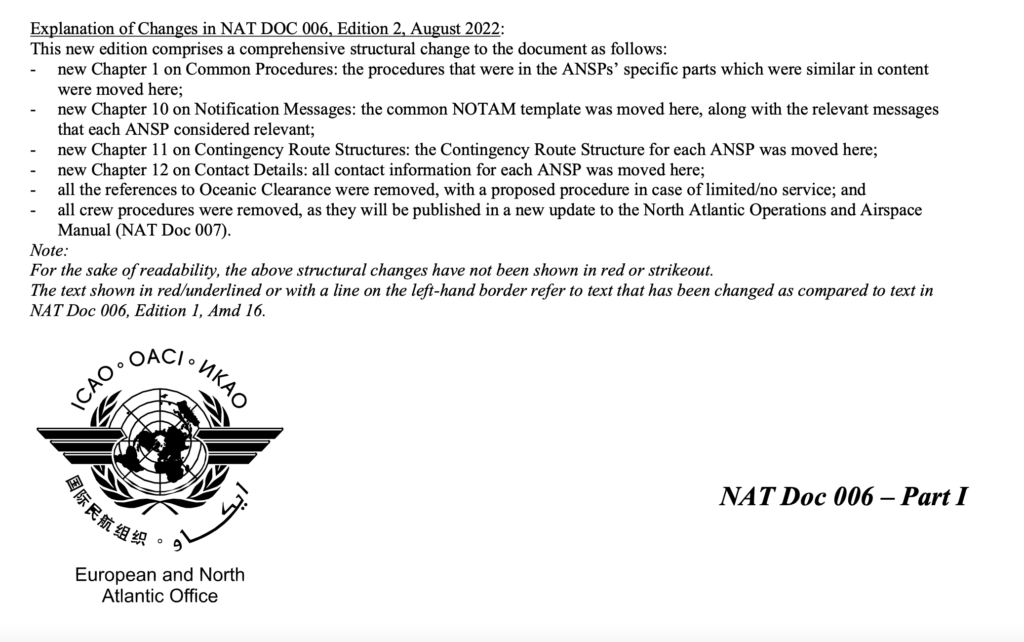
It is the Air Traffic Management Operational Contingency Plan for the North Atlantic Region, and we are talking about the Second Edition, August 2022 version which you can find here if you want a look. The last time it was updated was back in Feb 2021, and we covered those changes here.

Page 1

“Aha, a handy list of all the changes,” think Rebecca and Dave as they glance  at page one. “This will be easy. Our job is done already.”

“What does it say?” Rebecca asks.

“It says that there is a new chapter on Common Procedures which were there but are now here…” replies Dave. “And also something about a Notam and some route something somethings…”

“There’s still a lot of red again, isn’t there?” whispers Rebecca.

“Yes, there is,” sighs Dave.

“Should we read it for them?” Rebecca says wearily.

Dave nods.

All the changes are in red.

Finding the changes isn’t hard. Understanding them is the annoying bit. So we shall try and make sense of what all those changes are for you so you don’t have to.

(But before we go on though, here is the record of amendments so you can see if any of it looks remotely interesting to you. If not then you can go and do something much more interesting with your time instead of reading further.)
The Changes.

Chapter 1

They have updated the information on contingency situations thats might affect multiple FIRs. What could cause that? Volcanic ash could cause that.

They have also added in Reykjavik.

Chapter 1

Sorry, that bit before was just an intro or something.

So, Chapter 1 – Common Procedures.

  • Limited Service: If ANSPs are going to only be able to provide a limited service they will try and let everyone know at least 12 hours in advance by Notam. This is for times like if datalink going to be down or if there are some huge solar flares heading their way that might take out their HF for a bit.
  • No Service: It’s the No Service Situations we really need to worry about. If this happens then they will get a message to whoever they can, and whoever gets the message will help share it out to as many people as they can.

In any region, the results will be the same. With Comms disruption, they will obviously attempt other methods. There is likely to be a fair amount of frequency congestion on whatever methods are still working.

With control services, there may be some additional restrictions which affect traffic flows, and there may well be reroutings. Where possible, these will be limited to those not yet in the NAT (a bit easier for the old fuel planning). 

In the event of a sudden withdrawal of services, here is an excellent chart for pilots to print out and have handy.
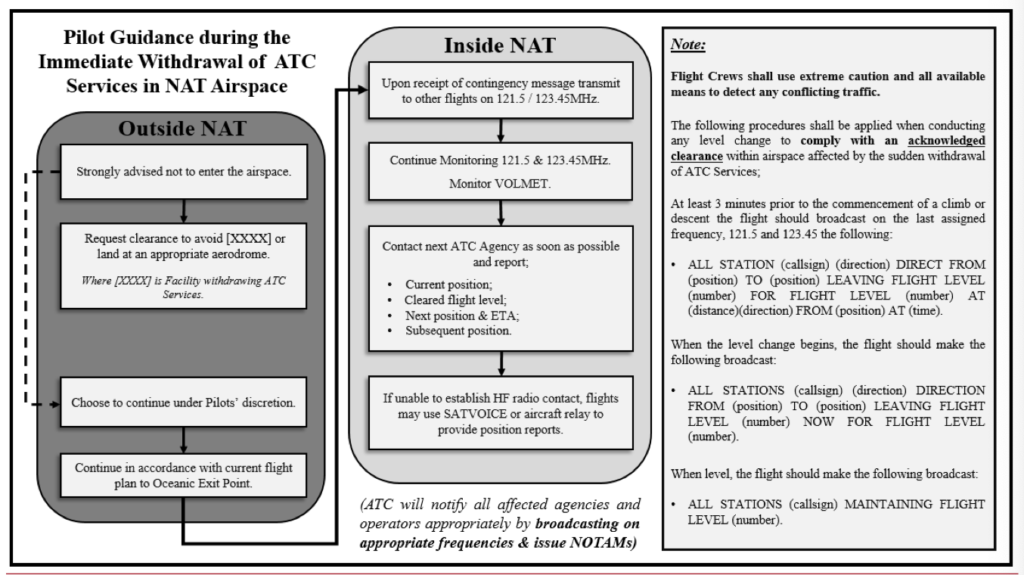
Strongly advised…

Immediate withdrawal of services

It’s what the handy guide says, but in case you don’t want to read that:

  • Already in the NAT? Basically, stick with the last received and acknowledge clearance, try and talk to anyone you can and make sure you give position reports. You can use SATVOICE for this too. If you’re in the middle of a level change, complete it as quickly as you can. If it’s a control centre evacuation and you’re on ADS then revert to voice.
  • Approaching the NAT? If you’re within 20 minutes and it is getting evacuated then stick with your last clearance. Only aircraft less than 60 minutes from their OEP can transit Gander. They guarantee no conflict profiles.

The Next Chapters

Shanwick: Contingency procedures have moved to chapter 11.

Gander: Nil Red

Reykjavik: This has a lot of new info, although not specifically in this section. The main thing is, if you can’t get hold of Iceland Radio HF then try Shanwick radio first, then Gander or Bodø if still no luck. Reykjavik is the only FIR without supporting procedures.

Santa Maria: If Comms are down and you have ATS safety SATVOICE (INMARSAT or IRIDIUM) then you can call them on 426302 or 426305. If you have a non ATS safety satellite network (some big old sat phone from the 80’s onboard) then try +351 296 886 655 but only if you really, really need to.

New York: Nein Rot.

Bodø: Bodø ACC includes Domestic control, Oceanic and Radio (HF). Thankfully it can be supported by basically all its neighbours FIRs (except Reykjvik).

Shannon: Non Rouge.

Brest: No roja.

Chapter 10 – Notification Messages

Or ‘The Great River of Red’ as I know call it. Actually, most of this can be looked at in the below image (it’s a picture of their example of a Notam).

Limited service? Info will be sent via other ANSPs.

No service? It has probably been evacuated and notifications of this will be sent via the NAT track messages and transmitted on any appropriate frequencies.
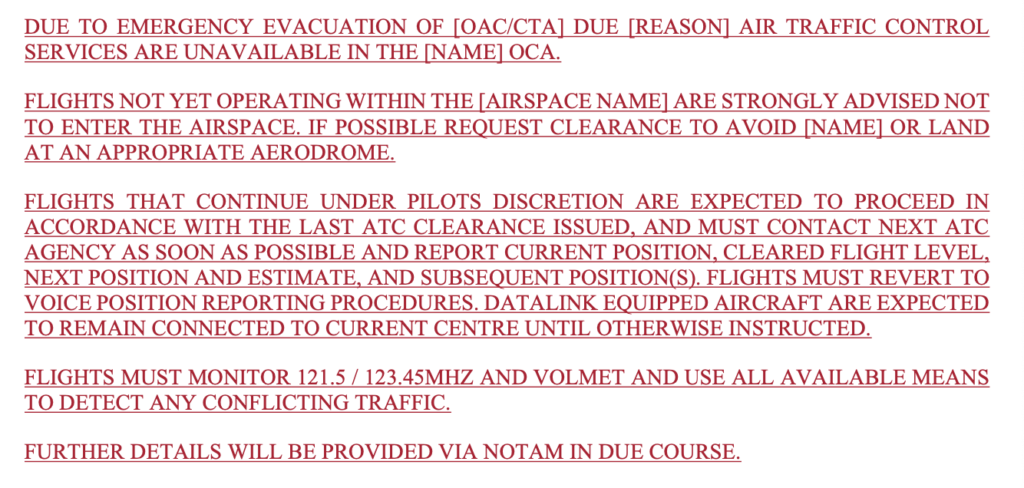
The example Notam. Although it probably won’t actually be red if you see it for real.

Chapter 11 – Route Structures

This contains info on the routes for each region. Mainly Reykjavik because they’ve added all of those in. There are some nice diagrams in this bit.

Chapter 12 – Contact Info

This is the contact details. Lots of red for the new Reykjavik folk.


That’s it. We’re off to play some Goldeneye on our N64. Found something important that we missed? Let us know! news@ops.group



The New EASA Fuel Policy: Does it affect you?

So EASA have changed their fuel rules and the ‘Decision’ they have published ain’t an easy thing to read. Here is what we think it says, in plainer English, to help you work out what it all means for you.

We are no pros on fuel planning through so this is more of a heads-up that things are a-changing. For the full regulations you will need to dive in yourself and try to fathom it out, but hopefully this gives some info on bits to really look out for.

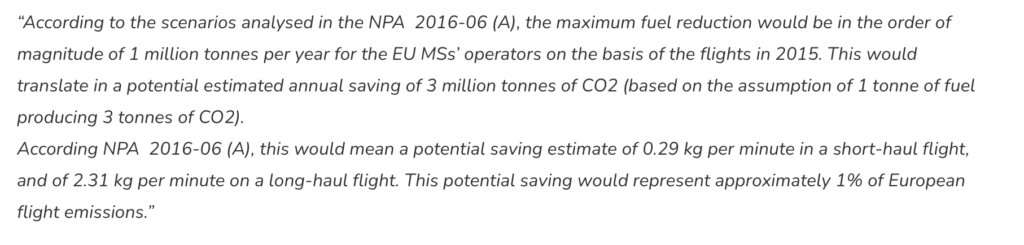
First of all, in EASA’s own words…

…What the change is all about?

They also say:

Give it to me in plain English.

  • It will improve fuel efficiency.
  • It will be nicer for the environment.
  • It will apply from October 30 2022.
  • The big change in fuel policy applies to Commercial Air Transport (CAT) operators (but there are a lot of changes for other folk in there too)

If you want to jump straight in and read it all yourself, then here is the link.

What’s changed then?

Remember the old Fuel Policy that we all know and love?

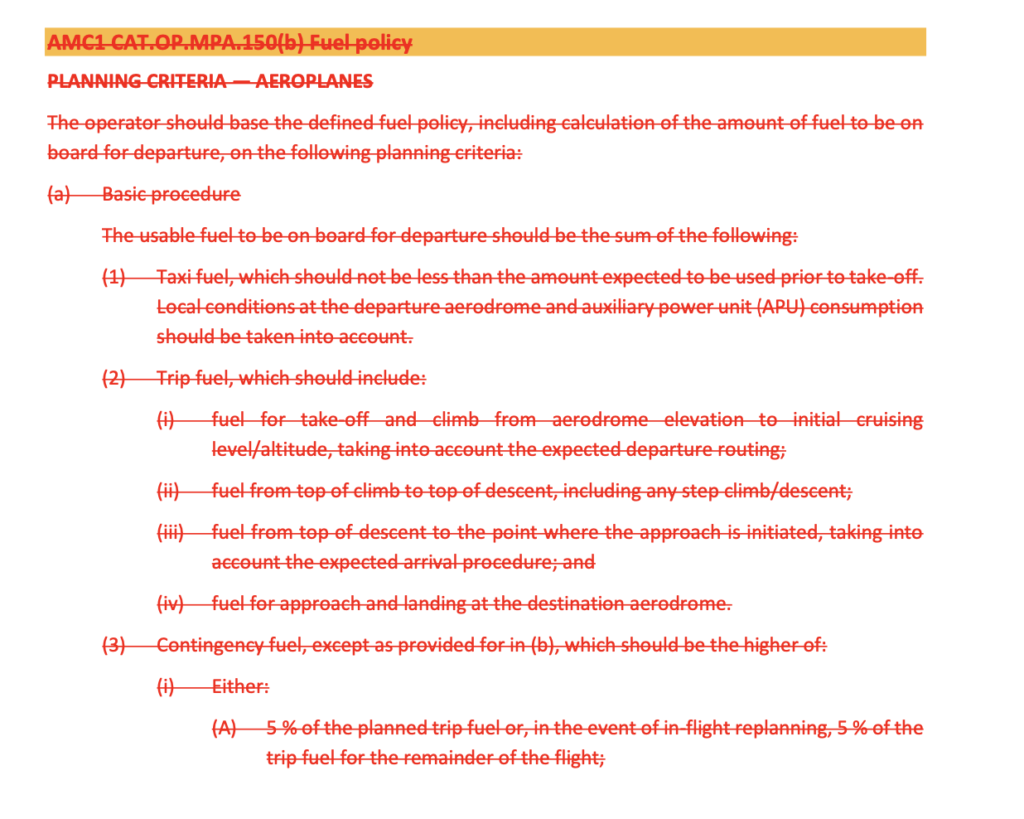
The one where you have to carry taxi fuel, trip fuel, fuel to get to your alternate, contingency fuel (and some additional bits in there about whether that needs to be 5% or 5 mins at 1500′, or 3% or if you can use STATCON…) plus your final reserve and any extra you might want…

Well, that is out and in its place are three new fuel schemes –

  • the Individual.
  • the Basic.
  • the Basic, with variations.

So the old fuel policy is chopped and there are three new schemes instead. 

Here’s the deal with them. The first thing to know is that the individual and the basic + variations are both voluntary, meaning you’ll need to meet a bunch of criteria to opt for them. The basic is what you’ll be on if the other two don’t apply.

Oh, and should have said it earlier, but this only applies if you’re an EASA operator.

Any idea which fuel scheme to read up on?

If you’re not a CAT Operator (now that header picture makes sense, right?) then the Individual Fuel Scheme (and all the many, many pages of info referring to that) probably won’t apply to you. That’s not to say it isn’t useful to read and know about anyway.

If you know you don’t have particularly enhanced fuel monitoring capabilities then the basic scheme is the one for you, and this is not really different from the current fuel policy as we know it. There are however a lot of small changes which you will need to know about.

EASA say 

So let’s look at the schemes.

1. The Individual Fuel Scheme.

This applies to big operators with big fuel monitoring systems in place which let them say “I know how much fuel I need all the time because I fly there a lot, monitor it and know about all the possible changes and risks and all that stuff that might affect it!”

So EASA are all “well, if you meet all our criteria then we’re gonna trust that you do know better, and can take just what you need and that’ll be better for you and the environment.”

OK, there might be a bit more to it than that, but in a nutshell if you’re a big operator and think this might apply then dig in and read all the new blue and see if you can opt for this scheme.

If you know this doesn’t apply, then read on.

2. The Basic Scheme.

Ah now this is more familiar. It is basically our old Fuel Policy made simple.  5% for your contingency. Done.

Here’s the actual contingency bit for reference:

For contingency fuel, calculate for unforeseen factors either: whichever is the higher; (1) 5 % of the planned trip fuel or, in the event of in-flight re-planning, 5 % of the trip fuel for the remainder of the flight; or (2) an amount to fly for 5 minutes at holding speed at 1 500 ft (450 m) above the destination aerodrome in standard conditions,

This is not voluntary. The other two are, and if you don’t go for either of them then this is the policy you’ll need to apply.

3. The Basic with variations.

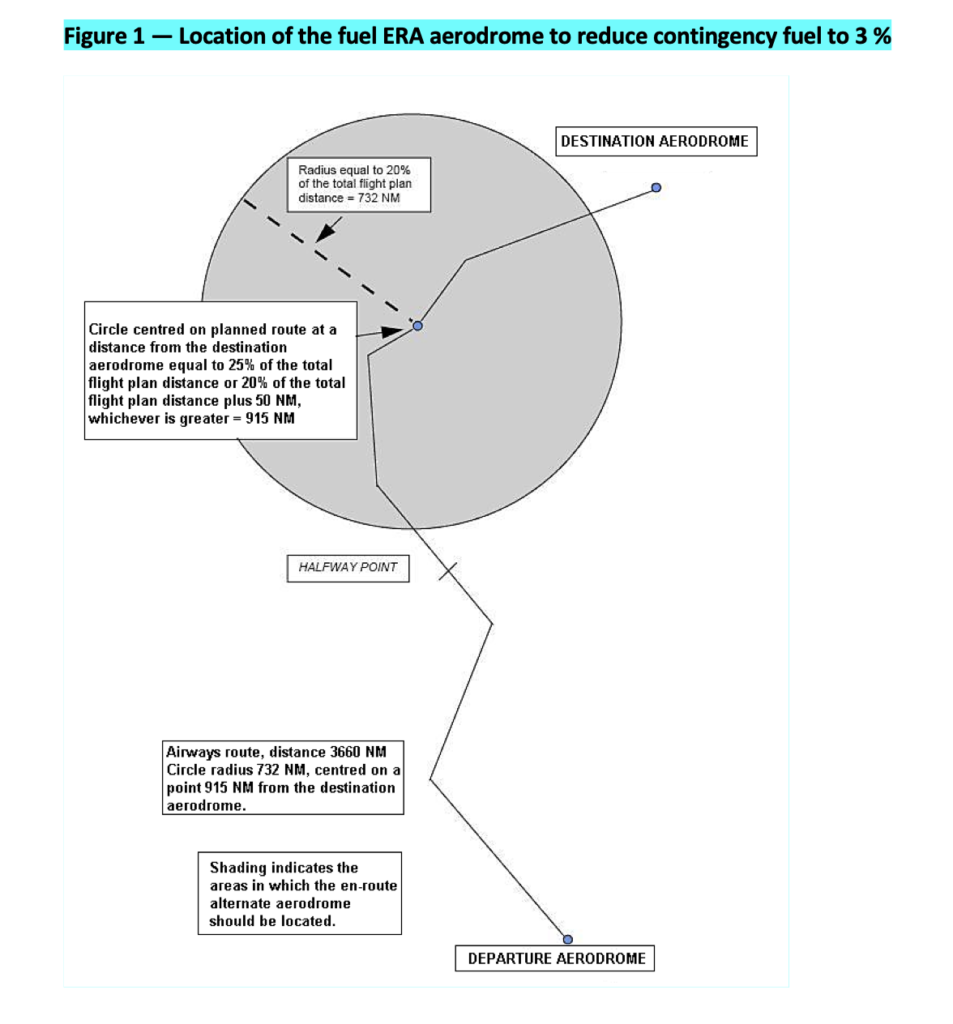
From what we can see, those variations really apply to the contingency and whether you can reduce to 3% or use STATCON, which is based on whether you have some sort of monitoring program in place, amongst other things.

Seems like a lot of blue just for that?

There is a lot because the two voluntary schemes have a lot of points attached to them which you need to know about if you’re planning on applying for one of those schemes.

Aside from the big policy changes, there are some changes and clarifications to definitions and what have you which are worth a read.

Do you need to read the Explanatory Note?

Not unless you really want an in-depth explanation as to why they need the new AMC and GM (acceptable means of compliance and guidance material) on fuel/energy planning, and a whole long list of references.

You can read it here if you do want to.

Annex I

This is the changes to the definitions annex. It is fairly short (they’ve removed acronyms) and made a few definition changes.

You can read it here, but you’re better off reading the full definitions annex here if it’s definitions you’re after.

Here’s one we found interesting:

  • Relevant safety information that might affect the safety of the flight: unforeseen hazards

They’ve published a nice list here of stuff to think about (which you were probably were anyway but just incase) it means stuff like unexpected ATC delays, met conditions which weren’t forecast, sudden obstructions on the runway, failure of some bit of the airplane that means you suddenly need a lot more runway. Sudden acts of nature that you didn’t expect…

The other Annexes

We jumped straight in to Annex IV because it is the Commercial Air Operators annex, and they did say at the start that most of the changes apply to this. If you are not a CAT Operator then take a browse through the annex that does apply. 

This contains all the info on the new schemes and the changes, criteria for opting for them etc. so this is what you need to read!

Some other bits worth looking out for.

  • Alternate Planning: We aren’t here to get into the nitty-gritty of the changes but someone very helpful and with more knowledge on it that us said that this “basically rewrites everything we learned” about flight planning. One of the big rewrites is on the Alternate Planning.
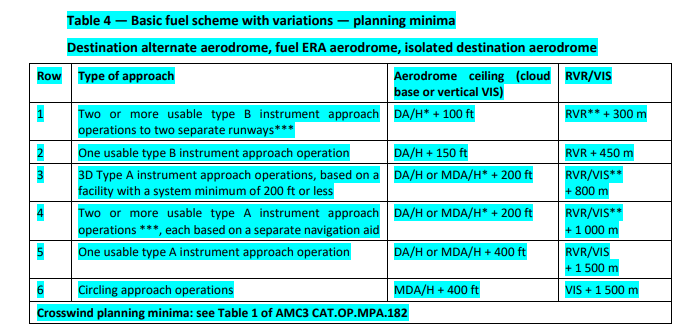
    • The old ‘step-down’ method of alternate planning doesn’t apply anymore. Instead it must be looked at individually each time.
    • Wind gusts also need to be considered.
    • Take a look at the tables (here’s the one for the basic + variations scheme) to get a better idea.

There are also some nicely updated or reclarified definitions throughout so even if the new optional schemes don’t apply to you, its good opportunity to remind yourself about certain meanings which apply to any fuel policy, even non-EASA ones.

  • Appropriate Meteorological information: There is a whole lot of blue here and they seem to have updated the definition on what this means and where you can get this weather from. Basically you can reproduce information from a reliable “weather man” source so long as you are just changing the layout, not the content.  
    • Reliable means it as some sort of quality assurance in terms of accuracy and integrity.
    • You can also use supplementary weather info – like some nice colourful charts.
  • Verifying weather conditions for adequate aerodromes: You have two choices, and the requirement for RFFS seems to have been removed from the adequate definition:
    • Adequate This means an aerodrome that you can fly to and use because its runway characteristics and anything else relevant meets your performance requirements. You don’t have to consider weather conditions to decide if an aerodrome is adequate.
    • Weather permissible You do need to consider the weather to determine if an adequate aerodrome is weather permissible for your planning purposes.
  • Minimum Fuel: This is worth a read, and because we think it is worth a read, we’ve recreated it here for you so you can just read that without everything else around it, if you so wish.

Is there a good way to read this?

It is a fairly unreadable document. The amount of blue and red makes it quite hard to work out what applies to you and what doesn’t. We suggest finding a way to separate the scheme that applies to you from the rest, and then read through the definitions and sections along side your current fuel policy to identify what has specifically changed.

Still totally confused?

We are too if we’re being totally honest. There are some big changes going on here and working out which fuel scheme applies to you is just step on.

EASA are holding a Webinar on this later in the year (Currently planned for July 7). You can register for it here. 

If you’re not already on it then it might be worth signing up to the EASA community network because they post updates, and folk have discussions on all things EASA on here so you might find more answers here.

There are some bits we were confused on so if you spot any errors or issues in this, please let us know at team@ops.group


Feb 2021 NAT Doc 006 Changes

ICAO have published an updated NAT Doc 006, effective Feb 2021.

This document details what happens on the North Atlantic when ATC goes down for any reason. It’s the official go-to manual to check the Contingency Plan they put in place during these so-called “ATC Zero” events.

In particular these include the contingency arrangements in place to deal with:

  • The airspace suffering contamination by volcanic ash.
  • The steps taken to deal with a mass turnback of traffic over the NAT region.

You can download a pdf of the new NAT Doc 006 here.

And you can get the little explainer doc here.

Summary of what’s changed:

  • They have updated the section talking about contingency plans for the Gander Oceanic FIR. There is basically some updated contact info, updated contingency routes in the event of Gander Evacuations, and some wording changes clarifying the procedures to be used in event of a comms disruption or full loss of ground-air comms capability.
  • The plan only applies to Gander Oceanic FIR, and has removed the ADS-B designated airspace over Greenland because Gander no longer provide ground based ADS-B separation.

Here’s a breakdown of each of the big changes, in chronological order (i.e. following the order they appear in the NAT Doc 006 guidance doc!):

The Disruption of ground/air comms capability section was updated:

Shanwick Oceanic FIR and Reykjavik Oceanic FIR provide supporting procedures for Gander. So if there is a general disruption of ground/air comms capability in Gander, comms services will be maintained using available equipment and will be supplemented with the assistance of adjacent facilities. HF normally provided by the CYQX International Flight Service Station will be delegated to other International Stations and the frequencies will be published in a NOTAM.

They then corrected the misspelling of the word ‘dependent’ about 50 times:

Ok, maybe only about 6 times.

The ‘No Service Procedure’ was updated:

If Gander ACC is evacuated, Shanwick will take over the ATC provision in the Oceanic bit as much as they can. They won’t issue re-clearances to aircraft in Gander Oceanic though. Moncton and Montreal ACC will take on the en-route ATC provision in Gander FIR.

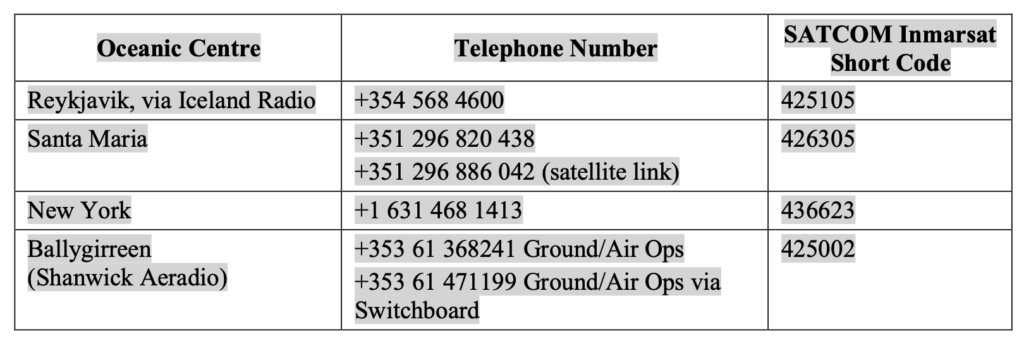
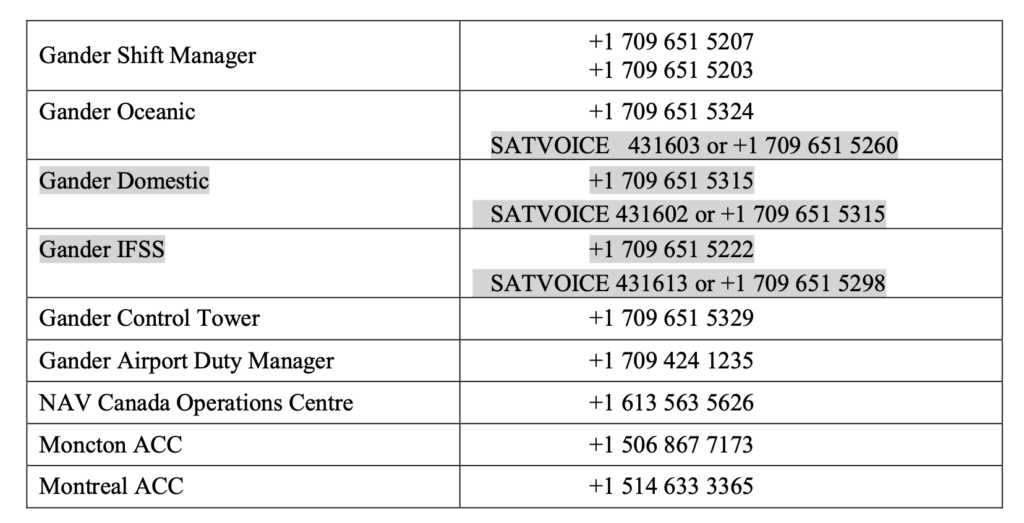
Contact Info updated:

Pilot/Operator Procedures were updated:

If you have a clearance already, and are routing in from another OCA, then in you go and follow the clearance.

This is what it says –

“While flights with an acknowledged oceanic clearance may transit Gander’s oceanic airspace, flights not yet within Gander OCA are strongly advised not to enter the airspace. Flights operating with an acknowledged oceanic/ATC clearance that continue under pilot’s discretion are expected to proceed in accordance with the last oceanic/ATC clearance issued. En-route requests for changes to route, level or speed should be limited to those required for flight safety.”

It has removed the bit about flights in other OCAs expecting a big re-route, and how Reykavik and Santa Maria will advise on procedures. The Procedures will be as per the Notam issued and the paragraph above gives the procedure.

East and Westbound flights above FL290 contingency routes have been updated:

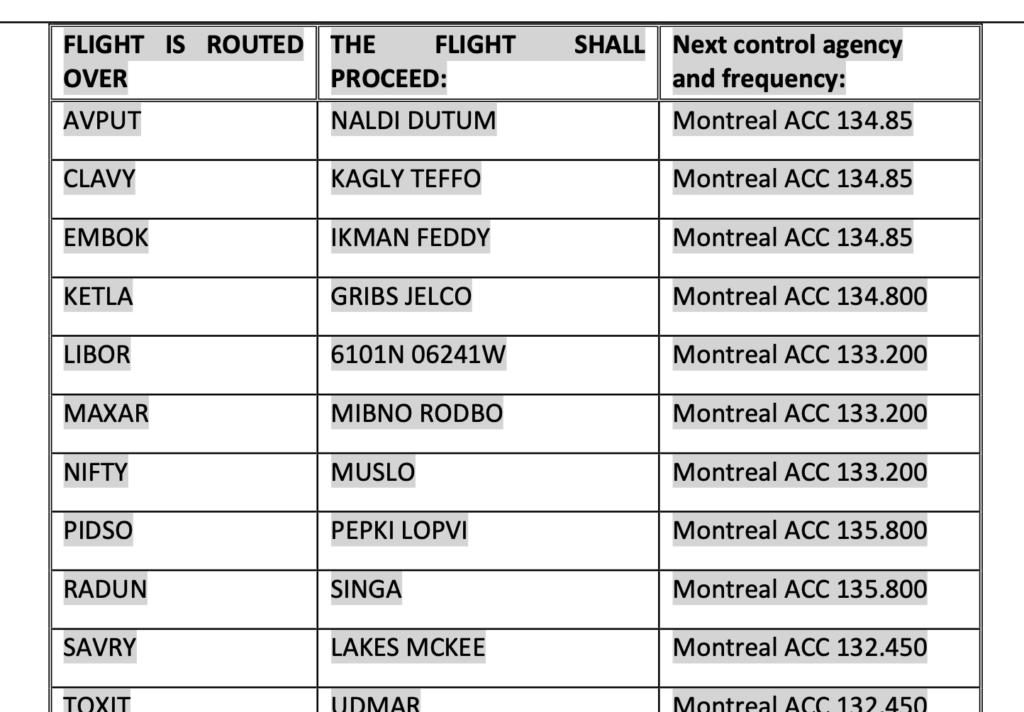
The change is that instead of just extending the OTS system to begin at fixes on the boundary between Gander and the Moncton or Montreal FIR, they will now use laterally spaced routes instead and connect them to oceanic exit points in the next agency. Once comms are established with the next agency, you’ll get a re-clearance.

There are a bunch of updated route tables (like this one below). So if you’re initially routing west via AVPUT and Gander evacuate, you will then proceed to NALDI, DUTUM and talk to Montreal for what to do after.

The long term contingency plan changed a bit:

Basically they clarified notes on how evacuations and loss of the Gander ATC service will likely not exceed 48-72 hours. They will also attempt to provide immediate or near immediate resumption of service specially for emergency, humanitarian and critical military flights. Everyone else can expect a “phased approach with flow control.”

Even more contact info was added:

The emergency NOTAM format has been updated:

Everyone loves a big long Notam. Here’s the new one they’ll be using from now on if everything suddenly stops working:

DUE TO EMERGENCY EVACUATION OF [OACC] DUE [REASON, e.g. COVID19] AIR TRAFFIC CONTROL SERVICES ARE UNAVAILABLE IN THE [NAME] OCA. FLIGHTS NOT IN RECEIPT OF AN OCEANIC CLEARANCE SHOULD REQUEST CLEARANCE TO AVOID [NAME] OAC/FIR OR LAND AT AN APPROPRIATE AERODROME. ONLY FLIGHTS OPERATING WITH AN ACKNOWLEDGED OCEANIC/ATC CLEARANCE ARE PERMITTED TO OPERATE WITHIN [NAME] OCA. FLIGHTS NOT YET OPERATING WITHIN THE [AIRSPACE NAME] OCA BUT IN RECEIPT OF AN [OCEANIC] OR [ATC] CLEARANCE ARE STRONGLY ADVISED NOT TO ENTER THE AIRSPACE. FLIGHTS OPERATING WITH AN ACKNOWLEDGED OCEANIC/ATC CLEARANCE THAT CONTINUE UNDER PILOTS DISCRETION ARE EXPECTED TO PROCEED IN ACCORDANCE WITH THE LAST OCEANIC/ATC CLEARANCE ISSUED AND MUST CONTACT NEXT ATC AGENCY AS SOON AS POSSIBLE AND REPORT CURRENT POSITION, CLEARED FLIGHT LEVEL, NEXT POSITION AND ESTIMATE, AND SUBSEQUENT POSITION(S). FLIGHTS MUST REVERT TO VOICE POSITION REPORTING PROCEDURES. DATALINK EQUIPPED AIRCRAFT ARE EXPECTED TO CONNECT TO/REMAIN CONNECTED TO CURRENT CENTRE UNTIL OTHERWISE INSTRUCTED. FLIGHTS MUST MONITOR 121.5 / 123.45MHZ AND VOLMET AND USE ALL AVAILABLE MEANS TO DETECT ANY CONFLICTING TRAFFIC. FURTHER DETAILS WILL BE PROVIDED VIA NOTAM IN DUE COURSE.

Anything we missed?

Let us know. news@ops.group


New NAT Contingency Procedures for 2019

Starting 28th March 2019, there will be some changes to the contingency and weather deviation procedures on the NAT. ICAO has published a new NAT Ops Bulletin with all the details.

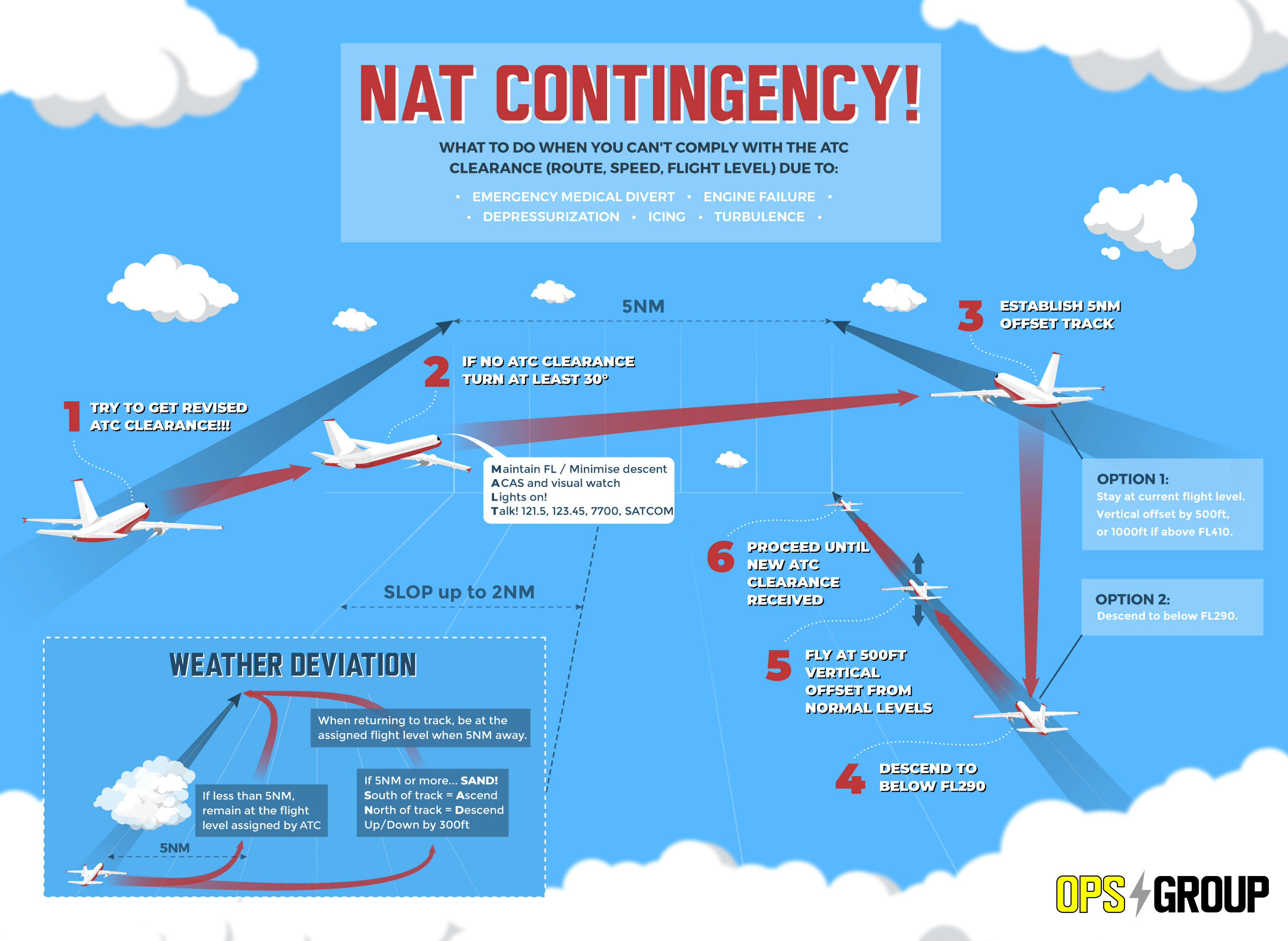
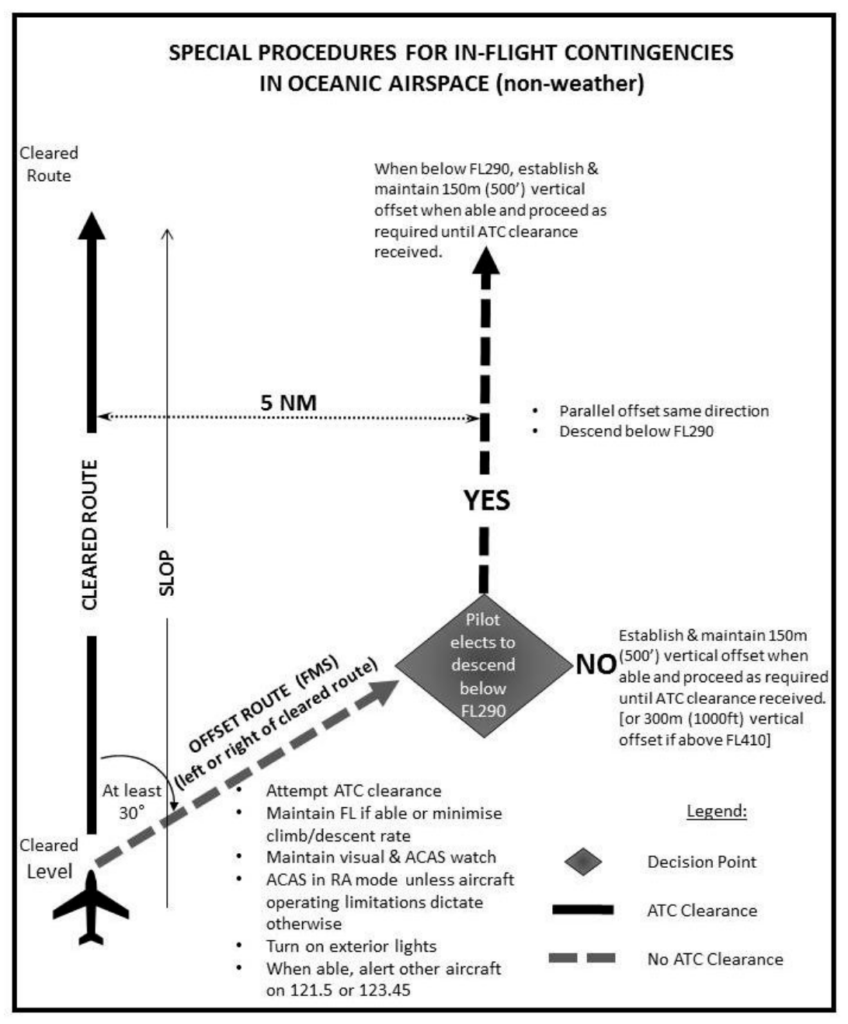
Before, there was a lot of confusion around the wording of these two procedures – but ICAO has now made this much clearer, and they have even included a little graphic to help us understand how it will work.

Thing is, it’s still a little clunky. So we decided to make our own version!

What’s new?

The simple answer is this: contingency offsets that previously were 15 NM with actions at 10 NM are basically now all 5 NM offsets with a turn of at least 30 degrees (not 45 degrees).

Rarely do we see ICAO oceanic contingency procedures undergo a formal revision. The last time a major revision occurred was in 2006 when ICAO standardized a 15 NM offset executed with a turn of at least 45 degrees. Prior to that, the North Atlantic and the Pacific had used different offset distances and a 90 degree turn.

Where and when?

A trial implementation is scheduled to begin in the NAT Region and New York Oceanic West starting 28th March 2019. ICAO is expected to formally publish the Standard in an update to PANS-ATM (ICAO Doc 4444) on 5 November 2020.

Why?

To support reduced separation being implemented in conjunction with Advanced Surveillance Enhanced Separation (ASEPS), Space Based ADS-B surveillance. The details for the ASEP trial can be found in NAT OPS Bulletin 2018-006 Trial Implementation of ASEPS using ADS-B.

Old version vs New version – full wording

Here’s the old version, as per the latest version of the NAT Doc 007, paragraph 13.3. (Note – this will be valid UNTIL 27 March 2019):

The aircraft should leave its assigned route or track by initially turning at least 45° to the right or left whenever this is feasible.

An aircraft that is able to maintain its assigned flight level, after deviating 10 NM from its original cleared track centreline and therefore laterally clear of any potentially conflicting traffic above or below following the same track, should:
a) climb or descend 1000 ft if above FL410
b) climb or descend 500 ft when below FL410
c) climb 1000 ft or descend 500 ft if at FL410

An aircraft that is unable to maintain its assigned flight level (e.g due to power loss, pressurization problems, freezing fuel, etc.) should, whenever possible, initially minimise its rate of descent when leaving its original track centreline and then when expected to be clear of any possible traffic following the same track at lower levels and while subsequently maintaining a same direction 15 NM offset track, descend to an operationally feasible flight level, which differs from those normally used by 500 ft if below (or by 1000 ft if above FL410).

Before commencing any diversion across the flow of adjacent traffic or before initiating any turn-back (180°), aircraft should, while subsequently maintaining a same direction 15 NM offset track, expedite climb above or descent below the vast majority of NAT traffic (i.e. to a level above FL410 or below FL290), and then maintain a flight level which differs from those normally used: by 1000 ft if above FL410, or by 500 ft if below FL410. However, if the flight crew is unable or unwilling to carry out a major climb or descent, then any diversion or turn-back manoeuvre should be carried out at a level 500 ft different from those in use within the NAT HLA, until a new ATC clearance is obtained.

And here’s the new version, as per the NAT OPS Bulletin 2018-005 Special Procedures for In-flight Contingencies in Oceanic Airspace (Note – this will be valid FROM 28 March 2019):

If prior clearance cannot be obtained, the following contingency procedures should be employed until a revised clearance is received:

Leave the cleared route or track by initially turning at least 30 degrees to the right or to the left, in order to intercept and maintain a parallel, direction track or route offset 9.3 km (5.0 NM).

Once established on a parallel, same direction track or route offset by 9.3 km (5.0 NM), either:
a) descend below FL 290, and establish a 150 m (500 ft) vertical offset from those flight levels normally used, and proceed as required by the operational situation or if an ATC clearance has been obtained, proceed in accordance with the clearance; or
b) establish a 150 m (500 ft) vertical offset (or 300 m (1000 ft) vertical offset if above FL 410) from those flight levels normally used, and proceed as required by the operational situation, or if an ATC clearance has been obtained, proceed in accordance with the clearance.

Note. — Descent below FL 290 is considered particularly applicable to operations where there is a predominant traffic flow (e.g. east-west) or parallel track system where the aircraft’s diversion path will likely cross adjacent tracks or routes. A descent below FL 290 can decrease the likelihood of: conflict with other aircraft, ACAS RA events and delays in obtaining a revised ATC clearance.

So to reiterate, the important change is that contingency offsets that previously were 15 NM with actions at 10 NM are basically now all 5 NM offsets with a turn of at least 30 degrees (not 45 degrees).

Weather deviations

If you have to deviate from your assigned track due to anything weather-related, there’s a whole different procedure to follow. Again, the NAT Ops Bulletin has all the details for this, but the bottom line seems to be:

For deviations of less than 5 NM, remain at the flight level assigned by ATC.

For deviations of 5 NM or more, when you are at the 5 NM point initiate a change as follows:

If flying EAST, descend left by 300ft, or climb right by 300ft.

If flying WEST, climb left by 300ft, or descend right by 300ft.

In other words – SAND! (South of track = Ascend, North of track = Descend; Up/Down by 300ft)

But remember, going right is probably better – it gets you out of the way of all the SLOP offset traffic that might be coming at you from the opposite direction!

Turnback procedure

In both the NAT Ops Bulletin and the new NAT Doc 007 which will take effect from 28 Mar 2019, ICAO has left out any specific reference to how to divert across the flow of traffic or turn-back procedure, and instead simplified it to just “proceed as required by the operational situation”. Turning back would assume you either employ the 5NM offset as per the new contingency procedure, or else get a new revised clearance.

Bottom line

If you operate in the NAT HLA, we recommend you read and review the NAT Ops Bulletin in its entirety. It’s relatively short but, beginning 28 March 2019, the procedures are expected to be implemented. You might want to prepare changes for your Ops Manuals and checklists too.

Make sure you stay tuned to OPSGROUP for changes that may occur as we approach 28 March 2019!

Further reading:

  • On Nov 1st we had a call with 140 OPSGROUP members about upcoming changes on the NAT in 2019, and how we can effect change. OPSGROUP members can find the PDF notes of this in your Dashboard.
  • A big thing driving the ASEPS trial is the rollout of Space-based ADS-B, which is scheduled to complete its deployment by 30 Dec 2018, giving us worldwide, pole-to-pole surveillance of aircraft. For more on that, and how it will affect operations on the NAT specifically, read the article by Mitch Launius here.
  • Use our quick guide to figure out where you are welcome on the NAT, depending on what equipment and training you have.


The Impact of Space-Based ADS-B on International Operations

I can distinctly remember the build up to and roll out of GPS navigations systems. Like so many of us, I was excited to see this new technology integrated into my cockpit. The idea that I would have the capability to accurately determine my position anywhere in the world was exciting!

It’s hard to overstate the significance of GPS navigation on the international operation of aircraft, particularly when operating in oceanic airspace. Today we are about to reach a similar milestone that could be even more significant – the introduction of a Space-Based Automatic Dependent Surveillance Broadcast (SB ADS-B) monitoring system.

When SB ADS-B completes its deployment (scheduled 30 December 2018), we will achieve worldwide, pole-to-pole surveillance of aircraft. This goes beyond a pilot knowing his or her own location. This opens up the ability for ATC to locate any ADS-B equipped aircraft anywhere in the world. With the US and EU ADS-B requirements approaching in 2020, aircraft that operate internationally will almost certainly be ADS-B equipped.

A brief history of Space-Based ADS-B

SB ADS-B technology has been placed into service by a commercial company, Aireon, and not a governmental entity, which has enabled it to be brought to operational status in a much shorter timeline than most other government implementations.

Although Aireon was initially established in 2012 to provide civilian surveillance services, the disappearance of Malaysia Flight 370 changed the industry. The inability to locate the aircraft forced industry regulators to consider how improved aircraft tracking might have helped to resolve the location of the aircraft in distress and prevent a future disaster. In response to this concern, ICAO created a standard for aircraft tracking designated as the Global Aeronautical Distress Safety System (GADSS). Aireon responded by creating a low-cost tracking solution based on aircraft ADS-B equipage utilizing the SB ADS-B network to meet that tracking requirement faster and cheaper than many of the alternatives.

This implementation takes advantage of the same ADS-B 1090ES systems already installed in most aircraft, not requiring any additional investment or modification from operators who currently comply with ICAO ADS-B approved 1090ES systems. Compare this to the evolving and evasive FANS 1/A+ requirements that have placed many operators in the position of having to upgrade aircraft (at great expense) only to find they are not PBCS and/or U.S. domestic compliant. Quite a contrast.

What are the benefits?

The primary advantage of the introduction of surveillance into oceanic operations will be a reduction in separation. Initially, this will be applied to in-trail spacing (longitudinal separation) and potentially reduce that separation to as close as 14 Nautical Miles (NM). The current longitudinal standard for data link approved aircraft is 5 minutes or approximately 50NM. The introduction would significantly increase the capacity of the most fuel-efficient routes and altitudes. The trial implementation is not expected to be restricted to specified tracks or altitudes, just between properly equipped aircraft.

Another key advantage of SB ADS-B is that the system is based on an active constellation of 66 low earth orbit satellites with geo-synchronous orbits that provide worldwide coverage. The system will also have 9 backup satellites available in orbit as well. The information on worldwide aircraft location will be in the system, it’s just a matter of having it sent to ATC control panels that are properly equipped to display the information. The SB ADS-B system operates independently from the ADS-B ground stations and can provide a direct data feed to air navigation service providers (ANSPs).

The primary targets for Aireon SB ADS-B services are ANSPs such as the FAA, EASA, Africa’s ASECNA, South Africa, New Zealand, Singapore, etc. This brings tremendous value to areas like Africa and Southeast Asia where ANSP’s face unique challenges involving infrastructure. Placing a network of ground-based ADS-B receivers in remote areas can expose them to vandalism or theft. As an example, a recently installed ILS system in Benin, Nigeria was stolen!

What does my aircraft need to be compliant?

In order for SB ADS-B separation reduction to be applied, aircraft will be required to be ADS-B and fully PBCS compliant. The controlling agency will determine eligibility based on the flight plan filing codes for ADS-B and PBCS. Let’s recall that the PBCS requires FANS 1/A+ approval with RCP240, RSP180, and RNP 4 capabilities. Just add ADS-B, NAT HLA, and RVSM equipage and approval and you’re ready! That is a lot of approvals, plus let’s not forget, TCAS Version 7.1 and Enhanced Mode S Transponder equipage is required as well.

Where will it be implemented?

Initial trial use of SB ADS-B for surveillance and separation will begin in Canada’s Edmonton Flight Information Region (FIR) in the first quarter of 2019. This will be followed by a planned trial launch in the North Atlantic (NAT) on 29 March 2019. The NAT oceanic surveillance trial program will be employed in both in Gander and Shanwick’s oceanic FIRs. Santa Maria will also introduce ADS-B separation standards, but that program will initially be limited to ground-based ADS-B operations.

We anticipate a mid-December 2018 release of a North Atlantic Ops Bulletin detailing the trial implementation which will be referred to as “Advanced Surveillance-Enhanced Procedural Separation” (ASEPS). This is to be followed by ICAO publishing the associated standards for ASEPS in a 5 November 2019 update to Procedures for Air Navigation Services – Air Traffic Management (PANS-ATM) Document 4444. This would move the ASEPS program beyond trial use and allow implementation of ASEPS based operations worldwide.

The final specifics involved in the trial program will be detailed in Canadian and United Kingdom Aeronautical Information Publications (AIPs), most likely involving a release of Aeronautical Information Circulars (AICs) to formally initiate the trial programs.

The NAT HLA does not anticipate requiring ADS-B for airspace entry but simply employing it as available. The impending U.S. and EU ADS-B requirements in 2020 will help ensure common equipage.

The introduction of ASEPS reduced separation standards in oceanic and remote regions will also impact contingency procedures for operators in the NAT HLA. To address this concern ICAO has created new contingency procedures for oceanic and remote operations which will also be identified in the November 2019 update to Procedures for Air Navigation Services – Air Traffic Management (PANS-ATM) Document 4444.

We expect the mid-December release of an additional North Atlantic Ops Bulletin detailing the trial implementation of these new contingency procedures in the NAT HLA airspace to be implemented with ASEPS. These new contingency procedures will initially only be used in the NAT HLA but, after the ICAO approval in November 2019, they may be implemented in other oceanic regions as well.

It would be important to note that the ASEPS target date for implementation, 29 March 2019, is also the target date for the expansion of the PBCS tracks in the North Atlantic Organized Track System. Add in the change in contingency procedures and that is a lot of moving parts, all happening at the same time, in the most congested oceanic airspace in the world.

One thing we don’t anticipate changing on March 2019 is strategic lateral offset procedures (SLOP). Changes may follow down the road but it’s not on the calendar now.

Let’s all get ready for a busy spring in the North Atlantic!

Mitch Launius is an International Procedures Instructor Pilot with 30West IP and can be contacted through his website: www.30westip.com