US FAA Improves Flight Tracking Privacy

Dec 2024 Update:
  • The FAA’s Privacy ICAO Address Program (PIA) has been updated. CPDLC services are now available for flights using a PIA. To receive it, pilots must file the PIA ICAO 24-bit address and N-reg in the flight plan.
  • Two other important changes – aircraft info held by the FAA and associated with a PIA are exempt from the Freedom of Information Act, and pilots can now request a new PIA every twenty days if they want. You view the updated FAA Privacy page here.
Feb 2024 Update:
  • The FAA’s Privacy ICAO Address program has been expanded to include some new oceanic and Gulf of Mexico routes.
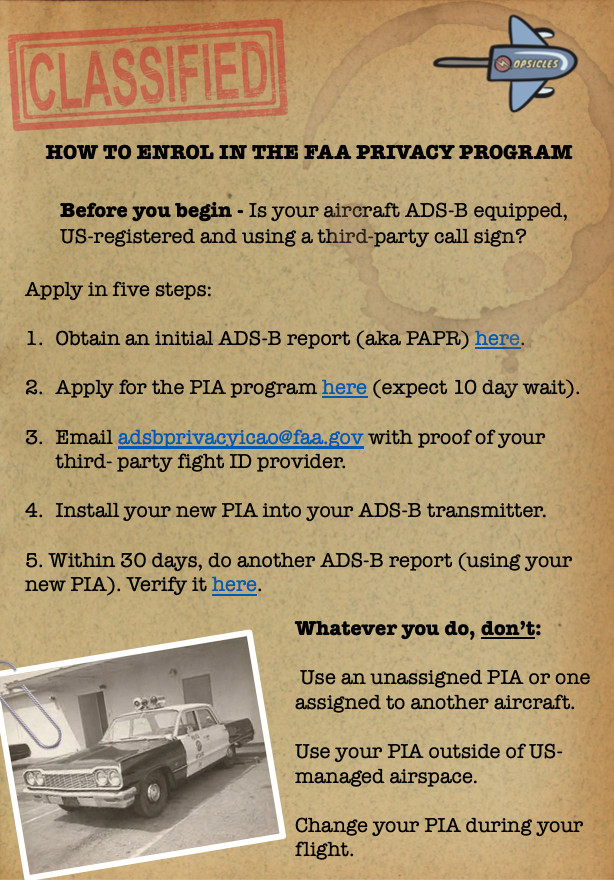
  • Check below for exactly which routes this program now applies to, and our Opsicle with steps on how to register.

If you’re not familiar with this program, it prevents users’ aircraft registration from being tracked by third parties using ADS-B output during US domestic flights. We wrote about it before here. But to explain what this program is and how it works in two sentences:

All Mode S equipped aircraft are assigned a unique ICAO 24-bit address – this is uniquely identifiable to your aircraft’s registration. The FAA’s PIA program assigns you another one to use that renders you secret-squirrel.

To participate, you must tick all three of these boxes:

  1. Operating an US-registered aircraft which is ADS-B equipped
  2. Using a third-party call sign
  3. Flying in US territorial airspace (the mainland, Alaska, Hawaii, and other US territories). Additionally, the PIA has been expanded to include US oceanic FIRs too – those more than 12nm from shore.

After news broke the program had been improved, we struggled to find a summary of the changes and got in touch with the FAA directly.

They advised while there is no ‘master list’ of the newly included routes, they have updated their website to include some valid examples including:

  • NYC to LA
  • Miami to Houston (via the Gulf of Mexico)
  • LA to Hawaii
  • Boston to Miami (with offshore routes more than 12nm from shore).

If you have an enquiry about a specific route, you can reach them on adsbprivacyicao@faa.gov. Chances are, as long as you stay within US jurisdiction, your route will be valid.

How to apply?

So, you want in? We’ve put together this little Opsicle with steps on how to register.

Click to open PDF.

More questions?

The FAA has quite a good FAQ section on the PIA which you can access here.


Canada ADS-B Mandate

Key Points
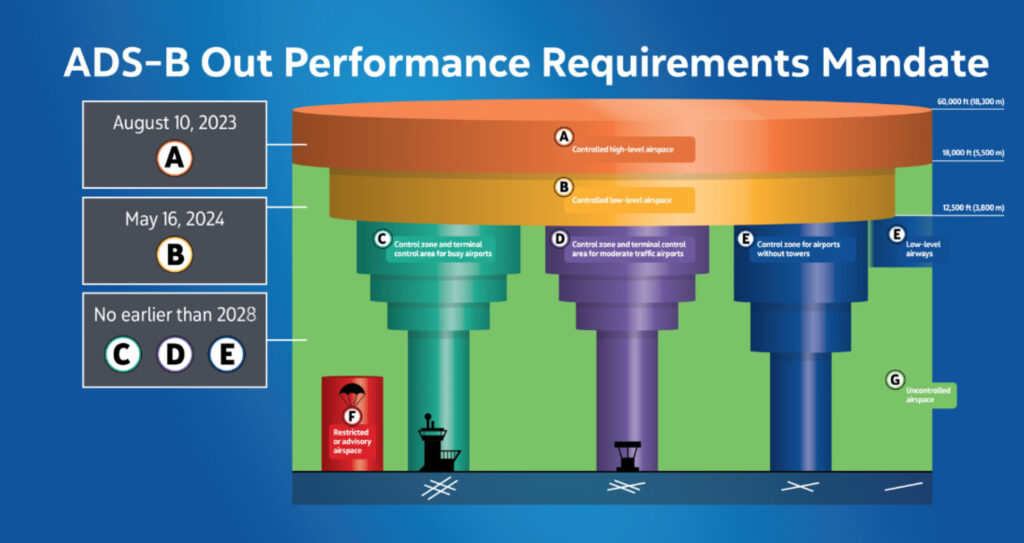
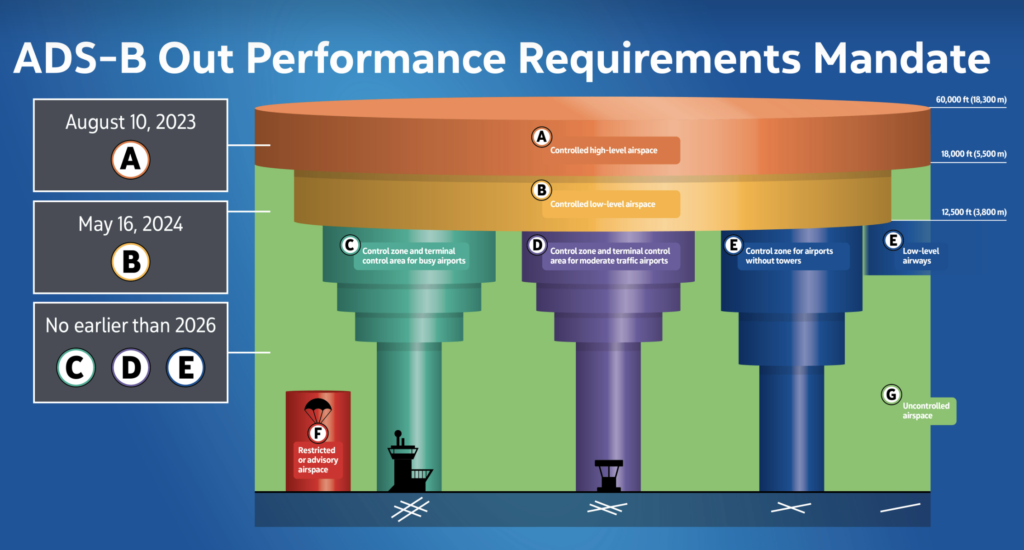
  • ADS-B became mandatory in Canadian Class A airspace in Aug 2023 (above FL180). It then became mandatory in Class B airspace (above FL125) in May 2024. Mandates in any Class C, D and E airspace will be determined no sooner than 2028.
  • You need an antenna able to broadcast to ADS-B receivers both on the ground and in space, and you need to include some extra stuff on your flight plan.
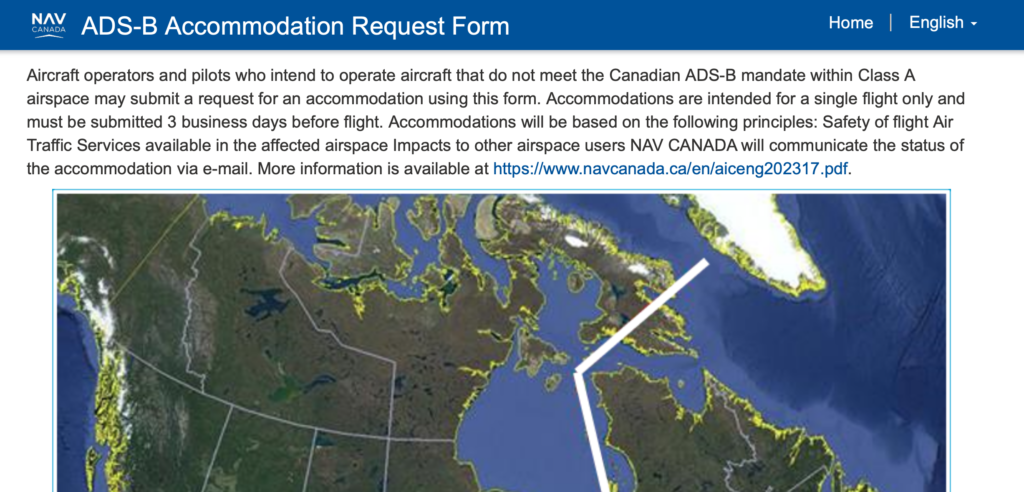
  • If you don’t have ADS-B, you have to apply for an exemption online from NavCanada.

What equipment do I need?

  • A transponder with ADS-B out capability that meet the minimum performance standards (or better) found in this fancy document. This needs to be attached to an antenna that can broadcast to ADS-B receivers both on the ground, and in space.
  • You can also find more on this in section 551.103 of the Canadian Aviation Regulations.

Extra Flight Planning Requirements

  • If you plan on entering airspace where the ADS-B mandate applies, there is some extra stuff you need to include in item 10b of your ICAO flight plan (assuming you have all the right gear on board).
  • Use the code B1 if you have ADS-B Out only, or B2 if you have ADS-B In and Out.
  • You’ll also need to include SUR/CANMANDATE in item 18.
  • One other gotcha – make sure the flight identification (flight number or aircraft reg) broadcast by your ADS-B equipment exactly matches the one used in item 7 of your flight plan. Lest there be trouble down the track!

My ride doesn’t have this fanciness. What are my options?

  • NavCanada will do their best to accommodate aircraft who don’t have the right gear on board, in the same way they’ll work to fit non-transponder equipped aircraft into transponder mandatory airspace.
  • They’ll assess each application on a first-come, first-served basis. It takes time to figure out behind the scenes, and so you’ll need to ask at least three business days before your flight.
  • There may also be suggested re-routes to make your request possible, along with special comments to include in Item 18 of your flight plan.
  • You can apply for an exemption online, here. If you have a number of flights to operate, you can also submit a blanket request via service@navcanada.ca.

More Info

You can find that in the Canadian AIP (ENR 1.6.3), or even better – this page from NavCanada dedicated to the ADS-B Mandate. This includes a fairly extensive FAQ section at the bottom.


ADS-B Controversy? Landing Fee Fuss in Florida

Several airports in Florida are proposing new landing fees using ADS-B to automatically invoice operators as early as next month.

AOPA, along with other industry collectives, are crying foul. Not necessarily at the prospect of more bills, but because of the use of ADS-B data to collect fees.

Simply put, in both design and mandate, ADS-B was never intended for this purpose. It exists due to its ability to improve the safety and efficiency of air traffic – not to clip the proverbial ticket.

What’s Being Proposed

Long story short, Florida has contracted a partnership of third-party companies that collect real-time airport operational data using ADS-B and use it to produce landing fee invoices.

The proposed billing structure will be based on weight, and the heavier you are, the more you will pay. The figure being widely thrown around is $3USD per 1000 lbs.

These fees may be introduced as early as 1 October 2024. Nearly a dozen Florida airports have already shown an active interest in implementing the new scheme.

For business jet operators, it’s hardly earth-shattering news. $225 USD in fees to land a Gulfstream 550 for instance is well within the realm of normalcy – given publicly available fees.

So why should we be taking note? Because of the precedent being set and the implications that this may have for the future use of ADS-B data.

Push Back

AOPA have written to the FAA asking them to block the use of ADS-B to collect fees. They’re also seeking legislative action to try and make sure this doesn’t happen.

They make the following points:

  • The fees will be collected by not-for-profit, public-use airports already operating in surplus thanks in part to Federal grants.
  • The domino effect. Airports have expressed concerns that if other airports introduce the new fees, they will have to do the same to protect themselves from the resulting influx of traffic.
  • This is not what ADS-B was intended for.

ADS-Being Watched

This is not the first time ADS-B has come under the spotlight for being used in ways that were never intended.

Case-in-point was the recent controversy of its data being used to track and publicize the whereabouts of prominent VIPs – one celeb famously described these as his ‘assassination co-ordinates.’ You can read about that more here.

In a similar vein, one can argue ADS-B data should not be used to collect billing information either.

It was never intended for this purpose. The technology was invented, and in many cases mandated for the better-than-radar effect it has on separation and airspace safety. Just take the fairly recent transition of the NAT HLA to space-based ADS-B for instance.

Where the lines become blurry is that ADS-B data isn’t protected – with the obvious exception of things like the FAA’s LADD and PIA Programs, which are limited in scope for international operators, and will be for some time yet.

The reality is that virtually anyone with around a hundred bucks worth of ADS-B receiver can track most 1090 MHz ADS-B equipped aircraft.

Unfortunately, the use of this data opens the door to commercial interests – the precedent arguably being set in Florida.

It is our data, and belongs in the aerospace system. Florida’s proposed landing fees may be of more concern to flight training and lighter aircraft right now, but we have a collective interest in supporting ADS-B only in its use for safety, and nothing more.

Staying Switched On

What we don’t want to see happen is more pilots and operators switching off ADS-B because they are skeptical of the system. Having your ADS-B switched on, even in areas where it’s not required, provides a massive advantage to aviation safety of being able to see other planes around you.

The risk with schemes like this new one in Florida is that it will drive more pilots to avoid the system, which could ultimately lead to more incidents and accidents.

Have more info?

We’d love to hear from you. You can reach us on team@ops.group around the clock.


ADS-B Mandates in 2023

Certain exemptions to the ADS-B mandate in Europe ended on June 7th, 2023, which means that most aircraft flying in Europe now need to have ADS-B.

Essentially, you were exempt until 7th June if your CofA was from between 1995-2020, and you had a retrofit plan in place, and you never benefitted from any EU funding for the retrofit.

Now, you’re only exempt if your CofA is from before 1995, or you’re doing a maintenance or delivery flight, or you’ll be ceasing ops within EU airspace before Oct 2025.

There’s a whole bunch of EU docs out there containing these rules, but the main one to check is 1207/2011.

Other ADS-B mandates around the world

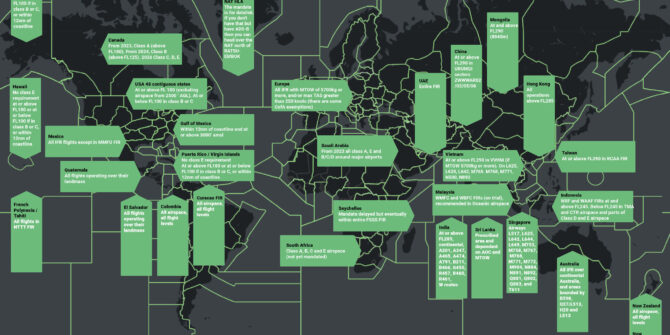
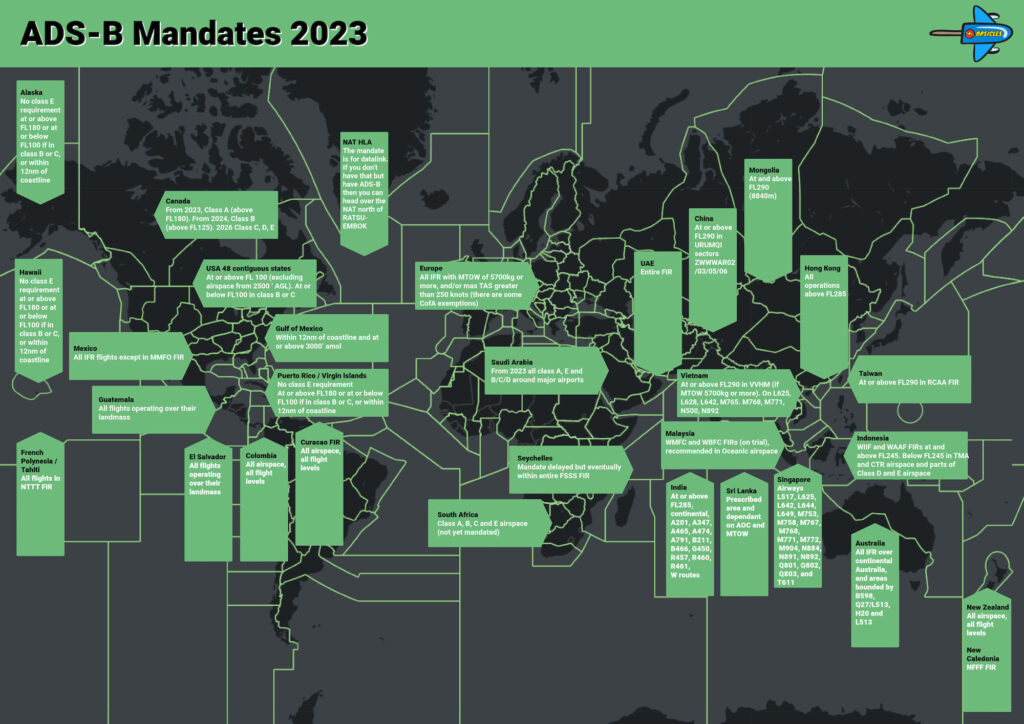
Here’s a map of all the current ADS-B mandates we know about, in a lovely green tint, mostly pointing in the right direction of where the airspace they refer to are!

Other ADS-B mandates coming soon

Fiji
July 13th 2023 – ADS-B will be required for all flights in the Fiji domestic sector of the NFFF/Nadi FIR. (You already need it in the New Caledonia sector, i.e. the bit around NWWW/Noumea airport). Ref: AIC 03/23

Canada
August 10th 2023 – ADS-B will be required for all flights in Class A airspace (at or above FL180), then in Class B airspace from May 16th 2024, then everywhere else from some time in 2026. Ref: NavCanada

Any more we missed? Let us know!


Cloaking Devices: The ADS-B Privacy Issue

ADS-B is fantastic bit of technology that has big safety and efficiency benefits for air traffic. The trouble is, there is also a growing level of insecurity about security surrounding it, because it doesn’t just allow ATC to know precisely where you are at all times – anyone who wants to can find that info too.

Are you ADS-Being watched?

We said all this about it before.

If you can’t be bothered to read it, then it basically says this:

  • Big benefit because it gives ‘radar like coverage’ in remote regions like the North Atlantic.
  • Big problem because it reduces privacy, and this could lead to security issues.

Whilst airlines don’t mind/aren’t really bothered about this as much (you can kinda tell where they are heading to and from, and get other info on the airplanes, with relative ease), the business aviation and private aviation world are more concerned.

The OPSGROUP ‘All Call’.

Here’s the frustration: The FAA runs a program called LADD which offers “hiding” of our ID on tracking sites (like FlightRadar24). The theory is good, but we’re now at a point here LADD simply highlights your aircraft on tracking sites that don’t play by those rules (like ADS-B exchange).

Here’s a video. One click shows everyone airborne that has requested privacy!

And then there is the issue of everywhere not the US because the FAA PIA system only works in US airspace. Cross the invisible boundary and you’re visible again. This includes offshore routes to the Caribbean or across the Gulf of Mexico.

Changing the PIA back to the ICAO one is a bit of a mission, and if you aren’t using it, then you’re not going to be able to log on to Domestic Enroute CPDLC, ARINC and SITA stations won’t recognise you. You’ll have to switch to a new flight plan provider to get the required call sign. In other words, it is not practical for a lot of operators.

We wanted to get an idea of how bothered folks are, and to share some of the info, so we sent out an ‘All Call’ to our members. The response was big. The concern and frustration is big.

So what has been happening?

ICAO held their 41st assembly earlier in 2022, and Saudi Arabia submitted a technical paper asking ICAO to fix the problem. Read it here.

The key points from the paper:

  • ADS-B Tracking of flights creates safety, security and privacy concerns.
  • There are some ways to hide your ID, but they don’t really work.
  • ICAO, please fix this.

So, maybe ICAO will take a look at it, but there isn’t an easy fix. It’s an inherent system problem that needs the system to change (maybe encryption, maybe dynamic hex codes, maybe something else…)

The NBAA are on it.

A panel to discuss the growing issue was held at NBAA-BACE on Oct 19, 2022. There is a great article on it which you can read here.

Here’s what we picked out of it:

  • Pre-ADS-B systems worked on interrogation – so you knew who was asking for the info.
  • The issue got bigger with ADS-B Out.
  • ADS-B isn’t going away because it is useful.

So they laid out a 4 step plan:

  • Aircraft registration should be held by a trust or LLC so there is a layer of separation between the principle owner and the name on the certificate of registration (because that’s on the public record and anyone can view it).
  • Folk should make sure their aircraft is participating in the LADD program (it does still do something). Find that here.
  • Use a third-party call sign. You can get this from a bunch of vendors like Foreflight and FltPlan.com.
  • The most important one: Take steps to change your 24-bit code associated with your registration. You can do this through the PIA system. Basically, the FAA assigns you an alternate 24-bit code to fool the sneaky flight trackers into seeing a different registration number.

The FAA are on it.

They have a whole site dedicated to ADS-B privacy which you can find here.

The info is pretty much everything we’ve said above, but they have some handy links and things too.

Is it enough though?

We aren’t sure it is.

It is an ongoing thing, which lots of people are looking into. In the meantime, we do have these questions, and your answers to them might help:

  • How have you solved this problem?
  • Have you worked out some black magic that hides your ID?
  • Have you found something that other operators can use?
  • Since LADD appears almost pointless, does PIA work for you?
  • Have you experienced any security or privacy issues because of public tracking?
  • Any suggestions or thoughts to share?

Drop us an email at news@ops.group if you have any answers/idea/suggestions/tips/questions/queries or other…


Are you ADS-Being watched?

ADS-B is quickly becoming mandated around the world – especially for IFR aircraft operating in busy controlled airspace at higher levels.

One of the major benefits of this is it provides ‘radar-like’ coverage where radar isn’t possible. They no longer have to wait many minutes for the next bit of info about where you are. Now aircraft can be tracked  “as good as” live.

But this means you are trackable by, well, anyone, and it’s got some wondering whether this is an issue?

‘B’ equals Big Benefits.

The ‘B’ stands for broadcast and this is what makes this system so great. Your aircraft continually broadcasts its precise GPS position, along with other info through a Mode S transponder, to any receiver listening.

The biggest benefit seen so far is probably over the North Atlantic where ADS-B allows controllers to “see you” a lot better. Not literally see you, but receive info on where you are with a lot of accuracy and most importantly in a decent time frame (a mere snippet of a second).

The benefit is it allows for reduced separation.

But the Problem is also the ‘B.’

Anyone with the right ears (including near airports) can listen in, and see who you are, where you are and what you’re doing. You can literally buy ADS-B receivers on Ebay for less than a hundred dollars.

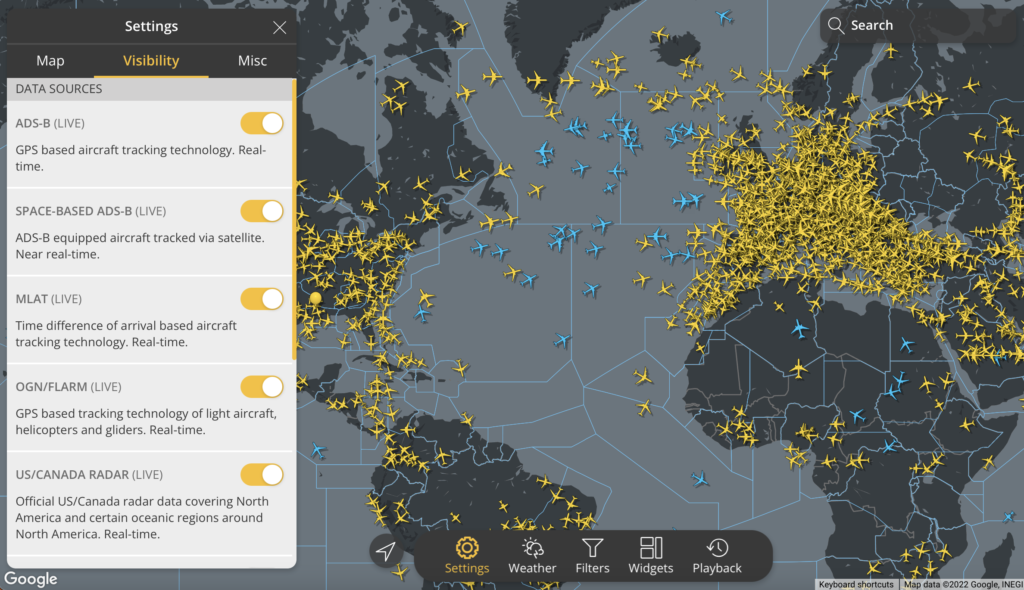
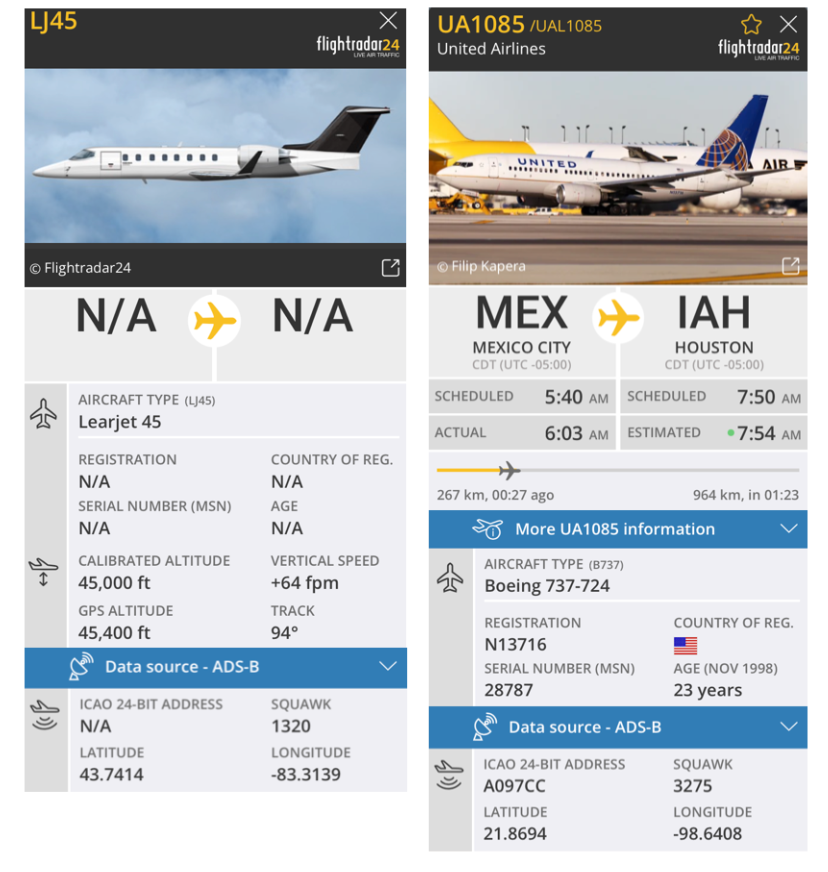
Take a look at FlightRadar and select the ‘ADS-B’ visibility on and suddenly the map fills up with many, many aircraft.

But this isn’t the main concern.

An aircraft’s ADS-B broadcast also contains a unique ICAO aircraft address –  specific to every airplane and directly linked to the tail number. Which means folk can not only track an aircraft, but see a lot of information about it that the operator might not want any old Joe Bloggs seeing.

If someone knows your tail number, it is pretty easy to discover who owns the aircraft, and even the address of the person registered to it.

And this is the concern. ADS-B has created a privacy and potentially even a security issue.

How can we be less visible?

If you are flying in USA domestic airspace then the FAA have two systems you can sign up to.

First up LADD, which stands for ‘Limiting Aircraft Data Displayed’.

This came into place from the ‘2018 HR 254 FAA Reauthorization Bill: Section 566, Right to Privacy When Using Air Traffic Control System’ as a replacement for the old BARR (Block Aircraft Registry Request) system.

This scrubs your data out of the FAA SWIM feed – the place where commercial tracking providers get their info.

You have two levels of privacy you can opt for. One that removes it all so these sites get none of your data, and one that allows tracking providers to still track you (the airplane owner or operator might like this), but not publish the data to the general public.

Then there is PIA – the Privacy ICAO aircraft address program where you can request an ‘alternate, temporary ICAO aircraft address which will not be assigned to the owner in the Civil Aviation Registry’.

Let’s Talk Hexes.

How does the PIA program work?

Well, your aircraft has a HEX code assigned to it – the unique 24-bit ICAO address. This is linked to the registration number which is registered in the Civil Aviation Registry, along with a bunch of private information about the aircraft and its owner.

So via the PIA system, you can get a different code assigned to your aircraft. One that isn’t linked to the tail number. This doesn’t stop your aircraft being tracked, but does mean not identifying data will be published because no-one can find it now.

These don’t solve the whole problem though.

There are several big limitations to know about.

Firstly, the FAA can only tell the commercial providers what to do with the data they receive from SWIM. Unfortunately, there are a lot of random trackers out there who have their own ways of tracking you, and the FAA has absolutely no power to stop them. Which is why getting the HEX changed is useful.

But, both LADD and PIA also only work in US domestic airspace which means as soon as you leave this and head into somewhere like the Deep Waters routes for example (which is Oceanic and managed but not owned by the US) then the FAA can no longer stipulate what is available and what isn’t.

The Atlantic, Pacific, off the East coast of the USA, and of course anywhere else in the world, still has the same problem.

Then there is the actual hassle of changing your ICAO HEX code. It has to be changed within a lot of your aircraft systems and involves a fairly lengthy maintenance process.

The NBAA are on it.

As usual, the very helpful NBAA are looking out for you already, and are working with the FAA to improve the timeframe it takes for your PIA request to be processed (currently within 60 days). And they are working to see if things like multiple codes could be an option.

There is also discussion as to how the programs can be extended into non-US domestic airspace.

So if you want to register, how can you?

All of it can be done via the FAA website.
File your LADD request here.
Head to this page for more info on the PIA.

If you want some more info?

The NBAA did an excellent podcast on this not so long ago which you can listen to here.

There is a good article on it here as well courtesy of ‘Plane and Pilot’.


Mexico ADS-B Mandate Coming Soon

Mexico’s ADS-B mandate, delayed a year, is coming into effect January 1, 2022.

Why was it delayed?

Apparently it came down to supply of ADS-B equipment issues meaning a lot of Mexican registered aircraft were unable to get it installed in time.

What do you need?

Mexico have mandated the use of 1090-MHz Mode S squitter transponders and as yet have not agreed to extend the mandate to allow 978 MHz Universal access transceivers, which are allowed in the US. The main difference is 978 MHz transponders are not allowed above 18,000′ while 1090MHz ones can be used at any altitude.

The mandate is for ADS-B Out. If you’re unsure on the difference then the FAA have a handy page on it here, but the simplified difference is Outtie’s broadcast an aircraft’s GPS location, altitude, groundspeed etc to ATC ground stations and other aircraft. Innie’s provide the aircraft with weather and traffic info delivered directly to the flight deck.

Where will you need it?

The rules look similar to those in the US:

  • Class A
  • Class B
  • Class C
  • Class E above 10,000 feet
  • Class E over the Gulf of Mexico, above 2,500 feet
  • Within 12nm of the Mexican coast, above 3,000 feet
  • Within 30nm of MMMX/Mexico City International Airport, above 10,000 feet

What if mine breaks?

There is a process for operators to request permission, in advance, if their ADS-B is inoperative. You can also request to fly without ADS-B equipment installed if you submit the request at least an hour before departure (probably a good idea to do it a little earlier).

Where is the official info?

All we have discovered so far is this Advisory which unfortunately is in Spanish. Watch this space for info on how to request the no ADS-B permission.

Where else do I need ADS-B?

We have a whole post on ‘ADS-B Mandates Around the World’ which you can read here.


European ADS-B Mandate Postponed

There was supposed to be a European ADS-B mandate coming in June 2020, but the deadlines are being pushed back.

Here’s the nutshell version of the amended requirements:

  • Any aircraft with a CofA from between 1995-2020 (i.e. pretty much everyone) won’t have to be fitted with ADS-B until 7th June 2023, but they will need to have a “retrofit program” established before 7th Dec 2020 (more on that below).
  • EXEMPT: Aircraft with a CofA before 1995; aircraft ceasing operations within the EU airspace prior to Oct 2025; aircraft doing maintenance or export/delivery flights.
  • One requirement that’s staying – all aircraft need to be equipped with Mode S ELS before 7th Dec 2020.

All of this has been published on the SESAR ADS-B webpage as one nice, neat little image:

On 29th April 2020, the EU approved and published these measures as Regulation 1207/2011 – the full text is available here.

And for guidance on exactly what your retrofit program should look like, check out the guidance here, as well as the FAQs here.


ADS-B Mandates Around The World!

ADS-B has come to the US and many parts of the world. What do you need to know?

Firstly, what is ADS-B? Automatic Dependent Surveillance-Broadcast uses the aircraft’s GPS position information and provides it to the mode S transponder allowing ATC to track the aircraft more accurately than radar does.

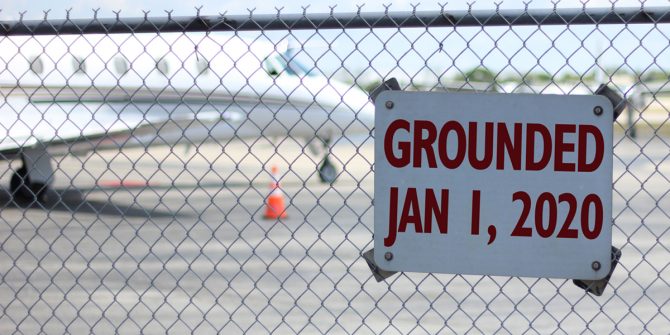
As of January 1, 2020, all aircraft operating within most US airspace are required to transmit certain information using ADS−B OUT avionics.

Briefly, ADS-B OUT transmits information from the aircraft to ground stations or satellites whereas as ADS-B IN avionics receives information from ground stations or satellite based systems.

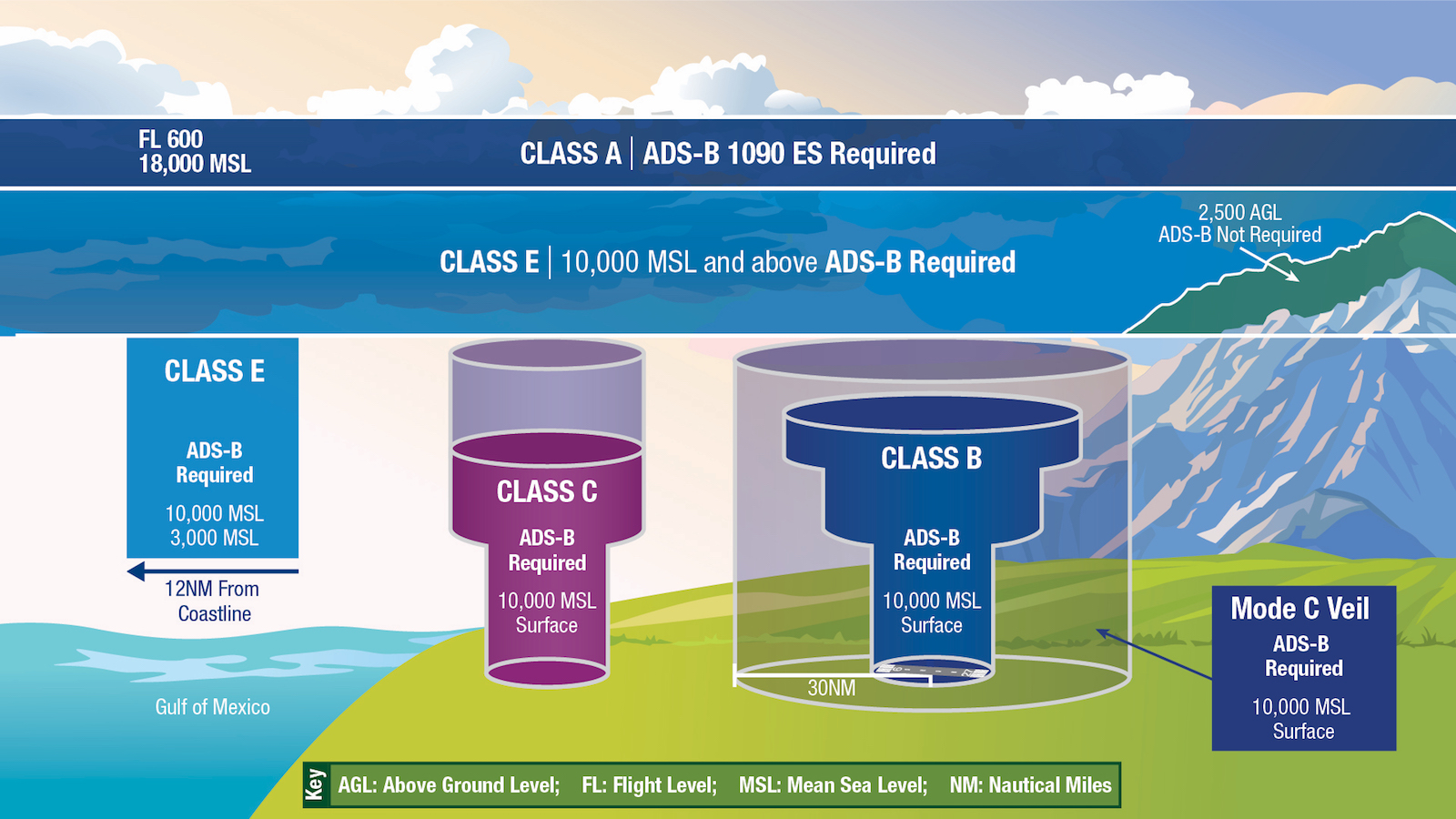
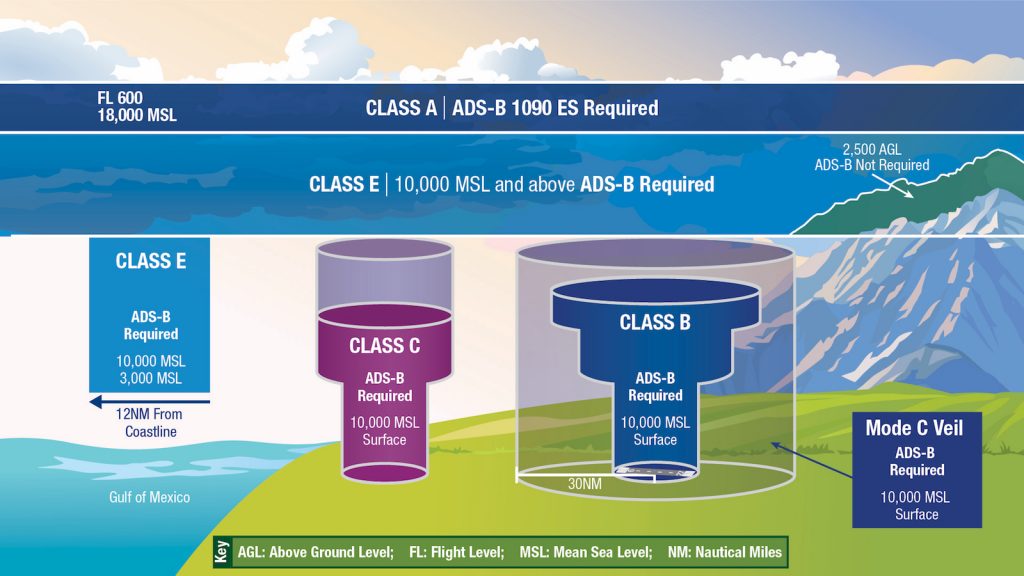
The ADS-B required airspace in the US includes everywhere Mode C is required AND:

  • Class A, B and C airspace, Class E at or above 10,000’ MSL (but not below 2,500’ AGL).
  • Within 30nm of Class B (Mode C veil).
  • Above the ceiling and within lateral boundaries of Class B and C up to 10,000’.
  • Class E over Gulf of Mexico, at and above 3000’ MSL within 12 nm of US coast. The non-contiguous US is also included: Hawaii, Guam, Puerto Rico and Alaska.
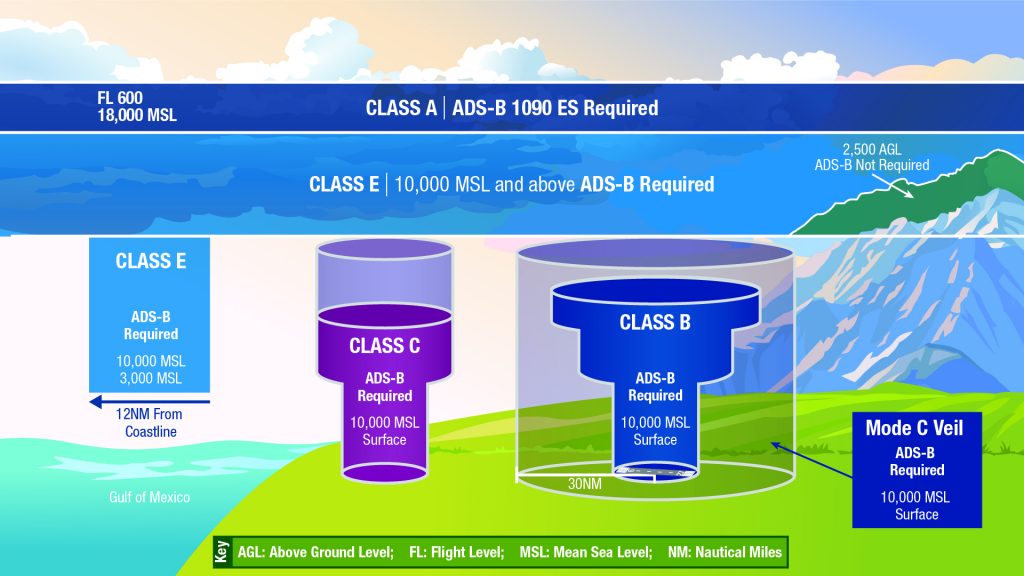
Also, according to the US AIM, operators flying at 18,000 feet and above will require equipment which uses 1090 ES (extended squitter). Those that do not fly above 18,000 may use either UAT (Universal Access Transceiver) or 1090ES equipment. For international operations 1090ES is by far the most accepted system.

Here’s the operational stuff…

For the most part you may notice very little change from radar controlled airspace and there may be no ADS-B specific controls in your cockpit.

During flight you may encounter ADS-B specific phraseology. Instead of the word ‘radar’ you may hear ‘surveillance’ as in ‘Surveillance service is terminated’. Another example would be ‘Pressure altitude is invalid’ instead of the previous ‘Mode Charlie is invalid’.

Failures may be dealt with differently depending upon avionics installations so check your manuals for any specific procedures. One example is if your left side GPS fails and you are using your number 1 transponder then ADS-B may loose data input therefore select transponder number 2 to continue ADS-B data transmission. There may be no indication of the ADS-B failure in the cockpit.

In the US, the operator is required to fly a route that has ADS-B service availability so the FAA has provided an ADS-B Service Availability Prediction Tool (SAPT) which should be used not more than 24 hours prior to the planned departure to ensure the planned route has ADS-B coverage. If there is an ADS-B outage along your planned route you must plan another route. Make sure your flight planning provider is doing this!

Flight planning codes are important as this is the only way that ATC knows you are properly equipped and authorized. The FAA’s InFO 15015 has good information on filing correctly. There are numerous codes for ADS-B equipment based on your specific installation of 1090MHz ES, UAT and/or VDL mode 4.

The FAA encourages the reporting of ADS-B surveillance malfunctions (AIM 4-5-7 f.). You can do this by phone or radio to the nearest Flight Service Station.

What if I don’t have ADS-B installed right now?

If you still don’t have ADS-B, your options aren’t great. The FAA spells it out in the Federal Register, but simply put, you must receive authorization from ATC to fly before every flight that is planned in ADS-B required airspace.

To do that, you have to use the new ADS-B Deviation Authorization Preflight Tool (ADAPT) that the FAA has developed – which allows you to request authorisation to fly from ATC. Do this online, at least one hour but not more than 24 hours before your flight. AOPA give this advice: “Don’t call the ATC facility to ask, and don’t request access from a controller over the radio – the answer will be no. Only if your ADS-B Out hardware fails in flight will controllers be able to issue an airspace authorization to an airborne aircraft.”

The word from the NBAA is that there is no planned relaxation of the ADS-B rules, so operators who have not equipped will be at the mercy of ATC for every single flight planned through ADS-B airspace. ATC might not be able to grant authorizations for a variety of reasons, including workload, runway configurations, air traffic flows, and weather conditions.

What are the ADS-B rules in the rest of the world?

ADS-B usage is expanding in many countries at different rates. We have compiled a list below of countries and requirements.

Mandates now in effect…

Australia: Requires ADS-B for operations at or above Flight Level 290. Foreign aircraft can operate without ADS-B below FL290 until June 2020. Check AC 21-45 for more info.

Hong Kong: The AIP GEN 1.5.3 states: All aircraft flying within Hong Kong FIR at or above F290 shall be installed with ADS-B. This requirement has been in place since December 2014!

Taiwan: In Jan 2020, ADS-B became mandatory for all aircraft operating within the Taipei FIR, at or above FL 290. Check our article for more info.

Vietnam: Since July 2018, Vietnam has required aircraft over MTOW 15,000kg to have ADS-B. But from 1st Jan 2020, this limit was brought down to apply to all aircraft over 5,700kg. Aircraft without ADS-B can still operate through Vietnam’s airspace, but are restricted to the lower levels. AIC 08/16 has all the details.

India: The ADS-B mandate across Indian airspace outlined in AIP SUP 148/2018 was due to take effect on 1st Jan 2019, has got delayed to 1st Jan 2020 (as advised by Notam). This AIP supplement states that all aircraft flying on PBN Routes pretty much everywhere in Indian continental airspace at or above FL290 must carry serviceable 1090 MHz ES ADS-B transmitting equipment that has been certified as meeting the requirements.

United Arab Emirates: AIC 13/2019 published in Nov 2019 says “Operators are made aware that ADS-B OUT will be mandated from 01 January 2020 within UAE airspace.” That means you need ADS-B everywhere, at all flight levels!

Malaysia: As per AIC 03/2017, from 31 December 2019 you need ADS-B to be able to operate on airways N571, P628, L510, P627, L645 and P574 between FL 290 to FL 410.

Singapore: Since May 2018, ADS-B has been required for ops at or above FL290 on airways L642, L644, M753, M771, M904, N891, N892, Q801, Q802, Q803 and T611. Check the AIP ENR 1.8 Section 7 for details.

Indonesia: Since the start of Jan 2018, all aircraft flying in Indonesian airspace at or above FL290 needed to be equipped with ADS-B. Check our article for more info.

French Polynesia/Tahiti: The AIC PAC-P A 06/19 says that from 1 January 2019, aircraft flying above flight level 195 need ADS-B. Then from 1 January 2022, this will be required for all flight levels!

Upcoming mandates…

Europe: ADS-B will be required after 7 June 2020 for aircraft over 5700kg and flying faster than 250 knots and on an IFR flight plan. There will be some exemptions for older aircraft in Europe. Check this EASA doc for more info.

Seychelles: From 7 June 2020, you’ll need ADS-B to fly through the FSSS/Seychelles FIR. AIC 1/2019 applies.

New Zealand: The CAA proposed rule change would make ADS-B mandatory for all aircraft in controlled airspace below Flight Level 245 from 31 Dec 2021.

Saudi Arabia: ADS-B will be required in Class A and B airspace starting 1 Jan 2021. The way they’ve published this is confusing: the requirements are laid out in this GACAR Part 91 document, backed up by this Notam issued for the OEJD/Jeddah FIR:
A1871/19 – ADS-B OUT REQUIREMENT ENFORCEMENT DATE IN CLASS A AND B AIRSPACE AS PER GACAR PART 91.303 IN KINGDOM OF SAUDI ARABIA HAD BEEN CHANGED TO 1 JANUARY 2021 INSTEAD OF 1 JANUARY 2020. 31 DEC 19:15 2019 UNTIL PERM. CREATED: 31 DEC 19:30 2019

Mongolia: This one straight from the AIP SUP: From 17 June 2021 at 0000 UTC, all aircraft flying within the airspace of Mongolia above flight level 6150m must carry serviceable ADS-B transmitting equipment (Mode S Transponder and GNSS source position)… Whilst aircraft flying below flight level 6150m, the carriage of ADS-B equipment remain optional.

Mexico: A Circular issued by the Mexican CAA in Dec 2019 advises that the ADS-B requirement over airspace of Mexico has been delayed until 1 Jan 2022.

South Africa: The plan was to mandate ADS-B at or above FL290 from April 2020, but they have recently issued a draft AIC that says this will be delayed to 15 June 2023.

Canada: In Nov 2019, Nav Canada announced it was delaying its 2021 ADS-B mandate. No new date has been set yet. So although ADS-B will be used for surveillance in Class A airspace (i.e. above FL180) from 25 Feb 2021 onwards, it won’t be mandatory for aircraft to be equipped.

Sri Lanka: Not mandated yet, but something’s in the pipeline. The CAA states on their website: “This is to inform all aircraft operators operating in Sri Lanka airspace (Colombo FIR) that ADS-B trial operations have been commenced and in the near future it will be fully operational covering the entire Sri Lanka sovereign airspace and extending the surveillance coverage of Colombo FIR further.”

Any countries we missed? Let us know!


Regulatory deadlines on the horizon

Regulatory compliance – nothing quite warms the heart like reading those two words, side by side. This year has seen quite a few changes in this department already (thank you, NAT HLA!), but here is a list of some other regulatory deadlines on the horizon…

Dec 31, 2019 – Operations in North Atlantic

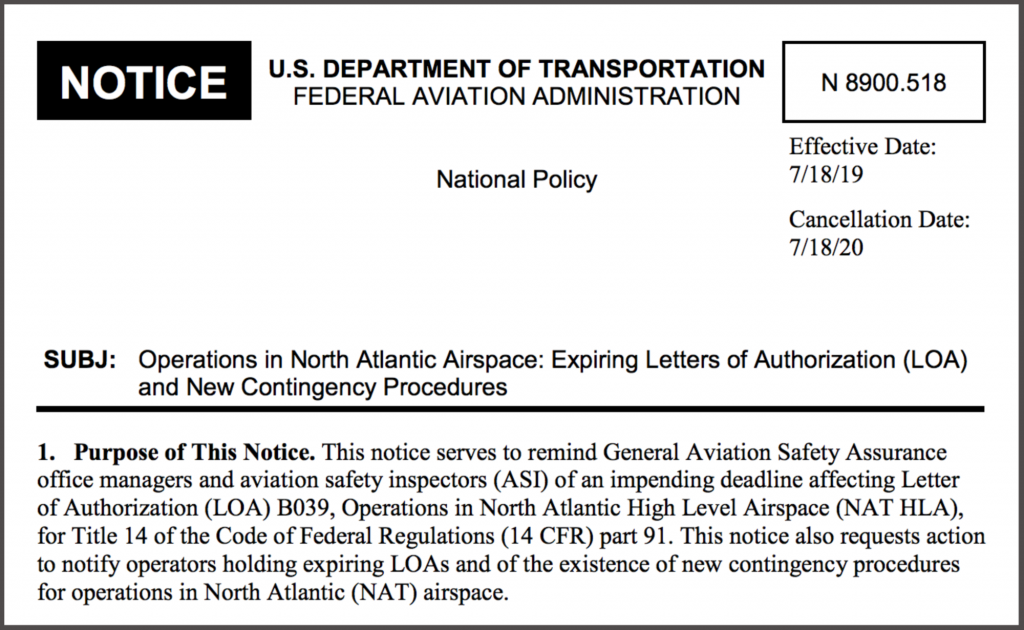
  • U.S. operators must have the revised LOA BO39: “Operations in North Atlantic High Level Airspace (NAT HLA)”. Operators holding the old MNPS LOA BO39 will not be permitted to fly in the NAT HLA beyond this date. Requirements include: RNP10, crew training and new contingency procedures incorporated in company operating handbooks. Read our article here.

Jan 1, 2020 – US ADS-B Out Mandate

  • ADS-B Out will be required where Mode C is required AND:
  • Class A, B and C airspace, Class E at or above 10,000’ MSL (but not below 2,500’ AGL).
  • Within 30nm of Class B (Mode C veil).
  • Above the ceiling and within lateral boundaries of Class B and C up to 10,000’.
  • Class E over Gulf of Mexico, at and above 3000’ MSL within 12 nm of US coast.

Jan 30, 2020 – Expansion of Datalink Mandate in the North Atlantic

  • Phase 2C of North Atlantic Datalink Mandate. FANS 1/A CPDLC and ADS-C will be required between FL290-FL410 throughout the entire NAT region (previously FL350-390). Read our article here.

Feb 5, 2020 – European Datalink Mandate

  • Initially legacy aircraft flying above FL290 in European airspace were to be equipped with CPDLC capability by Feb 2015. But due to equipage requirements and technical issues the mandate was delayed to Feb 2020, AND, even better, most GA/BA aircraft will be exempt from this. Read our article here.

June 7, 2020 – European ADS-B Out Mandate

  • Aircraft flying IFR in Europe with max certified takeoff weight of more than 5700kg (12,566lbs) OR max cruising TAS of more than 250kts must be equipped with ADS-B. GPS sensor with at least WAAS accuracy coupled to a 1090 Extended Squitter transponder required.


DELAYED:

Canada: ADS-B Out Mandate

  • This was planned to be implemented in Class A airspace from Feb 2021, and Class B airspace from Jan 2022. But Nav Canada has now postponed this mandate. They still plan on using ADS-B for surveillance, and this will be used on a priority basis for suitably equipped aircraft starting in 2021, but they say – “non ADS-B Out equipped aircraft will be accommodated within the airspace until a performance requirements mandate can be implemented.”

ALSO ON THE HORIZON:

August 14, 2020 – EU: SAFA Ramp Checks & Pilot Mental Health

  • EASA regulations requiring alcohol testing during ramp checks will take effect across all SAFA participating countries (although some countries have already started doing this: Austria, Belgium, Czech Republic, France, Germany, Greece, Iceland, Ireland, Italy, Netherlands, Portugal, Spain, Switzerland, UK, and Singapore). Tests may also be carried out by local police at any time.
  • All pilots working for European airlines will have access to mental health support programs.
  • European airlines will perform a psychological assessment of their pilots before the start of employment.

Any other biggies that we missed? Let us know!


Rockwell GPS fix coming soon

A large number of operators have been affected this week by a software glitch in some Rockwell Collins GPS receivers. After a few days of head-scratching, the cause of the problem was tracked back to the receivers’ failure to compensate for the “leap second” event which happens once every 2.5 years when the US Government update their satellites – which they did on 9th June.

This meant that certain aircraft equipped with the affected GPS receivers suddenly started getting ‘ADS-B fail’ messages, which initially led to groundings of aircraft which did not have GPS on their minimum equipment lists (MEL).

In a note from Rockwell on Monday 10th June, they advise that the next scheduled update by the U.S. Government to the GPS constellation is set for Sunday 16th June at 0000Z. This is when things should start working again, but they are not guaranteeing this will definitely fix the issue. Rockwell told OPSGROUP it’s a ‘wait and see’ situation.

In the meantime, it seems as though all the affected aircraft have been identified, and you should know at this stage if yours is working or not. Some aircraft remain grounded because there is no MEL relief. Rockwell are advising those who have not powered on their GPS units since the 9th June should leave them switched off. Make sure to check the advice from your OEM – some are advising to pull the GPS circuit breakers to prevent further issues. 

Until the issue is fixed, many aircraft will be forced to fly non-RNP routes below FL280 and navigate VOR-VOR, or else remain on the ground.

For more on this, or if you have something to share, head over to the OPSGROUP forum.


The Impact of Space-Based ADS-B on International Operations

I can distinctly remember the build up to and roll out of GPS navigations systems. Like so many of us, I was excited to see this new technology integrated into my cockpit. The idea that I would have the capability to accurately determine my position anywhere in the world was exciting!

It’s hard to overstate the significance of GPS navigation on the international operation of aircraft, particularly when operating in oceanic airspace. Today we are about to reach a similar milestone that could be even more significant – the introduction of a Space-Based Automatic Dependent Surveillance Broadcast (SB ADS-B) monitoring system.

When SB ADS-B completes its deployment (scheduled 30 December 2018), we will achieve worldwide, pole-to-pole surveillance of aircraft. This goes beyond a pilot knowing his or her own location. This opens up the ability for ATC to locate any ADS-B equipped aircraft anywhere in the world. With the US and EU ADS-B requirements approaching in 2020, aircraft that operate internationally will almost certainly be ADS-B equipped.

A brief history of Space-Based ADS-B

SB ADS-B technology has been placed into service by a commercial company, Aireon, and not a governmental entity, which has enabled it to be brought to operational status in a much shorter timeline than most other government implementations.

Although Aireon was initially established in 2012 to provide civilian surveillance services, the disappearance of Malaysia Flight 370 changed the industry. The inability to locate the aircraft forced industry regulators to consider how improved aircraft tracking might have helped to resolve the location of the aircraft in distress and prevent a future disaster. In response to this concern, ICAO created a standard for aircraft tracking designated as the Global Aeronautical Distress Safety System (GADSS). Aireon responded by creating a low-cost tracking solution based on aircraft ADS-B equipage utilizing the SB ADS-B network to meet that tracking requirement faster and cheaper than many of the alternatives.

This implementation takes advantage of the same ADS-B 1090ES systems already installed in most aircraft, not requiring any additional investment or modification from operators who currently comply with ICAO ADS-B approved 1090ES systems. Compare this to the evolving and evasive FANS 1/A+ requirements that have placed many operators in the position of having to upgrade aircraft (at great expense) only to find they are not PBCS and/or U.S. domestic compliant. Quite a contrast.

What are the benefits?

The primary advantage of the introduction of surveillance into oceanic operations will be a reduction in separation. Initially, this will be applied to in-trail spacing (longitudinal separation) and potentially reduce that separation to as close as 14 Nautical Miles (NM). The current longitudinal standard for data link approved aircraft is 5 minutes or approximately 50NM. The introduction would significantly increase the capacity of the most fuel-efficient routes and altitudes. The trial implementation is not expected to be restricted to specified tracks or altitudes, just between properly equipped aircraft.

Another key advantage of SB ADS-B is that the system is based on an active constellation of 66 low earth orbit satellites with geo-synchronous orbits that provide worldwide coverage. The system will also have 9 backup satellites available in orbit as well. The information on worldwide aircraft location will be in the system, it’s just a matter of having it sent to ATC control panels that are properly equipped to display the information. The SB ADS-B system operates independently from the ADS-B ground stations and can provide a direct data feed to air navigation service providers (ANSPs).

The primary targets for Aireon SB ADS-B services are ANSPs such as the FAA, EASA, Africa’s ASECNA, South Africa, New Zealand, Singapore, etc. This brings tremendous value to areas like Africa and Southeast Asia where ANSP’s face unique challenges involving infrastructure. Placing a network of ground-based ADS-B receivers in remote areas can expose them to vandalism or theft. As an example, a recently installed ILS system in Benin, Nigeria was stolen!

What does my aircraft need to be compliant?

In order for SB ADS-B separation reduction to be applied, aircraft will be required to be ADS-B and fully PBCS compliant. The controlling agency will determine eligibility based on the flight plan filing codes for ADS-B and PBCS. Let’s recall that the PBCS requires FANS 1/A+ approval with RCP240, RSP180, and RNP 4 capabilities. Just add ADS-B, NAT HLA, and RVSM equipage and approval and you’re ready! That is a lot of approvals, plus let’s not forget, TCAS Version 7.1 and Enhanced Mode S Transponder equipage is required as well.

Where will it be implemented?

Initial trial use of SB ADS-B for surveillance and separation will begin in Canada’s Edmonton Flight Information Region (FIR) in the first quarter of 2019. This will be followed by a planned trial launch in the North Atlantic (NAT) on 29 March 2019. The NAT oceanic surveillance trial program will be employed in both in Gander and Shanwick’s oceanic FIRs. Santa Maria will also introduce ADS-B separation standards, but that program will initially be limited to ground-based ADS-B operations.

We anticipate a mid-December 2018 release of a North Atlantic Ops Bulletin detailing the trial implementation which will be referred to as “Advanced Surveillance-Enhanced Procedural Separation” (ASEPS). This is to be followed by ICAO publishing the associated standards for ASEPS in a 5 November 2019 update to Procedures for Air Navigation Services – Air Traffic Management (PANS-ATM) Document 4444. This would move the ASEPS program beyond trial use and allow implementation of ASEPS based operations worldwide.

The final specifics involved in the trial program will be detailed in Canadian and United Kingdom Aeronautical Information Publications (AIPs), most likely involving a release of Aeronautical Information Circulars (AICs) to formally initiate the trial programs.

The NAT HLA does not anticipate requiring ADS-B for airspace entry but simply employing it as available. The impending U.S. and EU ADS-B requirements in 2020 will help ensure common equipage.

The introduction of ASEPS reduced separation standards in oceanic and remote regions will also impact contingency procedures for operators in the NAT HLA. To address this concern ICAO has created new contingency procedures for oceanic and remote operations which will also be identified in the November 2019 update to Procedures for Air Navigation Services – Air Traffic Management (PANS-ATM) Document 4444.

We expect the mid-December release of an additional North Atlantic Ops Bulletin detailing the trial implementation of these new contingency procedures in the NAT HLA airspace to be implemented with ASEPS. These new contingency procedures will initially only be used in the NAT HLA but, after the ICAO approval in November 2019, they may be implemented in other oceanic regions as well.

It would be important to note that the ASEPS target date for implementation, 29 March 2019, is also the target date for the expansion of the PBCS tracks in the North Atlantic Organized Track System. Add in the change in contingency procedures and that is a lot of moving parts, all happening at the same time, in the most congested oceanic airspace in the world.

One thing we don’t anticipate changing on March 2019 is strategic lateral offset procedures (SLOP). Changes may follow down the road but it’s not on the calendar now.

Let’s all get ready for a busy spring in the North Atlantic!

Mitch Launius is an International Procedures Instructor Pilot with 30West IP and can be contacted through his website: www.30westip.com


Australia ADS-B requirements: 2017 onwards

Last year Australia switched off most of its navaids, meaning that RNP became a requirement.

This year, they’re asking all aircraft flying in Australian airspace to be ADS-B equipped after February 2nd, 2017. ADS-B means that controllers can use your uplinked GPS position, instead of mammoth SSR Radar Units all over the country.

There are two exemptions:

  • Small Australian-registered GA aircraft
  • Foreign-registered aircraft with the restriction that you must fly below FL290 in continental airspace, and stick “RMK/NIL ADSB AUTH” into Field 18 of the Flight Plan.

You don’t need to apply for special authorisation, just show up.

References: