Mass evacuation of aircraft – Libya
Ops Alert – August 14, 2300Z
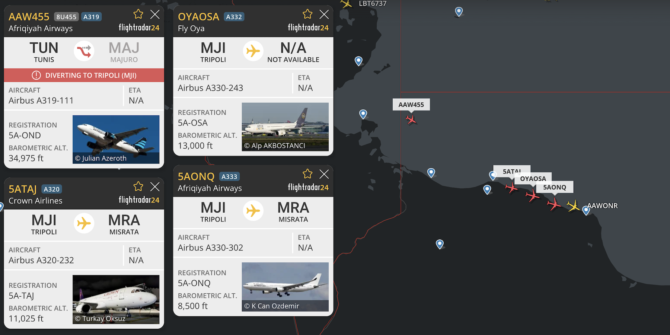
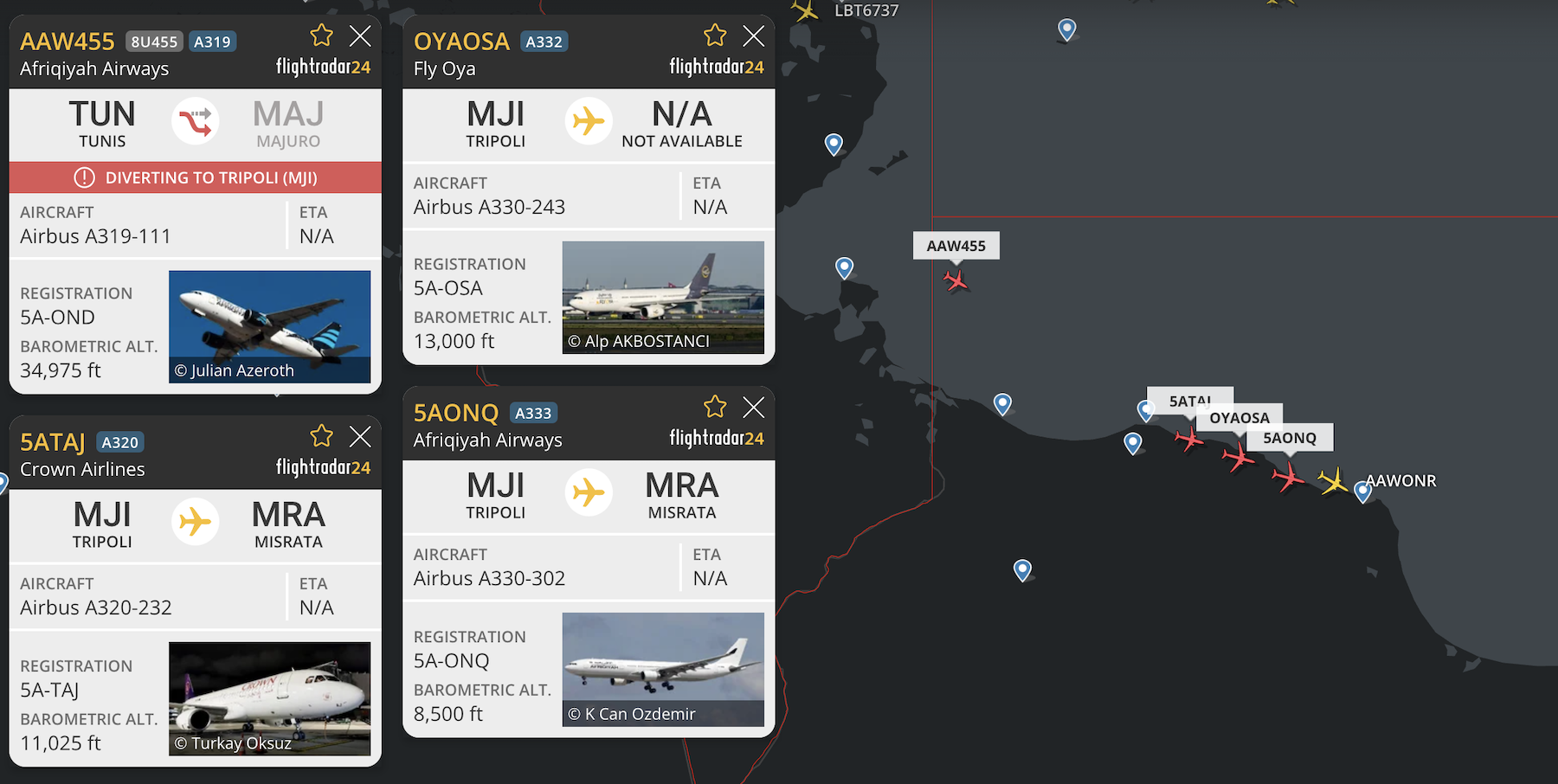
  • A mass evacuation of aircraft is taking place at the moment from Tripoli, including a number of A330 and A320 aircraft from both the largest carrier (Afriqiyah) and smaller operators. Inbound flights are also diverting, and the Libyan government aircraft, a King Air 350, is also being taken out of Tripoli. Almost all aircraft are being repositioned to Misrata (HLMS) – with approximately 25 aircraft being moved.
  • The reason for the evacuation is violent clashes involving gunfire taking place at Tripoli Mitiga airport (HLLM), as well as on road leading into Tripoli itself. Earlier on Monday night the head of ‘444 brigade’ that controls much of Tripoli, was detained at Mitiga airport by the Special Deterrence Force. The resulting risk to aircraft operations was deemed sufficiently high to begin the removal of aircraft to a safer location.
  • This situation highlights the instability of the security situation in Libya. With the airspace closure in Niger last week, routes over Africa have become very limited, and Libya/the Tripoli FIR may seem a tempting alternative.
  • Operators considering a Libya overflight should consider routings very carefully. This is the most significant aviation security event in Libya in the last few years, and highlights the ongoing risk to operations.
Refer to safeairspace.net/libya for the background, and ops.group/blog/2023-is-libya-safe-to-overfly-yet for more information.

A timely summary of the risk to civilian operators in the Tripoli FIR, from earlier in 2023, gathered by OPSGROUP from neighboring ATC units:

  • The ATM/CNS situation in the HLLL FIR is very basic and from our experience there are issues with communications and surveillance (or the lack of it).
  • There is a lot of military activity which is not always known to Tripoli and Benghazi ACCs also due to these communication and coverage issues.
  • There are still issues regarding coordination between the Tripoli and Benghazi ACCs. One seems to have certain rules which the other ignores. It is very frequent for example that either one or both reject overflights resulting in significant re-routings which we have to sort out (normally military flights) but not excluding civilian flights – sometimes even Libyan flights.
  • We see a lot of remotely piloted aircraft operating in the airspace which as far as we know are not operating in segregated airspace nor are they being controlled by the ATC units.
  • Only recently Libyan controllers went on a flash strike informing us that they cannot continue to handle the traffic with no radar equipment.
  • The AIS services are not functioning properly and the status of the airports is unknown.

Russian airspace closures escalate, aircraft diverting to exit

OPS ALERT – UUZZ/RUSSIA

A closing of Russian airspace to EU operators appears extremely likely in the coming hours.

In the last 24 hours, eight countries have denied Russian aircraft entry (UK, Poland, etc.). Each received a direct response by Russian NOTAM banning them in retaliation. Reports tonight from Germany indicate that the EU will close its airspace entirely as a block decision. Russia will respond.

Major carriers (KLM, DLH) have this evening turned aircraft around in flight to exit Russian airspace in anticipation. KLM confirms no operations into Russian airspace for at least 1 week.

Closures so far have been specific to scheduled operators but impact likely to spread. So far no closures directly targeting US operators, but avoiding Russian airspace is sensible given the uncertainty.


More on this in the Flight Ops channel

For the latest on this, head to the #Flight Ops channel on OPSGROUP Slack. We’ve just posted a copy of this alert there, and you can discuss and share updates on this specific topic with other members. The team will also post updates and further info there as we get news.

If you know more about this situation, please share an update in the channel, or email the team. Thank you!


FAA issues Emergency Order for Afghanistan (Updated)

On August 30, the FAA revised its Emergency Order for Afghanistan, with a new KICZ Notam.

Effective immediately, US operators and flight crew are prohibited from operating in the Kabul Flight Information Region (OAKX) at all levels. The FAA cites three specific risk factors: extremist/militant activity, limited risk mitigation capabilities, and disruptions to Air Traffic Services.

The main change is that flights to and from OAKB/Kabul airport are no longer exempt. 

Therefore the only exceptions are now as follows:

1. You can operate in the Kabul FIR (OAKX) if another US government agency authorizes it together with the FAA, or by way of “deviation, exemption, or other authorization” issued by the FAA Administrator. If you do plan to fly, you must call the FAA Operations Center in Washington.

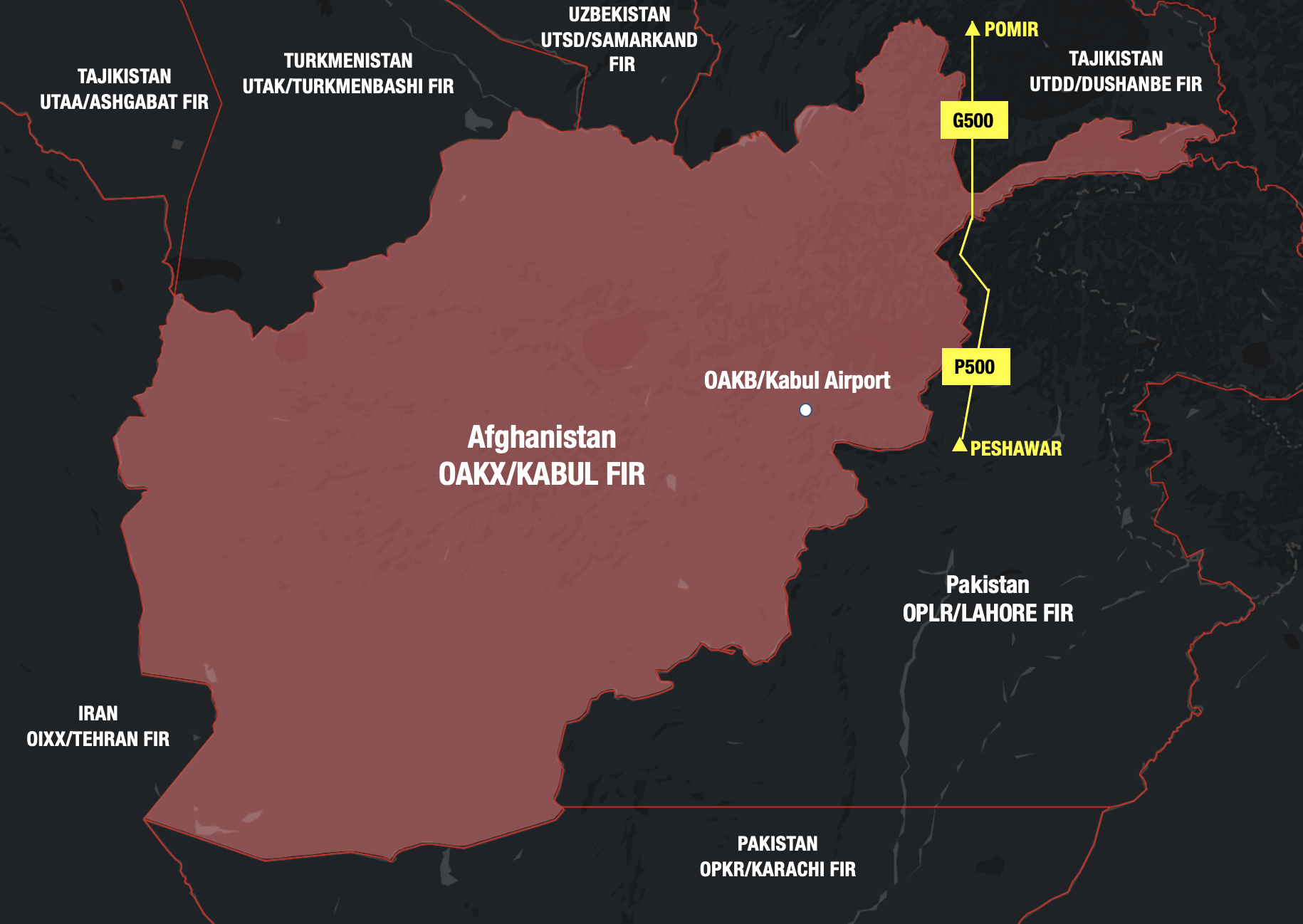
2. You can overfly on one airway: Use of airway P500/G500 is authorized for transiting overflights. (That airway cross the sliver of Afghan airspace in the east of Afghanistan between Pakistan and Tajikistan)

3. If you are experiencing an emergency.

The NOTAM is issued with permanent validity, and is presented in full below.

For further on Afghanistan, pilot and local situation reports, procedures, and assistance:

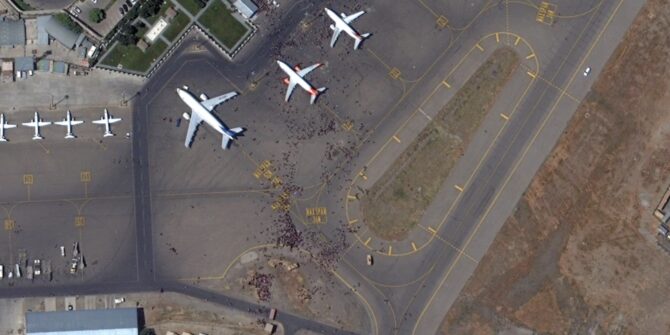
Satellite image via Washington post, Maxar Technologies 2021.


KICZ Notam A0029/21
Issued Aug 30, 1955 UTC
Valid until: Permanent

SECURITY..UNITED STATES OF AMERICA PROHIBITION AGAINST CERTAIN FLIGHTS IN THE KABUL FLIGHT INFORMATION REGION (OAKX)

THOSE PERSONS DESCRIBED IN PARAGRAPH A (APPLICABILITY) BELOW ARE PROHIBITED FROM OPERATING AT ALL ALTITUDES IN THE KABUL FLIGHT INFORMATION REGION (FIR)(OAKX), EXCEPT AS PROVIDED IN PARAGRAPH B (PERMITTED OPERATIONS) AND PARAGRAPH C (ALLOWANCES) BELOW, DUE TO THE RISK POSED BY EXTREMIST/MILITANT ACTIVITY, LACK OF RISK MITIGATION CAPABILITIES, AND DISRUPTIONS TO AIR TRAFFIC SERVICES.

A. APPLICABILITY. THIS NOTAM DOES NOT APPLY TO THE UNITED STATES DEPARTMENT OF DEFENSE. IT DOES APPLY TO: ALL U.S. AIR CARRIERS AND COMMERCIAL OPERATORS; ALL PERSONS EXERCISING THE PRIVILEGES OF AN AIRMAN CERTIFICATE ISSUED BY THE FAA, EXCEPT WHEN SUCH PERSONS ARE OPERATING U.S.-REGISTERED AIRCRAFT FOR A FOREIGN AIR CARRIER; AND ALL OPERATORS OF AIRCRAFT REGISTERED IN THE UNITED STATES, EXCEPT WHEN THE OPERATOR OF SUCH AIRCRAFT IS A FOREIGN AIR CARRIER.

B. PERMITTED OPERATIONS. THIS NOTAM DOES NOT PROHIBIT PERSONS DESCRIBED IN PARAGRAPH A (APPLICABILITY) ABOVE FROM CONDUCTING FLIGHT OPERATIONS IN THE ABOVE-NAMED AREA WHEN SUCH OPERATIONS ARE AUTHORIZED EITHER BY ANOTHER AGENCY OF THE UNITED STATES GOVERNMENT WITH THE APPROVAL OF THE FAA OR BY A DEVIATION, EXEMPTION, OR OTHER AUTHORIZATION ISSUED BY THE FAA ADMINISTRATOR. OPERATORS MUST CALL THE FAA WASHINGTON OPERATIONS CENTER AT 202-267-3333 TO INITIATE COORDINATION FOR FAA AUTHORIZATION TO CONDUCT OPERATIONS.

C. ALLOWANCES. USE OF JET ROUTES P500-G500 IS AUTHORIZED FOR TRANSITING OVERFLIGHTS.

D. EMERGENCY SITUATIONS. IN AN EMERGENCY REQUIRING IMMEDIATE DECISION AND ACTION FOR THE SAFETY OF THE FLIGHT, THE PILOT IN COMMAND OF AN AIRCRAFT MAY DEVIATE FROM THIS NOTAM TO THE EXTENT REQUIRED BY THAT EMERGENCY.

THIS NOTAM IS AN EMERGENCY ORDER ISSUED UNDER 49 USC 40113(A), 44701(A)(5), AND 46105(C).

ADDITIONAL INFORMATION IS PROVIDED AT:

HTTPS://WWW.FAA.GOV/AIR_TRAFFIC/PUBLICATIONS/US_RESTRICTIONS/

SFC – FL999, 30 AUG 19:55 2021 UNTIL PERM. CREATED: 30 AUG 19:59 2021


Risk Alert for North Korea (2/2020)

Risk Alert issued for North Korea:

North Korea has fired several missiles towards the Sea of Japan, according to South Korea’s military. No-one seems to know for sure if they were ballistic missiles (the ones that go up into space and then back down again, spraying debris all over international airways) or cruise missiles (the ones that fly at low altitudes making them hard to detect). Either way, they’re still launching missiles, and they’re still not providing any warning by Notam, and that = risk. Several countries have warnings in place for North Korean airspace, including the US which prohibits flights across the entire the ZKKP/Pyongyang FIR, including the oceanic part over the Sea of Japan. More info

For more details: https://safeairspace.net/north-korea/


Nationwide French ATC strike on Jan 9

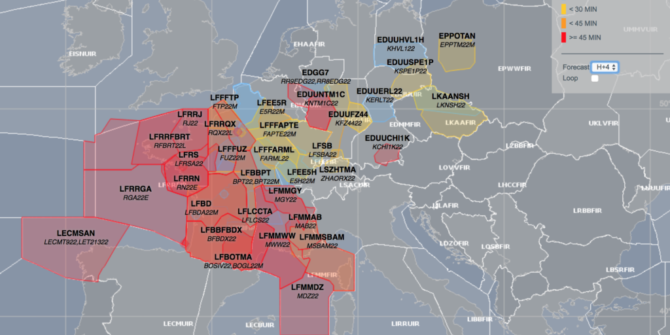
This week’s nationwide French ATC strike looks to be going ahead as planned. It will run from 1800z on Weds Jan 8, until 0530z on Friday Jan 10; but the worst of the delays will happen during the day on Thurs Jan 9.

At LFBO/Toulouse, airlines have been requested to reduce their scheduled flights by a third from 0500-2300z on Thurs Jan 9; but that’s the only airport which has issued this kind of restriction so far.

Eurocontrol’s Mitigation Plan can be found here.

We expect this strike will be much the same as the five French ATC strikes we had in December – big delays at the major airports and for overflights, busy Tango Routes with traffic avoiding French airspace in the west, and Algeria/Tunisia will most likely let you fly through their airspace without special permission if you want to avoid French airspace in the south.

For the latter, just make sure to add the right AFTN codes on flight plans! That means – as well as filing your FPL to the normal Eurocontrol addresses, you must also include those for Algeria (DAAAZQZX and DTTCZQZX) and Tunisia (DTTCZQZX and DTTCZRZX) – and make sure these are included for any subsequent DLA messages as well.

For real-time updates of any airspace issues once the strike has started, keep an eye on this handy French ATC webpage: http://dsnado.canalblog.com/

And check out our article for everything else you need to know about how to survive French ATC strikes!


Risk Alert for North Korea (12/2019)

Risk Alert issued for North Korea:

Germany has issued a new Conflict Zone Notam, valid through March 25, warning of the potential risk to overflights through North Korean airspace, due to the potential for launch of test missiles without prior notice. As a result, the Safe Airspace warning level for North Korea is now Level 2. The Notam comes as North Korea said it is planning a “Christmas gift” to the US, and the USAF believes this could be a long-range ballistic missile test. North Korea regularly launches short-range test missiles into the Sea of Japan, but halted its long-range tests after diplomatic talks with the US in early 2018. The US prohibits flights across all North Korean airspace, including the oceanic part of the ZKKP/Pyongyang FIR over the Sea of Japan.

For more details: https://safeairspace.net/north-korea/


Fifth French ATC strike of December happening this week

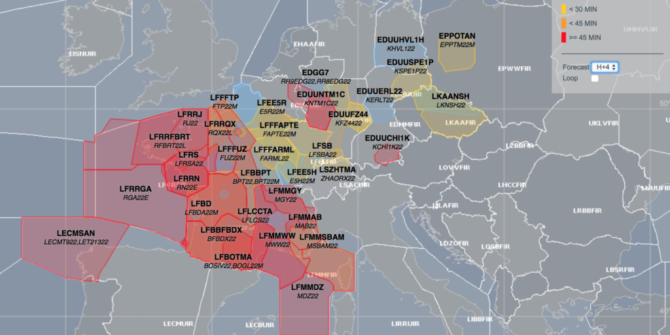
Another French ATC strike is planned for Thursday Dec 19 – the fifth strike so far this month! It starts from 1800z on Wednesday, and ends at 0530z on Friday, but the big delays should really only occur during the day on Thursday.

The airlines have not been requested to reduce their schedules so far.

The Tango Routes will be busy with traffic avoiding French airspace in the west, and you can route via Algerian/Tunisian airspace without special permission if you want to avoid French airspace in the south.

For the latter, just make sure to add the right AFTN codes on flight plans! That means – as well as filing your FPL to the normal Eurocontrol addresses, you must also include those for Algeria (DAAAZQZX and DTTCZQZX) and Tunisia (DTTCZQZX and DTTCZRZX) – and make sure these are included for any subsequent DLA messages as well.

Eurocontrol’s Mitigation Plan for this strike is here.

For real-time updates of any airspace issues once the strike has started, keep an eye on this handy French ATC webpage: http://dsnado.canalblog.com/

And check out our article for everything else you need to know about how to survive French ATC strikes!


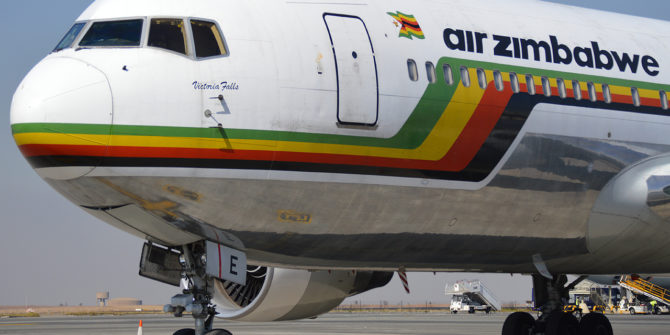
ATC in Zimbabwe at breaking point

The Air Traffic Controllers’ Association of Zimbabwe (ATCAZ) has raised concerns with the government over airspace safety.

They say that ageing equipment is mainly to blame, with loss of air-to-ground radio comms in the upper airspace now a common problem. There have been complete radio comms blackouts on four days this year.

ATCAZ also report that ATC staff are overworked; this was made apparent last week at FVRG/Harare airport when controllers who had worked the night shift refused to extend their hours in the morning, citing incapacitation and fatigue, forcing flights delays and cancellations.

It seems this particular incident provoked letters from ATCAZ to the Zimbabwe government to be leaked to local press, which detailed the long-standing concerns that obsolete ATC systems now pose an possible danger to airspace safety.

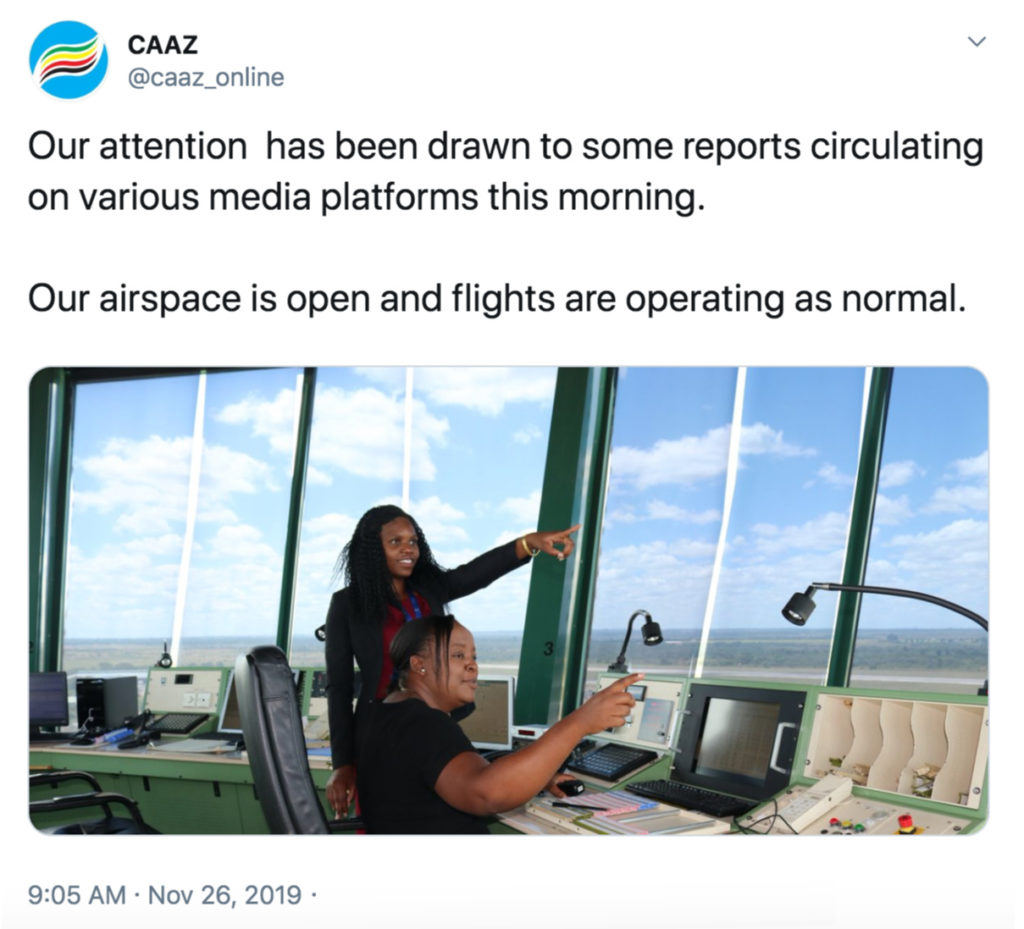
No word yet from the Zimbabwe CAA, except one tweet claiming that there’s no problem – “our airspace is open and flights are operating as normal,” they say.

The Zimbabwe government this week have said they are attempting to acquire a new radar system. Transport and Infrastructural Development minister Joel Matiza is quoted as saying – “CAAZ long identified the requirements for replacement of airspace management systems in 2013 which systems comprised air traffic control communications system, navigational aids systems, radar surveillance and aeronautical information management (AIM) systems. The authority is in the process of procuring the airspace management systems. The project implementation will be phased starting with the air traffic control system. The cost of the radar surveillance system is about US$22 million.”

Last week, IATA issued an updated version of their Inflight Broadcast Procedure (IFBP) guidance doc for Africa, having added FLFI/Lusaka to the list of FIR’s where this procedure should be applied. There’s no mention of Zimbabwe here, but it now appears that operators should prepare for degraded comms for flights through the FVHF/Harare FIR as well. Whatever new ATC systems the government may or may not install here, such things take time in this part of the world, so don’t expect any improvement any time soon.