Making a Ramp Check painless (with checklist)

The EU Ramp Inspection Program (RIP) is still alive and kicking – or the EU SAFA Programme, as it used to be called.

The RIP is not exclusive to Europe. Your aircraft can be inspected under the program in 49 different countries around the world, including Canada, Morocco, Singapore, and the United Arab Emirates.

Here are the key points:

  • Even though it’s now called the EU Ramp Inspection Program, ramp inspections for third country operators are still referred to as “SAFA ramp checks”. Yeah, it’s confusing.
  • Ramp checks are possible in every country in the world – but follow a more regulated and common structure in SAFA countries – totalling 49 – see the map and list below.
  • There is a standard checklist that is used by Inspectors in all SAFA countries, which you should be familiar with – see further down.
  • Three categories of findings have been defined. A “Category 1” finding is called a minor finding; “Category 2” is a significant finding and “Category 3” a major finding. The terms “minor”, “significant” and “major” relate to the level of influence on safety.
  • If there is a “corrective actions before flight authorised” finding – then the inspector is concerned and a repair must be made before the aircraft is released to fly.
SAFA

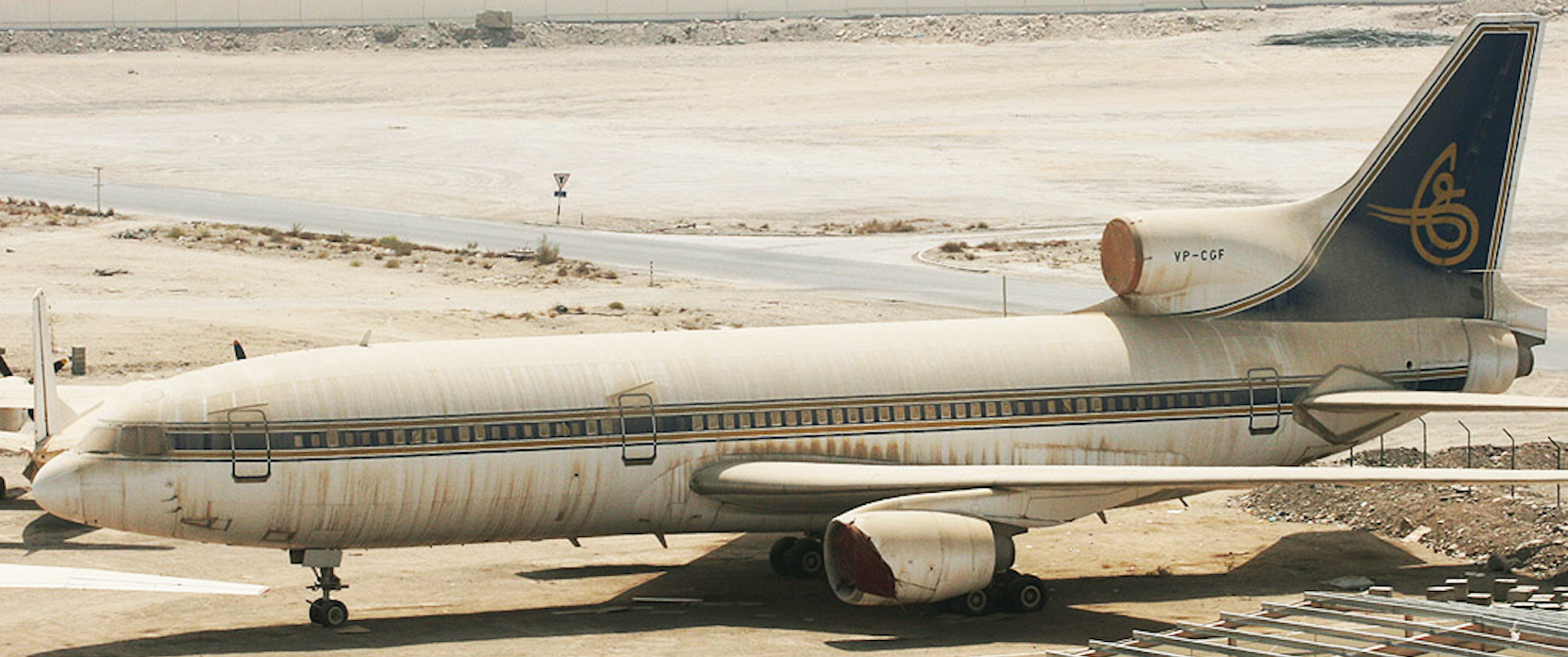
Unless your aircraft looks like this, you have little to worry about.

Here’s how a ramp check normally goes down:

  • The flight selected will either be your last of 6 legs for the day, or after a gruelling 12 hour jetlag-inducer, or at 3am when you were thinking about a quick nap during the turnaround. This much is guaranteed.
  • As you pull on to the stand, you will notice more yellow vests than normal hanging around.
  • Two of these will be your friendly ramp inspection team (to be fair, they almost always are)
  • A short time later, those yellow vests will be in the cockpit, and the first request will be for a look at your license, medical, aircraft documents (like Insurance, Airworthiness), and flight paperwork. Make sure you’ve done your fuel checks and there are a few marks on the flight plan.
  • If you get a good cop, bad cop scenario, one will disappear down the back (this will be the nice guy) and check the cabin, while the first will stay and ask you tough questions about the TCAS system.
  • Some time later, you’ll get a list of findings. The average check is probably about 30 minutes.
  • You can be guaranteed they will always have at least one finding – which will probably be obscure.
  • Sign off the checklist, and you’re on your way.

Some interesting points:

  • The Inspectors can ask you for manuals, documents, or guidance – but they are not supposed to test your knowledge of procedures, regulations, or technical matters. This doesn’t always happen in practice – so if you get a tough question – just say “I don’t know” – and let them note it if they want to. This isn’t a classroom test.
  • This guidance is given to Inspectors: Delaying an operator for a non-safety related issue is not only frustrating to the operator, it also could result in unwanted human factor issues with possible negative effects on the flight preparation. They can (should) only delay your flight for a safety related issue.
  • Remember, it’s not you that’s being inspected. It’s your aircraft. If you’re uncomfortable with the questions, get them noted and allow your operator to discuss later.
  • Every inspector is a little different. Work with them and you’ll find that 90% of your ramp checks will be over in 20 minutes with little issue.
  • Private Operators – especially in GA (even more so under the 5700kg mark) – are far less likely to get ramp checked. EASA guidelines do apply to General Aviation, but they are far more interested in Commercial Operators.
  • The items checked during ramp checks are based on a risk based approach and can differ from operator to operator (for example depending on findings raised during previous inspections). Meaning that operators who get ramp checked with findings will most likely get ramp checked again, to see if they’ve sorted out the problems!
  • EASA regulations requiring alcohol testing during ramp checks will take effect across all SAFA countries in Aug 2020. But some countries have already started doing this: Austria, Belgium, Czech Republic, France, Germany, Greece, Iceland, Ireland, Italy, Netherlands, Portugal, Spain, Switzerland, UK, and Singapore. More info

Common Findings:
See article: SAFA Ramp Checks: The Top 5 Offenders

Ramp checks cover 52 inspection items spread over 5 areas: flight deck, cabin, aircraft condition, cargo, and general/other.

But some of those 52 items generate more findings than others. A DSAC/IS-BAO study found that the top inspection items by number of CAT2 and CAT3 findings for business aviation were these ones:

1. Flight preparation (RI checklist item A13)
2. Mass and balance calculations (A14)
3. Manuals (A04)
4. MEL (A07)
5. Checklists (A05)
6. Defect notification and rectification (A23)
7. Navigation/instrument charts (A06)

So essentially, these findings all relate to five key areas: Flight Planning, Documents, Defects, Charts, Cabin Safety. Get these right, and your “sweatin over a ramp checkin” days are over, partner!

The Countries:
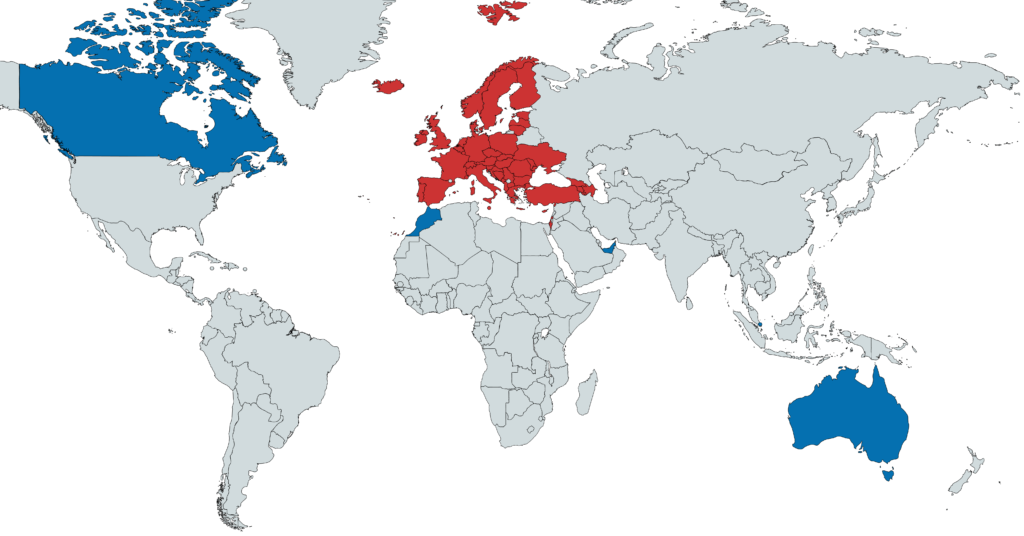
The 49 Participating States engaged in the EU Ramp Inspections Programme are:

Europe: Albania, Armenia, Australia, Austria, Azerbaijan, Belgium, Bosnia and Herzegovina, Bulgaria, Croatia, Cyprus, Czech Republic, Denmark, Estonia, Finland, France, Georgia, Germany, Greece, Hungary, Iceland, Ireland, Israel, Italy, Latvia, Lithuania, Luxembourg, Malta, Republic of Moldova, Monaco, Montenegro, Netherlands, Norway, Poland, Portugal, Romania, Serbia, Slovak Republic, Slovenia, Spain, Sweden, Switzerland, The Republic of North Macedonia, Turkey, Ukraine, and United Kingdom.

Rest of world: Canada, Morocco, Singapore, United Arab Emirates.

The Checklist:
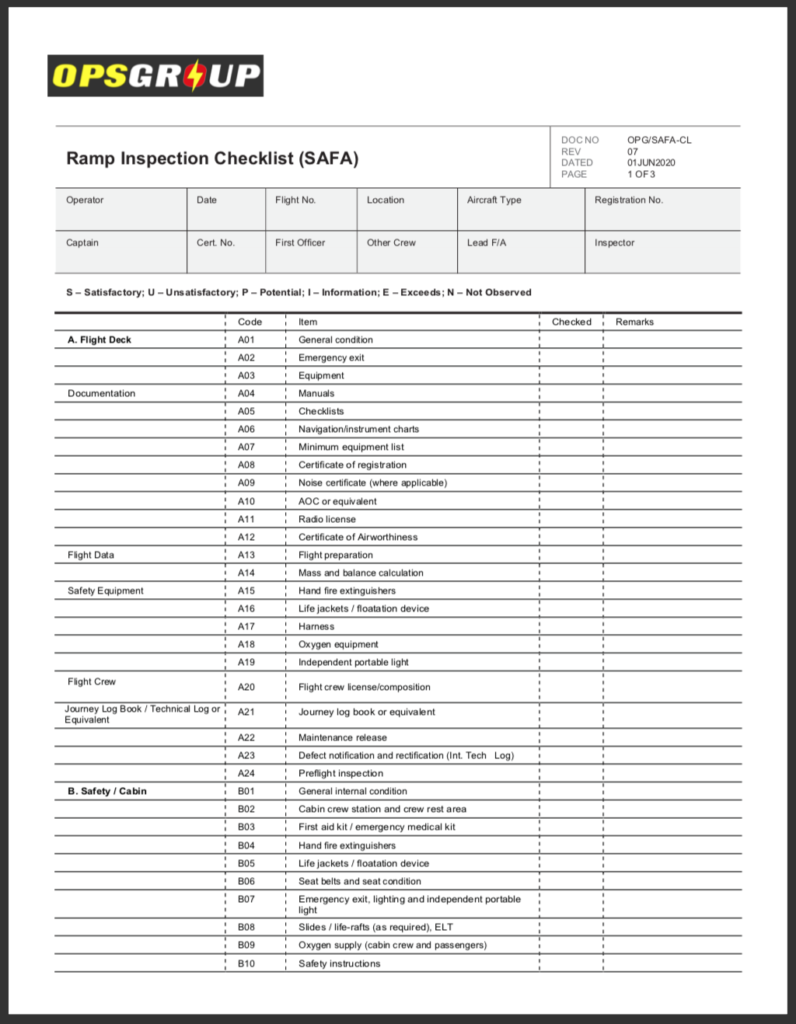
Download by clicking above, or here: Opsgroup Ramp Checklist

If you want to delve deep into each item on this checklist to find out exactly what inspectors should be looking for, check out this document published by EASA in Sept 2019, which has the inspection instructions in full. For all things Ramp Inspection Program related, check EASA’s dedicated webpage here.



International Ops Bulletin

Hey! Are you here for our World Famous International Ops Bulletin? The one where you get all this weeks new dangers and changes in International Ops? The one that 50,000 people read every week?

Cool. Here’s how to get it.

Every Wednesday, OPSGROUP issues a weekly International Ops Bulletin for International Pilots, Dispatchers, ATC, Regulators, Authorities, Airlines and Aircraft Operators.

We cover this weeks changes to International Flight Operations – Airports, ATC, Procedures, New rules, Visas, Airspace alerts, Weather issues, and warnings and dangers to international aviation.

You got choices:

  1. Get the free version. Grab a copy!
  2. Join OPSGROUP and get the full version.


Want to see a sample first?

Sure thing. It looks a little like this (click to open the full sample):


Fake Navigation fees are still a problem

It’s a concern: instead of sending your Nav Fees payment to Eurocontrol, you’ve actually sent it to some guy sitting in his underpants in his mother’s basement. And you’re not going to get it back.

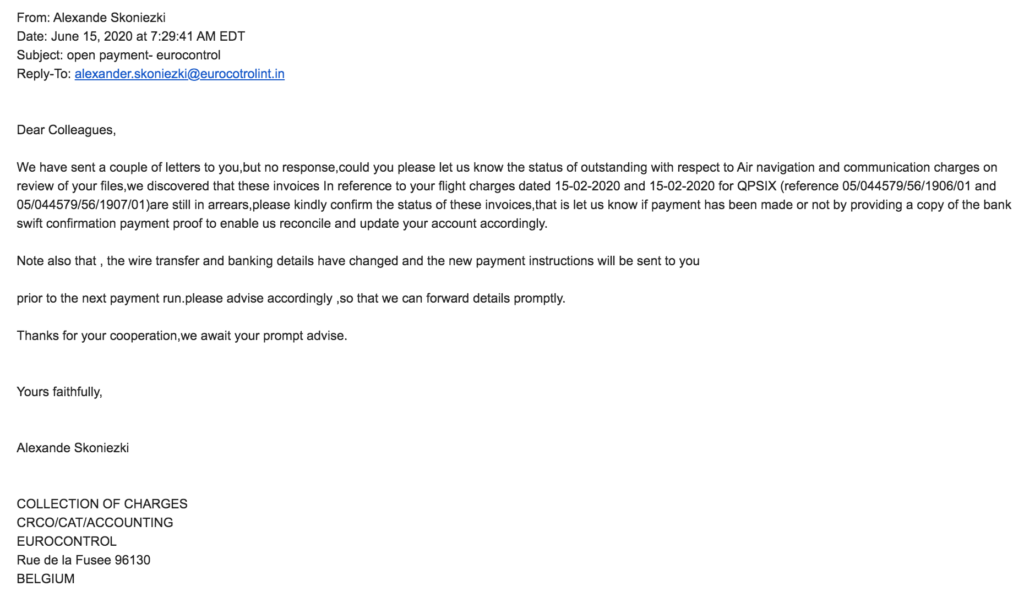
We’ve seen an increasing variety of scam emails, that at first glance look like they are from Eurocontrol – but aren’t. Here’s a good example from this week:

You’d be forgiven for glancing over it and responding to request the details of ‘their’ new bank account. And that’s where the problem begins – you’ll get a new bank account, only it won’t direct your money to Brussels.

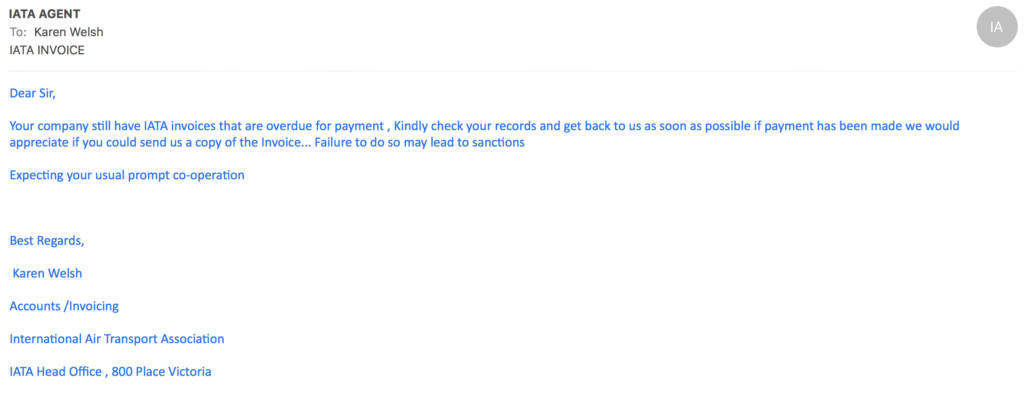
IATA has the same issue:

Fortunately, most of these emails are poorly written, and easy enough to identify as bogus – but that’s only if you are on your guard. The best solution is to simply be aware of the risk:

Eurocontrol

  1. Look at the sender address: real emails come from eurocontrol.int. Fake ones look similar, but might be something like @eurocontrolinc.com or @eurocontrolint.in.
  2. Most of the emails ask for a copy of an invoice or payment – be suspicious when you read that.
  3. Be especially alert when the email mentions a change in bank account. Eurocontrol has no plans to change bank accounts any time soon.
  4. Best advice: write to the real address: r3.crco@eurocontrol.int and ask for confirmation of any message, or call the Route Charges office on +32 2729 3838.
  5. The most secure way to handle Eurocontrol charges and payments is through their CEFA portal.

IATA

  1. Most recent fake addresses: invoice@iatahelpdesk.org, payments@iataaccounting.org
  2. Contact the real address: information.security@iata.org

The Air Charter Association have also warned that scammers have recently targeted business deals where operators charter out their aircraft to brokers. Similar to the fake IATA invoices scam, but more elaborate. Bottom line, if you’re chartering out your aircraft — or if you’re chartering one yourself — work with a reputable broker and triple-check all contact details (email addresses as well as phone numbers) and bank account details before pushing the button on any money transfers.

Even the mighty Japan Airlines fell victim to a targeted email scam back in 2017 which defrauded the company of JPY384 million yen – the equivalent of around USD $3.4 million. The airline received a series of emails purporting to be from a U.S. financial services company that had been leasing aircraft to Japan Airlines. Not realising it was scam, JAL promptly paid the money into a Hong Kong bank account, as requested. It was only later discovered to be fraudulent, when the genuine U.S. company demanded payment!

Have you been the target of similar scams? Let us know! – and we’ll add it to the list of dodgy email addresses and common scams.


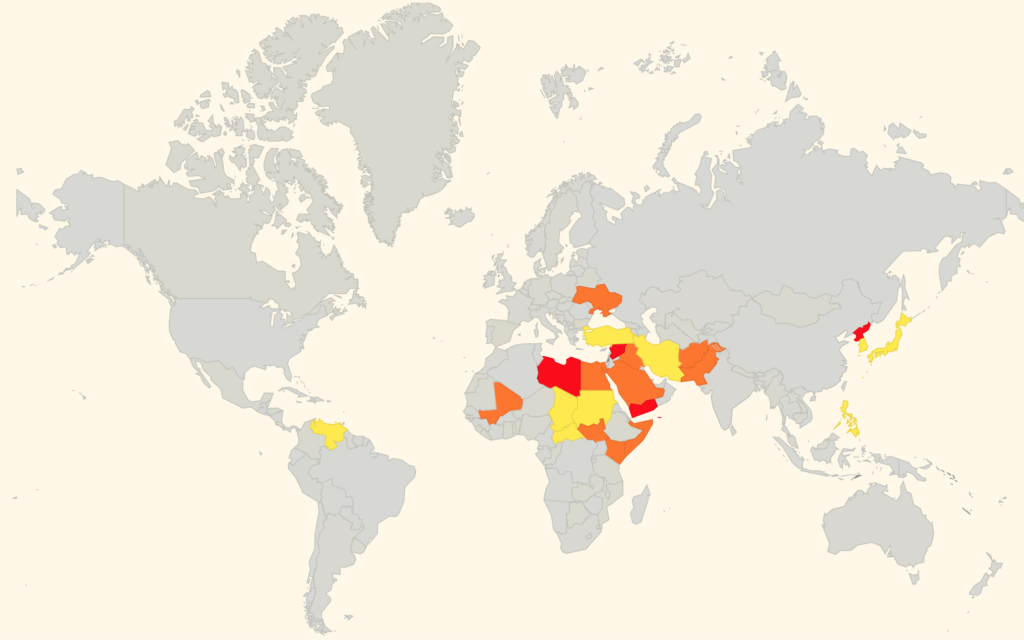
Risk Alert for North Korea (2/2020)

Risk Alert issued for North Korea:

North Korea has fired several missiles towards the Sea of Japan, according to South Korea’s military. No-one seems to know for sure if they were ballistic missiles (the ones that go up into space and then back down again, spraying debris all over international airways) or cruise missiles (the ones that fly at low altitudes making them hard to detect). Either way, they’re still launching missiles, and they’re still not providing any warning by Notam, and that = risk. Several countries have warnings in place for North Korean airspace, including the US which prohibits flights across the entire the ZKKP/Pyongyang FIR, including the oceanic part over the Sea of Japan. More info

For more details: https://safeairspace.net/north-korea/


Nationwide French ATC strike on Jan 9

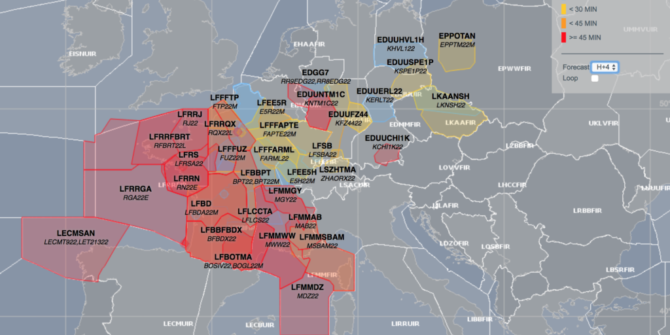
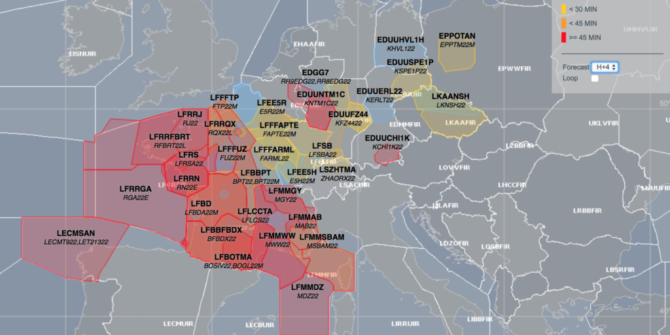
This week’s nationwide French ATC strike looks to be going ahead as planned. It will run from 1800z on Weds Jan 8, until 0530z on Friday Jan 10; but the worst of the delays will happen during the day on Thurs Jan 9.

At LFBO/Toulouse, airlines have been requested to reduce their scheduled flights by a third from 0500-2300z on Thurs Jan 9; but that’s the only airport which has issued this kind of restriction so far.

Eurocontrol’s Mitigation Plan can be found here.

We expect this strike will be much the same as the five French ATC strikes we had in December – big delays at the major airports and for overflights, busy Tango Routes with traffic avoiding French airspace in the west, and Algeria/Tunisia will most likely let you fly through their airspace without special permission if you want to avoid French airspace in the south.

For the latter, just make sure to add the right AFTN codes on flight plans! That means – as well as filing your FPL to the normal Eurocontrol addresses, you must also include those for Algeria (DAAAZQZX and DTTCZQZX) and Tunisia (DTTCZQZX and DTTCZRZX) – and make sure these are included for any subsequent DLA messages as well.

For real-time updates of any airspace issues once the strike has started, keep an eye on this handy French ATC webpage: http://dsnado.canalblog.com/

And check out our article for everything else you need to know about how to survive French ATC strikes!


Risk Alert for North Korea (12/2019)

Risk Alert issued for North Korea:

Germany has issued a new Conflict Zone Notam, valid through March 25, warning of the potential risk to overflights through North Korean airspace, due to the potential for launch of test missiles without prior notice. As a result, the Safe Airspace warning level for North Korea is now Level 2. The Notam comes as North Korea said it is planning a “Christmas gift” to the US, and the USAF believes this could be a long-range ballistic missile test. North Korea regularly launches short-range test missiles into the Sea of Japan, but halted its long-range tests after diplomatic talks with the US in early 2018. The US prohibits flights across all North Korean airspace, including the oceanic part of the ZKKP/Pyongyang FIR over the Sea of Japan.

For more details: https://safeairspace.net/north-korea/


Fifth French ATC strike of December happening this week

Another French ATC strike is planned for Thursday Dec 19 – the fifth strike so far this month! It starts from 1800z on Wednesday, and ends at 0530z on Friday, but the big delays should really only occur during the day on Thursday.

The airlines have not been requested to reduce their schedules so far.

The Tango Routes will be busy with traffic avoiding French airspace in the west, and you can route via Algerian/Tunisian airspace without special permission if you want to avoid French airspace in the south.

For the latter, just make sure to add the right AFTN codes on flight plans! That means – as well as filing your FPL to the normal Eurocontrol addresses, you must also include those for Algeria (DAAAZQZX and DTTCZQZX) and Tunisia (DTTCZQZX and DTTCZRZX) – and make sure these are included for any subsequent DLA messages as well.

Eurocontrol’s Mitigation Plan for this strike is here.

For real-time updates of any airspace issues once the strike has started, keep an eye on this handy French ATC webpage: http://dsnado.canalblog.com/

And check out our article for everything else you need to know about how to survive French ATC strikes!


ATC in Zimbabwe at breaking point

The Air Traffic Controllers’ Association of Zimbabwe (ATCAZ) has raised concerns with the government over airspace safety.

They say that ageing equipment is mainly to blame, with loss of air-to-ground radio comms in the upper airspace now a common problem. There have been complete radio comms blackouts on four days this year.

ATCAZ also report that ATC staff are overworked; this was made apparent last week at FVRG/Harare airport when controllers who had worked the night shift refused to extend their hours in the morning, citing incapacitation and fatigue, forcing flights delays and cancellations.

It seems this particular incident provoked letters from ATCAZ to the Zimbabwe government to be leaked to local press, which detailed the long-standing concerns that obsolete ATC systems now pose an possible danger to airspace safety.

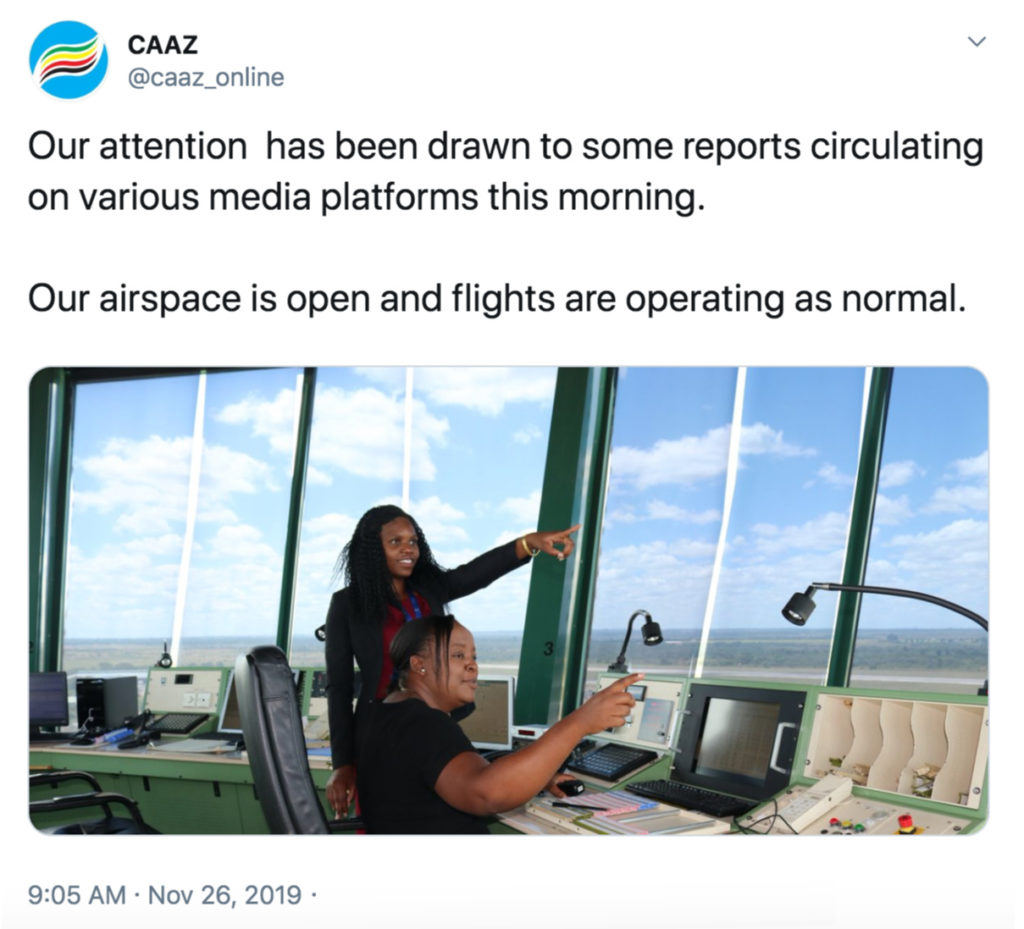
No word yet from the Zimbabwe CAA, except one tweet claiming that there’s no problem – “our airspace is open and flights are operating as normal,” they say.

The Zimbabwe government this week have said they are attempting to acquire a new radar system. Transport and Infrastructural Development minister Joel Matiza is quoted as saying – “CAAZ long identified the requirements for replacement of airspace management systems in 2013 which systems comprised air traffic control communications system, navigational aids systems, radar surveillance and aeronautical information management (AIM) systems. The authority is in the process of procuring the airspace management systems. The project implementation will be phased starting with the air traffic control system. The cost of the radar surveillance system is about US$22 million.”

Last week, IATA issued an updated version of their Inflight Broadcast Procedure (IFBP) guidance doc for Africa, having added FLFI/Lusaka to the list of FIR’s where this procedure should be applied. There’s no mention of Zimbabwe here, but it now appears that operators should prepare for degraded comms for flights through the FVHF/Harare FIR as well. Whatever new ATC systems the government may or may not install here, such things take time in this part of the world, so don’t expect any improvement any time soon.


Adios! That was our last International Bulletin (for non-members)

Dear Reader!

First, thanks for being part of this amazing group for the last year. We loved sharing our alerts, risks, dangers, and deviousness with you. It’s been a blast.

As we’ve mentioned, we’re now focusing our attention solely on Opsgroup members, so the International Ops Bulletin that you got yesterday was the last one for the year, and tomorrows Daily Brief will also be el final (sp? we’re good at Ops, not Spanish).

OK, so. Here’s the deal. We would like you, our favorite reader ever, to be part of this amazing group – 5000 airlines, pilots, dispatchers, airports, atcos, agencies, amazing-experts, analysts … the people that run international flight ops. Whatever the group is now, it’s going to be even more amazing – as we are adding in new contacts, better information, easier searching, and making it easier for members to connect with each other. We’ll continue the good fight against crappy circulars, mind-numbing mandates, awful AIC’s, nasty notams, and continue to remind the state bureaucrats that the people reading this stuff are Humans, not computers. We’ll continue to sniff out the security risks, and share them with those that need to know. And we’ll continue to basically make cool stuff – maps, charts, apps, guides, and winter ear-warmers – for the Opsgroup community.

We’ll also continue to manage the Clipperton FIR (ADS-B almost in place), keep adding things to Airport Spy, continue working with ICAO on Norm (he’ll be done for Christmas, we’re sure!), get SafeAirspace V2 online (coming December), and of course continue the hourly alerts, daily briefs, and weekly bulletins for members.

Bottom line, our request is that you join us! We need people like you to help this group. Put another way, we don’t want to continue without you.

Whatever your choice is, have a lovely day and rest of year, and let us be the first to wish you a happy Thanksgiving, and if we don’t see you until next year, Happy Christmas!

The Opsgroup Team – Ben, Cynthia, Igor, Dave, Dean, Slobodan, Amelia, Jamie, and Mark.

team@ops.group

PS –

If you prefer, you can also waitlist for 2019. Once we reopen membership, we may have a slightly different approval process, but you can add your name to be notified here.


NAT – Choose your own Adventure

For the latest changes and updates on the North Atlantic, including our most recent Guides and Charts, use our NAT reference page at flightservicebureau.org/NAT.

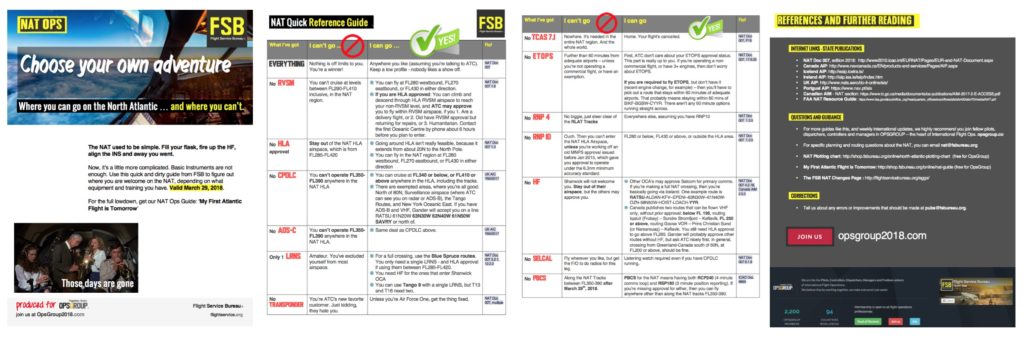
The NAT used to be simple. Fill your flask, fire up the HF, align the INS and away you went.

Now, it’s a little more complicated. Basic Instruments are not enough. Use this quick and dirty guide from FSB to figure out where you are welcome on the NAT, depending on what equipment and training you have. Valid for October 15, 2018.


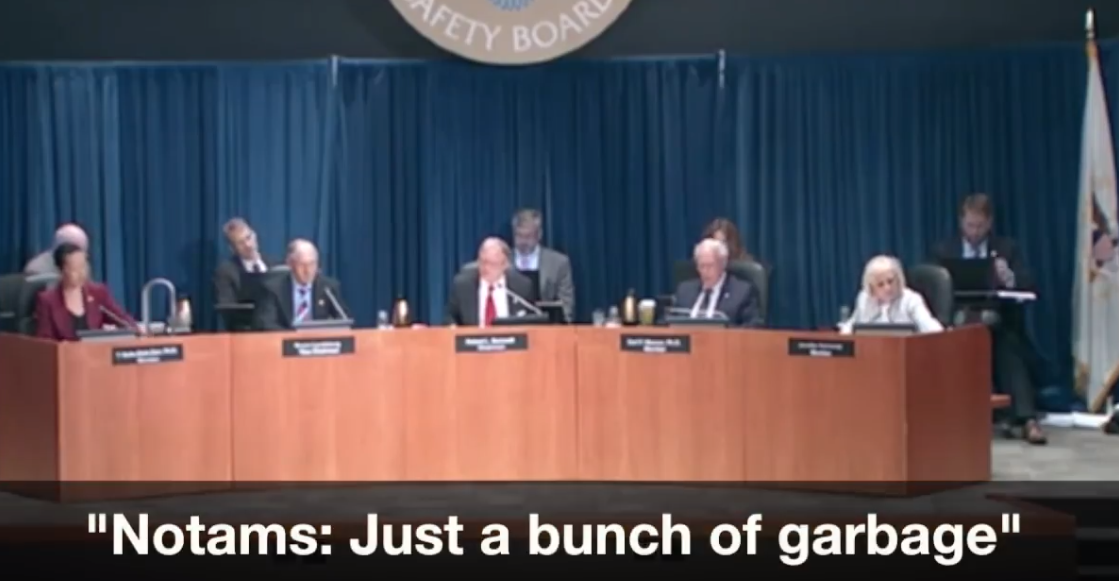
NTSB: Current NOTAM system is “just a bunch of garbage”

You were all very supportive when we wrote the initial article on the BS Notam problem last year, and have followed our journey in fixing the problem since then.

Big news!

The NTSB called the Notam System a bunch of garbage on Tuesday this week, and assigned probable cause of the AC759 incident in SFO to the Notams that were missed.


What this means to OpsGroup is massive fuel to our fire: we are working hard to fix this problem, and having a public facing government organisation like the NTSB come down like a ton of bricks on the Notam System drives us forward in leaps and bounds.

The group members have been decisive in helping us to identify the problem and taking action to fix this. So, we want to acknowledge all of you! Great work!

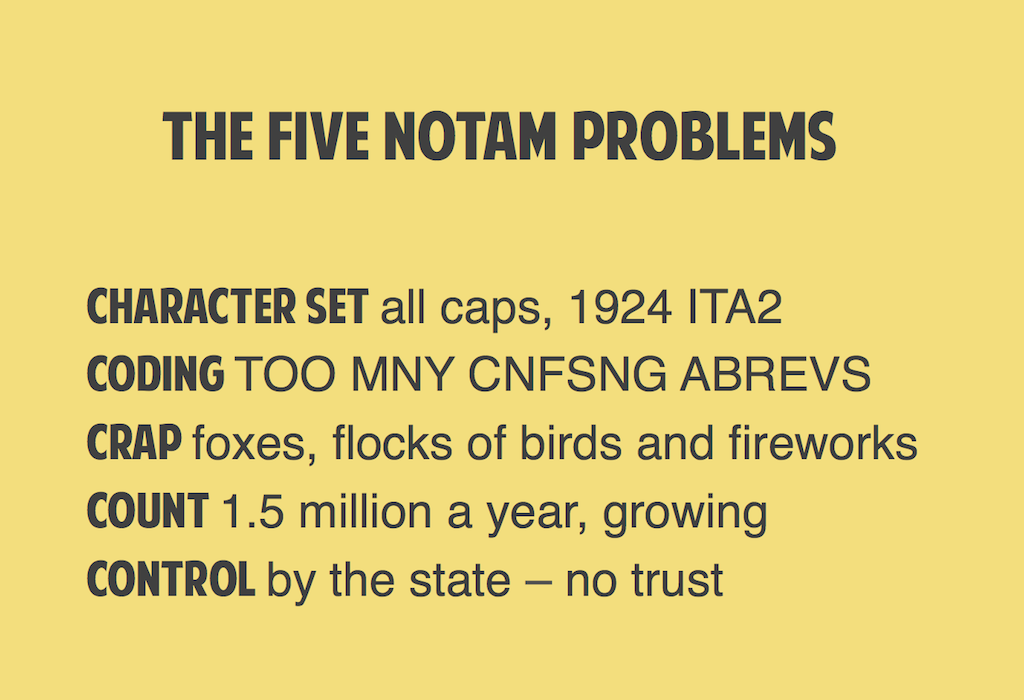
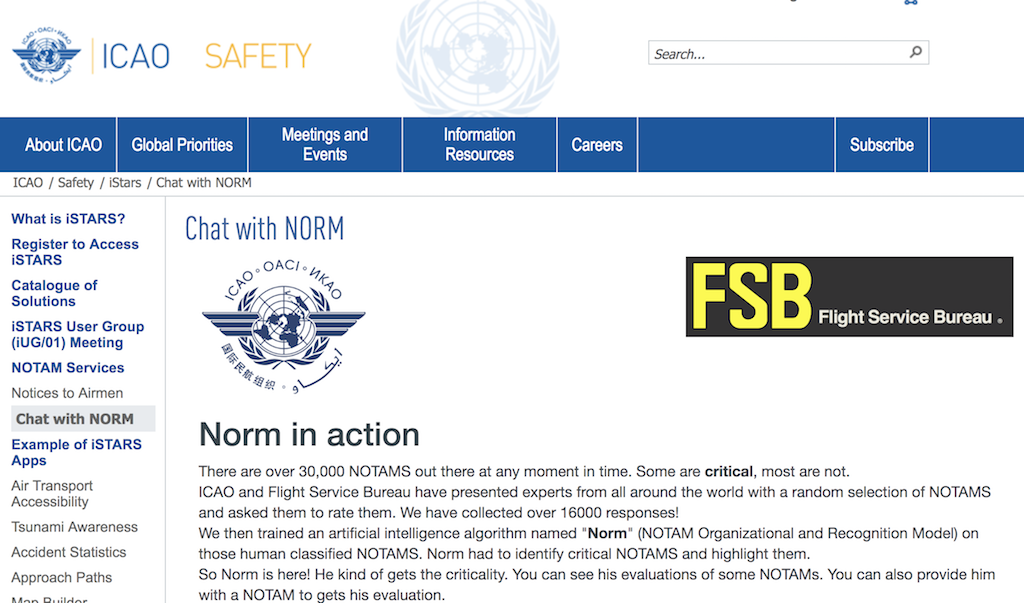
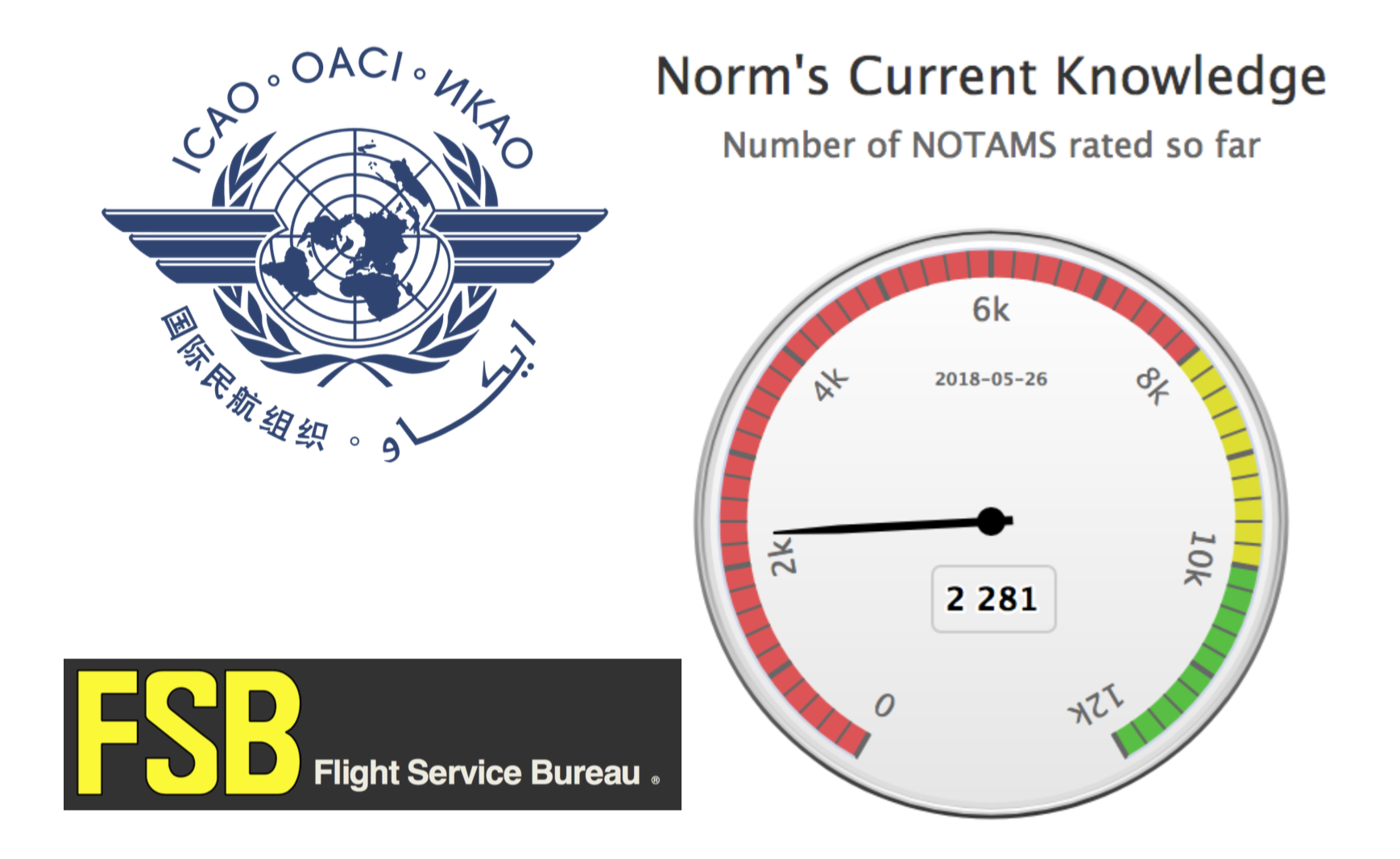
In solving two of the above five problems, we have been working with ICAO for several months now. You all got involved in Normand 17,000 Notams later, we happy to report that version 0.1 of Norm is now live on the ICAO website. Norm is a bot – an AI, that has learned what Notams look like, and thanks to OpsGroup rating these 17,000 Notams, is also learning which ones are critical and which ones are not.

He’s still young. He doesn’t get everything, but if you feed him a Notam you’ll see him assign it a criticality of 1-5.

This will in turn allow us to sort Notams, putting the most important stuff first.


US issues new guidance on Iran overflight risk

The FAA has published new guidance today on overflight risk for Iran, and the Tehran FIR (OIIX). The relationship between the US and Iran has soured in the past twelve months, since the last KICZ Notam and guidance was published. In May, when President Trump announced the withdrawal from the Nuclear deal, the Iranian parliament burned the US flag and shouted “Death to America”.

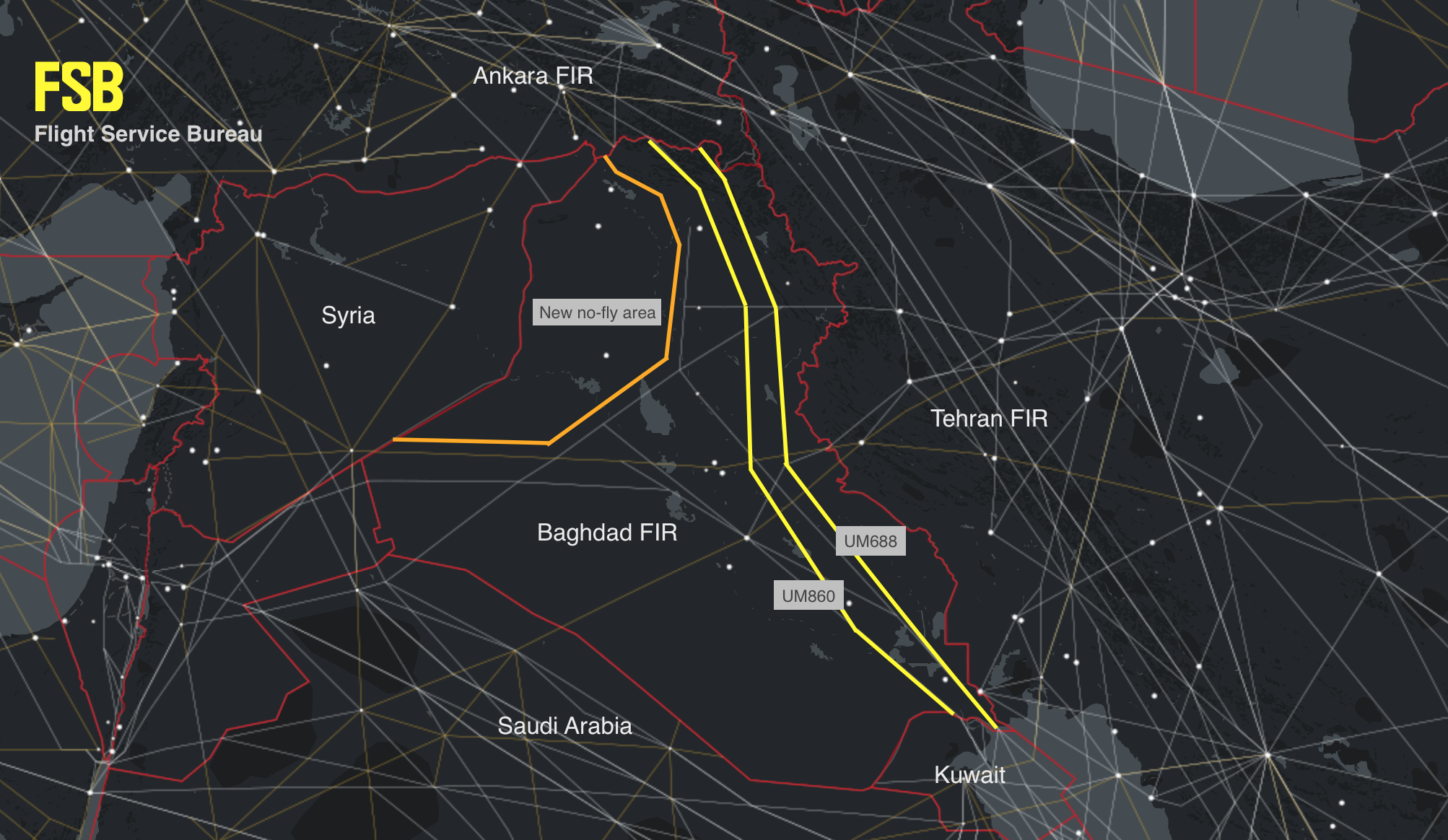
Without seeming alarmist, this relationship must be taken into account when planning flights through the Tehran FIR. Although the reopening of Iraqi airspace in November last year has provided additional routing options, our recent article London – Dubai, which way is best? shows that there is no perfect route in the region, and operators must consider their preference for Iraq vs Iran.

A new Notam for Iran, KICZ 16/2018 was published today, and contains new wording, rather than being an extension of the previous. The key message of the Notam is : “Exercise caution when flying into the Tehran FIR“.

In addition, new background guidance has been published in conjunction with the Notam, and these are the key new items:

  • There is concern for heightened Iranian air defense sensitivity and exercises as a result of regional instability and/or political tensions. Heightened Iranian air defense sensitivity may create an inadvertent risk to U.S. civil aviation operating in the Tehran FIR (OIIX)
  • A U.S. civil operator experienced a fighter intercept in the Tehran FIR (OIIX) in December 2017
  • There is the potential for Iranian surface-to-surface missile fire from western Iran, targeting Islamic State of Iraq and al-Sham (ISIS) positions located in the region (such as occurred in June 2017)
  • There is an inadvertent risk to U.S. civil aviation operations in the Tehran FIR (OIIX) from Iranian-fielded GPS jammers

We would add that if planning an overflight of the Tehran FIR, consider the risk from an unplanned landing – decompression, medical, engine fire – which may force you into Tehran or another airport – it’s a big chunk of airspace. The US State Dept currently advises: Do not travel to Iran due to the risk of arbitrary arrest and detention of U.S. citizens.

As always, we’d like to hear your thoughts and comments on this new information, overflying Iran, and Middle East risk in general. Comment below, or mail our team at comments@ops.group.

References

FAA Notam KICZ 16/2018 published Sep 9, 2018
FAA Background Notice on Tehran FIR published Sep 9, 2018
FAA Prohibitions, Restrictions and Notices (not yet updated)


New things in OpsGroup – gocrow, new alerts, Daily Brief, George 2, Foxes

Hello!

Summer – for those of us in northern parts, at least – is progressing, and so are we. I’m excited to tell you about a whole bunch of new things we’ve built for OpsGroup, to make your life easier (which is why you’re in the group in the first place, yes?)

Here’s the game changer: We’re starting to reach a point where you and your fellow members are reporting things to the Team every day, at a level that means we’re really covering most of the important operational news out there. Now, we are working on better ways for you to find it … read on.

Not a member yet? We LOVE welcoming new members to the group

Choose a plan – JOIN OPSGROUP

GoCrow

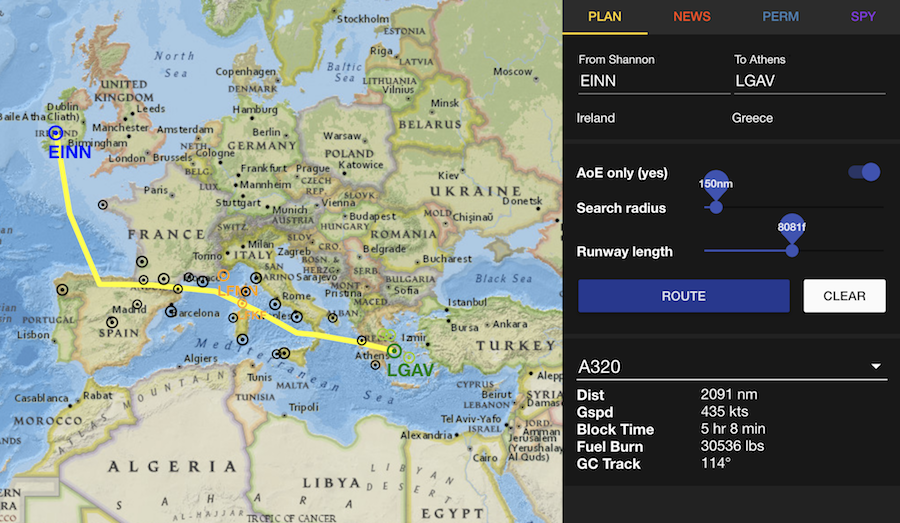
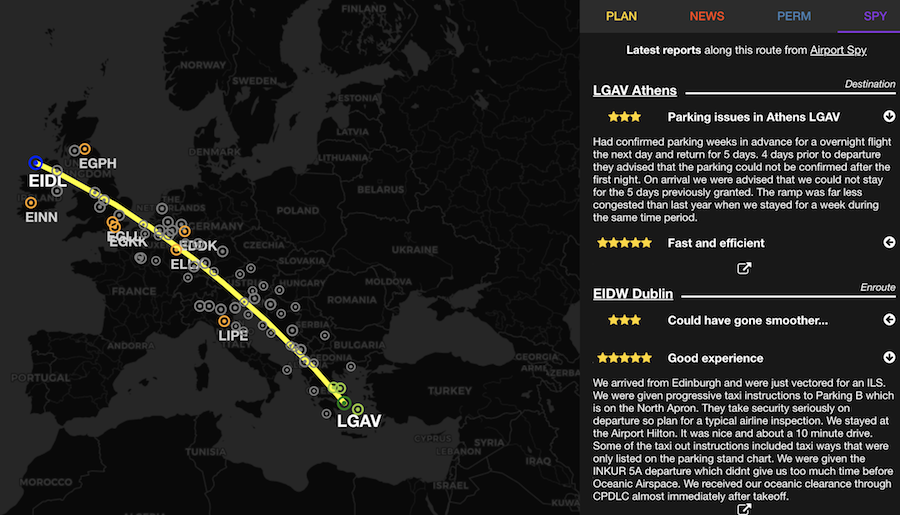
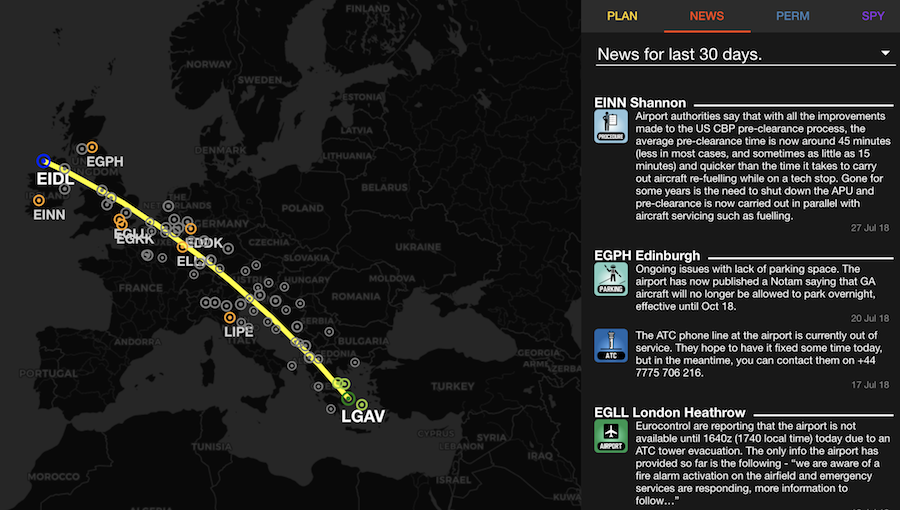
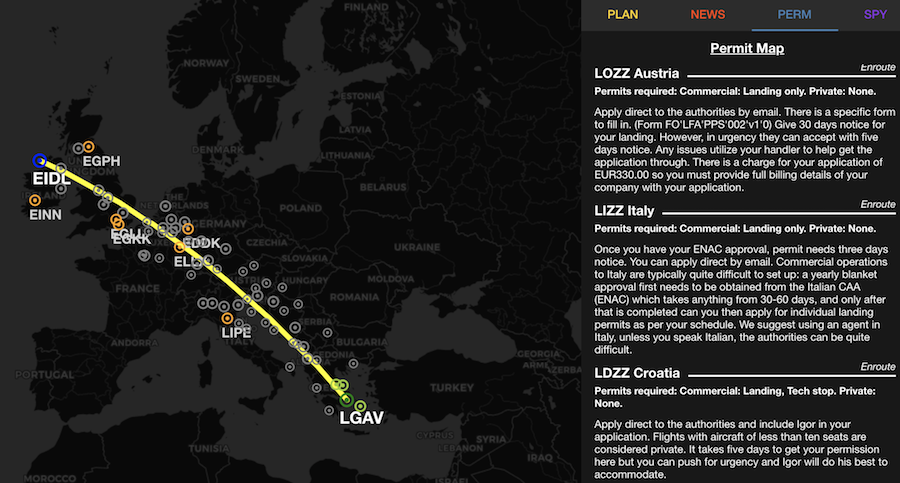
As the crow flies – pop in your departure and destination, and get all the information that we have for your route – Planning data – distances, times, fuel, Ops News and Alerts, Permit requirements, Airport Spy reports.

What’s new?

  • New tabs for NEWS, PERMITS, AIRPORT SPY
  • Sort News by last 7 days, 30 days, 3 months, year
  • Permit information for each country you overfly or pass near
  • Drag and change route – just click the yellow line, all info is recalculated
  • OPSGROUP Airport Spy reports along your route
  • Change underlays
  • now works on iPad
New underlay options, show different maps under your route (more coming).
Airport Spy reports are automatically pulled for your route.
Customized news report for your route.
Get country by country permit information.

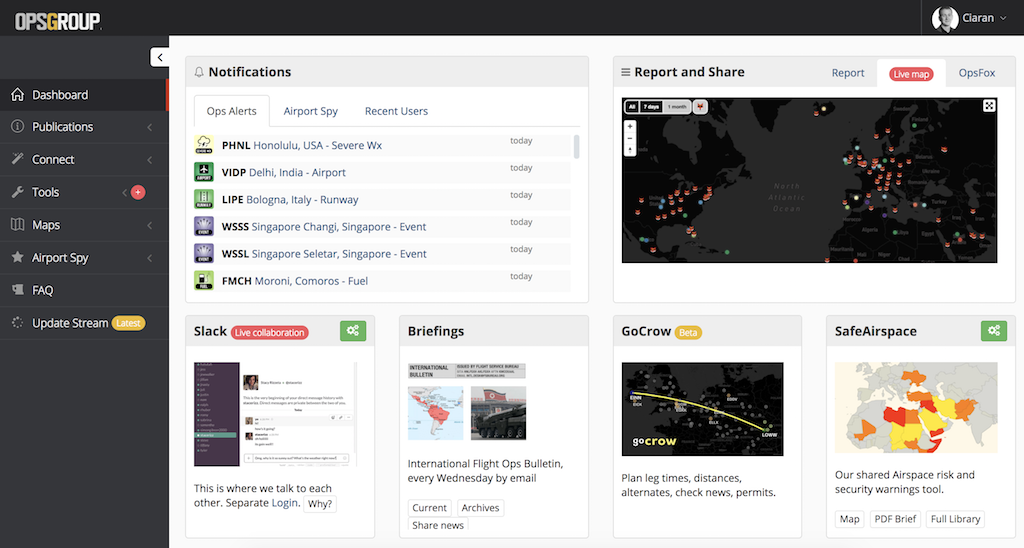
New Dashboard

What’s new?

  • Re-designed and improved look
  • A notifications tab for Ops Alerts and new Airport Spy reports.
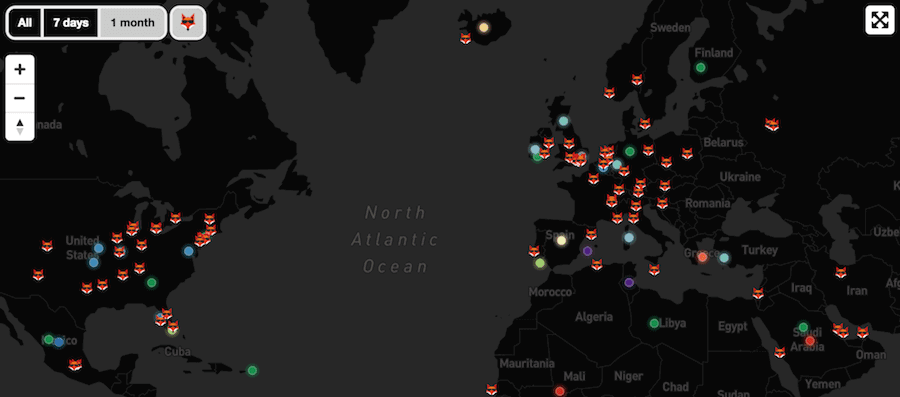
  • A live map of alerts, toggle 7 days/ 1 month / All, searchable news feed
  • Daily Brief archives in publications
  • FSB Blog posts now appear here also
  • Report it tool

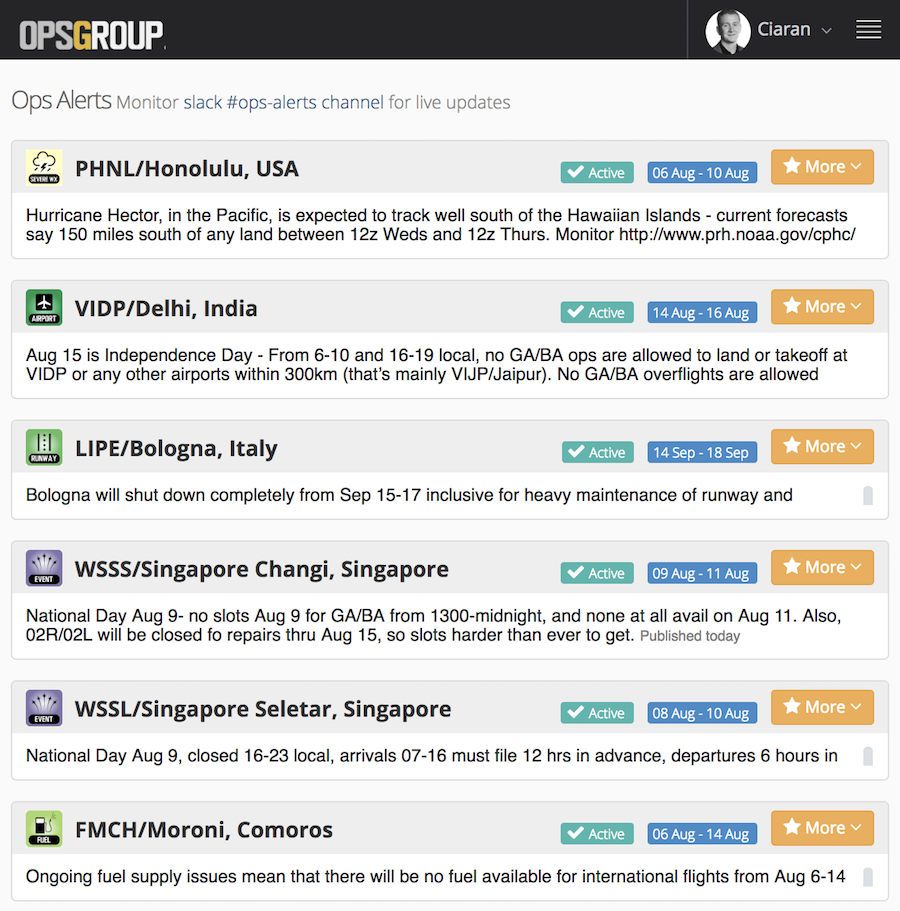
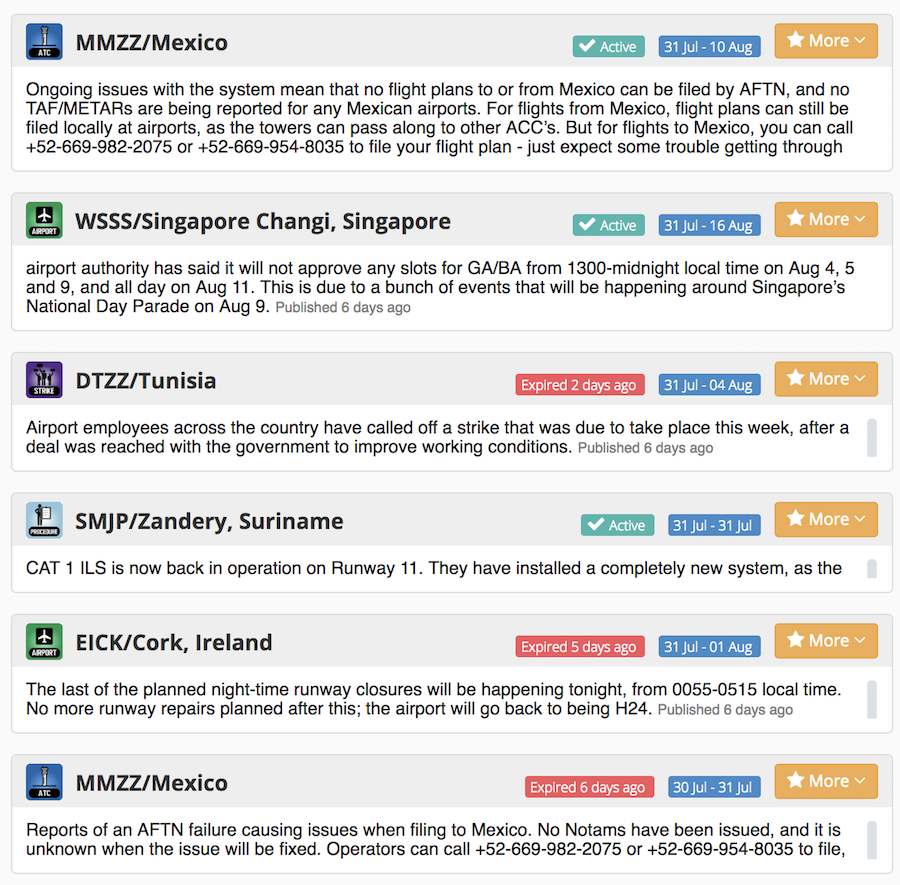
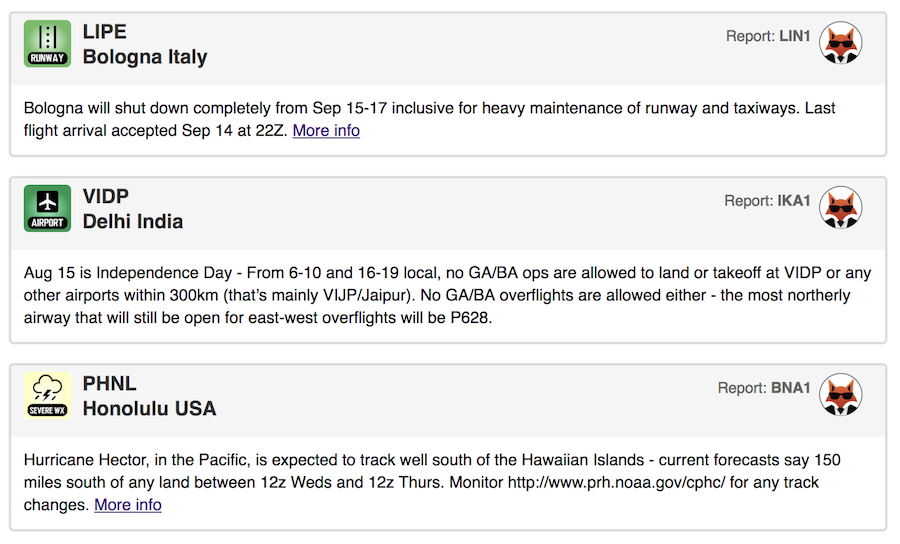
New Alerts Window

All ops-alerts issued by FSB for the group now have their own home at https://ops.group/ops-alerts. You can also find them in slack in the #ops-alerts channel, which will push notifications to your phone.

Each alert now has a category, validity dates, active marker, and link to more information:

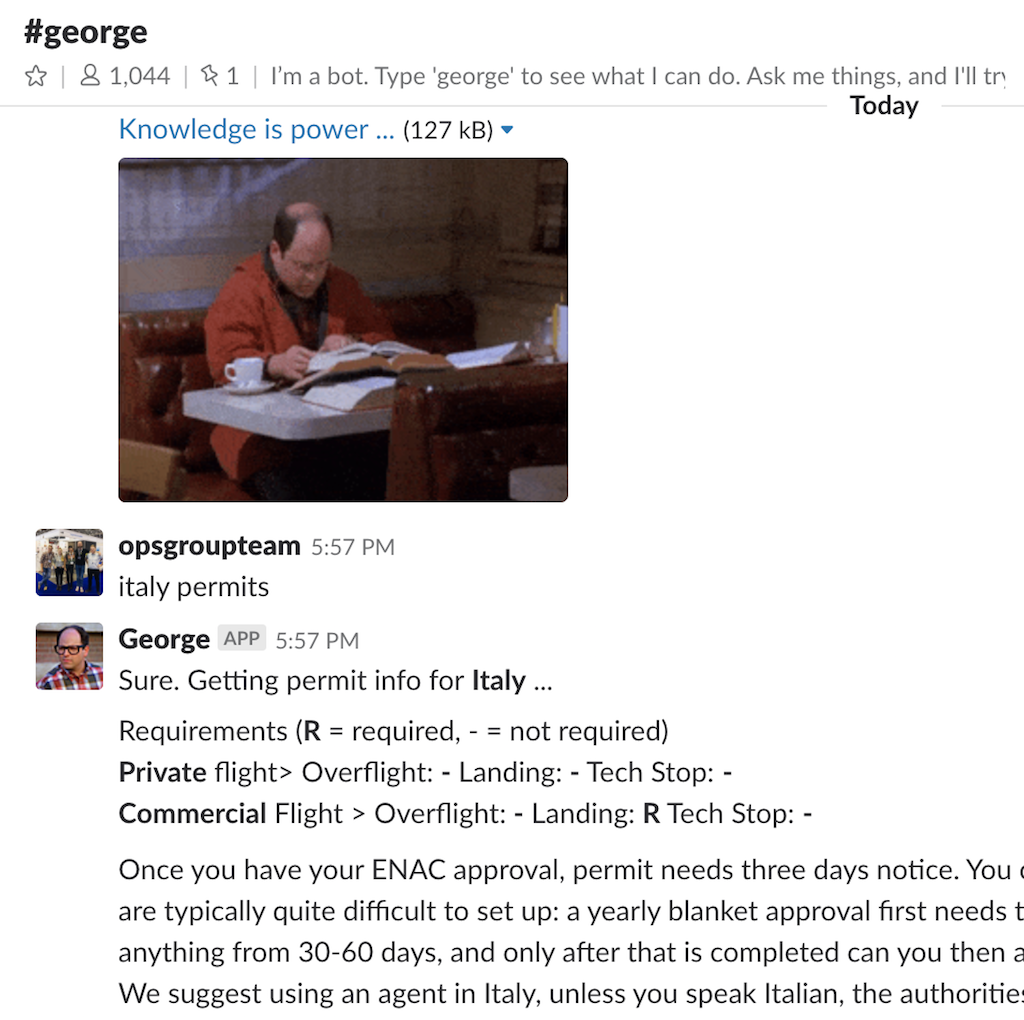
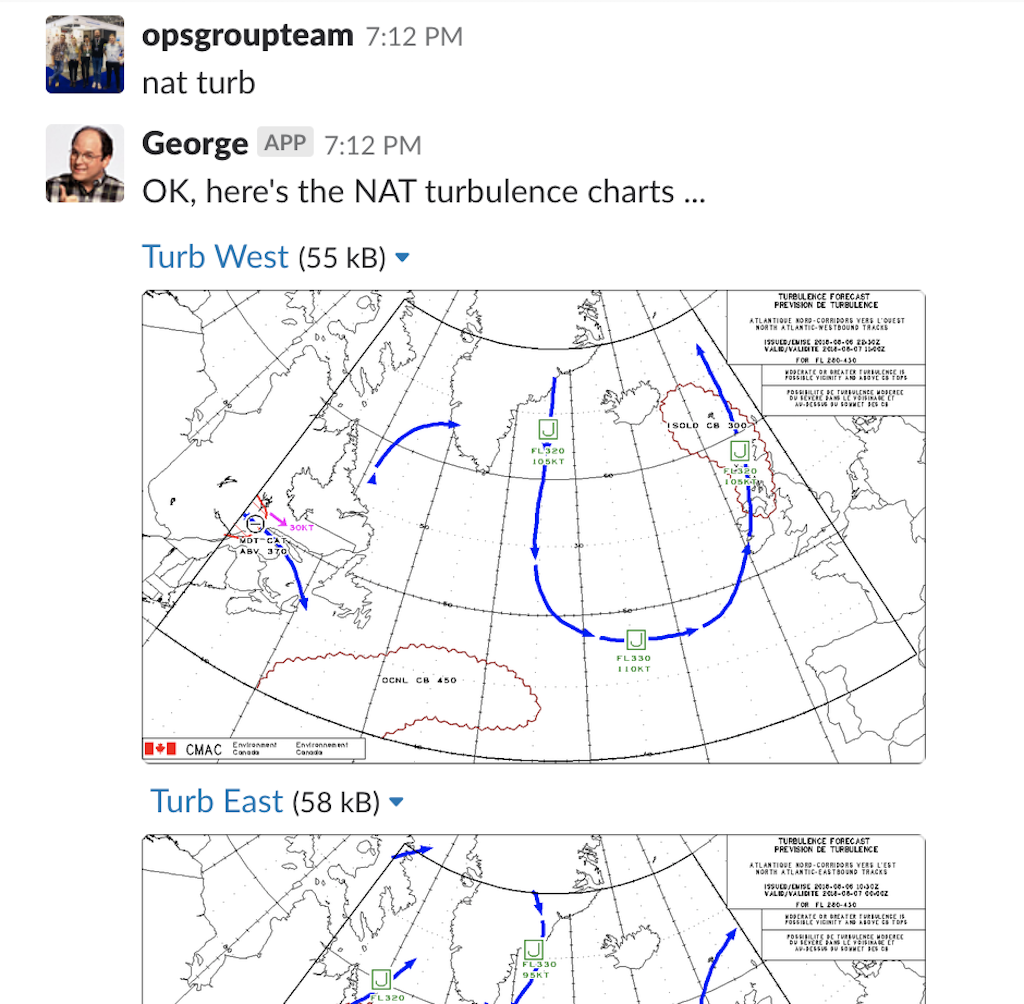
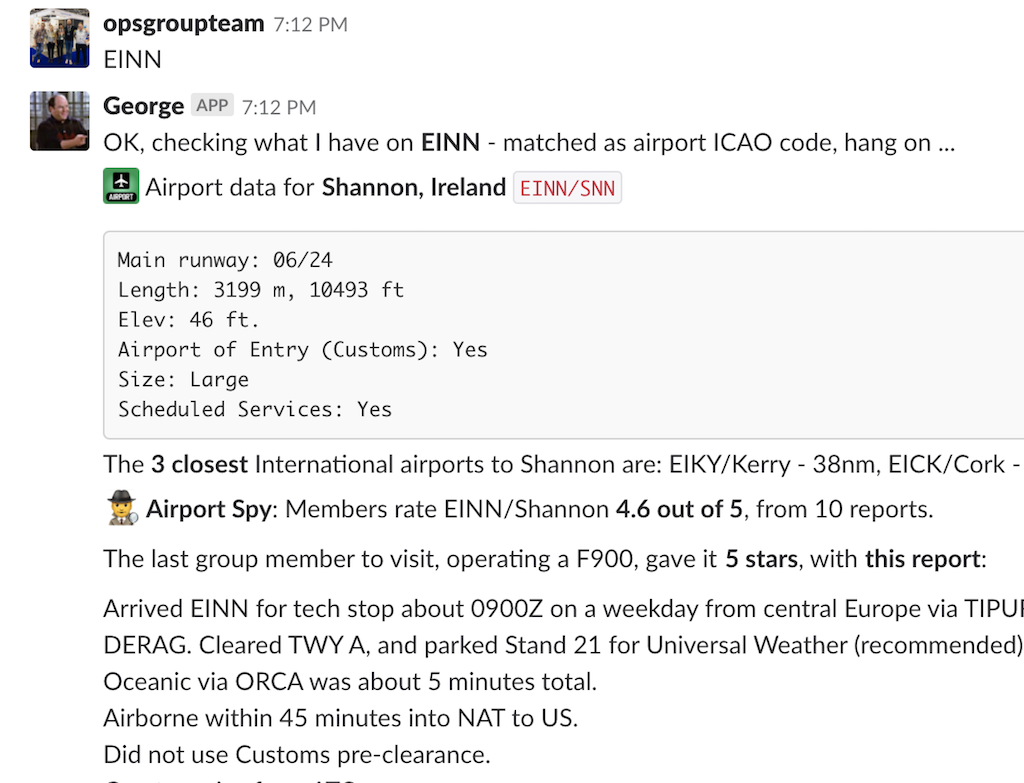
George

You know George from before, but we sent him for remedial training in North Korea and now he’s back, smarter, sharper, and better. George is a bot. We can’t call him AI, because he’s not that intelligent, but he understands a whole load of new commands: permitsweather, ICAO codes, airport names, countries, keyword searches. Go to the #george channel in slack to test him out.

OpsFox

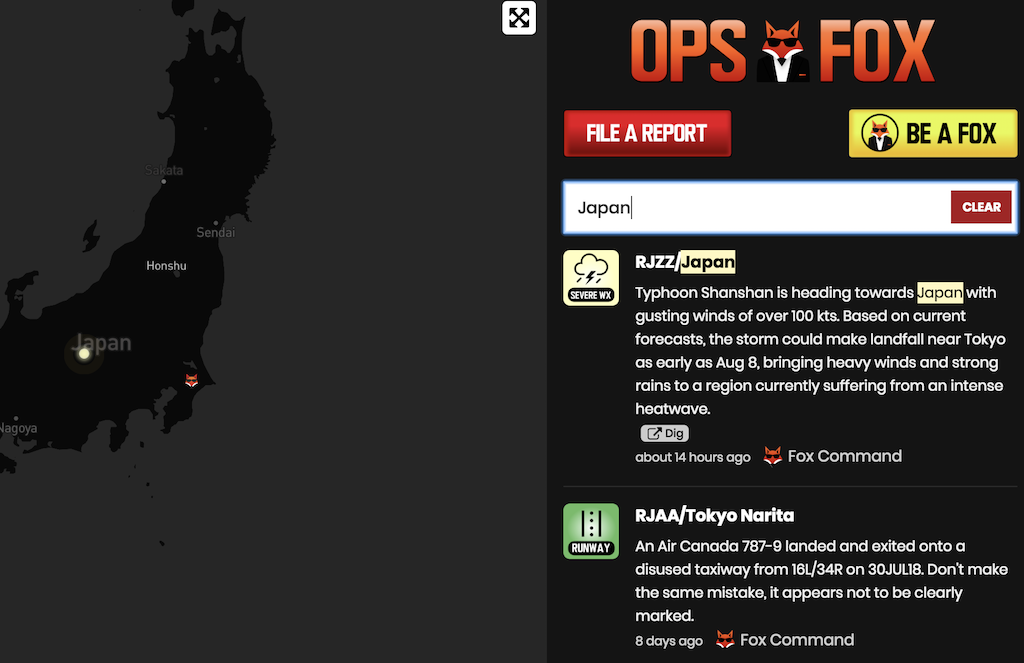
OpsGroup has set up a trusted network of spies: Pilots, Air Traffic Controllers, Dispatchers, and Ops Specialists – that can report directly into our system, adding categorized reports, based on what they see and know at their home base, or visited airport. We call this network OpsFox.

You can view the live map, or search for a specific country, or location:

Daily Brief

We love that you all love the Daily Brief! It’s been the most popular feature of the year – and we are happy to bring you daily updates every morning.


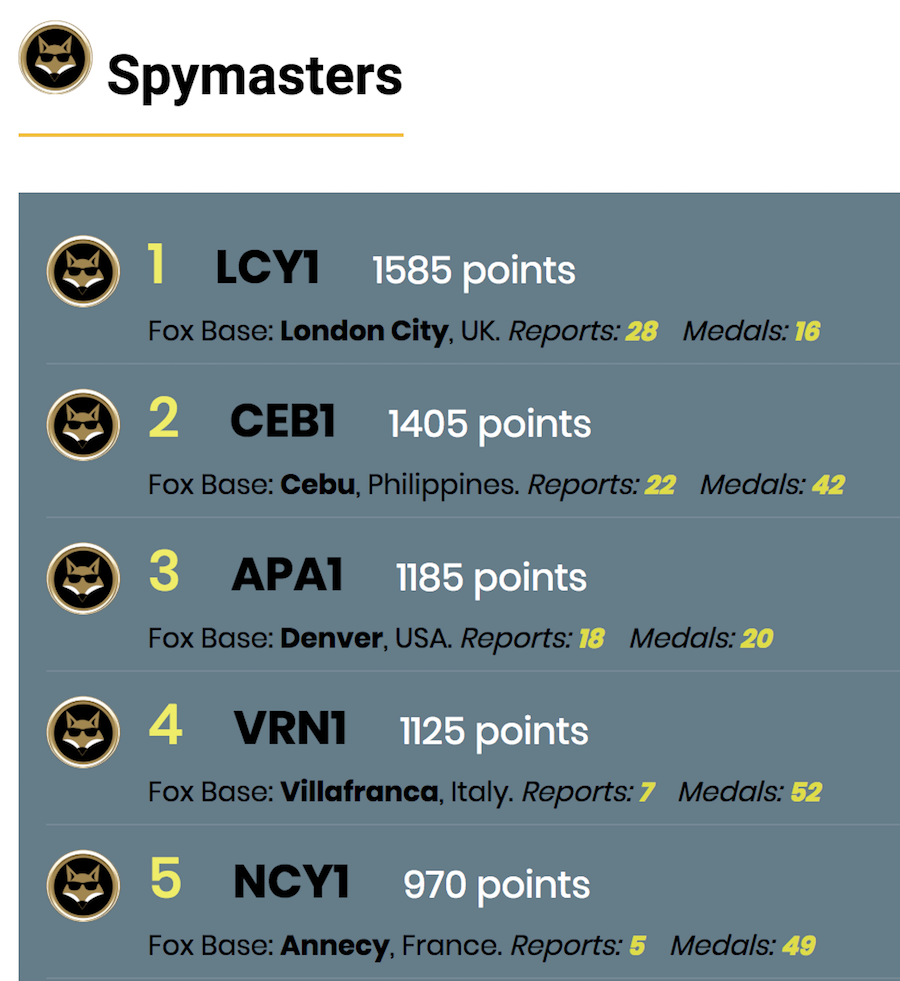
See those little fox badges? When we get a report from a Fox, we’ll mark it like that on the Daily Brief. If you’re a ground handler, and want to have your name listed as a reporter, then tell us and we’ll credit you for any reports you file – so that our members can contact you directly for more.

Also, as a fox, you earn points. Here’s the current Top 5!

We really hope you enjoy the new features! We listen to what the members want, and we build it – so keep your ideas coming to us. And of course, when you hear about something new:

Please! whether you’ve just checked in to the Holiday Inn at Teterboro, or are enroute with some fancy satcom wi-fi, let the other members know when you hear something important:

We hope you have a wonderful week! As always, keep us posted on anything the group should know about.

Oh – and if you REALLY liked something we added, hit reply and let us know! We’d love to hear.

Kind regards,
The Team.

 
Quick links – OPSGROUP members:


Choose a plan – JOIN OPSGROUP


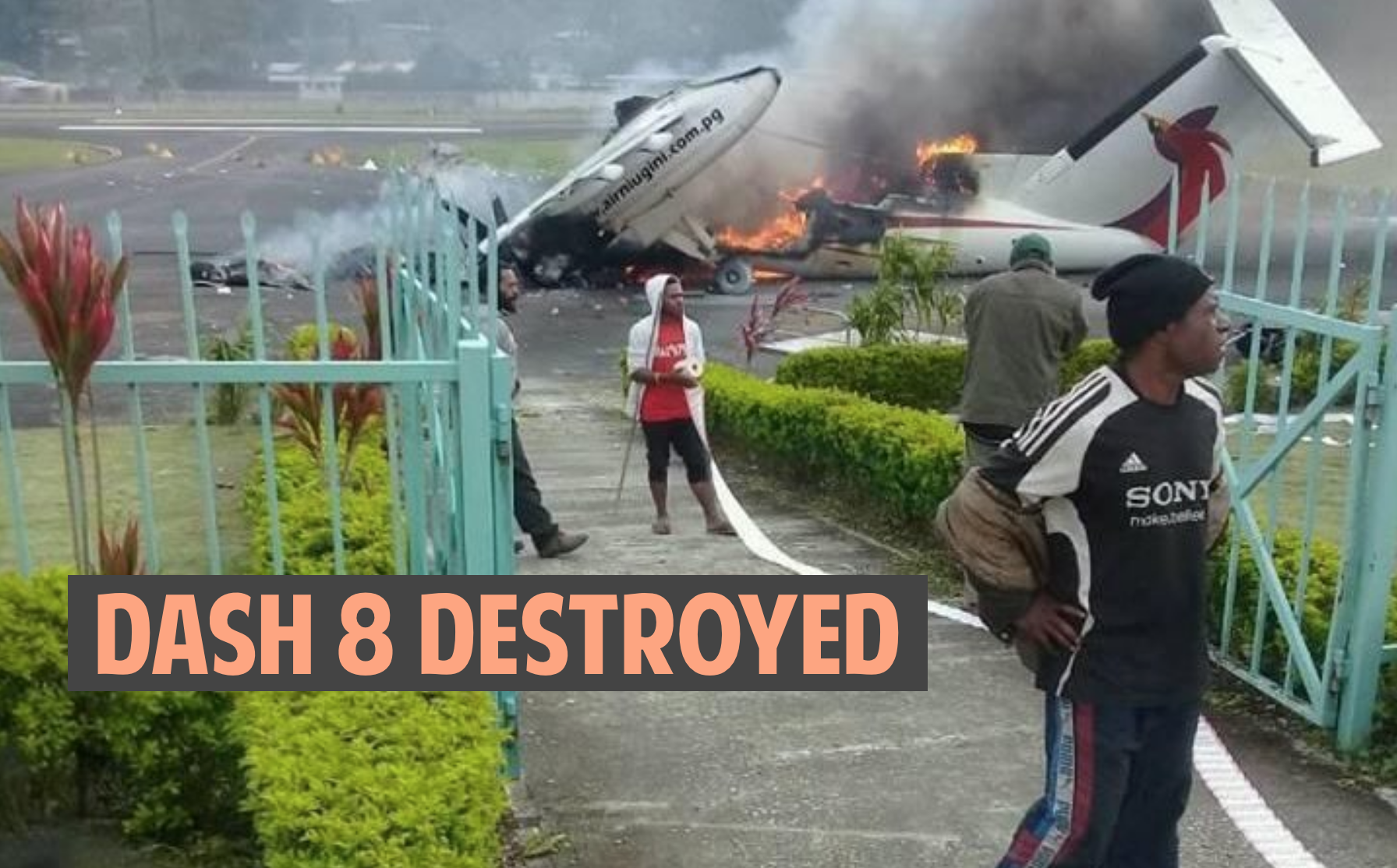
Dash 8 set on fire in Papua New Guinea, airport closed indefinitely

AYMN/Mendi has been closed indefinitely after protesters set fire to and destroyed an Air Niugini Dash 8 aircraft, which had just arrived from Port Moresby. The protest was in response to a court ruling confirming the election of the Southern Highlands governor William Powi.

Radio New Zealand reported:

“(Initially) the local police station commander Gideon Kauke had said police were guarding the aircraft to ensure there was no further damage, after its tyres had been flattened.

But he said his team of about ten police couldn’t contain a mob of uncountable numbers, particularly after missiles were thrown, forcing them to retreat; “we were guarding the plane but compared to them we were outnumbered and they came in all directions, all corners. Missiles were thrown, bush knives were thrown.”

Mr Kauke said some of the protestors, who continue to behave menacingly in Mendi as their numbers build up, were carrying guns. He said the protest was in response to a court ruling in Waigani confirming the election of the Southern Highlands governor William Powi.”

The Australian Department of Foreign Affairs is cautioning all to “reconsider your need to travel” to the regions affected by the unrest and to also “exercise a general degree of caution” for the whole of PNG.

The local NOTAM says it all.

A0773/18 – AD CLSD TO ALL ACFT OPS DUE CIVIL UNREST. 14 JUN 05:35 2018 UNTIL 13 JUL 06:00 2018 ESTIMATED. CREATED: 14 JUN 05:52 2018

Additional reporting indicates that the aircraft was shot at on landing, deflating the tyres.

Are you currently in PNG and can fill us in on more? Please comment below, or email us.


Escape from Teterboro .. FL400 or above

Skip the line up at Teterboro! The FAA has launched an initiative to allow some high-performance business aviation aircraft an escape route during SWAP events to mitigate delays at KTEB and KHPN. The goal is to offer flights that are filed to cruise at FL400 and above an exclusive route that would get them above the airline traffic. This route may add a few extra miles but will minimize ground delays.

As the FAA is required to test the route for ATC automation and familiarity, they are seeking pilots willing to participate in this test as early as this weekend, preferably in the morning, before traffic demand peaks. Aircraft participating in the test would be routed over GREKI and then on to westerly or southwesterly destinations.

If you’re willing to participate in the test this weekend, please at your earliest opportunity contact FAA Deputy Director System Operations, East-North Warren Strickland: warren.strickland@faa.gov

If you’re unable to participate in this weekend’s test, please advise Warren of other dates that may work for you.


Have you met Norm? He’s learning what a Notam is.

Actually, he already knows.  He’s seen more than 2 billion of them, read through them, grouped the words, and in the same way that you or I would, learned what different Notams look like, mean, and what they are about.

What Norm has no idea about though, is how important any particular Notam is. Until he learns from the people that know, he won’t know the difference between grass-cutting times, and airport closure times, in terms of criticality to crews.

Norm (full name Norman the Notam Organizational and Recognition Model) is an Artificial Intelligence ‘bot’ being built by ICAO and FSB. Calling him a bot does him a disservice; he’s already much smarter than a bot, but needs more training.

Norm  has one job: identify critical NOTAMS and highlight them, so that crews and dispatchers don’t miss the important stuff.

For this, FSB needs human pilots and dispatchers to teach him what is critical and what is not. When presented with a new NOTAM, Norm can then give it a criticality rating. He needs a sample of at least 10,000 NOTAMS to become usable, and 20,000 to become smart.

FSB is using the power of OpsGroup to train him – a collective of 4,000 airlines, operators, pilots, and dispatchers that work together and share information on changes, operational challenges, security, risk, and …. fixing Notams.

There are over 30,000 NOTAMS out there at any moment in time. Some are critical, most are not. Norm will ensure that crews have the option of seeing only the critical ones first.


French ATC strike 22 May – this one’s looking bad

Impact from todays ATC French strike is looking worse than usual.

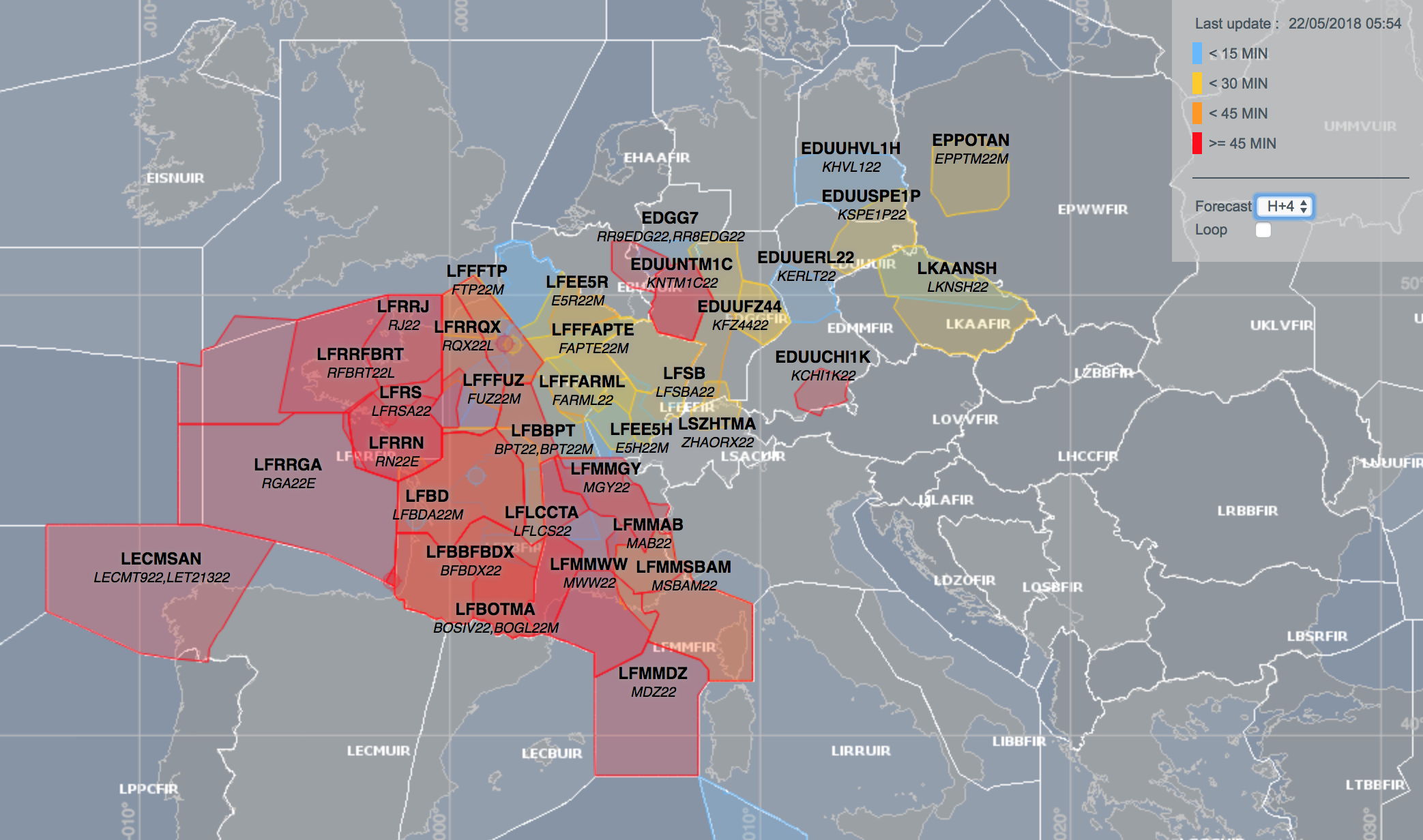
As things stand at 0600Z, there are a total of 400,000 delay minutes attributed to ATC Industrial Action in the ATC system for Europe,  an average of 20 minutes for every flight in Europe. That average is calculated for all 22,000 aircraft that will operate today in Europe, so assuming at most 2000 flights would operate through French airspace, it works out at around 220 minutes delay for every aircraft. And yep, finishing off the maths, that’s about 4 hours.

Those figures are pretty fluid because the good people at NM (CFMU) work really hard to reroute flights around the worst of it, but it’s safe to say, if you are operating in, over, near, or thinking about France today, you will have a pretty decent delay.

See below for the best places to get updates on todays strike.

Further reading:


Italy ATC Strike announced for May 8th

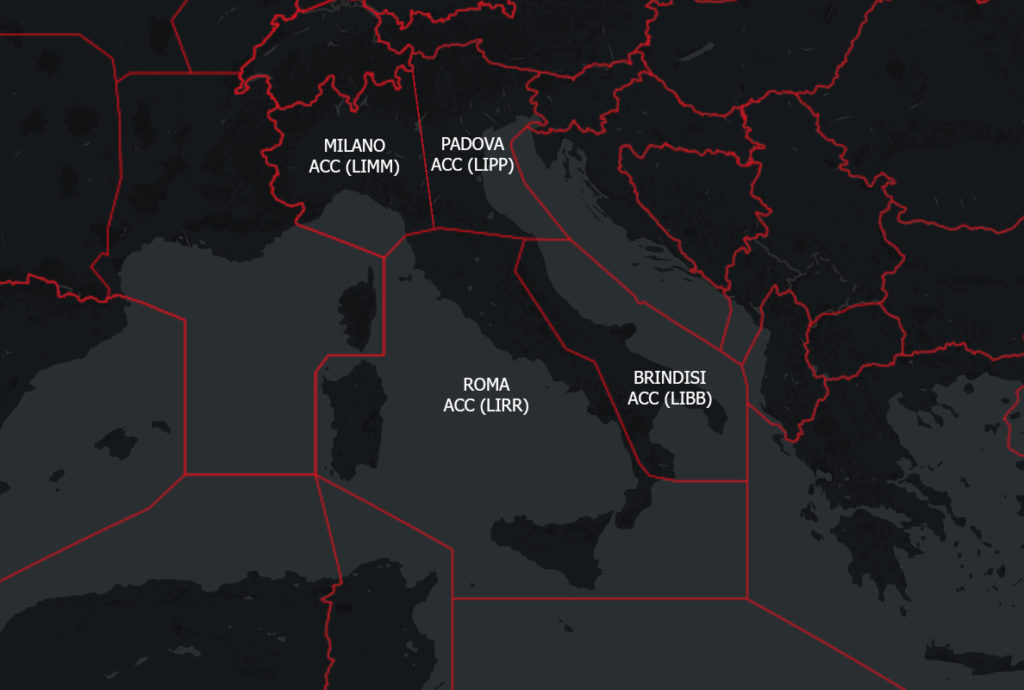
All airports in Italy and all ACC’s are planning a strike for Tuesday May 8th, from 08-16Z. Overflights, and intercontinental flights (eg US arrivals) are exempt. Expect disruption on the ground at all airports all day.

On strike from 11-15z:
-The ACC’s: LIBB/Brindisi, LIMM/Milano and LIPP/Padova.
-The airports: LIMC/Milan-Malpensa, LIEE/Cagliari, LICC/Catania, LIRA/Rome-Ciampino, LIBR/Brindisi, LICA/Lamezia Terme, LIMF/Turin and LICJ/Palermo.

On strike from 08-16z:
-LIRR/Roma ACC.
-The airports: LIRF/Rome-Fiumicino, LIRP/Pisa and LIRQ/Florence.

You can see the full Notam here. For updates, keep an eye on the Eurocontrol NOP page on the day of the strike.

Additional strikes are taking place by ground handlers at LIRP/Pisa, LIMC/Milano Malpsena, LIML/Milano Linate, LIRQ/Florence and LIPY/Ancona – so expect particularly big delays at those airports.


Russia is not closing its airspace to American flights

On April 17, the Russian Ministry of Transport extended overflight approvals for US airlines through to October 28, 2018 – just hours before the old agreement on overflights was due to expire.

This should bring an end to the rumour that had been circulating all week that Russia has closed its airspace to US aircraft, and were denying overflights. There are a couple of unrelated events which caused this confusion:

1. US strikes on Syria on April 14, with rhetoric of Russia retaliation – which in the end didn’t happen.

2. Spooked about how Russia might respond directly after the strikes, American Airlines temporarily decided not to overfly Russia on some of their flights from the US to Hong Kong… but then they quickly went back to doing so again on April 15.

3. With the deadline looming for extending the agreement, Russian civil aviation officials had reportedly cancelled a meeting in Washington earlier this week to discuss renewing the agreement.

4. Some areas of the Baltic Sea are closed on April 19 for Russian missile firing, which is a routine event.


References – all the relevant stories are here:


OPSGROUP wins bid to control 1.8 million km area of Pacific Airspace

1st April 2018: Clipperton Oceanic starts operations today, and is the world’s newest piece of airspace!

This one is different though – the users are in charge.

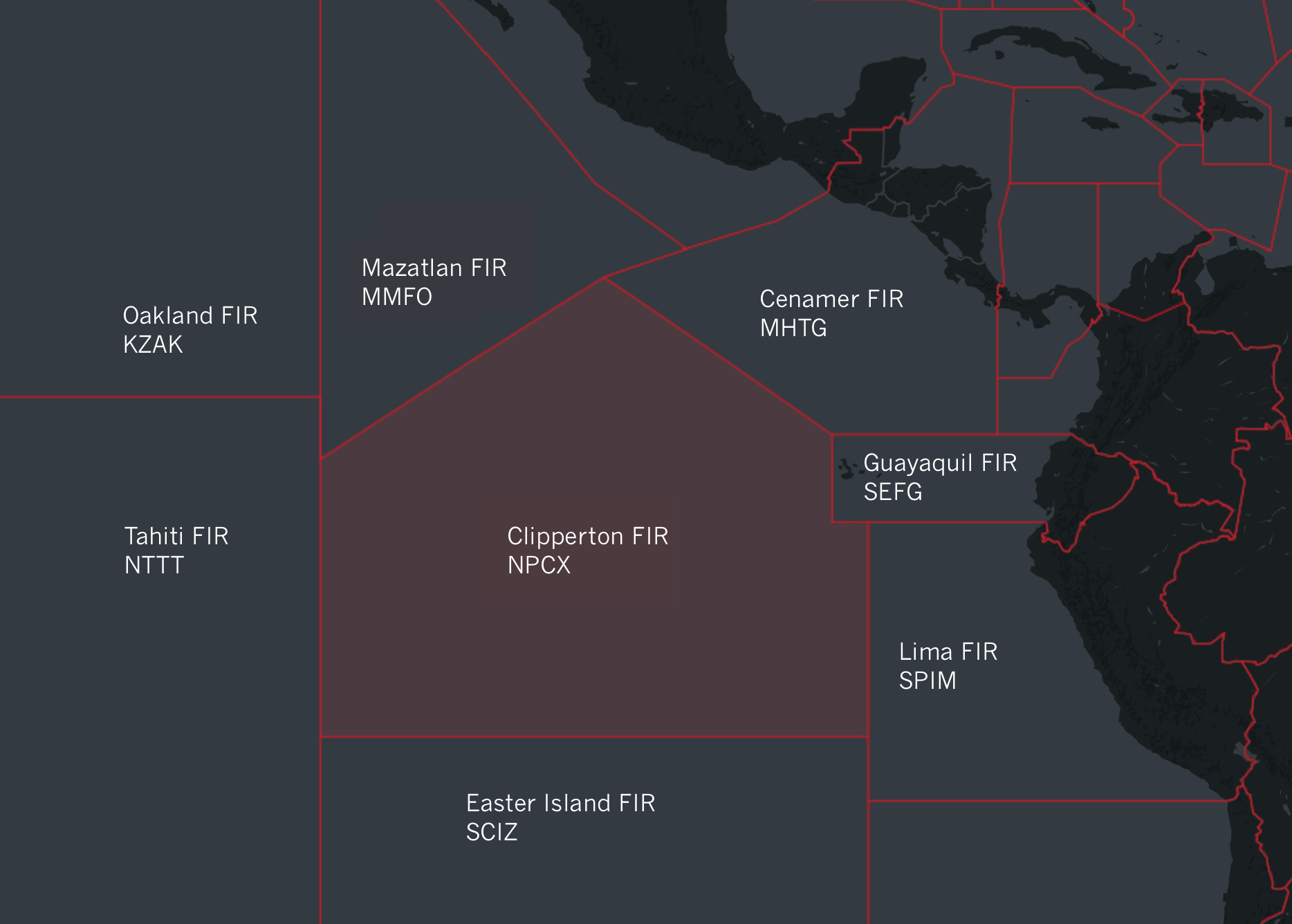
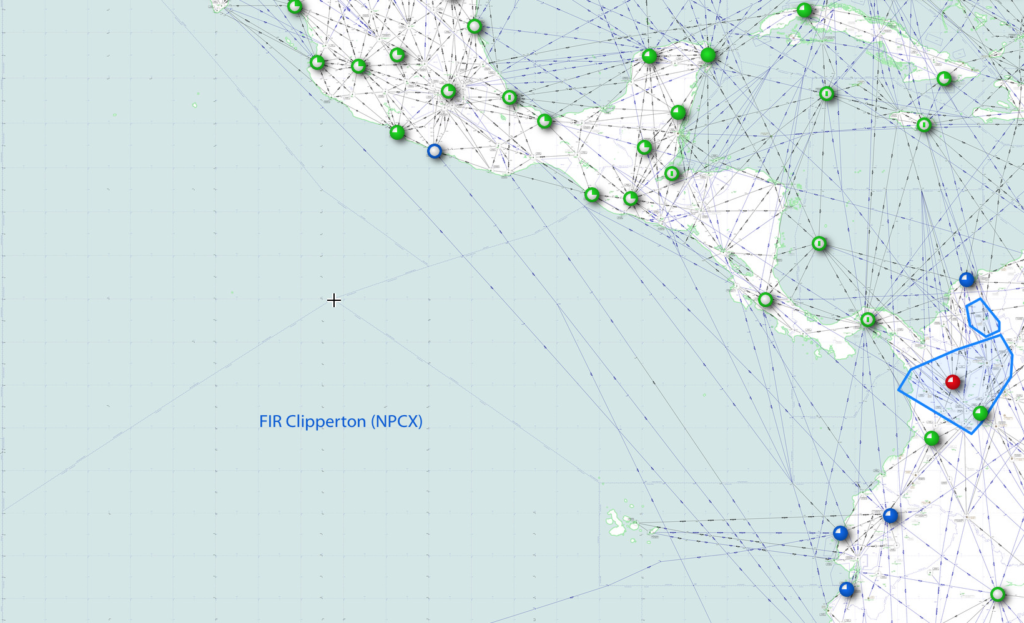
OPSGROUP take official control today of the Clipperton Flight Information Region (FIR) in the South Pacific, a 1.8 million square kilometre chunk of airspace west of the Galapagos Islands and north of Tahiti. The FIR has been unused since 1958, when the Clipperton Oceanic centre and radio service closed.

Announcing the news in an official Press ReleaseFrancois Renard, PM of the Clipperton Government said: “We are a little island but we are proud of our history in Pacific aviation. The years from 1937-1958, when Clipperton Oceanic was a name known to all passing aircraft, are looked back on fondly here. Now, we look forward – to a resumption of traffic on these once busy routes, and we are confident that OPSGROUP is the key to making this happen”.

For the first time, regulations are set by the users. There is no requirement for PBCS, RNP, ADS-B, ADS-C, GNS, GNSS, HLA, MNPS, RLAT, RLON, SLOP, or any of the other exponentially increasing acronyms that operators struggle to keep up with. No LOA’s, no slots, no delays. And no ramp checks. There are no Notams. Although it is large, it’s a simple piece of airspace, and that allows for a simple approach.

Juergen Meyer, a Lufthansa A350 Captain, and a long standing OpsGroup member said: “We’ve seen enough. Ercan (the Cyprus based Turkish ATC centre) doesn’t officially exist, yet you have to call them every time. French Guyana seems to have abandoned their ATC centre. Several African countries have outsourced their entire Permit Department, meaning you have to pay extortionate amounts just to secure a routine overflight. Greece and Turkey continue to hijack the Notam system for a diplomatic war. CASA Australia, like many others, continues to publish absolutely unreadable Notams, endangering safety. Nobody dares to enter the Simferopol FIR. The French ATC service is on strike more often than they are not. Libya lies about the security risks at their airports. Egypt and Kenya refuse to publish safety information because it would harm their tourism.”

Jack Peterson, an Auckland based operator of 2 G550’s, said: “If all these agencies can exist with a poor service, then why not try something different? Clipperton puts the users in charge, and we get to decide whether any of these rules or procedures actually serve us. Now that we have our own airspace, we can make it safe and user-friendly rather than user-hostile. And the South Pacific is the perfect place to start.”

OPSGROUP has also banned Ramp Checks within the region, a practice where pilots are taken hostage by the local Civil Aviation Authority during routine flights, and held accountable for the mistakes of their company, not being released from the ordeal until they submit with a signature.

The Clipperton FIR has a chequered history.

The island is named after a Pirate (John Clipperton). First activated in 1937, Clipperton Oceanic Radio provided a Flight Information and Weather service to trans-Pacific flights for 21 years, until it lost funding from a French-British-American government coalition in 1958.

In 1967, the Soviet Union attempted to takeover the airspace, offering to build several Surveillance Radars on the island. That was seen by the United Nations as a cover story, with their interest being more likely centred on having additional monitoring territory proximate to the US.

Since then, the Flight Information Region has remained dormant, appearing in most Flight Planning systems as “XX04”. Until the agreement with FSB, no service of any kind was provided.

The move has been seen by some observers as similar to the delegation of control of Kosovo airspace to Hungary in 2013, under a 5-year agreement that will likely be extended. Reinhard Kettu, newly appointed Oceanic Director, FSB, commented: “It’s not really the same thing. The Kosovo thing was just a delegation of Air Traffic Control, and at that, just for civil aircraft. Here, in Clipperton, FSB is taking full control of the aviation system. That will allow us to introduce an across-the-board user-first system.

On the Notam issue, OPSGROUP founder Mark Zee commented: “We’ve made things really simple here. Critical Notams, for the most part, tell us of a binary Yes/No for availability. Runway closed, ILS unavailable, Frequency u/s. It’s basically an On/Off switch, and the existing system handles that pretty well. When it comes to everything else, they fail, badly. So much rubbish about unlit towers, cranes, birds, and the rest. That makes up the noise. So, we’ve banned them in this new airspace, while we work on a better system. We will notify operators through the DCA of any withdrawn essential service or facility, for example if our HF is broken. Nothing else.”
Operationally, there are two new airways, UN351 and UN477, with 8 associated waypoints. HF is provided on the South Pacific MWARA Network, on the same frequencies as Auckland, Brisbane, Nadi, and Tahiti – 5643 and 8867 will be the primary ones.

Flight plans should be addressed to NPCXZQZX and NPCXZOZX. Although only HF is required to enter the airspace, CPDLC is provided and the AFN logon is NPCX. To begin, only a Flight Information Service is provided; no alerting, SAR, or Air Traffic Control service is part of the agreement. The rest is detailed in Clipperton AIC 03/18.

FSB and the Clipperton Government have also partnered with Thales and the KPA Military Construction Unit in a US$27 million agreement to build an entirely new Oceanic Control Centre on the Island, to be completed by 2021. “Until then, we will rely on HF and position reporting, but from 2021 we will be able to use space-based ADS-B”, said Mr. Kettu.

Clipperton Oceanic welcomes all. If you’re passing, say hello on HF. And if you’re planning to enter the airspace, make sure to read AIC03/18.

Media contacts:

Further Reading:


New Unsafe Airspace Summary and Map

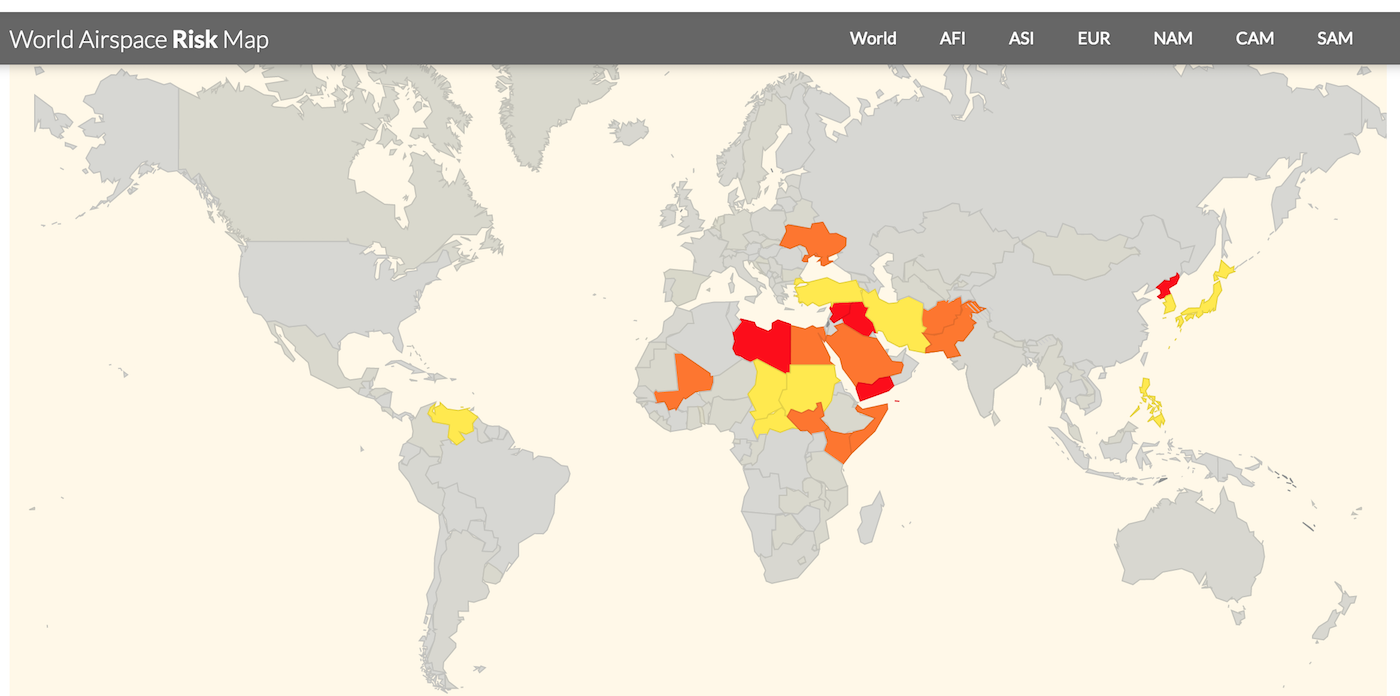
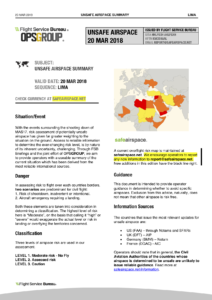
March 20, 2018: One of our biggest missions in OPSGROUP is to share risk information and keep operators aware of the current threat picture. The latest Unsafe Airspace Summary is now published, and available to members here as a PDF download (Unsafe Airspace Summary 20MAR2018, edition LIMA).

The main changes since the last summary are below. For a current risk map, refer to the Airspace Risk map in your member Dashboard.

The situation in Afghanistan remains similar. On March 13, Germany added wording to maintain FL330 or higher,  still recommending against landings at Afghan airports.

Germany also issued updated NOTAMs for Mali, Iraq, and South Sudan. All warnings remain as previous, unchanged from the prior NOTAMs.


PBCS PITA – here’s the latest Rumours and Facts

Well, we’ve been up all night on this one. PBCS is a bit of a minefield right now. But, very cool to get so much OPSGROUP input on this – about 100 replies. We have straightened out the Rumours vs Facts below, and this is our best shot at the present picture of PBCS.
Don’t take any of it as total fact, but we have redacted the best picture from the various experts in the group (and there are some great people – we should say a big THANK YOU!).

Got corrections? Comments below …

Oh for the days of HF and a dodgy INS accurate to about 6 miles. Anyhow ….

Results after OPSGROUP input – updated March 16th, 2018

These aircraft have Honeywell FMS’s that have the Latency Problem:

  1. All NZ-2010 Equipped Aircraft – NZ-2010 (NZ6.1)
  2. Bombardier Global Express/XRS/Global 5000 – IC-810 (NZ6.1)
  3. Dassault F900C/EX (Primus 2000) – IC-810 (NZ6.1)
  4. Dassault F900DX/EX/LX (EASy II) – EPIC (NZ7.1.2)
  5. Dassault F2000DX/EX/LX/S (EASy II) – EPIC (NZ7.1.2)
  6. Dassault F7X (EASy II) – EPIC (NZ7.1.2)
  7. Dornier 328-100 Turboprop – NZ (NZ6.2)
  8. Gulfstream GV – IC-810 (NZ6.1)
  9. Gulfstream G450 – EPIC (NZ7.1.2)
  10. Gulfstream G550 – EPIC (NZ7.1.2)


Latest Links:

United States – for N-reg aircraft


Canada 

Europe

NAT Region
Happy PBCS’ing!


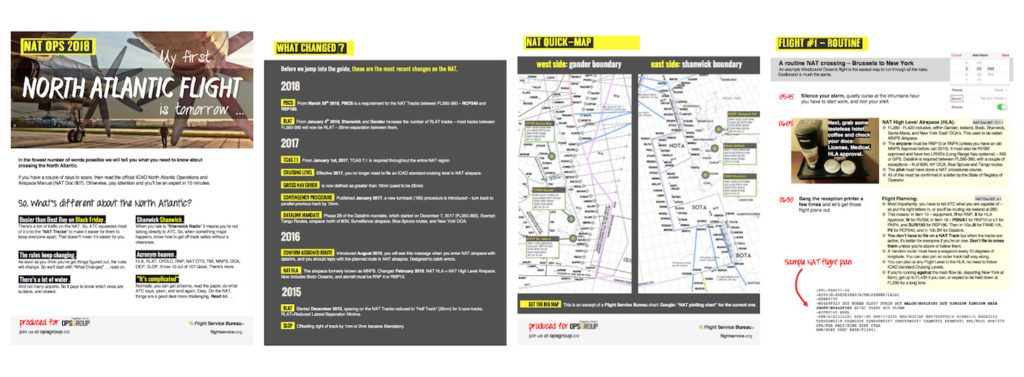
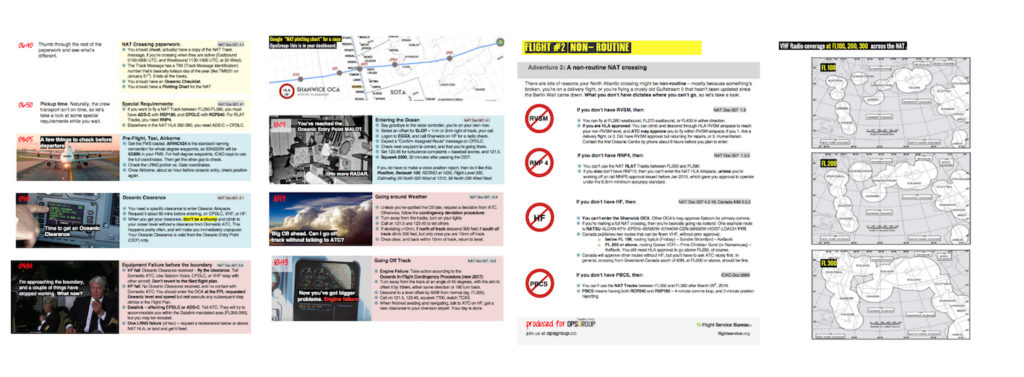
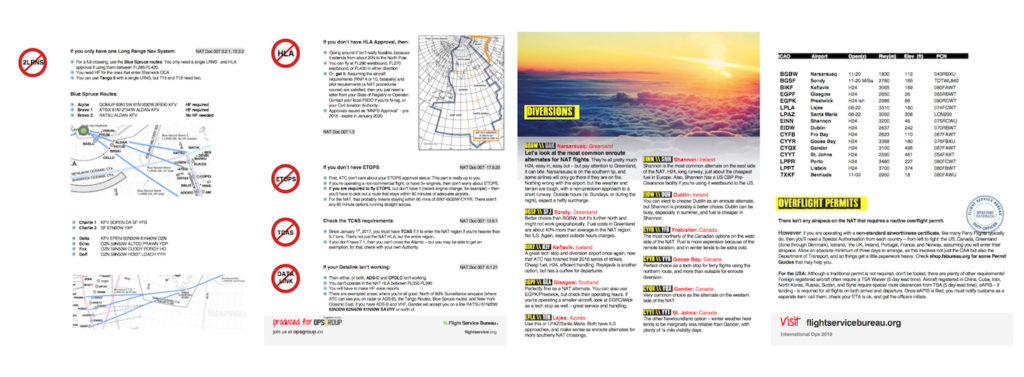
My first North Atlantic Flight is tomorrow – NAT Ops Guide (Updated 2018)

For the latest changes and updates on the North Atlantic, including our most recent Guides and Charts, use our NAT reference page at flightservicebureau.org/NAT.

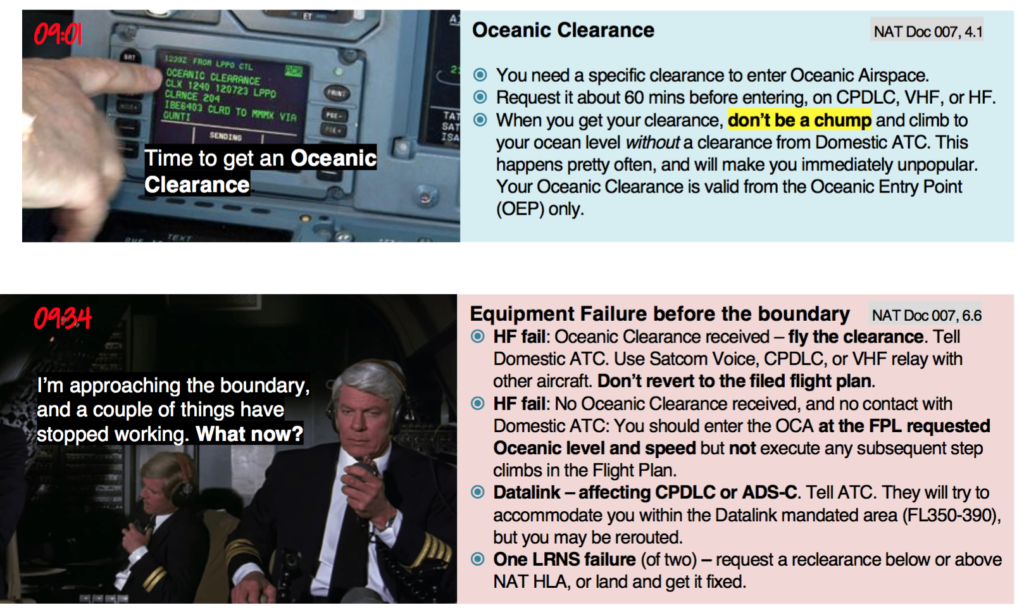
Of all the hundreds of questions we see in OPSGROUP, one region stands out as the most asked about – the NAT/North Atlantic. So, we made one of our legendary guides, to get everything into one PDF.  It’s called “My first North Atlantic Flight is tomorrow” – and now we’ve updated it for 2018!

Contents:

  • 1. What’s different about the NAT?
  • 2. Changes in 2018, 2017, 2016, 2015
  • 3. NAT Quick Map – Gander boundary, Shanwick boundary
  • 4. Routine Flight Example #1 – Brussels to JFK (up at 5.45am)

  • 5. Non Routine-Flights: No RVSM, No RNP4, No HF, 1 LRNS, No HLA, No ETOPS, No TCAS, No Datalink – what you can do and where you can go
  • 6. Diversion Airports guide: Narsarsuaq, Sondy, Kef, Glasgow, Dublin, Shannon, Lajes, Fro Bay, Goose Bay, Gander, St. Johns
  • 7. Airport data
  • 8. Overflight permits – routine and special

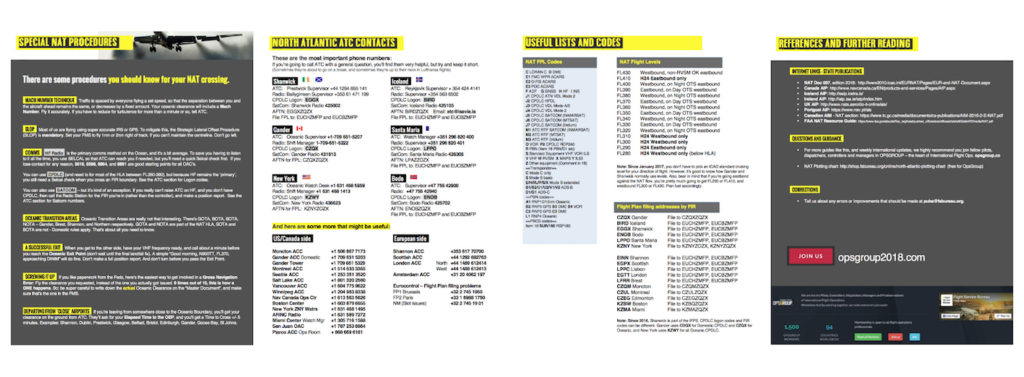
  • 9. Special NAT procedures: Mach number technique, SLOP, Comms, Oceanic Transition Areas, A successful exit, Screwing it up, Departing from Close Airports
  • 10. North Atlantic ATC contacts for Shanwick, Gander, Iceland, Bodo, Santa Maria, New York – ATC Phone, Radio Station Phone, AFTN, Satcom, CPDLC Logon codes; and adjoining Domestic ATC units – US, Canada, Europe.
  • 11. NAT FPL Codes
  • 12. NAT Flight Levels
  • 13. Flight Plan Filing Addresses by FIR
  • 14. Links, Questions, Guidance

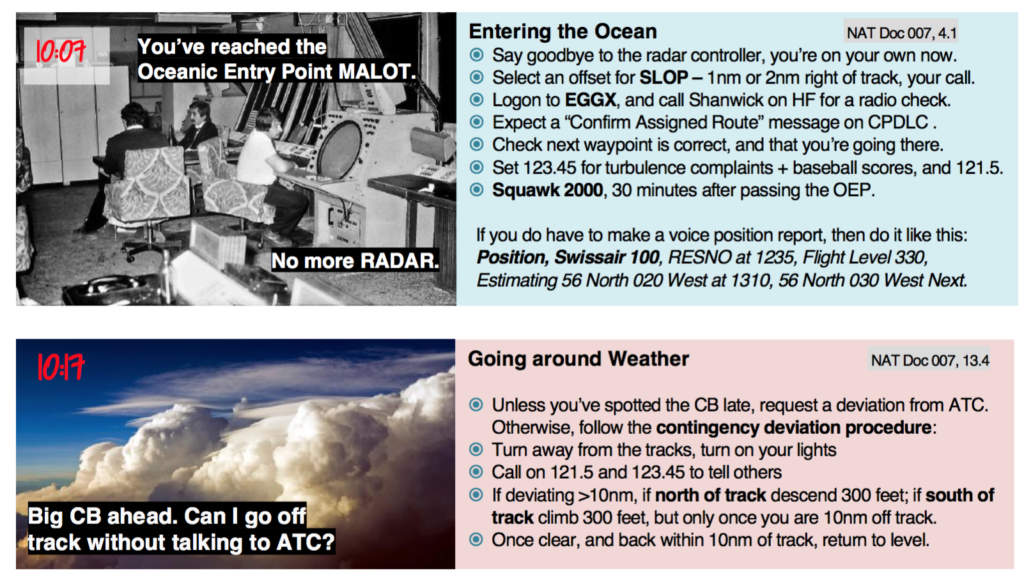
Excerpt from the Routine Flight #1:


Buy a copy ($20)   Get it free – join OPSGROUP

To get your copy – there are three options:

  1. OPSGROUP Members, login to the Dashboard and find it under “Publications > Guides”. All FSB content like this is included in your membership, or
  2. Join OPSGROUP with an individual, team, or department/airline plan, and get it free on joining (along with a whole bunch of other stuff), or
  3. Purchase a copy in the Flight Service Store!


The NOTAM Goat Show 2018

We’re on the hunt for prize Notams. 

In every definition of a Notam that exists, including the ICAO one, it includes these words: “the timely knowledge of which is essential“. Unfortunately, many Notam-creators’ sense of the essential shows a clear failure to understand the term . This is CNN’s version of fake news at it’s worst.

Now, we recently found one that listed peak goat-grazing times near the airport, so we thought we’d run a NOTAM Goat Show. And there will be prizes. We’re looking for the worst: the most irrelevant, the most useless, the most boring, the most unreadable. All those crappy Notams that are part of the 100 page print out you get in your flight briefing.

Send us your worst! goatams@fsbureau.org

There will be prizes, and as fun as all this is, you actually are helping to solve the problem of Bullshit Notams. We’re working on it.


It’s nice to meet you.

Yep, there is. It’s called OPSGROUP. We’re a big mix: pilots, dispatchers, controllers, managers, tech specialists, aviation authorities – all with one thing in common: International Flight Operations.

Back in 2016,  we figured out that great things happen when we solve problems together. Change is the biggest challenge, so we tell each other when we hear of something new. We keep each other safe by sharing information on risks.

Now we’d like you to get involved as well.

Why join us? Good question. Well, because if you don’t, you’ll miss a change and look like a chump. We don’t want that. You might overfly Libya. You might divert to Cayenne. You’ll only find out about the new rules when your G650 is impounded. You’ll pick the wrong handler because you didn’t get to see that Airport Spy review on Santiago from another member. You won’t know about that exemption. You won’t have anyone to ask whether you should stop at Keflavik or Reykjavik.

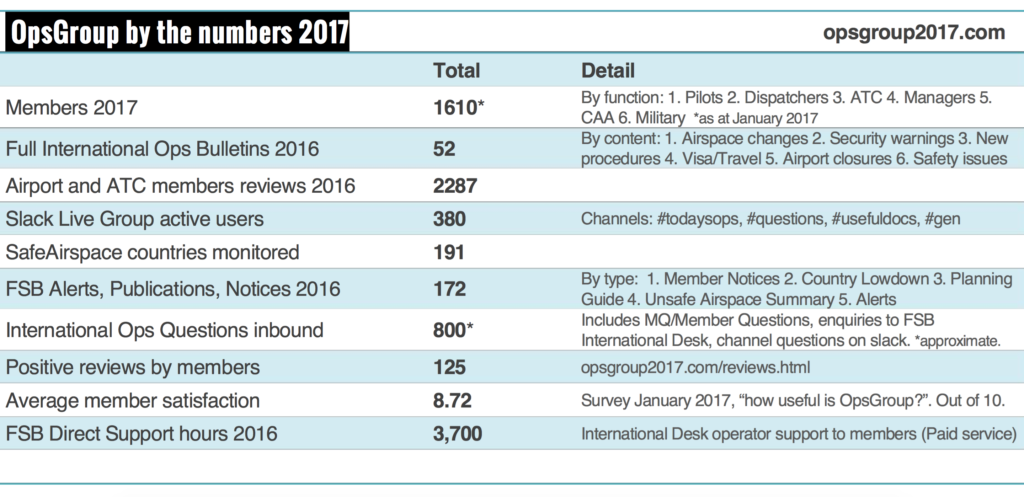
Life managing International Ops is hard enough without trying to do it all on your own. And we want you, because the more smart people like you we have in the group, the stronger it becomes. Pick a plan for yourself, or your team, or your entire flight department. There’s 1650 people waiting to answer your questions. And to pick your brain.

Read the reviews from existing members, and see why everyone from Airbus to the British Antarctic Survey to United Airlines is in the group. (hint: we’re all doing the same thing, and it’s getting easier).


Join OpsGroup


Welcome Pack

On joining, we will send you, and each team member if you are on a team or department plan:
– a Welcome Email, explaining the group, together with your Welcome Pack:
– The full FSB Airports Database (value $375)
– The current full International Ops Bulletin
– Our Polar Ops Planning Guide
– Current NAT Plotting Chart (value $35)

Everything

You (and each team member, if you choose a team plan) will then also get:
– Immediate access to our OpsGroup Dashboard
– The weekly International Ops Bulletin every Wednesday
Slack access to talk to the group
Ask-Us-Anything – we answer your International Ops questions
– Airspace warnings and overflight risk summaries
– Access to Aireport – 2300+ Airport and ATC TripAdvisor style reviews
– Everything we publish – Guides, Lowdowns, Charts, Member Notes
– Tools and Maps
– All previous content since the group started
See examples of all the above

Joining Process

2 straightforward steps:
– Choose an Individual, Team, or Department plan
– We send you everything you need to get started by email

You can cancel anytime you like, before the next billing period.

New members – that’s you – are welcomed several times a year. The current status is notified on this page. To make sure that new members are fully supported, and the existing group retains its high quality, we limit joining to window periods during the year.
If we’re closed, you can join the waitlist to be notified of the next opening window.


Join OpsGroup