No Room for Error – GNE’s and the North Atlantic

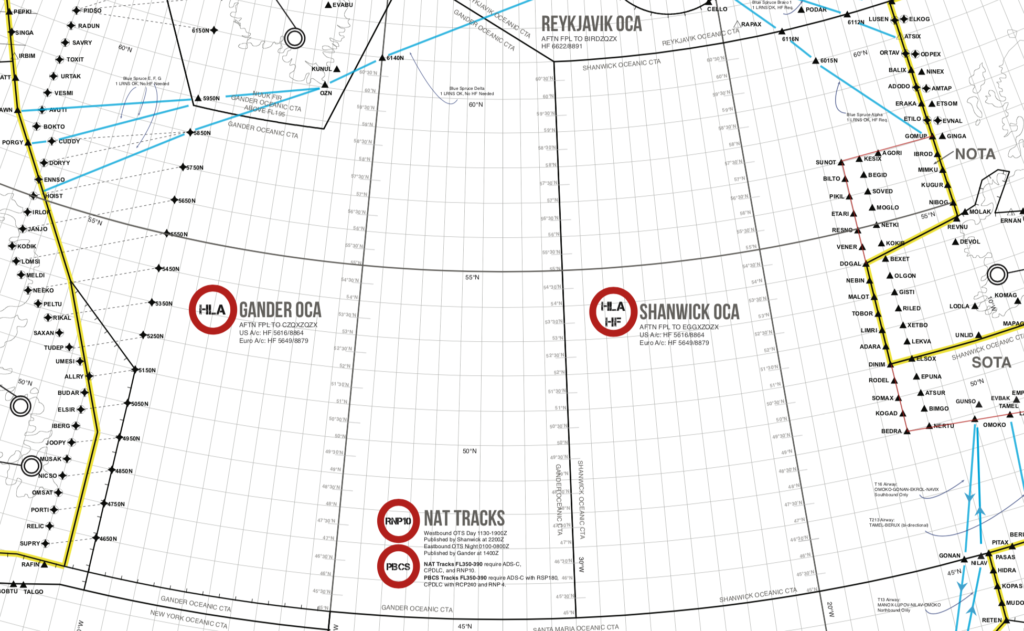
Advances in technology mean that aircraft in the North Atlantic High Level Airspace (NAT HLA) are flying laterally, longitudinally, and vertically closer than ever before. But North Atlantic gross navigational errors (GNE’s), which are lateral off-track deviations of 10nm or more, still occur regularly, and jeopardise the safety of you and the traffic around you. So don’t leave it up to Air Traffic Control (ATC) to discover your GNE! In this article, let’s look at some common human slip up’s that lead to GNE’s, and what we can do to prevent them.

[heading]Pre-Flight[/heading]Operating to the highest standards of navigational performance demands the tedious and careful monitoring of aircraft systems. Unfortunately, humans are by nature not the best monitors. During the long quiet of an oceanic crossing, we can fall victim to cognitive traps such as change blindness, expectation bias, and complacency.

But the potential for error on Atlantic crossings begins well before the first coast-out waypoint. In fact, it begins before take off. The following four areas are where strategies in mitigating a GNE begin.

1) Data Entry

Via ACARS:

Many pilots now use ACARS to automatically downlink the entire flight plan and winds aloft directly to the FMS. But an over-reliance on automation can lead to complacency, and so the more reliable the system, the more complacent we become as monitors. In one incident, a Boeing 747 suffered a GNE of 120nm. The flight plan downlink from ACARS unfortunately contained one bad coordinate that went unnoticed. Once lured into complacency by such reliable technologies, there can be a temptation to omit cross-checking.

What can we learn from this? Always verify the full coordinates in an ACARS downlinked flight plan. Similarly, if several different flight plans were run, ensure that you request your downlink using the most current and filed flight plan number.

Manually:

A manual entry means a pilot inserts the flight plan’s waypoints directly into the aircraft’s flight management system (FMS). But no matter how meticulously one may be, manual data entry can still produce errors. Then how do we guard ourselves against these errors?

Firstly, avoid using ARINC 424 shorthand for programming oceanic points. This has been a factor in many GNE’s, given how easy it is to misplace the letter as a prefix or suffix. For instance, consider how simply misplacing the “N” could cause a drastic lateral deviation:

  • 50N60 = 50N 160W
  • 5060N = 50N 060W

If you have the capability on your aircraft, use the full coordinates, including minutes.

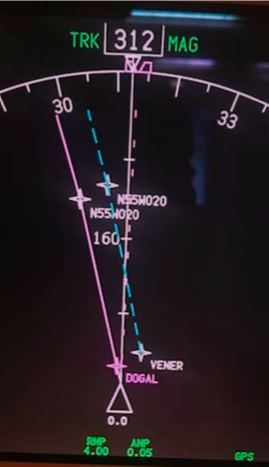
For the last few years, use of half degrees of separation has been on the rise in an attempt to enhance airspace efficiency. But on flight displays units that only show 7 digits, these half degree coordinates are misleadingly displayed as full coordinates. For instance, the half coordinate N55°30’ W020° will display as N55°W020° (see image below, which shows identical waypoint labels for points separated by half a degree!). In this case, it is imperative to view the expanded version of coordinates (degrees and minutes).
Another frequent error leading to GNE’s is transposing numbers during data entry. This commonly occurs when you complete almost the entire crossing along one degree of latitude, then fly the last waypoint at a different latitude. For example, with a cleared route of 57°N 050°W, 57°N 040°W, 57°N 030°W, 56°N 020°W, one can accidentally enter 57°N 020°W. This will put you 60nm off course.

But there is good news! These errors are easy to recognize and avoid by having a specific method of waypoint verification.

2) Waypoint Verification

Whether entered via ACARS or manually, both crew members must come together to perform a thorough cross-check. The following method recommended by ICAO in Doc007 seems to work the best:

  • One pilot reads the waypoint/coordinates, bearing and track from the FMS.
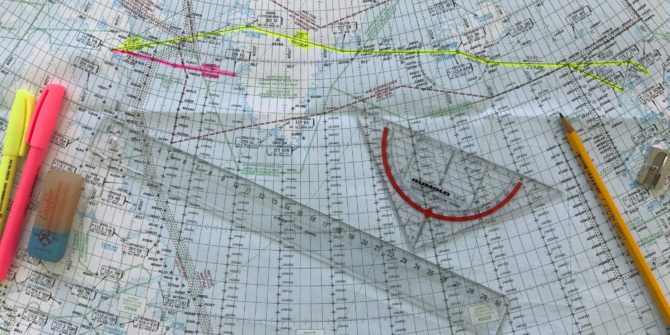
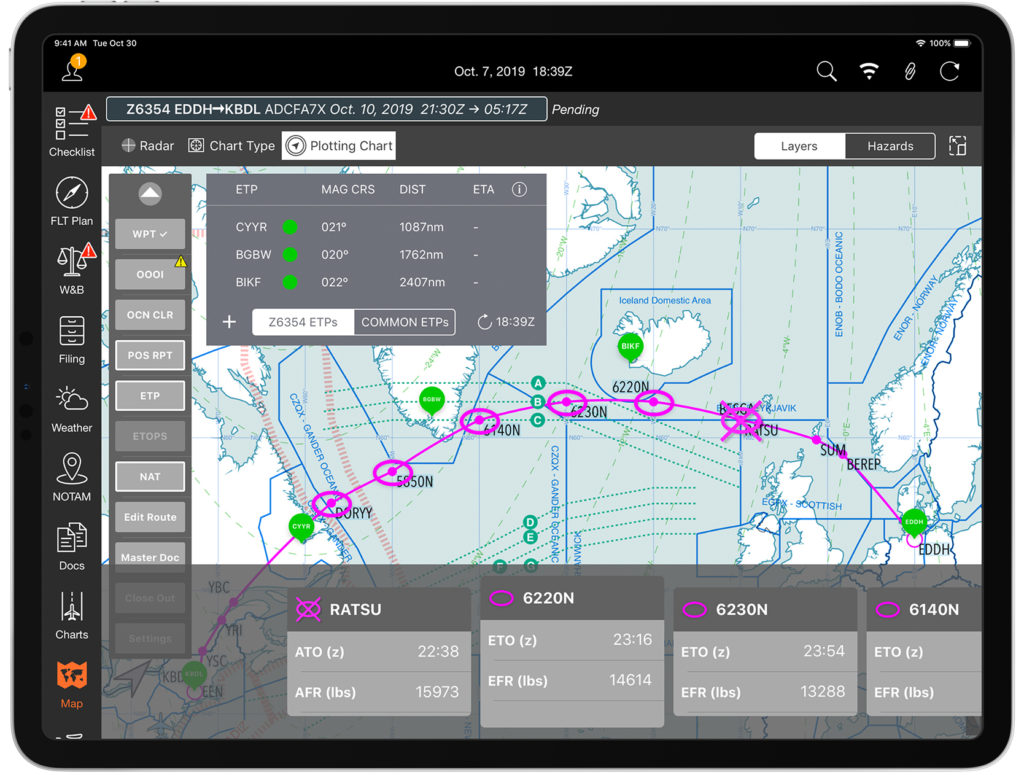
  • On the master document, the other pilot will circle the waypoint to signify the insertion of the correct FULL coordinates in the navigation computers
  • The circled waypoint number is ticked, to signify the relevant track and distance information matches
  • (In flight) The circled waypoint number is crossed out, to signify that the aircraft has overflown the waypoint.

[fancy_box box_style=”default” icon_family=”none” color=”Accent-Color” border_radius=”default” image_loading=”default”]

Cognitive Traps:

Expectation Bias is when your perception is influenced by your preconceptions. It is vital that the second crew member crosschecks from the FMS/CDU to the master document – and not vice versa – thereby increasing the chance of spotting an error.


Pop-up trip hustle – It’s one thing reading about waypoint verification, but it’s another thing actually sitting down and taking the time to do it. Do not be tempted to crosscheck your own work because you’re in a time crunch – it requires at least two separate sets of eyes.[/fancy_box]

3) Initialisation of navigation systems

The navigational integrity of your entire flight is predicated on an accurate starting position. Even a small error with on the ground can translate into a gross error later down the line in flight.

The FMS GPS position and your current parking coordinates (found on the 10-9 pages) must match. Avoid using “last position” function in the FMS – if you were towed overnight, the “last position” will be your previous location, not your current one! Sounds obvious, but mistakes happen.

Inertial systems, once aligned, must also complement the GPS coordinates. Initialisation of inertial navigation systems can take between 6-15 minutes, and errs on the longer side at more northerly latitudes – so be patient! Moving the aircraft during alignment will cause an alignment error. Bottom line: avoid repositioning/towing the aircraft during alignment, even it is to a nearby spot on the same ramp area. Position errors like this cannot be corrected once in flight.

4) Your Master Clock – (iPhones not authorised!)

Since our ETAs for oceanic waypoints must be accurate within +/- 2 minutes, it is vitally important that, prior to entry into the NAT HLA, your master clock is accurately synchronised to UTC. ICAO Doc007 has a list of approved sources from which you can set your aircraft master clock (and your iPhone isn’t one of them!). You are approved to use the GPS time which can be found in the FMS.[fancy_box box_style=”default” icon_family=”none” color=”Accent-Color” border_radius=”default” image_loading=”default”]

Cognitive Trap:

Close to the E/W Greenwich line or close to the equator, you’ll just be on the fringes of the opposing segment. So, take a close look at the E/W or N/S letter coordinates, especially if you are usually accustomed to flying from one particular geographic area.[/fancy_box][heading]Clearances & Communication[/heading]With a move away from spoken communications and towards datalink procedures, requesting, copying and verifying a clearance becomes a much simpler task! But it is still important to know your own limitations in the rare instance that you need to copy a clearance via voice.

Casual radiotelephony should be avoided

Casual radiotelephony can be the source of misunderstanding coordinates or clearances, and so all waypoint coordinates must be read back in detail, adhering strictly to standard ICAO phraseology. An example of standard ICAO phraseology requires enunciation of every individual digit. 52 North, 030 West would be read back as “Fife two north, zero tree zero west” as opposed to “fifty-two north thirty west”. Have no doubt about it, Shanwick can be the most strict in this regard.


Distractions and workload

If your departure airport is close to the oceanic boundary, e.g. Shannon or Miami, the benefit is that you will copy your oceanic clearance on the ground. Unencumbered by distractions typically associated with being in flight, you can focus almost fully on the task at hand. However, most flights pick up an airborne clearance, and it is important to prioritise this for a period of low workload.

Take the example of a Bombardier Global Express crew that narrowly avoided a GNE after copying a clearance. While they were in the midst of crosschecking the clearance with the FMS and climbing to their initial altitude, the flight attendant approached them with an issue. Instead of waiting, one of the pilots attended to the problem. A new waypoint wasn’t entered, and it was later caught by ATC in a position report. Try to avoid non-vital tasks until ALL the steps regarding copying, verifying and inputting a clearance are complete.

Following these simple standard operating procedures (SOPs) step-by-step will guard against clearance errors. If the steps are interrupted for any reason, start again from the beginning.

  • Two pilots monitor and record the clearance. The Pilot Monitoring (PM) will contact clearance delivery, while Pilot Flying (PF) monitors both the primary ATC frequency and the clearance delivery frequency.
  • The PM then records the clearance on the master document. The PF also copies down the clearance separately.
  • Clearance is read back to ATC. Any disparities between both pilots’ interpretations of the clearance must be clarified with ATC.
  • A deliberate cross check of the clearance to the filed flight plan and the FMS is made.

Re-Clearance

According to ICAO Doc007, “In the event that a re-clearance is received when only one flight crew member is on the flight deck…changes should not be executed…until the second flight crew member has returned to the Flight Deck and a proper cross-checking and verification process can be undertaken.” Sorry, they just don’t trust you to do this by yourself, and neither should you!

Errors associated with re-clearances, re-routings and/or new waypoints continue to be the most frequent cause of GNE’s. Therefore, a re-clearance or amended clearance should be treated virtually as the start of a new flight and the procedures employed should all be identical to those procedures employed at the beginning of a flight.

  • Both crews note the re-clearance
  • Reply to ATC via ACARS or voice
  • Amend the Master Document
  • Load the new waypoints into the FMS from the updated Master Document
  • One pilot verifies the input of the new waypoints reading from the FMS
  • Verify the new tracks and distances, if possible
  • Prepare a new plotting chart/re-plot in Jeppesen EFB

With datalink, you might have the capability to load the new route directly from the ATC message into your FMS flight plan. This will eliminate a transcription error on your part, but you cannot always count on the FMS to load this seamlessly. Oftentimes, if a revised coast-in waypoint doesn’t connect with your originally planned domestic airspace airway, it might cause a discontinuity. Worse, some crew have experienced their entire domestic flight plan drop out, left with only the oceanic portion.

Conditional Clearances – There’s always a catch!

A conditional clearance is an ATC clearance given to an aircraft with certain conditions or restrictions, such as changing a flight level based on a time or place. Conditional clearances add to the operational efficiency of the airspace, but are commonly misinterpreted by flight crews.

Shannon has been known upon first VHF contact to provide lateral conditional clearances on coast-in. For example: “N135AC, after DINIM, direct ELSOX”. Often, crew have been known to read back the correct transmission, but then execute the wrong procedure by proceeding directly to ELSOX.

Why is this happening? In studies of linguistics, verbs (such as ‘direct’) have been noted as having a perceptual priming effect, that more easily grabs our attention at the expense of weaker prepositions (such as ‘from’ or ‘after’). Listen carefully for prepositions. Similarly, in aviation vernacular, the word ‘direct’ means to proceed now to the specified waypoint. As pilots, we can distinguish this meaning with very little effort, and most of the time can expect to proceed present position direct. Thus, we are primed to go direct.

While this isn’t a complex sentence, research indicates that transmissions involving serial recalls (such as “proceed here then here…”) are susceptible to distortion, with the last word or item more commonly interfering with recall of the previous item.

A really simple way to prevent this is to write down clearances as they are being read to you, then read-back the transmission. You can also call attention to a conditional clearance by prefixing their read-back with the word “Verify” or “Confirm” over the radio. Via datalink, sufficient care always must be taken when factoring in all the contents of a clearance before acknowledging the message. The initial phrase “MAINTAIN FLIGHT LEVEL 300” is included to stress that the clearance is conditional. If the message is about to time out, and you need more time to process its contents, reply using “Standby”. Respond at your own pace![fancy_box box_style=”default” icon_family=”none” color=”Accent-Color” border_radius=”default” image_loading=”default”]

Cognitive Trap:

On the longer route segments between New York and Santa Maria, “when able higher” (WAH) reports might be solicited. ATC acknowledgement of a WAH report must not be misconstrued as a conditional clearance to climb. Any climb clearances will be issued separately from a WAH acknowledgement.[/fancy_box][heading]Miscellaneous[/heading]

10-minute Check – put the (Bad) Elf on the shelf for this

One of the best ways to capture a potential GNE and refresh your situational awareness is with the sublimely simple 10-minute check. Ten minutes after waypoint passage, you’ll use your current coordinates to plot your position on your plotting chart. If the coordinates don’t land on the plotted track line, an investigation into the source of the error must begin immediately. It doesn’t hurt to even make additional plots between waypoints too, but ICAO only requires the one 10-minute check.

Today, more pilots are carrying independent GPS units in their flight bags, providing crew with own-ship on their oceanic route map. Tempting though it may be to use this for present position information, it is currently not an approved source of navigation, and should NOT be used in lieu of a 10-minute check.[fancy_box box_style=”default” icon_family=”none” color=”Accent-Color” border_radius=”default” image_loading=”default”]

Cognitive Trap

It is easy to forget about the 10-minute check. Setting a timer once your waypoint passage tasks have been completed will help remind you to do so.[/fancy_box]

Autopilot mode – “Wait, are we supposed to be in heading?”

Incorrect autopilot mode selection has been known to be a factor in GNE’s. On an oceanic crossing, you can bank on being in NAV or LNAV most of the way across the Atlantic. But perhaps you used heading mode to deviate for weather or to intercept a SLOP. It is not uncommon among pilots to spare your passengers two steep banking turns (thanks LNAV!) by manually flying a SLOP intercept in heading mode. But if you forget to re-engage LNAV, you will continue drifting on your merry way, further and further off course.

Distraction, fatigue or complacency are common reasons for losing mode awareness, so the following simple tricks will help mitigate autopilot induced GNE’s.

  • It helps to verbally announce when you are transitioning temporarily into heading mode, to bring both pilots in the loop.
  • Employing sterile cockpit until you’re back in LNAV will help mitigate distractions.
  • In an abundance of caution, you can keep a finger on the heading button or heading dial until you are back in LNAV will serve as a reminder.

[fancy_box box_style=”default” icon_family=”none” color=”Accent-Color” border_radius=”default” image_loading=”default”]

Cognitive Trap:

The flight mode annunciators (FMA’s)  are the most reliable indicators of automation selection – more so than the flight guidance panel! Yet, a study found that pilots pay superficial attention to the FMA’s during critical mode changes. Don’t waste a valuable resource, and do consciously bring the FMA’s into your scan.[/fancy_box]Deliberate cross-checking and monitoring are a critical last line of defense for which we, as pilots, don’t get explicit training, but are nevertheless expected to perform effortlessly. But over the North Atlantic, there is little room for error. So, let’s recap what can be done!

  1. Allow sufficient time on the ground to set up
  2. Closely scrutinise data entry – whether the source is human or ACARS!
  3. Work together on waypoint verification
  4. Don’t work single pilot – always keep all crew in the loop
  5. Deal with clearances and re-clearances methodically

Understanding our vulnerabilities is key to the process of mitigating errors. Armed with an understanding of our own limitations, and an appreciation for the practices and habits mentioned above, a ‘would-be’ GNE can be averted.

Links

ICAO Doc 007 

Global Operational Datalink Document (GOLD)



Deteriorating post-election chaos in Bolivia

A single Notam for the country’s largest international airport indicates there’s no fuel available for a number of days. That’s always a surefire sign that something pretty serious is going on. 

The contested presidential elections last month in Bolivia has quickly led to civil unrest across the country in the past few weeks. Demonstrations, strikes, and roadblocks have resulted in armed conflict between opposing protesters as well as armed forces in which 32 people have died so far in what some are calling an uprising and others a coup. We’re going to take a look at the cause of the unrest and how international operators may be affected, especially when the trucks carrying your jet-fuel to the airport are attacked.

The Escalation

Evo Morales, the long-term Bolivian President won a contested election in October, but evidence quickly surfaced that the results were manipulated. Protests from Morales opposers erupted when Morales refused to stand down until eventually resigning when the military “requested” he do so in the interest of stability, but not before the current unrest unfolded. He is now seeking asylum in Mexico. Three other officials who were in line to be the constitutionally defaulted interim presidents all resigned and/or fled the country. The role eventually fell upon the deputy leader of the Senate and opposing party member, Jeanine Anez, who promised to hold new elections soon. Some countries are recognizing Anez as the President, while others are refusing to do so.


Morales supporters began countrywide protests as he would not be included in the new elections, a move they claim to be a part of a larger military coup. Protests between the two groups and with the armed forces have led to volatility in the past month. Bolivia’s constitution calls for the new elections to be held within 90 days.

Security

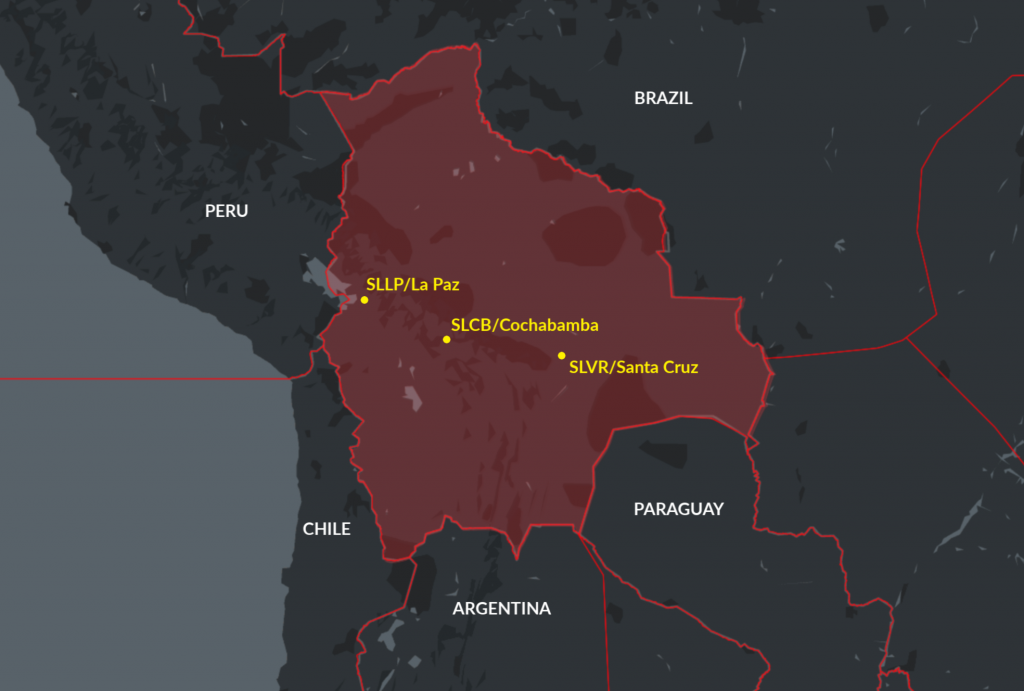
The US State Department has issued a Level 4: Do Not Travel Advisory for the entire country. State department non-emergency employees and their families have been ordered to evacuate. A Notam for SLLP/La Paz airport has been issued stating there is no fuel available. Protesters attacked a military escorted fuel convoy headed to the airport from a large nearby fuel plant, and further protests have been planned to occur near the airport. The Notam for La Paz has been pushed back three times so far and there’s no estimate of when fuel will again be available.

“We have not had anyone going into Bolivia for well over a month,” said Brian Leek, owner and CEO of FAM International Security, a global corporate security solutions firm. “If you don’t HAVE to go, don’t. Simple answer. Things have been brewing there for months and it finally burst last month.”

The demonstrations and barricades have closed roads in La Paz as well countrywide highways and access to airports. Security cannot be guaranteed. The intervention by the armed forces has escalated quickly, with tear gas and live ammunition being fired to disperse protests resulting in deaths across many of the larger cities like La Paz and Santa Cruz.

Is It Safe To Travel Throughout Bolivia?

Due to the instability, the simple answer is: Not right now. Leek is advising all operators to defer travel, at least until the beginning of December or whenever the new elections are announced. With the news that elections will be held soon, there is optimism that the violent protests will decrease as Morales opposition leaders are calling for peace. However, many Morales supporters state they will continue protests in demand that the former president be given an opportunity to return. One international medical and travel services company received reports of clients’ cars being attacked by protesters and one car being hit by an armed forces vehicle responding to a demonstration.

If you do operate into Bolivia, local ground handler, Pike Aviation, is recommending SLVR/Santa Cruz where fuel and full services are available and the protests in the city are minimal. SLCB/Cochabamba is also operating normally, but conflicts continue in the city. They also do not recommend operating into SLLP/La Paz. Leek couldn’t agree more. “If you have to go, Santa Cruz is an acceptable substitute. Just know that security around the airport is weak. So have plans in place to protect the aircraft.”


Regulatory deadlines on the horizon

Regulatory compliance – nothing quite warms the heart like reading those two words, side by side. This year has seen quite a few changes in this department already (thank you, NAT HLA!), but here is a list of some other regulatory deadlines on the horizon…

Dec 31, 2019 – Operations in North Atlantic

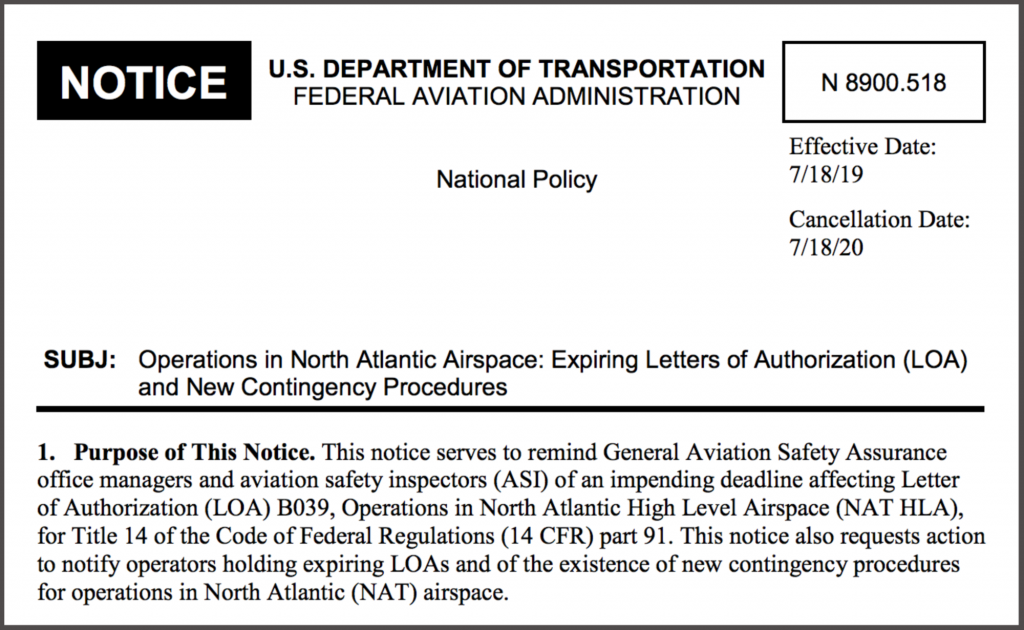
  • U.S. operators must have the revised LOA BO39: “Operations in North Atlantic High Level Airspace (NAT HLA)”. Operators holding the old MNPS LOA BO39 will not be permitted to fly in the NAT HLA beyond this date. Requirements include: RNP10, crew training and new contingency procedures incorporated in company operating handbooks. Read our article here.

Jan 1, 2020 – US ADS-B Out Mandate

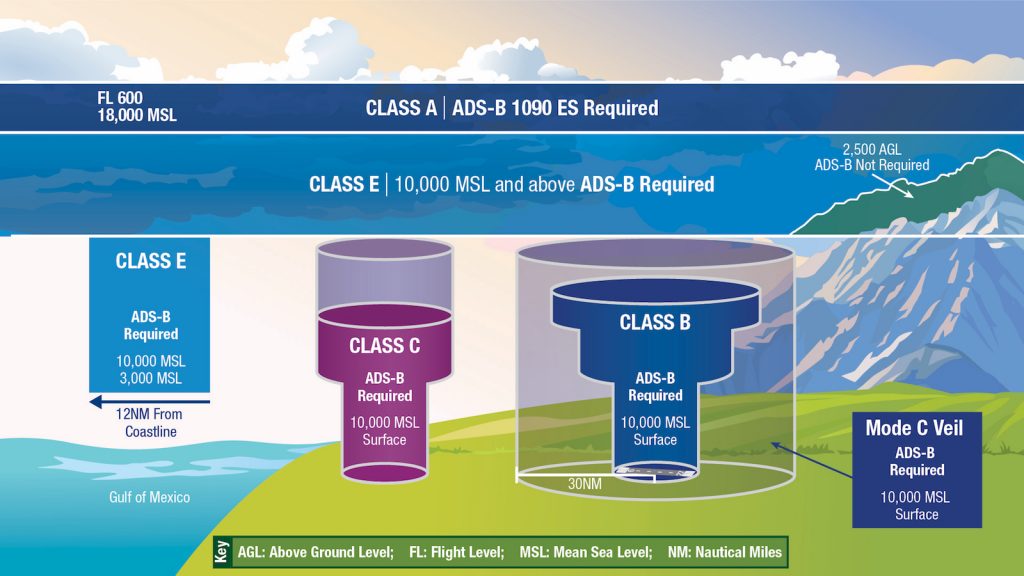
  • ADS-B Out will be required where Mode C is required AND:
  • Class A, B and C airspace, Class E at or above 10,000’ MSL (but not below 2,500’ AGL).
  • Within 30nm of Class B (Mode C veil).
  • Above the ceiling and within lateral boundaries of Class B and C up to 10,000’.
  • Class E over Gulf of Mexico, at and above 3000’ MSL within 12 nm of US coast.

Jan 30, 2020 – Expansion of Datalink Mandate in the North Atlantic

  • Phase 2C of North Atlantic Datalink Mandate. FANS 1/A CPDLC and ADS-C will be required between FL290-FL410 throughout the entire NAT region (previously FL350-390). Read our article here.

Feb 5, 2020 – European Datalink Mandate

  • Initially legacy aircraft flying above FL290 in European airspace were to be equipped with CPDLC capability by Feb 2015. But due to equipage requirements and technical issues the mandate was delayed to Feb 2020, AND, even better, most GA/BA aircraft will be exempt from this. Read our article here.

June 7, 2020 – European ADS-B Out Mandate

  • Aircraft flying IFR in Europe with max certified takeoff weight of more than 5700kg (12,566lbs) OR max cruising TAS of more than 250kts must be equipped with ADS-B. GPS sensor with at least WAAS accuracy coupled to a 1090 Extended Squitter transponder required.


DELAYED:

Canada: ADS-B Out Mandate

  • This was planned to be implemented in Class A airspace from Feb 2021, and Class B airspace from Jan 2022. But Nav Canada has now postponed this mandate. They still plan on using ADS-B for surveillance, and this will be used on a priority basis for suitably equipped aircraft starting in 2021, but they say – “non ADS-B Out equipped aircraft will be accommodated within the airspace until a performance requirements mandate can be implemented.”

ALSO ON THE HORIZON:

August 14, 2020 – EU: SAFA Ramp Checks & Pilot Mental Health

  • EASA regulations requiring alcohol testing during ramp checks will take effect across all SAFA participating countries (although some countries have already started doing this: Austria, Belgium, Czech Republic, France, Germany, Greece, Iceland, Ireland, Italy, Netherlands, Portugal, Spain, Switzerland, UK, and Singapore). Tests may also be carried out by local police at any time.
  • All pilots working for European airlines will have access to mental health support programs.
  • European airlines will perform a psychological assessment of their pilots before the start of employment.

Any other biggies that we missed? Let us know!


Escape From New York: How To Get In & Out of Teterboro (2019)

There’s nothing that will drain a smartphone battery quicker than a ground delay in Teterboro. Preflight complete, flight plan loaded, passengers onboard (they were actually on time for a change), engines started and – wait for it – you are instructed to contact “ground metering.” The word itself can make the stomach drop.

Yes, a line of thunderstorms is moving in, but it’s not quite solid. Most of my route does not look affected, but far better minds than mine have determined that diverting traffic require them to close my entry gate, as well as most of the surrounding ones. I receive an Expect Departure Clearance Time (EDCT) of over three and a half hours away!

Normally I make it as far as taxiing just short of TEB’s RWY 24 before the controllers present me with such a lovely ground delay and instruct me to park in the “penalty box.” This time I hadn’t even left the chocks (I wasn’t even actually supposed to start the engines before contacting “metering”, but of course I didn’t admit that mistake to the controller).
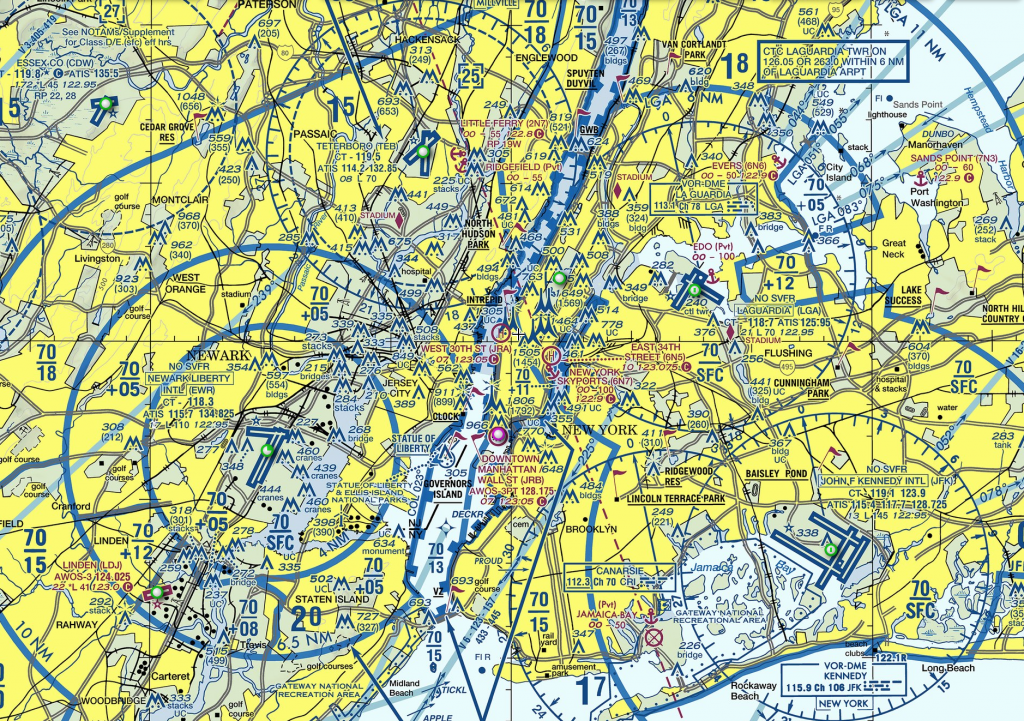
Ground delays due to weather or traffic saturation are not uncommon in Teterboro. We have to hand it to the Teterboro ATC staff for efficiently controlling one of the busiest GA airports in the world (about 174,000 arrivals a year). They not only deal with all the complications that come with being located under some of the most congested airspace in the world, they patiently work everyday with a bunch of A-list pilot personalities that think their schedules are more important than any delays. Well done, you ninjas of New Jersey!

Weather, traffic and pilots aren’t the only issues they’ve been dealing with lately. Improvement projects have been steadily grinding along for the past year and a half. And guess what? There’s even more to come!

So, after I inform my passengers of this delay, allow me to hop back up in the cockpit and let’s discuss some Teterboro info with the help from our good friend Dave Belastock, President of the Teterboro User Group. Perhaps you heard him speak on the latest OpsChat, but, if not, we’re going to dive in a little deeper.Oh, by the way, don’t be offended while I analyze my fantasy football scores on my phone; I’m a multi-tasker, and we’ve got three and half hours – well three now – to go and I’ve got 85% battery life on my phone left.

 

EDCT: T minus 3:00, battery 85%

The Entry

Getting into Teterboro can often be a frustrating game. When calling for a clearance at your departure airport, wagers can be made that an EDCT will be issued. Gone are the days in which operators would file a nearby airport (KMMU/Morristown, KHPN/White Plains, etc.) and change the destination to TEB enroute to avoid such ground delays. I’ve never tried it, but I did witness a former chief pilot broach the subject with clearance delivery at a Midwestern airport about attempting this. “If you to try that stunt, I’ll route you through Florida,” was the controller’s response.

But getting the heads-up on delays may depend upon early filing. The FAA’s Traffic Management Unit coordinates the flow programs into airports experiencing delays. According to one TMU official, “Get your flight plan filed prior to program implementation (at least a day in advance) and try not to change that proposal time. The command center ‘optimizer’ computer will issue releases/slots based on those times. And your flight plan won’t drop out of the system until 2 hours after your EDCT.”

I’ve had service providers tell me that the earlier you file, the higher up you are on the departure list. I never knew if this was true or not, but it may look like it certainly has a partial effect.


EDCT: T minus 2 hrs 30 mins, battery 67%.

Upon arrival into Teterboro, you will watch your TCAS light up like a Galactica arcade game, especially on a clear day. Glider activity near the MUGZY waypoint on the LVZ STAR to the northwest and GA traffic from multiple small airports flock below you. And the question usually comes up once you are beneath Newark’s Class B airspace: “What speed should we be going?”

The answer is of course 200 knots. But more than once I have been angrily asked by a controller what my speed was and, after answering 200 knots, speed reductions were quickly mandated to traffic following behind me. Thus, there was a perception that NY Tracon needed you to keep your speed up into TEB. But no controller may authorize an aircraft to exceed 200kts under Class B. If it makes you feel better to report your speed reduction, be my guest. But the answer is 200kts.

Those familiar with TEB approaches understand that you must certainly be on your game and brief your approach. The ILS RWY 6, including the circle to land RWY 1, has a mandatory altitude of 1500 feet at DANDY that pilots are still not making before intercepting the glide slope. The circle procedure can be tricky, especially with a tall antennae to the south of the airport. And if winds are gusty from the northwest expect turbulence from the distant hills. In 2017, a Learjet became unstable during this approach, stalled and crashed as the crew were unprepared for the approach. Early briefing and proficient monitoring will ensure a safe and simple approach.


EDCT: T minus 2 hrs, battery 50%.

Belastock mentions that a new RNAV GPS RWY 19 with LPV mins is expected to be published in December. Some aircraft flying a coupled ILS RWY 19 with the localizer captured at 2000 feet have experienced an uncommanded climb due to a false glide slide capture. This glide slope perturbation is triggered by aircraft moving on taxiway Q across RWY 19 and passing in front of the glide slope antennae, which briefly deflects the signal downward enough to satisfy capture parameters. Once the taxiing aircraft has cleared the glide slope critical area, the beam returns to its proper angle. If you have Approach mode armed, the autopilot may grab the temporarily deflected glide slope and then pitch up when the signal returns to normal. Close monitoring and quick action are required to prevent an altitude deviation. The GPS approach would circumnavigate this potential issue.

And speaking of that turn between UNVIL and TUGGZ to intercept the final approach course, you could very well see VFR aircraft just below you. You are outside Class D airspace at that point so separation requirements aren’t necessary. While other NY area airports have communication requirements for VFR traffic transitioning near congested airspace, TEB has none. TUG is currently working with the FAA to create a Class D transition area to the north to require communication. Fingers crossed.


EDCT: T minus 1hr 30 mins, battery 42%.

The Escape

RWY 6-24 is going to see substantial improvement in 2020. Currently, the plan is to close the runway several evenings through the summer, starting the day after Memorial Day through Labor Day. “Port Authority of NY and NJ staff have worked diligently to create a schedule that would least affect operators,” explained Belastock. “We are anticipating RWY 6-24 to close from 10pm Saturday nights until noon on Sundays. And then there will be two 24-hour closures beginning at 10pm Friday through Saturday night at dates to be determined.”

This will inevitably switch up the normal departure procedures. Whereas the RUUDY RNAV departure (we’ll discuss good ol’ RUUDY in a second) is the traditional departure, the alternative will be the DALTON 2 departure.

“Do you ever wonder why you have to hold short of RWY 24 for an extended period of time waiting for an IFR release?” asks Belastock. “That’s because NY Tracon requires a 10nm separation between you and the overflying Newark traffic.” The Dalton departure, however, is a VFR-IFR departure.

VFR? Really?

Yep, just as the instrument departure plate reads, aircraft depart VFR – 3 sm visibility and 3000’ ceilings are required – and when handed over to the departure controller, the IFR flight plan is activated. Theoretically there is no gap required between the VFR Teterboro departures and IFR Newark arrivals. But consideration was taken between all stakeholders, and a 5nm gap between TEB and EWR traffic was agreed upon. “TEB clearance can’t solicit the departure. You must request it and have a published departure plate available in the cockpit,” said Belastock.

Though this could mean a reduction in release time, if there is a delay in progress controllers can only offer an “indefinite delay” for traffic or weather issues, whereas they can give you a set time if using the other IFR departures. “Actually, NY Tracon is encouraging it. They want pilots and controllers comfortable with it,” said Belastock.

As for the RUUDY RNAV departure, good news! Pilot deviations are decreasing. Belastock and TUG worked closely with training facilities as well as OPSGROUP to get the word out. I even noticed the RUDDY departure was included in my latest recurrent simulator training. With the altitude restriction and noise abatement restrictions pilots need to be extremely situationally aware. “We don’t want to tell pilots how to fly their aircraft,” said Belastock. “But we need them to be fully aware of how the departure operates.”


EDCT: T minus 1:15, battery 37%.
The Window of Opportunity

My eyes are burning a bit from so much screen time on my phone. I query Gate Hold again – just like the other 73 pilots that are trying to chime in. Yep, that’s me you’re rolling your eyes at.  My EDCT time is actually extended further even though the weather is past my entry gate. “Is there anything we can do to get out of here,” I reply with a frustration.

“Can you fly a final altitude of 14,000 feet?”

Confusion mixes with a sense of impending opportunity. “Standby,” I answer. I always take extra fuel out of TEB, but I’m sure there cannot be enough to fly that low. I run the numbers…and, I’ll be damned, we can make the destination with a safe fuel reserve.

“Actually, yes we can,” I reply excitedly. “Start your engines and contact ground control,” comes the reply. As I taxi past all the other waiting aircraft, I couldn’t help but feel a sense of guilt…and some pleasure as well.

We departed on the RUUDY departure, flew west while climbing to 14,000 feet talking to NY Center and several approach controllers. When we were handed off to Cleveland Center, we requested a more appropriate cruising altitude and given it without question.

I later called TEB tower to see how this “gift” actually occurred. “It doesn’t happen often. But since your entry gate and route were getting so saturated with diverting traffic, you couldn’t fly it at your filed altitude. But this wasn’t the case for the lower altitudes,” explained the controller. “I can’t offer it unless you specifically ask. But even then it probably won’t be granted.”

I’ve been flying in and out of TEB for 15 years, and I’m still often learning new details about its operation. Perhaps I’ll keep this tool in my back pocket for the next great escape.


Mexico’s revamped CAA to make permit applications even tougher

If you thought that applying for Mexican landing permits couldn’t possibly get any more complicated, then think again!

On 16th Oct 2019, the Civil Aviation Authority in Mexico (DGAC) became the Civil Aviation Federal Agency (AFAC), and it sounds like they mean business. Local handlers are saying that policies and procedures that were typically overlooked or handled with lax criteria in the past are now expected to be more strictly enforced.

The following changes apply to Part 135 commercial operators looking to obtain Mexico landing permits. (For Part 91 private operators, no changes to the current rules and requirements are expected at present).

Insurance Policies

It’s long been the case that you need two insurance policies for ops to Mexico: your standard worldwide one, and a specific Mexican one issued by a Mexican company.

Authorities are now saying that for both of these policies, the original copies must be submitted in full; with coverage details, proof of payment, and aircraft details clearly shown. Digital copies are not good enough, and there have been some cases reported where applications have been rejected due to seemingly trivial things such as the signatures being too blurry, or even the “courtesy translation” stamp being on top of a signature.

Power of Attorney

To get a landing permit for Mexico, you need to nominate a local handling agent, sign a Power of Attorney saying that they are your legal rep there, and then the CAA will release the permit to them.

Previously, authorities were happy enough with a scanned copy of this Power of Attorney, but they are now saying this must be submitted as a notarized original with an Apostille. If you’re applying for Single Landing Authorization (see below) for short notice operations, you will have to send a digital copy of this, and commit to follow-up by sending the original copy too once available.

Single Landing Authorizations (one time shots):

The CAA traditionally allowed operators up to five Single Landing Authorizations before requiring an Indefinite Blanket Permit if operators continued flying into Mexico. The AFAC is now cracking down on this. So “one and done” will be the new rule with Single Landing Authorizations. After that, the Indefinite Blanket Permit must be applied for (although you should still be able to obtain SLA’s on a case by case basis, once your application for the Blanket Permit is underway).


Whether these implementations will continue to be enforced in the long-term remains to be seen. But for now, it looks like operators should prepare to apply for the Indefinite Blanket Permit if they are planning on doing more than just one flight to Mexico. Here is the original post on this topic by local Mexican agent Manny Aviation – we thank them for their help with alerting us to this!


The Changing Face of Disaster Relief Flying – How General Aviation (and Social Media) is Making A Huge Impact

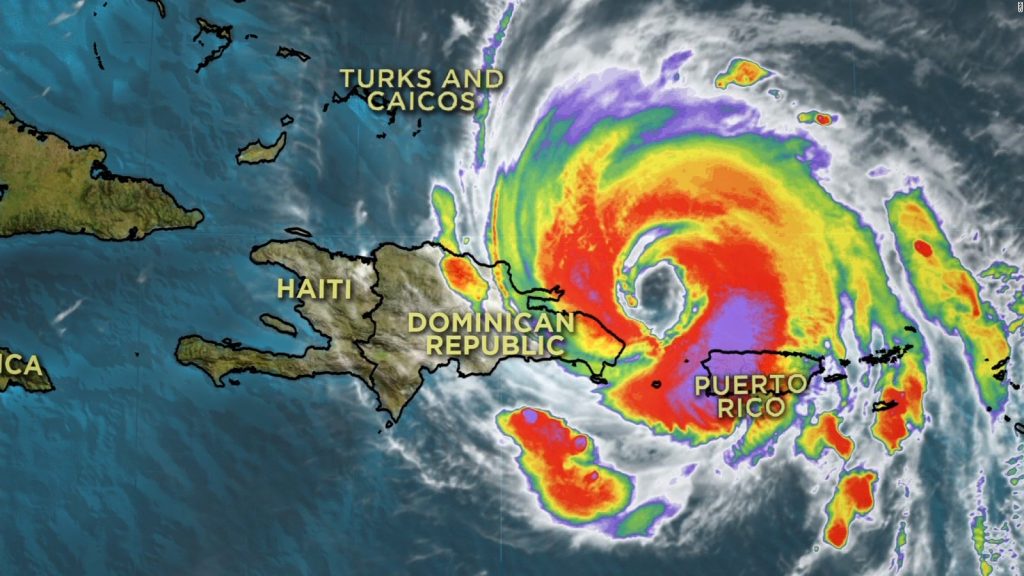
Approximately 200 miles east of Puerto Rico at Flight Level 390, a Miami Center air traffic controller beckoned us on the radio and commanded, “Descend to 17,500 or below and squawk VFR. Good luck.” Hurricane Maria had made land fall over Puerto Rico not even 48 hours prior, and, without power on the island, there were no San Juan Center air traffic controllers to coordinate aircraft flying through their large parcel of airspace.

This was our flight department’s first attempt at delivering humanitarian aid into a natural disaster zone so we expected some unknowns, but this directive was a bit unnerving. We had just begun our trip only hours earlier out of Ft. Lauderdale and now ATC wanted us to fly VFR over the ocean, 200 miles off the coast of our destination? Unknowns are one of many issues flight crews face on a constant basis, but being unprepared is quite another dreaded beast. Were we in over our heads?

A Burgeoning Resource

“Before Hurricane Katrina and the earthquake in Haiti, it was rare for Part 91 and 135 operators to partake in disaster relief,” explained Robin Eissler, the founder of PALS, Patient Airlift Services. “The past 14 years have seen so much change.”

When Katrina struck, Eissler began working with other flight department managers and dispatchers through the NBAA’s Airmail system to figure out a way to coordinate a general aviation response to the disaster. This would eventually become the building blocks for the HERO (Humanitarian Emergency Response Operator) Database, the NBAA’s registry for flight departments seeking to assist in such emergencies. “In terms of our HERO Database, we help to connect the aviation resource (airplane or other individual volunteer) with the relief organization best able to utilize that asset,” said Douglas Carr, Vice President, Regulatory and International Affairs of the NBAA. “Business aircraft can fly on short notice into airfields in which many airliners and cargo planes cannot.” The HERO program works closely with many humanitarian groups, especially Eissler’s PALS.

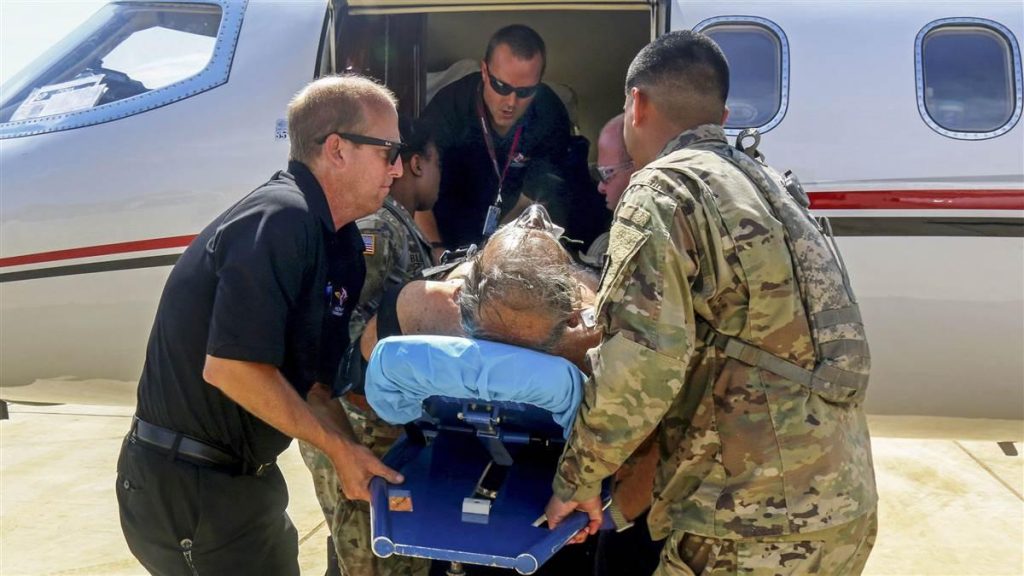
Shortly after Eissler formed PALS, the earthquake in Haiti struck. She described the general aviation humanitarian response as the grand experiment, “The government response was limited initially. The airlines shut down, and, other than military aircraft, corporate aircraft became a major source of delivering aid. We had over 1,000 flights for food and medical supply drops as well to evacuate the injured.”

In those early trials of PALS and the HERO Database, social media was a major asset. “We had a 13-year old girl in Haiti hit by a bus just after the earthquake and doctors said she needed an immediate evac,” recalled Eissler. “There were strict slots to get into Port Au Prince, and we had a G5 in Connecticut set to depart to get her when it had an engine issue. We immediately posted a need for help on our registry but also on Facebook. Five minutes later a Pilatus pilot just getting ready to leave Haiti posted that he had some room on the aircraft for her. She was delivered to the plane in critical condition laying in the bed of a pickup truck. But she’s alive and well today. Many might think social media is silly, but it can save lives.”

Now that the registries have been tested through further natural disasters, pilots and dispatchers can easily log-in and quickly see what requests have been posted and what missions might match their departments’ capabilities.

Haiti also played a major role in the creation of LIFT, a not-for-profit logistics provider for other NGO’s. It’s founder, Michael Rettig, spent over 30 years in the freight forwarding business. As he assisted in Haiti’s humanitarian response he saw what potential general aviation aircraft had to offer to such a response but also witnessed the lack of organization and preparation.

Rettig thrives on the efficiency of the supply chain and now applies his logistics experience to disaster relief through his organization. “60%-80% of every dollar spent on humanitarian aid used to be spent on logistics. That was way too inefficient,” he explained. “There’s a need for general aviation in humanitarian relief but there was a lack of coordination.”

Large transportation companies like UPS, FedEx and Maersk formed LET’s, Logistics Emergency Teams, to coordinate disaster relief. But general aviation was lacking such coordination. FEMA’s National Response Coordination Center was willing to listen to GA advocates but there needed to be more preemptive coordination. “Too many general aviation aircraft were showing up with aid that wasn’t necessarily what was needed,” Rettig said. “Flying in a G5 filled with Fiji water is a waste of money and resources. I much rather see medications like insulin or advanced communication system components and specialized technicians that can set them up being flown in. Corporate aircraft plug into the overall response framework by delivering high value, high impact aid.” Rettig and Eissler are very familiar with each other as their organizations work hand in hand during these responses. The required aid – whether it be medical or tech oriented – can be flown in and then medical patients can be flown out.

Planning Ahead

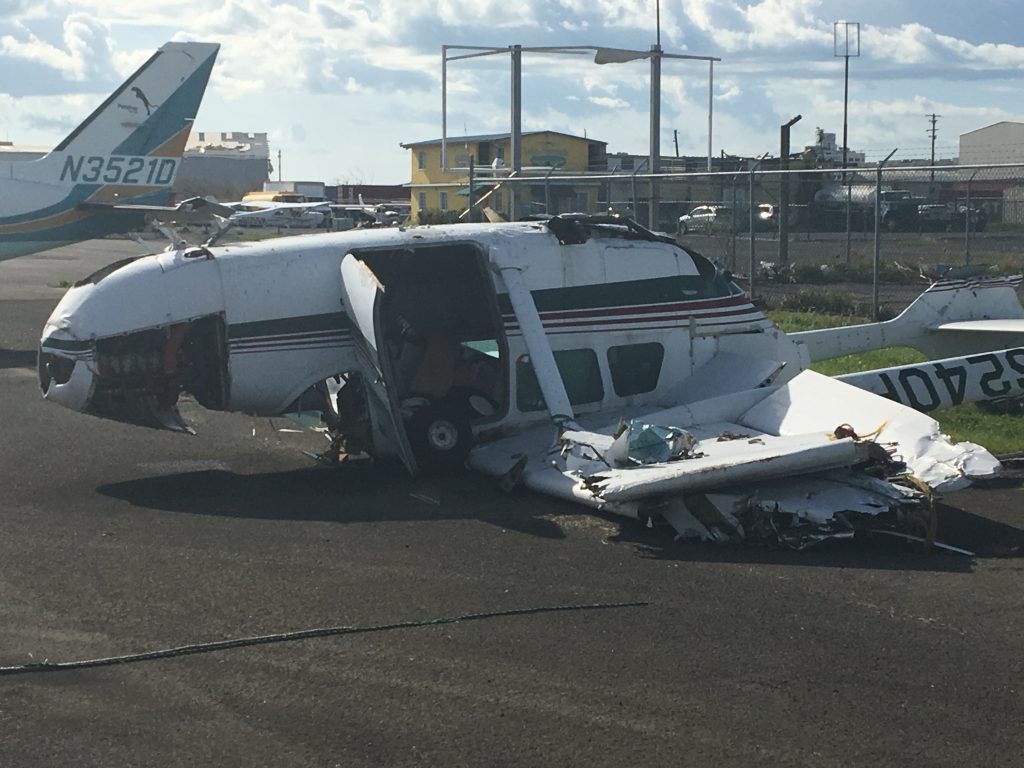
As we flew through the Wild West of uncontrolled airspace towards Puerto Rico, talking over a common radio frequency to the aircraft both ahead of and behind us as we obsessively monitored their positions on our Traffic Collision Avoidance System, we finally entered the traffic pattern over a small satellite airport in San Juan. After landing, we tried to maneuver down a taxiway with overturned Cessnas, mangled helicopters, obliterated hangars and even a pit bull limping down the tarmac. This was definitely unexpected.

Thankfully we had one of our maintenance technicians along with us who go out of the plane and guided us safely around the strewn debris. Surface conditions of the airfield are of a primary concern when entering a disaster zone, and without power and phone communications, there may not be much information available. Having a dedicated operator on the ground is so much more helpful in determining the safety of an airfield than putting all your trust in an email from an FBO employee or a flyover to check for debris.

Zac Clancy is Vice President of Global DIRT (Disaster Immediate Response Team), a nonprofit organization made up of prior military personnel who immediately arrive in disaster zones and even pre-position themselves in areas prior to a hurricane’s arrival. “We have multiple responsibilities from restoring communication connectivity to securing and transporting aid.” Once aircraft drop off the aid, what exactly happens to it? “We’ve seen cargo planes drop off tons of humanitarian aid on the tarmac and then leave. No one takes responsibility for it, no one protects it. We unload it, take legal responsibility for it and then work with other NGO’s to deliver it,” Clancy explained. Global DIRT employees also work directly with airport tower controllers in these affected areas on getting ATC slots and clearances for GA operators. “It’s interesting, in many cases I simply walk up to the control tower, knock on the door and speak directly with the controller,” said Clancy.

“We’ll assist you once you get here, but I highly suggest that all operators have a plan in place prior to any type of natural disaster response,” said Clancy.

As we unloaded boxes upon boxes of aid in the blistering afternoon air, we started to reexamine our original “plan”. Our dispatcher had worked tirelessly without rest since the hurricane hit to organize the flights as this type of mission was new to all of us, and she was learning on the go. “It’s the little things you don’t think of that you need to have already planned for. What are you willing and not willing to pack on the airplane? What company personnel should be permitted to go? Even, what type of packaging should be used?! Misunderstandings and miscommunications like these cause delays and headaches,” she explained. “What an aircraft owner or a corporation’s executive team may assume is possible, may not be so. Prior understanding is a key. And their understanding of the risks involved are necessary as well.” Eissler agreed, saying, “Corporate flight departments can get nervous once you start talking about safety and security and all the logistics on the ground. Working with us offers that extra layer of liability protection.” Rettig added – “If I can advise one thing, it’s to partner with a vetted organization that deals with these things. Don’t show up unannounced. No one wants disaster tourism.”

As we prepped our aircraft for departure, the skies over the small executive airport began to get congested with business jets transporting their own aid. A few go-arounds occurred and some aircraft exited the traffic pattern to manoeuvre back around to re-enter. Clear and detailed communications between flight crews were essential for safety.

As for communications on the ground, we were thankful to have a satellite phone to speak to our point of contact in the city that was delivering the aid by truck. ETA updates were necessary as NOTAM’s spelled out that all aircraft must depart the island by sundown or be stuck overnight. Thankfully, our maintenance technician had just finished dealing with an issue with our ELT as we didn’t even want to even consider the possibility of getting stuck overnight.

As we taxied to depart from our first disaster aid drop we were somewhat disappointed. We had planned on making two drops that day but delays in ATC letting us depart Ft. Lauderdale as well as delays in the actual delivering of the aid took much longer than we expected and there would be no way to make another round trip before nightfall. There was also a sense of guilt at having empty seats in the aircraft as we flew back to the mainland. Clancy couldn’t iterate enough, “The return legs of the relief flights are often under-utilized. While there is the need for aid coming in, often times there’s a need for things to go out as well: people highly in need of medical care, stranded citizens, and returning aid workers. Unfortunately, these flights back are empty because the planning wasn’t in place to know of such need.” In our situation, that would be the last time we would fly back with an empty aircraft.

Coordination

At the hotel that night, I began posting on OpsGroup about what we had witnessed, what we had learned, and what some of our concerns and misunderstandings were. The response was relieving as other operators and OpsGroup personnel chimed in with much needed info and support for the continuing flights.

Our dispatcher took her job to the next strata, and, in the ensuing days, we had much more structured missions. She coordinated with LIFT to send our own company’s disaster relief aid over in a cargo plane; no more strategic packing of goods in our corporate jet and no leaving behind of aid that was too big to fit in our plane. Whatever we needed to get over to the island could go. In exchange, Rettig coordinated a flight in which we flew technicians from a large tech company into a decommissioned naval airfield to begin fixing a specialized communication system to bring back cell coverage across the island.

There were no instrument approaches, just a government issued airport diagram. But a surprise radio contact from a Marine Corps air traffic controller aligned with a battalion sheltering in one of the decrepit hangars offered much appreciated assistance. Once again, the unexpected! As the technicians and engineers worked through the day, we could sense that this mission, which our aircraft was well suited for, may offer much more to the overall disaster response than the general aid we had delivered the day before.

The following day we flew in security and NGO personnel set up by ALANAid, American Logistics Aid Network, which works closely with LIFT, into San Juan International Airport, by then fully operational. Upon return, PALS filled the aircraft with sick and elderly personnel.

Again, we were a bit weary of what to expect as far as handling those in medical need. “As for planning, a flight department should know how they want to deal with the sick and elderly,” said Eissler. “We have you covered liability-wise, but departments have some small decisions to make beforehand – like, if they want passengers sitting up or laying down. What food, drink or medications you may want onboard. Many people don’t think of these things prior to picking up these passengers. But we point them in the right direction.”

Once we met our passengers, though, all weariness evaporated. Just witnessing their appreciation for simply taking them out of the sweltering FBO and into our aircraft’s air conditioning was heartwarming. And that would pale in comparison to witnessing them being reunited with family on the mainland.

The response in Puerto Rico made clear that there are a number of organizations that can assist a flight department in delivering disaster relief. Yet it seems to be a very small circle. They all seem to know each
other, work with each other… and, more importantly, respect each other.

It makes sense, considering the reason many of these people do this type of purposeful work. Before Katrina, Eissler was overseeing an aircraft management company.  A few years later after creating PALS, she would be getting calls from the military. “I’ve ordered an Air National Guard commander where to send his aircraft while standing in my kitchen on the phone. I’ve yelled at a commander for landing his C130’s on a runway that couldn’t support its weight. I’ve called in for a King Air to fly over a runway to check its integrity for other aircraft. And here I am – a mom in Texas and I’m making these calls!”

Rettig took a similar path; before Haiti he was working for a large shipping corporation but after coordinating a small aid flight in a friend’s PC12 to Haiti he found a passion. Now he’s handling transportation in all forms and sizes to assist NGO’s with humanitarian aid logistics across the globe. That passion underlies how many of these organizations can help general aviation departments in their effort to deliver humanitarian aid.

We continued flying into Puerto Rico for a few more days. Each day the mission changed but the logistics of the flights got easier as basic services began coming back on line. On our last flight back to the mainland to drop off passengers in Ft. Lauderdale, I walked an elderly woman with kidney failure into the FBO. After her awaiting family celebrated her arrival she hugged me with a tear smeared face. She then proceeded to FaceTime with her niece, an unmarried nurse in NYC. While holding me in the in frame of the phone’s video feed, she asked if I was married and if I’d like to meet her niece. More of the unexpected! Her hearty laugh was a great ending note on what was such a meaningful – and adrenaline filled – week of flying.

That year we would respond to hurricane aftermaths in Texas, Florida and North Carolina. And though we hope for no more natural disasters, we know better. And we look forward to helping in any way we can when they do happen. In normal operations we focus on service to ensure safe and successful business operations, the importance of which cannot be overstated. But when disaster relief becomes the business at hand, one cannot help to feel an even greater sense of purpose. Though achieving that goal can be daunting and anxiety-ridden, there are dedicated people out there to help in succeeding in that mission. And all who take part just may find enjoyment in the experience, even in the unexpected.

Resources