SE Asia Monsoon Season: What Are LSWDs and Why Will They Cost You Fuel?

June marks the start of monsoon season throughout Southeast Asia. From now until October, enroute weather deviations will routinely exceed 100nm.

This creates a significant challenge for controllers and coordination between the high number of FIRs that span congested air corridors between Taiwan, Hong Kong, Singapore and Indonesia.

To make matters worse, the 2024 Monsoon season is predicted to be a bad one.

And so, the answer is something called Large Scale Weather Deviation Procedures (LSWD) already innocuously appearing in FIR Notams like the one below.
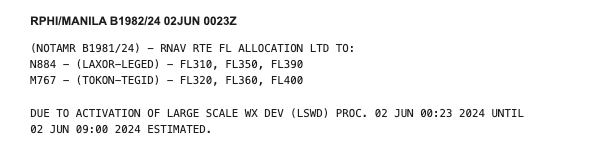
This raises two important questions:

  • What does LSWD actually mean?
  • What are operators doing about it?

In a nutshell, your standard contingency allowance may no longer be enough – meaning unfamiliar operators (especially on fuel critical routes) may unexpectedly be caught with their pants down.

So, let’s take a closer look.

The 2024 monsoon season is going to be bad.

The clever folk at the World Meteorological Organization recently said so.

Last year, in comparison, was weak.

You can take a look at their full report here, but the short story is that thanks to a spicy combination of ‘ninas and ninos’ much of Southeast Asia is about to receive up to ninety percent of its annual rainfall in the next few months. Which means large scale build-ups will be everywhere.

The airspace picture.

Spanning this area of unstable weather is a large number of adjacent FIRs serving some of the busiest air corridors in the world.

Take this routing (WADD/Bali to VHHH/Hong Kong) as an example, overlaid with current precipitation in the region. It’s very early days, but you can already begin to see the extent of the deviations FIRs are dealing with.
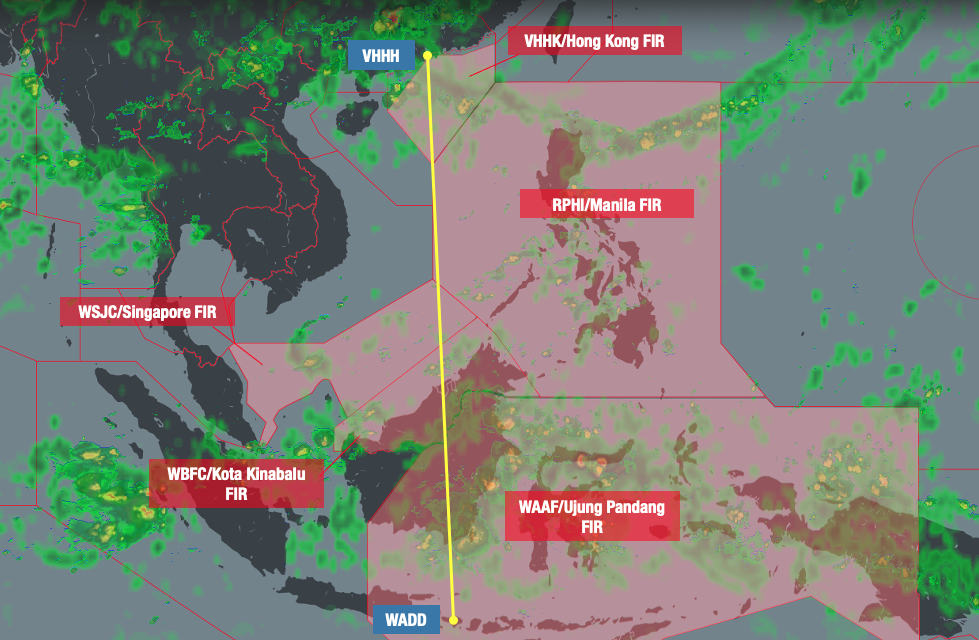
The sheer scale of weather deviations required by aircraft in this area creates a major challenge for air traffic control.

The lateral separation between adjacent airways is often far less than the deviation each aircraft will require, along with the narrower vertical margins of RVSM airspace.

This creates numerous problems for controllers – providing priority handling to one aircraft creates delays and disruptions for others. It’s your standard ripple effect.

To create room, ATC has specific protocols to manage these deviations. They call them LSWDs and they are used to reign in the mess.

How do these procedures work?

Traffic will be processed through a limited number of routes with level restrictions bound by their direction of flight. These routes can be found in each state’s respective AIPs.

Here’s an example found buried in Singapore’s docs:
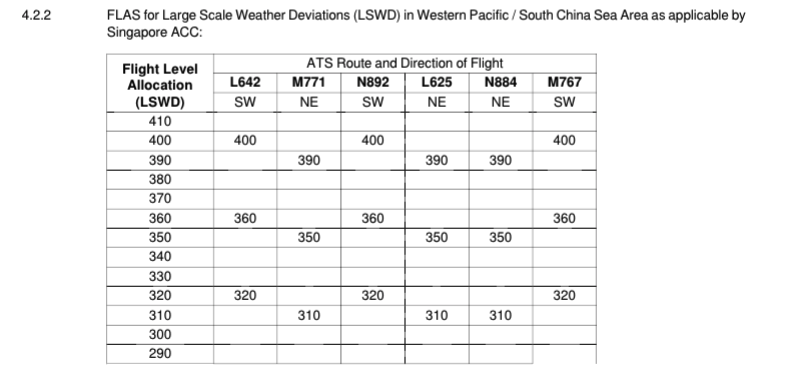
To make co-ordination easier between the numerous ATS sectors, all traffic operates with the same level availability whenever LSWDs are active.

For business jets, this may become problematic as higher flight levels (FL400+) may not be available for extended periods of time.

As a locally-based G550 Captain explains:

“Even if higher flight levels are available in one FIR, controllers may be reluctant to give them to you. This is because there is no guarantee that the next sector can accommodate it and it can be hard to get you down again…

 …The main thing with LSWD is knowing that a lot of levels we usually get won’t be available. And so, we carry more fuel accordingly. It may also be worth briefing the pax that conditions may be bumpier than they’re used to…”

Flow control and crossing time restrictions are also common which may mean the use of less efficient mach numbers.

This can also lead to delays for start-up clearances due to enroute spacing. When asked what additional fuel our local G550 Captain carries for these procedures, his answer was this – “at least thirty minutes.”

Have more to add?

Local operator feedback is invaluable to everyone in the group. If you’ve got anything to add to this article, get in touch with us at team@ops.group

Germany issue new warnings, Manila may not ban GA after all

Germany issues new warnings 25JAN Germany has issued fresh warnings on the airspace of EgyptSouth Sudan, and North Korea, in three separate Notams issued in the last week. We have updated the SafeAirspace.net country information pages with the specifics. Read the article


Manila may not ban GA after all 25JAN RPLL/Manila is not moving as quickly towards a complete ban of non-scheduled and General Aviation traffic as feared. This is good news for International Operators. Read the article.


HEZZ/Egypt, HSZZ/South Sudan, ZKZZ/North Korea Germany has issued fresh warnings on the airspace of EgyptSouth Sudan, and North Korea, in three separate Notams issued in the last week. We have updated the SafeAirspace.net country information pages with the specifics.

RPLL/Manila is not moving as quickly towards a complete ban of non-scheduled and General Aviation traffic as feared. This is good news for International Operators. Read the article.

NTAA/Tahiti The airport is open again as of Monday morning local time, after closing due to flooding after torrential rains, but many taxiways remain flooded. Expect delays in handling and tech stops.

KZZZ/USA Announced yesterday and expected to come into force this week, is an immediate ban on US visas (and therefore US travel) for citizens from 7 countries: Iraq, Iran, Syria, Yemen, Sudan, Somalia and Libya. This is distinct from the Visa Waiver Program ban in effect since January 2016.

GBZZ/Gambia FSB Risk Level changed from Level Three to “No Warnings” on Jan 24. New president has taken power. Parliament revoked State of Emergency. Situation calm.

SBZZ/Brazil In the last bulletin we had a headline about a Boeing 767 shot on approach in Brazil. A bullet was found lodged in the wing. Some updates to that story are here, and safeairspace.net’s Brazilpage is updated.

VZZZ/Southeast Asia Don’t forget it’s New Year in Asia this weekend. Travel-related delays and government office and business interruptions will peak 27 Jan to 01 Feb, and could last longer in Taiwan, Vietnam and China, where the holiday will be celebrated through 02 Feb.

EDDB/Berlin Brandenburg will now not open until 2018, as they found more problems with the fire system this week. This is a recurring story, which dates back to 2012. So, for the foreseeable, you’re stuck with Tegel and Schoenefeld.

LTFJ/Sabiha Gökçen (Istanbul) Due to insufficient capacity at LTFJ, applications for individual non-scheduled flights will be refused, and private/charter flights can only be operated at “non-busy hours”.

KBPI/Palm Beach is going to see some new TFR restrictions due to the proximity of Donald Trumps Mar-a-Lago estate. If operating when he’s down here, you’ll have to depart from a gateway airport to PBI – those are TEB, HPN, IAD, MCO and FLL. NBAA has the details.

LSGG/Geneva EBACE is on from Monday, 22 May through Wednesday, 24 May 2017. Now would be a good time to get those slots booked if you’re planning to head over.

LFMN/Nice has a new procedure where ATC will alert crews to windshear.

MSLP/San Salvador‘s only runway 07/25 will be closed from 1600-1700 each day until Feb 3rd.

VGHS/Dhaka The UK Department for Transport (DfT) announced today that it recently carried out assessments of security at Dhaka International Airport. Following this, the DfT has assessed that security at Dhaka airport does not meet some international security requirements (they haven’t said which).

OMAD/Abu Dhabi (Al Bateen) is hosting the International Defence Exhibition in February, so will not be available to IFR traffic daily between 0600-0800Z until Feb 23rd. There are also restrictions on using it as an alternate.

DNAA/Abuja The latest on the Abuja closure is that it will be completely closed to all traffic from March 8th – April 19th.

SKCG/Cartagena‘s only runway 01/19 is closed daily 0530-1100Z until Feb 6th.

NVZZ/Vanuatu Health authorities have declared a dengue outbreak following a large increase in suspected cases in December 2016 and January 2017. Protect yourself against mosquito bites

WSZZ/Singapore is implementing the new ICAO SID/STAR phraseologies from March 2nd. Read AIP SUP 29/17.

LIRF/Rome Fiumicino is working on 16R until March, so 25 will be used for deps and 16L for arrivals. This means delays, especially if you want 16L/34R for departure – they say up to a 60 minute taxi time.

UKZZ/Ukraine amended the military boundaries of its airspace on Monday Jan 23rd, identifying the Donbas conflict zone region as a separate area. More details here.


View the full International bulletin 25JAN2017