SAFA Ramp Checks: The Top 5 Offenders (+Alcohol test)
Highlights (updated 2024)
  • The Top 5 SAFA Ramp Check Findings are Flight Planning, Aircraft Documents, Defects, Charts, and Cabin Safety
  • It’s not a knowledge test, so feel free to say “I don’t know”
  • Alcohol testing is now common, see below for a guide

Ramp check! Not our favourite couple of words in the aviation vernacular, but when your number’s up, wouldn’t it be good to know what things most of us are getting wrong?

Well, here they all are, in a handy little guide. Download, print, attach to wall-of-your-choice, and enjoy.
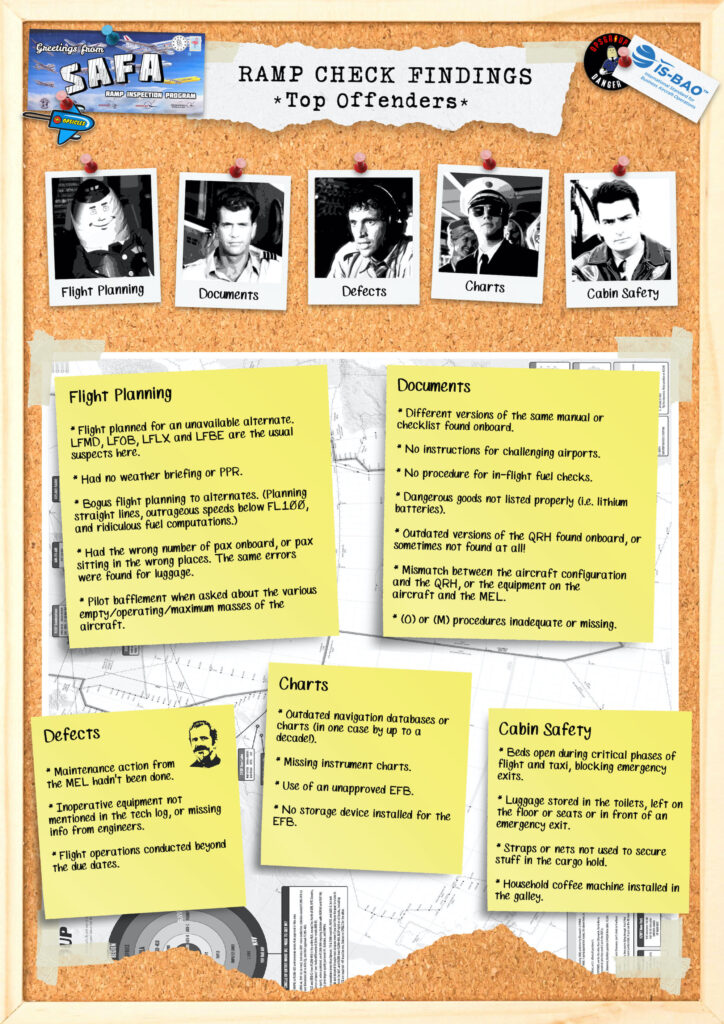
This is a PDF: click on it to download!

What do we base this on? Well, something pretty special happened recently. The French DSAC partnered up with IS-BAO to take a look at hundreds of de-identified ramp check findings in order to analyse the most frequent CAT 2 and CAT 3 findings in business aviation.

This is “special” for three reasons

  1. It’s great that an aviation regulator has actually shared this info because now we can see the top things we’re getting wrong.
  2. If we can see the top things we’re getting wrong, we can stop getting them wrong, and then ramp checks become faster and more efficient for everyone. 
  3. It’s great that this specific aviation regulator happens to be the one from France – because that’s where a lot of ramp checks seem to occur!

So, all good. IS-BAO published the results here, and it’s worth giving that a read first before we press on…

The Top 5 Offenders

As the good folks from IS-BAO point out – EASA Ramp checks cover 52 inspection items spread over 5 areas: flight deck, cabin, aircraft condition, cargo, and general/other.

But some of those 52 items generate more findings than others. The DSAC/IS-BAO study found that the top inspection items by number of CAT2 and CAT3 findings for business aviation were these ones:

1. Flight preparation (RI checklist item A13)
2. Mass and balance calculations (A14)
3. Manuals (A04)
4. MEL (A07)
5. Checklists (A05)
6. Defect notification and rectification (A23)
7. Navigation/instrument charts (A06)

So essentially, these findings all relate to five key areas: Flight Planning, Documents, Defects, Charts, Cabin Safety. Get these right, and your “sweatin over a ramp checkin” days are over, partner!

Have you been ramp checked recently?

Let us know! Where did it happen? How did it go? What things surprised you?

As always, we will de-identify anything you share with us before we tell anyone else about it. But we’d love to hear your stories, and other people will too! Our idea is to gather together as many of these stories as possible, and put them into a little book to help give other pilots and operators an idea of what to expect. So if you’ve got a story to share, send us an email at news@ops.group
Limited edition SAFA Ramp Check postcards.

In related news: the EASA RIM has been updated.

What’s the EASA RIM? Europe’s version of the Pacific Rim movie only with ramp inspectors saving the aviation industry from danger? Or just an updated version of a rather boring manual?

EASA Ramp Inspectors, heading out to work.

Sadly, just an updated manual.

EASA have made some amendments, corrections and added some other details to their Ramp Inspection Manual, so here is our guide to their 131 pages of guidance (and an Appendix).

What’s up?

The Changes to the RIM are contained in a 131 page document here. So this is the doc that crew might want to read. (The massive doc that ramp inspectors use is called the Appendix – we’ll get to that later).

The big stuff to look out for (that we could see) is stuff on Alcohol testing and they’ve changed the name of the “Standard Report” to “Safety Report”.

Page 76.

Let’s start with something small.

This isn’t actually a change, but just something we think might be of particular use. It is the Checklist for on-the-job training for ramp inspectors. Basically, it is a long list of all the stuff they need to check. Which means it’s a long list you might want to check so you know what you are going to get checked on.

Alcohol Testing.

Scroll to page 98 (section 10.3) and it lays out all the info on alcohol testing and how it should be carried out. There is a lot of info here (most of it for the inspecting agents rather than you) but still not uninteresting to read.

The general principles are that it should be done somewhere private, out of sight of anyone else, and if you aren’t happy with the spot they pick then chose another. 

They’re testing to see if you blow more than 0.2 grams of blood alcohol concentration. If you blow below that then you pass. If you test above then don’t panic straight out, they must do a follow up confirmation test which mustn’t happen before 15 minutes, or outside of 30.

Certain drinks can mess up the results:

  • “Aromatic beverages” like fruit juice (never heard them called that)
  • Mouth sprays with alcohol content
  • Medical juices (I don’t even want to know what that might be)
  • Burping on the test can create false positives.

Here is a particularly hideous flow chart of the entire process. 
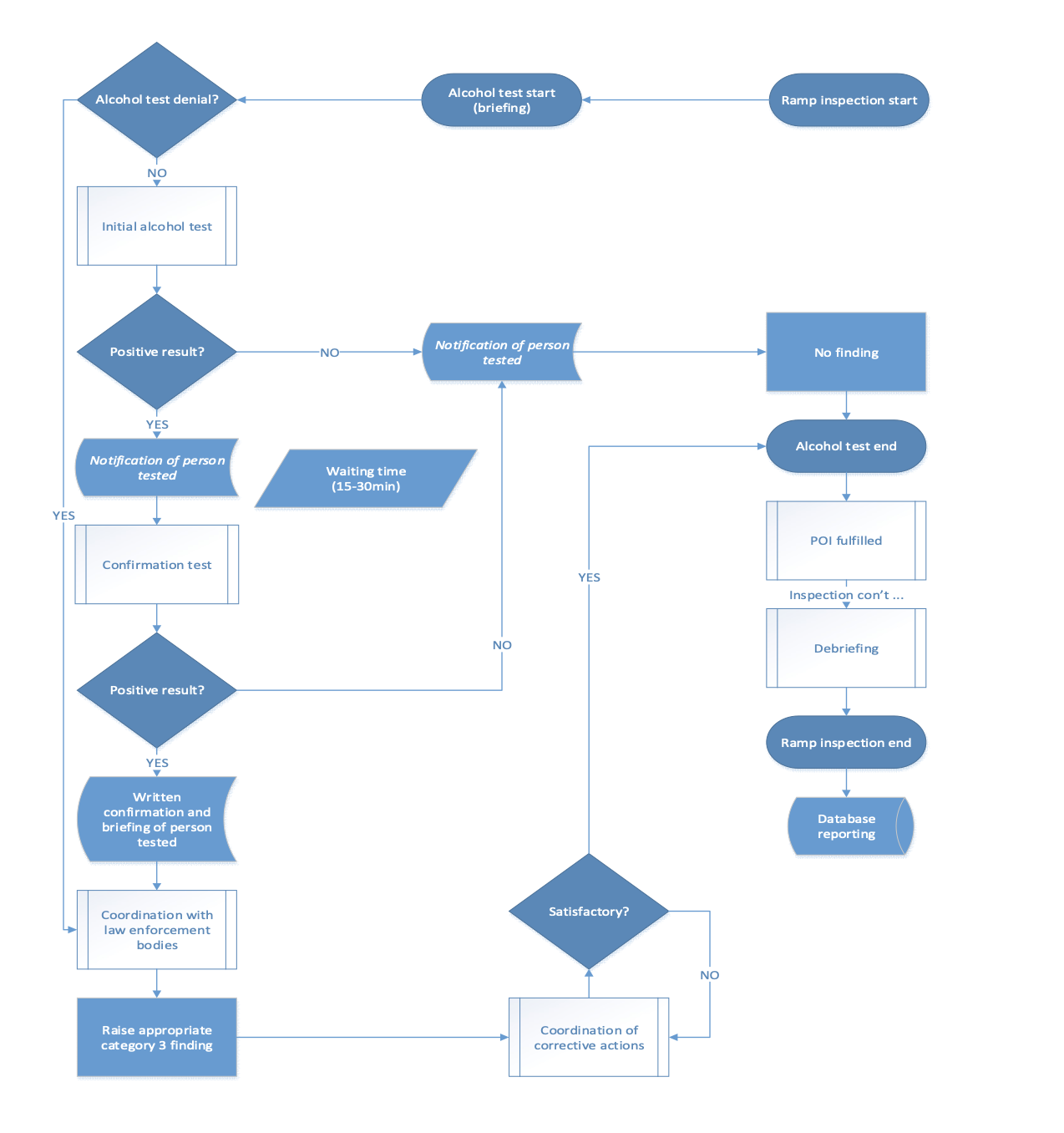
We think it’s easier to sum up stuff like this:

  1. Don’t ever go to work drunk. Most operators/states specify a minimum time between drinking and working but if you aren’t sure 12 hours is a generally decent one to work off.
  2. Of course even 12 hours won’t get you sober in time if you’ve been on a mega bender the night before. So don’t do that.
  3. If you wake up before you’re report time and realise you’re drunk/potentially drunk then CALL SICK!
  4. If you think a colleague is drunk, stop them from going to the airport! Report them if you need to.
  5. If you are at work, and get picked for a random test, make sure they do it correctly, in a private space following the right procedures.
  6. If you blow positive then don’t panic (unless you are drunk in which case do panic, you’ve messed up bad, partner). Have a think if you’ve maybe ingested something that could cause a false positive. Tell the inspector and wait for the confirmation test. They leave it at least 15 minutes, but don’t push for more than 30.

Moving onto The Appendix.

The Appendix to the RIM is a whole 304 pages filed with information on ramp check instructions and pre-described findings.

Many of which have just been updated.

Now, you might be thinking “why do I care how they’re instructing their inspectors on stuff?”. But you should care because if you know how they’re inspecting stuff, then it makes it a whole lot easier to not mess up on ramp checks and getting told off.

If you just want to scroll through the list of changes, then take a look here at the first 7 or so pages.

If you want a full description in standard EASA English, then read the whole 304.

If you want a summary of the changes then check this out.

Other useful stuff.

We wrote a whole post on ramp checks a while back and the stuff we wrote in that hasn’t really changed that much.

While ensuring you are complaint is important, remember is works both ways. Ramp Inspectors need to follow the rules and procedures as well. Particularly when it comes to not delaying you or disrupting your duties too much.

The manual only recommends they must give you 8-10 minutes of quality quiet time to set up for a flight. If you need more for safety reasons then tell them the time you need them to complete their checks by.

Final note.

Ramp checks can be frustrating. The best way to reduce that is make sure everything is in order and be prepared for them.

There are some airports we’ve heard are particularly vigorous with them:

  • Anywhere in France
  • Florence, Italy
  • Edinburgh, Scotland
  • London Heathrow
  • Copenhagen, Denmark (keen on the breath tests)
  • Amsterdam, Netherlands (also keen on the breath tests)

Let us know where you’ve experienced them so we can update the list!

Making a Ramp Check painless (with checklist)

The EU Ramp Inspection Program (RIP) is still alive and kicking – or the EU SAFA Programme, as it used to be called.

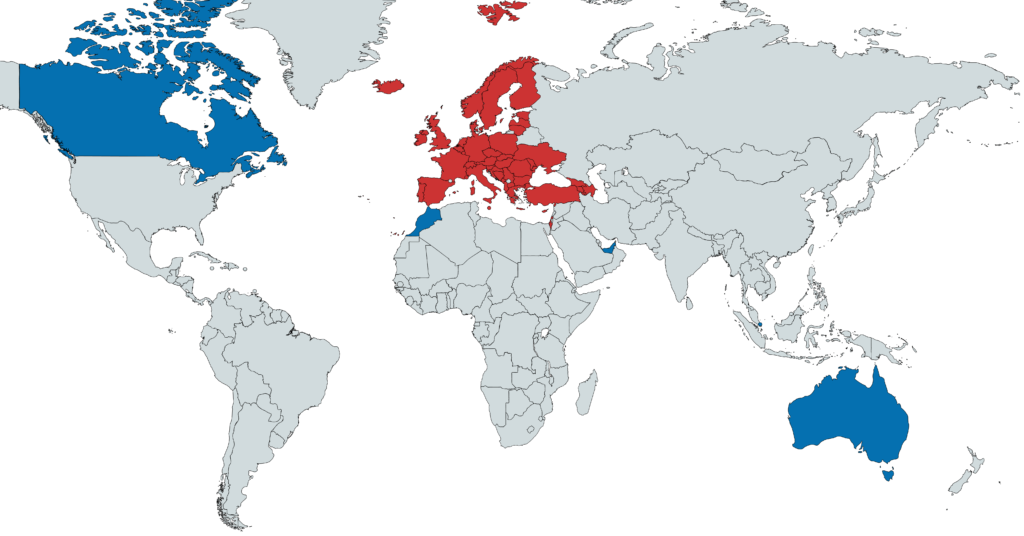
The RIP is not exclusive to Europe. Your aircraft can be inspected under the program in 49 different countries around the world, including Canada, Morocco, Singapore, and the United Arab Emirates.

Here are the key points:

  • Even though it’s now called the EU Ramp Inspection Program, ramp inspections for third country operators are still referred to as “SAFA ramp checks”. Yeah, it’s confusing.
  • Ramp checks are possible in every country in the world – but follow a more regulated and common structure in SAFA countries – totalling 49 – see the map and list below.
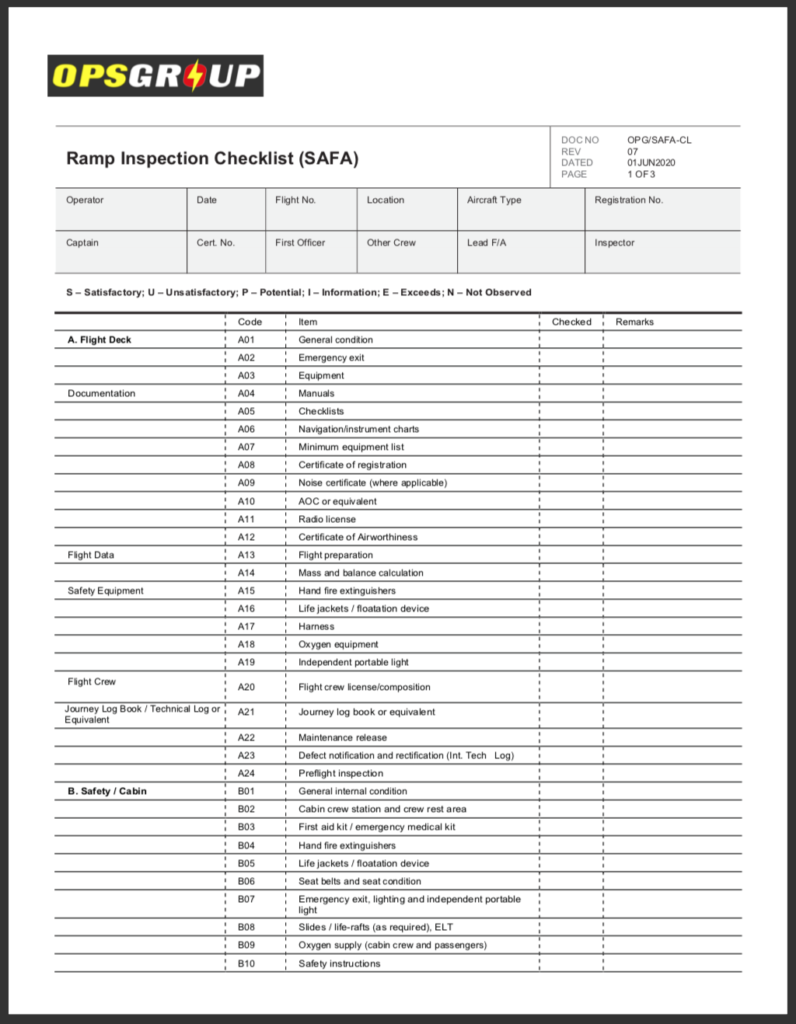
  • There is a standard checklist that is used by Inspectors in all SAFA countries, which you should be familiar with – see further down.
  • Three categories of findings have been defined. A “Category 1” finding is called a minor finding; “Category 2” is a significant finding and “Category 3” a major finding. The terms “minor”, “significant” and “major” relate to the level of influence on safety.
  • If there is a “corrective actions before flight authorised” finding – then the inspector is concerned and a repair must be made before the aircraft is released to fly.
SAFA

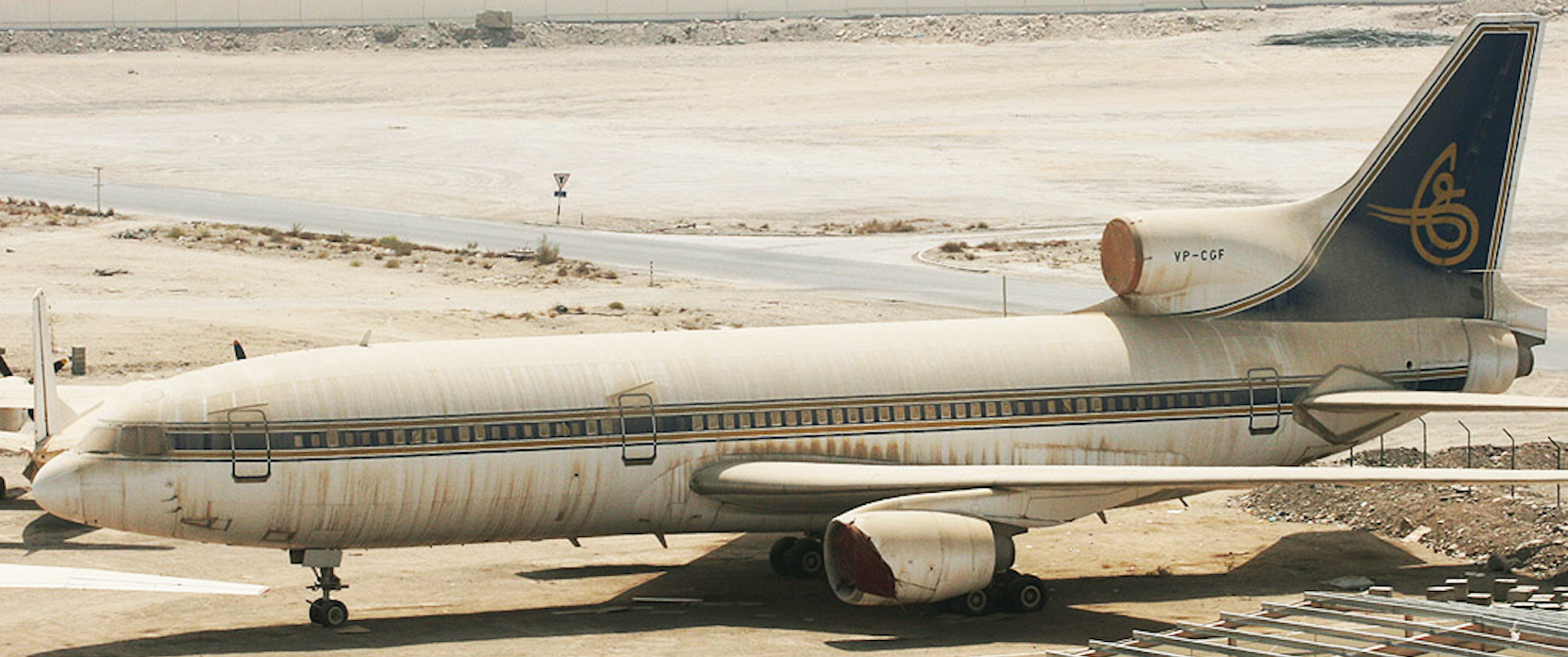
Unless your aircraft looks like this, you have little to worry about.

Here’s how a ramp check normally goes down:

  • The flight selected will either be your last of 6 legs for the day, or after a gruelling 12 hour jetlag-inducer, or at 3am when you were thinking about a quick nap during the turnaround. This much is guaranteed.
  • As you pull on to the stand, you will notice more yellow vests than normal hanging around.
  • Two of these will be your friendly ramp inspection team (to be fair, they almost always are)
  • A short time later, those yellow vests will be in the cockpit, and the first request will be for a look at your license, medical, aircraft documents (like Insurance, Airworthiness), and flight paperwork. Make sure you’ve done your fuel checks and there are a few marks on the flight plan.
  • If you get a good cop, bad cop scenario, one will disappear down the back (this will be the nice guy) and check the cabin, while the first will stay and ask you tough questions about the TCAS system.
  • Some time later, you’ll get a list of findings. The average check is probably about 30 minutes.
  • You can be guaranteed they will always have at least one finding – which will probably be obscure.
  • Sign off the checklist, and you’re on your way.

Some interesting points:

  • The Inspectors can ask you for manuals, documents, or guidance – but they are not supposed to test your knowledge of procedures, regulations, or technical matters. This doesn’t always happen in practice – so if you get a tough question – just say “I don’t know” – and let them note it if they want to. This isn’t a classroom test.
  • This guidance is given to Inspectors: Delaying an operator for a non-safety related issue is not only frustrating to the operator, it also could result in unwanted human factor issues with possible negative effects on the flight preparation. They can (should) only delay your flight for a safety related issue.
  • Remember, it’s not you that’s being inspected. It’s your aircraft. If you’re uncomfortable with the questions, get them noted and allow your operator to discuss later.
  • Every inspector is a little different. Work with them and you’ll find that 90% of your ramp checks will be over in 20 minutes with little issue.
  • Private Operators – especially in GA (even more so under the 5700kg mark) – are far less likely to get ramp checked. EASA guidelines do apply to General Aviation, but they are far more interested in Commercial Operators.
  • The items checked during ramp checks are based on a risk based approach and can differ from operator to operator (for example depending on findings raised during previous inspections). Meaning that operators who get ramp checked with findings will most likely get ramp checked again, to see if they’ve sorted out the problems!
  • EASA regulations requiring alcohol testing during ramp checks will take effect across all SAFA countries in Aug 2020. But some countries have already started doing this: Austria, Belgium, Czech Republic, France, Germany, Greece, Iceland, Ireland, Italy, Netherlands, Portugal, Spain, Switzerland, UK, and Singapore. More info

Common Findings:

See article: SAFA Ramp Checks: The Top 5 Offenders

Ramp checks cover 52 inspection items spread over 5 areas: flight deck, cabin, aircraft condition, cargo, and general/other.

But some of those 52 items generate more findings than others. A DSAC/IS-BAO study found that the top inspection items by number of CAT2 and CAT3 findings for business aviation were these ones:

1. Flight preparation (RI checklist item A13)
2. Mass and balance calculations (A14)
3. Manuals (A04)
4. MEL (A07)
5. Checklists (A05)
6. Defect notification and rectification (A23)
7. Navigation/instrument charts (A06)

So essentially, these findings all relate to five key areas: Flight Planning, Documents, Defects, Charts, Cabin Safety. Get these right, and your “sweatin over a ramp checkin” days are over, partner!

The Countries:

The 49 Participating States engaged in the EU Ramp Inspections Programme are:

Europe: Albania, Armenia, Australia, Austria, Azerbaijan, Belgium, Bosnia and Herzegovina, Bulgaria, Croatia, Cyprus, Czech Republic, Denmark, Estonia, Finland, France, Georgia, Germany, Greece, Hungary, Iceland, Ireland, Israel, Italy, Latvia, Lithuania, Luxembourg, Malta, Republic of Moldova, Monaco, Montenegro, Netherlands, Norway, Poland, Portugal, Romania, Serbia, Slovak Republic, Slovenia, Spain, Sweden, Switzerland, The Republic of North Macedonia, Turkey, Ukraine, and United Kingdom.

Rest of world: Canada, Morocco, Singapore, United Arab Emirates.

The Checklist:

Download by clicking above, or here: Opsgroup Ramp Checklist

If you want to delve deep into each item on this checklist to find out exactly what inspectors should be looking for, check out this document published by EASA in Sept 2019, which has the inspection instructions in full. For all things Ramp Inspection Program related, check EASA’s dedicated webpage here.


Flight Plan Alternates in Europe

In the US, under certain conditions you can get away with not having to select an alternate – as long as both ends of one runway are suitable and available, you have two runways. In Europe, there’s a similar rule, but the key difference is that there has to be separate runways – not one runway which you could land at either end of.

EASA recently issued this reminder letter to Third Country Operators:

For a flight to be conducted in accordance with the instrument flight rules, at least one destination alternate aerodrome shall be selected and specified in the operational and ATS flight plans, unless the duration of the flight from the departure aerodrome, or from the point of in-flight re-planning to the destination aerodrome is such that, taking into account all meteorological conditions and operational information relevant to the flight, at the estimated time of use, a reasonable certainty exists that:

1. the approach and landing may be made under visual meteorological conditions (VMC); and

2. separate runways are usable at the estimated time of use of the destination aerodrome with at least one runway having an operational instrument approach procedure.

In accordance with the ICAO definition, separate runways are two or more runways at the same aerodrome configured such that if one runway is closed, operations to the other runway(s) can be conducted.

Several ICAO contracting States have filed a difference to ICAO with regard to this standard, because their national regulation does not contain a requirement for separate runways at the destination aerodrome when opting to file a flight plan without a dedicated destination alternate aerodrome.

Please be informed that EASA expects TCOs to plan their flights in compliance with the ICAO standard. This means that an alternate aerodrome has to be listed in the ATS flight plan where required in accordance with standard 4.3.4.3.1 of Annex 6 Part 1 to the Chicago Convention, even though your national regulation is less restrictive in this aspect.

The respective destination alternate fuel shall be included in the pre-flight calculation of usable fuel in accordance with standard 4.3.6.3 of said Annex.

EASA will verify compliance by means of sampling flight documents during the initial authorisation and during continuous monitoring of TCO authorisation holders.

Furthermore, ramp inspections performed under SAFA/RAMP inspection programme will serve as an additional source of information for non-compliance.

Where a non-compliance is found, EASA will raise a level-2 finding in accordance with Part-ART of the TCO Regulation (EU) No 452/2014.

We therefore, encourage you to review your flight planning procedures and where necessary to align those to ensure full compliance with the respective above-mentioned standards.

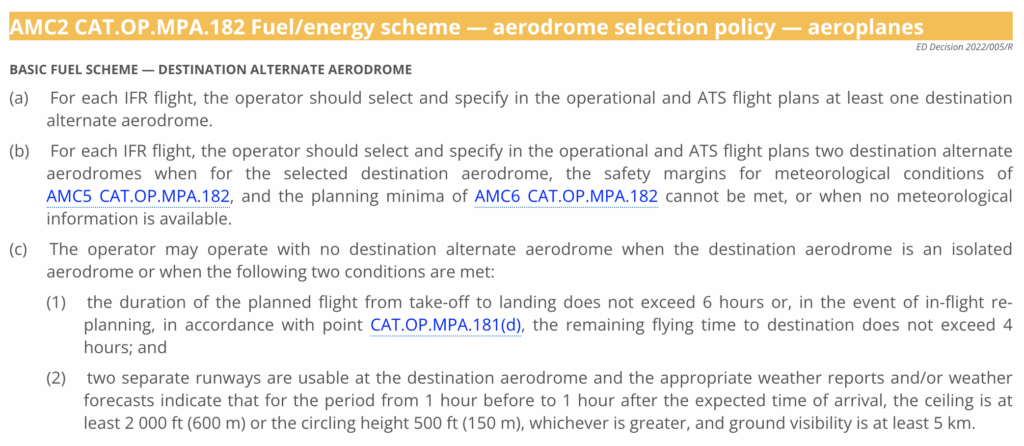
So can I plan a flight in Europe without an alternate?

Yes, but only in certain circumstances. EASA CAT.OP.MPA.182 has the details:

Or if you want to keep it simple, just file an alternate airport in your flight plan.

A Cautionary Tale

Here’s a recent report from an OPSGROUP member on this:

We were doing flights all over the EU without an alternate, when the weather didn’t require one as per our rules. Then we got SAFA ramp checked in EGSS/Stansted, and the ramp inspector took umbrage that we were coming in without an alternate on a clear day. We now carry an alternate for all single runway ops in the EU, with a realistic routing.

A Realistic Routing?

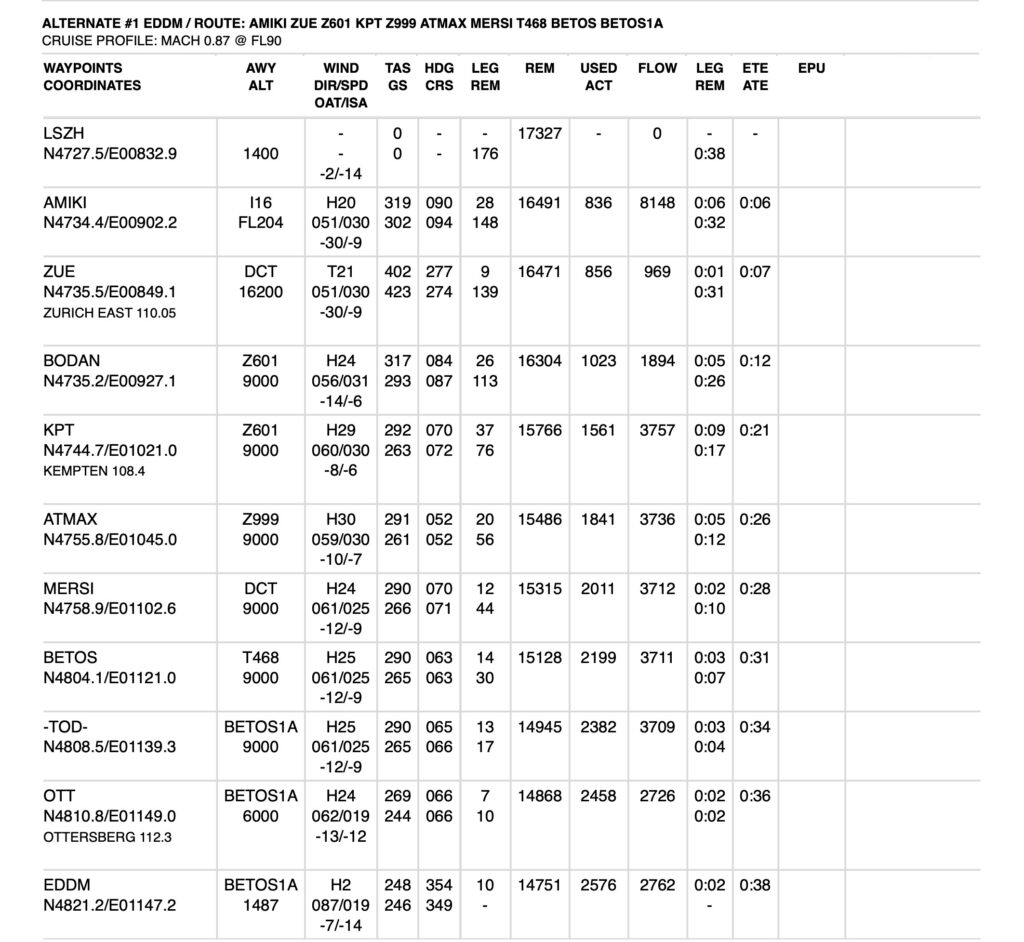
This is another thing to watch out for in Europe. You have to make sure your route to alternate is computed and included in your flight plan, that it’s realistic, and that it doesn’t break any rules. Let’s tackle those in order:

Computed and included in your flight plan:

It should look something like this:

Realistic:

This means you’ve included a proper route to alternate like the one shown above, not just one big DCT. The routing doesn’t have to be fully Eurocontrol compliant, it just has to be realistic. That means making sure you have enough fuel for a missed approach, climb, and descent to alternate. If you use a SID from your destination airport and join it up with a STAR for your alternate, that’s probably a safe bet.

Doesn’t break any rules:

The French DSAC recently partnered up with IS-BAO to take a look at hundreds of de-identified ramp check findings in order to analyse the most frequent CAT 2 and CAT 3 findings in business aviation. A common one was flights planned to unavailable alternates – usually those that cannot be used as per AIP or Notam, or those where you need PPR.

Common ones to watch out for:

LFTH/Toulon – can’t be used as alternate without PPR.

LFMD/Cannes – can’t be used as alternate except for flights to LFTZ/La Mole.

LFMQ/Le Castellet – this sometimes gets used as an alternate for LFMN/Nice and LFML/Marseille. But LFMQ rarely publishes TAF/METAR reports, so if you want to use this, you need to make sure you select at least one other alternate with a weather report!

Do you know of any more? Let us know!

More info

Head here to download the latest ramp check guidance straight from the horse’s mouth.


EU delays alcohol testing on ramp checks to 2021

The EU had some changes planned for Ramp Checks and Pilot Mental Health which were due to take place on 14 Aug 2020, but these have now been delayed to 14 Feb 2021.

The three big changes

  1. EASA regulations will be updated requiring alcohol testing during ramp checks. This will take effect across all SAFA participating countries. However, a lot of countries have already started doing this anyway: Austria, Belgium, Czech Republic, France, Germany, Greece, Iceland, Ireland, Italy, Netherlands, Portugal, Spain, Switzerland, UK, and Singapore. In most places, local authorities have the power to carry out breathalyzer tests at any time – not as part of ramp checks. For more on SAFA ramp checks, see our article.
  2. All pilots working for European airlines will have access to mental health support programs.
  3. European airlines will perform a psychological assessment of pilots before the start of employment.

Despite the delay to the implementation date, it’s still something worth looking at now. The UK CAA has published a Safety Alert with the following recommendations:

1. Operators are strongly recommended to continue to introduce Flight Crew Support
Programmes as required by the Regulation and to maintain existing programmes despite the deferred implementation date.

2. Operators should also consider the impact of the Covid-19 crisis on cabin crew and other safety-sensitive personnel as well as flight crew. It remains essential that senior management of operators, mental health professionals, trained peers and staff representatives work together to enable self-declaration, referral, advice, counselling and/or treatment, where necessary, in cases where there may be a potential safety issue resulting from a decrease in medical fitness.

3. Additionally, operators are encouraged to use this delay to develop their policies on the prevention and detection of the misuse of psychoactive substances and on the psychological assessment of flight crew.


Rules revised: SAFA Ramp Checks for ‘Suspect Aircraft’

01JUN: EASA have published new guidelines for inspectors to assess which aircraft should be prioritised for SAFA ramp checks in Europe and SAFA compliant states. ARO.RAMP.100(b) in the Part-ARO contains the updated list of aircraft that will be selected for priority checking:

(a) (when EASA receive) information regarding poor maintenance of, or obvious damage or defects to an aircraft;

(b) reports that an aircraft has performed abnormal manoeuvres that give rise to serious safety concerns in the airspace of a Member State;

(c) a previous ramp inspection that has revealed deficiencies indicating that the aircraft does not comply with the applicable requirements and where the competent authority suspects that these deficiencies have not been corrected;

(d) previous lists, referred to in ARO.RAMP.105, indicating that the operator or the State of the operator has been suspected of non-compliance;

(e) evidence that the State in which an aircraft is registered is not exercising proper safety oversight; or

(f) concerns about the operator of the aircraft that have arisen from occurrence reporting information and non-compliance recorded in a ramp inspection report on any other aircraft used by that operator;

(g) information received from EASA Third-Country Operator (TCO) monitoring activities;

(h) any relevant information collected pursuant to ARO.RAMP.110. (“whistleblowers”)


The revised Part-ARO, issued in May 2016, contains a large number of revisions and operators should take a close look at the changes.

For a general guide to SAFA Ramp Checks, have a look at our other article: Avoiding the Pain of a Ramp Check.

References: