Holidelays are Coming!

The NBAA recently did a very helpful podcast episode on preparing for the holiday season traffic.

What they are saying (the short version)

Watch out for increased traffic volumes during the holiday season. This will more than likely mean more traffic flow management initiatives and ground delay programs. Plan ahead.

What they are saying (the slightly longer version)

The weekends before and after major holidays seem to be the busiest, and this year is expected to be no different. Numbers are already looking higher than the pre-pandemic figures (2019) for the same season. So pre-planning and thinking about what might impact you, your flight or the airspace and airports in general is important.

The two main busy spots

  • Any popular ski resort airport
  • Any airspace that is usually busy and which is a route to or from popular holiday destinations – so areas like the NY metros, NE coast and routes to/from Florida and the Caribbean.

What they are saying (in much more detail)

The bits that are always busy

The north east coast and around New York commercial terminals get busy. It is already up to 80-90% normal volumes and the return of international flights means the remaining 10-20% is filling up fast. The same goes for the Florida and Caribbean to the north east routes, partly because all the airports and airspace along that region tends to be busy anyway.

How busy this all gets increases “just a little” during holiday season which means you are probably going to experience more traffic flow management, initiatives and ground delays. These mean you need to pre-plan more, particularly in terms of where you are filing to fly, and the fuel you are counting on needing to use.

There is an added complication in that the Presidential TFR in Wilmington, DE might get activated – and when it does, it has a further knock on effect on this already quite busy area. We wrote about that here if you want a read.
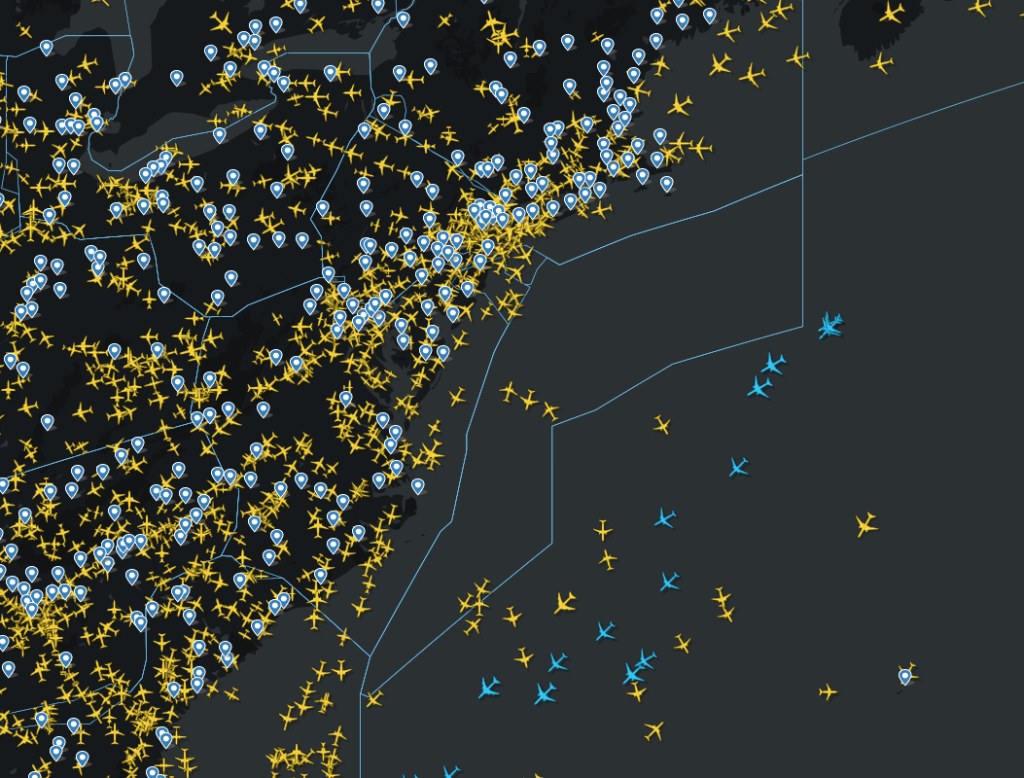
The NE coast and around the POTUS TFR are busy at the best of times.

The weather

The weather is a variable that can be hard to predict and the knock-on effect of it can be pretty far reaching. There are three things with the weather to really think about during the busy holiday season:

  • Ski resort airports tend to be tough to operate into anyway. When the weather gets rough this adds to the challenge, and to possible delays – particularly as they often have limited ramp capacity. 
  • Major snow storms and other wintery weather at the large, busy airports can result in a backlog of traffic across the airspace as aircraft hold for the weather to clear or divert. This puts extra pressure on the surrounding Centers. Additionally, aircraft on the ground can see long de-icing queues, and this fills up ramp space with delayed departures which means arrivals might be delayed as well.
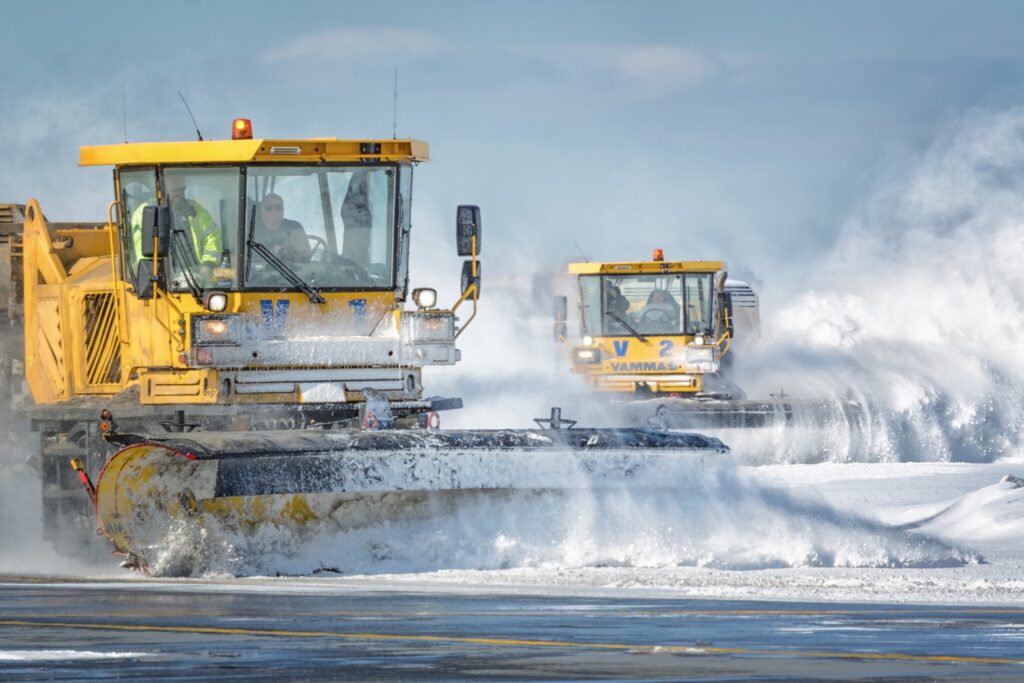
Delays due de-icing, clearing runways, of storms will have a knock on effect across the NAS.

The ski spots

Traffic volumes operating into places like Colorado, Wyoming, Utah, Idaho (particularly KASE/Aspen, KEGE/Eagle, KJAC/Jackson Hole, KSUN/Friedman Memorial) will be on the up during ski season and particularly over the holidays. 

Again, the fact these are often difficult anyway, have logistic and operational challenges and limited ramp space, means disruptions can build up pretty quickly. If they fill up then ATC will put on a stop on GA flights routing to them and you might be airborne when that happens so plan your diversions or holding fuel!

Staff shortages

A final thing to think about is staff shortages – you might not care that the big airlines are lacking pilots, but if you use these big airlines to move yourself or your own pilots around then you might start caring a little more. Delays for them also mean disruption to other aircraft needing to use the airport (ramps) so avoid planning flights or crew through the major airports if you can.

What are they saying to help with it all.

When to fly

Think about whether you really need to fly on that Sunday after the holiday. If you can wait until Monday or Tuesday then do. The same actually goes for flying out – if you can avoid the peak times (generally the Thursday or Friday before) then you will avoid a lot of the traffic and a lot of the possible disruption.

Where to fly

Try to avoid the big, busy connection terminals like JFK, Newark, La Guardia where commercial volume is already high – both as a place for you to head to, or a place to send your crew through. Also have a think about your alternates and the traffic volumes at those.

Filing your flight plans

Get your flight plans in early – that way they are ab for the FAA and they will be included in the planning of traffic flow initiatives. File them short notice and on the day you will be an unknown and that can make it harder for ATC to accommodate you.

Know what’s going on

Check the FAA re-routes tab in advance. You’ll find info on current traffic management initiatives here as well. You can also take a look at the overall status of the NAS and make sure you have that big picture view before you fly.

Check the preview for the following day as well – the ops preview is posted after the 9pm planning call. You’ll find it on the advisory database and can use it to make a provisional Plan A and B if you are heading out the next day.
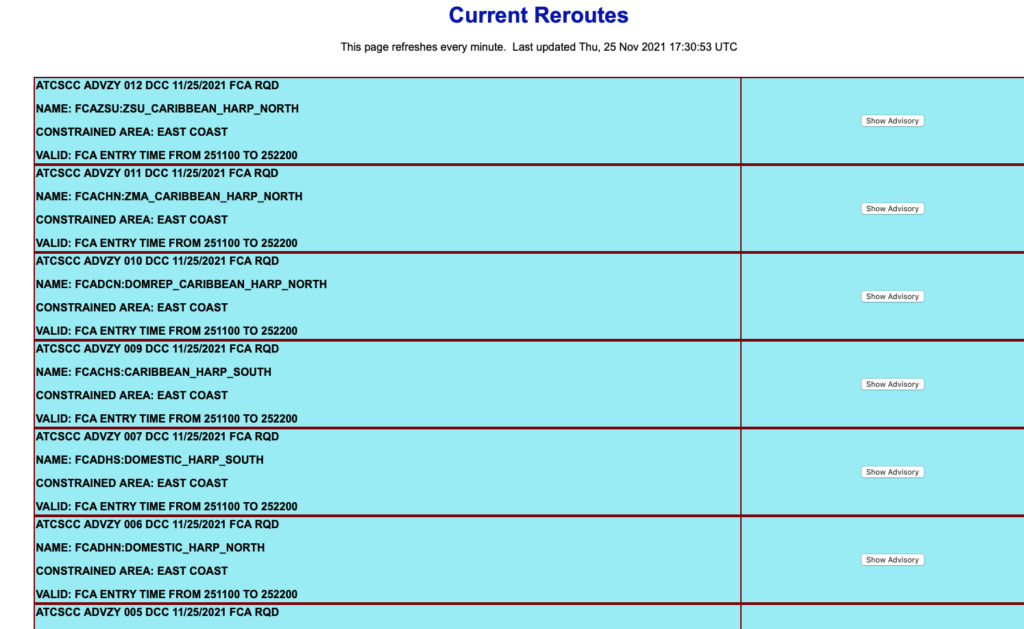
The Reroutes tab links to advisories and shows HARPs in force as well.

Check the weather

Pay attention to weather ahead of time and have those diversions planned out in advance. Also watch out for weather at larger airports because this can cause a ripple effect through the airspace. If Runway 11/29 at Newark closes then you’re going to see ground and air delays because of it…

But don’t assume no weather means no disruption. Even if its VFR along the east coast, if the volume is high there will be traffic management and airspace flow programs in place which might mean ground delays at Westchester or Teterboro…

Talk to your FBOs

Check with your FBOs in advance to confirm ramp space – even just prior to departure to see what’s happening on the day. Most of the Ski Resorts operate on a first come first served basis with no reservations, which can be great but can also lead to sudden capacity issues. Again, last minute stops for GA traffic might occur while you’re airborne and that could mean holding or diverting so check and plan in advance.

What else is going on out there?

Look out for HARP initiatives

Military airspace is often opened up to help ease congestion, particularly on Caribbean routes. In the past they have allowed access to airspace off the Mid-Atlantic which helps with the East Coast volumes, particularly in Jacksonville, Florida and Washington and DC Centers.

In previous years we’ve seen HARP routes between NY Metros/Philadelphia and Florida, as well as Boston Centers and Florida, and several in the Caribbean. Again, the great folk at the NBAA post some handy info on this so keep an eye out for their 2021/2022 info.

The routes are published in the FAA advisories as well so be sure to check these and file for them.

AZEZU

If operating between the Northeast and Florida then you probably know about the deep-water AZEZU route that keeps you out of the high volumes. Here is the section from the FAA playbook in case you aren’t familiar with it.

This route is changing from December 2nd and will become the WATRS deep-water route. There is actually no change to the routings, just the name, so the Playbook info remains more or less the same.
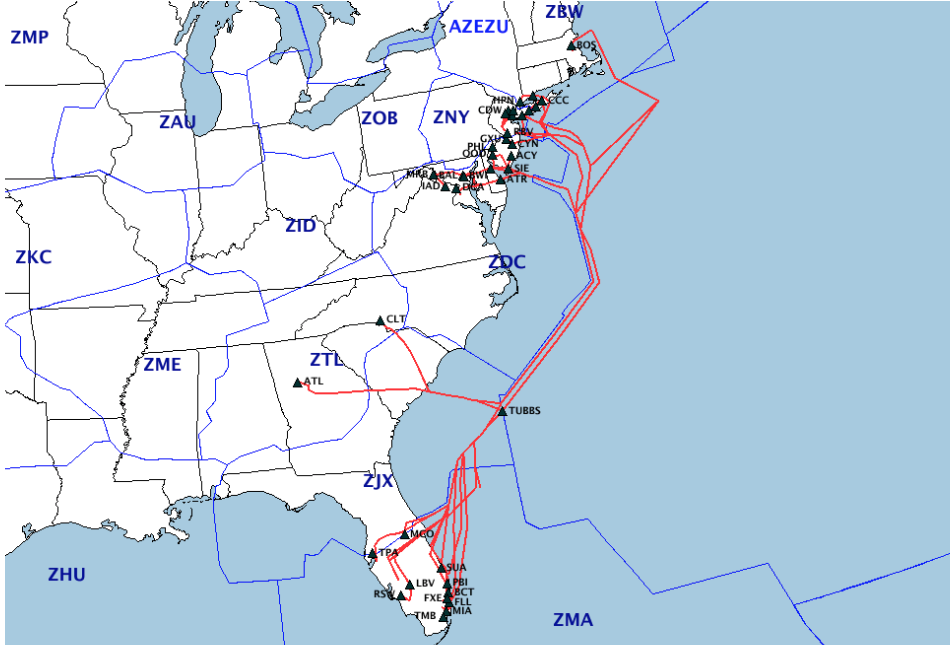
FAA Playbook AZEZU graphic

Our favourite page

We like this page where the NBAA post useful info on issues in regional airspace. It’s another one worth keeping an eye on.

Happy Holidays!


Contrails, Chemtrails and Climate Change

Putting ‘climate change’ in the title of a post on an aviation page probably isn’t the best way to draw in the readers. But this is not a lecture. Promise.

So, what is it about?

It isn’t about chemtrails. They aren’t a real thing.

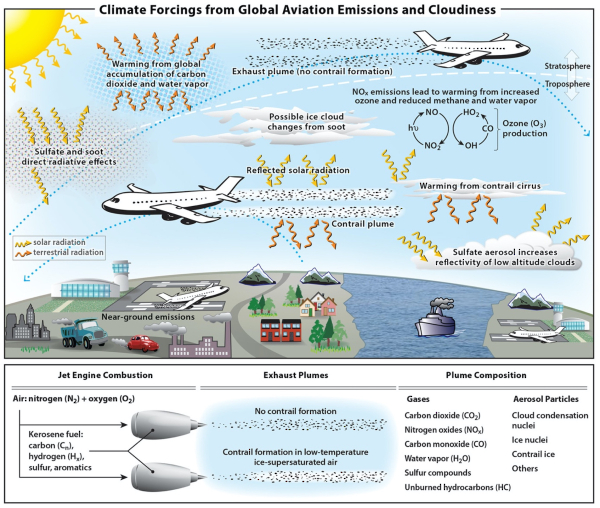
It is about contrails. The wispy bits of whatever that your airplane engines fart out as you fly, or the ‘engine plumes’ if prefer to imagine your airplane resembling something like a peacock.

Contrails are basically water vapour. They form when the exhaust gases from the engine starts to cool and mix with the air around them. The humidity rises, the water cools and condensation occurs.

A small, small proportion of what is burped out of the engine is not water though, but impurities from inside the engine.

Things like sulphur particles. It only makes up about 0.05%, but these tiny particles give the water something to freeze onto and they cause tiny ice crystals to form.

So why do we care about this?

They are quite a useful indicator of possible wake turbulence for us, but aside from that (and unless you are one of the pilots who likes to draw amusing pictures in the sky with them) then we don’t really care that much.

But maybe we should care a bit, because some contrails loiter up there for ages – these are known as homomutatus contrails. Frankly, anything which sounds a little like ‘mutant’ should cause concern, and these definitely do, because they are responsible for the word we shall not utter.

Ok, we will, just to be clear – global warming.

Not here to lecture though! Promise!

A little bit of science (still not a lecture)

So, the airplane burps out the water, it turns into contrails which then hang up there in the stratosphere. Aviation causes only about 5% of the water present in the stratosphere, so it isn’t a terrible culprit.

Unfortunately, though, those homomutatus contrails, plus the extra water, plus the ice particles – all that stuff left up there by airplanes – causes terrestrial radiation to backscatter. It also stores up some of the radiation coming in and the result is something they call ‘radiative forcing’.

Basically, extra heating-up happens.

So, airplanes are spitting out C02 and contrails, and the contrails are thought to be responsible for something between 20% to about 40% of all the radiative forcing aviation causes to occur (they don’t really know how much, but they reckon about that amount).

So… why are we actually telling you if this isn’t a lecture?

We’re getting there, stay attentive!

Free Route Airspace (a big open area between 2 waypoints where you are routed in a straight-line between them) has already helped reduce fuel burn and C02 emissions. They reckon it saved about 40 tonnes of fuel a day, and reduced the C02 by about 150 tonnes a day.

So, the helping-the-environment plans are already helping you because it means less fuel burn.

ICAO and Eurocontrol, in conjunction with EDYY/Maastricht have now set up a project called the Contrail Prevention Trial.

The Contrail Prevention Trial will initially only take place in Maastricht and the plan is to sometimes re-route aircraft around atmospheric conditions that are most conducive to contrails.

The Contrail Prevention Trial

If you are routing through Maastricht airspace you might find you are given a re-route. It won’t be huge, it might mean a little bit of an increase in fuel burn, but it will hopefully mean a decrease in the contrails your aircraft produces.

You won’t really know, but some clever science person down on the ground hopefully will.

So, a little bit of science, no lecture, and some info on why, if you are routing through Maastricht sometime in 2021, you might be given a tactical diversion. Now you know why 😊

Here is the official announcement on it, found on the Eurocontrol homepage:

CONTRAIL PREVENTION TRIAL – MAASTRICHT UAC (EDYY) AIRSPACE
===========================================================
IN AN EFFORT TO MINIMISE THE IMPACT OF AVIATION ON THE
ENVIROMNENT, MUAC WILL BE RUNNING A CONTRAIL PREVENTION TRIAL FROM
18TH JANUARY 2021 UNTIL 31ST DECEMBER 2021 BETWEEN 1500-0500UTC
WINTER (1400-0400UTC SUMMER).

FLIGHTS MAY BE TACTICALLY REQUESTED TO DEVIATE FROM THE PLANNED/REQUESTED
FLIGHT LEVEL BY THE SECTOR CONTROLLER.

ANY FLIGHT FLYING VIA MAASTRICHT UAC SECTORS BETWEEN THESE TIMES
MAY BE CHOSEN. THE TRIAL WILL GO AHEAD DEPENDENT ON THE WEATHER
CONDITIONS.

MUAC AO HOTLINE +31 43 366 1428

NMOC ON BEHALF OF MAASTRICHT (EDYY) FMP
===========================================================


Reroutes over France … not because of an ATC strike, this time

You’ll see lots of new acronyms being bandied about, like ERATO, EEE, a new DSNA ATM system in LFBB in accordance with SESAR … but in simple terms (our favourite words): France is changing from using paper strips to electronic strips for separating enroute aircraft, from November 17th, 2016.

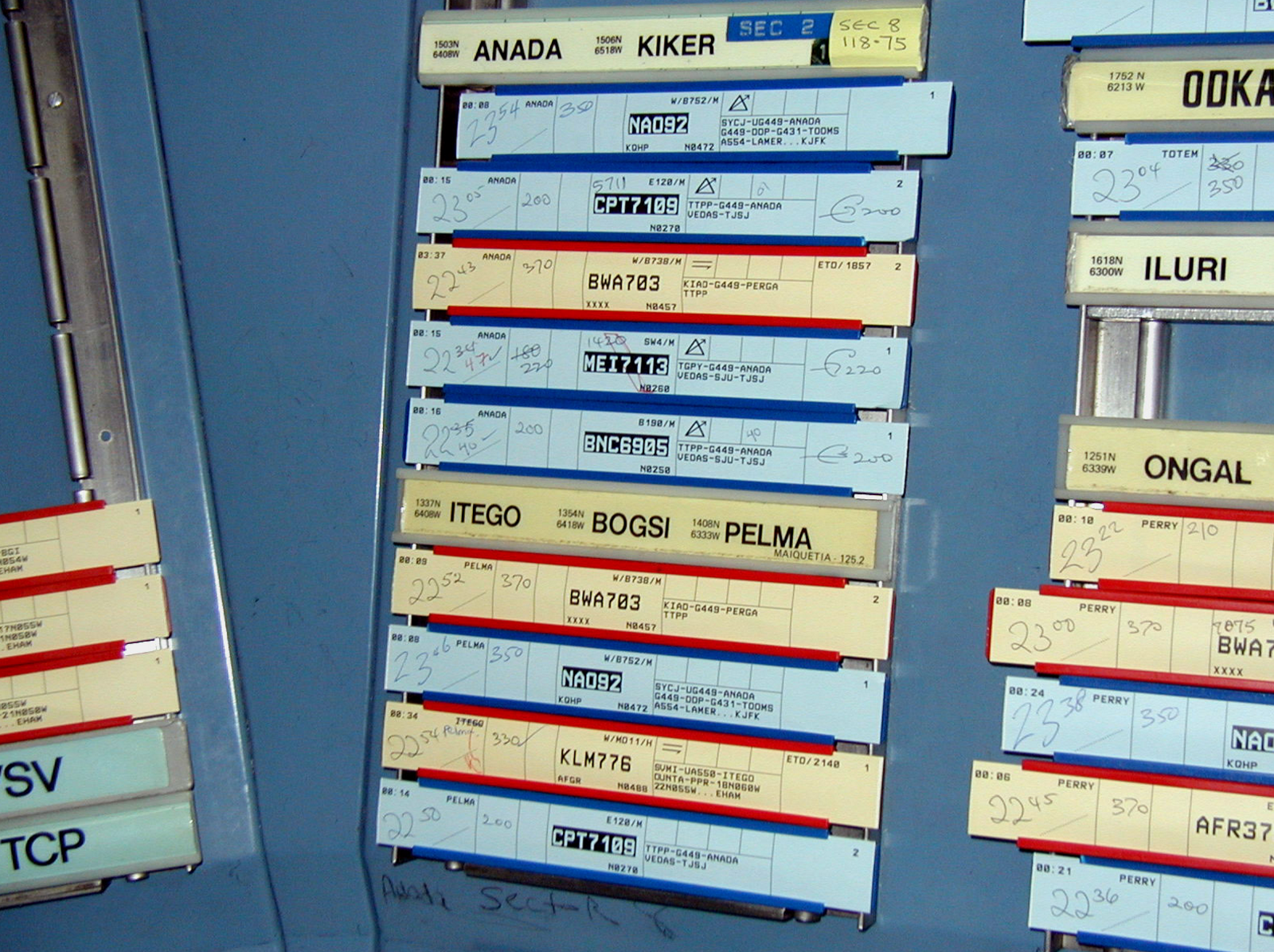
Since more or less day one of Air Traffic Control, paper has been used to record where the airplane is, and then placed somewhat geographically in relation to the other airplanes that might affect it. Changes are written on the strip by hand, with a pen.

Like the picture above.

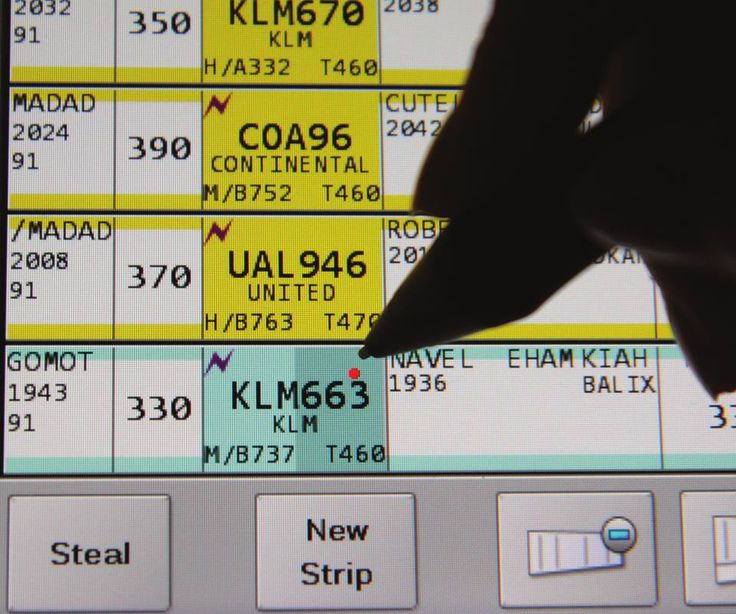
Because getting rid of any paper whatsoever is the most important thing in the world right now, there is a new electronic version of the same thing (and France is calling theirs ‘ERATO‘). Which looks a little like this:

elecboard


So, Bordeaux (LFBB) Center is first … starting today, November 17th. And because nobody is entirely sure how well this is all going to work, a whole bunch of traffic has to be rerouted away from Bordeaux, so that there aren’t too many aircraft per controller – both to allow them to learn, and in case it goes feet up.

Which means mass reroutes, and delays. There are contingency routes – which have become very familiar to operators after this years “Summer of Strikes” – the Tango Routes will be popular again.

Looking ahead, the plan calls for two weeks of fairly heavy reroutes, and then another two weeks of lower impact restrictions. They have said though, that normalisation won’t occur until after Christmas.

So, if you want some different options for getting around the Bordeaux FIR:

  • For north-south flights The Tango Routes – via Shanwick
  • For east-west flights try to file further north, into Belgian/Eurocontrol/German airspace, or come south into Barcelona/Marseilles
  • Read the Eurocontrol NOP – especially on the Tactical page on the ATFCM Measures (Scenarios) portlet -and selecting the link Scenario List: ID RR*ERA
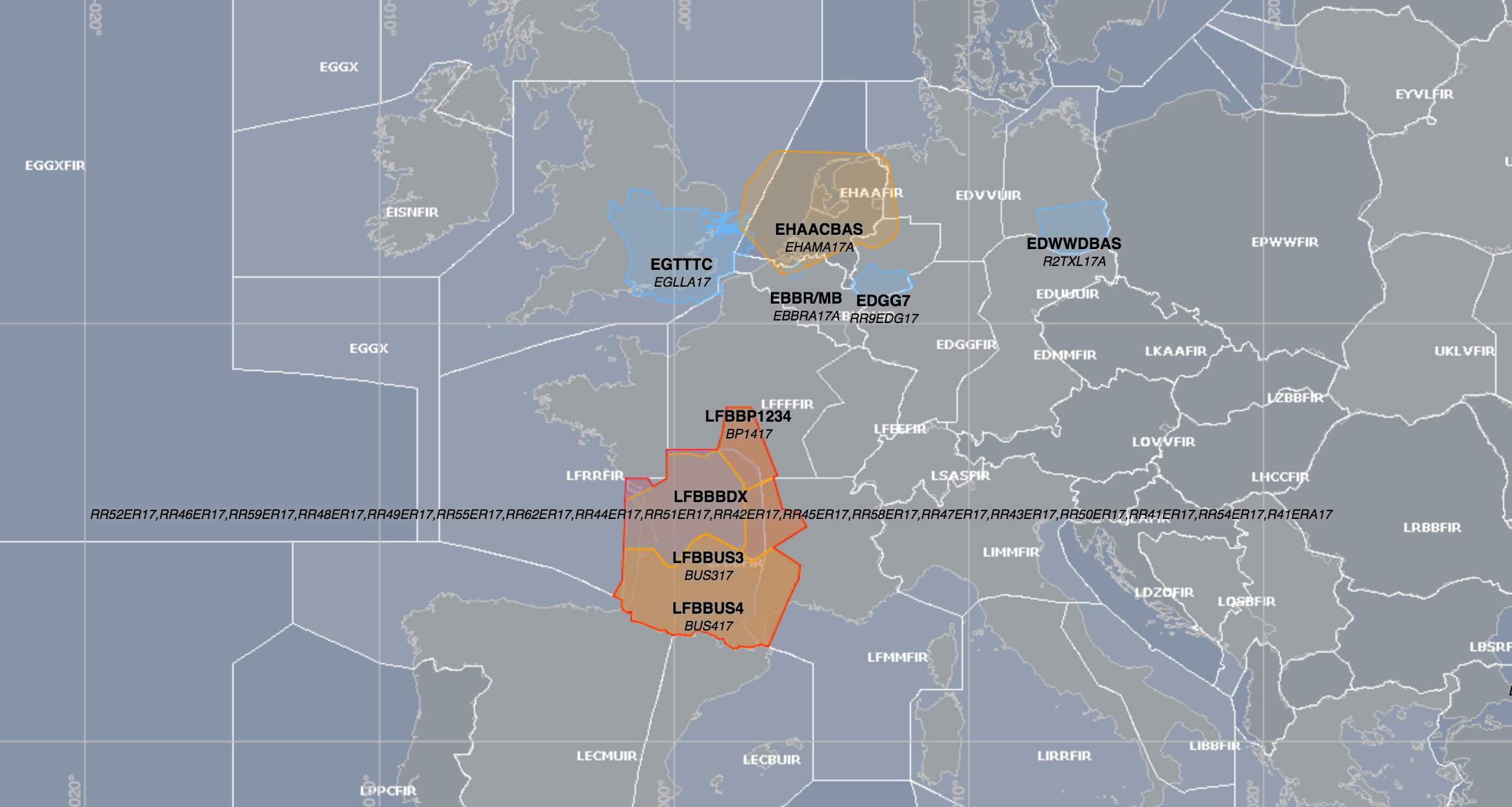
  • And, here’s a map – the red part is LFBB/Bordeaux FIR – don’t file through here:

lfbb-erato-map

The transition from paper to paperless has been going on for a while: Shanwick went ‘electronic’ in the mid 1980’s: this is what the enroute controllers’ screen looked like.

fdpssmall


Finally, here’s the ‘official version’:

DSNA, France’s air navigation service provider, is carrying out an in-depth modernisation of its en-route air traffic management system to cope with the increase of air traffic in France.

From November 17, 280 air traffic controllers at the Bordeaux Area Control Centre (ACC) will handle flights with a new-generation, stripless ATC system called ERATO Electronic Environment (EEE).

The EEE programme based on a SESAR solution has been co-financed by the European Union. EEE provides a modern work environment and innovative control assistance tools.

Nevertheless, as a prelude to any major ATC system implementation, capacities have to be temporarily reduced to allow each air traffic controller to master in real time operations all the new capabilities.

Delays in the south-west of France are therefore to be expected during two weeks. No flight cancellations have been requested by DSNA.

To minimise the impact on flight punctuality, DSNA, has developed a transitioning plan in close cooperation with the Network Manager (Eurocontrol), neighbouring air navigation service providers, and the most affected airlines and airport operators.

Eurocontrol traffic simulations shown that for this transition period, up to 500 flights will need to be rerouted each day to avoid the airspace under the responsibility of Bordeaux ACC.

Moreover, military activities in high altitude training areas will be limited. Regional airports will be impacted along with all flights from or to Paris from the south.

ERATO2Maurice Georges, CEO of DSNA, said: “DSNA staff is totally mobilised with the implementation of this major project. I appreciate the efforts made by the entire aviation community to ensure a successful commissioning of the Electronic Environment ERATO in Bordeaux.

“The transitioning phase ahead of us relies on high predictability for all flights and trustworthy collaborative processes with our customers and partners”.
This major technological step will enable DSNA to deliver a high level of performance. Within the framework of the FABEC and in line with our Single European Sky commitments, DSNA will thus meet new challenges ahead for safe and sustainable air transport.”


French ATC strike this weekend – Number 8

Notification has been given by French ATC Unions of a Three Day Strike this coming weekend from Friday-Monday, starting at 0400Z Friday 03JUN. This is Strike number 8 this year, and if it goes ahead, promises to be a disruptive one.

As with all previous strikes, reroutes if you are overflying will be important.

Highlights:

Reroutes via Tunisia, Algeria

Tunisia and Algeria regularly open up their airspace to reroutes during French ATC action – and will likely do so again for this strike.

  • Tunisia (DTTC FIR): Overflight permit is required (AFTN direct DTTVYAYX)
  • Algeria (DAAA FIR): Overflight permit not required during this strike but copy FPL to DAAAZQZX and DTTCZQZX

Reroutes via Shanwick Airspace

Read our earlier post on this: https://ops.group/blog/the-three-sisters-shanwicks-tango-routes/