SAFA Ramp Checks: The Top 5 Offenders (+Alcohol test)
Highlights (updated 2024)
  • The Top 5 SAFA Ramp Check Findings are Flight Planning, Aircraft Documents, Defects, Charts, and Cabin Safety
  • It’s not a knowledge test, so feel free to say “I don’t know”
  • Alcohol testing is now common, see below for a guide

Ramp check! Not our favourite couple of words in the aviation vernacular, but when your number’s up, wouldn’t it be good to know what things most of us are getting wrong?

Well, here they all are, in a handy little guide. Download, print, attach to wall-of-your-choice, and enjoy.
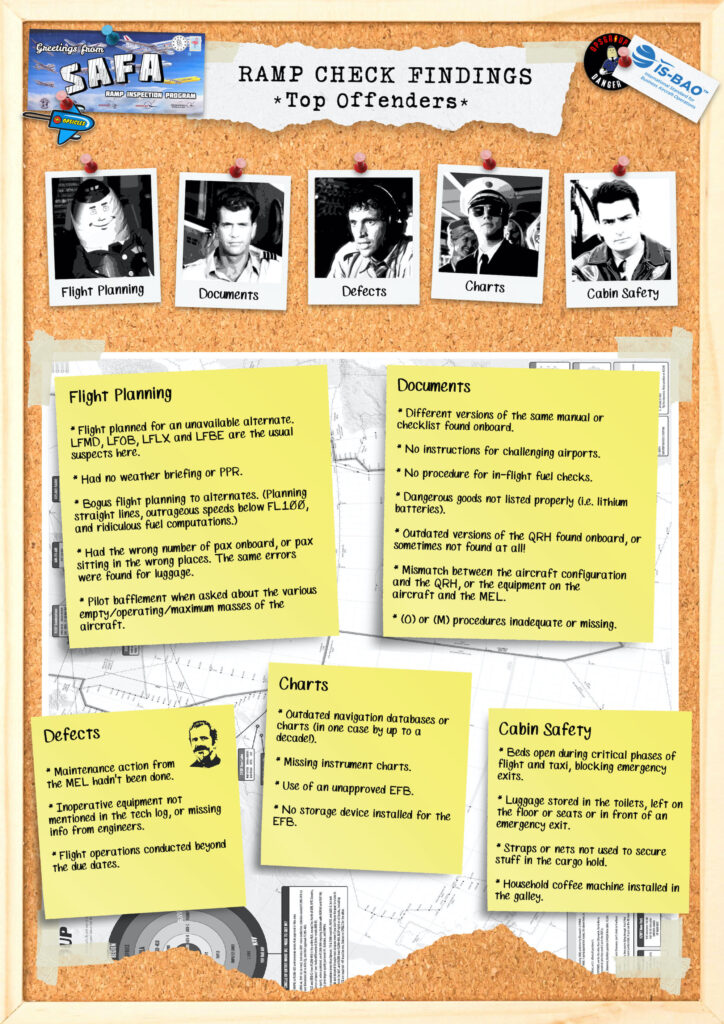
This is a PDF: click on it to download!

What do we base this on? Well, something pretty special happened recently. The French DSAC partnered up with IS-BAO to take a look at hundreds of de-identified ramp check findings in order to analyse the most frequent CAT 2 and CAT 3 findings in business aviation.

This is “special” for three reasons

  1. It’s great that an aviation regulator has actually shared this info because now we can see the top things we’re getting wrong.
  2. If we can see the top things we’re getting wrong, we can stop getting them wrong, and then ramp checks become faster and more efficient for everyone. 
  3. It’s great that this specific aviation regulator happens to be the one from France – because that’s where a lot of ramp checks seem to occur!

So, all good. IS-BAO published the results here, and it’s worth giving that a read first before we press on…

The Top 5 Offenders

As the good folks from IS-BAO point out – EASA Ramp checks cover 52 inspection items spread over 5 areas: flight deck, cabin, aircraft condition, cargo, and general/other.

But some of those 52 items generate more findings than others. The DSAC/IS-BAO study found that the top inspection items by number of CAT2 and CAT3 findings for business aviation were these ones:

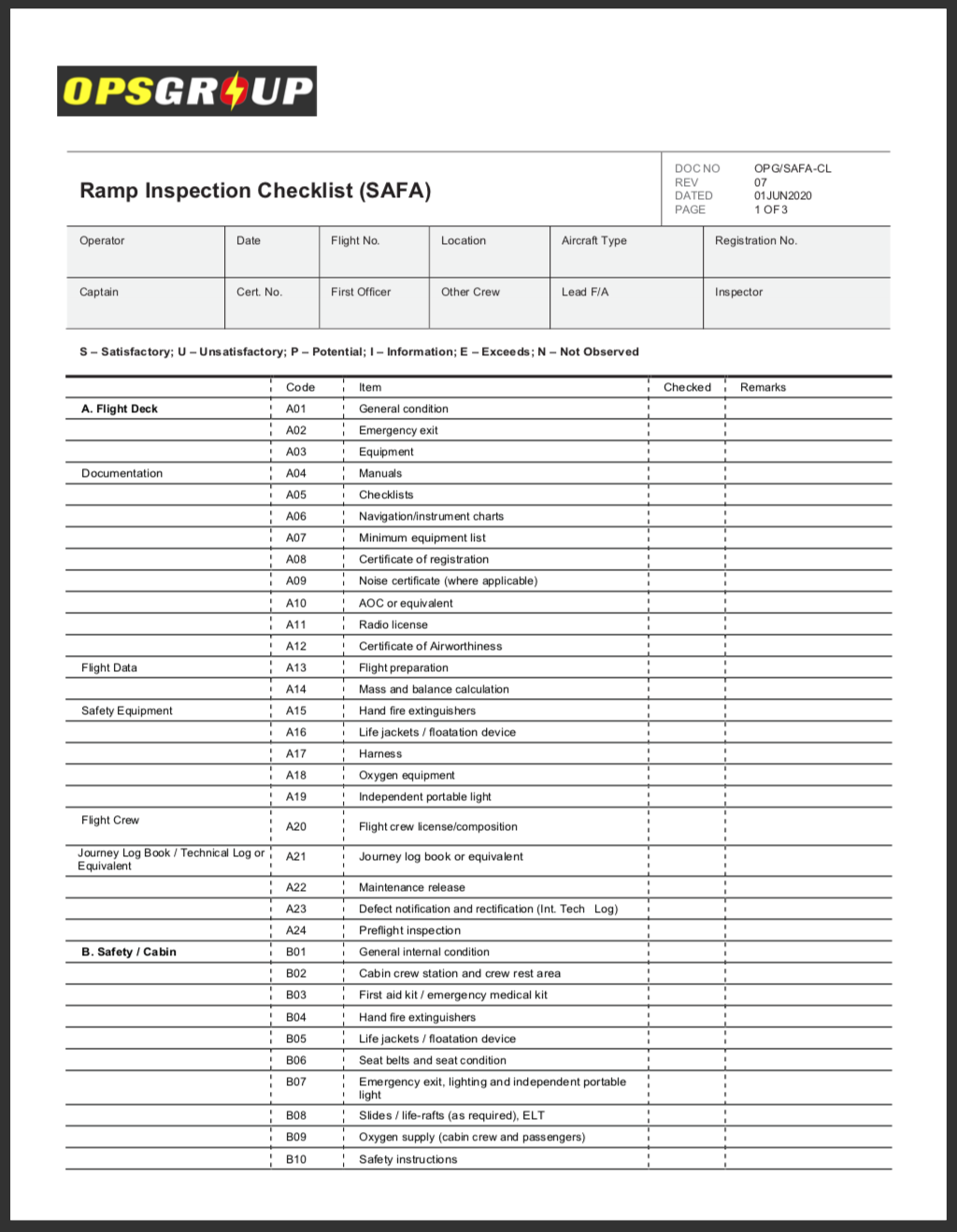
1. Flight preparation (RI checklist item A13)
2. Mass and balance calculations (A14)
3. Manuals (A04)
4. MEL (A07)
5. Checklists (A05)
6. Defect notification and rectification (A23)
7. Navigation/instrument charts (A06)

So essentially, these findings all relate to five key areas: Flight Planning, Documents, Defects, Charts, Cabin Safety. Get these right, and your “sweatin over a ramp checkin” days are over, partner!

Have you been ramp checked recently?

Let us know! Where did it happen? How did it go? What things surprised you?

As always, we will de-identify anything you share with us before we tell anyone else about it. But we’d love to hear your stories, and other people will too! Our idea is to gather together as many of these stories as possible, and put them into a little book to help give other pilots and operators an idea of what to expect. So if you’ve got a story to share, send us an email at news@ops.group
Limited edition SAFA Ramp Check postcards.

In related news: the EASA RIM has been updated.

What’s the EASA RIM? Europe’s version of the Pacific Rim movie only with ramp inspectors saving the aviation industry from danger? Or just an updated version of a rather boring manual?

EASA Ramp Inspectors, heading out to work.

Sadly, just an updated manual.

EASA have made some amendments, corrections and added some other details to their Ramp Inspection Manual, so here is our guide to their 131 pages of guidance (and an Appendix).

What’s up?

The Changes to the RIM are contained in a 131 page document here. So this is the doc that crew might want to read. (The massive doc that ramp inspectors use is called the Appendix – we’ll get to that later).

The big stuff to look out for (that we could see) is stuff on Alcohol testing and they’ve changed the name of the “Standard Report” to “Safety Report”.

Page 76.

Let’s start with something small.

This isn’t actually a change, but just something we think might be of particular use. It is the Checklist for on-the-job training for ramp inspectors. Basically, it is a long list of all the stuff they need to check. Which means it’s a long list you might want to check so you know what you are going to get checked on.

Alcohol Testing.

Scroll to page 98 (section 10.3) and it lays out all the info on alcohol testing and how it should be carried out. There is a lot of info here (most of it for the inspecting agents rather than you) but still not uninteresting to read.

The general principles are that it should be done somewhere private, out of sight of anyone else, and if you aren’t happy with the spot they pick then chose another. 

They’re testing to see if you blow more than 0.2 grams of blood alcohol concentration. If you blow below that then you pass. If you test above then don’t panic straight out, they must do a follow up confirmation test which mustn’t happen before 15 minutes, or outside of 30.

Certain drinks can mess up the results:

  • “Aromatic beverages” like fruit juice (never heard them called that)
  • Mouth sprays with alcohol content
  • Medical juices (I don’t even want to know what that might be)
  • Burping on the test can create false positives.

Here is a particularly hideous flow chart of the entire process. 
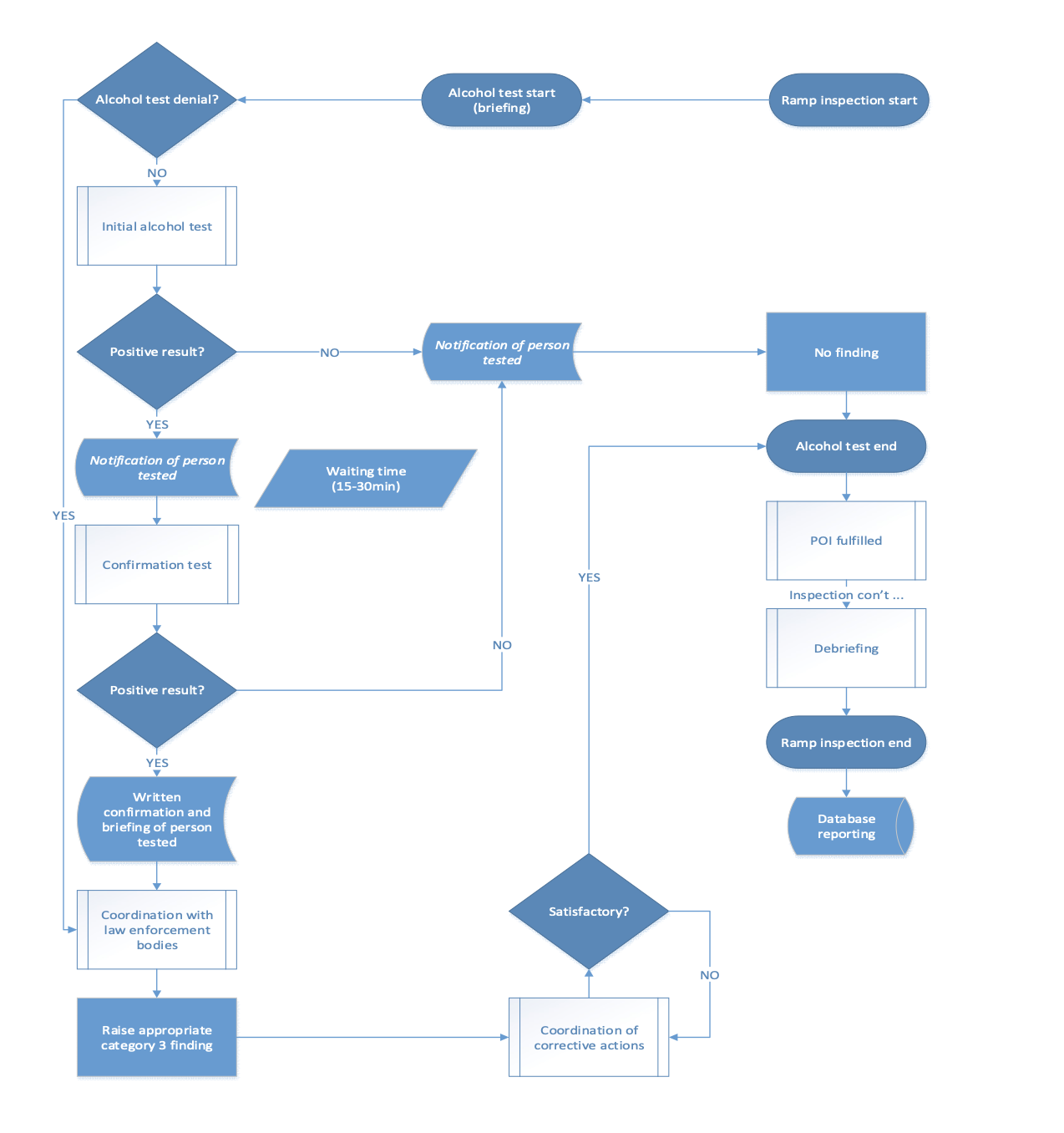
We think it’s easier to sum up stuff like this:

  1. Don’t ever go to work drunk. Most operators/states specify a minimum time between drinking and working but if you aren’t sure 12 hours is a generally decent one to work off.
  2. Of course even 12 hours won’t get you sober in time if you’ve been on a mega bender the night before. So don’t do that.
  3. If you wake up before you’re report time and realise you’re drunk/potentially drunk then CALL SICK!
  4. If you think a colleague is drunk, stop them from going to the airport! Report them if you need to.
  5. If you are at work, and get picked for a random test, make sure they do it correctly, in a private space following the right procedures.
  6. If you blow positive then don’t panic (unless you are drunk in which case do panic, you’ve messed up bad, partner). Have a think if you’ve maybe ingested something that could cause a false positive. Tell the inspector and wait for the confirmation test. They leave it at least 15 minutes, but don’t push for more than 30.

Moving onto The Appendix.

The Appendix to the RIM is a whole 304 pages filed with information on ramp check instructions and pre-described findings.

Many of which have just been updated.

Now, you might be thinking “why do I care how they’re instructing their inspectors on stuff?”. But you should care because if you know how they’re inspecting stuff, then it makes it a whole lot easier to not mess up on ramp checks and getting told off.

If you just want to scroll through the list of changes, then take a look here at the first 7 or so pages.

If you want a full description in standard EASA English, then read the whole 304.

If you want a summary of the changes then check this out.

Other useful stuff.

We wrote a whole post on ramp checks a while back and the stuff we wrote in that hasn’t really changed that much.

While ensuring you are complaint is important, remember is works both ways. Ramp Inspectors need to follow the rules and procedures as well. Particularly when it comes to not delaying you or disrupting your duties too much.

The manual only recommends they must give you 8-10 minutes of quality quiet time to set up for a flight. If you need more for safety reasons then tell them the time you need them to complete their checks by.

Final note.

Ramp checks can be frustrating. The best way to reduce that is make sure everything is in order and be prepared for them.

There are some airports we’ve heard are particularly vigorous with them:

  • Anywhere in France
  • Florence, Italy
  • Edinburgh, Scotland
  • London Heathrow
  • Copenhagen, Denmark (keen on the breath tests)
  • Amsterdam, Netherlands (also keen on the breath tests)

Let us know where you’ve experienced them so we can update the list!

That MMEL Thing: Here’s an Update

It looks like there might finally be a solution to the long-running MEL vs MMEL issue for US operators headed to Europe, keen to not get a ramp check finding!

The brief Backstory

Since 2017, US aircraft have been getting hit with ramp check findings in Europe because EASA decided that the D095 LOA wasn’t good enough – they wanted to see a D195 LOA instead, but it was taking operators a long time to get these approved by the FAA in the US due to a big backlog of applications.

The Solution

The FAA has published an updated Advisory Circular (AC 91-67A) which speeds up the process of getting this D195 LOA.

The NBAA have reported that the FAA has also updated guidance to its field offices, who will now issue the LOA after a brief review, provided the application is accompanied by an “attestation letter”.

The slightly longer Backstory

Over the past few years, ramp checks on some US aircraft in Europe highlighted an important issue – EASA and the FAA have different interpretations of the ICAO standards regarding deferring aircraft discrepancies.

In the US, with FAA authorization operators can use a master minimum equipment list (MMEL) to defer repairing certain equipment. But in Europe, MMEL cannot be used in lieu of an MEL specific to each aircraft or fleet.

The European Aviation Safety Agency (EASA) began requiring all aircraft transiting European airspace to have an approved Minimum Equipment List (MEL) for each, individual aircraft (i.e. a D195 LOA). An MEL that references the MMEL was not acceptable (i.e. a D095 LOA).

This was a pain for US operators, as to get an individual MEL approved under the LOA from the FAA takes time – but by not doing so, they ran the risk of getting a ramp check finding in a European country. (France seems to be the place where this happens most often!)

At the start of 2018, the rumour was that the FAA and EASA reached an agreement: the FAA would start requiring international operators with D095 LOAs to obtain new D195 LOA’s instead, and in return EASA would halt any findings for a period of 12 months to allow for these new LOA’s to be issued. There was no official announcement on this, but SAFA data did indicate that ramp check findings for use of D095 were greatly reduced for a time.

The FAA proposed a policy change to phase out the D095 LOA over the next 3-5 years, and to work out a streamlined approval process to issue everyone with D195’s instead.

The French CAA said they would stop issuing ramp check findings once the FAA has launched the new policy.

FSDOs across the US then started processing the backlog of D195 requests from operators (there were lots!). In the meantime, US operators with the D095 LOA continued to face the same old MMEL findings on ramp checks in Europe.

How to prepare for a ramp check in Europe?

Here’s the article we wrote all about how to make a ramp check painless.

And here is a copy of the OPSGROUP SAFA Ramp Checklist. Download it here.

Keep a copy with you and run through it before you head to Europe.

Further Reading


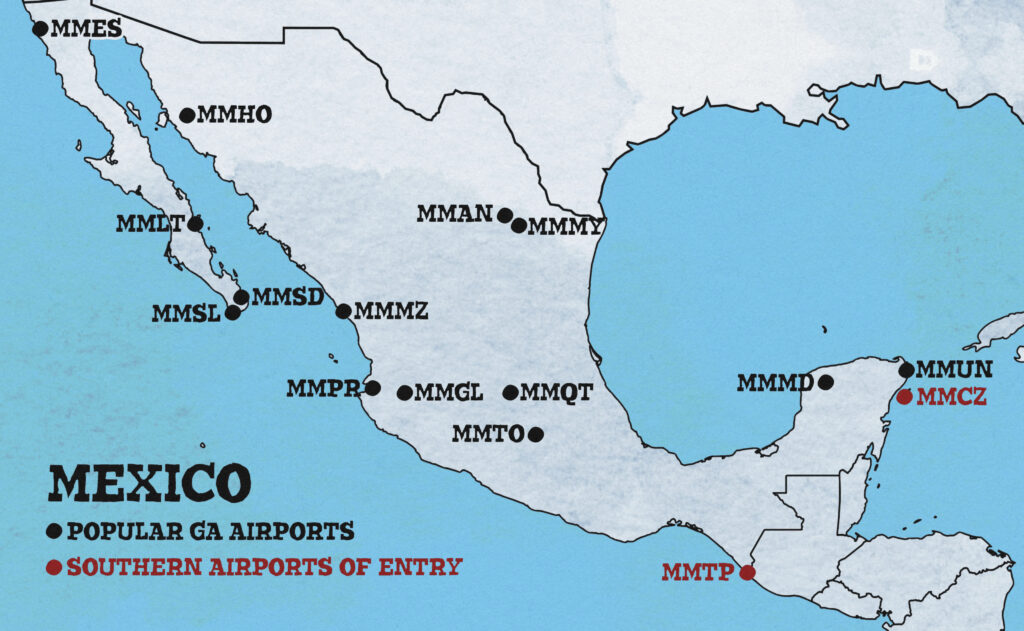
Ops to Mexico? Prepare to get ramp checked!

Authorities have announced a ramp check program will be in place from now until mid-Jan 2024.

They had a similar surge in ramp checks last year during the same period – the official line then was that this was instituted to ward off cabotage.

Make sure you have all the required docs on board – big fines apply for anyone missing anything important. Local agents advise these checks are taking up to 40 mins to complete. 

Ramp Check Reports 

We’ve had a few recent reports from OPSGROUP members who have been ramp checked at airports in Mexico:

MMZO/Manzanillo (Jan 2024)

Part 91 trip, Falcon. The Mexican ramp check/arrival was a bit more detailed than we’ve previously experienced. We frequent this airport and the customs/immigration officers opened every available panel, bag onboard, AND wanted us to open the avionics nose cone which was odd. We explained screwdrivers and a ladder were required – and they didn’t make us open it. An important note: we were repositioning empty into the airport and leaving with Pax that the handler is quite familiar with (in a good way).

Airport Permit /paperwork was issued without problems, but every potential crew member will need to be listed on the aircraft’s paperwork.  Handler suggested operators should submit all possible names to prevent delays to their future ops. We requested the permit 48 hrs prior to landing and it came through just a few hours before we headed down there. Short notice trips will be unlikely.  Permit good for 6 months, at this airport only. 

MMTP/Tapachula (Oct 2023)

Part 91 customs stop, the whole process took exactly one hour from Block in to Block out. G600 with 15 pax and three crew.

– Upon arrival, the military and drug sniffing dogs were plane-side waiting for all the bags to come off(including crew bags).
– They were snapping photos nonstop.
– They did not want us to take our trash bags out. We just double bagged and left them in the lav.
– Myself, our FA, along with our pax and handler walked about 100 yards to the customs building, in a light drizzle.
– Bags got x-rayed and we waited while there was some back and forth between the customs agents. They stamped docs and permits which took a good 30-40 minutes.
– Walked back out to the jet and departed with no issues.

MMTO/Toluca (Aug 2023)

Part 91 operator came in from the Caribbean on our way to Toluca. The ramp and customs personnel were there waiting for us and marshalled us to an area of the GA ramp. 30 yards or so from a covered entrance to the terminal. We were able to Leave the APU running with a crew member onboard. Passengers and crew were escorted into the terminal to clear. They did an exterior sweep and came on board the aircraft. I do believe all bags came off and went through security in a private area. I don’t recall any specific questions but the whole process took probably 25-30 minutes.

Been to Mexico recently? How did it go? Please file a quick report here!

What docs to carry onboard?

Here’s the list of everything you should carry on board for trips to Mexico in case you get ramp checked:

1) Airworthiness Certificate
2) Registration Certificate
3) Worldwide and/or Mexican Insurance stating Private use when flying Far Part 91 and Charter use when flying Far Part 135. When flying Far Part 135, it is mandatory to have both insurances: worldwide and Mexican.
4) Pilot’s licenses: both sides and stating aircraft type rating.
5) Pilot’s medical certificates: valid document according to crew role (Pilot in Command or Second in Command), type of flight and according to pilot’s age.
6) If holding Multiple Entry Authorization (MEA), this document and its corresponding payment receipt, must be on board.
7) For Charter operations, the following additional documents are required:
a. Valid Air Operator Certificate (AOC): Copies are accepted considering this document might include many tail numbers (fleet). Payment receipt should also be included.
b. FAA OST 4507 FORM copies are accepted considering this document might include many tail numbers. Alternatively, the appropriate exemption document, Certificate of Public Convenience and Necessity is also accepted.
c. If holding a Mexican Indefinite Blanket Permit (IBP), this should be accompanied by the Mexican AOC, and the Yearly Verification (including payment receipt) for it to be considered valid. Copies are accepted considering this document might have many tail numbers.
8) The logbook (maintenance logbook) stating the most recent information about maintenance performed on the aircraft.
9) The authorization to operate as a mobile radio aeronautic station; (Aircraft radio station license/authorization).
10) The Flight Manual.
11) Noise Certificate.
12) The Minimum Equipment List (MEL) when the type certificate indicates it.
13) Mexican AIP (for Private flights, a Jeppesen Airway Manual has been sufficient in the past for this. Charter operators, however, are required to carry a copy of the Mexican AIP – you will need to subscribe to the AIP through AFAC and carry electronic copies onboard).
14) The preflight checklist.
15) If full or partial (inbound/outbound Mexico) route involves overflying the ocean, then a life raft and/or life jackets are required to be on board, according to the type of aircraft. Please note this is also a usual requirement, but Mexican CAA will also be double checking for this.
16) Weight and Balance Manifest.
17) First Aid Kit.
18) Jeppesen Manuals, (at least electronic format).
19) If operating Far Part 91 – Private flights, it is required to present a document stating the purpose of the flight, to include the name of the lead passenger and to declare its connection with the aircraft (owner, employees, etc). If accompanied, letter must declare the relationship of the passengers with the lead passenger (family, friends, employees, etc). This will prove there is no commercial purpose under any circumstance. To present this letter, having it notarized is not necessary.

Private flights watch out!

Private flights to Mexico on aircraft that are used for both private and charter flights should watch out – the authorities in Mexico will likely require further proof that you are, in fact, a private flight. So if the aircraft is not registered in the name of the pilot or one of the pax, the best thing to do is prepare a notarized letter identifying the legal owner of the aircraft and that the owner is authorizing the crew and pax to be on board. The letter should also clarify that the flight is a private, non-commercial flight. 

Further Reading

For a look at some of the long-standing challenges affecting General Aviation ops to Mexico, as well as some of the more recent issues which maybe haven’t been widely reported yet, check out our article.


Flight Plan Alternates in Europe

In the US, under certain conditions you can get away with not having to select an alternate – as long as both ends of one runway are suitable and available, you have two runways. In Europe, there’s a similar rule, but the key difference is that there has to be separate runways – not one runway which you could land at either end of.

EASA recently issued this reminder letter to Third Country Operators:

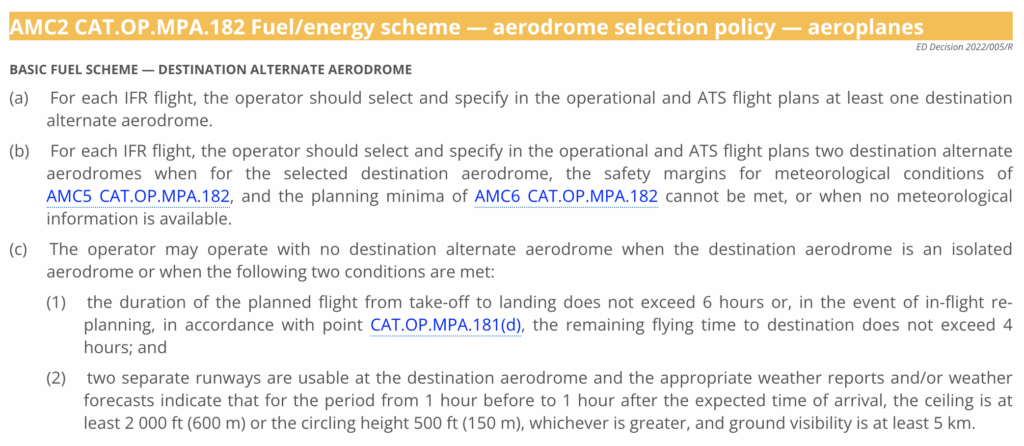
For a flight to be conducted in accordance with the instrument flight rules, at least one destination alternate aerodrome shall be selected and specified in the operational and ATS flight plans, unless the duration of the flight from the departure aerodrome, or from the point of in-flight re-planning to the destination aerodrome is such that, taking into account all meteorological conditions and operational information relevant to the flight, at the estimated time of use, a reasonable certainty exists that:

1. the approach and landing may be made under visual meteorological conditions (VMC); and

2. separate runways are usable at the estimated time of use of the destination aerodrome with at least one runway having an operational instrument approach procedure.

In accordance with the ICAO definition, separate runways are two or more runways at the same aerodrome configured such that if one runway is closed, operations to the other runway(s) can be conducted.

Several ICAO contracting States have filed a difference to ICAO with regard to this standard, because their national regulation does not contain a requirement for separate runways at the destination aerodrome when opting to file a flight plan without a dedicated destination alternate aerodrome.

Please be informed that EASA expects TCOs to plan their flights in compliance with the ICAO standard. This means that an alternate aerodrome has to be listed in the ATS flight plan where required in accordance with standard 4.3.4.3.1 of Annex 6 Part 1 to the Chicago Convention, even though your national regulation is less restrictive in this aspect.

The respective destination alternate fuel shall be included in the pre-flight calculation of usable fuel in accordance with standard 4.3.6.3 of said Annex.

EASA will verify compliance by means of sampling flight documents during the initial authorisation and during continuous monitoring of TCO authorisation holders.

Furthermore, ramp inspections performed under SAFA/RAMP inspection programme will serve as an additional source of information for non-compliance.

Where a non-compliance is found, EASA will raise a level-2 finding in accordance with Part-ART of the TCO Regulation (EU) No 452/2014.

We therefore, encourage you to review your flight planning procedures and where necessary to align those to ensure full compliance with the respective above-mentioned standards.

So can I plan a flight in Europe without an alternate?

Yes, but only in certain circumstances. EASA CAT.OP.MPA.182 has the details:

Or if you want to keep it simple, just file an alternate airport in your flight plan.

A Cautionary Tale

Here’s a recent report from an OPSGROUP member on this:

We were doing flights all over the EU without an alternate, when the weather didn’t require one as per our rules. Then we got SAFA ramp checked in EGSS/Stansted, and the ramp inspector took umbrage that we were coming in without an alternate on a clear day. We now carry an alternate for all single runway ops in the EU, with a realistic routing.

A Realistic Routing?

This is another thing to watch out for in Europe. You have to make sure your route to alternate is computed and included in your flight plan, that it’s realistic, and that it doesn’t break any rules. Let’s tackle those in order:

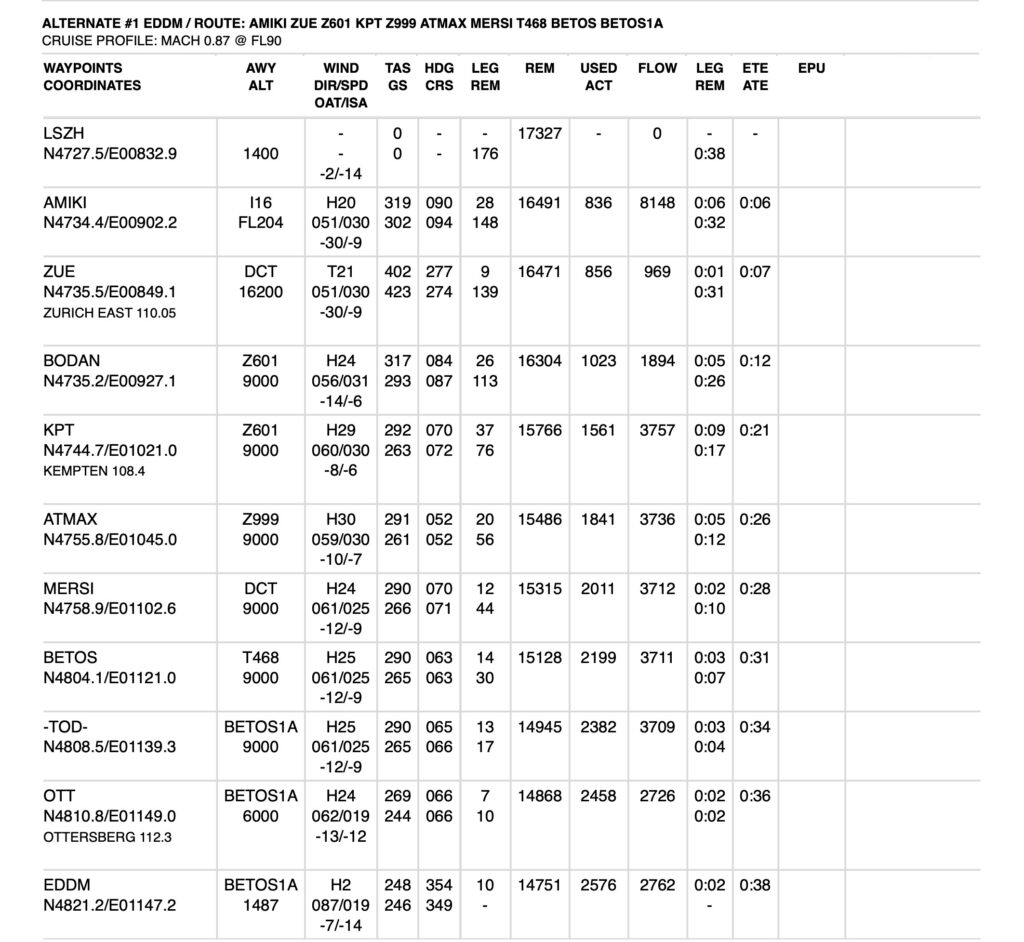
Computed and included in your flight plan:

It should look something like this:

Realistic:

This means you’ve included a proper route to alternate like the one shown above, not just one big DCT. The routing doesn’t have to be fully Eurocontrol compliant, it just has to be realistic. That means making sure you have enough fuel for a missed approach, climb, and descent to alternate. If you use a SID from your destination airport and join it up with a STAR for your alternate, that’s probably a safe bet.

Doesn’t break any rules:

The French DSAC recently partnered up with IS-BAO to take a look at hundreds of de-identified ramp check findings in order to analyse the most frequent CAT 2 and CAT 3 findings in business aviation. A common one was flights planned to unavailable alternates – usually those that cannot be used as per AIP or Notam, or those where you need PPR.

Common ones to watch out for:

LFTH/Toulon – can’t be used as alternate without PPR.

LFMD/Cannes – can’t be used as alternate except for flights to LFTZ/La Mole.

LFMQ/Le Castellet – this sometimes gets used as an alternate for LFMN/Nice and LFML/Marseille. But LFMQ rarely publishes TAF/METAR reports, so if you want to use this, you need to make sure you select at least one other alternate with a weather report!

Do you know of any more? Let us know!

More info

Head here to download the latest ramp check guidance straight from the horse’s mouth.


EU delays alcohol testing on ramp checks to 2021

The EU had some changes planned for Ramp Checks and Pilot Mental Health which were due to take place on 14 Aug 2020, but these have now been delayed to 14 Feb 2021.

The three big changes

  1. EASA regulations will be updated requiring alcohol testing during ramp checks. This will take effect across all SAFA participating countries. However, a lot of countries have already started doing this anyway: Austria, Belgium, Czech Republic, France, Germany, Greece, Iceland, Ireland, Italy, Netherlands, Portugal, Spain, Switzerland, UK, and Singapore. In most places, local authorities have the power to carry out breathalyzer tests at any time – not as part of ramp checks. For more on SAFA ramp checks, see our article.
  2. All pilots working for European airlines will have access to mental health support programs.
  3. European airlines will perform a psychological assessment of pilots before the start of employment.

Despite the delay to the implementation date, it’s still something worth looking at now. The UK CAA has published a Safety Alert with the following recommendations:

1. Operators are strongly recommended to continue to introduce Flight Crew Support
Programmes as required by the Regulation and to maintain existing programmes despite the deferred implementation date.

2. Operators should also consider the impact of the Covid-19 crisis on cabin crew and other safety-sensitive personnel as well as flight crew. It remains essential that senior management of operators, mental health professionals, trained peers and staff representatives work together to enable self-declaration, referral, advice, counselling and/or treatment, where necessary, in cases where there may be a potential safety issue resulting from a decrease in medical fitness.

3. Additionally, operators are encouraged to use this delay to develop their policies on the prevention and detection of the misuse of psychoactive substances and on the psychological assessment of flight crew.


Expect breathalyzer during German Ramp checks

German authorities confirm they have been conducting random breathalyzer tests during ramp checks since as far back as Jan 2017, despite this not being part of the official EU SAFA ramp inspection guidelines.

In Dec 2016, following the accident of the Germanwings Flight 9525, EASA published a proposal to the European Commission to better support pilot mental fitness. One of their recommendations was to introduce random alcohol screening as a part of ramp checks within the EU.

Although that proposal has still not been adopted yet, local authorities in Germany say they can still perform these tests on the basis of German national law alone.

Have you had a recent ramp check anywhere with any surprise items not part of the standard checklist? Comment below…

Further reading


European Ramp Checks – most popular questions from inspectors

Of late, the level of interest in OpsGroup for European Ramp Checks has been very high.  There has been a lot to think about. First, we discovered in March that French inspectors had started recording a finding for operators that were using the Manufacturer MEL instead of a customized one, and it turned out that across EASA-land inspectors were raising the same issue. There is an update on that below.

One of our members posted a great list of the most popular findings/issues raised by EASA Inspectors in the last 12 months, together with the skinny on “how to fix these, so you don’t get a finding”.

So, first let’s look at the Top 3 Categories, with the subset questions, and then an update on the D095 MMEL/MEL issue.

Popular European Ramp Check Items

Visiting and locally based aircraft may be subjected to ramp inspections as part of a States’ Safety Programme. The EU Ramp Inspection Programme (EU RIP) is one such inspection regime which currently has 48 participating states. The EU Ramp Inspectors review findings and use this intelligence as a basis for prioritising areas to inspect during a ramp check.

The most frequent findings and observations raised since January 2016 follow. This information can be used to help avoid similar findings being raised during future ramp inspections on your aircraft.

Most Frequent Findings

The main 3 categories of findings, relate to: Minimum Equipment Lists, Flight Preparation and Manuals.

1. Under the category of Minimum Equipment List, the finding is.
• MEL not fully customised.

2. Under the category of Flight Preparation, the main findings are:
• PBN Codes recorded on the flight plan which the operator did not have operational approval for
• Use of alternates which were not appropriate for the aircraft type; and
•[blur]Use of alternate airports which were closed[/blur]

[blur]3. Under the category of Manuals, the main finding is.
• AFM was not at the latest revision.[/blur]


[blur]Simple Steps to Avoid Similar Findings[/blur]

[blur]1.    Review your MEL, especially amendments made to the MEL after the initial approval, and ensure it is fully customised:
•    Where the MMEL and/or TC holders source O&M procedures require the operator to develop ‘Alternate Procedures’ or ’Required Distribution’ etc. these must be specified in the operators MEL and/or O&M procedure;[/blur]


Full report in your OpsGroup Dashboard, including the standard ramp checklist PDF:

Opsgroup Dashboard login Join OPSGROUP for access

To get the full report and checklist – there are two options:

  1. OPSGROUP Members, login to the Dashboard and find it under “Publications > Notes to Members”. All FSB content like this is included in your membership, or 
  2. Join OPSGROUP with an individual, team, or department/airline plan, and get it free on joining (along with a whole bunch of other stuff), or

Rules revised: SAFA Ramp Checks for ‘Suspect Aircraft’

01JUN: EASA have published new guidelines for inspectors to assess which aircraft should be prioritised for SAFA ramp checks in Europe and SAFA compliant states. ARO.RAMP.100(b) in the Part-ARO contains the updated list of aircraft that will be selected for priority checking:

(a) (when EASA receive) information regarding poor maintenance of, or obvious damage or defects to an aircraft;

(b) reports that an aircraft has performed abnormal manoeuvres that give rise to serious safety concerns in the airspace of a Member State;

(c) a previous ramp inspection that has revealed deficiencies indicating that the aircraft does not comply with the applicable requirements and where the competent authority suspects that these deficiencies have not been corrected;

(d) previous lists, referred to in ARO.RAMP.105, indicating that the operator or the State of the operator has been suspected of non-compliance;

(e) evidence that the State in which an aircraft is registered is not exercising proper safety oversight; or

(f) concerns about the operator of the aircraft that have arisen from occurrence reporting information and non-compliance recorded in a ramp inspection report on any other aircraft used by that operator;

(g) information received from EASA Third-Country Operator (TCO) monitoring activities;

(h) any relevant information collected pursuant to ARO.RAMP.110. (“whistleblowers”)


The revised Part-ARO, issued in May 2016, contains a large number of revisions and operators should take a close look at the changes.

For a general guide to SAFA Ramp Checks, have a look at our other article: Avoiding the Pain of a Ramp Check.

References: