Iraq Airspace Risk For Overflights
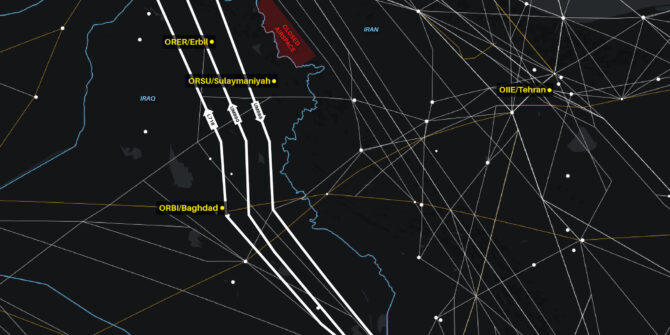
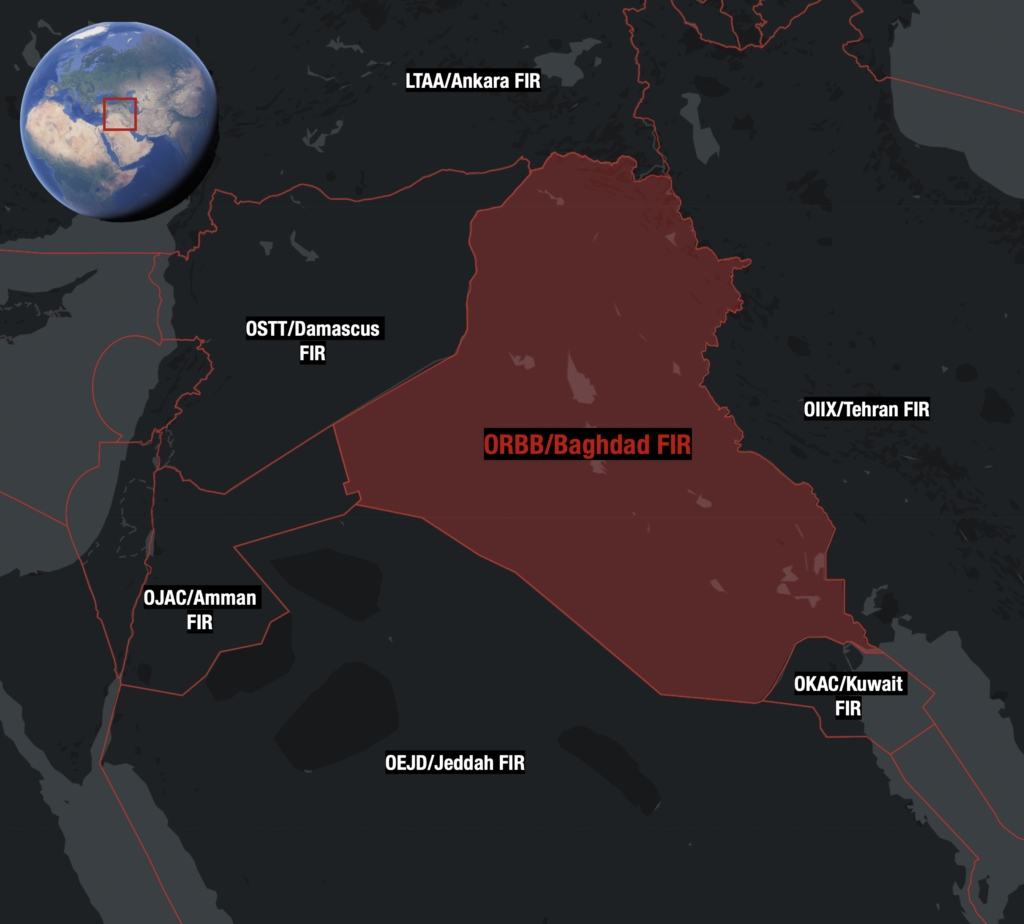
International operators overflying Iraq should take note of recent events impacting airspace risk in the region.

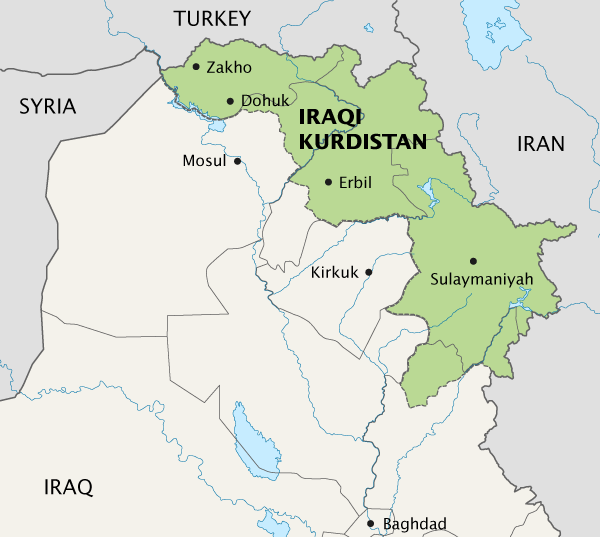
Iran have closed a section of airspace in the north of the country along the border with Iraq, and are potentially using the area to launch missile and drone attacks at targets near ORER/Erbil airport, in close proximity to heavily flown international air routes.
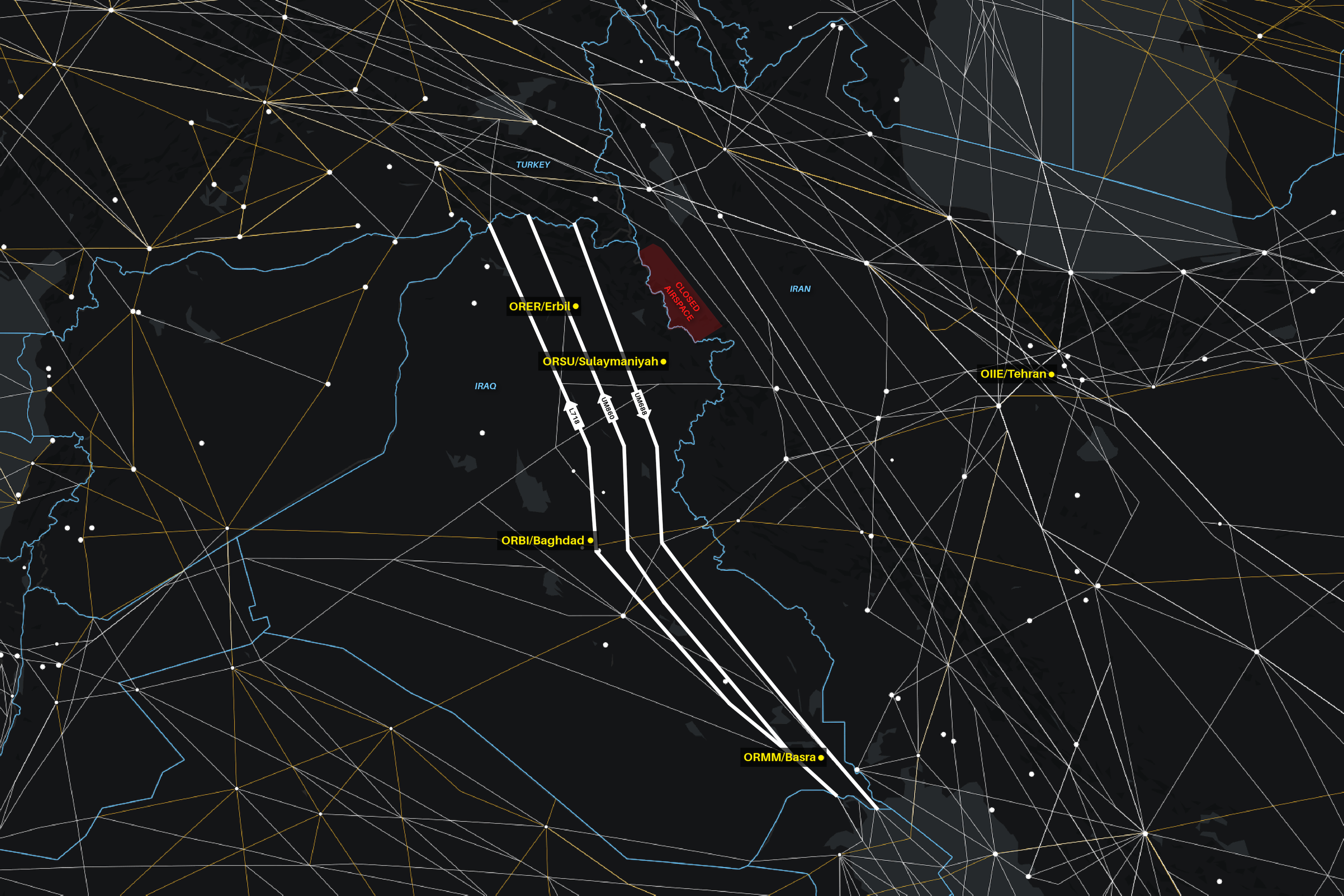
Click for hi-res version.

Iranian attacks

Iran are warning their own operators against flying in Iraqi airspace, and especially at Erbil airport, which came under direct fire from Iranian surface-to-surface ballistic missiles in Feb 2021 and again in March 2022. Iran launched further attacks this week on an area 35 miles east of Erbil, reportedly targeting a Kurdish opposition group in the region – an armed opposition force that is banned in Iran.

Here is the warning issued by Iran:

OIIX A2959/22 - AIRSPACE SAFETY AND SECURITY WARNING ISSUED BY IRAN CAA IN
RESPONSE TO THE HAZARDOUS SITUATION WITHIN THE TERRITORY AND
AIRSPACE OF BAGHDAD FIR (ORBB),
IRANIAN REGISTERED AIR OPERATORS ARE ADVISED TO TAKE
ALL POTENTIAL RISKS INTO ACCOUNT IN RISK ASSESSMENT AND FLT
PLANNING DECISIONS WHEN OPERATING AT AIRPORTS WHICH ARE LOCATED
WITHIN BAGHDAD FIR (ORBB) ESPECIALLY ERBIL INTERNATIONAL AIRPORT
(ORER), DUE TO THE RISK POSED BY
MILITANT ACTIVITY AND LIMITED RISK MITIGATION CAPABILITIES IN IRAQ. 28 SEP 17:35
2022 UNTIL 05 OCT 18:30 2022 ESTIMATED. CREATED: 28 SEP 17:43 2022

Iraq airspace risk

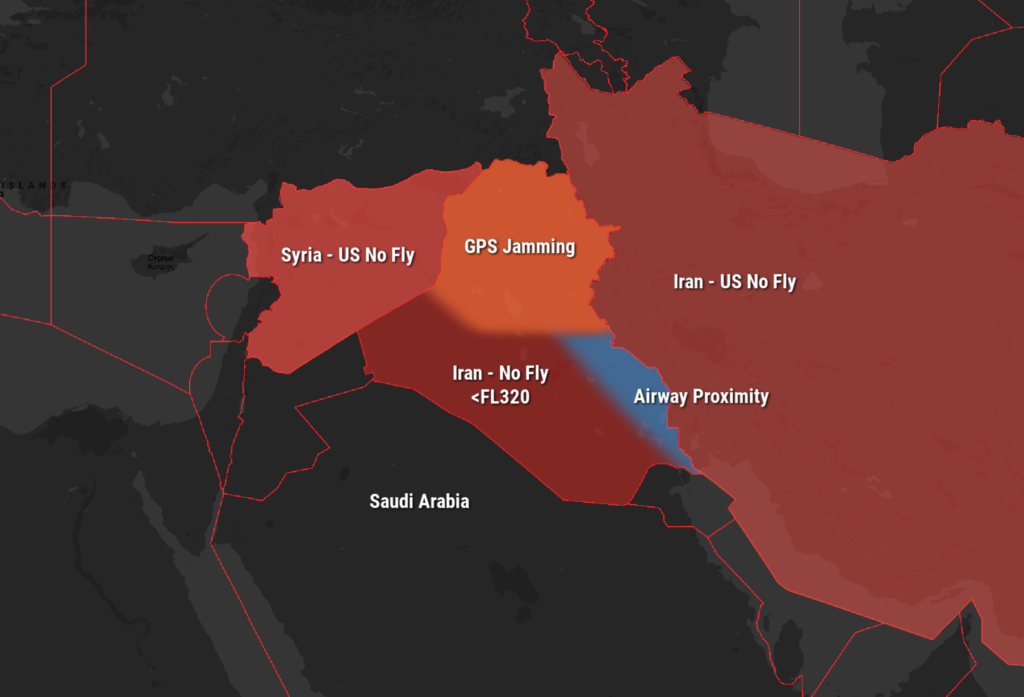
Several countries warn against overflights of both Iran and Iraq. The US FAA bans N-reg aircraft from the OIIX/Tehran FIR, and says that overflights of the ORBB/Baghdad FIR must be at FL320 or above – and just last week they extended these rules to 2024.

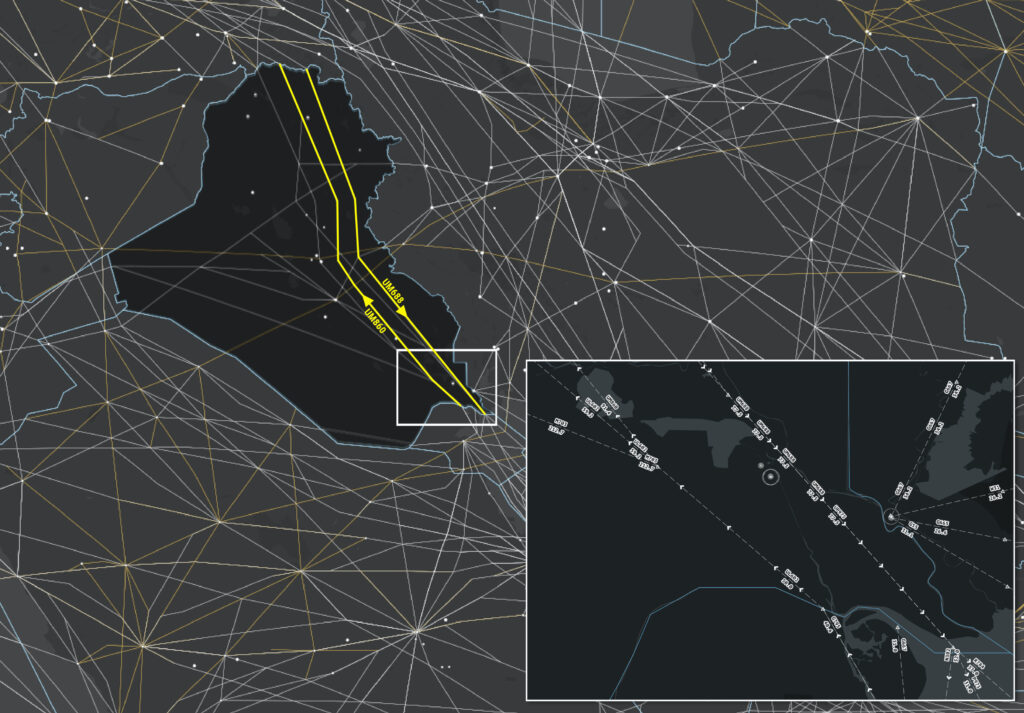
But the Iranian attacks in northern Iraq raise questions and concerns about overflights of Iraq. Airways UM688 (southbound) and UM860 (northbound) through Iraq are popular routes for international flights between Europe and the Middle East. Is it really safe to fly these routes now, even above FL320?

It’s worth digging into the US FAA guidance on Iraq a bit deeper to get a clearer picture of exactly what the risk is here. SFAR 77 has the info, and this is (some of) what it says:

  • Iranian-aligned militia groups (IAMGs) have access to UAS and anti-aircraft capable weapons systems which present inadvertent risks to the safety of U.S. civil aviation operations in the ORBB/Baghdad FIR at altitudes below FL320 and at potentially targeted airports.
  • IAMGs likely lack the ability to conduct effective target identification and airspace de-confliction, increasing the risk of an accidental shoot down of a civil aircraft due to misidentification or misperception.
  • In addition, the FAA remains concerned about cross-border military activity. Both Iran and Turkey have previously conducted various no-notice, cross-border operations striking targets in northern Iraq using a variety of weapons, including short-range ballistic missiles, rockets, and weaponized UAS. In a recent example, on March 12, 2022, up to twelve Fateh-110 surface-to-surface ballistic missiles launched from western Iran and impacted near the construction site of the new U.S. consulate in Erbil, Iraq, and Erbil International airport (ORER). While this attack did not pose a direct threat to the airport, the missile trajectories possibly presented an inadvertent risk to aircraft in flight that might have been operating at low altitude in the vicinity of Erbil International airport (ORER) during the time of the attack.
  • In general, unannounced third-party cross-border operations in the Baghdad FIR (ORBB) present a low altitude safety-of-flight risk for aircraft flying in the vicinity of the targeted location(s) and for aircraft on the ground at airports co-located with, or in close proximity to, the intended targets. These activities also pose an airspace de-confliction challenge.

Should I avoid overflying Iraq?

For most Europe-Middle East flights, the route through Saudi-Egypt is a safer option than Iraq.

Even routing through Iran is probably a safer bet at the moment (although we don’t advise that either!). We received a report from an OPSGROUP member this week who routed through Iran:

“I would estimate our flights through Iran vs Iraq are taking (approximately) 10-15 mins longer, but at significantly less risk. We only consider airports that are served by either Emirates or FlyDubai as suitable for diversion, but only as a last resort, such as OIIE, OISS and OIFM. The company we use for support and handling if such diversions are required is Hadid. They are excellent for sorting any problems/permits in the Middle East.”

Here’s the Iraq risk, as we see it:

  • Potential of intentional targeting by terrorist organisations who possess portable anti-aircraft weaponry.
  • Civil aircraft may be misidentified by the air defence systems of both local and foreign military who are active in the country.
  • Iraq is politically unstable, and security and safety on the ground is unpredictable and likely to be high risk.
  • The US have pulled their troops out and so there is little protection at the major airports. 
  • ORBI/Baghdad and ORER/Erbil airports are common target for rocket attacks. Militia and terrorist groups are active in these areas.

Want a full briefing?

Just click here. Safeairspace.net is our conflict zone and risk database run by OPSGROUP. We continually assess the risk to operators the world over. It presents that information in a way that will always be simple, clear, and free. You can also add your email to our new fortnightly airspace risk briefing that contains only what you need to know, delivered every second Monday.

Iraq Overflights: A Recent Report

The US FAA recently amended their long standing Notam prohibiting US Operators from entering the ORBB/Baghdad FIR. The KICZ Notam A0036/21 used to bar flights at all levels, but now US operators are allowed to overfly Iraq provided they remain at or above FL320, as per the SFAR.

So, what can you expect if you elect to use this newly available routing, and what risks remain?

You can still expect risk

Iraq remains a political volatile country and the security there is unpredictable. Terrorist groups remains active, and have access to anti-aircraft weaponry.

What should you do?

  • Continue to monitor alerts and sites such as Safeairspace to confirm what the current situation is.
  • Flights should remain above FL320 to avoid risk from MANPADS.
  • Do not use Iraqi airports as diversion options unless it is an absolutely critical emergency situation.

All going well, here’s what expect

Plan to use the UL602, UM860 and UM688 airways. These are major airways utilised by traffic routing between Europe and the Middle East. Iraq offers the slightly shorter route compared to Iran (and Iran remains out of bounds for US operators).

The routings to plan are as follows:

Northbound:
– TASMI DCT SEPTU DCT ROXOP UM860 NINVA
– TASMI UL602 ALPET L718 DEBNI DCT EMIDO L718 KABAN (all flights need to be at or above FL280 before DEBNI to stay clear of restricted area OR/R 401).

Southbound:
– TASMI RATVO UM699 SIDAD (via airway)
– RATVO DCT SISIN UM688 SIDAD (DCT – subject to availability)

Kuwait are good at handing you over, and Bahrain and the UAE airspace is all well managed.

ATC standards are good, and standard VHF throughout, with radar. It is worth keeping your headsets on though because a good listening watch is required at all times in this region.

Routing south you might find yourself slowed down or shifted levels, or given early descents, as they manage the flow into some of the major hubs in the Middle East. If you fly into the Bahrain FIR (via RABAP or LONOS) be aware there are high levels of congestion here, particularly military traffic.

Any other considerations?

Iraq borders Syria which is an absolute no go area. There is a large prohibited area in the northwest quadrant of Iraqi airspace along the Syrian border. If you are looking to use LCLK/Larnaca as a diversion airport, consider how you will manage routing around Syria.

The main southerly airway lies extremely close to the Iranian border. The border is not a straight line so consider whether you might accidentally cross it if detouring for weather, or if offered a direct routing which cuts the corner.

You do occasionally get some major storms in this region. When they are there, they aim to be impressive!

GPS jamming is a problem, usually in the northern region from around 40nm north of the border and through about one third of the airspace. Of course, if you have INS and/or VOR/DME RNAV etc then you’ll be ok, but if you’re using something like Garmin avionics which rely solely on GPS then not so much. UAE airspace requires at least one GPS too, so update ATC if you need support!

What if I have to land there?

Security and safety on the ground is unknown and likely to be high risk.

The US have pulled their troops out and so there is little protection at the major airports. Leaving the airports will result in possible security issues and is unadvisable. While the airports are generally well maintained and serve some major international airlines, conditions are challenging particularly in the summer when temperatures regularly exceed 40°C. Terrain is also a consideration.

Cultural and religious regulations must be taken into account, and political conflict with certain nationalities should be considered. Alcohol and drugs are banned with severe penalties.

ORBI/Baghdad is a common target for rocket attacks, particularly because of its proximity to an air base. Rebels and terrorists are active in this area. The facilities and runways are decent with two ILS approaches and two runways of 4000m and 3301m. This should only be used in absolute emergencies.

ORMM/Basra is the second largest airport in Iraq and has a good length runway and an ILS. This should only be used in absolute emergencies.

ORER/Erbil offers a very decent length runway and facilities. The main area of issue is over the hills to the north of the airport. This is the only airport which may be recommended for use as a possible en-route diversion.


Kurdistan airports to re-open

The Iraqi Prime Minister has lifted the government ban on international flights to the Kurdish airports ORER/Erbil and ORSU/Sulaymaniyah.

The central government will take full control of the airports, and will start allowing international flights to resume in the coming days. No international flights have operated from these airports since the end September 2017. Their closure was seen as a punitive measure taken by the Iraqi central government following the September 25th independence referendum in the Kurdistan Region.

The authorities have now withdrawn the Notams that were previously in place for both of these airports advising that they were closed to international flights. Both Iran and Turkey currently still have Notams in place prohibiting flights to these airports from using their airspace – but we expect these to be updated soon to reflect the lifting of the ban.

A0661/18 NOTAMR A6765/17
Q) LTXX/QAFXX/IV/NBO/E /000/999/3901N03524E465
A) LTAA LTBB B) 1802010551 C) 1803312359 EST
E) ALL TFC FROM/TO ORSU AND ORER AERODROMES (ALSO AS ALTERNATE
AERODROME) ARE NOT AUTHORIZED TO USE TURKISH AIRSPACE UNTIL FURTHER
NOTICE EXC EMERGENCY, AMBULANCE AND HUMANITARIAN AID FLIGHTS.
A0223/18 NOTAMR A3746/17
Q) OIIX/QAFXX/E/000/999/
A) OIIX B) 1801160610 C) 1804160600 EST
E) ALL TRAFFIC FM OR TO ORSU AND ORER ARE NOT AUTHORIZED TO USE
TEHRAN FIR.

Further reading:


ORER and ORSU: Closed to International Ops

The Iraqi CAA will ban all international flights to/from ORER/Erbil and ORSU/Sulaimaniyah starting from Friday 29th Sep. 

From then on, those airports will only be open for Iraqi carriers and domestic ops.

Tensions around the Kurdish autonomous region of Iraq are rising following a referendum on independence.

The Iraqi govt has demanded that the KRG (Kurdistan Regional Government) hand over control of its two international airports – ORER and ORSU. Until the KRG comply with this request, the international ban on flights to these airports is set to continue.

At the request of the Iraqi govt, Iran had already closed it’s airspace to ORER/ORSU traffic earlier this week, and Turkey was considering implementing the same ban.

The KRG are now deciding whether to give up control of their airports or lose their international flights. Should it be the latter, then from now on anyone attempting to travel to the region will have to transit via Baghdad.

We will update as more information becomes available.