FAA Airspace SLOP Mini Guide

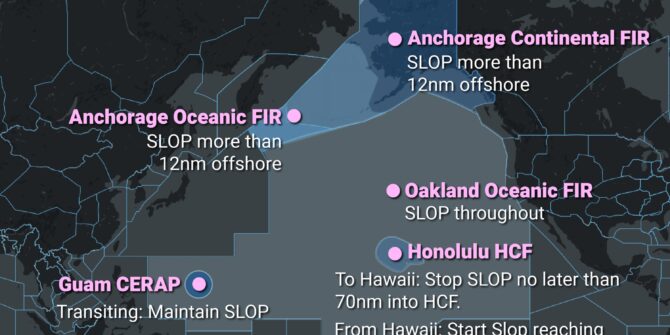
Strategic Lateral Offset Procedures (SLOP) in FAA-Controlled Oceanic Airspace and the Anchorage FIR are based off the ICAO Doc 4444 SLOP rules, and can be found in the FAA AIP ENR section 7.1.

I don’t want to read the FAA AIP ENR section 7.1

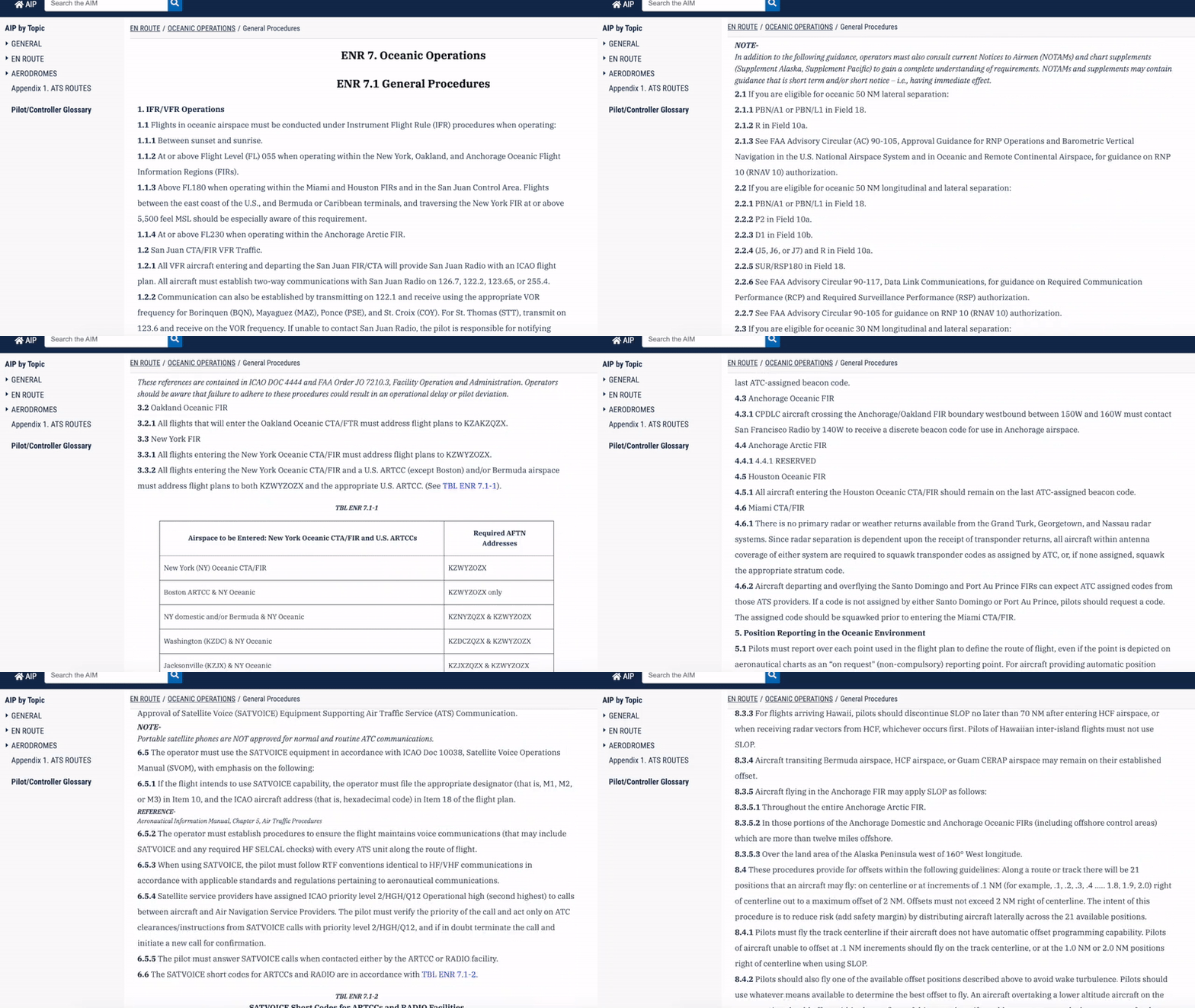
No, neither do we. Here’s what that experience looks like:

Handy info, but fairly brutal on the eyes and soul.

Is there another way to get this info?

Indeed there is!

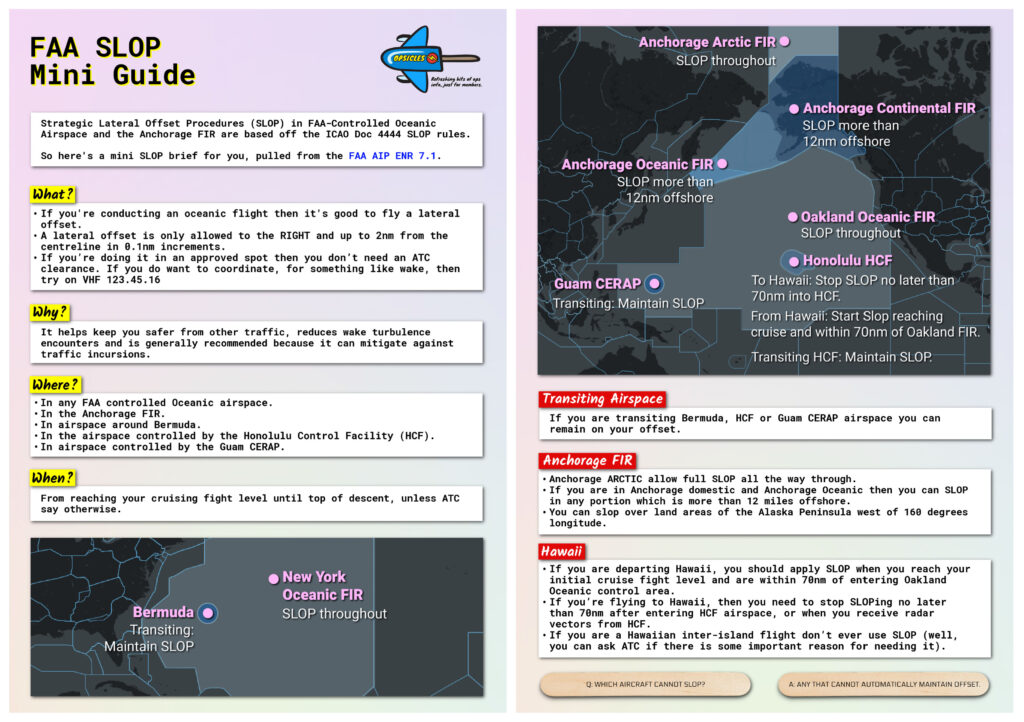
We took all the excellent info provided by the FAA with regards to SLOP rules in FAA airspace, and turned it into a quick guide – complete with a simple map of the rules for the different regions.

OPSGROUP members can download a copy for free here.

If you’re not an OPSGROUP member, but you’d like to be, you can join here. (Or you could just screenshot the image above instead – if you’d like a grainy, pixelated JPEG instead of the full, juicy PDF).

We’re going to be publishing more of these little docs over the next few months. We’re calling them “Opsicles” – refreshing bits of ops info, just for members. So keep an eye out for the next installment!


The 511 on the Nov 5th ICAO changes

A whole bunch of procedural stuff will be changing from 5 Nov 2020, with the release of a new amendment to ICAO’s Procedures for Air Navigation Services document. There will be changes to Oceanic Contingency and Weather Deviation Procedures, Wake Turbulence Separation, SLOP Procedures, and how the FAA defines Gross Navigation Errors.

What is the PANS-ATM (ICAO Doc 4444)?

Procedures for Navigation Services – Air Traffic Management. In other words, the ‘go to’ manual for aircrews who operate internationally. It explains in detail the standard procedures you can expect to be applied by air traffic services around the world, and what they expect in return.

Here is a summary of the most important changes coming on 5 Nov 2020. Thanks to Guy Gribble at International Flight Resources for this update.

Oceanic Contingency Procedures

Basically, what you should do if you need deviate from your flight path without a clearance. Weather avoidance, turbulence, depressurisation, engine failure – you get the picture. Published procedures are changing: there will be one standard set of Contingency and Weather Deviation Procedures for all oceanic airspace worldwide.

If you’ve been flying in the North Atlantic Region over the past year and a half, you’ll be familiar with how it works – the new procedures were introduced there back in March 2019, and now they’re being rolled out everywhere.

The main change here is that Contingency offsets which previously were 15 NM are basically now all 5 NM offsets with a turn of at least 30 degrees (not 45 degrees).

For more on this, check out our article.

Wake Turbulence

Flight Plan Category
There will be a new wake turbulence category for flight plans:

No longer will ‘Heavy’ rule the skies. ‘Super’ is about to be added, which will cover the largest aircraft including the A380-800, and Antonov 225. You will even get to say it after your callsign on initial contact with ATC.

ICAO Doc 8643 will shortly include all aircraft which qualify for the category.

You’ll need to tell them your category in Flight Plan Item #9 too. For Super, the letter ‘J’ is what you’ll need to include.

Here’s the new line up:

J – SUPER (Check Doc 8643 to see if you qualify)
H – HEAVY (Max take-off weight greater than 136,000kg/300,000Lbs)
M – MEDIUM (Max take-off weight greater than 7,000kg/15,500Lbs)
L – LIGHT (Max take-off weight less than or equal to 7,000kg/15,500Lbs)

Wake Turbulence Separation Categories
Countries may choose to use the ICAO wake turbulence codes above to determine how much room to give you from preceding traffic, or they can elect to use a grouping.

Currently, ICAO groupings are based simply on weight and there’s only three of them. The problem with that approach is that sometimes the separation provided is excessive which slows down the flow of traffic and creates unnecessary delays.

The US and Europe were on to it when several years ago the FAA and Eurocontrol joined forces to look at the wake characteristics of aircraft in more detail. They came up with a better system – it was a process known as Aircraft Wake Turbulence Re-Categorization or simply, RECAT.

Turns out that when you take into account factors such as approach speeds, wing characteristics and handling abilities of various aircraft it is possible to safely reduce separation.

As a result, six new categories were created. You can read about those in FAA SAFO #12007 and EU-RECAT 1.5 if you would like to know more.

The point is, ICAO is now adopting those categories.

So why does it matter?
Because the separation applied when following smaller aircraft may be reduced to as low as 2.5nm on approach. Closer than you may be accustomed to.

Out with the old, in with the new. Here’s what you can expect to see in November:

Old:
HEAVY (H) – aircraft of 136,000kg or more
MEDIUM (M) – aircraft less than 136,000kg but more than 7,000kg
LIGHT (L) – aircraft of 7,000kg or less

New:
GROUP A – ≥136,000kg and a wingspan ≤80m but >74.68m
GROUP B – ≥136,000kg and a wingspan ≤74.68m but >53.34m
GROUP C – ≥136,000kg and a wingspan ≤53.34 m but >38.1m
GROUP D – <136,000kg but >18,600kg and a wingspan >32m
GROUP E – <136,000kg but >18,600kg and a wingspan ≤32m but >27.43m
GROUP F – <136,000kg but >18,600kg and a wingspan ≤27.43m
GROUP G – <18,600 kg or less (no wingspan criterion)

Separation standards will soon be published accordingly.

Strategic Lateral Offset Procedures (SLOP)

Wait, what?
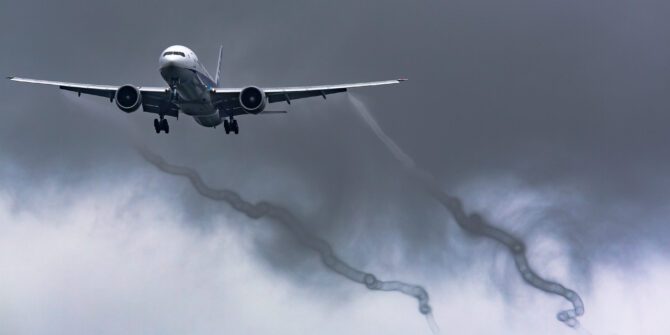
As a result of extremely high levels of accuracy in modern navigation systems, if an error in height occurs there is a much higher chance of collision. It is also greatly increases the chance of an encounter with wake turbulence.

In some airspace, when the lateral separation applied or the distance between adjacent parallel routes is greater than 6nm, aircraft can deviate up to 2nm right of track without a clearance. This is what is known as SLOP.

The way in which it is applied is changing
Where the lateral separation minima or spacing between route centerlines is 15NM or more; offsets to the right of the centerline will allowed up to 2nm.

When the lateral separation minima or space between route centrelines is less than 15nm (but more than 6nm), you will be able offset up to 0.5nm right of track.

So, it is important you are familiar with what kind of lateral separation is being applied in the airspace you are operating.

The FAA will change their definition of GNE’s

On 5 Nov 2020, the US FAA will change their definition of Gross Navigation Errors to mean anything more than 10nm (down from 25nm), to align with ICAO’s 10nm definition that currently exists on the NAT HLA. So after this date, the FAA will require you report all lateral errors, 10nm or greater worldwide.

More on this from Guy Gribble at International Flight Resources:

“Keep in mind that ATC does not always advise a crew that it files a report; therefore, the FAA inspector will try and contact the crew as soon as possible so the crew will remember details of the event. ATC keeps voice and communications records for between 30-45 days. New York Radio and San Francisco Radio keep voice communications for 30 days. The FAA directs that oceanic error investigations should be complete within 45 days of the incident.”


Oceanic Plotting: Classic Navigation meets New Age Tech

Flying over large expanses of ocean, one might assume the cockpit would be a quiet, boring space with little more to do than to speculate about company rumors or constantly graze on the galley snacks you long ago promised yourself you’d stop eating. But the reality is that to ensure a safe and compliant oceanic crossing, the tasks involved can be intensive and the cockpit can be a busy place!

Plotting and monitoring your route over the ocean – or any remote area for that matter – is one of those vital tasks necessary to ensure safe navigation. And with some familiarization with up-and-coming technology and hands-on training, plotting can serve as both a confirmation of aircraft navigational abilities and a last ditch resort if such capabilities fail.

Why We Plot

Legally speaking, the crew of any turbojet that flies a route that exceeds 725 nm from “the service volume of an ICAO approved ground based navaid must perform plotting procedures as a way to generate a ‘reliable fix‘ of its position once per hour (the distance decreases to 450 nm if flying a turboprop),” explains Guy Gribble, General Manager of International Flight Resources.

With the breadth and reliability of most modern aircraft long range navigational systems (LRNS) and flight management systems (FMS), it may seem archaic to manually plot an oceanic course. But studies have shown that plotting greatly reduces the chances of flying off course and causing a gross navigational error. FMS’s are NOT infallible and the pilots operating them even more so!

Plotting not only assists in ensuring you are flying your cleared AND verified route, it serves as a system of checks and balances when reviewing your (and your co-pilot’s) inputs into the FMS. In the event of a partial or complete loss of navigational abilities, the plotting chart also works as an emergency form of dead reckoning. And lastly, combined with the Master Document, the plotting chart is the trip’s legal record of compliant (or lack thereof) oceanic navigation if a state authority were to review or investigate the trip for any reason.

Requirements

The first requirement begins with the plotting chart itself. The chart must be oriented North, be based on WGS-84 (World Geodetic Standard of 1984) and mean sea level, and of a valid date. It must also be to a scale that can clearly depict the flight route and other oceanic tracks. Other than that, manufacturers are free to customize charts to whatever preferences they desire.
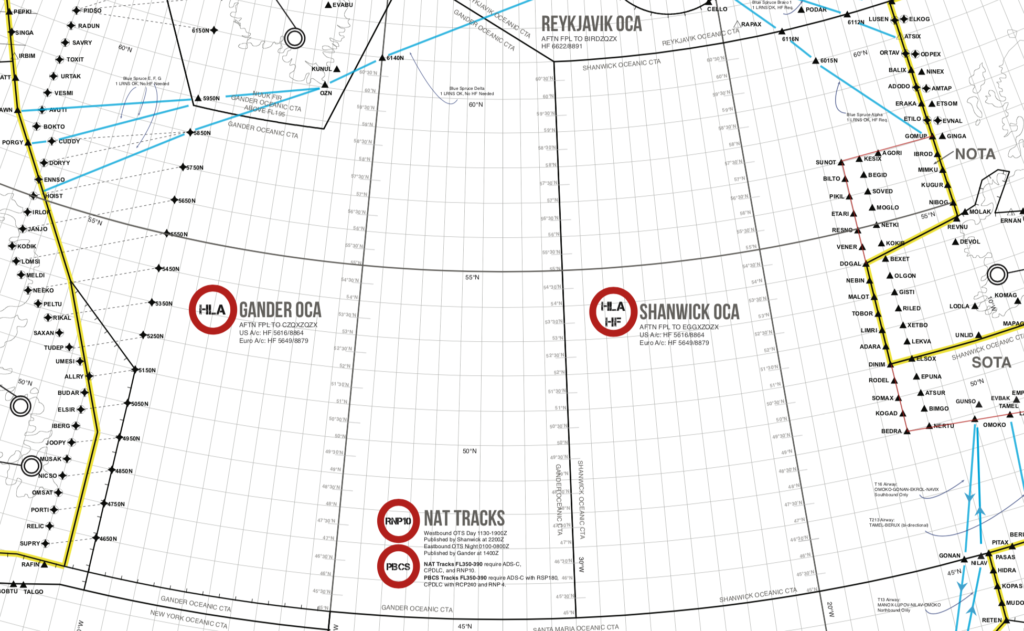
As far as chart validity dates go, many charts do not have expiration dates; rather that dates published are based upon the measurement of variation. “You may have to go to the manufacturer’s website to see if a new chart is available,” Gribble says. “If you download it on an iPad, they are updated automatically.”

The information crews must include on the chart starts with the aircraft’s CLEARED route (reroutes are very common, and many GNE’s have occurred by crews flying the filed flight plan, not the cleared flight plan). The route’s waypoints – coast out, coast in, and lat/long positions – must be clearly marked on the chart using standard symbology. The chart should also include graphic depictions of ETP’s (Equal Time Points). ETP’s are calculated locations where an aircraft would turn around, divert or continue on its route in case of an abnormal or emergency situation. Flight planning services normally provide these points with your flight plan and are usually based on an engine failure, a depressurization event or a medical emergency. If one of these emergencies were to occur, the crew may have to perform a contingency manoeuvre and must try to avoid adjacent and underlying oceanic tracks should a diversion or descent be required. Thus, neighboring oceanic tracks published daily should be included on the chart for situational awareness. Additionally, it’s a good idea to mark decent alternate airports on the chart.

Monitoring your oceanic route is accomplished through a 10 Minute After Waypoint Check. 10 minutes (or roughly 2 degrees of longitude) after crossing each oceanic waypoint, the crew must verify their current position by 1) plotting the current lat/long on the depicted route, 2) computing both magnetic course and distance to the next waypoint and 3) comparing this information to that of the FMS. There are three methods permitted to do this:

  1. The Plotting or Paper Method
  2. The Navigational Display Method
  3. A customized and approved method

The “plotting or paper method” is for aircraft with any navigational configuration. It requires the crew to record the time and plot their present lat/long  on the paper chart by using the coordinates from the “non steering” LRNS and take immediate action if the plotted point doesn’t align with the cleared route. The “steering” LRNS – the one coupled and following the autopilot – is then used to verify that the next waypoint is consistent with the cleared route and the autopilot is steering to that waypoint.

The “navigational display method” is for aircraft equipped with an operable FMS. The crew must confirm that the aircraft symbol is on the route programmed in the FMS and set to the smallest scale and checked for any cross track deviation. The crew must take corrective action to address such deviations. And, as with the previous method, the steering LRNS is used to confirm it is headed to the next waypoint on the cleared route. “With the navigational display method, an easy way to record your fix is to have your digitally generated map zoomed in to at least 5nm. Then have your autopilot coupled FMC display the time, lat/long and RNP – the 4 pieces of info you need. Then just take a picture of that with an iPad or iPhone, and that will serve as your recorded plot,” explains Gribble.

And for the “customized and approved method… if you have created one that has been authorized, we’d love it if you shared! FedEx is one such carrier that has created its own procedures for confirming a reliable fix.

Regardless of the method, it should be spelled out entirely in the company’s operating manuals. Comparing navigation system positioning isn’t the only form of cross-checking. If a reroute is given, good crew resource management is absolutely required when copying, entering and cross-checking the new route.

Along with plotting the position, crews must calculate the magnetic course (remember your private pilot days: true course  +/- east/west variation = magnetic course) and measure distance to the next waypoint, both of which are necessary if navigational capabilities of the aircraft are compromised and dead reckoning is required. If you don’t remember how to do these, don’t worry, Code7700 has published a helpful guide on how to do it manually and electronically. There are also several apps and Excel based tools available out there, and many plotting charts have examples to walk you through it.

Ops Spec B036 authorizes navigation over oceanic and remote areas for aircraft having multiple long range navigation systems (B054 if only using a single LRNS) and B037 or 39 dictates whether over the Atlantic or Pacific oceans. “The important thing about B036 is that the operator must spell out in that authorization whether plotting will be accomplished by paper or an electronic method,” explains Gribble. “Part 135 operators must also demonstrate that they have initial and recurrent training programs along with the procedures spelled out. And for the few Part 125 operators, they are required to have a Letter of Deviation Authority.”

Gribble warns, “Operators spend all this time and effort getting LOA’s, Op Specs, and updating manuals and procedures. Then crews never read them again. Keep studying those documents! There are so many restrictions in your LOA’s. Maybe you’re not approved to fly Blue Spruce routes. Unfortunately crews forget what the documents detail, and resort to just flying the way other pilots have been operating. There’s a loss of knowledge.”

He also stresses, “Absolutely use the ICAO (NAT OPS Bulletin 2017-005) or FAA (AC 91-70B Appendix D) issued oceanic checklists! They are excellent resources and cover everything from preflight through arrival at the destination.”

Paper VS The Future

Just over a year ago at an international operators conference there was a presentation for electronic plotting. The presenter spent an hour demonstrating how to perform an oceanic crossing without paper. Although impressive, at that time there was no single app that could perform all the required plotting tasks, and the shear number of additional apps that had to be opened and closed on the iPad to substitute for whatever the main app lacked was astounding. At that point, paper was still king. But in just a little over a year, technology does what it usually does – improved exponentially. And it now looks like there are some apps that can handle all the oceanic plotting tasks, and they’re only getting better.
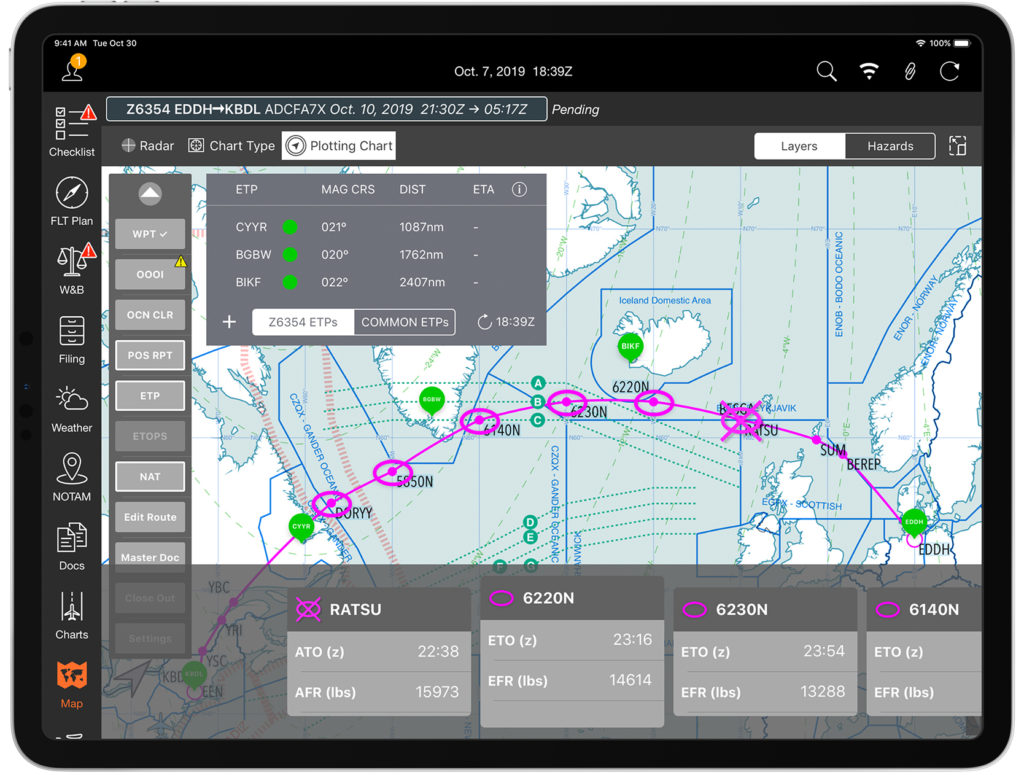
Mitch Launius, from 30West IP, sees the opportunity for increased safety as these electronic apps continue to improve. “Having another form of redundancy in the cockpit will make things safer in the cockpit. This technology is very new. You could say we’re only at Version .5 – barely out of Beta – but these programs will evolve quickly. This is just the tip of the iceberg. It’s going to happen.”

30West IP has produced several YouTube webcasts, a few which focused on the operational capabilities of some of these apps. “The FAA fully understands the opportunity electronic devices and some of these apps offer for oceanic navigation and they are embracing it – just slowly – as they want to ensure safety of changing procedures.” He points out the requirements for permitting Electronic Flight Bags into cockpit. “If you’re Part 135, you will need the POI’s authorization to receive Ops Spec A061, which would show that an operator demonstrates a change to its procedures.” AC 91-78 Use of Class 1 or Class 2 Electronic Flight Bag is also good resource to check.

However, if an operator is Part 91, there is no authorization required. “Regardless of what you hear, there is no Letter of Authorization required if you are a private operator,” explains Launius. “An inspector would like to see three things, advisory in nature only, however. They want to see that the company’s operating manuals address the addition of EFB and oceanic navigation, that the crew is trained, and that there is a document management procedure in place for recording the crossing.” AC 120-76 Guidelines for the Certification, Airworthiness and Operational Approval of Electronic Flight Bags should be used for guidance.

If transitioning a flight department from paper to electronic plotting might seem intimidating and difficult, Launius disagrees. “It might be much easier than you think. You must update your manuals with a few paragraphs to acknowledge the use of EFB and change in procedures. Then have all the pilots meet and train on the EFB’s. And if you’re a part of an SMS, you’ll just need to show a change in management policy. So perhaps have the pilots meet back up in 6 months and discuss what works and what doesn’t and restructure the procedures as needed.”

“If your department is flying to Europe 2 or 3 times a month, using electronic plotting is going to be very useful,” says Guy Gribble. “But if you’re only flying 2 or 3 times a year, I still believe the ease and affordability of paper is preferable, for now. Some of the newest models of Gulfstream, Globals and Falconjets actually will have the ability of their FMC’s to pull data of its location and wirelessly transmit it to an iPad. Now that’s truly electronic plotting.”

Code7700 has published an impressive article comparing some of the leading electronic plotting apps. Arinc, Jepp FD, Foreflight, plotNG and Garmin are just a few that offer these apps, along with some other flight planning services. Some of the benefits of going paperless is the ability to download both the flight plan and daily oceanic tracks, ETP’s can be updated as can ETA’s, and, through typing or using a stylus, the Master Document can also be downloaded and filled out as the flight proceeds without the all the chicken scratch normally seen on paper plots.

If operators perform many crossings per year, crews will become accustomed to using the apps as well as some of the creative techniques that may be required to compensate for some of the more complicated tasks. Course calculating and distance measuring still seem to be rather cumbersome tasks on most of the apps but operators have come up with some inventive and manageable ways to overcome this. Of course the cost is much greater than the affordable bundles of paper charts, but some of the flight planning companies may provide the app for free if using their services. Ultimately, it will come down to the operator’s needs and the frequency of oceanic crossings.


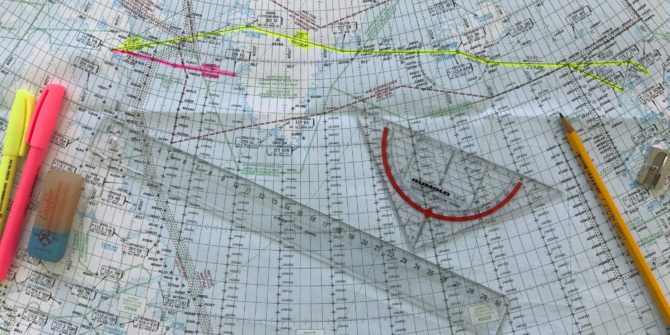
Thanks to Roger Harr at www.n138cr.ch for the header photo of this article!

Iridium Fault Fixed

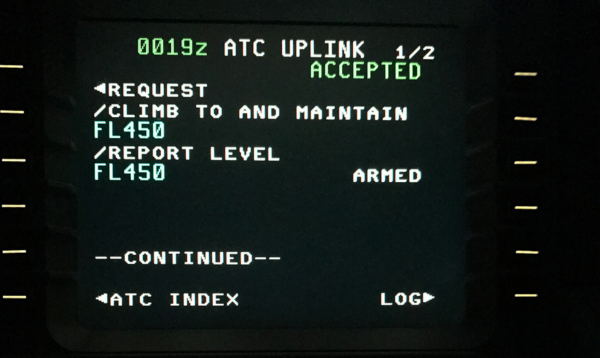
Last week we reported on an equipment issue with Iridium satcom that prompted a ban by a number of Oceanic ATC agencies. Some aircraft were receiving massively delayed clearances sent by ATC via CPDLC – and one took the instruction and climbed 1000 feet, even though the message was meant for the flight the aircraft operated previously.

Here were the areas which had previously published Notams restricting the use of Iridium: Brazil Atlantico (SBAO), Auckland (NZZO), Chile (SCIZ), Japan (RJJJ), Anchorage (PAZA), Oakland (KZAK), New York (KZNY and KZWY).

However, all FIR’s have now removed their notams which banned the use of Iridium for CPDLC and ADS-C. This has happened after tests were performed last week using Iridium SATCOM which confirmed that Iridium no longer queues CPDLC uplinks for more than five minutes.

Article header photo by @Zelgomat


Oceanic ATC’s tell us their position on Iridium Satcom

Last week we reported on an equipment issue with Iridium satcom that prompted a ban by a number of Oceanic ATC agencies. Some aircraft were receiving massively delayed clearances sent by ATC via CPDLC – and one took the instruction and climbed 1000 feet, even though the message was meant for the flight the aircraft operated previously.

Today, we checked-in again with all the oceanic ATC centres, to see what their current policy is on the issue.

EGGX/Shanwick told FSB that they are aware of the issue, reviewed it, but have decided not to ban the use of Iridium for either CPDLC or ADS-C just yet. LPPO/Santa Maria have the same position. So, in this airspace, you can use Iridium, for now.

CZQX/Gander said they did a safety analysis of it, and decided not to ban it. They have all kinds of conformance alerts in place to prevent any problems from happening – so if aircraft deviate they get notified immediately.

BIRD/Reykjavik aren’t that concerned about the issue – they use HF most of the time anyway.

Chile (SCIZ)
Japan (RJJJ)
Anchorage (PAZA)
Oakland (KZAK)
New York (KZNY and KZWY)
All these centres have published Notams instructing crews not to use Iridium for CPDLC or ADS-C. Until the fault is fixed, in those regions you’ll have to either use HF for ATC comms, or use another SAT provider.

Auckland (NZZO) and Brazil (Atlantico SBAO) have applied the ban to CPDLC alone. Use ADS-C if you like.


From Iridium themselves, they told FSB: “We’ve updated their queue management system. Every minute, there is a queue check. If there is any message that is older than 4 minutes, it marks as timed out, and will not be delivered. This update was done at ground level, so it does not require any software updates by the user. We’re still waiting on feedback from FAA workgroup on the fix and if it’s sufficient to allow use of Iridium for CPDLC and ADS-C.”

That’s it for now! We’ll keep you posted, or, even better – tell us below in the comment section if you hear news.


Iridium fault prompts ban by Oceanic ATC

Aircraft Operators using the Iridium Satellite service for ATC comms should be aware of an equipment issue that has prompted a ban by a number of Oceanic ATC agencies in the last few days

Right now, Chile (SCIZ), Japan (RJJJ), Anchorage (PAZA), Oakland (KZAK), New York (KZNY and KZWY) have all told operators not to use Iridium for CPDLC or ADS-C. Until the fault is fixed, in those regions you’ll have to either use HF for ATC comms, or use another SAT provider. Auckland (NZZO) and Brazil (Atlantico SBAO) have so far only applied the ban to CPDLC alone. Nothing has been published yet by Gander (CZQX), Shanwick (EGGX), Reykjavik (BIRD) or Santa Maria (LPPO) – although we’re keeping a close eye on them for any update.

Here’s what happened:

On Sep 12th, an Alaskan Airlines flight had a failure of their CMU (Comms Management Unit) that caused the Iridium connection to stop working. An ATC message was sent to the aircraft but not delivered. On the next flight, the CMU power was reset and corrected the issue, and the pending message was delivered. The CMU did not recognise the message as being old, and so it was presented to the Flight Crew as a control instruction. FSB understands that this aircraft took the climb instruction and executed the level change, climbing 1000 feet .

Another flight, operated by Hawaiian out of Oakland, had a similar problem. This aircraft had both Iridium and Inmarsat on board, and during the flight switched over to Inmarsat as the provider. An ATC message was routed via Iridium, but didn’t reach the aircraft before the switch. Some 23 hours later, on the next flight, Iridium was activated again and again the ATC message presented as a “live” instruction. On this occasion, the crew queried the instruction and did not climb.

The problem in simple terms is that if ATC sends a CPDLC message like “Climb FL370“, which is obviously only valid for “right now”, but another crew gets the message hours later, then you have a very high risk of the new crew accepting that and climbing.

For now, Iridium has a plan to fix the ground side to not allow older SBD messages to be delivered, and they say they are testing it at the moment and expect to release it soon.

OpsGroup members will be updated directly on further news.

Notam copies below:

ANCHORAGE PAZA A0626/17 - USE OF CPDLC AND ADS-C VIA IRIDIUM SATCOM IS PROHIBITED WITHIN THE ANCHORAGE OCEANIC, DOMESTIC AND ARCTIC FLIGHT INFORMATION REGIONS (FIRS). SFC - UNL, 13 OCT 19:40 2017 UNTIL 13 NOV 00:00 2017 ESTIMATED. 
CREATED: 13 OCT 19:35 2017
NEW ZEALAND AUCKLAND NZZO B4985/17 - USE OF CPDLC (DATALINK) VIA IRIDIUM SATCOM 
IS PROHIBITED WI NZZO FIR. COMMUNICATION WI NZZO FIR IS TO BE VIA HF 
RDO ON THE APPROPRIATE SP6 FREQ. OPERATORS USING IRIDIUM SATCOM MAY 
CONTINUE TO USE ADS-C FOR POSITION REPORTING WI NZZO FIR. HF VOICE 
POSITION REPORTS ARE NOT REQUIRED UNLESS SPECIFICALLY REQUESTED. 
08 OCT 21:56 2017 UNTIL 08 JAN 21:00 2018 ESTIMATED. 
CREATED: 08 OCT 21:56 2017
OAKLAND KZAK A4306/17 - FOR ACFT EQUIPPED WITH IRIDIUM SATCOM, USE OF CPDLC AND ADS-C VIA IRIDIUM SATCOM IS PROHIBITED WITHIN OAKLAND CENTER OCEANIC AIRSPACE. COMMUNINCATION WITH KZAK MUST BE VIA HF FOR IRIDIUM USERS. 
13 OCT 19:49 2017 UNTIL 31 DEC 23:59 2017. CREATED: 13 OCT 19:54 2017
NEW YORK KZNY A0334/17 - USE OF CPDLC AND ADS-C VIA IRIDIUM SATCOM IS PROHIBITED WITHIN NEW YORK CENTER OCEANIC AIRSPACE. 13 OCT 19:27 2017 UNTIL 30 DEC 08:00 2017. CREATED: 13 OCT 19:38 2017
NEW YORK KZWY A0502/17 - USE OF CPDLC AND ADS-C VIA IRIDIUM SATCOM IS PROHIBITED WITHIN NEW YORK CENTER OCEANIC AIRSPACE. 13 OCT 19:27 2017 UNTIL 30 DEC 08:00 2017. CREATED:13 OCT 19:36 2017
BRAZIL ATLANTICO SBAO N0095/17 - FOR ACFT EQUIPPED WITH IRIDIUM SATCOM, 
USE OF CPDLC IS PROHIBITED WITHIN ATLANTICO CENTER OCEANIC AIRSPACE. 
FLIGHT CREWS CAN LOG ON SBAO TO ALLOW THE USE OF ADS-C FOR POSITION 
REPORTING. COMMUNICATION WITH SBAO MUST BE VIA HF. IF USING ADS-C 
POSITION REPORTING, HF VOICE POSITION REPORTS ARE NOT REQUIRED 
UNLESS SPECIFICALLY REQUESTED. 15 OCT 12:00 2017 UNTIL
13 JAN 12:00 2018.  CREATED: 15 OCT 01:22 2017
JAPAN FUKUOKA RJJJ J7236/17 - FOR ACFT EQUIPPED WITH IRIDIUM SATCOM, USE OF CPDLC AND ADS-C VIA IRIDIUM SATCOM IS PROHIBITED WITHIN FUKUOKA OCEANIC AIRSPACE. COMMUNINCATION WITH RJJJ MUST BE VIA HF FOR IRIDIUM USERS. 16 OCT 10:08 2017 UNTIL UFN. CREATED: 16 OCT 10:09 2017


Iceland ATC strike bigger than ever

We had some really positive hints at a resolution of the Iceland ATC strike last week, but it’s not over yet – by any measure. Today sees another long list of airspace and airport closures. Oceanic Eastbound, Westbound and landing traffic all affected.

BIKF/KEFLAVIK A0454/16 06JUL 1007Z

(NOTAMR A0453/16) – DUE TO STAFF SHORTAGE BIKF TWR SERVICE LIMITED
TO SCHEDULED COMMERCIAL AND INTERNATIONAL
FLIGHTS, AMBULANCE AND EMERGENCY  FLIGHTS.
NO TOUCH AND GOES OR LOW APPROACHES FOR VFR
TRAINING FLIGHTS, ONLY DEPARTURE AND ARRIVAL.
TWR BIKF SERVICE LIMITED TO AMBULANCE AND
EMERGENCY FLIGHTS ONLY DURING THE FOLLOWING
HOURS: 09:00-09:30, 11:30-12:00 AND 14:00-14:30. 06 JUL 10:05 2016 UNTIL 06JUL 21:00 2016.

BIRD/REYKJAVIK OACC A0452/16 05JUL 2146Z

(NOTAMR A0451/16) – DUE TO STAFF SHORTAGE IN REYKJAVIK OACC WESTBOUND
TFC PLANNING TO ENTER BIRD FROM ENSV VIA GUNPA,
VALDI, IPTON, INGAL, ISVIG AND EGPX VIA LIRKI, GONUT,
OLKER, MATIK AND RATSU AND THEN PROCEEDING INTO EGGX
OR CZQX SHALL REMAIN SOUTH OF BIRD CTA. 06 JUL 11:00 2016 UNTIL 06 JUL 20:00 2016.

BIRD/REYKJAVIK A0450/16 05JUL 1518Z

– DUE TO STAFF SHORTAGE IN REYKJAVIK CENTRE,
OPERATORS SHALL FILE TO COMPLY WITH THE FOLLOWING:
1. EASTBOUND TFC WILL NOT BE ACCEPTED FROM CZQX AND
EGGX EXCEPT  TRAFFIC WITH DESTINATION IN ICELAND,
SCANDINAVIA, BALTIC STATES AND RUSSIA.
2. EASTBOUND TRAFFIC FROM AERODROMES EAST OF 105W
WITH  DESTINATIONS IN THE MIDDLE EAST SHALL REMAIN CLEAR OF
BIRD CTA.
OPERATORS ARE URGED TO KEEP REQUESTS FOR LEVEL AND
SPEED AMENDMENTS WITHIN BIRD CTA TO A MINIMUM.
FOR FURTHER INFORMATION CALL REYKJAVIK SHIFT
MANAGER +354 424 4141. 06 JUL 02:00 2016 UNTIL 06 JUL 08:00 2016.

BIRD/REYKJAVIK A0452/16 05JUL 2146Z

(NOTAMR A0451/16) – DUE TO STAFF SHORTAGE IN REYKJAVIK OACC WESTBOUND
TFC PLANNING TO ENTER BIRD FROM ENSV VIA GUNPA,
VALDI, IPTON, INGAL, ISVIG AND EGPX VIA LIRKI, GONUT,
OLKER, MATIK AND RATSU AND THEN PROCEEDING INTO EGGX
OR CZQX SHALL REMAIN SOUTH OF BIRD CTA. 06 JUL 11:00 2016 UNTIL 06 JUL 20:00 2016.


Santa Maria Strike: Four Routes

Update: 1730Z/Weds – we have received notification that Portuguese Industrial action may be being withdrawn. We will update and confirm when certain.

LPPO/Santa Maria Oceanic has published four special routes for use during the upcoming “July Friday Strike Series” ATC Industrial Action.

If you happen to be crossing the LPPO FIR on a Friday morning in July, then expect a hefty reroute if you didn’t file per the plan.

The Strike Time Period is : 0700-0900Z, during which time only these four routes will be accepted.

ROUTE A– 45N020W 40N030W 37N040W

ROUTE B– DETOX 39N020W 36N030W 34N040W

ROUTE C– LUTAK 36N020W 33N030W 29N040W

ROUTE D– ULTEM 27N040W

The cutoff time for these routes is when you enter the LPPO/Santa Maria FIR

Traffic entering prior to 0700Z: unrestricted

Traffic entering the FIR between 0700-0900Z: Must file and fly one of the four Routes above.

Traffic entering the FIR after 0900Z: unrestricted