Hand sanitizers on board: Fire risks
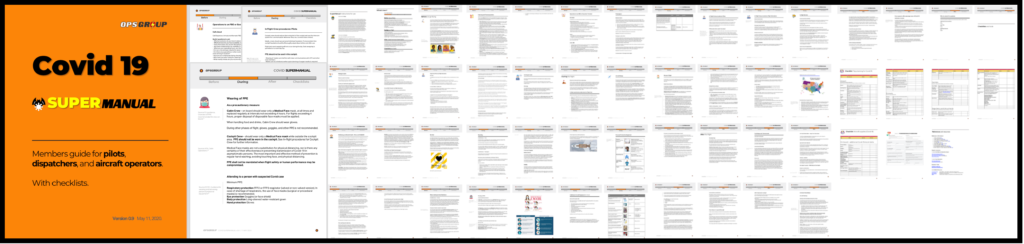
This is an extract from the OPSGROUP Covid-19 Supermanual, version 0.9 – May 11, 2020


Hand Sanitizers – fire risk

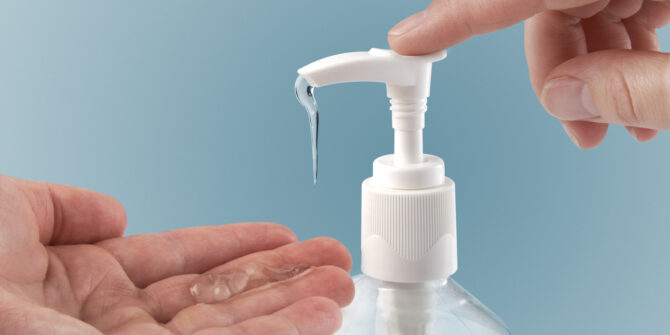
In a documented case in May 2020, an individual suffered first and second degree burns when they made contact with a metal surface and a static discharge ignited the still wet hand sanitizer. Hand sanitizer gels contain large concentrations of alcohol. Once the hand sanitizer is applied, individuals must make sure the gel has suitable time to dry. Alcohol vapors can ignite if exposed to an ignition source, such as light switches or cigarette lighters. Crews should be made aware of this risk, especially in the aircraft operating environment. Original source here.

Dangerous Goods exemption requirements

Alcohol-based hand sanitizers are classified as dangerous goods and are not specifically permitted by the IATA Dangerous Goods Regulations and ICAO Technical Instructions for the Safe Transport of Dangerous goods by Air (DGR 2.5, ICAO Technical Instructions Part 1;2.2) .

Operators that wish to add alcohol-based hand sanitizer to the items carried in galleys or installed in lavatories will need to request authorization from their civil aviation authority (State of the Operator) in accordance with the provision that is set out in Part 1;2.2.1 a) of the ICAO Technical Instructions.

IATA recommends that the request for authorization addresses the following:

– The classification and UN number of the hand sanitizer. For example, UN 1987, Alcohols, n.o.s. (ethyl alcohol mixture), UN 1170, Ethanol solution. However, the safety data sheet from the manufacturer of the hand sanitizer should be checked for the classification;

– The quantity of hand sanitizer in each container and the number of containers to be carried on the aircraft;
– What steps will be taken to ensure that the hand sanitizer is kept away from sources of heat or ignition;

– Provision of information to crew members on the carriage of the hand sanitizer. For example, that crew members will be advised on the procedures through a bulletin or other appropriate method.

Crews can take hand sanitizers as carry on, each bottle max 0.5L, under the IATA Dangerous Goods regulations, total for toiletries is 2L.


What else is in the manual?
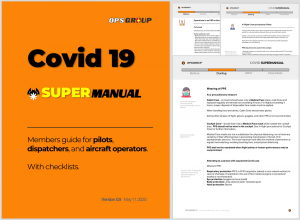
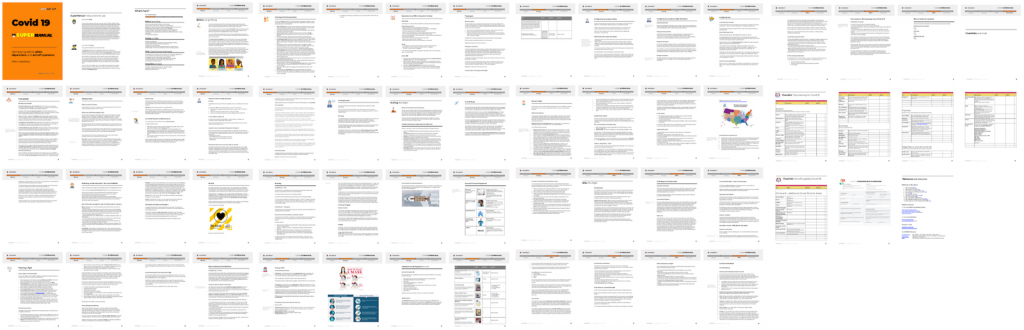
We’ve divided the manual into four areas around phases of flight: Before, During, After … and a Checklists section.

Before we go flying

About Covid, Precautions, Off duty crew and staff
Going to work, Health Check, Illness at work, Dispatchers
Flight Crew – Fit to fly, License, medical and recency, keeping aircraft and crew current
Wellbeing and Mental Health: How to find calm, Be Kind
Planning a flight, Crew pairings and planning
Aircraft cleaning and preparation, Risks: Hand Sanitizers, Dangerous Good regulations
Catering and Food preparation, Operations to an FBO or Executive Terminal, Passengers
Arriving at work, Briefings

During our flight

In-flight considerations
Aircraft Setup, Boarding, Temperature Checks, Baggage, Seating
Wearing of PPE (Personal Protective Equipment)
Additional Aircraft Equipment
In flight Crew procedures: Pilots, Flight Attendants, In-flight Service
Illness in Flight – Crew actions, Dispatch actions, Cleaning procedure

After – back home (or downroute)

Disembarking
Tech Stops and Turnarounds, Interim Cleaning, Walkaround
Arrival at Destination, Waste Disposal, Cleaning at outstation
Overnights/Layovers, Hotel guidance, Crew PPE kits
Crew Illness away from Home base
AOG/Unplanned overnight
Arrival at Home base,
Aircraft Cleaning, Cockpit cleaning
Crew exposure, Contact tracing

Checklists

Checklist: Trip planning in Covid-19
Checklist: Aircraft supplies
Passenger Health Screening form example

For more about the Covid-19 Supermanual contents, and to download a copy, use this link.

Covid SuperManual for Flight Operations

Hi members,

The OPSGROUP Covid-19 SuperManual is ready! Before we get into it, a BIG thank you to everyone that took part in this huge effort. The team here received 100 or so individual Operations Manuals and Flight Ops Bulletins, and that’s what this ‘Super Manual’ is: a collation of all of the group knowledge and procedures around Covid.

This is OPSGROUP at its best – you guys coming together to share your piece of the puzzle, and then we put them all together and get the full picture out to the whole group. So, well done everyone!


What’s in the “Covid Super Manual” ?


We’ve divided the manual into four areas around phases of flight: Before, During, After … and a Checklists section.

Before we go flying

About Covid, Precautions, Off duty crew and staff
Going to work, Health Check, Illness at work, Dispatchers
Flight Crew – Fit to fly, License, medical and recency, keeping aircraft and crew current
Wellbeing and Mental Health: How to find calm, Be Kind
Planning a flight, Crew pairings and planning
Aircraft cleaning and preparation, Risks: Hand Sanitizers, Dangerous Good regulations
Catering and Food preparation, Operations to an FBO or Executive Terminal, Passengers
Arriving at work, Briefings

During our flight

In-flight considerations
Aircraft Setup, Boarding, Temperature Checks, Baggage, Seating
Wearing of PPE (Personal Protective Equipment)
Additional Aircraft Equipment
In flight Crew procedures: Pilots, Flight Attendants, In-flight Service
Illness in Flight – Crew actions, Dispatch actions, Cleaning procedure

After – back home (or downroute)

Disembarking
Tech Stops and Turnarounds, Interim Cleaning, Walkaround
Arrival at Destination, Waste Disposal, Cleaning at outstation
Overnights/Layovers, Hotel guidance, Crew PPE kits
Crew Illness away from Home base
AOG/Unplanned overnight
Arrival at Home base,
Aircraft Cleaning, Cockpit cleaning
Crew exposure, Contact tracing

Checklists

Checklist: Trip planning in Covid-19
Checklist: Aircraft supplies
Passenger Health Screening form example


Some things to highlight
: these were the most discussed areas in the SuperManual work group:

  • Cockpit PPE, to wear or not to wear. Although there is no specific guidance (yet) from authorities, the vast majority of operators are opting for the rule “No PPE to be worn on the Flight Deck” – considering the risks and impact on ATC comms, intra-crew comms, quick donning of oxygen masks, and the unknown potential impact of wearing masks and gloves. We have therefore opted for this play-it-safe approach – the safety of the flight comes before any potential (and seemingly unlikely) benefit from wearing masks while flying.
  • Dangerous Goods regulations. Operators need to check the rules as they apply to your own operation, but for most, carrying hand sanitizers on board in galleys and cabins requires approval from your Aviation Authority.
  • Aircraft Cleaning. Before you rush to wipe everything down, check the section on cleaning for some materials that should not be used as they will degrade the paintwork and cause damage to aircraft parts.
  • Illness in Flight. We saw this in almost every manual, with some wildly differing versions. So, in the SuperManual, there are 2 full pages on how to handle this, have a read.


How to use the SuperManual

  • Use it as a “Oh, I hadn’t thought of that” – read through and see what might apply to your operation
  • Remember that OPSGROUP is a mix of operators: some airline, some corporate, charter, private ops, military, and others. Not everything will apply to your operation. So, when you copy and paste into your own manual, apply common sense
  • Use the sources in the left column to double check the latest situation and guidance from authorities. Things are changing fast, and this might be out of date soon. Also, it might just be plain wrong. Don’t believe everything you read!

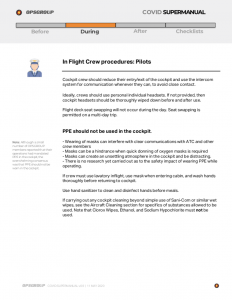
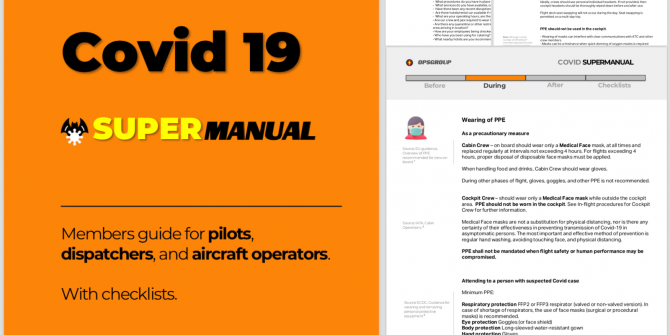
Example page with source notes:

Take part in the next round

  • This is version 0.9. We might not get to a v1.0 for a while, until more of the manual is backed up by official guidance, but this is everything we’ve seen and know in the group right now.
  • If you want the next version sent to you directly, send us what you have. As with all the 100 or so manuals we’ve already received, none of the original manual is shared or identified, everything is anonymous, and once we’ve had a look we’ll delete the manual. Top secret stuff, we know!

Download the Covid SuperManual:

  • Get it in your Dashboard: right here
  • Or, check your email – all members received a copy on publication.


Wednesday, May 13th @ 4pm Eastern, 8pm UTC

A special OpsChat around Flight Operations and Covid-19, to coincide with the release of the OPSGROUP Covid-19 SuperManual. More on that here.

A recording of the OpsChat will be available in the Dashboard shortly.


Questions?

Let us know – team@ops.group. We’d love to hear feedback on the manual, what might make it better, additions, corrections, improvements … and if you have a manual to share for the next version, please do send it to us.

Cheers,
The OPSGROUP Team.