Climb for Contrail Prevention – What’s Happening in the Maastricht UAC?

A few weeks back, the following Notam was issued for the Maastricht UAC (i.e. the busy airspace above FL 245 over Belgium, the Netherlands and Luxembourg):
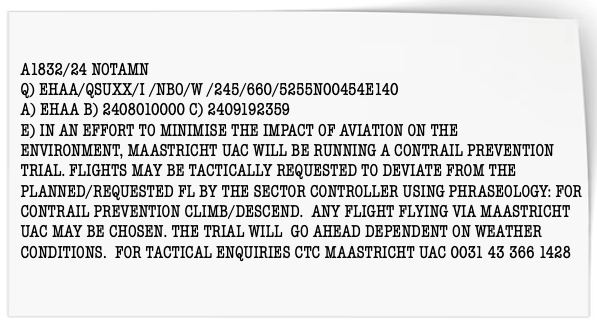
Essentially if you are flying through that airspace between now and September 19 you may be instructed to climb or descend using the phrase ‘for contrail prevention.’
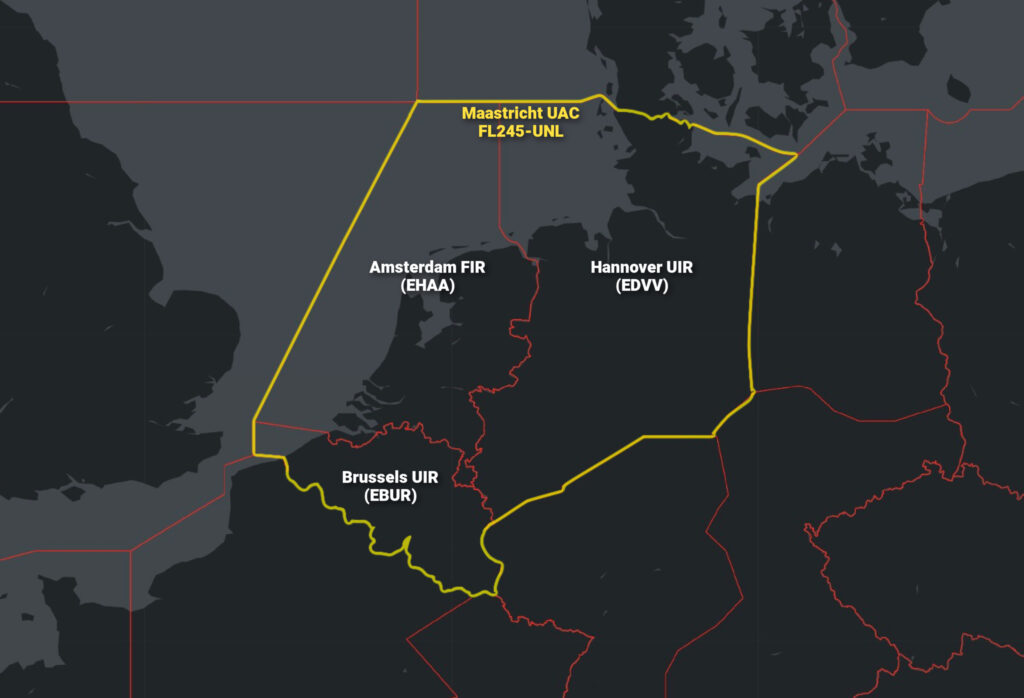
Maastricht have teamed up with DLR (the German Aerospace Center) in a bid to lower aviation’s ‘non-CO2’ climate impact. In other words, the effect aviation is having on the environment beyond fossil fuel emissions.

In that sense, this trial is one-of-a-kind and has been running on-and-off since 2021.

If you’re wondering why you’re being asked to deviate from your desired level, and what that has to do with contrails, read on.

What does any of this have to do with contrails?

The concept of non-CO2 impacts may be less familiar to operators. Non-CO2 effects have to do with complex interactions between aircraft emissions and their effect on the surrounding atmosphere.

This includes soot particles – a byproduct of combustion. It may come as a surprise that contrails are not (as is often misrepresented) just water vapor. When water vapor exits the exhaust nozzle of a jet engine, it condenses and freezes to these soot particles creating tiny ice crystals.

These crystals form contrails. They are in fact a type of cirrus cloud with a fancy name that sounds like a bad cold – homogenitus. And if conditions are right, they can persist for hours – long after the aircraft that created them has disappeared over the horizon.

At night in busy airspace (such as the Maastricht UAC) these contrails can have a warming effect by trapping heat in the atmosphere, just like naturally occurring clouds.
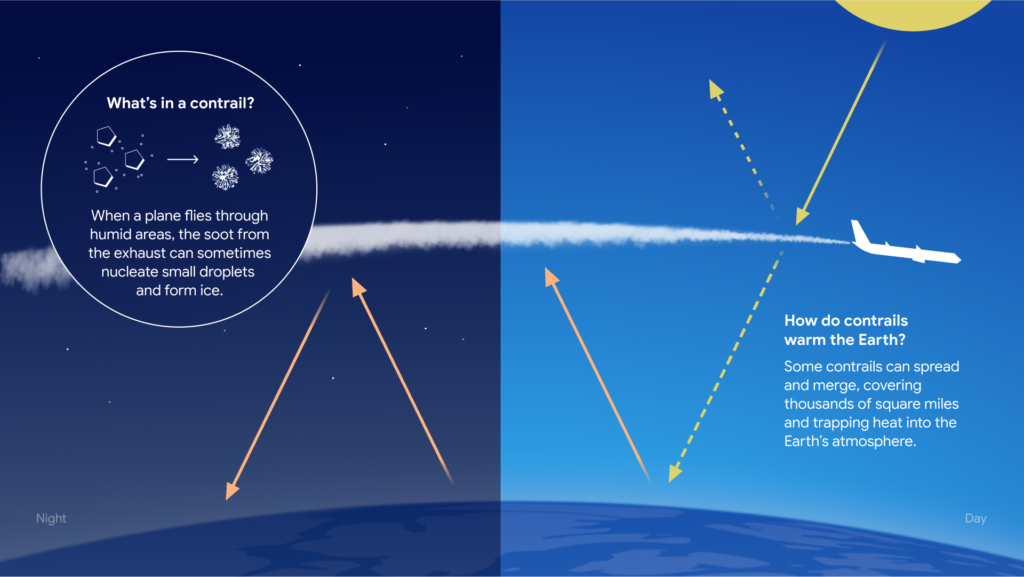
This process occurs across quite a shallow band – around FL300 in Winter and FL360 in Summer.

So, contrails are important. Why do I need to change levels?

The strength and persistence of contrails has a lot to do with the state of the atmosphere around them. Part of the industry’s approach is predicting when the atmosphere is favourable to form contrails and making small flight path adjustments to avoid the worst of those conditions.

Enter the Maastricht UAC Contrail Prevention Project.

Covering your tracks

The airspace of Maastricht often experiences conditions favorable for the formation of contrails. Therefore, it is the ideal testbed for the trial.

The project focuses on identifying those conditions and preventing prolonged level flight through them. In a nutshell, the German Aerospace Center identify when conditions in the Maastricht UAC are favorable for the formation of contrails by looking at satellite data.

Taking predicted traffic levels into account, the duty supervisor then gives the thumbs up for controllers to conduct ‘contrail prevention activity.’

If it goes ahead, it will begin after 4pm local and run through the night until 6am local.

Affected aircraft will be directed by air traffic control to change flight level using the phrase ‘for contrail prevention.’

What about fuel burn?

EUROCONTROL advise that ATC will only request the minimum level change required – i.e. will keep you as close as possible to you chosen level as conditions permit.

Anyone operating in Maastricht airspace may be selected to participate in this trial. It is important to inform the controller if the level change will affect flight safety for which all levels will remain available.


Contrails, Chemtrails and Climate Change

Putting ‘climate change’ in the title of a post on an aviation page probably isn’t the best way to draw in the readers. But this is not a lecture. Promise.

So, what is it about?

It isn’t about chemtrails. They aren’t a real thing.

It is about contrails. The wispy bits of whatever that your airplane engines fart out as you fly, or the ‘engine plumes’ if prefer to imagine your airplane resembling something like a peacock.

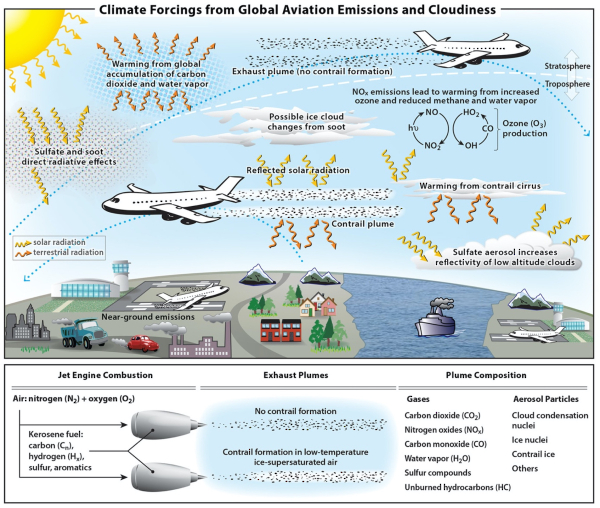
Contrails are basically water vapour. They form when the exhaust gases from the engine starts to cool and mix with the air around them. The humidity rises, the water cools and condensation occurs.

A small, small proportion of what is burped out of the engine is not water though, but impurities from inside the engine.

Things like sulphur particles. It only makes up about 0.05%, but these tiny particles give the water something to freeze onto and they cause tiny ice crystals to form.

So why do we care about this?

They are quite a useful indicator of possible wake turbulence for us, but aside from that (and unless you are one of the pilots who likes to draw amusing pictures in the sky with them) then we don’t really care that much.

But maybe we should care a bit, because some contrails loiter up there for ages – these are known as homomutatus contrails. Frankly, anything which sounds a little like ‘mutant’ should cause concern, and these definitely do, because they are responsible for the word we shall not utter.

Ok, we will, just to be clear – global warming.

Not here to lecture though! Promise!

A little bit of science (still not a lecture)

So, the airplane burps out the water, it turns into contrails which then hang up there in the stratosphere. Aviation causes only about 5% of the water present in the stratosphere, so it isn’t a terrible culprit.

Unfortunately, though, those homomutatus contrails, plus the extra water, plus the ice particles – all that stuff left up there by airplanes – causes terrestrial radiation to backscatter. It also stores up some of the radiation coming in and the result is something they call ‘radiative forcing’.

Basically, extra heating-up happens.

So, airplanes are spitting out C02 and contrails, and the contrails are thought to be responsible for something between 20% to about 40% of all the radiative forcing aviation causes to occur (they don’t really know how much, but they reckon about that amount).

So… why are we actually telling you if this isn’t a lecture?

We’re getting there, stay attentive!

Free Route Airspace (a big open area between 2 waypoints where you are routed in a straight-line between them) has already helped reduce fuel burn and C02 emissions. They reckon it saved about 40 tonnes of fuel a day, and reduced the C02 by about 150 tonnes a day.

So, the helping-the-environment plans are already helping you because it means less fuel burn.

ICAO and Eurocontrol, in conjunction with EDYY/Maastricht have now set up a project called the Contrail Prevention Trial.

The Contrail Prevention Trial will initially only take place in Maastricht and the plan is to sometimes re-route aircraft around atmospheric conditions that are most conducive to contrails.

The Contrail Prevention Trial

If you are routing through Maastricht airspace you might find you are given a re-route. It won’t be huge, it might mean a little bit of an increase in fuel burn, but it will hopefully mean a decrease in the contrails your aircraft produces.

You won’t really know, but some clever science person down on the ground hopefully will.

So, a little bit of science, no lecture, and some info on why, if you are routing through Maastricht sometime in 2021, you might be given a tactical diversion. Now you know why 😊

Here is the official announcement on it, found on the Eurocontrol homepage:

CONTRAIL PREVENTION TRIAL – MAASTRICHT UAC (EDYY) AIRSPACE
===========================================================
IN AN EFFORT TO MINIMISE THE IMPACT OF AVIATION ON THE
ENVIROMNENT, MUAC WILL BE RUNNING A CONTRAIL PREVENTION TRIAL FROM
18TH JANUARY 2021 UNTIL 31ST DECEMBER 2021 BETWEEN 1500-0500UTC
WINTER (1400-0400UTC SUMMER).

FLIGHTS MAY BE TACTICALLY REQUESTED TO DEVIATE FROM THE PLANNED/REQUESTED
FLIGHT LEVEL BY THE SECTOR CONTROLLER.

ANY FLIGHT FLYING VIA MAASTRICHT UAC SECTORS BETWEEN THESE TIMES
MAY BE CHOSEN. THE TRIAL WILL GO AHEAD DEPENDENT ON THE WEATHER
CONDITIONS.

MUAC AO HOTLINE +31 43 366 1428

NMOC ON BEHALF OF MAASTRICHT (EDYY) FMP
===========================================================


Most GA/BA aircraft now exempt from Europe’s 2020 Datalink Mandate

Europe’s datalink mandate takes effect today – 5th Feb 2020!

The original plan was that datalink would be required for all aircraft operating in Europe above FL285 from this date, but then the EU announced that this would not be required for several categories of aircraft, the main two being:

  • Aircraft with a certificate of airworthiness first issued before 1 Jan 2018 and fitted prior to this date with FANS 1/A.
  • Aircraft with 19 seats or less and a MTOW of 45359 kg (100000 lbs) or less, with a first individual certificate of airworthiness issued before 5 Feb 2020.

In other words – most GA/BA aircraft! (You can read the rule here – latest version in 2023).

Added to that, in early Decemebr 2019 the EU Commission approved plans to pass an additional resolution that makes a bunch of other aircraft exempt too:

Aircraft permanently exempt:

  • Aircraft in Annex I
  • Aircraft in Annex II with a CofA issued before 5 Feb 2020

Aircraft which have up to 5 Feb 2022 to do the avionics retrofit:

On Feb 3, EASA issued a Bulletin which says that operators who are exempt from the mandate should include the letter “Z” in Field 10 and the indicator “DAT/CPDLCX” in Field 18 of their flight plan. If you don’t, ATC won’t know you’re exempt, and you may struggle to fly above FL285!

Bottom line, for operators who are exempt from the mandate, these flights should not be restricted to the lower flight levels below FL285. Logged-on traffic might just get better directs and faster climbs, that’s all.

It should be noted that the Datalink Mandate is not the same thing as the Logon List. The Logon List is the thing you need to get registered on if you want to get CPDLC when flying in Maastricht, France, Switzerland and Portugal. And it only applies to ATN CPDLC aircraft. If you’ve only got FANS1/A, Maastricht will let you log on, but France, Switzerland and Portugal will not.


The Backstory…

This mandate was actually supposed to come into force back in Feb 2015, but got delayed to Feb 2020 due to technical issues with the system, particularly disconnections, known as ‘provider aborts’ – which is where an aircraft loses datalink connection with the ground for more than six minutes.

The high amount of these provider aborts has led some sectors (Maastricht UAC, France, Switzerland, and Portugal) to implement the Logon List (formerly known as the “White List”), which effectively means that CPDLC is only provided to those aircraft with avionics that are known to suffer a lower provider abort rate. The Logon List only applies to ATN B1 equipped aircraft, not those with FANS1/A – Maastricht are planning to introduce a similar list for FANS1/A aircraft at some point in the future, to ensure that only aircraft that have the latency timer feature will be able to log on.

In their original postponement of the mandate back in 2015, the EU said the following:

“This excessive rate of random provider aborts causes a degradation in the network performance potentially presenting aviation safety risks by increasing the pilots and controllers’ workload and creating confusion leading to a loss of situational awareness.”

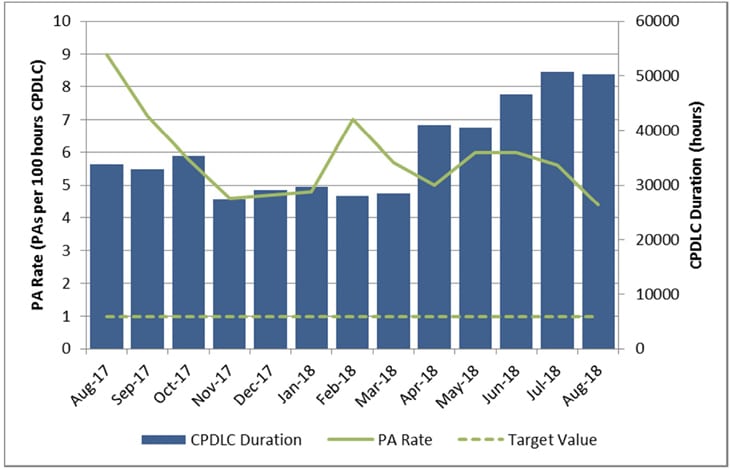
Their goal was to get the number of provider aborts down to 1 per 100 flight hours. By mid-2018, the number had dropped to a rate of 4.4 per 100 flight hours, and data from this year has that figure down to 3.9 per 100.

Added to that, they wanted to get at least 75% of flights across the network filing with datalink. Current data suggests this is still lingering at around the 40% mark. So if the datalink mandate had been implemented as planned in Feb 2020 without these new exemptions, that would have meant that approximately 60% of the traffic would have been restricted to below FL290!

As the EU make clear in their new ruling, that is ultimately why the new raft of exemptions has now been brought in, ahead of the Feb 2020 mandate:

“Acknowledging the ongoing data link implementation issues and corrective actions taken and recognising the objective that at least 75 % of the flights should be equipped with data link capability, the criteria for exemptions should be amended. Those criteria should remain effective, without placing an undue economic burden on specific operator categories which contribute significantly less to the overall number of flights. Such categories should include operators of aircraft with Future Air Navigation Systems (FANS) 1/A systems installed, operators of older aircraft, and of aircraft designed to carry 19 passengers or less.”

Ultimately, when the datalink mandate comes in on 5 Feb 2020, it now looks like most GA/BA aircraft will be exempt from this, meaning that those without CPDLC will be able to continue to operate above FL285.


Thanks to the European Business Aviation Association for their help with this article!

Article header photo by @Zelgomat


Midweek Briefing 06JUL: Hong Kong capacity problems, Iceland: The fun continues

Hong Kong capacity problems 06JUL During this year, the Hong Kong CAA has issued a couple of warnings to operators to stick carefully to their allocated slots, but it’s not making much of a difference to operations there. Read the article.

Iceland: The fun continues 06JUL Last week there were some really positive indications that the ATC strike in Iceland was coming to an end, but it’s now worse than ever, with Westbound, Eastbound, and landing traffic all affected. Read the article.


HECC/Cairo FIR A restriction exists for traffic to and from the Amman FIR, so if overflying Jordan and then Egypt, or vice versa, you can only use the waypoint METSA.

OMAE/Emirates FIR has some updated peak times. Departures need a slot between 0630-0730Z and 1700-0000Z. Arrivals will be spaced 5 mins apart during these times also, as will aircraft entering the OMAE FIR from nearby airports like Muscat, Isa, and Baghdad.

EIDW/Dublin Runway 10/28 is closed overnight until 09JUL.

OERK/Riyadh, Saudi Arabia will be hosting the ‘Global Ministerial Aviation Summit’ 29AUG-31AUG. 55 different ministers from various countries are expected to be in attendance. Be aware of potential restrictions leading up to and after the event.

CYFB/Iqaluit Another NAT alternate favourite, CYFB has some runway closures throughout July.

EGCC/Manchester is doing some work on 05L/23R overnight until 08JUL and has advised operators to carry some extra gas due possibility of holding.

LOWW/Vienna has published a helpful list of rush hour periods – worth avoiding these times as holding is common at VIE. The times are: 0530-0750, 0920-1030, 1140-1240, 1340-1500, 1615-1800, and 1840-1940Z.

BIZZ/Iceland Despite optimistic reports of a resolution to the ATC dispute in Iceland last week, the situation remains unresolved. Last night BIRD Oceanic was closed to most Eastbound traffic once again, as was BIKF. A new addition to restrictions is a closure to many Westbound flights on Wednesday 06JUL – “DUE TO STAFF SHORTAGE IN REYKJAVIK OACC WESTBOUND TFC PLANNING TO ENTER BIRD FROM ENSV VIA GUNPA,VALDI, IPTON, INGAL, ISVIG AND EGPX VIA LIRKI, GONUT, OLKER, MATIK AND RATSU AND THEN PROCEEDING INTO EGGX OR CZQX SHALL REMAIN SOUTH OF BIRD CTA” Read the article.

EDYY/Maastricht ATC have requested crews operating through the Maastricht UIR to log on to CPDLC EDYY, if you have datalink. While voice remains the primary comms method, you might get an uplink message if the frequency is busy – it’s not a test, you should confirm – most of these uplinks are likely to be frequency changes.

EPZZ/Poland has advised operators to check carefully whether permission is required in advance of operations at airports other than EPWW/Warsaw. Many countries including Poland have reinstated Border Controls within the Schengen zone. Best advice is to treat each country as having full Border Controls for the moment (so think Passport, GenDec, etc.)

SPIM/Lima FIR (Note that the airport is now SPJC, distinct from the FIR code) is shutting down airway UG427 after 21JUL.

SUEO/Montevideo ACC (Uruguay) has some comms issues in it’s airspace, and has advised of some extreme spacing between aircraft irrespective of FL – 40nm. For now, this ends today (06JUL) but may happen again.

WSZZ/Singapore Qualifying citizens of Singapore are now eligible to apply for US Global Entry membership – and benefit from expedited entry to the United States at designated airports. Similarly, qualified U.S. citizens are eligible for enrolment in Singapore’s enhanced-Immigration Automated Clearance System (eIACS).

ZMUB/Ulaanbaatar, Mongolia is downgraded to RFF Cat 7 until 10JUL. Also, from 12-16JUL, you can’t file this as an alternate which may limit your options somewhat.

LFPG/Paris due to maintenance on the ILS for Runway 08L/26R from 18JUL to 02OCT. The only approaches that will be available will be RNAV based procedures (LNAV/VNAV, LPV, LNAV) and VOR/DME.

GQNN/Nouakchott, Mauritania has moved to a new international airport this June. Located approximately 10nm north of the city, it has an annual passenger capacity of 2 million. Infrastructure from the capital’s old airport was transported to the new one.

SECU/Cuenca Following the landing incident on 28APR of an E190, all inbound flights will be reportedly be held if the runway is wet – until end of August.

LFMH/St Etiennee Fuel outage on 07JUL, 0800-1100 UTC.

Canada/Mexico From 01DEC2016, Mexican nationals will be able to travel to Canada without a visa for business and tourism for up to 90 days.

Turkey/Russia Russia has lifted the travel restrictions on tourists between the two countries. The ban was put in place following the downing of a Russian military aircraft last year.

Bangladesh Germany, Australia and the U.K. have banned direct cargo flights from Bangladesh due to security concerns.

Israel/China The Israeli parliament has ratified a multiple-entry visa agreement with China, under which Chinese business visitors and tourists can enter Israel multiple times with the same ten-year visa and vice versa.

EZZZ/Europe the European Union updated Air Safety list (aka the Airline Blacklist) on 17JUN, and lifted a ban on Zambian air carriers.

Uganda Introduction of ‘e-visa’ system. You must show a valid yellow fever vaccination certificate on arrival.

ZJSA/Sanya FIR, China has an ADS-B trial up and running on L642 and M771. Radar is still the primary separation tool, but ATC ask that you check your Flight ID matches your FPL.

View the full International Bulletin 06JUL2016