Turkey: New rules for GA/BA flights
Strange things are happening in Turkey.

Strange Thing #1

A few weeks ago we spotted a new doc issued by the Turkish CAA with guidelines for foreign registered aircraft who wish to operate domestic legs in Turkey – to get a permit, you now need to apply at least 15 days in advance, and you will need to prove that you have investments in the country.

Strange Thing # 2

Then this week, Turkey suddenly revoked all landing permits for non-Turkish operators unless they had “special exemptions”.

No one seemed to know why this happened, what these special exemptions were, or how to go about applying for them.

So we got in touch with local Turkish handling agent Gozen Air for some urgent help to understand what’s going on!

Here’s what they said:

With effect Feb 13, 2021, the Turkish CAA (TCAA) has started to apply operational 
limitations for all non-Turkish registered aircraft on general-business aviation 
operations to/from Turkey. This was just a verbal announcement by the TCAA - they 
haven't made any official announcement yet, though a change in the AIP and on the 
permit application system is expected soon.

In the meantime, here's the lowdown:

Flights will only be considered as Private if the following criteria is met:
- Owner must be the same as the aircraft operator. i.e. the aircraft can't
be leased out.
- Aircraft can only have maximum 12 passenger seats (or 19 seats if the country 
of aircraft registration has a bilateral agreement with Turkey).

If flights don’t match this criteria for any reason, then the flight will be 
considered a Commercial flight. In this case, the operator must apply for a 
charter landing permit, and include these docs in the application:
- AOC / Operations Specification
- Authorization Letter to your representative company in Turkey
- Handling Agreement (in case you are operating more than 4 flights to/from Turkey)
- Aircraft documents: Insurance, Registration, Noise, Airworthiness.

Regardless of whether a flight is considered Private or Commercial, foreign aircraft
with passengers onboard can only fly to Turkey from the country the operator/aircraft 
is registered in.

Bottom line, the issue is that there was previously no separation between Commercial and Private flights among business aviation in general, and most of the business aviation flights were considered as private before. Now, the TCAA has implemented these new measures to regulate them, and also to protect the local Turkish operators in business aviation – although the roll-out of the new rules has so far been a bit uncoordinated and confusing.

Strange Thing #3

Back in December 2020, we had one report of a flight headed from Sweden to Cyprus – when on the runway about to depart, they received notification from the Turkey ACC that overflight of Turkish airspace was not allowed, and they would have to route around the country.

We had several other reports that the United Arab Emirates CAA are now denying approvals for flights to/from Turkey – they haven’t officially published this new rule anywhere, but local permit agents have confirmed this is what’s happening.

These events might be connected. Might not be. Might be to do with political tensions surrounding recent EU plans for sanctions against Turkey and naval drills off the Turkish coast. Might not be.

Whatever it is that’s going on, if you’ve got a flight going to or over Turkey any time soon, double-check your permits are all still valid, and keep an eye on any AFTN replies you might get from Turkey once you’ve filed your flight plan.

If you need help with ops to Turkey, of for overflight of the LTAA/Ankara FIR, you can get in touch with local agent Gozen Air by email at: occ@gozenair.com

Greece-ing the Turkey: The Aegean Dispute

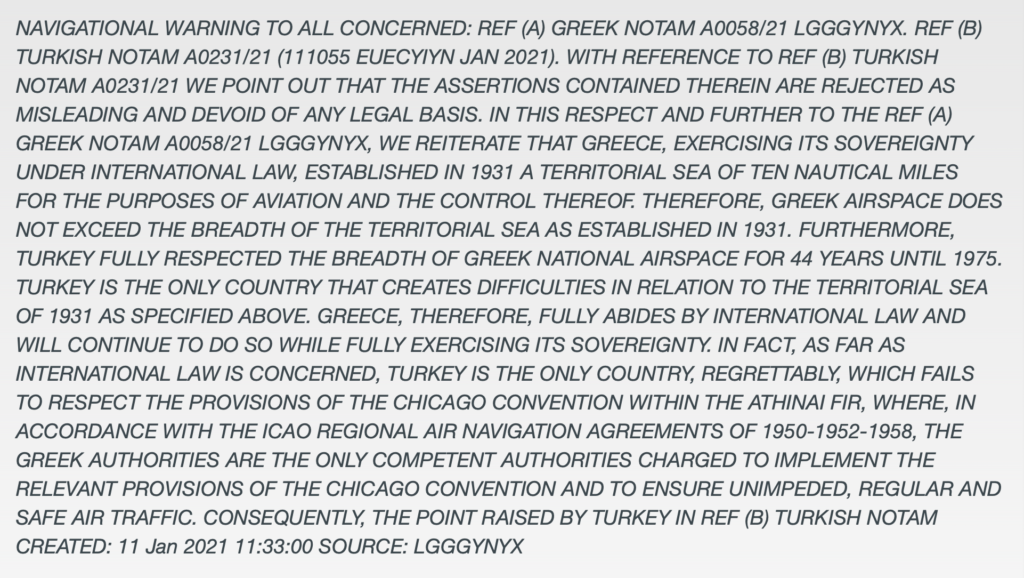
The dispute between Turkey and Greece is one we have mentioned before. Not because it was having a particularly big impact on aviation operations, but because of the vaguely amusing Notam battle they have been waging against each other for the last few years.

But what appears to be a rather silly conflict actually has a more serious side to it, so we thought we would take a little look at what is going on.

What are they arguing over?

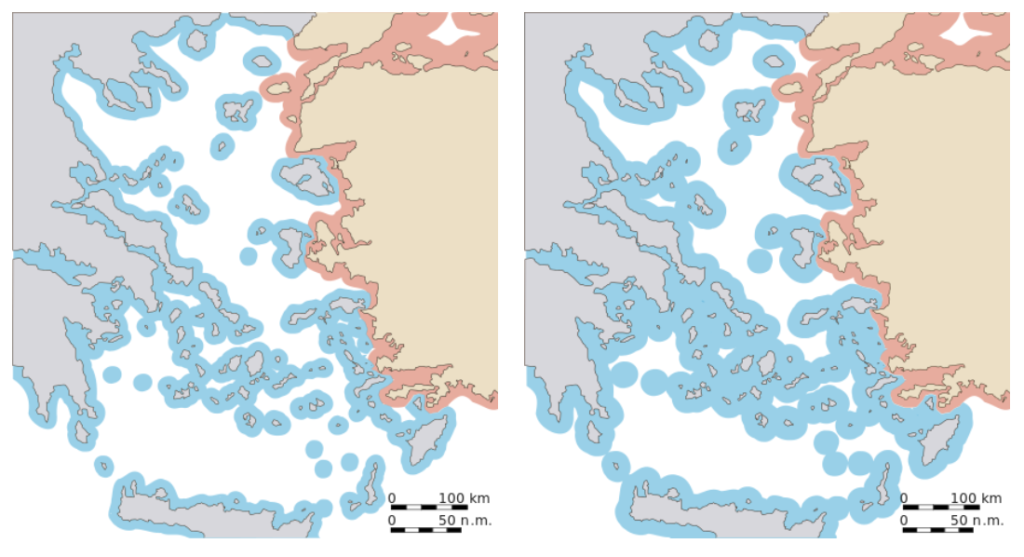
This dispute is about what disputes always seem to be about – who owns some bit of land, or in this case, a Continental Shelf (so a bit of land that is submerged under several miles of Eastern Mediterranean Sea). Turkey want it because it is a treasure chest of energy resources, while Greece want it because, well, they reckon it was always theirs.

The dispute goes a bit “higher” than the continental shelf though. Like those annoying neighbours who keep pushing their fence backwards into your garden, so Greece have decided that their airspace extends not the usual 6nm (based off territorial waters), but 10nm. Turkey refuse to recognise those extra 4nm as Greek. Nor do ICAO who have a 1948 statute saying airspace must coincide with territorial water boundaries. 

So we would say that’s one:nil to Turkey, except for Greece’s point that they actually laid claim to those extra 4nm way back in 1931 before ICAO came along with their statute. Plus, this isn’t the only area Turkey has had disputes over, so maybe Greece have a bit of a point.

But do we care, or can we just let them keep bickering?

Well, the permanent Notam battle can be ignored with a simple filter that removes the likes of these from your Notam package:

However, that is not the only repercussion. Actually, all this makes for some messy airspace controlling because it impacts FIRs and with that, who controls military flight activity. This has led to a bunch of provocations from both sides, with them regularly sending military aircraft into the 4nm disputed bit just to annoy the other side. And this is a problem, because it often escalates with retaliations. In 1996, Turkey claimed one of their aircraft had been shot down by a Greek fighter jet, and in 2014 the number of Turkish incursions into Greek airspace rose to nearly 1,500.

Tensions flared up again in 2020 when Turkey finalised their purchase of Russian S-400 mobile surface-to-air missile system. Now, this wasn’t specifically aimed at Greece, but it did go against NATO and US orders, resulting in big sanctions against Turkey.

Greece spent 2020 developing stronger defensive ties with their neighbouring countries, and at the start of this year, placed an order for 18 French Rafale fighter jets to pad out their Air Force. 

A bit of a jam

Deliberate GPS Jamming is also a major issue in the Eastern Mediterranean and across Turkish airspace, adding to the list of threats commercial aircraft have to consider.

So is this a conflict to watch?

2020 was a tense year between the two nations, and 2021 seems unlikely to see much de-escalation. While direct conflict between the two will likely be prevented by neighbouring countries and the EU and NATO, the dispute is still simmering away.

For commercial flight operations, the impact remains primarily in the Notam world, but attention does need to be paid to any temporary prohibited or restricted airspaces which might pop up because of increased military activity in the region.

Additionally, Turkey is a large country and their airspace provides a major overflight route between Asia, the Middle East and Western Europe. Having an awareness of the political tensions between the two countries is important, particularly if routing to or from Greece, or carrying Greek nationals onboard, since this might compound your problems if you have to divert into a Turkish airport.


ORER and ORSU: Closed to International Ops

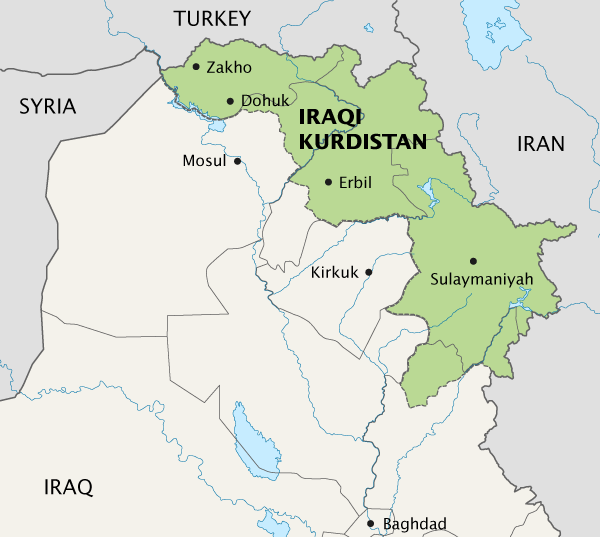
The Iraqi CAA will ban all international flights to/from ORER/Erbil and ORSU/Sulaimaniyah starting from Friday 29th Sep. 

From then on, those airports will only be open for Iraqi carriers and domestic ops.

Tensions around the Kurdish autonomous region of Iraq are rising following a referendum on independence.

The Iraqi govt has demanded that the KRG (Kurdistan Regional Government) hand over control of its two international airports – ORER and ORSU. Until the KRG comply with this request, the international ban on flights to these airports is set to continue.

At the request of the Iraqi govt, Iran had already closed it’s airspace to ORER/ORSU traffic earlier this week, and Turkey was considering implementing the same ban.

The KRG are now deciding whether to give up control of their airports or lose their international flights. Should it be the latter, then from now on anyone attempting to travel to the region will have to transit via Baghdad.

We will update as more information becomes available.


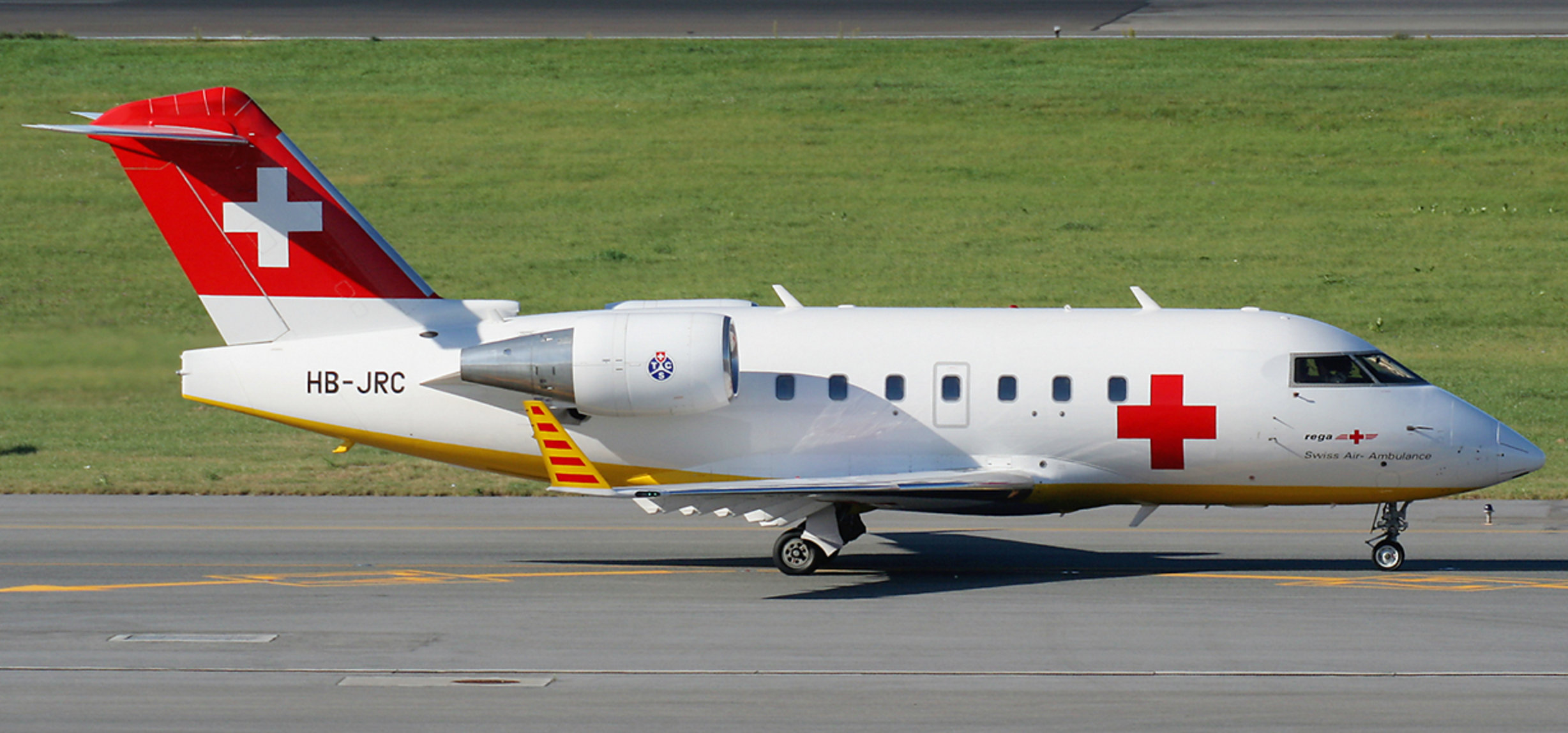
Turkish airspace: Air Ambulance Flights

The Turkish DGCA has issued a notice relevant to Air Ambulance Operators planning to operate in Turkish Airspace.

All active ambulance flights  should, on first contact with Air Traffic Control (Istanbul/Ankara), both landing and overflying Turkey, specifically declare that they are operating as an “Active Ambulance Flight“.

This procedure is implemented with effect 09AUG2016, and in place permanently.