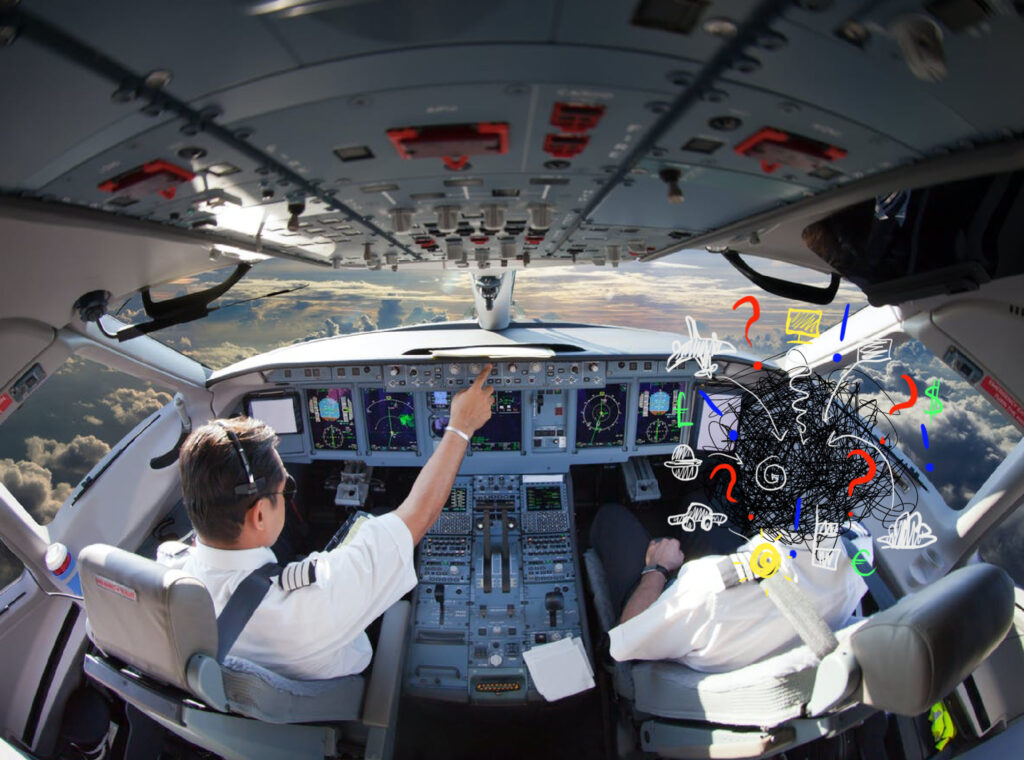
Storm in the Cockpit: Tales of Conflict and Clashes

We’ve said it before, and we’ll say it again – the flight deck is a weird little world to work in. We lock ourselves into our button-filled booth, with one other person, and sit there for hours on end, putting ourselves through no end of challenging things.

I am talking things like fatigue, boredom, stress and, yep, dealing with people.

You’re one, I’m one, they’re one (if they’re not then you’ve got an even bigger problem). Point is, we’re all people, people can be challenging. and dealing with those challenges is a big part of our jobs. But we rarely talk about it. At least not in a very human way.

Well that stops now!

We want to talk about human stuff. The good, the bad and the ugly stuff that makes us human, and often ‘not such ok’ humans from time to time.

We wrote a little book.

It’s just 3 stories. Tales of things that happened to pilots (to us!) where there was a storm brewing, a conflict growing, a nugget of irritation and anger flowering.

You can download the PDF here.

We want pilots (people) to share these stories, because these are the experiences we can all learn from, think about, probably have happen to us.

So, if you have a story, share it – please – we will even add it in (anonymously if you prefer). Send it to team@dangerrr.club

A normal day at work, as a pilot, is often anything but normal.

Just think about it for a moment – everything you do is monitored, you are strapped into a little box and expected to work away for hours on end, doing things where one little error can easily escalate, where one small slip can slide you into a catastrophe. And you can’t step out if you feel off.

You can’t even step out to have a simple bathroom break with having to prioritise it, and awkwardly announce it to the other person.

The airplane “office” is a strange spot to work in at the best of times, and then we add in a whole load of challenges that make living up to the ‘ok pilot’ standards even more difficult.

What are we talking about?

All the things that make our little, puppy brains act even more strangely:

Fatigue – flying at crazy hours of the day and night, across timezones, and expecting our brains to go “yeah, ok, I’m good with this! I don’t need sleep.”

Boredom –  yeah, I’ve said it. Sitting in the cruise in the middle of the night, monitoring monitoring monitoring can get tedious, and a bored brain can be a bad (or at least not as good as usual) brain.

Stress – The pilot job can be a tricky one. Things happen. Often they are things we don’t like having happen, but we’re the only two up there in that cockpit who can sort it.

Random pressure – it’s all over the shop. At home, from the company, from the passengers, from inside your own little brain.

And of course… People – The behaviour, attitude, values, ideas, smell, sounds, way they put a glove on to fly all impacts how we act too.

Whether it’s a ‘Stranger Danger’ (working with someone you don’t know at all, and maybe are struggling to find any common ground with) to the ‘Friendly Foe’ (flying with the same person you always fly with, who you know really, really well…), and all the others in between. They all have their challenges. People do weird stuff from time to time, but we never talk about how to deal with it.

Not really.

I mean really talk about how to deal with someone doing something weird, or how to spot it in yourself when you’re getting cranky, grumpy, grouchy, slouchy, slack or mad or mean.

So, we’re here to talk about it.

Now, before we do, let’s have a quick chat on CRM courses. These are of course great.

Sometimes.

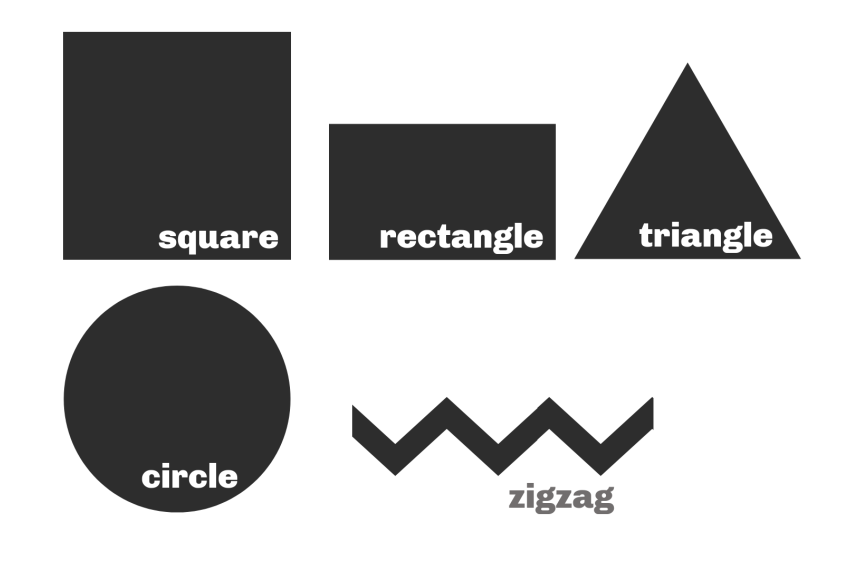
Especially the ones where you have to pick which shape appeals to you most. In fact, let’s do it now quickly –

Which shape appeals to you most?

Pick one. Only one.

Right, so, whichever shape you have picked tells us so much about you as a person…

  • The square is a tireless worker. Diligent, patient, methodical, neat, organised, logical. Predictable, rational, data driven.
  • The Rectangle is a transitional shape which means this person is curious, inquisitiveness, adventurous, motivated. Always trying new things, always lively and interested.
  • The Triangle is the shape that symbolises leadership. This person focuses on goals, analyses situations fast, is confident, thinks they’re always right, assertive and argumentative. Their career gives their life meaning.
  • The Circle is a harmonious person who loves good interpersonal relationships. They value people and wellbeing, are the glue that holds the team together. They have sympathy, and empathy, lots of emotional IQ and often super creative.
  • The Zigzag is (not a shape!) but a symbol of creativity, imagery, conceptualism and aesthetics. They live for experience and reflection, new ideas and methods, possibilities rather than actual realisation.

I bet you fit perfectly into one, and not any others right?

No? No! Of course you didn’t! Because we aren’t defined by one shape and a couple of sentences about said shape.

We can change on a fairly daily basis (or by the minute, if you’re like me and particularly susceptible to things like hunger rage). What’s more, this does very little to actually help us establish how to work with a triangle if I’m a circle, or to deal with that flimsy whimsical zigzag while you, the square, are trying to get a basic job done.

Human Factors has some answers though.

They do indeed have some.

We have (thankfully) moved a long way from simple symbols and SHELL models to tell us what sort of errors and mistakes, biases and behaviours can cause concerns in the cockpit. We know about our non-tech competencies, we know about those hazardous attitudes. We know that a too steep cockpit gradient might lead to an unassertive FO not speaking up, and we even know that there is a risk of the too friendly flight deck and the risk of complacency.

The thing is, we read the reports, accident investigations, and we think about how that crew crashed. 

But what we rarely talk about is the bits that lead to that. The off day, the slight challenge, the things we see and experience all the time which never lead to the big bad accident, but which could, one day, if we don’t deal with it right. The reason we don’t is… well, why would we? Unless you bring them up yourself then they aren’t in an accident investigation report, they generally aren’t covered in a CRM manual, because they just aren’t big enough.

Which means we are never talking about us, each other, our experiences. We assume we all know how to deal with them, because they are everyday human things. But in the cockpit, in that locked chamber, these are what often amplify.


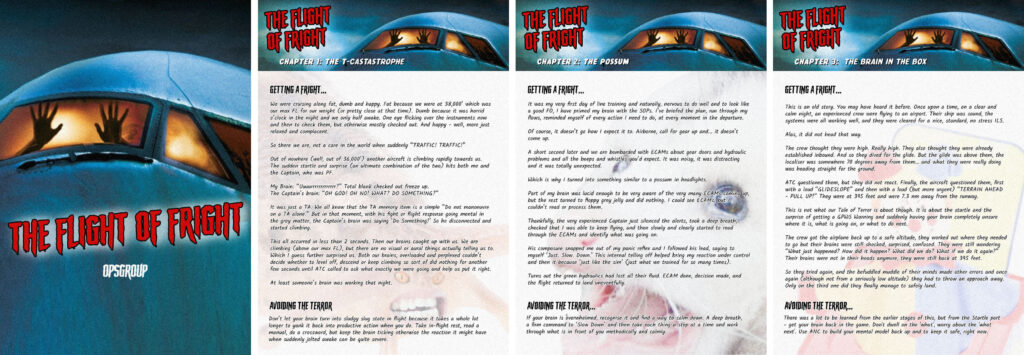
The Flight of Fright: Tales of Startle and Surprise

We may have brought this up before. I think we referred to it as “that old chestnut”, and talked about how the lack of currency (a lot of folk were heading back to the cockpit after big periods of Covid-no-flying) made it a big threat to think on.

But it turns out lack of flying isn’t the only issue. In fact, Startle and Surprise are a bit less “old chestnut” and a lot more “giant conkers still encased in their spiny suits, falling on pilots’ head from 40,000 feet”. They can affect anyone, and regardless of experience or currency, can be hard to deal with.

So we thought we’d take another look, and a slightly more personal look, to see if that might help folk be less, well, startled when something startles them, (or surprised by something surprising).

It’s all in your head.

It really is, which means reading about the Science of Amygdala and the Theory of ‘fight and flight’ is great, but it probably won’t actually change your reaction. At least, not the one that counts. You may say “oh, so that’s why my brain did that!” several hours afterwards when the adrenalin has worn off, but in the heat of the moment?

Knowing the theory probably won’t help.

If you want to know how to not react the ‘wrong’ way to Startle or Surprise, then you need to think about how you do currently react – analyse those past events and what your brain did during them – because once you understand and are aware of that, then you can start to think about how to control it a little more.

A very wise lady wrote an interesting thing of this for the RAeS magazine. She pointed out that one of the big issues with training for Startle & Surprise is the fact that you can’t really do it that effectively in a simulator. 

  • First of all, we all go to the sim expecting hideous things to happen and are generally quite primed for it. 
  • Secondly, unless your sim is particularly high tech then chances are they have to build up to a lot of those startlingly surprising things. Like the old “close your eyes and only open them when I say ready” UPRT practice. If you know what’s coming, the effect is less.
  • Thirdly, as much as we’re told to treat the sim like a real flight, our little brains always know deep down that it is just a sim and we aren’t going to really be in any life threatening jeopardy, which can change just how much ‘fight or flight’ it really goes for.

So it is hard to really experience a full Startle or Surprise in the sim. But we can still benefit from the practice by using it to review our reactions and thinking about how they felt, what we did, how we recovered – we can mentally prepare ourselves for the real deal should we ever encounter it.

Are you a ‘flight’ risk?

I am a naturally very jumpy person. My husband takes great amusement in making me jump at every opportunity which sadly has only further developed my “scream first, think later” response. 

Would I have a similar reaction in an airplane?

Embarrassingly, yes. I once flew into my wind shear memory items after the system yelled “Wind Shear!” at me. Great. Nice to know I’m that well conditioned. Only the warning had gone off at 12,000’ because the system had malfunctioned, and me hurling it into TOGA basically all out panicked the poor thing. 

Are you a ‘fight’ risk?

I’ve seen other pilots startled by the dings of ECAM during an engine start, seen the EGT skyrocketing and yanked the start master off – de-powering a bunch of the systems the clever FADEC probably would have used to help the situation.

Both the flight or fight reactions generally have us wanting to do something immediately – to take action, to get ‘out of danger’ – and generally before we’ve really understood the situation and all the information in front of us.

The ‘duh!’ Moment

The other response is the ‘freeze up’. 

A prime example of this occurred in the French Bee go-around incident of 2018. Startled by an unexpected wind shear warning the FO seemed to freeze – cognitive incapacitation. This was quite an extreme example (extreme in how long it lasted).

I’ve heard folk say “I really froze up!” when they were startled or surprised, “There was this moment of cluelessness, where I just didn’t know what to do!” This isn’t the same as the poor French Bee FO though who, after carrying out that probably amounted to a conditioned memory reaction then checked out entirely for almost the entirety of the go-around procedure.

Is a momentary freeze up such a bad thing?

That ‘duh’ moment is a pause. It is your brain trying to work out what is going on, and this can be to your benefit if you recognise it, and use it as a trigger to start getting the brain back into gear.

https://giphy.com/gifs/movie-film-1990s-1aKKuZOjn3qUg

The worst thing to do would be to do something because you feel you need to. You need to give your brain time, but how can you do this?

What should that response be?

A lot of folk say “sit on your hands” but this is easier said than done. 

I mean, you’re not literally going to sit on your hands. Mine tend to go into a sort of weird claw shape when I’m truly startled, which I’ve never understood because what use is that? I’m not a clawed apex predator, and it makes sitting on my hands particularly uncomfortable.

What I think the phrase is aiming for is giving yourself a couple of seconds to allow your brain to get out of the startled state and start actually taking in the information and processing it properly. So a better method, or technique, is the deep breath trick.

Literally one big guzzling breath of air. 

I like this one for two reasons – one it really works, and two it turns what would have been a mortifying yelp into a sort of wheezing gasp which is less startling for the person sat next to me.

Be a rock. 

Or rather a ROC – Relax, Observe, Confirm.

Actually, ROCK works too – Relax, Observe, Confirm, Know (what to do).

This is a really good mantra to get into your brain. Deep breaths to clear the mind. Look at what is in front of you. Vocalise it so the other pilot knows what’s going on.

The point is, you are going to be startled at some point. Things are gong to surprise you, and chances are, you will have the age old human survival reaction to this. You probably can’t help it, but if you can recognise it in yourself and stop it from taking over totally, then that is a good thing.

After all, the other ‘old chestnut’ CRM thing – the one about stress levels and how well you perform (because adrenalin is a useful thing, to a point) is also a science fact.

So – a challenge.

Try and think of a time when you’ve been startled, or surprised, and try and remember the feeling.

Once you start to recognise it, and to understand how you react, then you can really start to condition yourselves with a better response, or at least a way to manage it.

Then try to think of a situation when an immediate response really is required. Aside from the obvious “TERRAIN AHEAD, PULL UP!” or a really violent wind shear warning, there are very few. Engine fire? You still need to confirm the right one. TCAS? RTO? They build in the natural delay.

We’ve put together a bunch of ‘stories’ – A Startle and Surprise Story Book.

We aren’t astronauts.

Chris Hadfield, Canadian Astronaut, once talked about how astronauts sometimes might only have the time they can hold their breath for to solve a problem. I tend to yelp which means I let all the air out, so I would be awful in this situation. 

Thankfully, we aren’t astronauts, and there is rarely going to be a moment when you have to act right this second or that’ll be it. So taking two seconds, two breaths, to calm down and work out what actually does need to be done is pretty much always going to be a good thing to do.

Want to read some other stuff?

Try this for size. (It’s the old post we wrote about this very subject when folk were heading back into the skies after long periods off).

And here’s our book again in case you didn’t already download it. If you have a personal story to share of a time when you fought the twin headed gorgon of Startle & Surprise, send it in and we will add it (anonymously of course). Email us at news@ops.group


Danger Club is Back!

At the end of 2021, we ran 6 Danger Club meetings. The idea behind them? To start a new conversation on safety danger.

We wanted to get people talking about the humans in human factors – to bring the discussion back to our own operations, to share insights and experiences, to learn what we can be doing better.

Because we are all just fallible humans figuring out where our faults may lie.

The Story so Far

We don’t want to talk about all the usual cases – The Tenerife disasters, the Kegworths. They were huge learning opportunities, but even after learning from them (at nearly every CRM session), incidents are still happening, and we want to ask why?

So we took a look at less known incidents and accidents, ones where the stuff that happened is stuff that could happen to any of us.

Nothing technical, just human.

An autopilot disconnected too early and an approach not stabilised, a too steep cockpit gradient, or that day flying with your buddy where it is way too casual… Times where one small error became two, and then became three, and suddenly wasn’t so small because the crew just didn’t ‘get their head back in the game’.

Now We’re Bringing it Back.

After a bit of delay due to many goings on at the start of 2022, we are now bringing Danger Club back. Our first meeting of 2022 will take place at 1800 UTC on Thursday March 24th, and wherever you are in the world, come join us!

11am LA, 2pm New York, 6pm UK, 7pm Berlin, 10pm Dubai, 7am (Wednesday) New Zealand…


What are we going to talk about?

We want to stick with the ‘theme’ of looking at non-fatal incidents and accidents, and talking about the ‘What Ifs’ that could potentially happen to us.

The first one is an interesting one because the main question we thought as we read to the end was simply “How?”

“How did it get that far?”

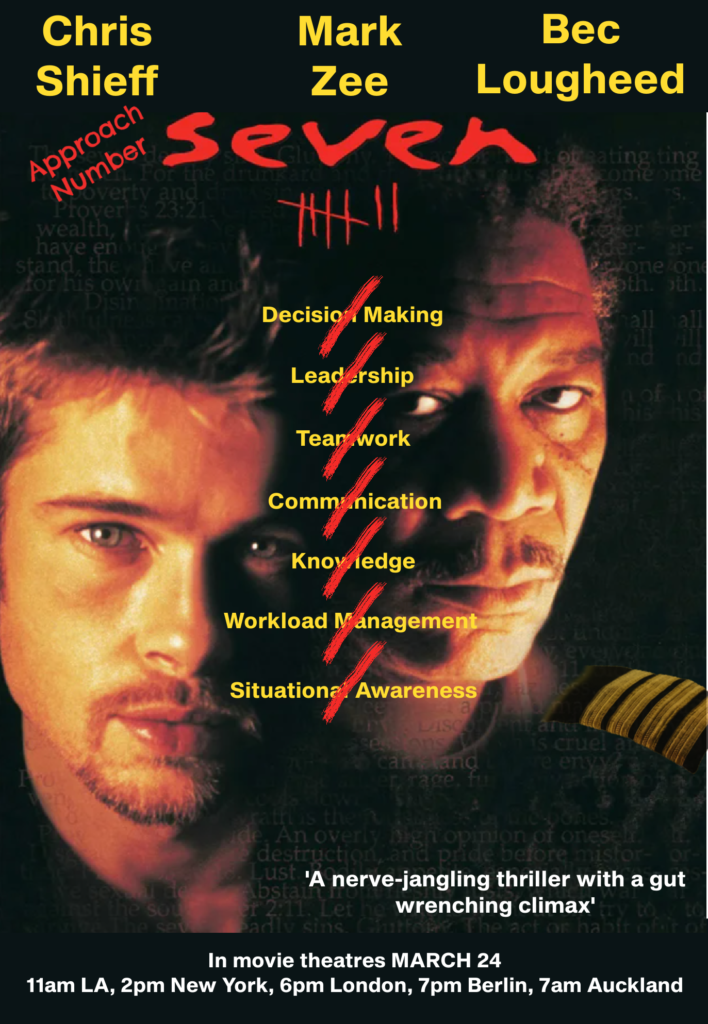
How did a crew of a 737 end up having to carry out 7 approaches before finally managing to land? Was there a point during their decision making process where this could have been avoided? What was running through their heads as this progressed, and more importantly how can we all avoid making the same mistakes?

So put it in your diary!

March 24th, 2022 at 1800 UTC

Danger Club #7: Thursday, Mar 24: 1400 ET / 1800 UTC
11am LA, 2pm New York, 6pm UK, 7pm Berlin, 10pm Dubai, 7am (Wednesday) New Zealand…
Incident: Jet Always B737: Lucky Number Seven


And if you’ve not been to one before?

Just come along and take part. We are all students in this and we all ask is you switch your camera on during the session, but how much you input is entirely up to you.


Getting Your Head Back in the Game

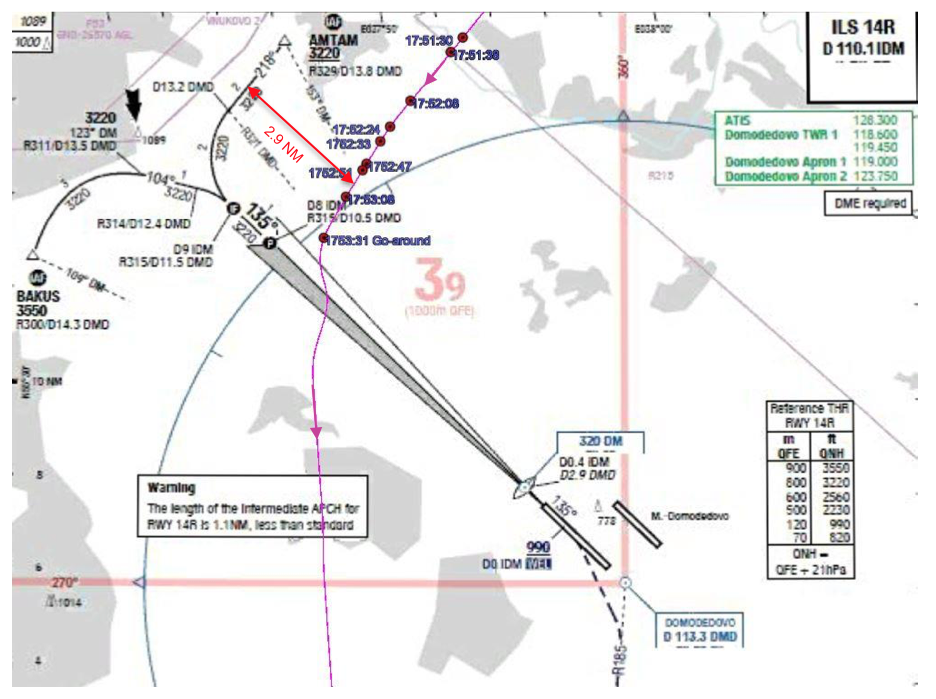
In 2017, an Airbus 380 routing to UUDD/Moscow Domodedovo had a serious incident attributed to “Descent below Cleared Altitude during Approach and FS not reconfigured following a reset doing the Second Approach.

What happened, in plain English (and minus 166 pages of report), was an aircraft carrying 422 passengers descended to 395 feet AGL, had an EGPWS warning, and then attempted a second approach which they went around from before finally landing without incident from the third approach.

Now, it might come as a surprise, but  if we are going to talk about either of those approaches, then we actually should talk about the second one. Here’s why…

(But before that) The Report

A large number of the aforementioned 160 plus pages of this report discusses and analyses Airbus specific (and at times quite technical) factors involved in the second approach. Things to do with FMS sequencing, oscillations from mismatching position signals, FMC resets, multiple waypoints…

But if we sift through this technical stuff and really ask what led an experienced crew, with a full functioning modern aircraft, into this situation then the real root cause is simple.

Stress.

Stress caused by what had happened earlier clouding their ability to do what needed to be done next.

We’ve all been there.

We have all experienced a time where something has gone wrong and our brain has refused to drop it. Instead of getting to work, it’s sat there reminding us what we just did, how silly it was, even when we’ve tried to move on and get our focus back on the current situation.

You no doubt have your own examples – the first manoeuvre in a sim assessment that is so messy you spend the rest of the session dwelling on it, wondering if it was too messy to pass. The time you did something silly on the line and sat there stewing away with the “why did I do that?!” and the “What an idiot I am!” thoughts.

And out on the line, this dwelling on what happened just now, instead of what is happening now now is particularly critical because, as we know, a flight is a pretty dynamic beast, and it doesn’t stop at the mistake – it keeps moving on. If we don’t get with the program, then where it is going to move us to might very well be another equally or even tighter spot than the one we are still stewing over.

Now, us pilots are tough on ourselves, often our own worst critic. We are also quite detail-oriented which means if we allow our brain the freedom to, it tends to start throwing a few additional ingredients into that stew pot, until there is a nice bubbling hot soup of worry filled with self blame, bruised ego, concerns about repercussions and just a little fixation on hindsight.

But if we let this soup spill into the remainder of the flight, we can get burned very quickly. So, how can we get our head back into the game?

Time

Yep, time is a wonderful thing. They say it heals all.

Alas, we don’t always have it, and if you don’t, then you’re going to need to do two things.

One: Take just a few moments to throw everything into the stew pot.

Two: Stop stirring it and put it aside until you do have the time to really sit and look at your reflection in the probably quite thick, dark gloop (ok, enough with the stew analogies, I promise).

You are going to have to wait until you can sit and reflect, dissect, digest. This does not mean disregarding it immediately though.

After a stressful or surprising event, it can take between 20-30 minutes for adrenalin levels to really drop down to normal again. In the flight deck SOPs, memory items, all our years of practice are there to help bring those levels back to normal quickly. But you still need time to acknowledge something happened, and to regroup. While you may not have time for the full self-trial, you do need to make time for your brain to get it together again.

But how long do you need?

That is very dependant on you and on the situation. A group of pilots were asked to give an estimate of how long they thought they’d need to reset and re-brief for a second approach following a “not their fault” event leading to a go-around. It wasn’t particularly scientific, there was a hypothetical pig involved, but for the most part the group seemed to feel 5-10 minutes was adequate.

This was a situation where they were not to blame though. Throw in the embarrassment and concern about repercussions and the time to put all that aside may be much more.

Admit it, Move on.

A key step in this seems to be simply admitting something went wrong. Acknowledging a mistake, out loud. Saying “That happened, but now we need to do this…” can be trigger to your brain to focus on that “now we need to” element which is so important to safety. It can also be the trigger to bring the other person back into the now as well.

Without this, it is often hard to stop your brain from running through the events again and again, self-preservation kicking in as your brain so thoughtfully tries to find reasons, evidence, excuses as to why it wasn’t really your fault.

We need to Rebuild

In the A380 incident, this seems to have been what happened. Added to that was a likely loss of trust – in themselves or potentially in the aircraft – because there was not time to review and work out what had really happened. And this is the next thing you need to give yourself time to do – rebuild.

Just as we rebuild our automation after a wind shear event, or a TCAS RA, we need to rebuild our own mental model of the situation as well, and using a structured method – sticking to SOPs, ANC, what we know – will help reset your brain back into the ‘now’ far more quickly, and with far more useful context to keep you safe. By going back to basics, starting simple with a good bit of ANC and working up again, you can determine where to place your trust and then go from there.

The Process

The process look simple:

  • Give yourself time to take in what happened and to acknowledge it.
  • Mentally put it aside until there is time to think on it again.
  • Rebuild the situation and your own mental model, bring your brain back into the game.

But can we prepare for this even earlier?

Train to Fail

We probably don’t spend anywhere near as much time thinking about failing as we should. I mean, it’s not nice to. Adding some Kobayashi Maru exercises into sim profiles probably isn’t the way to go about it, but in fact building resilience is something that can only really be done through practice.

By resilience, we mean that ability to bounce back. The capacity to recover from difficulties. Mental toughness. Some of this can be prepared with briefings on mitigation strategies, threat and error managements and all that good stuff.

But the resilience to bounce back from a real unexpected, unprepared for event –  that only comes through actual experience of those sort of situations.

How can we train to fail in sims though? And especially in the sort of scripted sims that are all many smaller operator pilots have exposure to?

The Element of Surprise

Sim scenarios which involve an element of surprise are critical. It doesn’t have to be something huge, but it does have to be something that actually tests the pilot’s decision making, situational awareness and resilience skills. They also don’t have to fail, but they do have to experience that “not going to plan, what do you do now?” moment where they need to reset their brain, rebuild their SA, and regroup with the other crew member.

If Resilience is the key, how to build it is the question.

The resilience to bounce back needs to be developed, practiced and thought about. And a process for doing it needs to be identified.

Resilience, or a lack of, is unfortunately what led the crew of the Moscow A380 into having to discontinue a second approach. While the factors leading to the first may seem so much more important to review because that first approach led to a so much more dangerous condition, the really critical Human Factor in this, and in so many experiences on the line, lies in the question of “How can we get our head back in the game following an event?”

Think you have an answer to this? We would love to hear it. You can reach us on team@ops.group.


Danger Club .. the story so far

What happens in Danger Club? Top secret of course, but very simple: we get together as pilots to talk about safety danger. This isn’t the usual safety meeting (hence the strikethrough): we’re just fallible humans figuring out where our faults may lie.

The first six meetings have been met with enthusiasm from all attending, and some really interesting discussions have resulted.

Top topics so far: Taking control from the PF, finding your voice as the F/O, MAYDAY calls and emergencies, over-experienced captains, automation vs hand-flying, the risks of a too shallow cockpit, whether there is such a thing as too much experience, and the question of when do we become too comfortable with risk?

It’s been fun and fascinating. Bec wrote a great article on one of the topics after one of the sessions: Fighting for Control, and Chris wrote another one: Grandchildren of Magenta.

OPSGROUP members – keep an eye on the OPSGROUP forum for details of the next event!


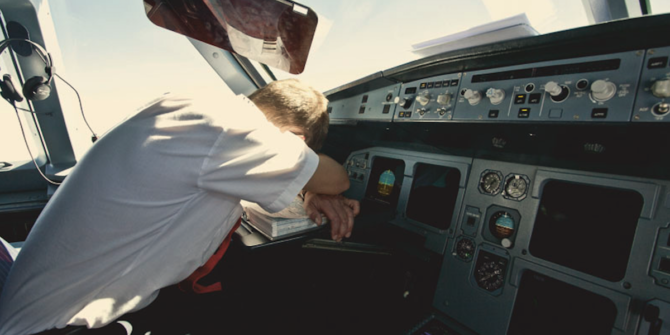
Cockpit napping – what are the rules?

As is too often forgotten by regulators, aircraft flown by humans require rules that match human needs.

One of those needs is sleep. Normally, we do this for about 33% of the day. If you manage to get a perfect night’s sleep, have a short ride to the airport, and then operate a long haul flight that departs on schedule, you might get away with not feeling tired during it. Most of the time, these perfect conditions don’t show up on the day.

Especially with the cumulative fatigue we suffer as pilots, a quick nap works wonders.

NASA did extensive research on this in 1994, and the findings showed that “The benefits of the nap were observed through the critical descent and landing phases of flight … The nap did not affect layover sleep or the cumulative sleep debt displayed by the majority of crew members. The nap procedures were implemented with minimal disruption to usual flight operations and there were no reported or identified concerns regarding safety.” This gave us the term, “the NASA Nap“.

So, napping is good. NASA says so. But, around the world, we have very different regulatory approaches to this. To make it sound better, the regulators call it “Controlled Rest”, or CR.

Places where you can:

Australia, Bolivia, Canada, China, Europe, Israel, India, New Zealand, Turkey, and the United Arab Emirates.
[source: Flight Safety, 2018]. Know more? Comment on the article and we’ll update.

Places where you definitely can’t:

The US. Although the Air Force and the Coast Guard allow it, the FAA does not – neither for Part 91, nor Part 121. CR was considered when the latest FAA rules were developed beginning in 2010, but it was excluded from the final regulations. FAA Advisory Circular 120-100 (FAA, 2010, page 11) states:
Although a number of foreign air carriers authorized in-seat cockpit naps during flight, the FAA does not authorize such in-seat cockpit naps.

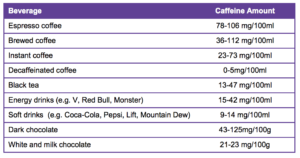
Just drink coffee!

That seems to be the FAA position. No napping allowed. There are some wonderful resource guides, listed below, that delve deep into the subject, but in terms of napping – it’s still forbidden. Why? That’s a good question. We don’t know.

Guidance Docs:

Discussion

We will discuss the topic in the Ops Chat on December 12th, 2019 at 12pm EST – register here:
https://ops.group/opschat


No Room for Error – GNE’s and the North Atlantic

Advances in technology mean that aircraft in the North Atlantic High Level Airspace (NAT HLA) are flying laterally, longitudinally, and vertically closer than ever before. But North Atlantic gross navigational errors (GNE’s), which are lateral off-track deviations of 10nm or more, still occur regularly, and jeopardise the safety of you and the traffic around you. So don’t leave it up to Air Traffic Control (ATC) to discover your GNE! In this article, let’s look at some common human slip up’s that lead to GNE’s, and what we can do to prevent them.

[heading]Pre-Flight[/heading]Operating to the highest standards of navigational performance demands the tedious and careful monitoring of aircraft systems. Unfortunately, humans are by nature not the best monitors. During the long quiet of an oceanic crossing, we can fall victim to cognitive traps such as change blindness, expectation bias, and complacency.

But the potential for error on Atlantic crossings begins well before the first coast-out waypoint. In fact, it begins before take off. The following four areas are where strategies in mitigating a GNE begin.

1) Data Entry

Via ACARS:

Many pilots now use ACARS to automatically downlink the entire flight plan and winds aloft directly to the FMS. But an over-reliance on automation can lead to complacency, and so the more reliable the system, the more complacent we become as monitors. In one incident, a Boeing 747 suffered a GNE of 120nm. The flight plan downlink from ACARS unfortunately contained one bad coordinate that went unnoticed. Once lured into complacency by such reliable technologies, there can be a temptation to omit cross-checking.

What can we learn from this? Always verify the full coordinates in an ACARS downlinked flight plan. Similarly, if several different flight plans were run, ensure that you request your downlink using the most current and filed flight plan number.

Manually:

A manual entry means a pilot inserts the flight plan’s waypoints directly into the aircraft’s flight management system (FMS). But no matter how meticulously one may be, manual data entry can still produce errors. Then how do we guard ourselves against these errors?

Firstly, avoid using ARINC 424 shorthand for programming oceanic points. This has been a factor in many GNE’s, given how easy it is to misplace the letter as a prefix or suffix. For instance, consider how simply misplacing the “N” could cause a drastic lateral deviation:

  • 50N60 = 50N 160W
  • 5060N = 50N 060W

If you have the capability on your aircraft, use the full coordinates, including minutes.

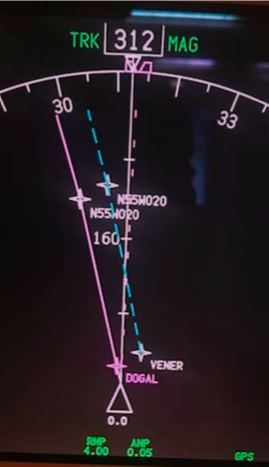
For the last few years, use of half degrees of separation has been on the rise in an attempt to enhance airspace efficiency. But on flight displays units that only show 7 digits, these half degree coordinates are misleadingly displayed as full coordinates. For instance, the half coordinate N55°30’ W020° will display as N55°W020° (see image below, which shows identical waypoint labels for points separated by half a degree!). In this case, it is imperative to view the expanded version of coordinates (degrees and minutes).
Another frequent error leading to GNE’s is transposing numbers during data entry. This commonly occurs when you complete almost the entire crossing along one degree of latitude, then fly the last waypoint at a different latitude. For example, with a cleared route of 57°N 050°W, 57°N 040°W, 57°N 030°W, 56°N 020°W, one can accidentally enter 57°N 020°W. This will put you 60nm off course.

But there is good news! These errors are easy to recognize and avoid by having a specific method of waypoint verification.

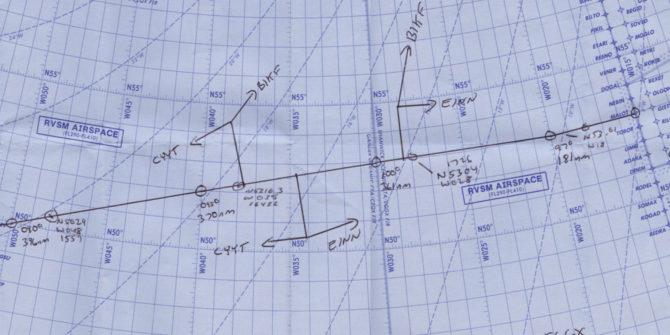
2) Waypoint Verification

Whether entered via ACARS or manually, both crew members must come together to perform a thorough cross-check. The following method recommended by ICAO in Doc007 seems to work the best:

  • One pilot reads the waypoint/coordinates, bearing and track from the FMS.
  • On the master document, the other pilot will circle the waypoint to signify the insertion of the correct FULL coordinates in the navigation computers
  • The circled waypoint number is ticked, to signify the relevant track and distance information matches
  • (In flight) The circled waypoint number is crossed out, to signify that the aircraft has overflown the waypoint.

[fancy_box box_style=”default” icon_family=”none” color=”Accent-Color” border_radius=”default” image_loading=”default”]

Cognitive Traps:

Expectation Bias is when your perception is influenced by your preconceptions. It is vital that the second crew member crosschecks from the FMS/CDU to the master document – and not vice versa – thereby increasing the chance of spotting an error.


Pop-up trip hustle – It’s one thing reading about waypoint verification, but it’s another thing actually sitting down and taking the time to do it. Do not be tempted to crosscheck your own work because you’re in a time crunch – it requires at least two separate sets of eyes.[/fancy_box]

3) Initialisation of navigation systems

The navigational integrity of your entire flight is predicated on an accurate starting position. Even a small error with on the ground can translate into a gross error later down the line in flight.

The FMS GPS position and your current parking coordinates (found on the 10-9 pages) must match. Avoid using “last position” function in the FMS – if you were towed overnight, the “last position” will be your previous location, not your current one! Sounds obvious, but mistakes happen.

Inertial systems, once aligned, must also complement the GPS coordinates. Initialisation of inertial navigation systems can take between 6-15 minutes, and errs on the longer side at more northerly latitudes – so be patient! Moving the aircraft during alignment will cause an alignment error. Bottom line: avoid repositioning/towing the aircraft during alignment, even it is to a nearby spot on the same ramp area. Position errors like this cannot be corrected once in flight.

4) Your Master Clock – (iPhones not authorised!)

Since our ETAs for oceanic waypoints must be accurate within +/- 2 minutes, it is vitally important that, prior to entry into the NAT HLA, your master clock is accurately synchronised to UTC. ICAO Doc007 has a list of approved sources from which you can set your aircraft master clock (and your iPhone isn’t one of them!). You are approved to use the GPS time which can be found in the FMS.[fancy_box box_style=”default” icon_family=”none” color=”Accent-Color” border_radius=”default” image_loading=”default”]

Cognitive Trap:

Close to the E/W Greenwich line or close to the equator, you’ll just be on the fringes of the opposing segment. So, take a close look at the E/W or N/S letter coordinates, especially if you are usually accustomed to flying from one particular geographic area.[/fancy_box][heading]Clearances & Communication[/heading]With a move away from spoken communications and towards datalink procedures, requesting, copying and verifying a clearance becomes a much simpler task! But it is still important to know your own limitations in the rare instance that you need to copy a clearance via voice.

Casual radiotelephony should be avoided

Casual radiotelephony can be the source of misunderstanding coordinates or clearances, and so all waypoint coordinates must be read back in detail, adhering strictly to standard ICAO phraseology. An example of standard ICAO phraseology requires enunciation of every individual digit. 52 North, 030 West would be read back as “Fife two north, zero tree zero west” as opposed to “fifty-two north thirty west”. Have no doubt about it, Shanwick can be the most strict in this regard.


Distractions and workload

If your departure airport is close to the oceanic boundary, e.g. Shannon or Miami, the benefit is that you will copy your oceanic clearance on the ground. Unencumbered by distractions typically associated with being in flight, you can focus almost fully on the task at hand. However, most flights pick up an airborne clearance, and it is important to prioritise this for a period of low workload.

Take the example of a Bombardier Global Express crew that narrowly avoided a GNE after copying a clearance. While they were in the midst of crosschecking the clearance with the FMS and climbing to their initial altitude, the flight attendant approached them with an issue. Instead of waiting, one of the pilots attended to the problem. A new waypoint wasn’t entered, and it was later caught by ATC in a position report. Try to avoid non-vital tasks until ALL the steps regarding copying, verifying and inputting a clearance are complete.

Following these simple standard operating procedures (SOPs) step-by-step will guard against clearance errors. If the steps are interrupted for any reason, start again from the beginning.

  • Two pilots monitor and record the clearance. The Pilot Monitoring (PM) will contact clearance delivery, while Pilot Flying (PF) monitors both the primary ATC frequency and the clearance delivery frequency.
  • The PM then records the clearance on the master document. The PF also copies down the clearance separately.
  • Clearance is read back to ATC. Any disparities between both pilots’ interpretations of the clearance must be clarified with ATC.
  • A deliberate cross check of the clearance to the filed flight plan and the FMS is made.

Re-Clearance

According to ICAO Doc007, “In the event that a re-clearance is received when only one flight crew member is on the flight deck…changes should not be executed…until the second flight crew member has returned to the Flight Deck and a proper cross-checking and verification process can be undertaken.” Sorry, they just don’t trust you to do this by yourself, and neither should you!

Errors associated with re-clearances, re-routings and/or new waypoints continue to be the most frequent cause of GNE’s. Therefore, a re-clearance or amended clearance should be treated virtually as the start of a new flight and the procedures employed should all be identical to those procedures employed at the beginning of a flight.

  • Both crews note the re-clearance
  • Reply to ATC via ACARS or voice
  • Amend the Master Document
  • Load the new waypoints into the FMS from the updated Master Document
  • One pilot verifies the input of the new waypoints reading from the FMS
  • Verify the new tracks and distances, if possible
  • Prepare a new plotting chart/re-plot in Jeppesen EFB

With datalink, you might have the capability to load the new route directly from the ATC message into your FMS flight plan. This will eliminate a transcription error on your part, but you cannot always count on the FMS to load this seamlessly. Oftentimes, if a revised coast-in waypoint doesn’t connect with your originally planned domestic airspace airway, it might cause a discontinuity. Worse, some crew have experienced their entire domestic flight plan drop out, left with only the oceanic portion.

Conditional Clearances – There’s always a catch!

A conditional clearance is an ATC clearance given to an aircraft with certain conditions or restrictions, such as changing a flight level based on a time or place. Conditional clearances add to the operational efficiency of the airspace, but are commonly misinterpreted by flight crews.

Shannon has been known upon first VHF contact to provide lateral conditional clearances on coast-in. For example: “N135AC, after DINIM, direct ELSOX”. Often, crew have been known to read back the correct transmission, but then execute the wrong procedure by proceeding directly to ELSOX.

Why is this happening? In studies of linguistics, verbs (such as ‘direct’) have been noted as having a perceptual priming effect, that more easily grabs our attention at the expense of weaker prepositions (such as ‘from’ or ‘after’). Listen carefully for prepositions. Similarly, in aviation vernacular, the word ‘direct’ means to proceed now to the specified waypoint. As pilots, we can distinguish this meaning with very little effort, and most of the time can expect to proceed present position direct. Thus, we are primed to go direct.

While this isn’t a complex sentence, research indicates that transmissions involving serial recalls (such as “proceed here then here…”) are susceptible to distortion, with the last word or item more commonly interfering with recall of the previous item.

A really simple way to prevent this is to write down clearances as they are being read to you, then read-back the transmission. You can also call attention to a conditional clearance by prefixing their read-back with the word “Verify” or “Confirm” over the radio. Via datalink, sufficient care always must be taken when factoring in all the contents of a clearance before acknowledging the message. The initial phrase “MAINTAIN FLIGHT LEVEL 300” is included to stress that the clearance is conditional. If the message is about to time out, and you need more time to process its contents, reply using “Standby”. Respond at your own pace![fancy_box box_style=”default” icon_family=”none” color=”Accent-Color” border_radius=”default” image_loading=”default”]

Cognitive Trap:

On the longer route segments between New York and Santa Maria, “when able higher” (WAH) reports might be solicited. ATC acknowledgement of a WAH report must not be misconstrued as a conditional clearance to climb. Any climb clearances will be issued separately from a WAH acknowledgement.[/fancy_box][heading]Miscellaneous[/heading]

10-minute Check – put the (Bad) Elf on the shelf for this

One of the best ways to capture a potential GNE and refresh your situational awareness is with the sublimely simple 10-minute check. Ten minutes after waypoint passage, you’ll use your current coordinates to plot your position on your plotting chart. If the coordinates don’t land on the plotted track line, an investigation into the source of the error must begin immediately. It doesn’t hurt to even make additional plots between waypoints too, but ICAO only requires the one 10-minute check.

Today, more pilots are carrying independent GPS units in their flight bags, providing crew with own-ship on their oceanic route map. Tempting though it may be to use this for present position information, it is currently not an approved source of navigation, and should NOT be used in lieu of a 10-minute check.[fancy_box box_style=”default” icon_family=”none” color=”Accent-Color” border_radius=”default” image_loading=”default”]

Cognitive Trap

It is easy to forget about the 10-minute check. Setting a timer once your waypoint passage tasks have been completed will help remind you to do so.[/fancy_box]

Autopilot mode – “Wait, are we supposed to be in heading?”

Incorrect autopilot mode selection has been known to be a factor in GNE’s. On an oceanic crossing, you can bank on being in NAV or LNAV most of the way across the Atlantic. But perhaps you used heading mode to deviate for weather or to intercept a SLOP. It is not uncommon among pilots to spare your passengers two steep banking turns (thanks LNAV!) by manually flying a SLOP intercept in heading mode. But if you forget to re-engage LNAV, you will continue drifting on your merry way, further and further off course.

Distraction, fatigue or complacency are common reasons for losing mode awareness, so the following simple tricks will help mitigate autopilot induced GNE’s.

  • It helps to verbally announce when you are transitioning temporarily into heading mode, to bring both pilots in the loop.
  • Employing sterile cockpit until you’re back in LNAV will help mitigate distractions.
  • In an abundance of caution, you can keep a finger on the heading button or heading dial until you are back in LNAV will serve as a reminder.

[fancy_box box_style=”default” icon_family=”none” color=”Accent-Color” border_radius=”default” image_loading=”default”]

Cognitive Trap:

The flight mode annunciators (FMA’s)  are the most reliable indicators of automation selection – more so than the flight guidance panel! Yet, a study found that pilots pay superficial attention to the FMA’s during critical mode changes. Don’t waste a valuable resource, and do consciously bring the FMA’s into your scan.[/fancy_box]Deliberate cross-checking and monitoring are a critical last line of defense for which we, as pilots, don’t get explicit training, but are nevertheless expected to perform effortlessly. But over the North Atlantic, there is little room for error. So, let’s recap what can be done!

  1. Allow sufficient time on the ground to set up
  2. Closely scrutinise data entry – whether the source is human or ACARS!
  3. Work together on waypoint verification
  4. Don’t work single pilot – always keep all crew in the loop
  5. Deal with clearances and re-clearances methodically

Understanding our vulnerabilities is key to the process of mitigating errors. Armed with an understanding of our own limitations, and an appreciation for the practices and habits mentioned above, a ‘would-be’ GNE can be averted.

Links

ICAO Doc 007 

Global Operational Datalink Document (GOLD)