New Rule for Qatar Overflights
Update – Sep 10:

Not directly related to this article, but thought we’d mention it here for the next few days just FYI!

Ops Alert – Sep 10: So far the Israeli airstrike in Qatar on Sep 9 has not triggered major disruptions in adjacent FIRs. There are no new airspace restrictions to report, and OTHH/Doha is operating normally. Flight tracking indicates that major airlines are still overflying Qatari airspace. Despite this, continue to monitor the situation closely. The diplomatic response to this event is still unfolding – sudden airspace closures are possible if the situation escalates.

Original story – Sep 9:

The Doha FIR might be small geographically, but it’s strategically important. A huge chunk of regional traffic passes through here, especially flights heading between the UAE and Europe that want to avoid Iranian airspace.

And now there’s a new rule: if you’re flying in the northern portion of the OTDF/Doha FIR, you need to submit a flight notification if you plan to use certain offshore routes.
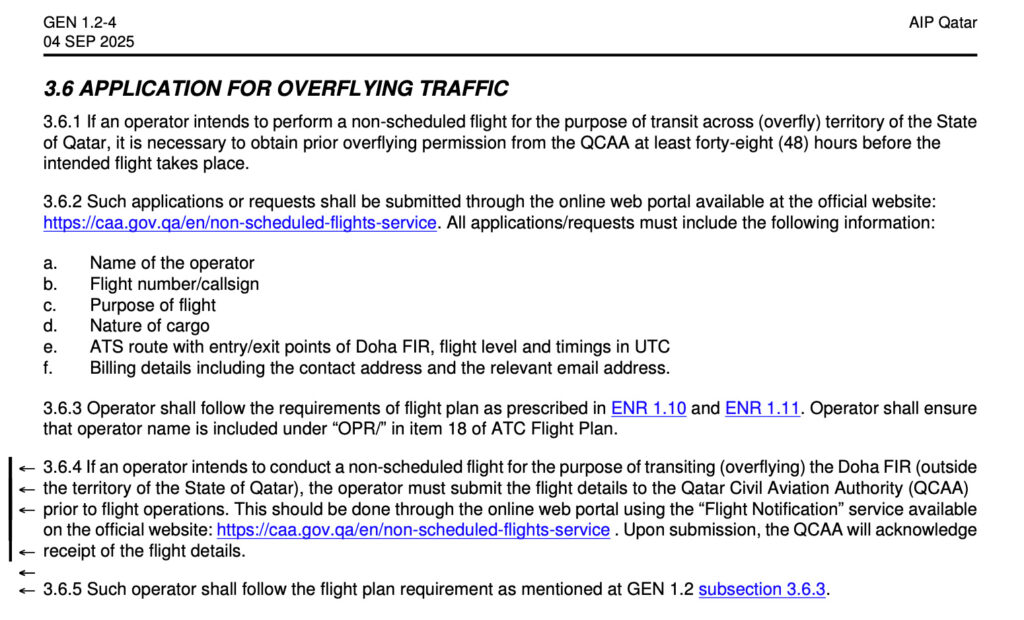
These routes don’t require permission to fly – that hasn’t changed – but you do now need to tell Qatar CAA in advance that you’re going to be there. The notification is submitted through the QCAA’s online portal, the same place you’d normally go for overflight permits.

The new rule came in on 4 Sep 2025, and applies to all “non-scheduled” operators (includes charter flights, private operators, ad-hoc flights – basically everything other than airline flights).

The affected routes

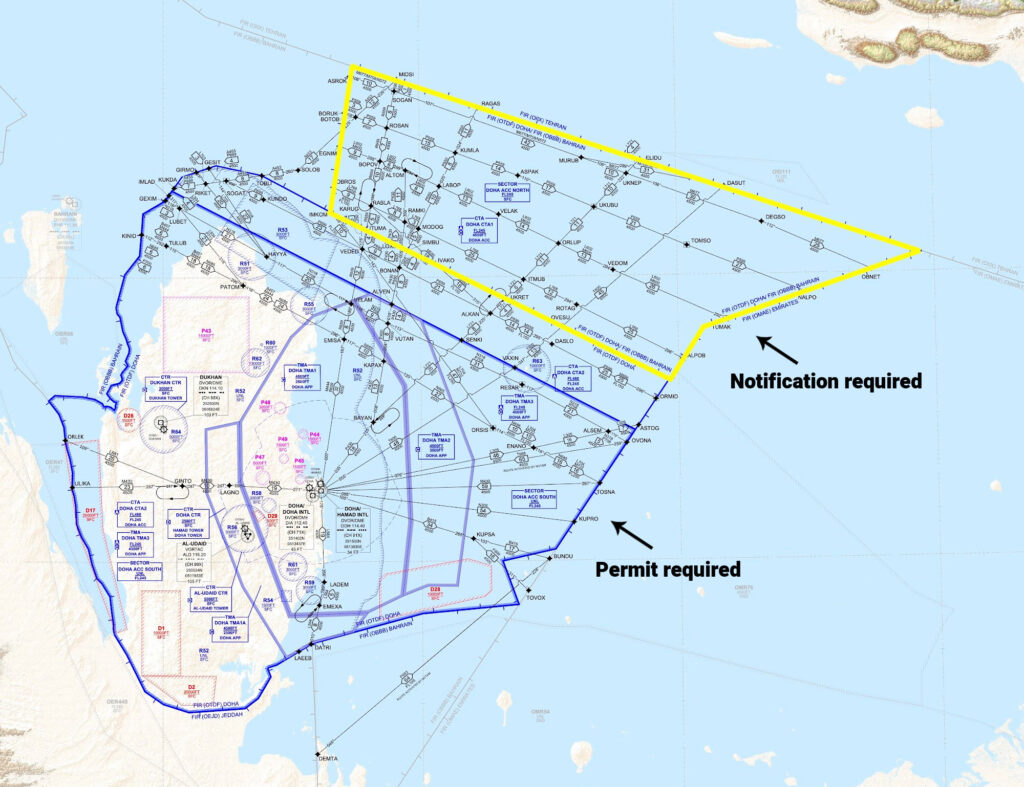
The rule applies specifically to these routes:

  • M677/M708 (ASROK/OBNET)
  • P559/L704 (BORUK/NALPO)
  • L602/T557/M600 (TUMAK/EGNIM)
  • L768/M556 (ALPOB/OBROS)

These are the offshore routes running north of Qatar, in international waters.
Why the new rule?

First, a quick refresher on who controls what inside the Doha FIR:

  • The southern part of the OTDF/Doha FIR: Qatar controls everything, from SFC-UNL.
  • The northern part of the OTDF/Doha FIR: This part covers international waters, not Qatari territory. Operationally, ATC responsibility here still switches at FL245 — Qatar handles traffic below this level, and Bahrain handles traffic above it.

The rule is simple

  • Flying in the southern part of the OTDF/Doha FIR: Standard overflight permit required — no changes.
  • Flying in the northern part of the OTDF/Doha FIR: Submit a flight notification via the QCAA portal.

This flight notification isn’t a permit and doesn’t need approval, it simply lets Qatar know who’s flying there in case you dip into their controlled airspace unexpectedly.

Notifications are submitted through the same QCAA portal used for permits. Bahrain continues to provide ATC in the northern area, and you don’t need a Bahrain permit unless you’re a weird non-ICAO, military, or state flight.
Ops Planning for the World Cup 2022

Here’s some info on Qatar to help prepare if you’re planning on heading there during the World Cup 2022.

UPDATE: Bombardier are trying to negotiate support for Challengers and Globals / QAS just put their prices up

The dates to know about.

The World Cup takes place from November 20 to December 18. So anytime during those dates (and probably a few days either end) it is going to be just a little bit busier.

Get parking requests, handling requests, and permit requests in early!

Before we get into it, I’m going to share THIS LINK because it takes you through to the full slot coordination page which has a lot of info on to you might need. Not just on slots, but on regulations, handling stuff, and all that jazz.

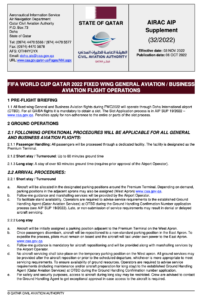
There is also a new AIP SUP 32/2022 effective Nov 3 which contains , and if you still ain’t sure then daily CDM conferences take place at 0800 UTC, with an ATFM Daily Plan published at 1000 UTC.

The airports to know about.

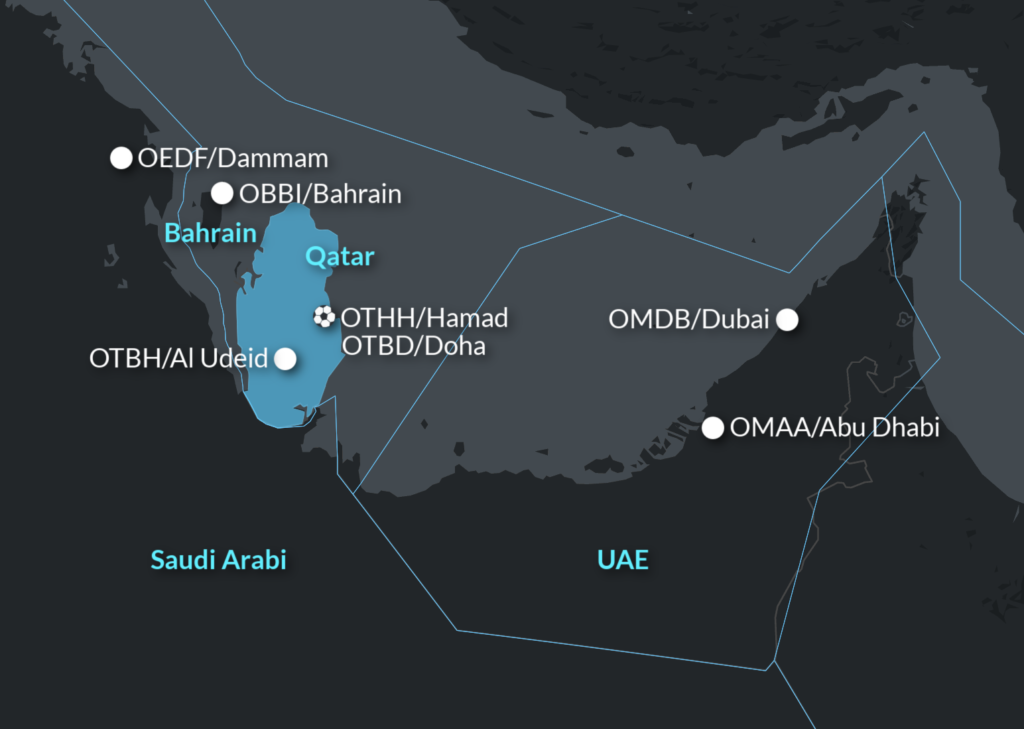
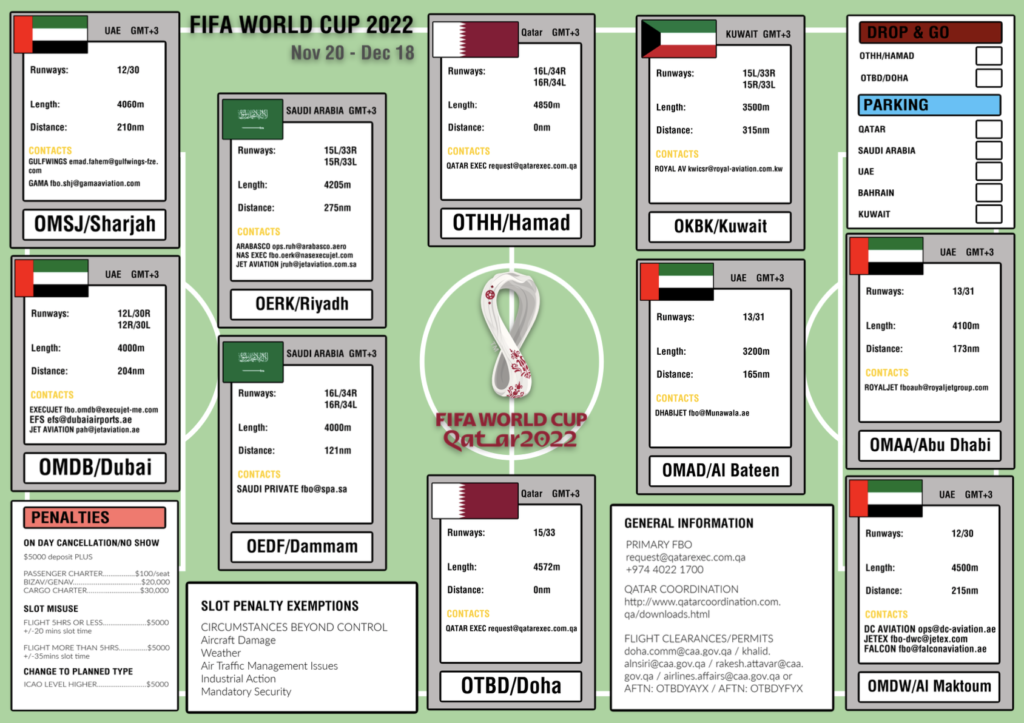
You have two choices if you want to actually fly to the World Cup – OTHH/Doha International (actually called Hamad) or OTBD/Doha International (actually called Doha).

You should probably also be aware of OTBH/Al Udeid Airbase because it is fairly close to the Double Dohas, has two big runways and has been known to confuse some people.

OTHH/Hamad is the main international airport in Qatar.

You will find:

  • 2 giant runways (4250m and 4850m)
  • All the runways are CAT II/III
  • RFF 10

If you want to head in here, then bear in mind this is the main international airport for the country and it is already busy with scheduled airline traffic.

You can find info on the general fees for operating here in the AIM. 

The official FBO is Qatar Executive reachable at request@qatarexec.com.qa or +974 4022 1700

All their rates and fees are available here. There may be different charges for operating during the World Cup though so get in touch with them soon!

We discovered this updated fee list from QAS. It has jumped up just a little during the World Cup period so don’t rely on old fees…

OTBD/Doha is the older international airport and was pretty much decommissioned for a while there. It looks like it will be used for charter and private stuff, and some airline overflow traffic. 

You have:

  • One runway – RWY 15/33
  • 4570m / 14,993’
  • CAT I ILS 15 / CAT II/III ILS 33
  • RFF 9

A quick bit on Slots, because they are quite a big deal.

Slots are already filling up fast. And they are mandatory. And there is an official process for requesting them which you can read about here.

If you haven’t already organised it then get on this fast. I can’t stress that enough. Do it now!

There are a few things to know:

  • You will need to pay a 5000USD deposit
  • The deposit will be deducted from airport charges
  • There will be hefty penalties applied for:
    • No shows or Go shows
    • Misuse (seriously late aircraft)
    • Using a different aircraft type to the one mentioned in the slot request
    • Cancelling on the day

There are exceptions to the penalties. Basically for anything outside the operator’s control:

  • If your airplane gets damaged (presumably not through your own fault)
  • If the weather is particularly adverse
  • Delays due to issues with Air Traffic management
  • Industrial action
  • Security related stuff (of the mandatory sort)

What sort of penalties are you looking at?

  • If you cancel on the day or don’t show up then on top of losing the slot booking deposit, you can expect the following penalties:
    • 100USD per seat (per flight) if you’re a passenger charter flight
    • 20,000USD if you’re a GA/BA flight
    • 30,000USD if you’re a charter cargo flight
  • If you just ‘misuse’ your slot then they’ll fine you the following:
    • 5,000 USD for arrivals more than 20 minutes outside the approved slot time, for flights 5 hours or less
    • 5,000USD for arrivals outside 35 minutes of the slot, for flights longer than 5 hours
  • Finally, if you take a different type in then expect a 5,000USD fine for each higher ICAO category than the one approved.

We got all this info from here – the official local slot rule spot.

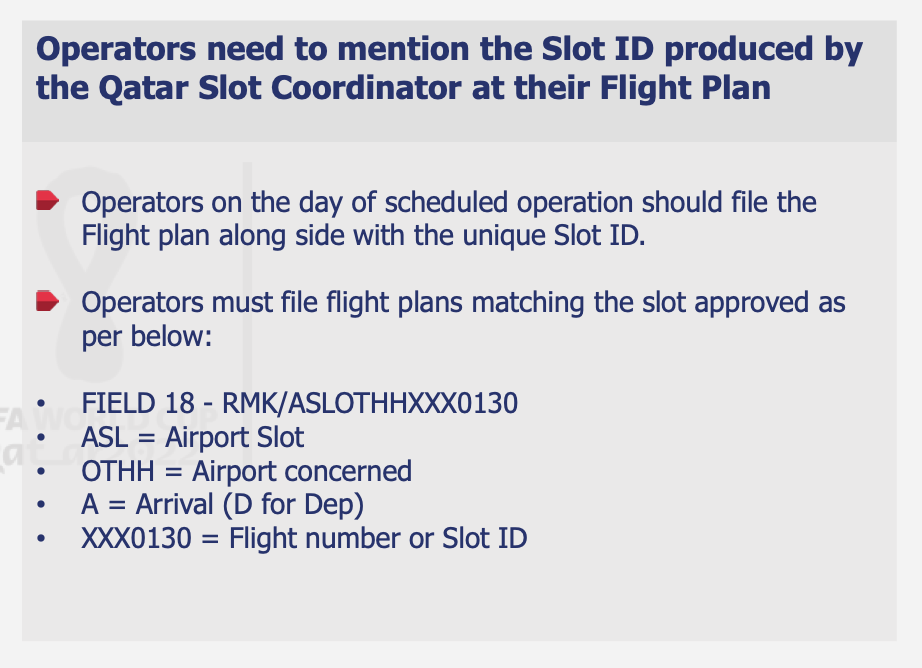
If you sort it all out, get your slot, and plan to use it properly, then on the day, you’ll need to do this:

If you don’t want to stick around in Qatar…

There are some handy and fairly close other places which you might want to consider using instead (if you can’t get parking in Doha). These are probably what you’ll file as your alternates for Doha anyway, given the size and airport numbers in Qatar (2).

Next to Qatar you have Bahrain and OBBI/Bahrain International. A very good alternate, although we are currently checking whether flights direct between the two countries are possible.

Just past Bahrain you have Saudi Arabia, and OEDF/Dammam International. This is a good alternate, although not as good as OBBI. A little bit further into Saudi and you have OERK/Riyadh.

On the other side of Qatar you have some water and then the UAE with OMAA/Abu Dhabi, OMDB/Dubai, OMDW/Another Dubai are all good alternates. We also heard that OMSJ/Sharjah FBO Gama Aviation is offering 7 days free parking there.

Head north and you’ll find OKBK/Kuwait. Also a good alternate. I forgot to put it on the map, it is up there just outside the edge of the picture though.

Some things to know about the country.

You need permits for both landings and overflights. To get all your flight clearances stuff,  try these folk at the Civil Aviation Authority Qatar: doha.comm@caa.gov.qa / khalid.alnsiri@caa.gov.qa / rakesh.attavar@caa.gov.qa / airlines.affairs@caa.gov.qa or AFTN: OTBDYAYX / AFTN: OTBDYFYX

Their AIP is available online, for free, if you need it. You can find it here.

They have a new airspace. Yes indeed. Read about that here.

You really, really can’t take alcohol into Qatar. Or a lot of medication (anything containing Codeine will get you into trouble. Anything else, just carry a prescription for it).

Because Qatar is fairly small and hotel rooms fairly limited, most are requiring tickets to the game so you might have trouble finding space for your crew if they’re overnighting.

It will be mandatory to have a maintenance agreement in place with your ground handling agent if you are operating into Qatar, or else you’ll have to carry your own engineer/maintenance person with you onboard – even for a drop and go.

  • Bombardier are negotiating with Qatar Executive for them to provide support for the Challenger and Global series of aircraft. It’s not been finalised yet, but hopefully will all be in place before things ‘kick off’ (if you’ll pardon the pun).

Some Covid stuff.

As of at the moment, Air Crew can enter Qatar for 96 hours. To do this, you need a vaccination certificate and a PCR taken in Qatar within 72 hours of your arrival. Unvaccinated crew will not be allowed in.

A quick definition.

Football = Soccer (if you’re American).


The Doha FIR: Qatar is finally getting its own airspace

For such a small place, Qatar has some big history. It is in the news (and in aviation news) a fair old amount over the past few years.

And now another newsworthy event is occurring, because it is finally 

getting

its 

own 

airspace!

We feel like we should send a house (well, airspace) warming gift? Send us ideas. Or maybe just go and use the airspace.

What’s the story?

We posted this back in 2021 when the news first hit the headlines that Qatar was looking to get its own airspace.

In short, (in case you can’t be bothered to click the link and read it), with the exception of the OTHH/Doha terminal area, all the airspace was controlled by Bahrain. Which was never a problem until Qatar had a fairly large ‘diplomatic dispute’ with many of their neighbours, and it reignited the campaign to get their own airspace.

They pushed the idea, there was some feedback, it wasn’t good, so they put in a new proposal fixing the issues, and it was approved.

Now it is actually happening!

The OTDF/Doha FIR will be established, effective from 8th September 2022.

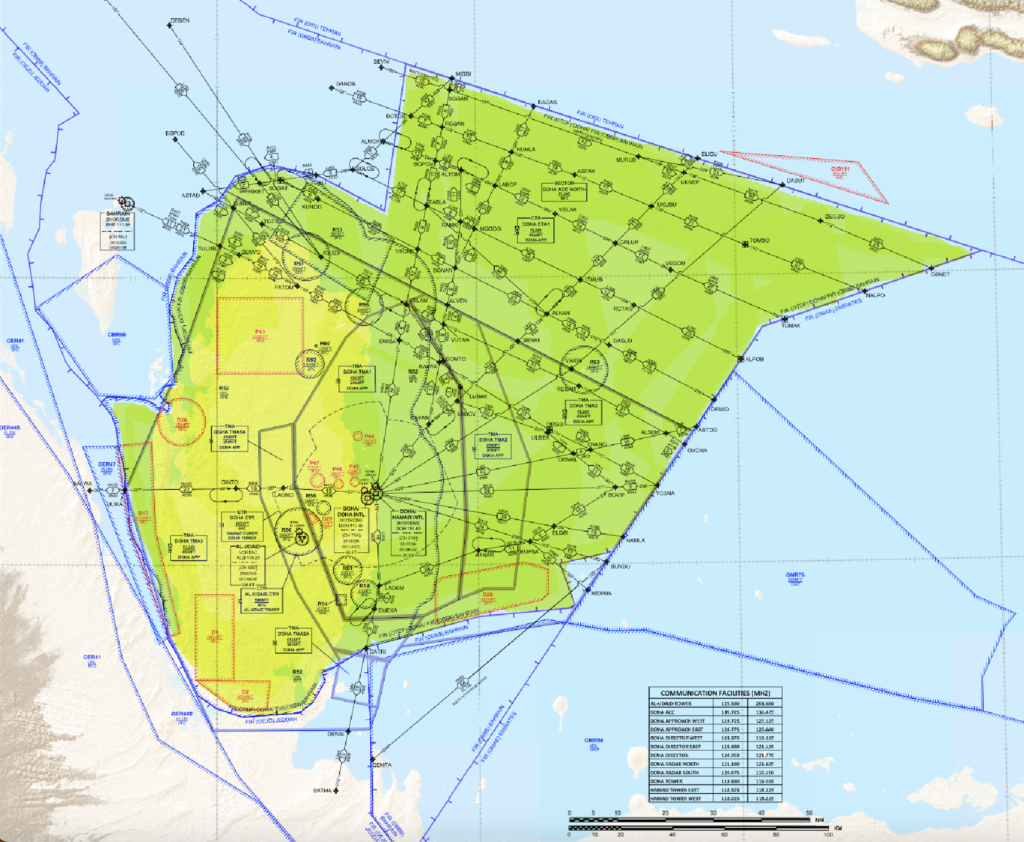
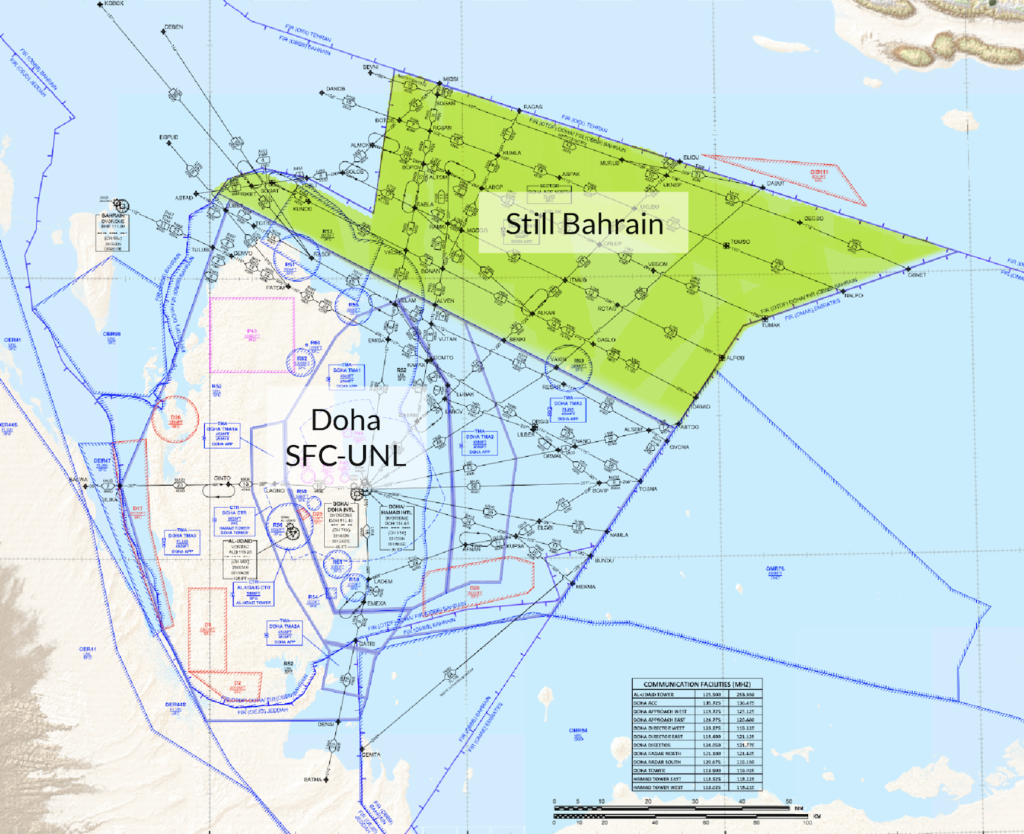
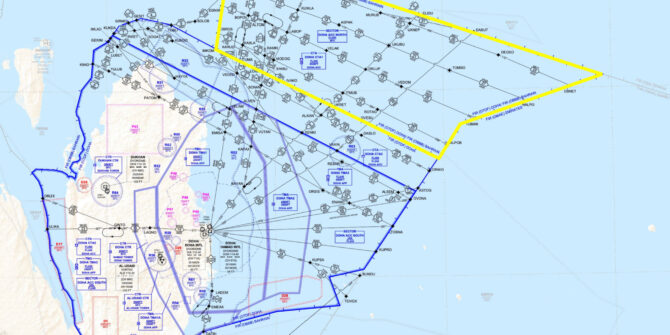
Here is a map of what the lateral boundaries look like.

If you click here, you’ll be transported to a lovely high res PDF fresh from the AIM (and minus the badly done highlighting) so you can see it all much more clearly.

The vertical boundaries will be surface level to FL245, which means flights above FL245 will still be in the Bahrain FIR and under their control. So if you’re overflying, you probably aren’t going to notice much during Phase 1.

You can access all the info on this in the Qatar AIP, available here.

So that’s it?

No, that’s not it, because there are several phases.

Phase 2 is when Doha Control grabs control of all the airspace above the State of Qatar and their waters. This means surface level to somewhere unlimited above them. 

Bahrain will still be responsible for controlling the international waters bits nearby, but only up to FL245. Now you might notice the difference if you’re overflying, but not much – just some new frequencies to talk to.

This will come in from 23rd March 2023.

Finally…

Sometime after the end of 2024, Doha will become the ‘responsible authority’ for the entire FIR, surface level to unlimited, including over the international waters.

What is important to know?

Communications:

Well, initially there won’t be much change at all if you’re only overflying. 

Obviously, if you descend down into Doha then you are going to be speaking to someone not in Bahrain, but you would have been anyway once you entered the OTHH/Doha terminal area. Now it will just be a little earlier.

There have never been issues with the handover between Bahrain and Doha.

Flightplannng:

OTHHZPZX is the current general flight plan one.

All flight plans and departures messages for flights planning on operating through or within the Doha FIR must include addresses OTDFZQZX

If you’re going to overfly on the A453, L602, L768, M600, M677, P559, P699, T308, T872, Y856 ATS Routes (via North of Qatar) then make sure you use OTBDYWYX in the message address.

In the absence of AFS, you can email: doha.comm@caa.gov.qa or fax at (974) 4462 1052 / (974) 4470 5075. An acknowledgement of receipt must be obtained via tel (974) 4470 5080 / (974) 4470 5081.

ATC (in general):

Controllers in the Doha TMA were always well trained and a good standard. There is no reason to suspect the new controllers responsible for the FIR won’t also be.

Procedures are unlikely to have changed, it will now just be a Dohasian rather than a Bahrainian controller calling the shots.

(No, Dohasian isn’t a real name, I made it up).

Weather:

Weather avoidance might require you to talk to both Doha and Bahrain if you’ll be crossing the temporary boundary (into the international waters area). 

Contingency procedures:

Until the official AIM is published this isn’t confirmed, but the assumption is this will remain the same.

It’s so small, why do we care?

While the airspace is smallish in the schemes of airspace size, it is biggish in terms of importance for the region. Around over thirty percent of traffic in and out of the UAE routes via Bahrain (soon to be Qatari) airspace, Kuwait and then up via Iraq to Europe, avoiding Iranian airspace to the right.

OTHH/Doha and OKBK/Kuwait provide two “final” alternates for en-route diversions for aircraft routing over Iraq, and also for aircraft routing south if UAE airspace closes. They are also close to Saudi airspace and useful alternates if ESCAT procedures prevent aircraft from operating into Saudi Arabia.

Anything else?

Not that we can think of, but you can tell us if you experience anything worthy of reporting once it goes live this September.

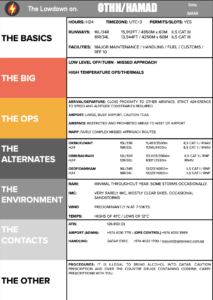
We did make this Airport Lowdown for OTHH/Doha in case you need it.


New Airspace On The Way In the Middle East: The Doha FIR

Plans are underway to establish a new flight information region in a busy air corridor over the Middle East.

Since 2018, Qatar has been campaigning to control its own airspace by establishing the Doha FIR  – a process that would involve cutting the existing OBBB/Bahrain FIR in half.

For the first time, an improving political environment has led ICAO to give Qatar the go-ahead, as long as it can work directly with Bahrain to sort out all of the technical side of things. When established, over thirty percent of traffic in and out of the UAE will pass through the new airspace and so it is worth taking a closer look.

A little background.

With the exception of terminal airspace at OTHH/Doha, Qatar’s air traffic is controlled by Bahrain in a long standing agreement. Qatar first proposed to assume control over its own airspace three years back – a suggestion that was opposed by several countries including the UAE, Saudi Arabia and Bahrain.

Why?

Primarily because it came at a politically sensitive time.

Just the year before a diplomatic crisis led to Saudi Arabia, the UAE, Bahrain and Egypt (among others) cutting ties with Qatar. From an aviation perspective, a blockade was formed which prevented Qatari registered aircraft from using their airspace and vice versa. From an operational perspective there was likely little regional appetite to release a large chunk of Middle Eastern airspace into a political road block.

Thus criticisms were quickly tabled. The primary feedback was this:

  • Qatar hadn’t provided operational justification for the change.
  • An additional ANSP in this busy piece of airspace would make co-ordination more complicated.
  • Safety may be compromised, while cost would go up for operators.
  • Bahraini air traffic control had done a great job of safe and efficient flow of traffic for decades, why change?
  • Capacity would tank.

Qatar on the other hand argued that the proposal would improve safety while providing some economic award for the industry too.

Then things changed.

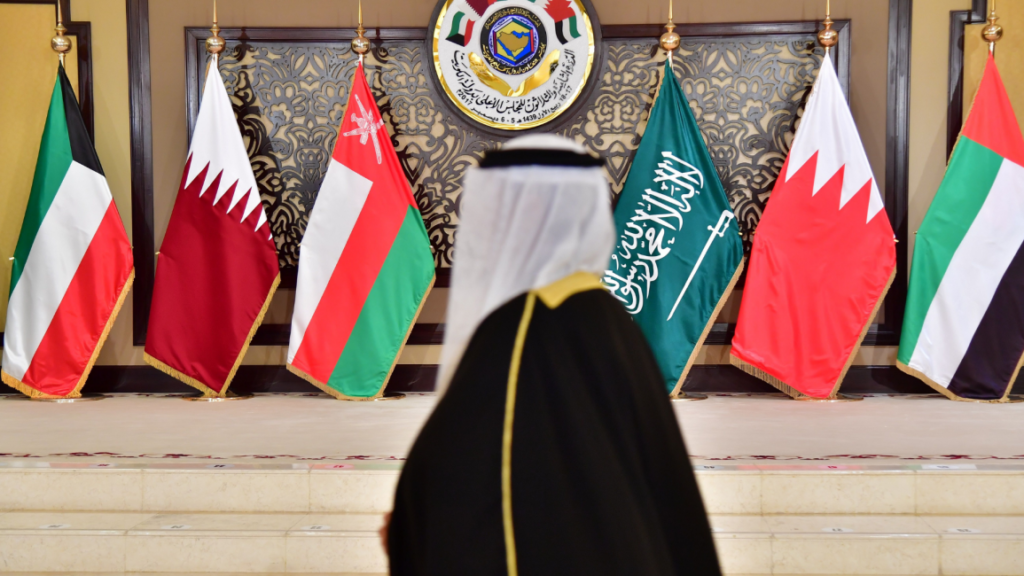
Earlier this year while the world continued to revel in the ‘delights’ of a certain pandemic, the political situation for aviation in the Middle East changed for the better. Following a successful GCC summit, the blockade was lifted. Meaning all parties could once again use each other’s airspace. Tensions subsided and it was good news for fuel burns and flight times.

Enter the Chicago Convention.

The what? Spoiler alert: It has nothing to do with the Cubs. It’s basically the landmark agreement among all ICAO member states that establishes the core principles for international ops. It’s a big deal. Buried within its many hallowed pages is this: each state has ‘complete and exclusive sovereignty over the airspace above its territory’. And ICAO have agreed that in this case, the principle applies.

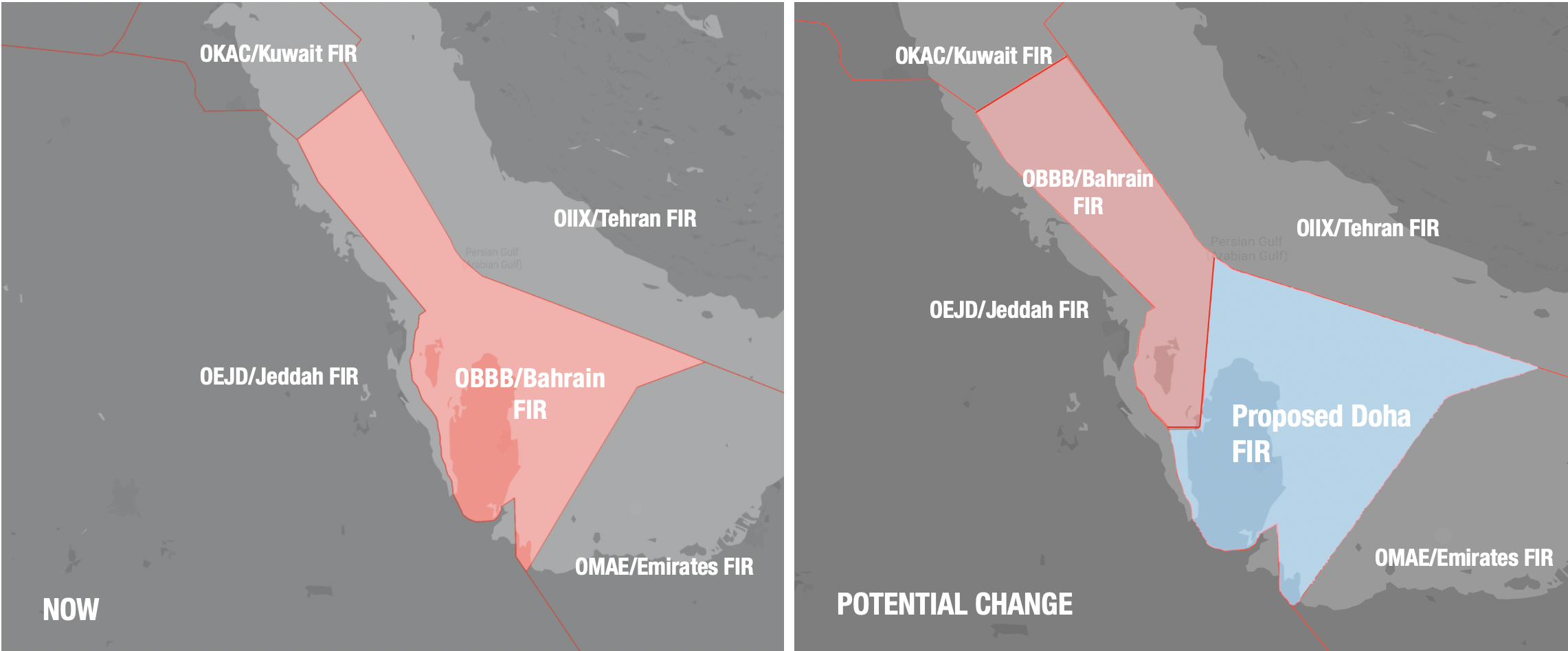
So what is the proposed airspace going to look like?

 Pictures are always better than words. So here are some pictures:

Why do ICAO only agree ‘provisionally’?

Because quite a bit of work needs to happen behind the scenes to make the proposal a reality.

Essentially Qatar has to do two things:

  1. Prove that safe and efficient systems and infrastructure are in place in their airspace to be.
  2. They need to work directly with Bahrain to report back on all of the technical arrangements that will make the proposal real. It is not the easiest task for either side given diplomatic histories but in promising signs for the region, work is under way.

What happens now?

Qatar and Bahrain are due to report back to ICAO later this year, likely November or December. How long after that meeting the changes may be implemented is still up in the air (bad pun not intended).

But keep an eye out for updates on the change which appears to now be well on its way to altering the skies over the Middle East.