Russia restricts flights over Crimea and Black Sea

The airspace warnings for the Ukraine are on the rise again, and for good reason – Russia seem to be going on a renewed military offensive, focusing their efforts on the area of disputed airspace over Crimea.

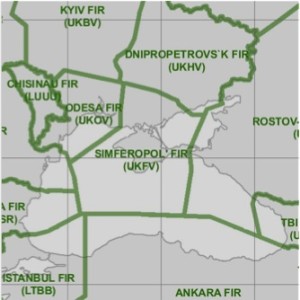
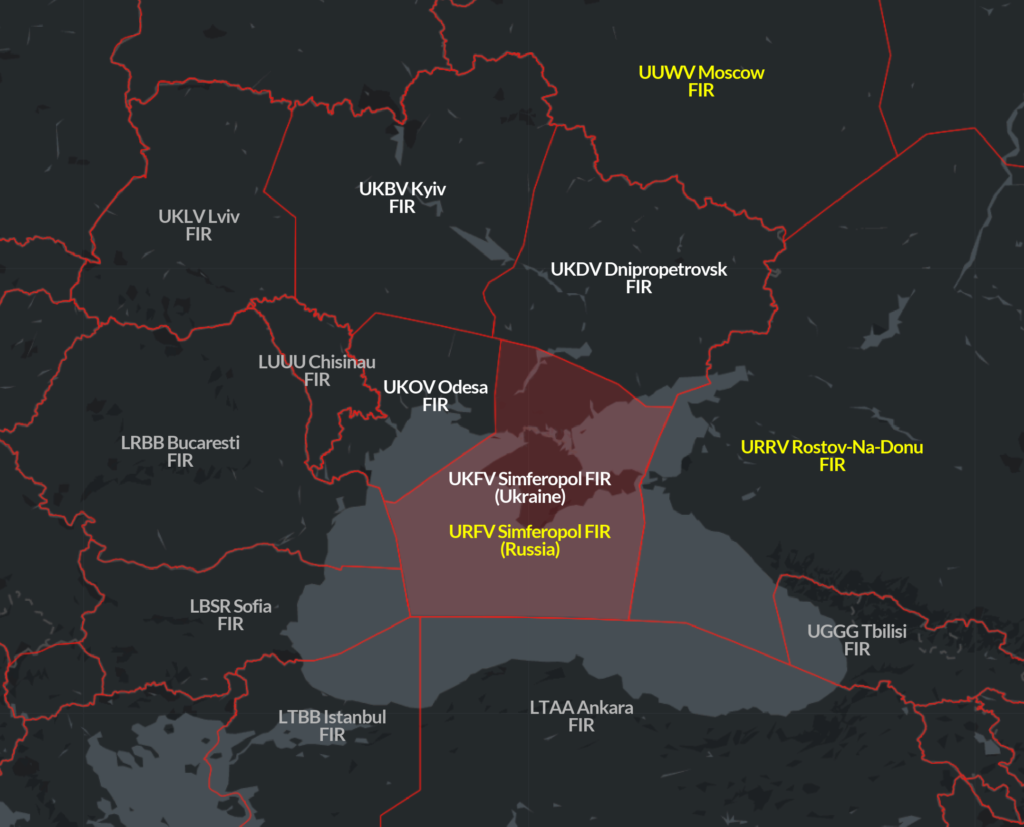
Following Russia’s annexation of Crimea in March 2014, the ATC Center in Simferopol has been run by Russia. Russia claims the airspace, and publishes Notams under the URFV code they invented for it. Ukraine refuses to recognise the change, and still controls the airspace under the internationally-recognised UKFV code.

So what jurisdiction do Russia have, and how much attention should we be paying to the Notams which they issue for an area of airspace that is not theirs to control?

What are Russia saying?

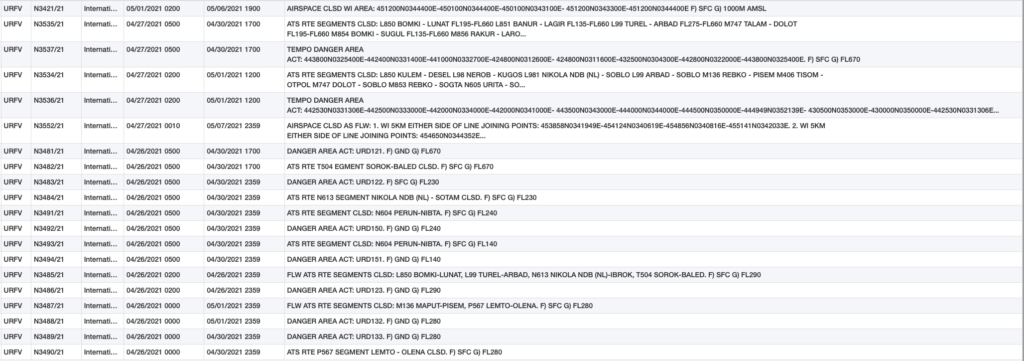
Russia have published a long series of URFV Notams advising of danger areas and limitations to airways across the Simferopol FIR. These run from April 20-30 – some only apply from FL350 upwards; others apply to all flights from SFC right up to altitudes higher than most aircraft can fly (we saw a FL670 thrown in there). These danger areas are most likely due to military activity, which may include live firing exercises.

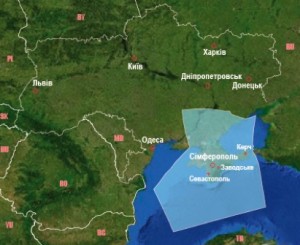
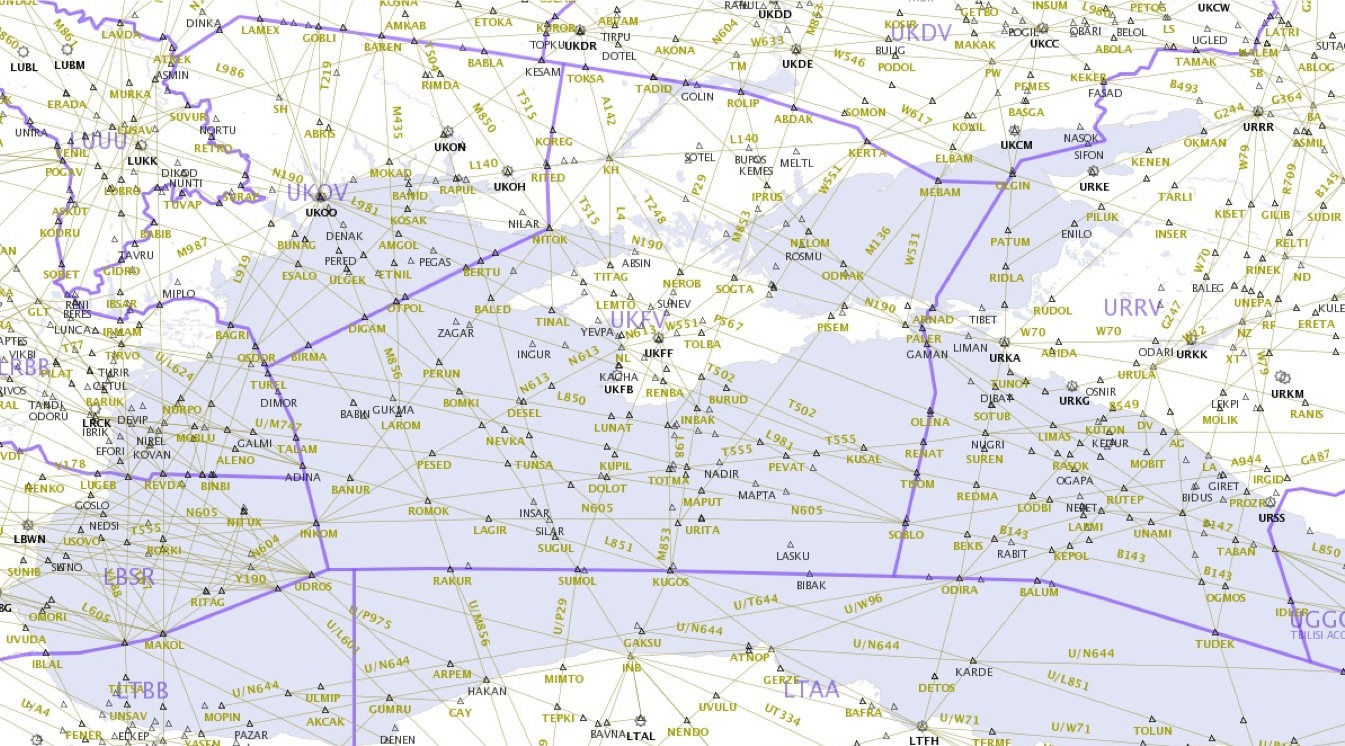
The zone of restriction of flights includes some areas over the southern part of Crimea, from Sevastopol to Feodosia, the territorial waters adjacent to the Southern coast of Crimea, and part of the international waters of the Black Sea, and are possibly in relation to Russia’s plan to move warships into the area.

A long list of Notams from Russia

What are Ukraine saying?

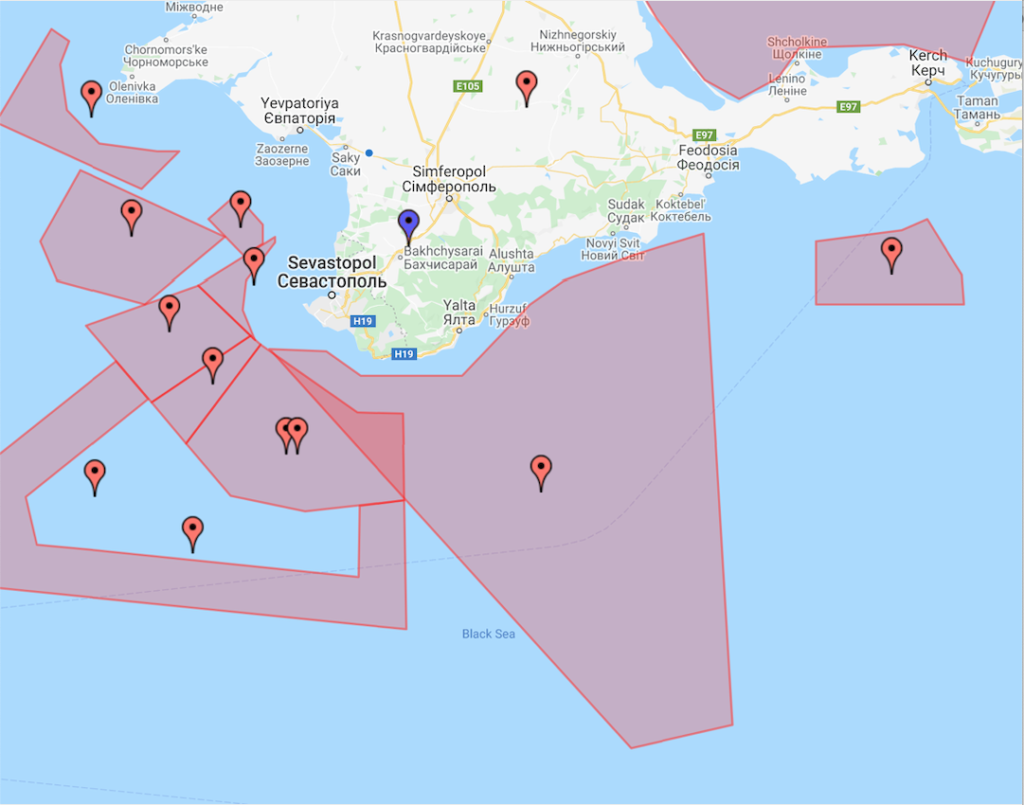
Ukraine aren’t happy about it, and have issued a bunch of Notams for the same periods effectively establishing danger areas at all levels in the portions of the FIR that are over water – i.e big chunks of the Black Sea and Sea of Azov (to the northeast of Crimea).

All the Ukrainian UKFV Notams advising about these danger areas carry this note:

DUE ACTIVITY PUBLISHED BY RUSSIAN FEDERATION.
THE PUBLICATION BY RUSSIAN FEDERATION OF INFORMATION 
RELATED TO AIRSPACE UNDER RESPONSIBILITY OF UKRAINE 
DOES NOT COMPLY WITH THE PROVISIONS OF THE ICAO 
AIR NAVIGATION PLAN - EUROPEAN REGION (DOC 7754) 
AND THE ICAO ANNEXES 11 AND 15.

In other words – although Russia do not have jurisdiction in this airspace, they have published a bunch of danger areas here, so we (Ukraine) had better do the same, to make the warning “official”.

A quick plot of the danger areas published by Ukraine under the UKFV code looks something like this

What are other authorities saying?

So far, none of the other state authorities around the world have published or updated their own warnings in response to this recent issue specific to the airspace over Crimea.

Just last week, the US FAA updated their airspace warning for Ukraine – but this was in relation to the UKDV/Dnipropetrovsk FIR in the east of the country along the border with Russia. The US warning to operators in this region was to exercise extreme caution within 100nm of the entire Russia-Ukraine border, due to risks associated with recent increased tensions between the two countries. They said that if hostilities escalate here, the airspace on both sides could be exposed to potential weapons activity posing a risk to civil aircraft from misidentification or miscalculation.

The most recent US advice for the UKFV/Simferopol FIR came in October 2020, when they actually removed their restrictions on overflights of this airspace. At that time, they said the security situation had sufficiently improved here – while Russia continued to assert territorial claims over the region, Ukraine had established appropriate risk management measures to ensure safe operations for aircraft along the Black Sea routes.

Several other states have existing warnings in place for Ukraine. Canada advise operators to avoid the UKFV/Simferopol and UKDV/Dnipropetrovsk FIRs entirely, whereas the UK and France say that overflights of eastern Ukraine should only be planned on airways over the Black Sea to the south of Crimea.

For more details on Ukraine and other airspace warnings, head to SafeAirspace.net

What are we saying?

Two major points –

  1. Russia do not have jurisdiction over the Simferopol airspace, so the Notams to follow are those published by Ukraine under the UKFV code.
  2. Regardless of what is out there, clearly extreme caution in this area is required. Russia are making all the moves to increase their military presence and potentially reignite the ongoing conflict.


Monday Briefing: Confusion over Crimea, Kosovo Upper Airspace reopens

Confusion over Crimea: Special Report Apr 3 : Simferopol ACC re-opened 03APR creating confusion as to who should be providing ATC service in the Crimea region. We have published a Special 6 page International Ops Notice (03/2014) “2014 Airspace and Regulatory Changes in Crimea”.

Kosovo Upper Airspace re-opens Apr 3 : After 15 years, the last remaining chunk of European airspace closed to overflying traffic in the Balkans has reopened. The KFOR sector over Kosovo became available on 03APR, with route savings immediately apparent to operators.

Kxxx/USA Operators should be aware of the new FAA ATC phraseologies effective 03APR. The FAA will implement “climb via” phraseology and procedures for departure operations consistent with existing “descend via” phraseology and procedures. “Climb via” and “descend via” are abbreviated ATC clearances that require compliance with the procedure’s lateral path, associated speed restrictions, and altitude restrictions published on the SID or STAR. Some good information at http://www.nbaa.org/ops/cns/pbn/climb-via/

LLOV/Ovda, Israel will be closed to all flights 01MAY-07MAY

DGAA/Accra, Ghana Until 23JUN, The main runway (03/21) is open daily from 0500-2300Z only; no traffic accepted outside these hours.

LFMN/Nice Change in parking procedure; if approval is granted for parking, but operator changes to another, larger aircraft, then the previous approval will be cancelled. Co-ordinate all aircraft changes with Airport Ops.

YPXM/Christmas Island has reopened after the recent Cyclone in the Indian Ocean.

OSDI/Damascus FIR – For those still overflying, Syria has closed airway L513 from BURSA to LEBOR UFN.

HSSM /Malakal, South Sudan is only accessible with permission from the government security services. This is very difficult to obtain and makes the airport effectively shut.

HSWW /Wau, South Sudan is open without any specific additional permission being required.

MGGT/Guatemala City ChevronTexaco, for any fueling on the east and military ramps from 0900-1600 LT, requires a minimum of 24 hours’ notice.

HLLS/Sebha, Libya remains closed until 07APR.

CAA Closures. Myanamar has an extended closure due to public holidays from 12-21APR. The Chinese CAA are celebrating National Tomb-Sweeping Day on 07APR.

UK Charter Permits. Significant changes to the approval process for Landing Permits for the UK will take effect on 06 APR. CAA will take over the responsibility for issuing approvals from the Department for Transport (DFT). Also, previously, a cabotage objection could be raised by a group of UK Charter Operators – this is removed. A fee is likely to be charged by the CAA for permits from this point forward.

Turkey. Effective 10APR2014 Visa on Arrival is no longer available at Turkish Airports. Visitors must apply online through https://www.evisa.gov.tr/en/ for an e-Visa.

Australia. A reminder to all operators who are not ADS-B equipped, of the restrictions when operating into Australian Airspace effective from 15DEC13. If you not ADS-B equipped you must file with CASA, a Form 208 exemption application 14 days in advance of proposed operations into Australian Airspace. Then operations will be confined to the SSR radar coverage area extending from 200 nm north of Cairns down the East coast to 200 nm west of Adelaide. This is commonly referred to as the J curve. If you intend operating into the Brisbane or Melbourne FIRs from the west and north west of Australia, and are not ADB-B equipped you will be required to operate at FL290 or below.


Special Report: Crimea and Simferopol FIR

Crimea & Simferopol FIR
Following the recent events in Ukraine and Crimea, we received a high volume of requests for information on the airspace and current situation. The information below is a majority extract from our International Ops Notice 03/14 published on 05APR.

SUMMARY

Effective April 2014 a significant number of changes will affect Airports and Airspace in the Crimean Peninsula.

BACKGROUND – What happened?

Following the removal of Ukrainian President Viktor Yanukovych on 21 February, Russia moved to take control of Crimea, an autonomous republic that until now has been part of Ukraine. While the referendum that ceded authority is disputed internationally, Crimea is now under de facto control of Russia, creating a political standoff with Europe and the US that has led to a complicated airspace situation.

AIRSPACE AND AIRPORTS INVOLVED

  • Simferopol FIR A large and significant FIR covering busy Black Sea routes, with a predominant east/west flow, with ATC service provided from Simferopol Airport.
  • Simferopol Airport A large airport in the centre of Crimea with International and Domestic Air Service, with TWR/APP
  • Sevastopol Airport A smaller civil, domestic airport beside the town of Sevastopol in the southwest of Crimea, with TWR.
  • Zavodskoe Airport Another smaller domestic airport beside Simferopol, with an AFIS Unit.
  • Kerch Airport Used only by general aviation, currently bankrupt.

Some History – MARCH DEVELOPMENTS

  • 13 March Russian troops took control of the Towers, Airports, and ATC Centre. Simferopol and Sevastopol closed to civil traffic. ATC Service from Simferopol was terminated.
  • 14 March ATC Service for the Simferopol FIR is now provided by other ATC Centres in Ukraine. Odesa took control of the western portion (Sectors 3,4,5) and Dnipropetrovsk the eastern portion (Sectors 1,2)
  • 16 March Referendum held in Crimea, result determines wish to join Russia.

Current Status – CHANGES SINCE RUSSIAN CONTROL OF CRIMEA

  • 24 March Rouble adopted as official currency of Crimea
  • 24 March Russian Passports issued to existing population. Russian Visa required to enter for non-Ukrainians/Crimeans
  • 31 March Clocks move forward 2 hours, Crimea is now on Moscow time
  • 03 April Simferopol ACC re-opens, providing ATC Service in the Simferopol FIR
  • 03 April Permit now required to enter Airspace over Crimea, according to NOTAM from Russia


Simferopol ACC

The Simferopol FIR is normally controlled from an Area Control Centre located at Simferopol Airport. It was closed on 13 March (picture taken same day) when Russia took control of facilities in the peninsula, and service for the FIR was provided using remote radar data by Ukrainian controllers from Odesa and Dnipropetrovsk.

At 10am on 3 April Simferopol ACC was reopened, managed by a new service provider called “Krymaeronavigatsiya”. The controllers in the centre are mostly the same controllers that operated Simferopol ACC for the Ukrainian National Authority.

To reactivate control of the airspace from Simferopol, Russia issued several NOTAMs on 28 March which were subsequently disputed by Ukraine and Eurocontrol. This has led to an unsafe situation leading to an ICAO letter and recommendation to avoid the Simferopol FIR until the situation is resolved.

NEW ICAO CODES

URFB Sevastopol Belbek (was UKFB)
URFF Simferopol (was UKFF)
URFV Simferopol FIR/ACC (was URFV)

* Issued by Russia, not (yet) recognised outside Russia.

Aircraft Reports

Since the re-opening of Simferopol ACC on 03 APR, Eurocontrol has rejected FPL’s containing routings through the Simferopol FIR with the exception of the L851 airway which runs along the southern part of the FIR.

Traffic operating through the Simferopol FIR on Friday 04APR reported issues with “Joint Authority”:

B747 enroute Europe-ME:
Instruction from Bucharest ACC to contact Odessa on 134.675
On initial contact with them, they advised us to comply only to their instructions!
Then Simferopol ACC calls on 121.5 and advised to switch on 120.4.
Also they advised us to comply only to their instructions!
Both performed radio check to see if the aircraft is still on frequencies Both provide instructions (position report), fortunately the same
.”

CL601 enroute LOWW/Vienna-URKK/Krasnodar
We were passed onto Odessa Radar and checked in with them. We were then told to maintain our altitude and also warned NOT to get in contact with Simferopol as it is not a legal ATC station.
We were also given another frequency in case we lost comms with Odessa.
We were contacted on 121.5, the emergency frequency by Simferopol advising us to contact them on their frequency numerous times. We decided as a crew to stay with Odessa. We were then passed onto Rostov control and continued the flight with no incident.


ANALYSIS

At present, there is effectively a stand off between Russia and Ukraine over recognititon of who is the rightful Authority to manage the airspace over Crimea. Russia has determined that it is Simferopol ACC, and is providing full service for the airspace from the existing ATC Centre. Ukraine, through Eurocontrol, determined that it should continue to provide service from remote sites, and therefore asserts its authority over the airspace.

The result, is that two Authorities are both stating claim over what has become Disputed Airspace, in a very similar situation to that in Northern Cyprus. So, who is right? There is no correct answer. The political situation is complex at present, and it difficult to determine what the future will bring.

Purely on a practical analysis however, it can be said with relative certainty, that Crimea will remain under Russian control, and it is likely to be a matter of time before Russian managed operation of Simferopol ACC is accepted internationally, either on a safety case or a relaxing of political stance.
Until such time, operation within the Simferopol FIR is operationally possible but carries with it the risks associated with Disputed Airspace.

Questions and Answers

What’s happening?
Russia has claimed territorial control over Crimea, leading to the reopening of Simferopol ACC after a three week closure, and the same claim over airspace. Ukraine, under a new government, has defied the move, issuing its own NOTAMs to declare Russia’s move invalid.

Can we enter the Simferopol FIR?
In short, Yes. The airspace is not closed. However, it’s probably not a good idea, if you can avoid it. Two countries have claimed authority over the running of ATC – Russia and Ukraine, and there is no clear winner. For some operators there will be no choice but to enter, so see below for advice.

Can I file a flight plan to enter the Simferopol FIR?
Yes, if you’re outside Europe. However, any FPL filed within the IFPS Region (ie. Eurocontrol) will be rejected if it contains a routing through the Simferopol FIR.

What if we decide to enter the airspace? Are there any sanctions or restrictions?
No, there aren’t any legal or diplomatic sanctions preventing this, only Flight Planning restrictions from Eurocontrol. On the first day that Simferopol ACC was open, 145 flights were handled through the FIR, primarily non-European operators. If you do enter, we recommend:
•    Two VHF sets – one on Simferopol frequency, one on Odesa or Dnipropetrovsk frequency
•    Contact and remain in contact with both controllers, as long as possible
•    Fly standard levels, do not request a level change
•    Monitor TCAS
•    Consider any instruction to change level or routing carefully, and coordinate with both ATC’s.

Is this is the same situation as Ercan (Cyprus) ?
Kind of. Since 1974 there has been Disputed Airspace over the northern part of Cyprus, and two stations vie for control of the airsapce – Ercan and Nicosia. However, there are a couple of important differences. First, ICAO has declared it’s recognition only of Nicosia, this is not the case in Crimea, where ICAO has only said it’s unsafe at present, so avoid. Second, there are clear instructions for crossing that airspace – for Crimea, at present, there are no procedures – again, only an advice to avoid.

Do I need a permit to enter Simferopol FIR?
Not at present, but this could change fast. Officially, Russia has declared the FIR to fall under the same rules as the rest of Russia, which means that a permit should be required to enter the airspace. However, there are two complicating factors.

1. A number of “Non-Sovereign routes” run through the Black Sea that Russia does not require a permit for (as the next sector is Rostov-on-Don airspace), requiring only advance notification to UUUWZDZX. Simferopol FIR would likely follow the same logic, though this has not been published.

URRV FIR (Rostov) Non- Sovereign Routes
GAMAN G277 BANUT
OLENA R230 LAMET A277 BANUT
BANUT A277 LAMET R230 OLENA
BANUT B147 TISOM
SOBLO B143 IDLER

2. The second factor is that the confusion at present is allowing leniency for overflight permits. However, if the situation is resolved with Russia being recognised as the sole controlling Authority, then flights over Crimean landmass will absolutely require a permit to overfly.

What about the Airports in Crimea? Is Simferopol open?
Yes, Simferopol is open to civil traffic, and a permit is required from the Russian Authorities. The process follows the same procedure as in the rest of Russia, with local Crimean approval, and also Federal approval required. Sevastopol is lesser used in any case, but may be available.

Is there any security risk in overflying Crimea?
No. The situation on the ground in Crimea is very stable, and there is no determined risk of any ground-air strikes or anything affecting security of flight.

Is there a safety risk in overflying Crimea, or entering the Simferopol FIR?
At the moment, yes. There is a risk level, although relatively minimal, due to the potential for confusion as to the correct controlling authority. The risk is highest near the airspace boundaries with other Ukrainian sectors. There is likely to also be an increased volume of traffic speaking Russian and therefore reducing situational awareness for international crews overflying.

So, is Simferopol an “Illegal” ATC Station?
No. Their authority is questioned by Europe, but they are fully trained, valid controllers, with ICAO recognised licenses. It’s worth remembering that although Simferopol is currently declared “illegal” by some adjacent sectors, they are the same controllers that were operating that airspace just three weeks ago, and have done so for decades. If you are in there, you should at least be talking to them, not least because they will have control of conflicting westbound Russian traffic that will not be in contact with other sectors.

What happens westbound from Russia?
If you are entering Simferopol FIR from Rostov-na-Donu FIR, you will be transferred in a normal fashion to Simferopol ACC on the usual (historic) frequencies. Once approaching the boundary with Odessa or Dnipro you should make contact at least 10 minutes in advance.

Is there any co-ordination between Simferopol and Odesa, or Dnipropetrvosk ATC ?
We’re uncertain, but we believe flight information is being exchanged in terms of boundary estimates and OLDI interchange. However, verbal communications are not likely cooperative at the moment, given the disputed control of the airspace.

When will this be resolved?
Hard to say, and the question that everyone is asking. The Ukraine NOTAMS are valid until 14APR, but that indicates little. A long term avoidance of the Simferopol FIR is unlikely due to commercial pressure. At a minimum, the airspace south of the landmass, ie. L850 and south, could be expected to be made available in the event of an ongoing standoff.
Map_Block FIR_Block Crimea_Airspace


Monday Briefing: Security in Caracas, Tripoli, UK Permit rules

Security issues rule out Venezuela, Libya Mar 23: SVMI/Caracas, Venezuela, and HLLT/Tripoli, Libya, should be off your tech stop or charter lists for the foreseeable future. Both airports have been subject to rising security risks over the last months, reaching a climax last week with a bomb attack on RWY 09/27 in Tripoli and increased civil unrest in Caracas.

New rules for UK Permits Mar 23 : Significant changes to the approval process for Landing Permits for the UK will take effect on 06 APR. CAA will take over the responsibility for issuing approvals from the Department for Transport (DFT). Also, previously, a cabotage objection could be raised by a group of UK Charter Operators – this is removed. A fee is likely to be charged by the CAA for permits from this point forward.

SVMI/Caracas, Venezuela Public unrest has raised tensions in the capital to the point where several airlines have suspended service, including Air Canada this past week. Coupled with the security issue is a payment issue, with the Venezuelan government not releasing ticket payments. SVMI remains open and operational, but not recommended. For tech stops, consider TNCC/Curacao just to the north.

Uxxx/Crimea Region. Following the referendum on 16MAR, Crimea is now officially Russian Territory. This places the Simferopol FIR under Russian Control, but service is still provided by Ukraine. Simferopol Sectors 3,4 and 5 are now controlled by Odesa, and Sectors 1 and 2 are controlled by Dnipropetrvosk. UKFF/Simferopol and UKFB/Sevastopol are closed to civil traffic. No decision has yet been made by the Russian CAA as to whether permits will be required to overfly Crimea. It seems unlikely that there will be any change to the present ‘no permit required’ situation in the coming weeks at least, though when Simferopol Airport reopens we would anticipate Landing Permits being required through Russia.

VTSP/Phuket – International restrictions due to construction until 31MAR. Slot and PPR require 48HR PN, Landing Permit requests should allow 10 days.

LIxx/Italy ATC Industrial action announced for 30MAR 1030-1430Z. For this and subsequent strikes, ENAC, the Italian provider, will accept a limited number of pre-arranged flights from each AO.

EHAA/Amsterdam FIR Due to Nuclear Summit in the Hague on 24 and 25MAR, most of the FIR is accessible by Prior Permission only, including all flights to EHAM, EHRD, EHEH. Contact nss.ppr@minienm.nl or +31 (0) 577453696.
LLOV/Ovda, Israel will be closed to all flights 01MAY-07MAY

DGAA/Accra, Ghana Until 23JUN, The main runway (03/21) is open daily from 0500-2300Z only; no traffic accepted outside these hours.

YPXM/Christmas Island is closed and unmanned at present due to a Cyclone.

HLLT/Tripoli, Libya was subject to a bomb attack on Friday. The device was placed on the centerline of RWY09/27 overnight and detonated with a timer. Most regular operators cancelled flights immediately, with no set date to resume operations.

OSDI/Damascus FIR – For those still overflying, Syria has closed airway L513 from BURSA to LEBOR UFN.
UK Charter Permits. Significant changes to the approval process for Landing Permits for the UK will take effect on 06 APR. CAA will take over the responsibility for issuing approvals from the Department for Transport (DFT). Also, previously, a cabotage objection could be raised by a group of UK Charter Operators – this is removed. A fee is likely to be charged by the CAA for permits from this point forward.

Turkey. Effective 10APR2014 Visa on Arrival is no longer available at Turkish Airports. Visitors must apply online through https://www.evisa.gov.tr/en/ for an e-Visa.

Australia. A reminder to all operators who are not ADS-B equipped, of the restrictions when operating into Australian Airspace effective from 15DEC13. If you not ADS-B equipped you must file with CASA, a Form 208 exemption application 14 days in advance of proposed operations into Australian Airspace. Then operations will be confined to the SSR radar coverage area extending from 200 nm north of Cairns down the East coast to 200 nm west of Adelaide. This is commonly referred to as the J curve. If you intend operating into the Brisbane or Melbourne FIRs from the west and north west of Australia, and are not ADB-B equipped you will be required to operate at FL290 or below.

URSS/Sochi Starting from 20JAN, including period of XXII Winter Olympic Games and XI Winter Paralympic Games 2014, airlines are obliged to send the passenger manifest with exact Name, Surname, Passport number and series, or other ID, Ticket number, 24 hours prior to departure and no less then 4 hours prior to departure – passenger manifest changes, when operating to Sochi International airport (IATA code-AER). Information should be sent to the following e-mails: Checkin_DIsp@aer.basel.aero, Chief_smena_SAB@aer.basel.aero. See NOTAM A3075, A4018.


Monday Briefing: Simferopol ACC closed, new Kolkatta Oceanic ACC

Simferopol ACC closed – uncertainty in Crimea Mar 18: On 13MAR ATC service over Crimea ceased to be provided by Simferopol ACC, with responsibility shifted to Odesa and Dnipropetrovsk ACC’s. UKFF/Simferopol and UKFB/Sevastopol Airports are closed to civil traffic. It remains to be seen whether the Referendum on 16MAR results in the FIR being controlled by Russia, with ensuing permit requirements.

New Oceanic Area for India Mar 19 : Effective 19MAR a new Oceanic Area Control Centre (OACC) comes into being – Kolkatta Oceanic, partly covering the Kolkata and Chennai FIR’s on the eastern side of India over the Bay of Bengal. The callsign will be “Kolkata Oceanic”. Further details below …

VECF/Kolkata OACC, India A new OACC/Oceanic Control Centre becomes operational on 19MAR known as the Kolkata Oceanic Control Centre. The area is operational from MSL to FL460, CPDLC is primary comms method, HF backup on 10066/6556/3491. See India NOTAM A0211/14.

Uxxx/Crimea Region. With the current situation in Crimea, there have been several changes this week in the provision of ATC in the region. Simferopol Sectors 3,4 and 5 are now controlled by Odesa, and Sectors 1 and 2 are controlled by Dnipropetrvosk. UKFF/Simferopol and UKFB/Sevastopol are closed to civil traffic. It remains to be seen whether the Referendum on 16MAR will result in the airspace being controlled by Russia, with the possibility that a permit will be required as for the rest of the Russian Federation.

LFxx/France has announced industrial action on the 18MAR. Negotiations will continue over the weekend with SNCTA , and the strike situation will be much clearer on Monday.

SACF/ Cordoba ACC, Argentina Radar issues continue, no radar control provided in the South Sector of the FIR.

OAKN/Kandahar – AIrcraft planning through flights using Military Ramp face fuel restrictions due supply issues. Limit of approx 1200USG per aircraft.

VTSP/Phuket – International restrictions due to construction until 31MAR. Slot and PPR require 48HR PN, Landing Permit requests should allow 10 days.

SBKP/Campinas – Airport will be closed between 0330-0730LT on 13-15MAR and 18-22MAR.

OSDI/Damascus FIR – For those still overflying, Syria has closed airway L513 from BURSA to LEBOR UFN.

Turkey. Effective 10APR2014 Visa on Arrival is no longer available at Turkish Airports. Visitors must apply online through https://www.evisa.gov.tr/en/ for an e-Visa.

UK Charter Permits. Significant changes to the approval process for Landing Permits for the UK will take effect on 06 APR. CAA will take over the responsibility for issuing approvals from the Department for Transport (DFT). Also, previously, a cabotage objection could be raised by a group of UK Charter Operators – this is removed. A fee is likely to be charged by the CAA for permits from this point forward.

Australia. A reminder to all operators who are not ADS-B equipped, of the restrictions when operating into Australian Airspace effective from 15DEC13. If you not ADS-B equipped you must file with CASA, a Form 208 exemption application 14 days in advance of proposed operations into Australian Airspace. Then operations will be confined to the SSR radar coverage area extending from 200 nm north of Cairns down the East coast to 200 nm west of Adelaide. This is commonly referred to as the J curve. If you intend operating into the Brisbane or Melbourne FIRs from the west and north west of Australia, and are not ADB-B equipped you will be required to operate at FL290 or below.

URSS/Sochi Starting from 20JAN, including period of XXII Winter Olympic Games and XI Winter Paralympic Games 2014, airlines are obliged to send the passenger manifest with exact Name, Surname, Passport number and series, or other ID, Ticket number, 24 hours prior to departure and no less then 4 hours prior to departure – passenger manifest changes, when operating to Sochi International airport (IATA code-AER). Information should be sent to the following e-mails: Checkin_DIsp@aer.basel.aero, Chief_smena_SAB@aer.basel.aero. See NOTAM A3075, A4018.