Mexico City says no to cargo

The Mexican government hinted at it in December 2022, and IATA got involved and said “please don’t do that”, but then the government decided to do it anyway.

So here is a little summary on the Cargo Conundrum at MMMX/Mexico City for all those who fly cargo into Mexico. And also for anyone who flies into Mexico because we have added some other handy things in for you too.

The Cargo Ban

MMMX/Mexico City will no longer allow cargo operations. This means scheduled and Ad-hoc cargo only ops.

This doesn’t apply to belly cargo on passenger flights. You are still fine to head in.

The Presidential order came out sometime around 18 February, and gave airlines 90 days to shift their operations. It was then extended to 107 days because folk pointed out that 90 days would be a bit tight.

Anyway, by sometime in May/June you won’t be able to operate cargo flights into MMMX/Mexico City.

Good news though – right up the road (literally about 40km) is MMSM/Felipe Ángeles International Airport, and they would love to handle your cargo.

Find the airports…

No-one likes MMSM though…

OK, that isn’t entirely true. The problem is, according to IATA, that it lacks the infrastructure and getting the entire cargo chain to up sticks and move in 90 (or even 107) days is problematic and challenging.

Here is what IATA said about it all.

Why do we care if we don’t fly cargo?

Well, on the one hand it might be good news for you because it will mean more capacity at MMMX/Mexico City, and that is something it is definitely lacking.

On the other hand, it might cause issues for operators who carry belly cargo in on passengers flights in large quantities, because cargo handling companies might not want (or be able) to maintain the capacity and standards to handle it across both airports, and the cargo only airport is going to get priority.

For operators who fly both dedicated freighters and cargo on passenger flights it also means one more airport now having to be operated into, with all the support, contacts, coordination and what have you to worry about.

There are questions over whether MMMX/Mexico City will accept diversions from MMSM/Felipe Ángeles. We haven’t heard no so will assume it is a yes, but it is worth considering where you will go.

No-one likes MMSM…

It is not that they don’t like it, but the airport has issues. Or at least it did.

The main issue is to do with its proximity to MMMX/Mexico City (only about 40km away). Back in 2022 this led to a fairly severe near miss between aircraft operating into the two airports.

That’s all in here if you want a read.

They do want your cargo though

They say on their website that they are –

“Equipped with the most advanced security technology for the transport of national and international merchandise, this terminal has 22 bonded areas and 8 MARS positions (Multi-Aircraft Remote Stands), in an area of ​​345,881 m2. Its purpose is to meet the need for infrastructure for handling foreign stuff things blah exciting something about a gate nose and containers 12 meters long.”

Wonderful stuff.

We also noticed two things about the website:

  • There is no FBO contact. We can’t find any contacts except for their social media email. If you have any contact info for FBO, cargo handling or anything other useful airport contact please share it because we can’t find it anywhere.
  • They are really proud of their themed toilets. Two of the home page slide show pictures are of toilets and they have a dedicated section discussing them (fourth on the corporate Airport Services list in fact). Check out the photos!

Our favourite toilet

So, in summary

  • Don’t plan on flying cargo into MMMX/Mexico City from Mayish time.
  • Do let us know if you have any contacts for MMSM/Felipe Ángeles.
  • Do send us Airport Spy reports on both (all) Mexican airports so other pilots and operators can see what horrors/joys befell you and can plan for them.

Dangerous Goods: The Bad Ones

IATA recently ‘urged action’ over rogue lithium-battery shippers. Folk are apparently sneaking them onboard without proper notification or packaging, and this could turn into one big, hot mess for airlines.

So, here is a closer look at Lithium Ion batteries, what they are, what they can do, and how to better deal with them onboard.

What are they?

In big terms they are things that power a lot of our airplanes. In smaller terms, they are the batteries in our phones and portable electronics.

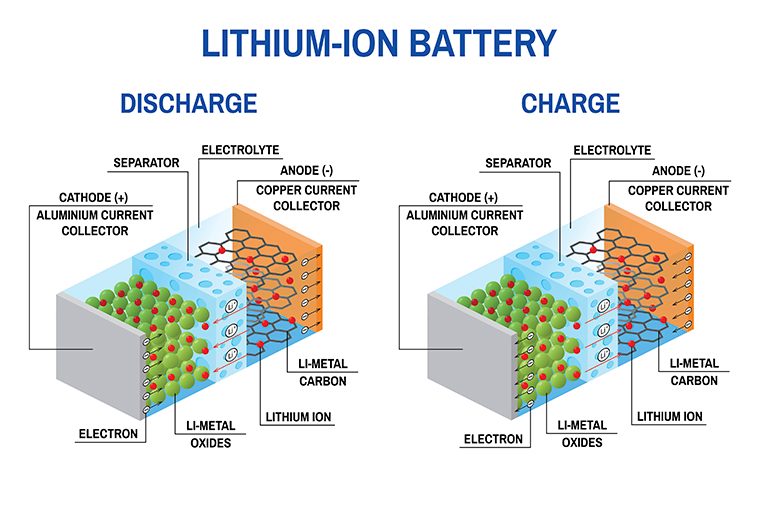
And in super simple terms (and with some creative licence thrown in) they are a cell that contains an electrolyte liquid. Lithium Ions get all charged up, and when they are feeling particularly positive, they dive into the electrolyte and swim through it. The movement of them gets the electrons all excited too, and they go zooming along from the current collector, through the device (your phone, laptop, airplane) which sucks out their charge, and then they get collected up by the negative current collector. 

They are different to regular Lithium (without the ion) batteries because they are rechargeable. They also have no memory effect (they don’t get lazy when repeatedly recharged) and they have good energy-to-weight ratios.

What is the risk?

They sometimes go into thermal runaway, usually when charging, but also if you bash them about (think iPhone stuck under business class seat, getting repeatedly run over by the chair mechanism as the passenger tries to pull it out again).

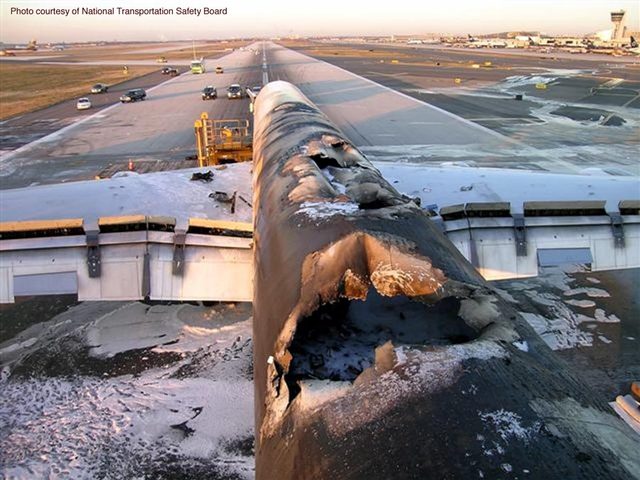
Thermal runaway, as the name suggests, involves them getting really hot – so hot it reaches the melting point of the metallic lithium and causes a pretty horrid reaction when it just keeps getting hotter and hotter until flame, fire, explosion…

You might think a small phone would not be much of a hazard but there are a lot of very flammable things in your airplane cabin. And there are a lot of things with lithium ion batteries in them that people bring onboard.

Then there are airplane batteries themselves. Boeing had an issue early on with their 787 Lithium Ion batteries leading to an All Nippon Airways 787 having a pretty serious incident with one before the problem was resolved.

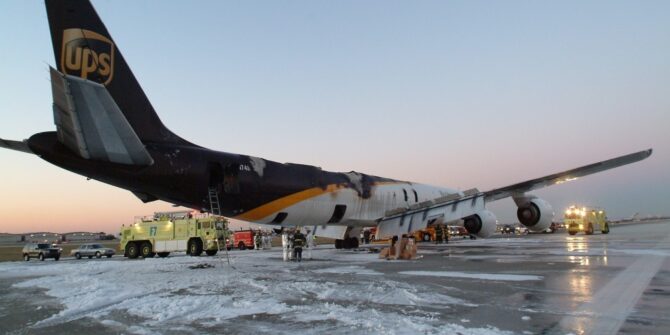
The biggest risk though comes from those in the cargo bay. Particularly the ones that you don’t know are there, should not be there, and which you cannot monitor. A UPS 747 crashed in Dubai after LI batteries in the cargo hold caught fire. The report suggested the heat and smoke from the fire disabled the crew oxygen system and entirely obscured their view within 3 minutes of the initial warning.

What can we do about them?

Most airlines will have a procedure written into their manuals, but it is worth a quick recap because there are some important bits to note.

  • If it has flames, use Halon. If you are using halon (in the cockpit) make sure at least one of you puts a smoke hood on – the stuff is very bad for you.
  • If there are no flames and it is just smoking hot, then cool it down by pouring water or a non-alcoholic liquid on it. If it is a laptop or something fixed in the cockpit then have a little think before you go slugging water on it though, because there are other electrics around which might not like it that much.
  • Don’t try to pick it up (without gloves on). Don’t cover it with ice thinking this will help cool it better, because it actually just insulates it more making it hotter. Don’t put it in fire resistant bags for the same reason.
  • Once it is safe to move, use fire gloves and put it in a receptacle – things like waste bins are good. Fill with water and store it somewhere safe where you can keep monitoring it.

Getting your crew to be vigilant for phones under seats (and passengers not moving said seat until phone is retrieved) is a good plan too.

The Cargo Concern

Lithium Ion batteries in the cargo hold are a different matter. If you have Dangerous Goods approval then you will have manuals and info on this. If you don’t have DG approval then any mention of Lithium Ion batteries on a NOTOC should be concerning you.

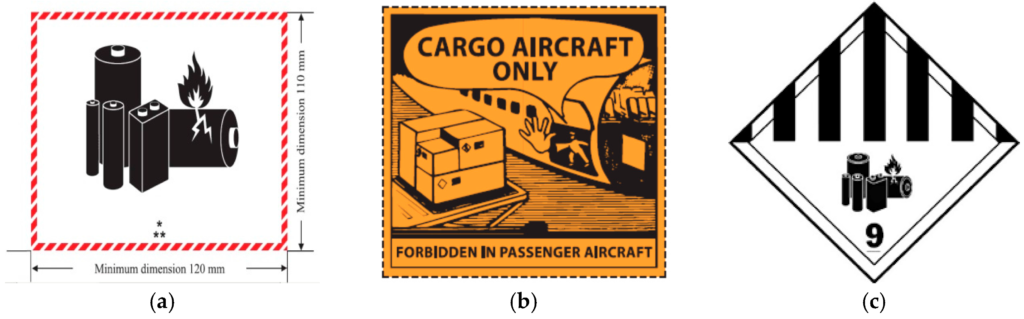
Lithium Ion batteries are a Class 9 Dangerous Good. The ones to look out for are the UN3480 and UN3090 numbers:

  • UN 3090, Lithium metal batteries (shipped by themselves). These are are not rechargeable and are designed to be chucked out after their initial use. They are actually Lithium Metal batteries. These are prohibited for carriage on passenger aircraft.
  • UN 3480, Lithium ion batteries (shipped by themselves). These are the rechargeable ones found in your phones and things.
  • UN 3091, Lithium metal batteries contained in equipment or packed with equipment
  • UN 3481, Lithium ion batteries contained in equipment or packed with equipment

Lithium Ion batters are allowed to be carried on cargo aircraft so long as they have been handled properly. The proper handling, packing, labelling and loading (what they need to be separated from) is all covered by IATA in their massive DG Manual. You can get that here, and find some handy online while you’re at it.

Again, if your operator doesn’t have DG Approval then this is just for info. If you’re wondering whether they do have approval then they don’t – crew have to undergo a yearly Dangerous Goods refresher course and you would remember this (because it is generally quite boring).

So, the simplest thing is to not carry them…

That would be great, but unfortunately it is not that simple. Lithium Ion batteries are in everything nowadays. They come in all shapes and sizes. So the first step is ensuring your passengers know what they are in, and are aware that they shouldn’t be putting these in their checked baggage.

Here is a handy info brochure to give to passengers.

This is a general ‘heads up’ list of some of the things an LI battery might be lurking within:

  • First up, those luggage bags which have them installed in them – if the battery can’t be removed and is more than 0.3g or 2.7Wh it probably shouldn’t be carried. If the battery is under those limits, or if it is removable then it can come onboard but only in the cabin, not in checked baggage.
  • Any lithium ion battery that is under 2g or 100Wh can generally be brought into the cabin. There is often a limit here (20 per person) but this varies with different operators.
  • Mobility aids – electric wheelchairs – often cause problems because folk don’t always know what their battery details are, and it is the airport staff who have to deal with this. The battery on these has to be in an enclosed container to prevent short circuits, and it must be attached as per the manufacturer instructions, or removed if it can be. If it is removed then it must not exceed 300 Wh or 160Wh if there are two of them on the device.
  • Hidden batteries – A lot of devices contain batteries. eBikes. Drones. Things that passengers don’t always think about.

The Captain probably needs to know about the location of these, so if you see stuff being loaded on and haven’t been informed about it, ask.

Finally, rogue shippers. Because of the restrictions, people are sneaking them onboard hidden in incorrect packaging, and without declaring them. They key to stopping this is going to lie with the airlines, operators and ground staff who need to be vigilant. The crew cannot do much more than mitigate the situation if some are onboard, and do cause issues.

Here is the full note from the US Department of Transport and IATA

What to do if you have an incident

If you have a Dangerous Goods Incident, you need to report it, and usually quite quickly. The FAA info page is here to help.

Lithium Ion battery fires are extremely hot and burn incredibly fast. If you think you have LI onboard that might be compromised, get that airplane on the ground as quickly as possible, and get your passengers off.

Want to read some more?


Cargo Fail: How not to convert your pax aircraft

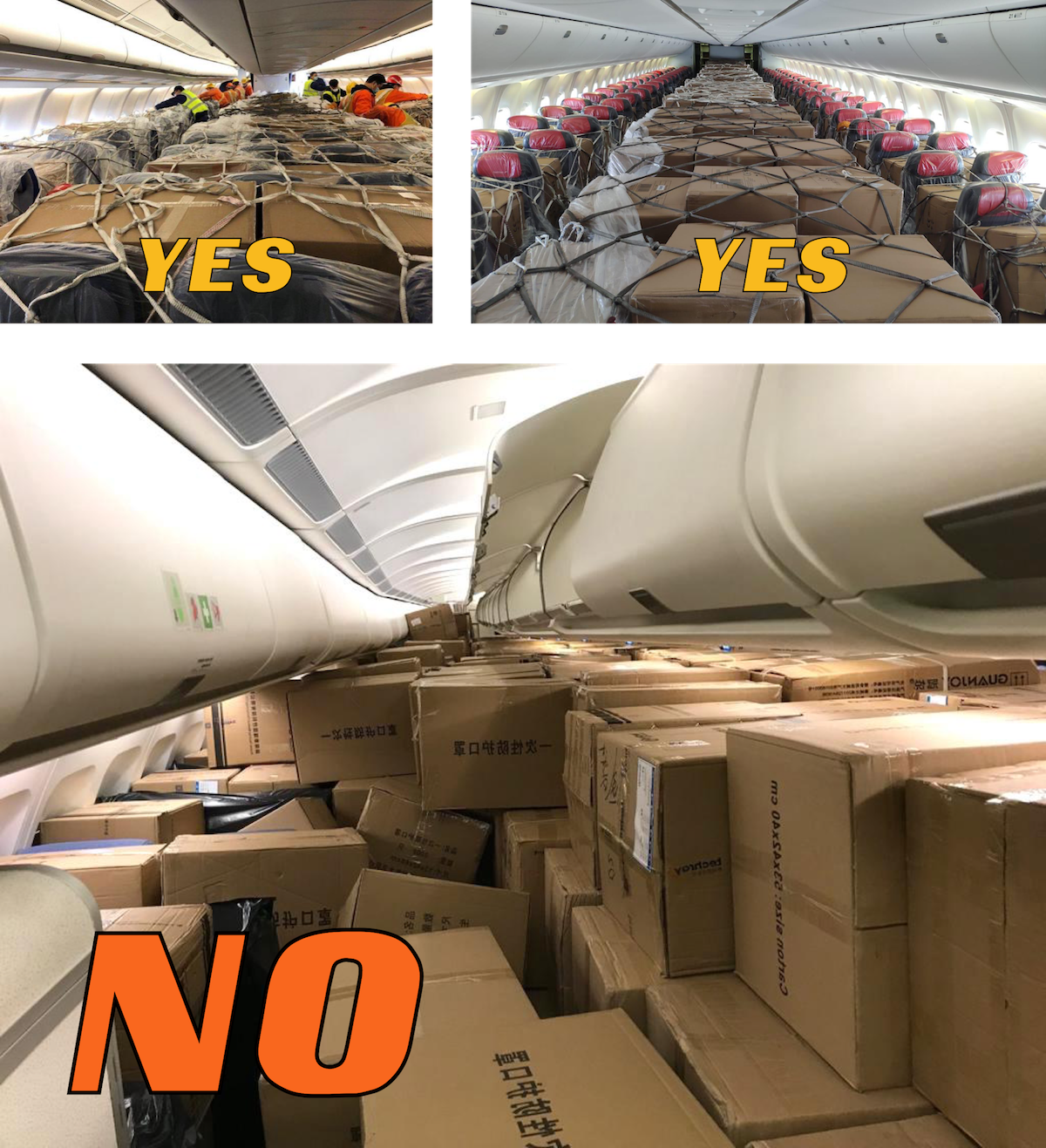
A good number of airlines are working through the process of quickly converting passenger aircraft to cargo (and a few are making a mess of it).

Here’s a simple guide to help you in the process.

Cargo Conversion Guide

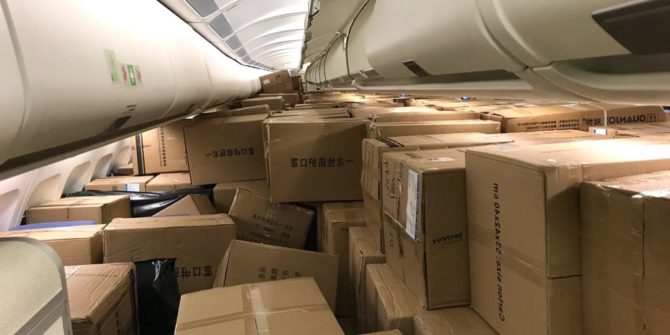
Um, that’s basically it. Avoid picture three, and you’re fine.

A few more details …

It’s not hugely complex, and there is some good official guidance on it. Based on the EASA rules (document below in the footnotes), here’s a good summary from one of our member operators:

Setting up the cargo

* The mass of the cargo shall not exceed the structural loading limits of the floor
* Aisles & exits MUST remain clear to allow for emergency action
* Loads on seats must not exceed 77kg
* Underseat stowage is only permitted if the cargo is FULLY under the seat. The weight for underseat cargo shall not exceed 9kg
* All cargo packaging must be able to handle the Delta Pressure
* The vertical CG of the cargo must be equal or lower than the
during all flight phases
passenger CG provided by the seat supplier
* Cargo carried in overhead bins must not exceed the weight stated
* Dangerous Goods MUST be carried in the hold ONLY.

During the flight

* There must be ONE empty row in-between crew in the passenger compartment and cargo
* The only persons permitted on board the aircraft are employees of the company acting in their role. Any other persons would be classed as passengers and the flight would not be operated in accordance with the exemptions
* On board crew MUST occupy Cabin Crew seats. Crew cannot share a row with cargo
* Any fire/smoke in the passenger compartment must be easily
– investigated by the crew on board and must be able to be
– extinguished by the onboard equipment.
– All smoke/fire detection equipment shall be maintained in accordance with EASA regulations

Loadsheet and monitoring

* Load Sheet to ACCURATELY reflect the position of cargo onboard
* PIC must be informed of cargo contents by NOTAC – to be including in briefing pack
* The CG of the aircraft must be operated within those for passenger flights
* Cargo to be checked during flight phase. At the minimum:
– Before Takeoff
– Before Landing
– During Cruise Phase
* At any other time on the direction of the PIC
– Avoiding making PA’s to the cargo. Unlikely to be interested.

OK, we added that last point, but other than that, it’s a good list. Now for the official stuff.

EASA Guidelines for Boxes on Seats

The approval, in Europe at least, stems from Article 71(1), so you can find those rules in full here: EASA Cargo in Pax Compartment . EASA updated this recently to allow operators to stick boxes on seats, but if you’re planning a bigger conversion, then you’ll need the info below.

EASA wider advice

(from this page)

In the context of the emergency situation created by the COVID-19 pandemic, EASA has committed to treating projects supporting the collective effort to transport medical supplies and other important goods as efficiently as possible. The following message is intended specifically for Design Organisations and Operators, and offers updated information on airworthiness and certification aspects.

We have developed further guidance on the design change classifications, certification aspects as well as use of Exemptions in accordance with Art. 71.1 of the Basic Regulation 2018/1139 for limited time periods.

In order to enable an early availability of a transport solution in the frame of the current COVID-19 situation, EASA supports the use of the provisioning of Article 71.1, also for on-going projects, through additional support to National Competent Authorities and operators as required.

For a permanent use, a design change approval is required.

Transport of medical supplies under a design change approval

Approved Design Organizations may reclassify such modification as “Minor Change” and approve these under their DOA-privileges, allowing for the use of cabin seats when related to the transportation of medical supplies (e.g. masks, gloves, clothing, etc.) provided they are not classified as dangerous goods. This has to be indicated in the approval documents and AFM Supplement.

Since this kind of installation is a change in the scope of operation of the aeroplane, and in the absence of dedicated operational requirements covering this kind of operation, the installation and the procedures for operation have to be addressed taking into account the specific configuration of each aeroplane model affected.

Transport of other cargo under a design change approval

For transport of cargo other than medical supplies as well as in case removal of seats are necessary to allow fixation of cargo onto the aircraft structure for cargo operation, a Major Change or STC application is required and will be processed by EASA with priority.

While preparing your documentation, please consider the following information:

  • For the installation of Cargo Seat Bags the CM-CS-003
  • The published Special Condition, can be used as appropriate guidance, also in the frame of Minor Changes.
  • Already approved STC
  • Guidelines published by the aircraft manufacturers Airbus (ref.: FOT-999-0028-20-00) and Boeing (ref.: MOM-MOM-20-0239) have been issued.

Aside from the advice issued by EASA, the FAA have also published a SAFO, and IATA have chipped in with some guidance of their own too.

In the US the FAA writes the aviation regulations in 14 CFR, but the Pipeline and Hazardous Materials Safety Administration (PHMSA) writes the Hazardous Materials Regulations (HMR) in 49 CFR Parts 171-180. The FAA’s SAFO contains a nod to the hazardous materials/dangerous goods regulations, but PHMSA has published some information and relief documents that might be useful such as notices and issuance of guidance and Special Permits providing limited relief to some regulation.

For the hazardous materials regulations you should go to 49 CFR Part 175.

Both FAA and PHMSA have dedicated pages which should be checked often for the most current information. Those pages can be found here:
https://www.faa.gov/coronavirus/
https://www.phmsa.dot.gov/news/assistance-public-during-covid-19

Time to swap hats

Now that you’ve got your airplane converted, you need to get yourself across to the dark side as well.

Cargo pilot conversion tips:

–  You’ll need a baseball cap, preferably old with grease stains.

– You can make even longer than normal PA’s, the boxes will probably pay more attention than the passengers used to. Just skip the ‘Please remain in your seats …’ part on the taxi in, these are the most well behaved guests you’ve ever had.

Get better stories. That one about the time you had to feather two props on an Electra out of Ostend with eight pallets of porcelain toilets. Cheat and get some good ones here.

– You can now wear your uniform for a week without changing it. Spill some coffee on it on Day 1.

– No need to deviate left or right, just plough through those CB’s. And forget the turbulence reports, the boxes can take it and so can you.

– You’ll need a new type rating: the coffee maker. Don’t worry, you’ve got 8 hours to Shanghai to figure out how to make it work.

– Good news, you qualify for membership of the Freight Dogs forum on PPRuNe.

And finally … a Cargo Pilot Ground course in 3 mins. Learn from the old masters:


Eurocontrol – Cargo Flights alerts

In 2012, the EU put in place the EU ACC3 program – air carriers that fly cargo or mail from a non-EU airport to an EU airport must ensure that all cargo and mail carried to the EU is physically screened or comes from a secure supply chain which is validated.

Air carrier stations in third countries are required to have undergone an audit to obtain an EU Aviation Security Validation in order to acquire or maintain their ACC3 designation. This validation needs to be reissued every five years, according to the EU Regulations.

On 01FEB16, Eurocontrol set up a NM ACC3 alerting system –  checking Flight Plans, and sending a message to the European Commission and the relevant EU Member State/s when a flight is identified as not having the correct ACC3 accreditation.