RNP-AR: New Arrival Procedures at Toronto
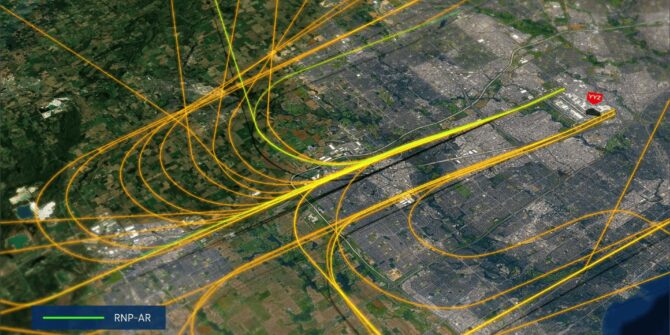
Everyone loves an aviation acronym, don’t they? So this post is about an acronym that causes a lot of confusion. Is an RNP-AR the same as an RNAV, and what if you add GNSS on the end?

It is also about CYYZ/Toronto Pearson airport because they have just implemented the ‘biggest’ deployment of ICAO E0R standard at any major international airport in the world.

OK, so what exactly have they done?

If you haven’t heard the term EoR before, then it just means Established on RNP-AR”  and means they can use reduced separation standards.

So in simple terms, they’ve started using RNP-AR approaches. Which is great because reduced separation standards means reduced track miles for you, which means reduced fuel costs and time and all that joylessness at the end of a long and tiring flight.

So, RNP-AR approaches are way better.

Nav Canada says this – “The EoR separation standard allows aircraft to be considered established on final as soon as they’re on the RNP-AR procedure, which is now in use for both ends of Toronto Pearson’s north runway (05-23). As a result, some aircraft approaching from the south will have the opportunity to fly up to 1,000 feet higher when aircraft to the north are established on an RNP-AR procedure, thereby providing aircraft with the opportunity to reduce their noise over communities located south and downwind of the airport.”

And here’s a little video to learn even more about the project.

But before you disappear, here are some of Toronto’s charts and a little discussion on these approaches in case you’re seeing them for the first time ever.

The Charts.
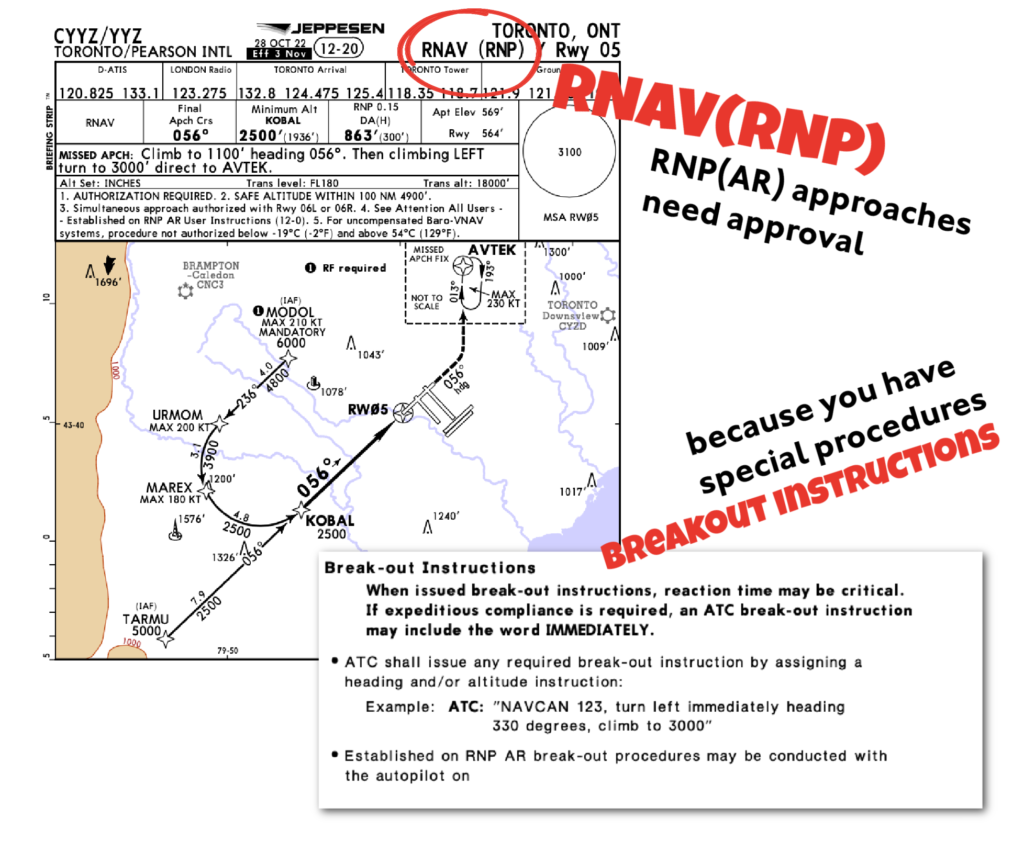
RNP(AR) and the ones to watch for if you don’t have approval

General RNP-AR Info.

Because a lot of folk find the RNP, RNAV, RNAV RNP, RNAV GNSS, RNP AR terminology just a little confusing (it is!), here is a link to a post talking all about it.

A mini summary:

  • RNAV is the original name. The system doesn’t require alerting (when you go outside the required tolerance)
  • RNP is the new name, and the system requires alerting
  • In the US they call RNAV approaches GPS approaches, and RNAV (RNP) when they need authorisation
  • RNAV/RNP (GNSS) requires GPS. If it doesn’t, it might use something like DME/DME to back-up accuracy
  • AR means authorisation required, which means you need training and approval to fly them
  • They all come under PBN which stands for Performance Based Navigation
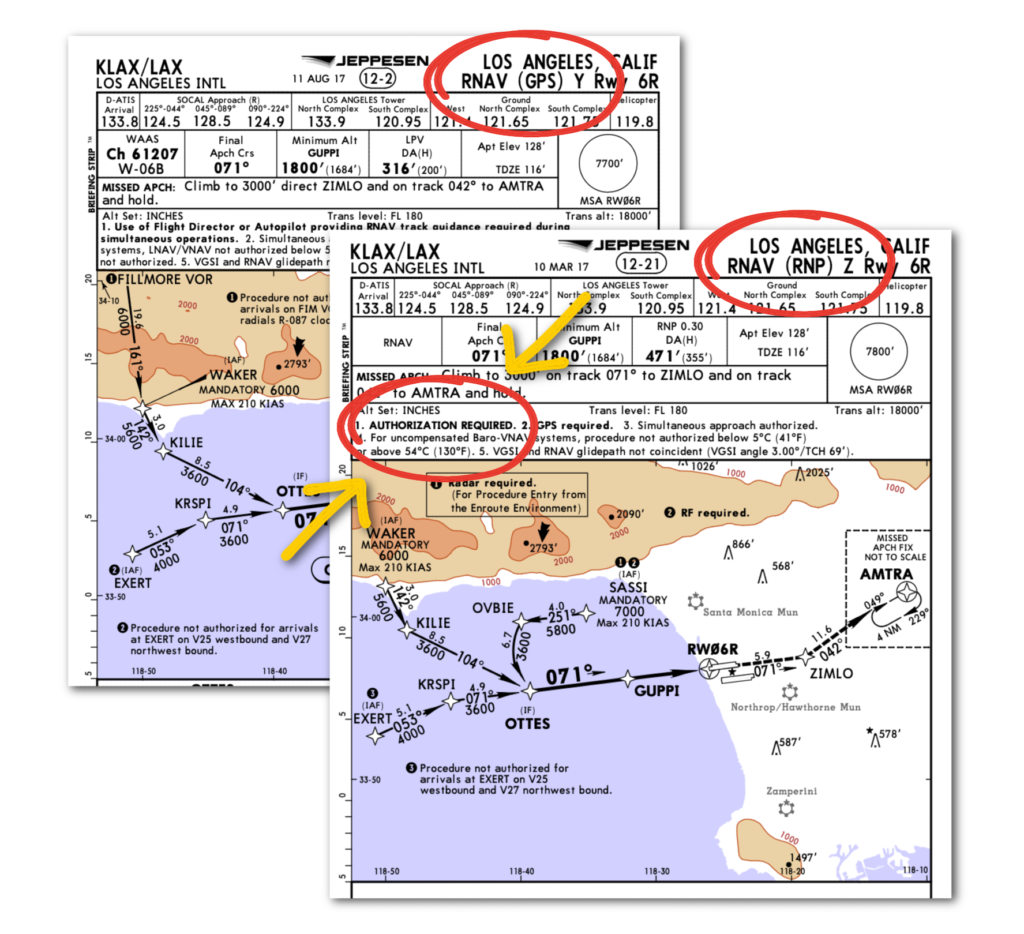
The difference (in the US)

CYYC/Calgary

Calgary is next in line to get them (probably).

There is a ‘period of public comment’ open now until Feb 3rd 2023, so get your voice heard if you have comments on these plans.


The Toronto Slot Machine

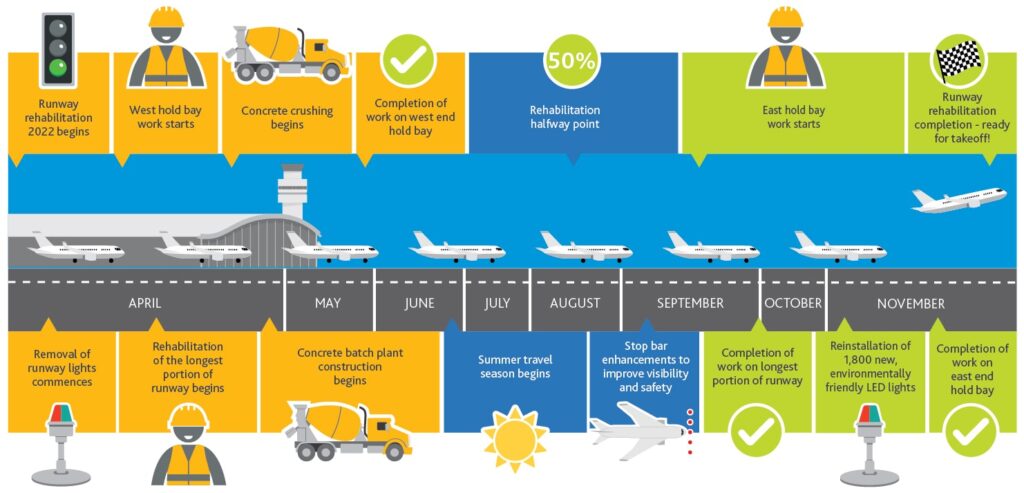
CYYZ/Toronto Pearson has construction works planned this Fall (that’s autumn for European folk), which is going to mean some slot restrictions. Here’s the info on it.

What are they doing?

They have been rehabilitating one of the runways – 06L/24R – since April 2022. The overhaul will give it another 30 or so years of life.

So far they’ve sort of done one third of it, and are finishing up the mid section, so just have the end bit to go – but this is the longest section to complete.

After this they’ll be whacking in a lot of LED lights and also working on new bay areas.

You can read all about it here.

What does it mean for traffic?

This is actually their second busiest runway which means fairly big disruption. Normally Toronto runs a dual or triple runway configuration when it gets busy, but since they can’t do that, they’ve been maximising the efficiency of the other two where they can.

With the biggest bit of the construction coming up, they have put some slot restrictions in place to manage the traffic, effective Aug 2.

This will mainly impact Business and General Aviation flights.

  • First up, there are limited slots between 15:00 and 19:59 local time, each day
  • This applies to arriving and departing aircraft
  • BizAv/GenAv flights looking to operate between 06:30 to 12:29 must file a reservation with the Airport Reservation Office Online Coordination System (ARO OCS)

Good news though – any unallocated capacity (with an hour to go) will be available for BizAv/GenAv flights. So you might be able to sneak in last minute (although we wouldn’t recommend depending on it).

ARO OCS?

Find all the info on that here, and if you’re not already registered then do it because it takes 7 days.

Actually that link takes you directly to Toronto’s site on it and there is a bunch of handy info there like who is exempted, how to do it, forms etc.

The Directive.

The official stuff on it can be read here. It says what we said, but you can also find some handy contact info in there too, in case you have any questions on it all.


Toronto RNP-AR Plan

What does Toronto Pearson International airport and a Canadian Goose have in common?

They are both very noisy!

Which is why NavCanada are looking to change the airspace at the airport. More specifically, they are planning on implementing RNP-AR approaches in an attempt to make it cleaner, greener, quieter. Just like Canada itself. 😊

Anyway, here’s a quick look at the proposed routes and how they will help with noise and efficiency.

Runway 05/23

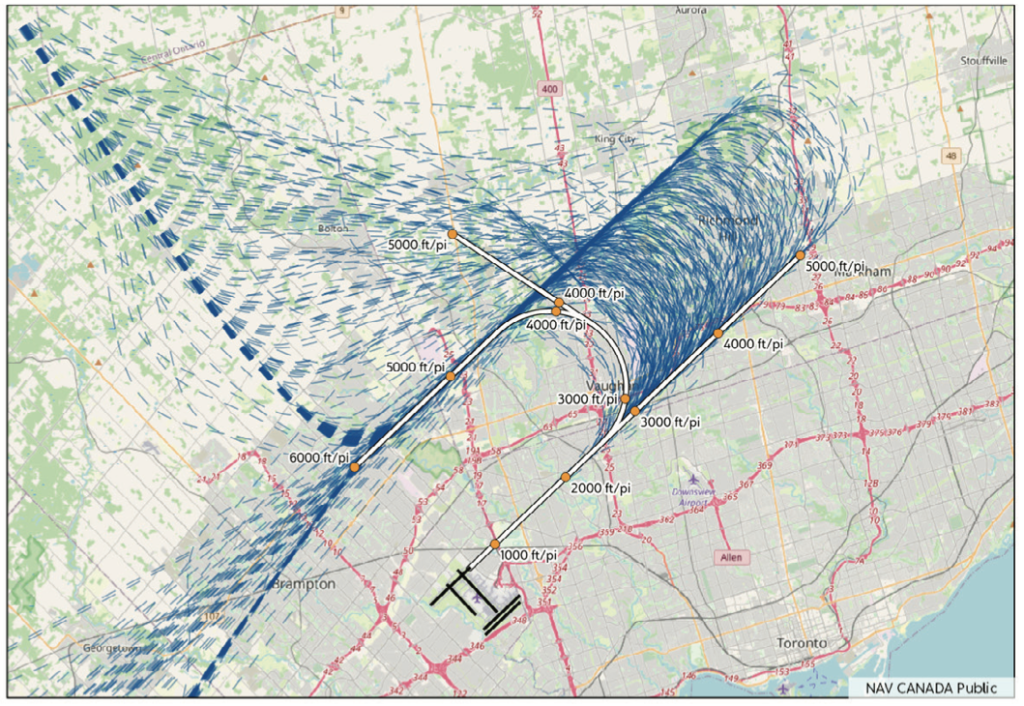
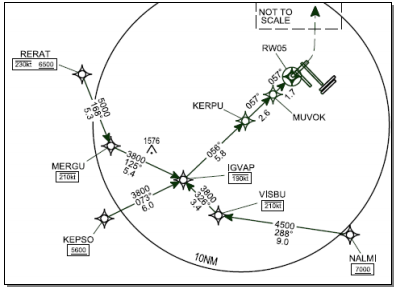
They are planning to introduce RNP AR approaches. The big benefit of these is they line you up with the runway sooner which means you fly less and so burn less fuel. They also help with continuous descent ops (see the traffic management bit below for how that works).

Here is a picture of how it will shorten the distances for you. The RWY23 plans can be checked out here, and the ones for RWY05 here.

Traffic Management

In standard simultaneous parallel operations, ATC apply a 1000’ or 3nm lateral separation between aircraft which usually means folk on one runway head in at 4000’ for final approach while those going to the other runway head in at 3000’. Those dropped down to 3000′ often don’t fly a CDA and it is less efficient, but also more noisy for those on the ground with aircraft flying for longer periods at lower levels.

An RNP-AR means aircraft do not have to drop down to a lower altitude because those on the RNP-AR are already ‘established’ on the procedure during the downwind curved bit that bring you onto finals.

One of the current issues with Toronto is the approaches don’t tend to link with the arrivals so there is often a messy, inefficient in-between bit where you are just sort of flying along waiting for a vector.

So why do we care about proposals?

Mainly because it’s good to know what’s changing so you can get ready for it. But also because most of the feedback received during these stages of discussion tends to be from disgruntled folk who live near the flight paths and don’t always want to see changes brought in.

Visit the NavCanada site here for the full info.


New procedures at Toronto

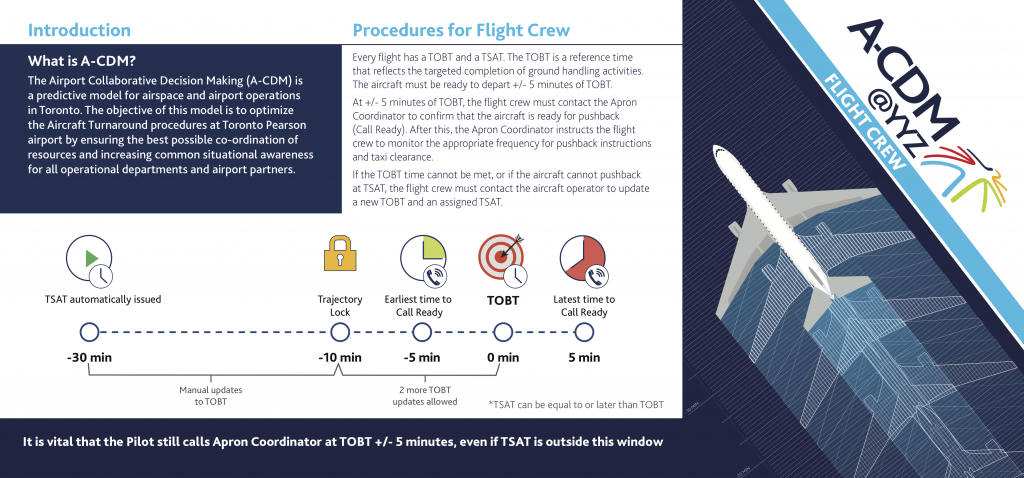
The airport launched an Airport Collaborative Decision Making (A-CDM) trial on Sep 16 which will continue until Spring 2020. In theory you should see faster turnaround and taxi times, but there are two key requirements to be aware of:

  1. Make sure you’ve got slots approved in advance for arrival and departure.
  2. For departure, you’ll get a Target off Block Time (TOBT), which you’ll need to update with ATC if you think you’re going to exceed it by 5 minutes or more.

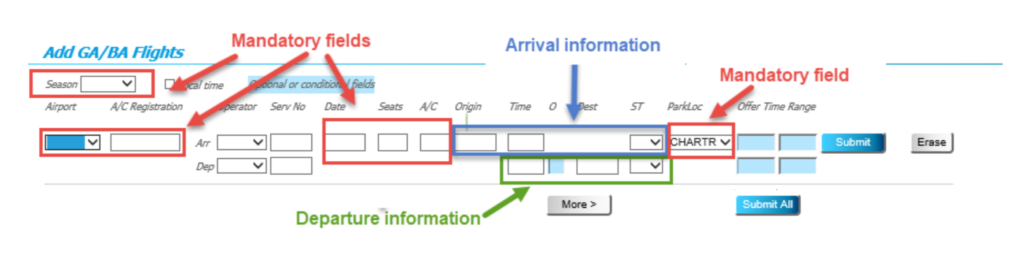
The airport started requiring GA/BA flights to obtain slots back in February 2019. After a few teething problems, they decided to start allowing local handlers to arrange these on behalf of operators. If you get a local handler to do this for you, you can book slots up to 30 days in advance – Skycharter & Signature provide this service.

If you do want to arrange slots yourself, that’s still an option, but you will only be able to request these 3 days in advance. Various flight planning providers have said they can arrange slots for operators too, but they all seem to be restricted to 3 days as well. Toronto is a busy airport, and this restriction may mean that you won’t be able to get the arrival/departure times that you want.

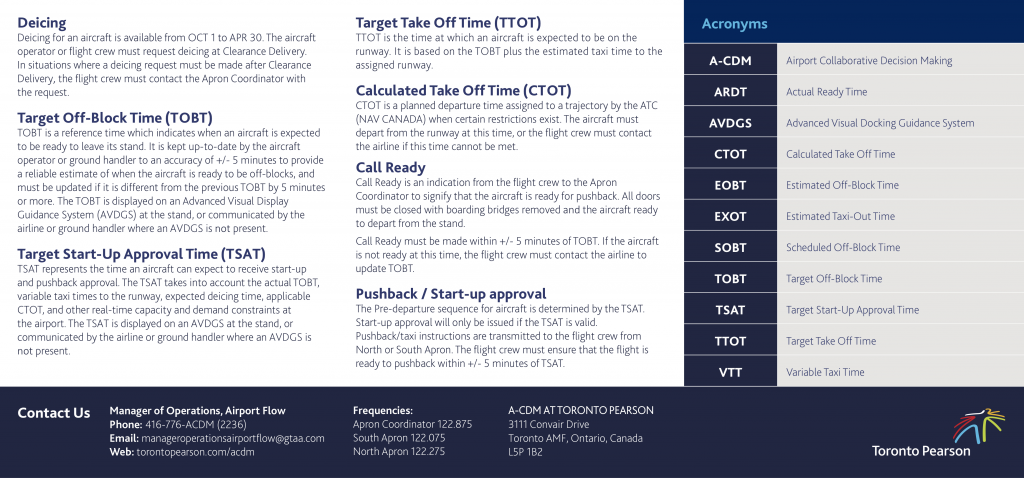
Once you have your slots, your aircraft then gets automatically entered into the A-CDM system. For departure, you will get a Target off Block Time (TOBT), and pilots will need to update this with ATC if they think they are going to exceed it by 5 minutes or more – getting your handler to update your slot reservation at this stage won’t work! Once you get within 10 minutes of the TOBT, you can only update it 2 more times. If a third TOBT update is required, you’ll need to contact the Airport Flow Manager for instructions (+1-416-776-2236).

The airport has published this A-CDM quick reference guide for operators:

Other useful stuff to know about CYYZ/Toronto:

  • Toronto still has a night curfew between the hours of 0030-0630L. If you need to arrive between those hours, you need to contact the after-hours slot team (+1-416-776-3480), who will consider your request. But watch out! For ops approved during the curfew hours they usually charge you around 20 times the landing fee!
  • All the approach charts now make reference to a new procedure, implemented in Feb 2019, called Continuous Descent Operations (Jepp chart 10-2). This is designed to help reduce airport noise levels, and involves aircraft flying a continuous descent in the lowest power and drag configuration possible. ATC may instruct pilots to do this during daytime and evening periods when traffic is relatively light. More info
  • Updated advice has been issued about the runway selection criteria at Pearson. When the north-south runways are in use (RWY 15/33) the airport sees an arrival capacity reduction of around 40%. So crosswind component guidelines have been included in AIC 12/19 for dry, wet and contaminated runways.

If you have further info to report, please do! Email us at news@ops.group


No more slots misery at Toronto

The ongoing slots-related misery at CYYZ/Toronto airport looks like it may be coming to an end. 

The airport has always required GA/BA flights to obtain slots for flights operating overnight (0030-0630 local time), but in mid-Feb 2019 they made this a requirement for flights H24.

This was a new system, and there were a few teething problems, the main one being that operators had to do everything themselves, as local handlers were not allowed to arrange slots on their behalf. Added to that, unless you were a Toronto-based operator, you could only request slots 3 days in advance!

But the system has now changed, with the airport authority saying that local handlers are now allowed to arrange slots on behalf of all operators. Of those local handlers, Skyservice has decided not to provide this service, but Skycharter & Signature say they can arrange slots for operators up to 30 days in advance

If you do want to arrange slots yourself instead of getting a local handler to do it for you, that’s still an option, but you will only be able to request these 3 days in advance. Various flight planning providers have said they can arrange these slots for operators too, but they all seem to be restricted to 3 days too. Toronto is a busy airport, and this restriction may mean that you won’t be able to get the arrival/departure times that you want.

If you want to try doing it yourself, the official guidance is here. If you want an FBO to do it for you, get in touch with Skycharter or Signature, and spare yourself some misery.

One last thing to note: Toronto still has a curfew between the hours of 0030-0630L. If you need to arrive between those hours, you need to contact the after-hours slot team (+1-416-776-3480), who will consider your request. But watch out! For ops approved during the curfew hours they usually charge you around 20 times the landing fee!

If you have further info to report, please do! Email us at blog@ops.group, or comment below.

Other interesting stuff at CYYZ/Toronto:

  • All the approach charts now make reference to a new procedure, implemented in Feb 2019, called Continuous Descent Operations (Jepp chart 10-2). This is designed to help reduce airport noise levels, and involves aircraft flying a continuous descent in the lowest power and drag configuration possible. ATC may instruct pilots to do this during daytime and evening periods when traffic is relatively light. More info
  • Updated advice has been issued about the runway selection criteria at Pearson. When the north-south runways are in use (RWY 15/33) the airport sees an arrival capacity reduction of around 40%. So crosswind component guidelines have been included in AIC 12/19 for dry, wet and contaminated runways.

Canadian Ops Update

Just a short update on a few things happening in Canada that you might have missed…

Nationwide
  • There has been a change in the Maximum Indicated Airspeeds for holding patterns to bring them more in line with the rest of the world. This came into effect on 11OCT18 and will be reflected in the 08NOV18 AIP update. Refer AIC 25/18.

  • It’s been over a year and a half since NavCanada suspended it’s Climb/Descend via SID phraseology, adding a complication for pilots that regularly cross the border from USA to Canada and v.v. It initially trialed then quickly suspended them “out of concern over altitude deviations we were seeing in the system and the unforeseen large increase in workload as a result. We are continuing to communicate with airlines, aircraft operators and our employees as we revert to the phraseology rules that were in place prior to this change.​” We understand this phraseology has now been officially put in the trash and wont be returning.
CYYZ/Toronto Pearson Airport
  • There are new nighttime RNAV approaches starting in CYYZ/Toronto Pearson from 08NOV18. These RNAV (GNSS) X instrument approach procedures are for night-time ops between 0030L-0630L on runways 5/6L/6R/23/24L/24R. The procedures are designed to minimize the noise footprint. The ATIS will advertise these as the primary approach type when they are active. Pilots can expect to be cleared directly to the initial approach waypoint, then subsequently cleared for the approach including the appropriate transition. Refer AIC 28/18.

  • Slots are currently required for all flights between 0030-0630 local time. The airport authority was planning to make slots mandatory for all GA/BA flights H24 from Nov 17 onwards, but this will now be delayed to some time in early 2019. For more info, contact the Airport Reservation Office at aro@gtaa.com

Do you know more? Drop us a line!