Ethiopia Airspace Update
Update – July 26, 2022

There has been no major fighting in Ethiopia’s northern Tigray region since late Dec 2021. A ceasefire agreed in March 2022 has mostly been upheld, and Ethiopia’s federal and Tigray regional governments look set for negotiations soon.
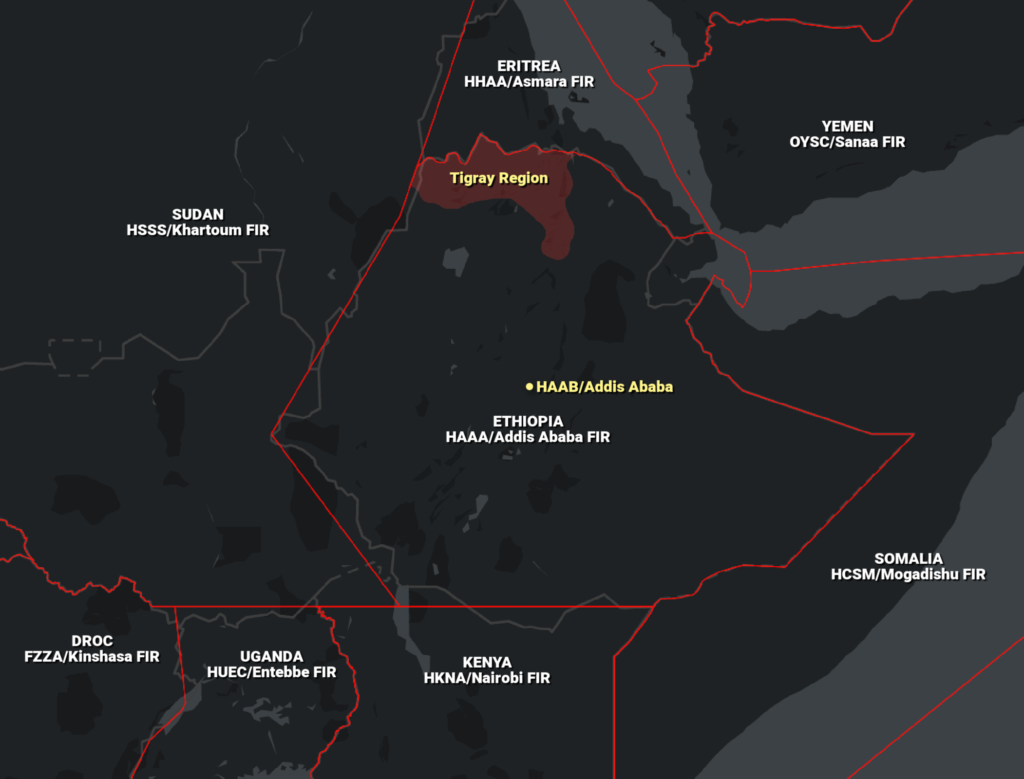
For the time being though, airspace in the north of the country should still be avoided – several states maintain active airspace warnings for the HAAA/Addis FIR, and Ethiopia still have a Notam in place banning all flights at FL290 and below.

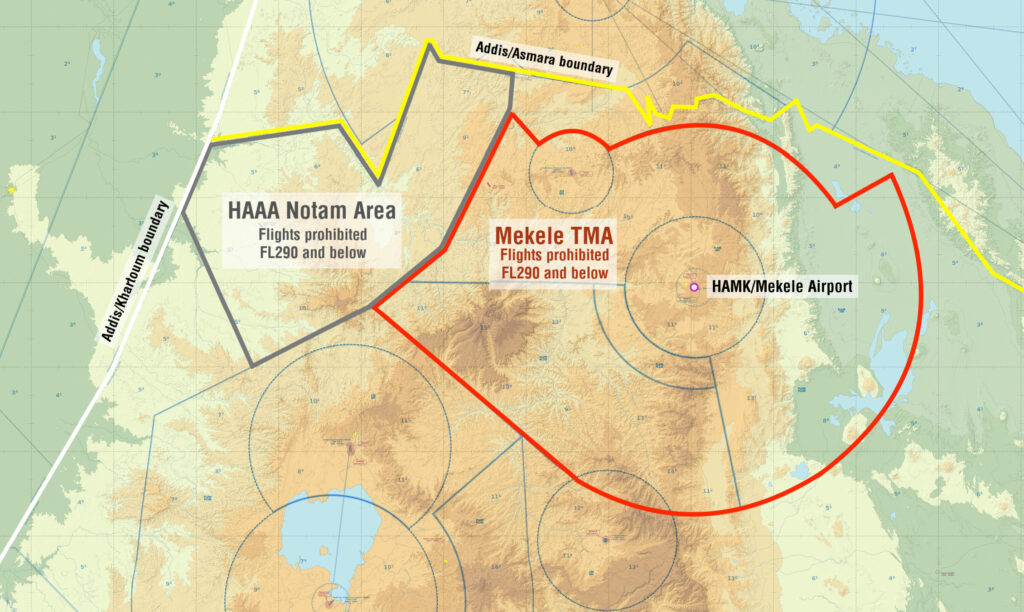
Here’s the current version of the Notam, the content of which hasn’t changed since its first iteration:

HAAA A0220/22 - FLIGHT IS PROHIBITED TO FLY AT OR BELOW FL290 WITHIN
MEKELE TMA AND WITHIN THE AIRSPACE DEFINED BY JOINING
THE FOLLOWING SUCCESSIVE POINTS AND LINES
135914.7N 0362048.9E
130042.8N 0365122.9E
ETOBU(132132N 0373433E)
TILUD(134116N 0375950E)
EVITO(142911N 0382424E)
THE COMMON FIR BOUNDARY BETWEEN ADDIS AND ASMARA AND
THE COMMON FIR BOUNDARY BETWEEN ADDIS AND KHARTOUM
REF AIP SUP A 04/2021. GND - FL290, 27 MAY 09:00 2022 UNTIL 27 AUG 09:00 2022. 
CREATED: 27 MAY 09:00 2022

Better yet, here’s a picture of what this actually looks like:
Update – Nov 18, 2021:

  • The US published a new airspace warning and Background Information Note for Ethiopia, cautioning against overflights of the HAAA/Addis Ababa FIR below FL290. The conflict between the Ethiopian military and opposition forces had intensified. Aircraft below FL290 were at increased risk from anti-aircraft fire.
  • The US, the UK, Germany and France all issued security warnings advising their citizens to leave immediately.

Update – Nov 9, 2021:

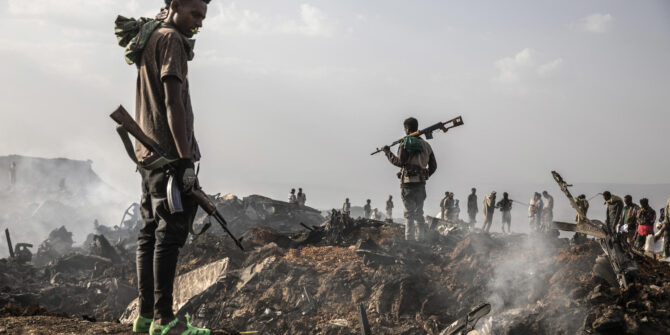
  • Ethiopia is on the verge of civil war. The government declared a six-month nationwide state of emergency on Nov 2, following increased fighting between the Ethiopian military and opposition forces in the Tigray region in the north of the country.
  • Concern that ATC services in the HAAA/Addis FIR may be affected with little notice. Overflights of Ethiopia may be at increased risk of anti-aircraft fire at all levels.
  • Several factors impacting risk to overflights: military aircraft being used in combat roles, unmanned aircraft operating in region, unstable political situation on the ground, and conflict spilling over into adjacent regions. All of this pointed to an increased risk of misidentification and miscalculation – aircraft mistaken for something of military interest, or simply caught in the crossfire.
  • Opposition forces in Tigray have access to conventional surface-to-air missile systems that can reach aircraft as high as FL260. They have also previously shown an intent to target aviation interests with rockets and ballistic missile attacks on airports within the region, as well as across the border in Eritrea. Other military interests in the area have weapons capable of reaching much higher – including the Ethiopian military. More sophisticated systems are present in or near the region that are capable of reaching as high as FL490. For context, in August 1999 the Ethiopian military shot down a Learjet near the border with Eritrea. Then in May 2020 they also downed an Embraer 120 in Somalia. Both were misidentified.

Further reading

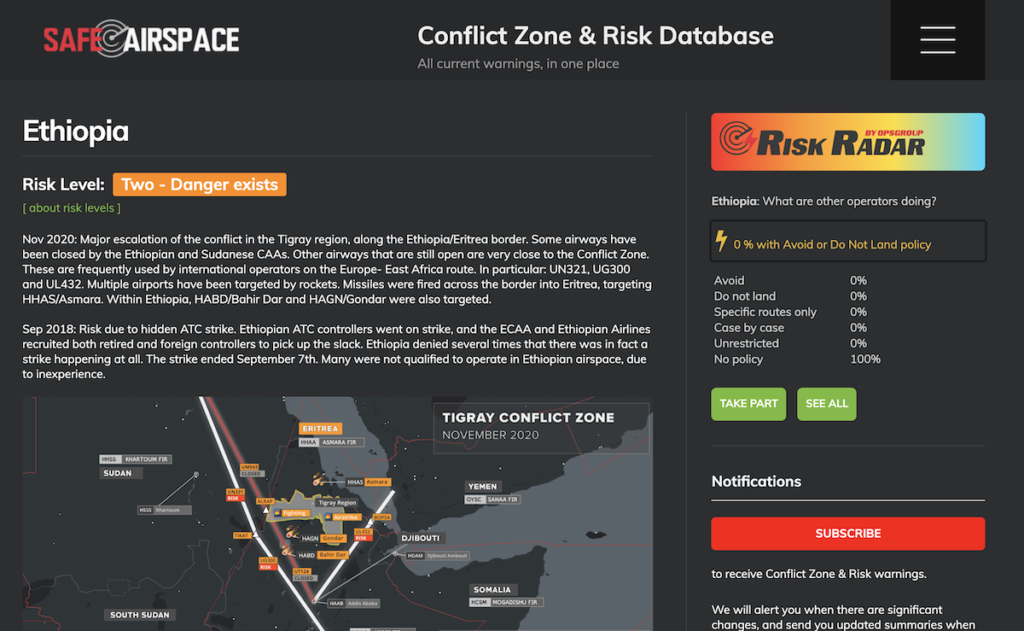
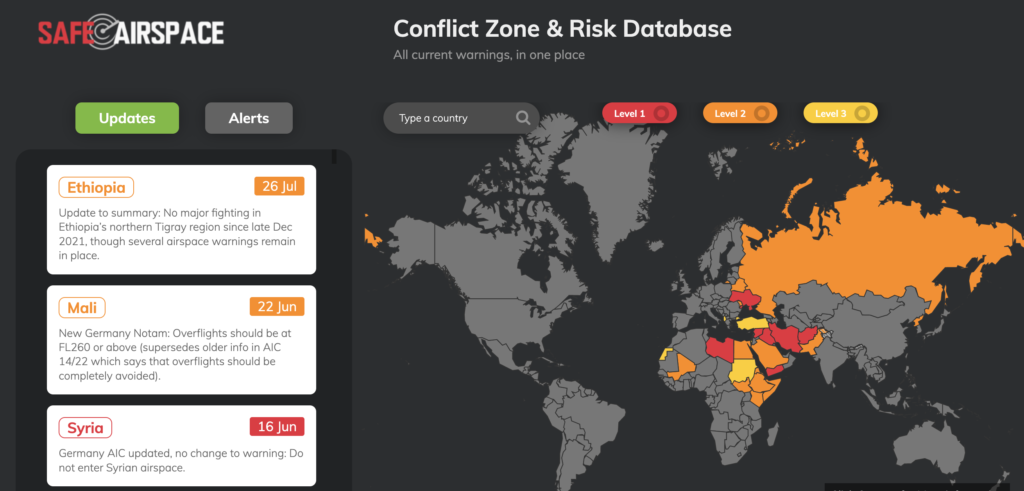
SafeAirspace.net is our conflict zone and risk database. Click here for a full briefing on the situation in Ethiopia.
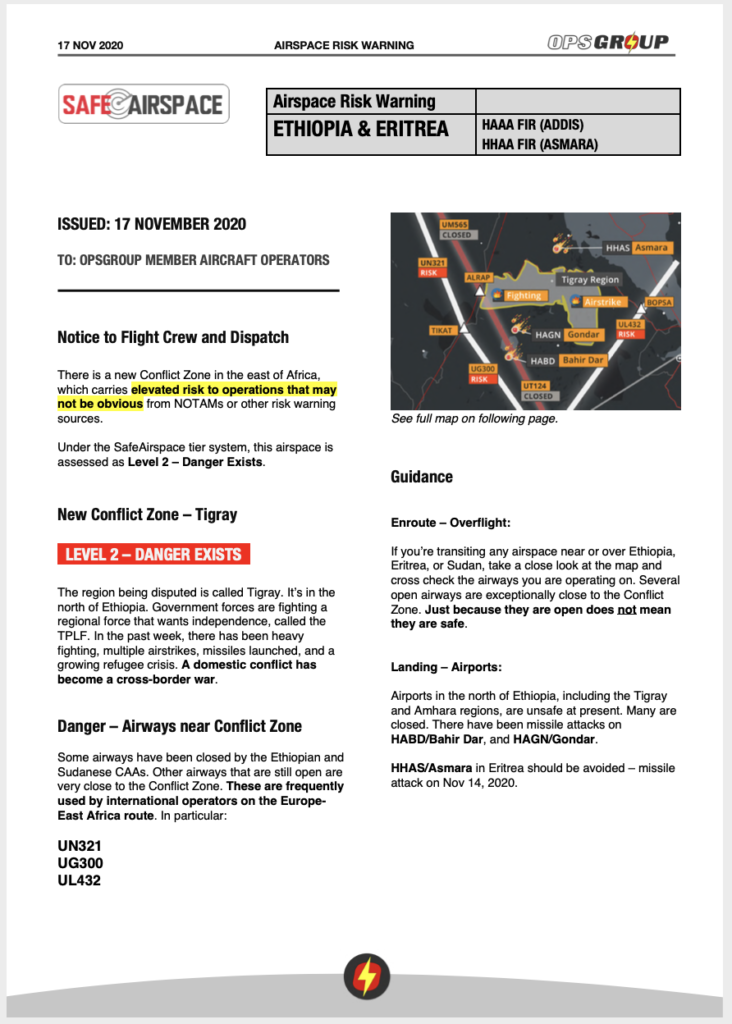
Airspace Risk Warning – Ethiopia and Eritrea

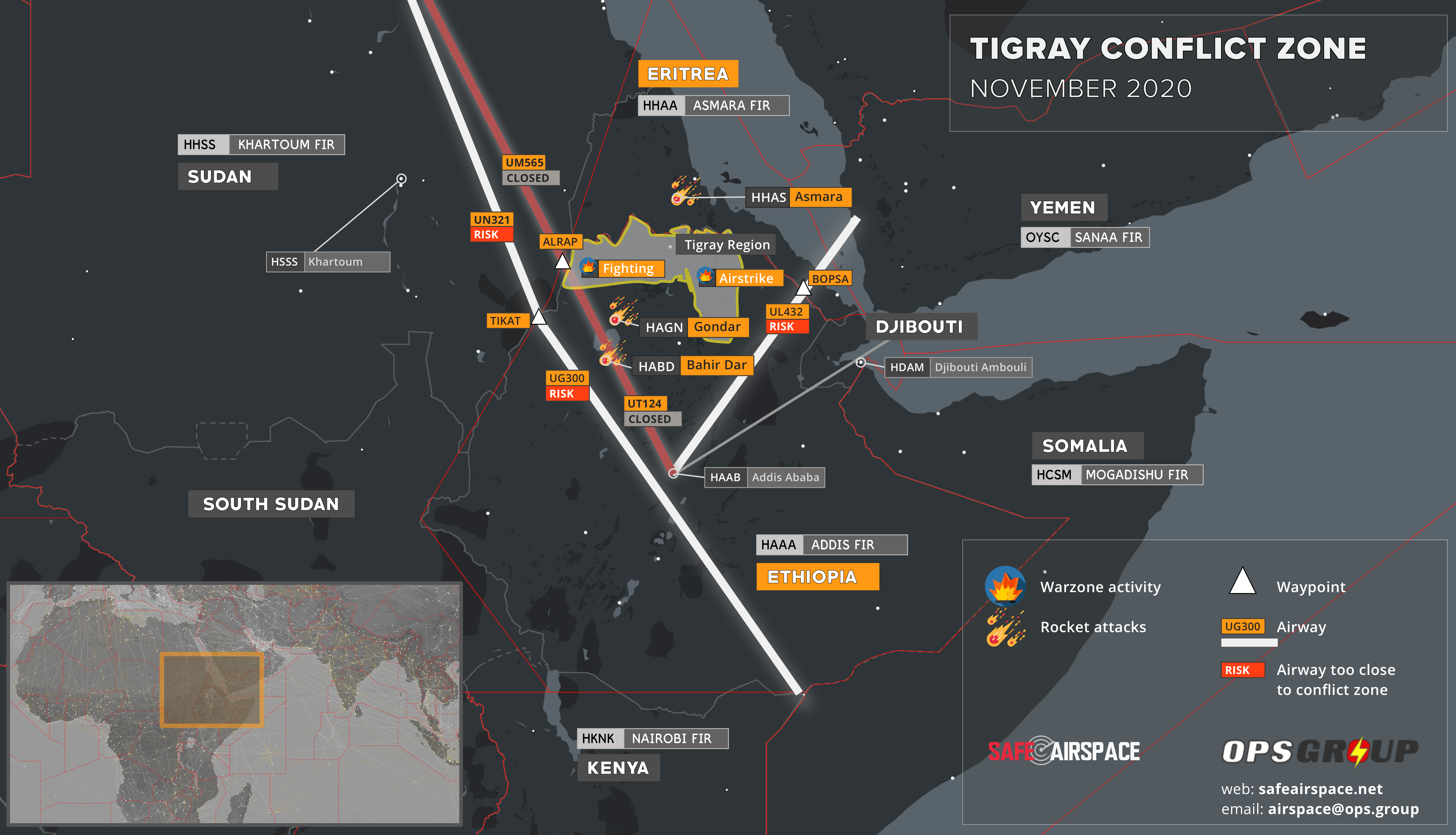
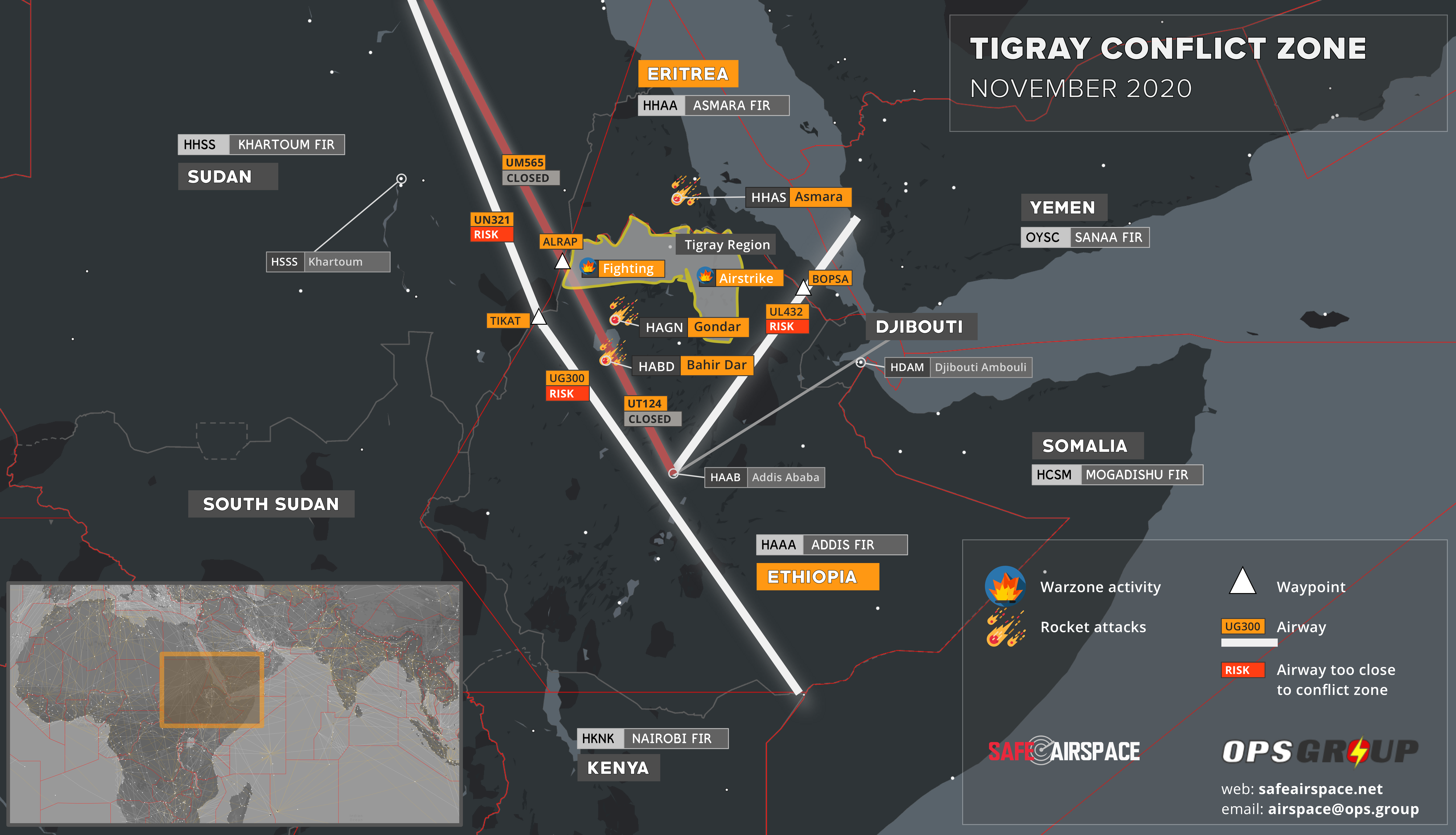
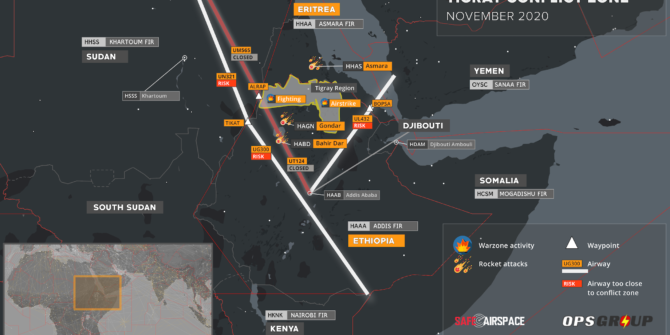
There is a new Conflict Zone in the east of Africa, which carries elevated risk to flight operations that may not be obvious from NOTAMs or other risk warning sources.

Some airways have been closed by the Ethiopian and Sudanese CAAs. Other airways that are still open are very close to the Conflict Zone. These are frequently used by international operators on the Europe- East Africa route. In particular: UN321, UG300 and UL432. We are concerned that operators may be using these routes without being aware of the risk.

OPSGROUP has today issued an Airspace Risk Warning to its members.

Download OPSGROUP Airspace Risk Warning – Ethiopia/Eritrea (PDF)


Download Hi-Res version of this Conflict Zone map


Situation

The region being disputed is called Tigray. It’s in the north of Ethiopia. Government forces are fighting a regional force that wants independence, called the TPLF. In the past week, there has been heavy fighting, multiple airstrikes, missiles launched, and a growing refugee crisis. A domestic conflict has become a cross-border war.

Our Concerns

There are many warning flags that point to previous shootdown incidents – not least MH17 and PS752. These are the reasons we are particularly concerned about the risk to civil aviation in this region:

Local NOTAMs are misleading
The NOTAMs issued by the Ethiopian CAA to close airways in the conflict zone (UM308, UT124) do not say why they are closed. NOTAMs issued to reroute traffic to adjacent routes (UN321, UL432) do not say why they are rerouted. The same applies to NOTAMs issued by the Sudan CAA to close airways and reroute traffic. Flight crews and aircraft operators are therefore not alerted to any conflict in the area by NOTAM.

Arbitrary Reroutes
Traffic is being rerouted to other airways by ATC, but it’s not clear, or likely, that there has been any risk assessment. European flights are now using UN321/UG300, and UL432 – all of which come exceptionally close to the conflict zone. As we’ve learned from MH17 and PS752, just because airspace is open and available, does not mean it is safe.

Previous shootdowns
The Ethiopian Army shot down an Embraer 120 in May 2020, in Somalia. The Ethiopian Air Force shot down a US Learjet in August 1999 in the Eritrean border region. Both were misidentified.

No guidance to operators
No aviation authorities or official sources have issued any guidance or warnings to date via normal channels.

Rapid Escalation of Conflict
The situation has intensified rapidly, and is extremely unpredictable and unstable. The impact on aviation has not been widely reported.

Guidance

Enroute – Overflight:
If you’re transiting any airspace near or over Ethiopia, Eritrea, or Sudan, take a close look at the map and cross check the airways you are operating on. Several open airways are exceptionally close to the Conflict Zone. Just because they are open does not mean they are safe.

Landing – Airports:
Airports in the north of Ethiopia, including the Tigray and Amhara regions, are unsafe at present. Many are closed. There have been missile attacks on HABD/Bahir Dar, and HAGN/Gondar. HHAS/Asmara in Eritrea should be avoided – missile attack on Nov 14, 2020.

Information Sources

The Conflict Zone & Risk Database at SafeAirspace.net contains all current published warnings and alerts for Ethiopia and Eritrea.

The countries that issue the most relevant updates for unsafe airspace are:

• US (FAA) – through Notams and SFARs
• UK (DFT) – by Notam and then AIP
• Germany (BMVI) – by Notam
• France (DGAC) – by AIC

Note: Operators should not rely on EASA Conflict Zone Information Bulletins (CZIB)’s as a primary source of information. These serve only as pointers to the above sources, and often are not issued until several months after updates, if at all. Note that the Civil Aviation Authorities of the countries whose airspace is determined to be unsafe are unlikely to issue reliable guidance.

Group effort

This information is compiled from OPSGROUP member input, information, intelligence and analysis. If you have additional information to share, please send it to report@safeairspace.net.

Members: More information

OPSGROUP Members: More information in the discussion in the Forum about Ethiopia/Eritrea:
Forum > International Ops > New Conflict Zone Ethiopia/Eritrea

All links to further resources are there.