Sydney BizAv Fees Set to Skyrocket
From July 1, YSSY/Sydney will move ahead with a major fee overhaul for BizAv. After strong pushback from the local community – led by ExecuJet and the Australian Business Aviation Association (ABAA) – some of the most extreme fee increases have been softened. Parking will no longer have a flat rate and now allows 180 minutes free, but fees remain steep for longer stays. Runway charges are rising sharply, and mandatory GPU/PCA fees and environmental charges will still apply. Operators should prepare for a noticeable jump in operating costs.

What’s changing?

The proposed fee increases are eye-watering:

  1. Parking fees:
    The good news is that BizAv operators will now get 180 minutes of free parking in designated BizAv areas. This replaces the originally proposed flat AUD $3,220/day rate. After the free period, fees are tiered based on aircraft weight and length of stay. For aircraft over 40,000 kg MTOW, charges start at AUD $1,000/day for days 1 to 3 and go up to AUD $2,500/day beyond 7 days. Smaller aircraft pay less, starting at AUD $500/day.
  2. Runway charges:
    The runway fee will jump from AUD $60 minimum to AUD $340 minimum, with the per-1,000 kg MTOW fee going from AUD $6.91 to AUD $17. 
  3. GPU and PCA requirements:
    Sydney Airport now mandates the use of Ground Power Units (GPU) and Preconditioned Air (PCA) where available. Even if you don’t use them, you’ll be charged a blended rate depending on aircraft code – ranging from AUD $11.35 to $21.74.
  4. Environmental spill charges:
    Expect a new AUD $300 charge for unreported fuel or oil spills, or AUD $150 if you self-report.

Why is this such a big deal?

These are not small adjustments – they represent a major change to how BizAv is charged at Sydney. Even with some softening of the original plan, the new structure will lead to substantially higher costs, especially for longer stays. Many see this as part of a broader shift toward prioritizing commercial operations.

Who’s pushing back?

ExecuJet (the main local FBO) and the Australian Business Aviation Association (ABAA) led the response, engaging directly with the airport. They submitted formal objections and encouraged all operators to speak up during the consultation. If you have any questions, contact ExecuJet directly at fbo.yssy@execujet.com.

What’s next?

The revised fee structure is confirmed and takes effect on July 1. Operators flying to Sydney should review the new rules closely and adjust planning and quoting accordingly. While the original plan was moderated thanks to community input, BizAv costs at YSSY are still about to get much steeper.

Sydney Near Miss!

On November 14, a major runway incursion was narrowly avoided involving an Airbus A380 and Boeing 737. It sounds like the incident may have been caused by an ATC error – although an ATSB investigation is still underway.

Despite millions being spent in recent years to improve runway safety at the airport, this incident is a timely reminder that incursions can and will continue to happen in Sydney.

Here’s a look at why, and what you can do about it.

The Layout.

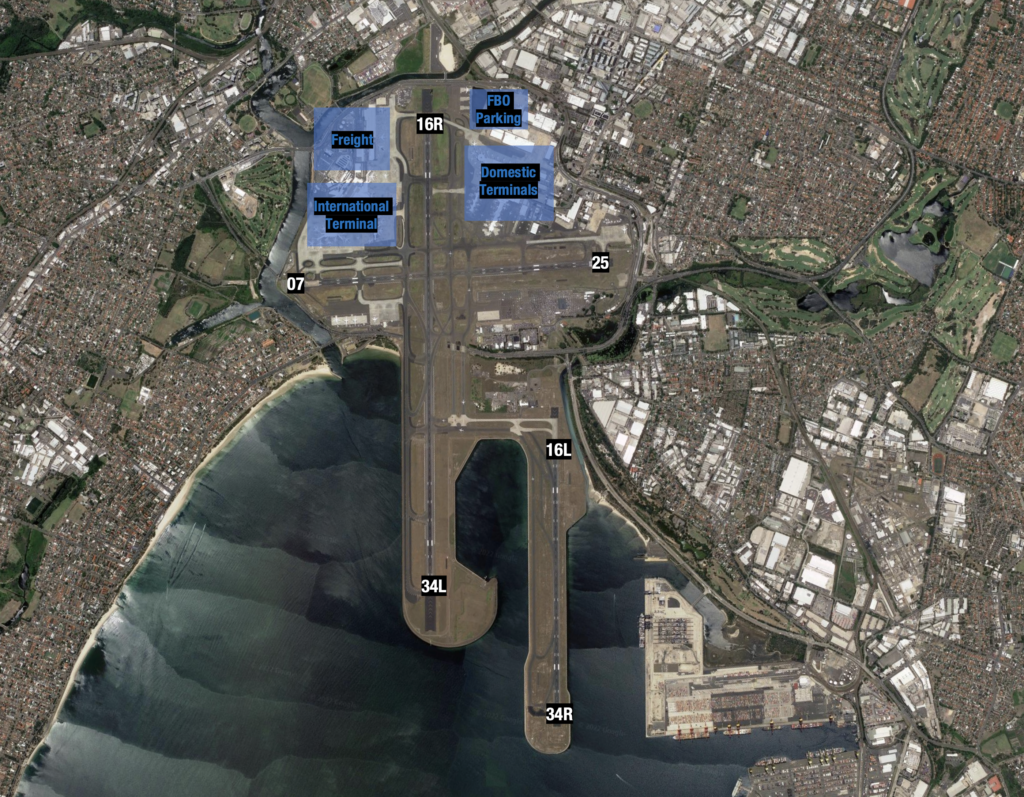
Sydney’s runway layout is complex. There are three runways – two parallel ones (16/34 LR) and another runway that runs perpendicular to them (07/25). The airport itself sits perched on the edge of Botany Bay, with the parallel runways extending well out over water. And all terminals and FBOs are found clustered together on the northern side of the airport, near the 16R threshold.

Which means taxis to/from all the other runways are lengthy and potentially confusing. And during those taxis, almost every aircraft will need to cross a runway. Often twice.

That’s a lot of crossing traffic when you consider that the airport processes up to eighty movements an hour at peak times – it is literally Australia’s busiest.

Mistakes Happen.

Authorities are well aware of the risk of runway incursions at Sydney airport. So much so that they have spent a commendable amount of time and money to improve runway safety.

Possibly the best advancement in recent years has been the installation of stop bar lighting at every single runway holding point, along with improved signage and markings.

And yet mistakes keep happening. The November incident is a great example – here’s what went down.

The November 14 Incident.

  • In CAVOK conditions, a Boeing 737-800 was cleared to land on Runway 25. With their clearance they were informed that an Airbus A380 was holding position on Runway 34 waiting to depart.
  • When the 737 had cleared the intersection of the two runways, the A380 was cleared for take-off and began to roll.
  • After landing the 737 received its taxi clearance from ground which instructed them to cross runway 34L on Golf back to the domestic terminal.
  • As the 737 crew approached the active runway, they were surprised to see it was still occupied with the departing A380. They queried the clearance with ATC who immediately told them to hold short.
  • The closest the two aircraft came to each other was 300m (just shy of 1000’) thanks in part to the vigilance of the 737 crew. While not a particularly close shave, there was potential for this to have become a major accident. Which is why the ATSB are asking questions they are.

Here’s a simple animation of the incident with a bird’s eye view:


What can we learn from this?

Future incursions, although rare, will happen. But there are steps that all crew can take to help reduce those statistics and stay safe.

A good place to start is this. To cross a runway in Sydney always remember the ‘hat-trick.’ You know all about cricket right? Well if you’re headed to Australia, this phrase can also be used to impress Aussies at the bar over a cold Fosters  (disclaimer: no one drinks it there, and whatever you do never call a prawn a shrimp). It means three successes of the same kind. Or in other words: a set of three good things.

So, there are three things that you’ll need:

  • A clearance from ATC
  • Confirmation that the stop bar is out
  • Runway is visually clear out both sides

If any of them are missing (or uncertain), do not enter the runway.

The crew of the 737 above captured a potential accident because at least one of their hat-trick was missing.

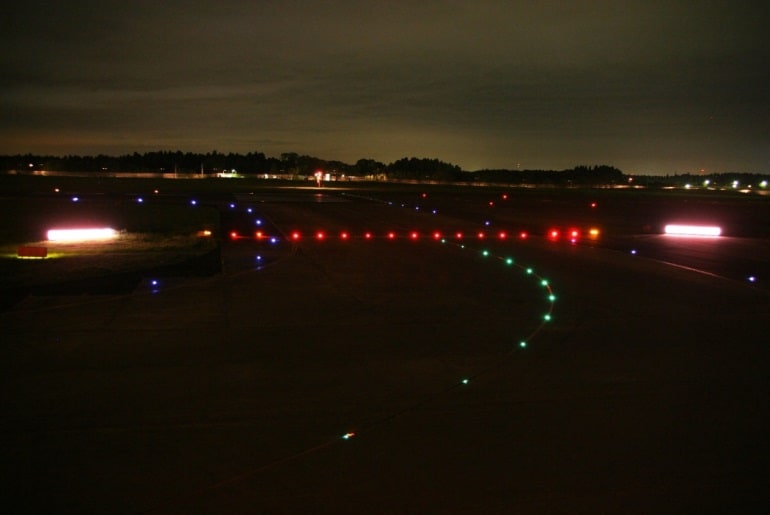
The stop bars themselves are worth a mention too. What’s more obvious than a big row of blazing hot red lights to make you get on the brakes, right? They work really well, but in their simplicity, there can be confusion.

A while back, IFALPA released some pretty good stuff that is still relevant today. You can read it here, but there are a few scenarios to take away:

The stop bar’s out, but we haven’t been cleared…
Stop. An extinguished stop bar on its own is not an indication you are cleared to cross. It may have been turned off in error, or for a preceding aircraft.

We’re cleared, but the stop bar is still lit…
Yep you guessed it, stop. And this happens really often. You’ll need to ask ATC to turn it off. Never, ever cross a lit stop bar.

Help from ICAO

Did you know they have a whole manual dedicated to helping controllers and pilots alike avoid runway incursions? You can download it here.

Have some stories of your own to share?

We’d love to hear from you. They don’t need to be from Sydney, but we can all learn from them. You can reach our team completely anonymously at news@ops.group.


Major runway works in Sydney

From October 15 until late November, major work is taking place on the threshold of YSSY/Sydney’s world famous Runway 16R – the most used, widest and longest runway at Australia’s busiest airport.

During that time it will not be available for any arrivals (around the clock), and there will be a reduced length for departures.

Here’s a quick rundown of what this means for operations at the airport, and what to expect if you’re visiting the Emerald City in the coming months.

Crunch time

The threshold slab is over half a century old. Pavement failures have been on the rise leading to FOD damage and temporary repairs have become a common occurrence. With things being quieter at the moment, the airport is finally biting the bullet and replacing it completely.

Airport authorities looked at simply displacing the threshold for Runway 16R for arrivals but decided that operationally it wasn’t safe or efficient. So instead, procedures at the airport will temporarily change.

Arrivals

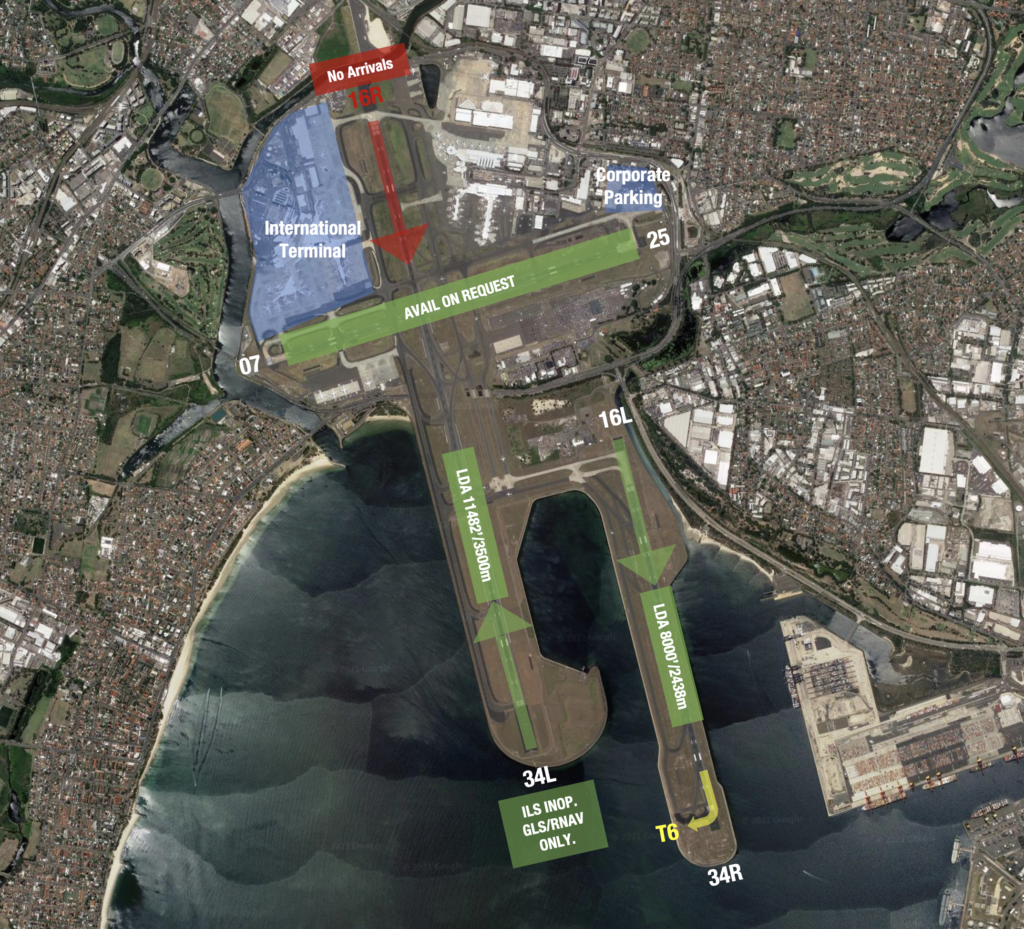
In southerly conditions (which is half the time), all arriving aircraft can expect to land on the shorter Runway 16L. It has 8,000’/2438m of hard stuff, and is narrower at 148’/45m wide. The ILS is CAT 1 only.

First of all, carry extra fuel. With all arrivals being sequenced for one runway, you can expect extensive holding and/or slow-downs during peak times. Just like the freeways, these are early morning and early evening.

Wide body traffic can expect to vacate at T6 – right down the far end. From there it’s a much lengthier (and potentially confusing) taxi to the international side of the airport which may see you cross two active runways. Remember that progressive taxi instructions are always available if you’re unfamiliar with the airport.

Runway 07/25 is also available if you need it operationally, and it is around the same length. You’ll need to request this early from ATC. Remember to use the phrase ‘operationally required’ – it will help ATC to accommodate your request.

In northerly conditions, Runway 34L will still be used for arrivals at reduced length. The LDA will be approx. 11480’/3500m. Expect to see workers and trucks at the far end. Also, a head’s up – the ILS won’t be available during the works. The GLS approach will still be an option, but if you can’t fly one in your ride, you’ll need to do an RNAV approach. They’ll cancel work for the day and switch the ILS back on if things are starting to look murky out there.

Here’s a picture of what this all looks like:

Departures

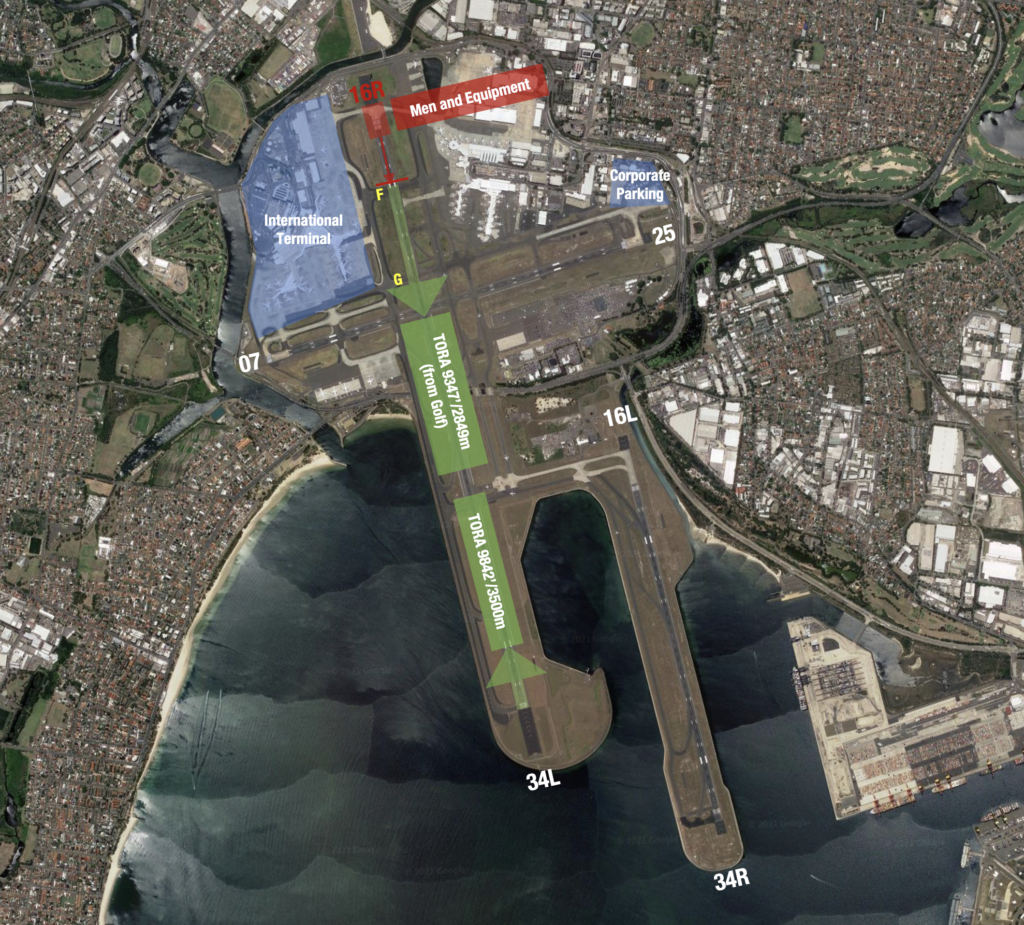
You will still be able to depart from Runway 16R, but you’ll need to roll from between taxiways Foxtrot and Golf.  Small jets and turbo props may be be cleared for take off from Foxtrot, but heavier jets can expect to taxi forward to Golf first due to jet blast. TORA from there is 9347’/2849m.

And here’s what that looks like:

Wet Season

Sydney can experience severe convective thunderstorms late in the year (the warmer months down under). If the winds are southerly, and there are thunderstorms forecast it’s time to think extra hard about fuel planning during this time.

Being part of one the busiest air corridors in the world, and with only a single runway for arrivals the queue may begin to back up in a hurry during storms. Extensive holding times and diversions are not uncommon in these conditions.

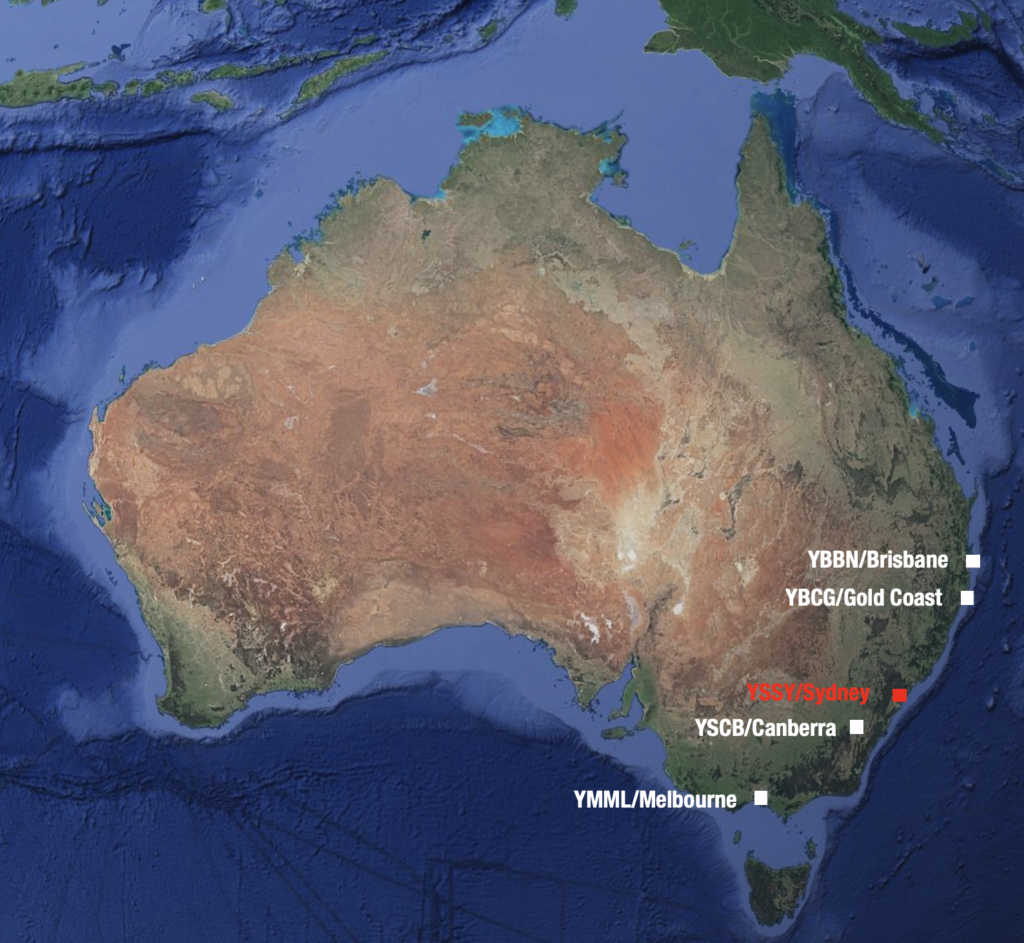
There are a few decent options as alternates, but they’re not right next door. The closest is YSCB/Canberra (132nm). A few things to think about though – it can be a challenging place in bad conditions due to the high terrain that surrounds it. Apron space can also become limited if it is receiving lots of diversions.

Most international operators use one of the below:

  • YMML/Melbourne (384nm) to the south.
  • YBCG/Gold Coast (368nm) and YBBN/Brisbane (395nm) to the north.

Looking for the official word?

YSSY Notam H5212/21 is the place to start. IFALPA has also published a Safety Bulletin based on the info available from airport authorities.