Spoofed Before the NAT? Here’s What to Do

An OPSGROUP member on a recent westbound NAT flight from the Middle East received the following message via CPDLC:
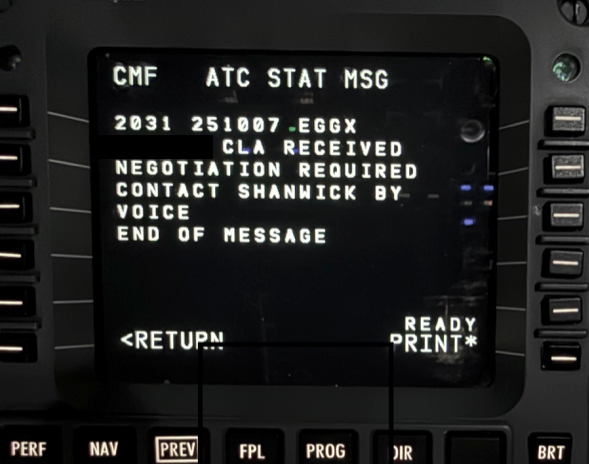
The crew contacted Shanwick via HF, who requested their RNP capability and operational status.

The controller explained that due to their point of departure (OMAA/Abu Dhabi) they wanted to be certain the aircraft had not been contaminated by GPS jamming or spoofing before it entered oceanic airspace.

It’s been a while since we wrote about this procedure, and since then we’ve had this NAT Ops Bulletin published by ICAO telling operators what to do on the NAT if they’ve experienced jamming/spoofing, so we reached out to NATS directly for an update. Here’s what they had to say…

Defensive Measures

NATS reported they continue to receive a large number of flights every day that have been impacted by GPS interference prior to oceanic boundaries.

The issue is that once an aircraft’s navigation system has been ‘contaminated’ by bad GPS data, it may not be possible to recover full RNP capability in flight, even if the normal GPS signal is restored.

These aircraft may no longer meet RNP 4/10 accuracy required in the NAT HLA, even long after the trigger event occurred.

The NAT Ops Bulletin which was published back in Jan 2025 requires crew of NAT-bound aircraft that have encountered GPS interference to notify their first NAT ANSP via RCL. Even if your aircraft shows no lingering effects, ATC still want to know.

NATS advise that late notification by pilots of a RNP degradation (such as approaching an oceanic entry point) greatly increases controller workload. They often need to move other aircraft out of the way to provide increased separation (in some cases from 14nm to 10 minutes), it’s a big deal.

As a result, they are employing defensive controlling measures. Based on previously spoofed/jammed flights and regions of known risks, they may proactively contact flights assessed as higher risk to confirm status before entry – although the exact selection criteria isn’t public. Increased separation will be applied until normal navigation performance is confirmed by the pilots.

In a nutshell, this is why the OPSGROUP member received the message above.

A special thank you to NATS for their help in answering this question.

Jammed or spoofed? You need to let your NAT ANSP know

The NAT Ops Bulletin we keep mentioning – this provides the guidance for NAT traffic on how to manage GNSS interference. Here it is again, so you can’t miss it! ⬇️
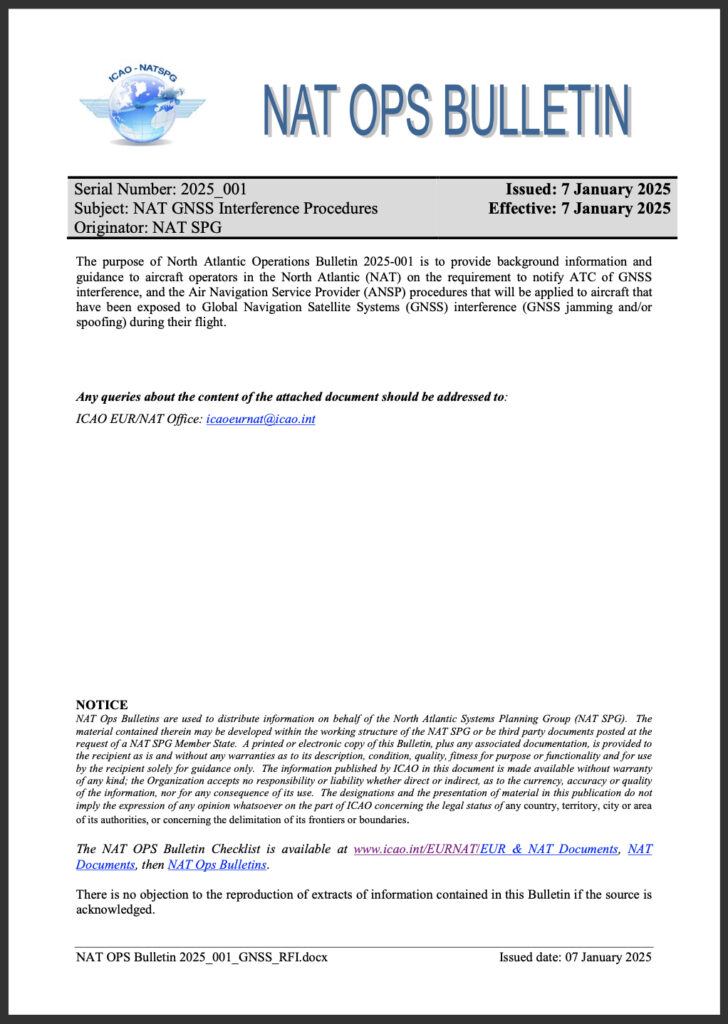
Key takeaway from this: If you suspect or know that your aircraft has encountered any kind of GPS interference (both jamming or spoofing), NAT-bound traffic must let their first NAT ANSP know in the RCL – even if the aircraft appears to have recovered.

This is prefixed by ‘ATC REMARKS/GNSS INTERFERENCE’ and must include details of any system degradations.

A few messages to keep handy are:

‘ATC REMARKS/GNSS INTERFERENCE NO IMPACT.’

‘ATC REMARKS/GNSS INTERFERENCE NO CPDLC/ADS’

‘ATC REMARKS/GNSS INTERFERENCE RNP 10 ONLY’

‘ATC REMARKS/GNSS INTERFERENCE NON-RNP10

By including your status in the RCL, you are giving ATC a head’s up before you arrive.

In most cases, you will still be allowed in the NAT HLA. A loss of RNP 4 isn’t a deal breaker, as you can still enter under RNP 10. But your clearance may be less optimal (likely level changes) due to the increased separation from other traffic.

The big one to look for is a loss of RNP 10. You will not be cleared into the NAT HLA, and instead will need to remain below FL290 or above FL410. With an obvious fuel impact, this may lead to an unplanned diversion.

The Bulletin includes a handy flow chart that’s worth printing and keeping in your flight bag.
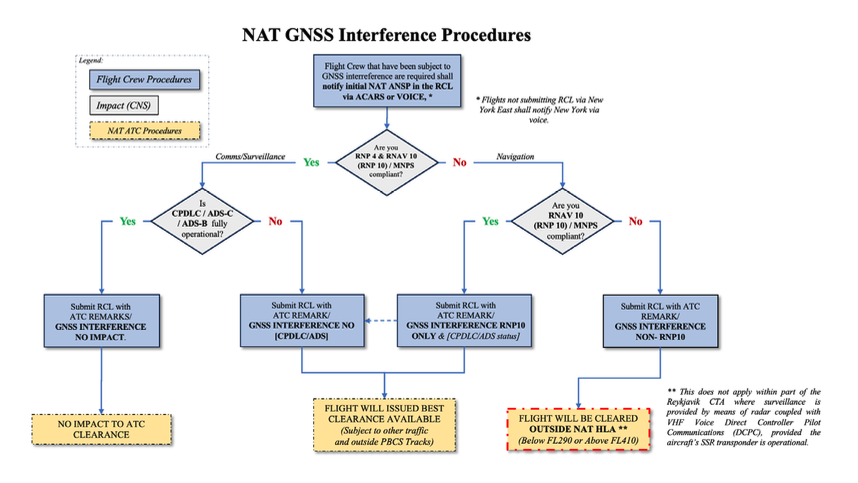
Click for PDF.

Latest ICAO Feedback

The latest three-yearly ICAO Assembly was held in Montreal from Sep 23 – Oct 3.

During the event, ICAO issued its strongest condemnation yet of both Russia and North Korea, directly blaming them for deliberate GNSS interference in violation of the Chicago Convention. Russia, in particular, has been blamed by ICAO for destabilising navigation across European airspace.

We continue to receive regular reports from OPSGROUP members of both jamming and spoofing. Interference is now a regular occurrence in the Baltic region, particularly around Kaliningrad, Eastern Finland, the Baltic Sea, and nearby airspace. Other reports have been received from Germany, Poland and Norway.

Recent airspace incursions, airstrikes and drone activity associated with the ongoing conflict in Ukraine have almost certainly escalated the use of GPS interference as a defensive measure. Civil aviation will continue to operationally grapple with this hazard. With no obvious solution in site, our best defence remains procedures like the one detailed above.


Back to the Radio: Gander Goes Voice-Only Pre-Oceanic

  • Since the removal of Oceanic Clearances in December 2024, Gander had been issuing pre-Oceanic route amendments via CPDLC. But crew confusion over these messages has led to increased VHF workload for controllers.
  • To help fix this, from 5 May to 31 December 2025, Gander will issue all route amendments before the Oceanic Entry Point by VHF voice only, even if the aircraft is logged on to CPDLC. All other OCR procedures remain unchanged.

More info can be found in Canada AIP SUP 46/25. The same update has been announced via Notam too:

CZQX H1579/25 - EASTBOUND FLT IN GANDER DOMESTIC, ENROUTE TO GANDER OCEANIC, 
WILL BE ISSUED OCEANIC ROUTE AMENDMENTS VIA VHF VOICE IN LIEU OF CPDLC LOADABLE 
ROUTE CLEARANCES. ALL OTHER OCEANIC CLEARANCE REMOVAL (OCR) PROC REMAIN UNCHANGED. 
REFER TO AIP CANADA SUP 046/2025. 
05 MAY 00:00 2025 UNTIL 04 AUG 16:00 2025. CREATED: 01 MAY 12:36 2025

We’ve written before about crew confusion and errors on the NAT following the introduction of the new “No Oceanic Clearance” procedure.

Since 4 Dec 2024, Oceanic Clearances are no longer being issued by Gander for eastbound flights, and a new procedure is in place using the same ACARS 623 RCL message process enabling you to send your desired time, level and speed at the Oceanic Entry Point (OEP) so ATC can develop an optimal Oceanic profile for your flight.

But there have been plenty of cases of flight crew getting it wrong, the top 5 being:

  1. Sending the RCL at the wrong time
  2. Asking for an Oceanic Clearance
  3. “DIY” level changes
  4. Wrong handling of RCL Rejected messages
  5. Repeated voice requests for “route confirmation” blocking active ATC frequencies due to CPDLC UM79 route clearance confusion.

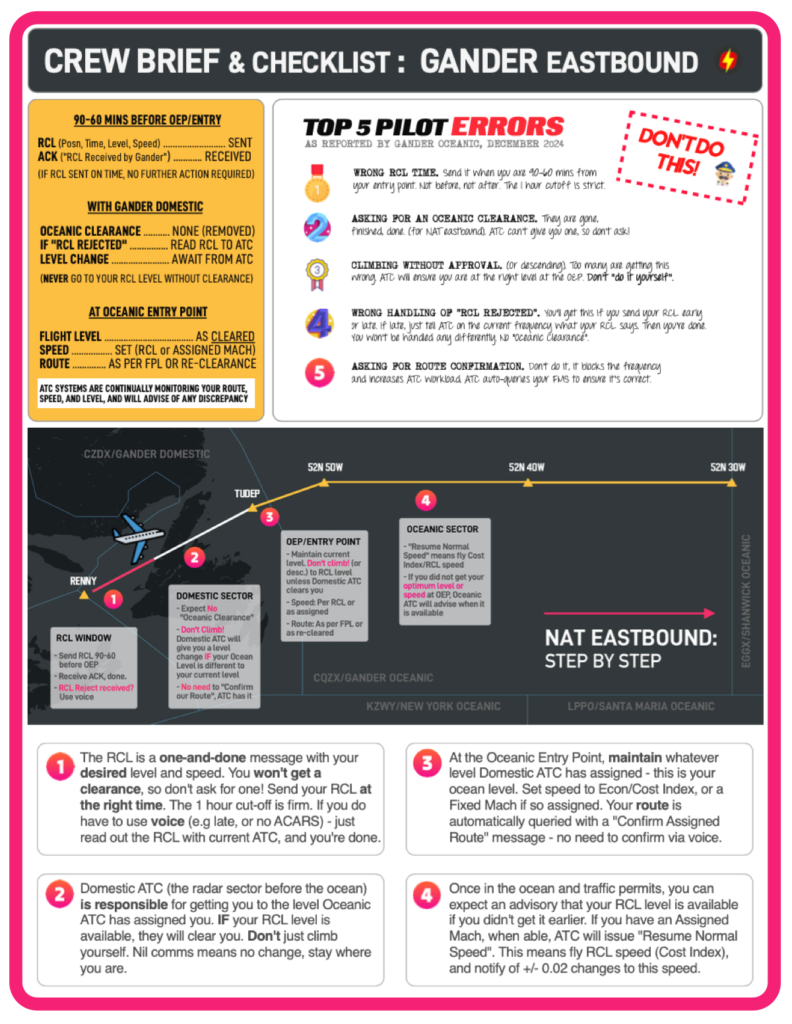
We previously published this Crew Brief and Checklist, which you can download below:

Download the Gander RCL Crew Brief and Checklist (PDF, 1Mb)

⬆️ All the info in the Checklist is still accurate, except for this new change from May 5: Gander will issue all route amendments before the Oceanic Entry Point by VHF voice only, even if the aircraft is logged on to CPDLC. Note that Moncton and Montreal will continue to issue CPDLC UM79 route amendments.

Getting it wrong

Since Canada removed Oceanic Clearances in Dec 2024, things haven’t exactly gone smoothly. Crews are confused. Controllers are overloaded. Frequencies are clogged.

The ICAO North Atlantic Implementation Management Group published this report in April 2025, which gives a bit more info about what’s been going wrong. Here’s a summary:

  1. Misinterpretation of “RCL RECEIVED”. Crews wrongly believe this means their requested level and speed are approved.
  2. Expectation of Verbal Clearance. Crews continue to ask for Oceanic Clearance or confirmation, despite RCL automation.
  3. Confusion Over Clearance Level. Crews question why the cleared level differs from what was requested in the RCL.
  4. Timing Errors. RCLs sent too early or too late are rejected, leading to further confusion.
  5. Old Habits Die Hard. Habits from the previous Oceanic Clearance system persist among crews.
  6. Interpretation Problems with UM79. Some crews are reading the UM79 and thinking “direct to the Clearance limit,” which is wrong.
  7. Incomplete Route Displays. Missing route chunks – Depending on the avionics, not all of the routing shows up properly, or crews miss them.
  8. FMS Issues and Fuel Warnings. The FMS throws up alerts. Crews wonder if something’s off with the routing.
  9. Reluctance to Load Routes. Crews hesitate to load the Clearance into the FMS without voice confirmation – they’d rather check with ATC first, just to be sure.
  10. General Avionics Variability. Every aircraft is different – and so is how it shows the message. It’s not standard, which means more chances to mess it up.
  11. Incorrect or Partial Route Loading. Frequent errors like skipping waypoints or only partially loading Clearances – or just loading it wrong altogether!
  12. BizAv-Specific Confusion. Not sure how true this is, but the doc says that BizAv crews in particular are struggling with strange LL coordinate formatting.
  13. Increased Voice Frequency Use. Radio overload – all these doubts mean more calls to ATC. VHF is getting slammed.
  14. High ATC Workload. ATC are super busy with constantly jumping in to prevent route deviations due to misinterpretations.
  15. Prevented Deviations. A high number of potential lateral or vertical deviations are being caught just in time by ATC.

Phew! Who knew this whole Removal of Oceanic Clearances thing was going to be so much work!

Getting it right

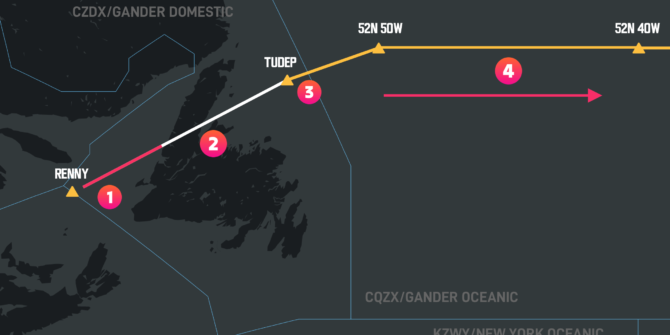
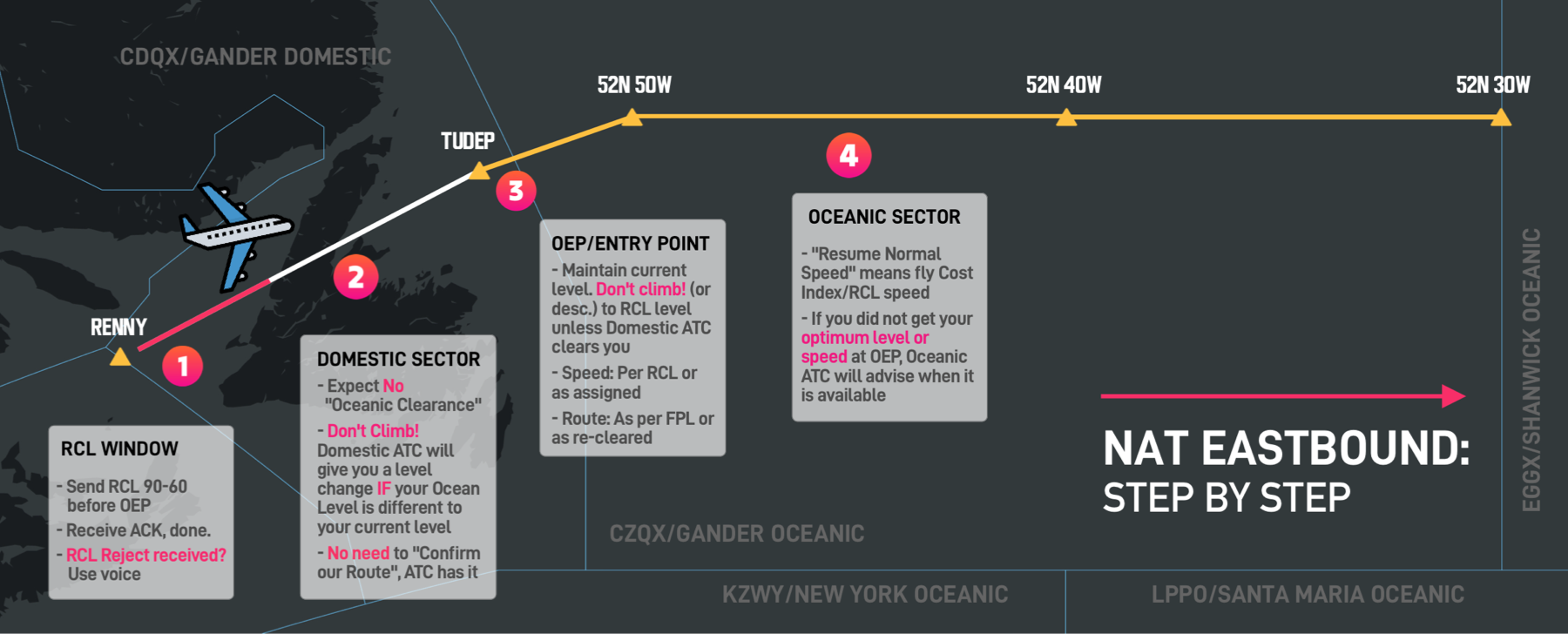
In our previous post, we did attempt to draw out some straightforward guidance for crews heading eastbound on the NAT through Gander on how to get it right. But for those of us who prefer cold hard text rather than little pictures and maps, here’s some step-by-step guidance:

  1. File your flight plan. Do this as usual, including your planned route, speed, and flight level(s).
  2. Log on to CPDLC. The Gander Domestic logon code is CDQX. Gander Oceanic logon is CZQX. No need to add anything else as the transfer of connections should be automatic.
  3. Submit your RCL. Do this via the ACARS 623 process between 90-60 mins prior to the OEP for Gander. Remember, this RCL is a message you send to ATC telling them your desired route, level, and speed across the NAT. It’s not asking for a Clearance – it gives ATC the details needed to build your optimal profile.
    Submit the RCL by voice instead of the ACARS 623 process if any of the following apply:
    – You don’t have datalink capability or it’s not working.
    – You’re departing from an airport less than 45 minutes’ flying time from the OEP (send the RCL 10 minutes prior to start-up).
    – You receive an “RCL REJECTED” message for any reason.
    – You don’t receive an “RCL RECEIVED” response within 15 minutes.
  4. 🆕 Expect any Oceanic route amendments from Gander Domestic via VHF voice, not CPDLC. Between 5 May and 31 December 2025, Gander Domestic controllers will issue any route amendments via VHF voice only, even if you’re logged on to CPDLC. This is a temporary change to reduce confusion, controller workload, frequency congestion and hopefully identify mitigations for the UM79 errors. Any route changes after you progress by the OEP will still be issued via CPDLC or HF by Gander Oceanic.
  5. Don’t request a clearance! There is no eastbound Oceanic Clearance anymore, so don’t ask ATC to confirm your route!
  6. Don’t climb! Maintain your domestic cleared level. Domestic ATC (the radar sector before the ocean) is responsible for getting you to the level Oceanic ATC has assigned you. If your RCL level is available, they will clear you. Do not climb without a clearance! Nil comms means no change, stay where you are. At the OEP, set speed to Econ/Cost Index, or a Fixed Mach if so assigned. Your FMS routing is automatically checked with a “CONFIRM ASSIGNED ROUTE” message – no need to confirm via voice. If there’s a problem, ATC will contact you.
  7. Once in Oceanic airspace… Any further route or level changes will be issued via CPDLC or HF, as before. Once in the ocean and traffic permits, you can expect an advisory that your RCL level is available if you didn’t get it earlier. Continue normal NAT procedures, including position reporting (as required), speed change notifications, and monitoring of appropriate frequencies.
Back to the Radio

For crews, these temporary changes will feel like stepping back in time to the old school pre-CPDLC era. After years of progress toward datalink-driven automation, we’re now back to copying Oceanic route amendments over VHF – just like the old days. Until the system catches up, have your pens ready and your radios tuned – because Gander is going retro, at least for now.

What about flights heading the other way across the NAT?

Westbound flights are still fully doing things the old-fashioned way, as Shanwick have still not removed Oceanic Clearances yet!

They initially planned to drop these in Dec 2024, but identified some system issues at the last minute which would have created major problems in providing a full ATC service.

The latest news from them is that they don’t expect to do this before Summer 2025 – and NATS will give at least 2 months’ notice before making any changes.

For more on that, Opsgroup members can check this briefing.


High levels of Pilot Error with NAT RCL: New Briefing and Checklist

The number of pilot errors following the introduction of the new “No Oceanic Clearance” procedure is turning out to be far higher than expected. As a result, Gander have had to implement an evening Airspace Flow Program (AFP), restricting eastbound traffic.

Since December 4th, Oceanic Clearances are no longer being issued by Gander for eastbound flights, and a new procedure is in place using an RCL message to send your desired time, level and speed at the Oceanic Entry Point (OEP).

However, the very high level of non-compliance with this new procedure is surprising and troubling. Errors by flight crew fall into a number of different categories, but can be summed up in a “Top 5”, including sending the RCL at the wrong time, asking for an Oceanic Clearance, “DIY” level changes, wrong handling of RCL Rejected messages, and repeated voice requests for “route confirmation” blocking active ATC frequencies.

A new Crew Brief and Checklist has been published today, which you can download below. Please save a copy, and send to your crew and colleagues!

Download the Gander RCL Crew Brief and Checklist (PDF, 1Mb)


Top 5 Pilot Errors

  1. WRONG RCL TIME. Send it when you are 90-60 mins from your entry point. Not before, not after. The 1 hour cutoff is strict.
  2. ASKING FOR AN OCEANIC CLEARANCE. They are gone, finished, done. (for NAT eastbound). ATC can’t give you one, so don’t ask!
  3. CLIMBING WITHOUT APPROVAL. (Or descending). Too many are getting this wrong. ATC will ensure you are at the right level at the OEP. Don’t “do it yourself”.
  4. WRONG HANDLING OF “RCL REJECTED”. You’ll get this if you send your RCL early or late. If late, just tell ATC on the current frequency what your RCL says. Then you’re done. You won’t be handled any differently. No “Oceanic Clearance”.
  5. ASKING FOR ROUTE CONFIRMATION. Don’t do it, it blocks the frequency and increases ATC workload. ATC auto-queries your FMS to ensure it’s correct.


Notes on the RCL process

  1. The RCL is a one-and-done message with your desired level and speed. You won’t get a clearance, so don’t ask for one! Send your RCL at the right time. The 1 hour cut-off is firm. If you do have to use voice (e.g late, or no ACARS) – just read out the RCL with current ATC, and you’re done.
  2. Domestic ATC (the radar sector before the ocean) is responsible for getting you to the level Oceanic ATC has assigned you. IF your RCL level is available, they will clear you. Don’t just climb yourself. Nil comms means no change, stay where you are.
  3. At the Oceanic Entry Point, maintain whatever level Domestic ATC has assigned – this is your ocean level. Set speed to Econ/Cost Index, or a Fixed Mach if so assigned. Your route is automatically queried with a “Confirm Assigned Route” message – no need to confirm via voice.
  4. Once in the ocean and traffic permits, you can expect an advisory that your RCL level is available if you didn’t get it earlier. If you have an Assigned Mach, when able, ATC will issue “Resume Normal Speed“. This means fly RCL speed (Cost Index), and notify of +/- 0.02 changes to this speed.

Worried about getting it wrong?

Of course, it always makes sense to double check any uncertainties, but if you can keep it off the frequency, that’s very helpful for ATC. At the moment, there is a high volume of extra requests (which makes life hard for the controller). Remember one key point: ATC systems are continually monitoring your route, speed, and level, and will advise of any discrepancy. Your route in the FMS is queried by a UM137 message (“CONFIRM ASSIGNED ROUTE”), to ensure both you and ATC have the same understanding of your track, or random route acoss the Ocean.

If you’re not certain about how the procedure works, use the Crew Brief and Checklist (developed specifically for Gander Oceanic), and refer to NAT Ops Bulletin 2023_001 Rev 4, and NAT Doc 007.

Can you share? Please do.

The quicker we can get this information out to all NAT crews, the better. Please share with your flight department, fleet, or operation – just download the Crew Brief and Checklist and pass it on.


Questions? Can we help?

If you have a question about the new RCL process, just comment below or send us an email. We want to help make sure that we are all on the same page!


NAT Doc 007 – New Edition

A new version of NAT Doc 007 has been published today (July 4th, 2024).

NAT Doc 007 is the main go-to guidance doc for ops over the North Atlantic. All the specifics about how to operate your aircraft safely through the complex airspace of the region are here. As of this morning, the latest version is NAT Doc 007 2024 Amendment 4. Download a copy.


What’s changed?

For this particular update, not a lot. The changes relate to the language around the new RCL process, and what to expect back from ATC once you send your RCL. This is part of the Oceanic Clearance Removal project.

Earlier in the year, the new RCL response included the language “RCL RECEIVED BY [ANSP]. FLY CURRENT FLIGHT PLAN OR AS AMENDED BY ATC

That turns out to have been creating confusion, so the RCL response will now just say:
RCL RECEIVED BY [ANSP]

These changes are in section 6.2.26 onwards.


What’s the latest with the RCL/OCR project?

Santa Maria and Iceland have made the change, so entering that portion of the NAT HLA does not require an Oceanic Clearance. You do still have to send an RCL in the same way as if you were requesting an Oceanic Clearance, but once sent, and you get an ACK – that’s it. For more on the new process, read about Oceanic Clearance Removal.

Gander, Shanwick, and Bodø have postponed their change to December 4th, 2024. This means that for now, nothing has changed – you get an old-school Oceanic Clearance in the same way you always did – with an RCL, or via voice.


So there are two kinds of RCL then?

Yep. For Gander, Shanwick, and Bodø, RCL means Request Clearance. You send this message, then wait to get your Oceanic Clearance back, usually via an OCL message on datalink.

For Iceland and Santa Maria, RCL means RCL Message. This is a “Check-In” of sorts, but the format is the same as the old meaning of RCL.

Confused? You’re not alone. But by Christmas, all will be easier – once everyone is on the same page. Play “Clearance or No Clearance” to help get things straight.


The hole in NAT Doc 007

There’s one problem with NAT Doc 007 – we’re in limbo land until Christmas. All of the guidance relates to how to send an RCL in a post-Clearance world. But for the next 5 months, most of us still need an Oceanic Clearance, and there’s no information on how to actually get one.

In the previous version of NAT Doc 007, Chapters 5 and 7 related to the Oceanic Clearance process, but those have been deleted. So, here’s a copy of the old NAT Doc 007 from 2023, which details that process.


Can we help?

If you have a question about this or need some help, just write us a note and we’ll do our best: team@ops.group.


Don’t Climb! A Big NAT No-No

Last week, Gander Oceanic asked us to get the word out on this growing problem. More and more crews are getting this wrong, especially since OCR/RCL is starting to happen elsewhere on the ocean. The same issue is common on the other side of the pond, most frequently in the Shannon FIR.

What’s the problem?

Pilots climbing without a clearance.

Why would we do that?

Because we think we have a clearance.

OK, tell me more

When you get your Oceanic Clearance – or send your RCL, it contains an Oceanic Entry Point, Flight Level, and Speed. From that point, that’s what you should fly. But if you are currently at a different level to the Oceanic Cleared Flight Level, you have to ASK for the level change. That’s really all there is to it.

Oceanic Clearance is not a Domestic Clearance

Your Oceanic Clearance is valid only from the Oceanic Entry Point (OEP). Take this example.

ACA123 CLRD TO LFPG VIA NEEKO 54NO50W 56N040W 57N030W 57N020W PIKIL SOVED
FM NEEKO/1348 MNTN F330 M082

Your Oceanic Clearance commences at NEEKO. You must be at FL330 by the time you reach NEEKO, and then track to 54N50W.

But, if you’re still somewhere over Newfoundland at say FL320, you have to request higher from Gander Domestic ATC, before you climb to your Oceanic Level.

If you just decide to climb without asking, that’s where your day will start to go wrong.


Recent procedural changes to the NAT may also be compounding the problem, so let’s take a closer look.

Wait, I thought Oceanic Clearances on the NAT were a thing of the past?

Soon soon, but not yet. While Reykjavik and Santa Maria have removed oceanic clearances, Bodø, Gander and Shanwick are still targeting December 4 for the big switch. Until then, expect to receive a conventional oceanic clearance when approaching their airspace.

Oceanic Clearances

 You can read all about them in NAT OPS Bulletin 2020_001 Rev 1, but the crux of the issue is found in Section 5.3 (Clearance Delivery):

… The flight level contained in the ACARS data link oceanic clearance is the “cleared oceanic flight level” for the purposes of complying with the lost communication procedures detailed in State AIPs, ICAO Doc 7030 (North Atlantic Regional Supplementary Procedures) and NAT Doc 007. ATC is responsible for providing a clearance to enable the flight to reach this flight level before reaching the OEP. If there is a concern, flight crews should contact ATC…

They made this handy picture too:

 In other words, the flight level contained in the ACARS datalink oceanic clearance is NOT a clearance to climb (or descend). You need to request this with your active ATC.

Why is this becoming a problem again?

We can only speculate – Gander aren’t sure either. But we suspect the use of datalink, in addition to recent RCL changes may be the culprit. For instance, back in May, the automated response to an RCL message was changed (ironically to reduce any ambiguity). It now only reads “RCL Received by (ANSP).” In other words, the “fly current flight plan or as amended by ATC” bit was removed. A full oceanic clearance therefore contains more information, and the use of ambiguous phrasing such as ‘cleared level’ may be creating more confusion on the NAT than ever before.

Questions?

Comment below, or email the OPSGROUP Team for help!