FAA extensions to pilot regulatory relief

The FAA has agreed to extend the regulatory relief packages for both Part 91 and Part 135 operators beyond the original end date of June 30. Here’s the lowdown:

Part 135

  • Back in March, the FAA announced a 3-month extension to the grace period for recurrent training requirements for Part 135 operators. They’re now saying that operators who have training due in July will have until the end of October to get this done. Read the FAA letter here.
  • In addition, the FAA has provided two additional months of flexibility on the protective breathing equipment requirements, extending that exemption until the end of July.
  • Note that you still have to tell the FAA if you’re planning on using these exemptions.

Part 91

  • Pilot medical certificates which expired in March do not have any extra time beyond June 30; but for those expiring between April 30 and Sept 30, these will all get three months extensions to their validity.
  • Validity of flight reviews, instrument currency, and knowledge tests have also been extended to September.
  • Read the updated SFAR in full here.

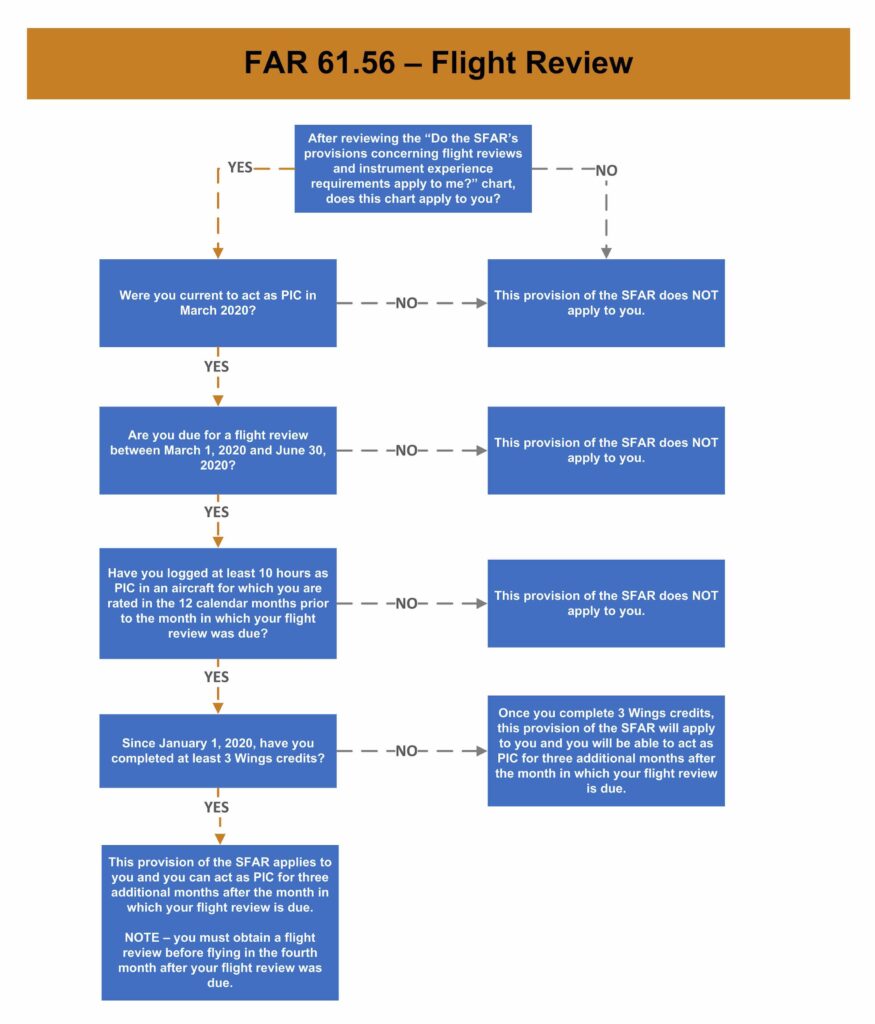
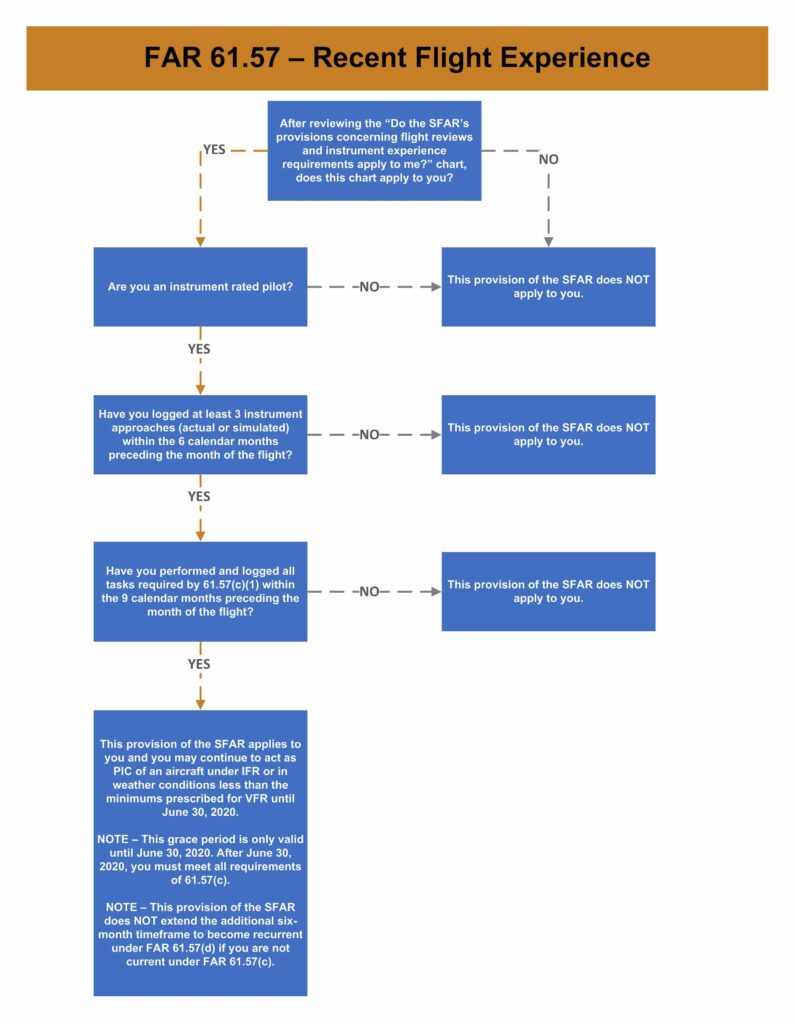
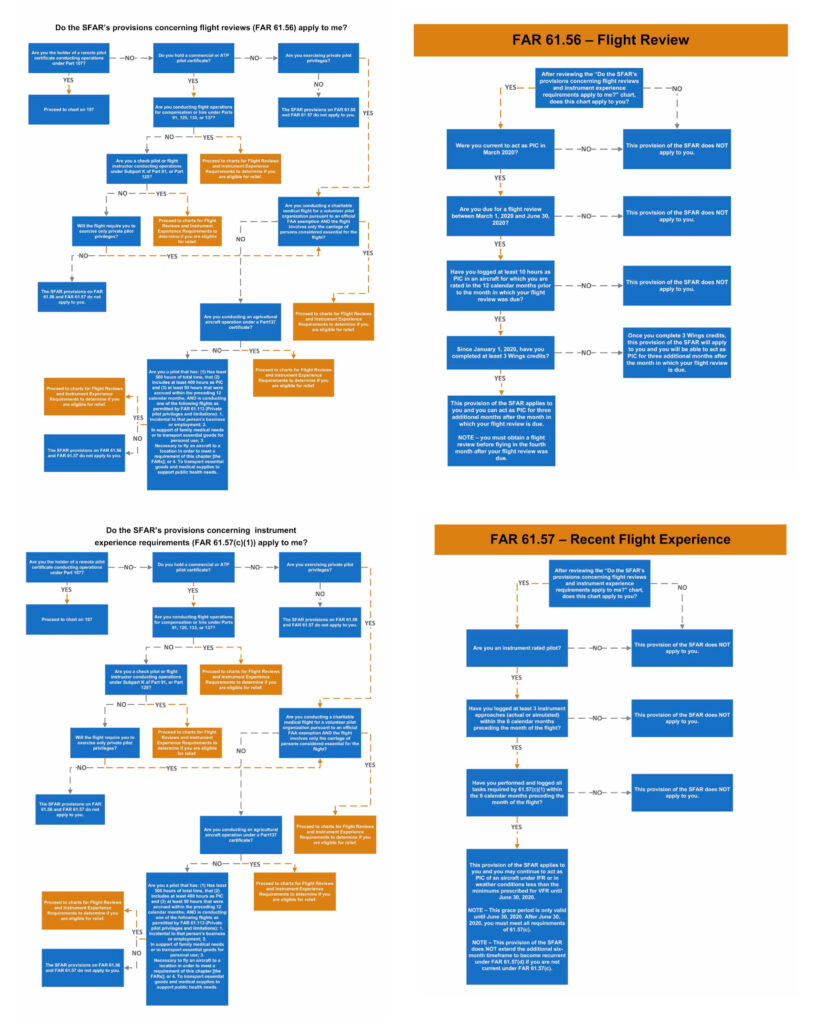
For US pilots keen to know if the SFAR on Part 91 regulatory relief applies to your individual situation, check out these easy-to-follow flowcharts to help you work it out! (No need to squint – just click on the image and get whisked away to a magical place where these flowcharts will all make perfect sense 😊)


“Operation: Paperwork Misery” – new US rules on pilot data reporting are coming soon

The FAA has launched “Operation: Paperwork Misery” – a Notice of Proposed Rulemaking which will require operators to submit a whole bunch of additional pilot data to the agency via a new Pilot Records Database.

Here’s the plan, according to the FAA:

The FAA is proposing to require the use of an electronic Pilot Records Database (PRD) and implement statutory requirements. The PRD would be used to facilitate the sharing of pilot records among air carriers and other operators in an electronic data system managed by the FAA. Air carriers, specific operators holding out to the public, entities conducting public aircraft operations, air tour operators, fractional ownerships, and corporate flight departments would be required to enter relevant data on individuals employed as pilots into the PRD, and this would be available electronically to those entities. In addition, this proposal identifies all air carriers, fractional ownerships, and some other operators or entities that would be required to access the PRD and evaluate the available data for each pilot candidate prior to making a hiring decision.

Here’s a translation of how that may work in real life, from the NBAA:

The FAA’s PRD proposal would subject many business aviation operators to a substantial pilot-data reporting burden not previously applied to non-commercial operations. This proposed rule also amounts to a complete overhaul in the way commercial operators access information about a pilot before hiring and the way certificate holders will provide FAA historical and future records. It expands the types of operations required to give the FAA records documenting an individual’s compliance with FAA or employer required training, checking, testing, currency, proficiency, or other events related to pilot performance, including check pilot comments. Due to the extensive nature of the reporting requirements, the proposed rule has the potential to impose significant new burdens on Part 91 operators of all sizes.

“This is really regulatory overreach at its worst,” said Doug Carr, NBAA’s vice president for regulatory and international affairs. “We have a situation where our community will see no safety benefits as a result of compliance with this program, and the creation of a definition solely for the purpose of satisfying paperwork is not in the best interest of our community.”

Although the FAA’s new rule was issued on March 30, they have so far resisted calls from the industry to extend the comment period beyond June 29 – meaning many operators now don’t have enough time to trawl through the 200-page NPRM document to work out just how brutal the onerous new requirements are going to be, nor get much of a chance to provide any objections to the plan.

“It is exasperating that the FAA has given industry just 90 days to unpack a complicated plan amassed over nine years, and released as the aviation community fights for its survival during COVID-19,” said Koester. “It would not seem unreasonable to allow another 30 days for discussion, so we are pursuing other means to encourage the FAA to provide for this minimal, reasonable accommodation.

The NBAA are now encouraging affected operators to review the NPRM and submit comments providing as much detail as possible about the impact of these proposed changes to their operations. To do that, click here:


Alternatively, you can submit your comments via the tool NBAA has launched to assist with this. Click here for that.

For more info on the specific impact of this proposed NPRM, here is what the NBAA have compiled, which we’re sharing here with their permission:

Concerns for all operators

Check pilot comments
The NPRM would require operators to include check pilot comments from training events in the pilot record database. As unflattering comments may cost pilots future job opportunities, this may leave check pilots or their employers open to liability and diminish the opportunity to improve safety by focusing additional training on check pilot comments.

Overly burdensome and inconsistent reporting requirements
Both the draft advisory circular and the NPRM contain language requiring operators to report a pilot’s aeronautical experience, flight time, and flight maneuvers performed to maintain privileges of their certificate. These burdensome reporting requirements could reasonably result in a need for certificate holders to log every flight hour, instrument approach, and landing in the pilot record database.

Language within the NPRM also contains many contradictory statements leaving operators unclear on the intent of the proposal and the actions required by the rule. Most notably, 111.220(b)(3) states no person may report records documenting aeronautical experience, yet 111.220(a)(2) requires air carriers to report records related to currency and proficiency.

Concerns for Part 91 operators

Definition of Corporate Flight Department
For the first time, this NPRM would codify a definition of a “corporate flight department”. The definition crafted solely for compliance with record keeping requirements does nothing to enhance other elements of our industry and excludes a substantial portion of business aviation that considers itself part of the community.

New recordkeeping and reporting requirements
This NPRM results from Public Law 111-216 (Airline Safety and Federal Aviation Administration Extension Act of 2010), which indicates operators must report training and employment records already maintained by operators. The proposed rule would require Part 91 operators to undertake new record keeping and reporting burdens. Some operators already use sophisticated software systems for managing and tracking pilot training, checking, testing, currency, and proficiency. However, many operators use simple tracking systems that will require manually reporting these records to the FAA.

Concerns for Part 125 and Part 135 operators

The FAA will charge operators a $110 fee any time they pull records for a pilot candidate.

Part 125
The NPRM requires Part 125 operators to report historical records dating back to August 1, 2010. Operators will be required to upload employment, training, checking, testing, currency, proficiency, and disciplinary records for every pilot under their employment over the last ten years. Operators will be able to upload records in XML or manually.

Part 135
The NPRM requires Part 135 and 121 operators to report historical records dating back to August 1, 2005. Operators will be required to upload employment, training, checking, testing, currency, proficiency, and disciplinary records for every pilot under their employment over the last 15 years. Operators will be able to upload records in XML or manually.

NBAA’s Perspectives

While the NPRM contains some potential efficiency improvements for the Part 125 and Part 135 communities, we believe that a substantial number of these proposals would burden the part 91 community far beyond the intent of Congress. For certificated operators currently required to comply with the Pilot Records Improvement Act (PRIA), the NPRM may streamline record reporting and requesting processes, expedite response times, and allow for more informed hiring decisions.

The NPRM would also require reporting more information than under PRIA by more segments of the aviation community, including corporate flight departments and 91.147 air tour operators. The proposal would require these constituencies to report not just training and checking events, but also any event that leads to proficiency or maintains currency, such as day or night landings, flight hours, and instrument approaches. This process will be burdensome and provide little information that enhances hiring decision making abilities.

NBAA encourages affected members to review the NPRM and submit comments to the public docket providing as much detail as possible about the impact of these proposed changes to their operations.

Read the NPRM on the regulations.gov website.

Download the NPRM (PDF)

Comments should be submitted no later than 11:59 p.m. EDT on June 29, 2020.

Submit comments


Pilot Relief: FAA Covid rules in simple english

Let’s start here:

Notwithstanding the 6 calendar month period specified in paragraph 2 of SFAR No. 100-2 of this chapter, a person may exercise the relief specified in paragraph 1 of SFAR No. 100-2 of this chapter for a duration of 9 calendar months after returning to the United States, provided the person is eligible in accordance with paragraph 2 of SFAR No. 100-2 of this chapter, complies with the documentation requirements specified in paragraph 3 of SFAR No. 100-2 of this chapter; and … 

Ugh. Ok, how about this:

Notwithstanding the period specified in § 61.55(c), a person who is required to complete the second-in-command familiarization and currency requirements under § 61.55(b)(1) and (2) between March 1, 2020 and June 30, 2020 for purposes of maintaining second-in-command privileges may complete the requirements of § 61.55(b)(1) and (2) in the month before or three months after the month in which they are required, provided the pilot meets the requirements of paragraph 2.(b)(1)(ii) of this SFAR. A pilot who meets the requirements of § 61.55(b)(1) and (2) within the period prescribed by this paragraph 2.(b)(1)(i) will be considered

If you find all of this perfectly readable, then continue your adventures here with the official document, and you’re done.

For the rest of us humans, the FAA relief rules, although welcome, are classic federal robot-speak.

On 5th May 2020, the FAA issued a Special Federal Aviation Regulation which provides regulatory relief to Part 91 operators who have been unable to comply with certain training and testing requirements due to the coronavirus outbreak. Essentially, they extended the validity of medical certificates, flight reviews, knowledge tests, and recency of experience requirements – in most cases until June 30.

The FAA had already issued a series of extensions for certain Part 135 training requirements back in March – essentially adding a grace period for recurrent training by an additional two months to May 31. More on that here.

But for pilots keen to know if the SFAR on Part 91 regulatory relief applies to their individual situation, thankfully AOPA has created easy-to-follow flowcharts to help you determine if the provisions in the SFAR apply to you …

Let’s try again, in plain English …


Has your medical certificate, flight review, or instrument currency expired? If so, read this to determine whether you can fly.
Thanks to Dan Namowitz, Associate Web Editor at AOPA!

The FAA’s 94-page special federal aviation regulation on flying during the coronavirus pandemic is complicated, and pilots need to read it carefully to determine what does and does not apply to their individual situations.

The flowcharts and decision guide below are offered to help you avoid getting crosswise with the rules—or safety—and to steer you clear of bad advice you might get by word of mouth or from other informal sources. Some of the provisions, especially those related to flight reviews and instrument proficiency, apply only to those who plan to fly five types of specific operations for which the FAA has determined relief is appropriate under the SFAR. However, medical certificate extensions have a different set of qualifications that depend on dates, not the type of flight operation. Confusing, isn’t it.

Your first step is to figure out whether the SFAR’s provisions concerning flight review or instrument currency apply to your case. If they do, proceed to page two of the flow chart and follow the “yes” column. If you end up in the “no” column, it means the SFAR doesn’t apply to you and you must comply with the same flight-review and instrument currency rules that you have followed before.

Has your flight review expired, and does the SFAR’s provisions apply to your case?
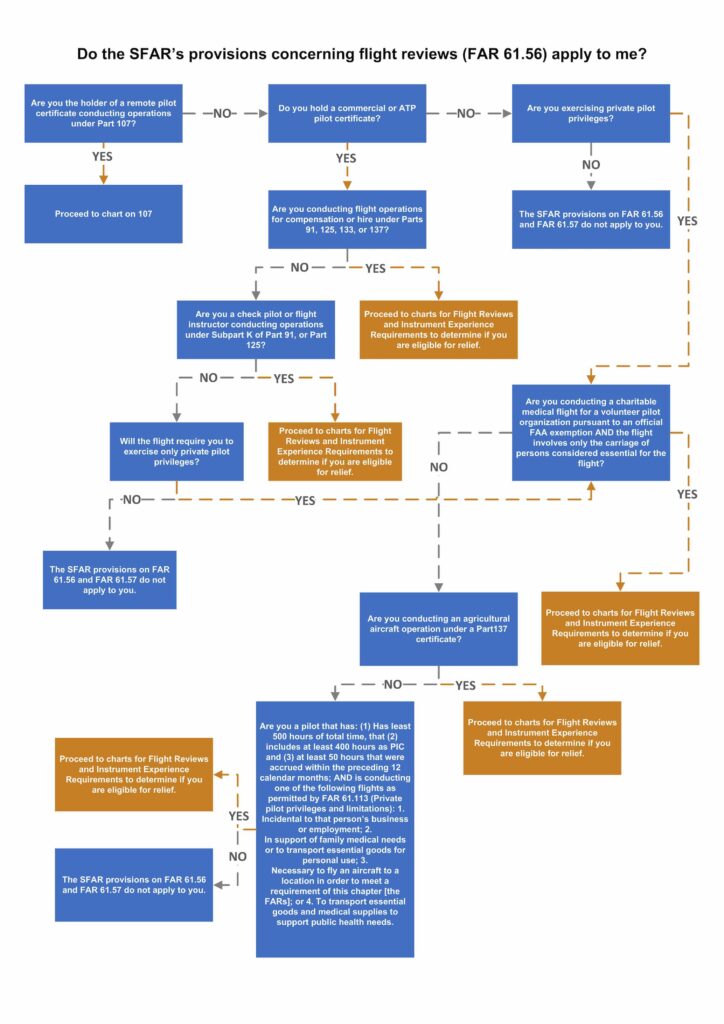
The first question to ask yourself is, “Were you current to act as pilot in command in March 2020?” If the answer is yes, the next step is to check your flight review expiration date. If the expiration date falls between March 2020 and June 2020, next determine whether you have flown 10 hours as PIC in an aircraft for which you are rated in the 12 calendar months prior to the month when your flight review was due. (Again, a “no” answer means you would continue with your usual flight review schedule.)

If the answer is yes, here’s your next question: Have you completed at least three credits under the FAA’s Wings Pilot Proficiency Program?

Don’t despair if the answer is no. In this case, you can still acquire the credits, which would put you back in the “yes” group. In that case, the SFAR allows you to act as PIC for three additional months after the month in which your flight review is due.

Reminder: This regulatory relief “applies only to persons conducting specific operations for which the FAA has determined relief is appropriate” in the SFAR. (Before flying in that fourth month after the month when your flight review was due, you must have a new flight review.) So, a private pilot with a flight review that expires in April who meets the qualifying criteria can use this SFAR to fly one of the five permitted types of flight operations, but not for other types of flight operations not listed in the SFAR.

Has your instrument currency expired?
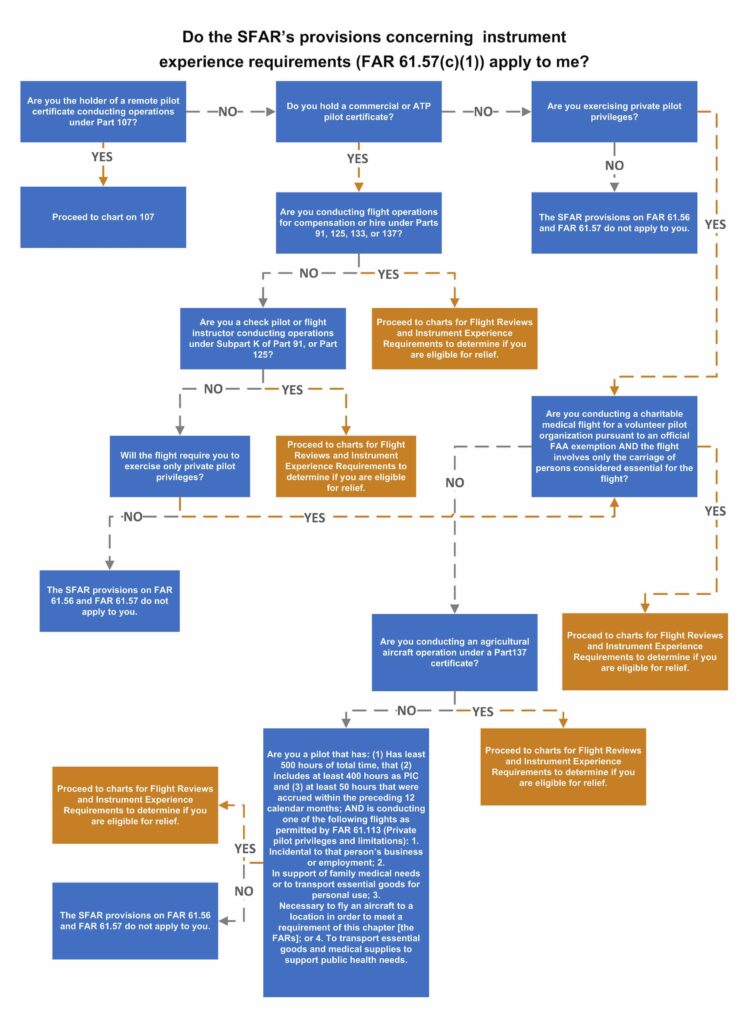
Instrument pilots who plan to exercise their privileges to conduct “specific operations for which the FAA has determined relief is appropriate” under the SFAR must also verify their recency of experience. Again, the steps can be tracked on the flow chart, and if at any time you find yourself in the “no” column, it means you must get an instrument proficiency check as would usually be the case at this point in your recency-of-experience cycle.

However, if you are among instrument pilots who have logged at least three instrument approaches (actual or simulated) within the six calendar months preceding the month of the (planned) flight, read on: Next you would check whether you have performed and logged all tasks required by FAR 61.57(c)(1) within the nine calendar months preceding the month of the flight.

No? Thank you for playing.

Yes? Then the SFAR applies and you may continue to act as PIC of an aircraft under IFR or in weather conditions less than the minimums prescribed for VFR until June 30, 2020—for those five types of operations outlined in the SFAR. After June 30, you must meet all requirements of FAR 61.57(c). Note that this “grace period,” as the FAA calls it, does not extend the additional six-month timeframe to regain your currency.

Has your first, second, or third class medical certificate expired?
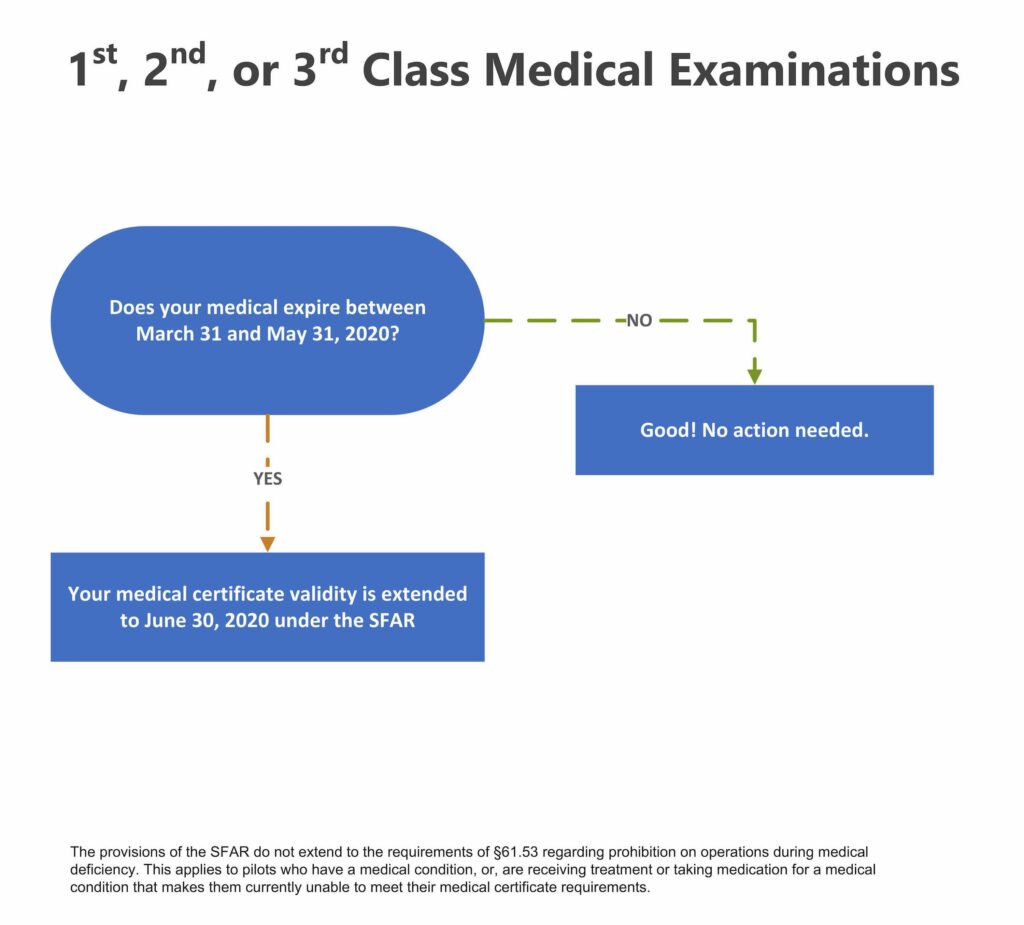
If you have navigated one or more of the scenarios posed above, this one will be a cinch.

If your first, second, or third class medical expired or expires between March 31 and May 31, its validity is extended to June 30—no matter what type of flying you do.

If your medical’s expiration date as issued is outside the March 31 to May 31 date range, your usual renewal timetable applies and no action is needed.

BasicMed? It will be 2021 before the first pilots to have begun flying under BasicMed will need to see their issuing doctor again, so the SFAR does not address BasicMed. BasicMed pilots who need to complete the online course that is required every 24 months can do so on AOPA’s website.

Now that you have followed these steps and have kept yourself on the good side of the SFAR, two tasks remain: One is to contact your insurance representative and get written confirmation that your coverage remains in force if you fly under the SFAR.

For those pilots who live in states or municipalities that have stay-at-home orders in effect for health reasons, the final step is to check the status of those orders so you don’t get a ticket for being on the road for the wrong reason as you drive to the airport.

Thanks to AOPA for sharing this article, which first appeared on their website here.


Total ban on US private flights to Cuba

Effective today, June 5th, no US private aircraft will be allowed to travel to Cuba. The rule comes from the BIS – the US Bureau of Industry and Security, part of a further clampdown on Cuba policy by the US government.

We spent the day here in OPSGROUP clarifying the new rules and what it means for US operators.

What happened? BIS issued a new rule today, June 5 called “Restricting the Temporary Sojourn of Aircraft and Vessels to Cuba”. [official copy here] [Guidance here]. 

This is tough to read and understand. Nothing new about that. So, we asked OPSGROUP, discussed it with a whole bunch of members, got some legal interpretation, and got some great help from the NBAA.

Here’s the plain English wrap up:

  • US Part 91 private flights: Effective June 5, you cannot operate an N-reg aircraft privately to Cuba for any reason. This includes Corporate. It doesn’t matter if your passengers meet the “category requirements (see later)”, it’s a no go. 
  • Part 135 Air Ambulance: You can go, and you don’t need a license. From the rules: “Air ambulances operating under 14 CFR part 135, may depart from the United States under its own power for any destination”. “Air ambulances will remain eligible for the license exception when destined to Cuba”.
  • Part 135 Charter: This was unclear because of the wording of the new rules. But you can go. We asked BIS specifically about this, and the wording of the new paragraph is meant to be read as a series of options that allow you to go to Cuba – 135 is covered under the “AOC holder” bit.
  • Part 129: You can go. Part 129 is foreign operators. An example would be Air Canada doing a charter from JFK-HAV. That’s allowed.
  • Part 121: No changes. Airlines can operate.

BIS vs OFAC

The first gatekeeper of Cuba rules is BIS. If they don’t prohibit your operation, eg. Part 91 – then you proceed to the second gatekeeper – OFAC, and look into whether you need a license, and what category your passengers are travelling under.

Categories of allowed travel

There were 12 categories – or “reasons” to be allowed to go to Cuba. There are now 11. The one removed was known as “People to people”. These are set by OFAC.

What does Cuba say?

Thanks to one of our members who called the Cuba CAA this morning, and got this:
In our country there is no regulation in this regard. They can fly over
and land registrations of any nationality without any distinction
provided they meet the requirements requested and that you know
all right
.”

As we would expect, none of the restrictions come from the Cuba side. So everyone continues to be welcome in Havana, it’s just the US government that is restricting matters for US operators.

A super simple FAQ

Can I fly my private C172 to Cuba?
No. 

Can I fly my owner to Cuba in a G550, if he passes the ‘category test’?
No. He can go, but has to go on a commercial service.

Can I operate a Corporate Jet to Havana, for business reasons?
No. Regardless of the reason the principles might want to go to Cuba, you cannot operate any aircraft under Part 91.

But I see in the rules that you can apply for an exemption from BIS?
Yeah, you can, but they will say no. “License applications for the temporary sojourn to Cuba of those vessels and aircraft are subject to a general policy of denial.”

Can I operate a charter flight to Cuba?
Yes. BIS rules don’t prohibit this. But you then need to look into the OFAC rules.

Can I go to Mexico first, and then to Cuba?
No. In their lengthy FAQ, “A license from the Bureau of Industry and Security (BIS) is required to fly private or corporate aircraft to Cuba, even if the aircraft stops in another country first.”. And y’all ain’t gettin’ no license.

I am a Canadian operator. Can I operate to Cuba?
Yep. This is all about US operators being restricted. You can fly direct to Havana like you always did, and under the Part 129 bit in the new rule, you can also operate from the US to Cuba. 

So, we think we have this all correct as the final version. If we don’t hear any objections, we’ll add this to the OPSGROUP databank, and make a blog post. From here, we will post this in the new Forum, and the discussion can continue there!

THANKS EVERYONE!

Great team effort today to get this into an understandable-by-humans format. Well done!