Shanwick Delays OCR Until Post-Summer 2026
Big update on Shanwick’s plans: they’ve now confirmed that the move to the new Oceanic Clearance Removal (OCR) system won’t happen until sometime after summer 2026. That’s a fairly significant shift, as earlier expectations were that it might roll out by the end of summer 2025.

Why the delay?

Over in Gander, when OCR went live last December, things got messy. Controller workload spiked as crews struggled with the new procedures — there were lots of extra radio calls, some confusion over routing, and even a few close calls that controllers had to step in and prevent. More on that here.

Shanwick has pointed to a mix of factors behind the delay — including their own operational complexities and the issues Gander has been dealing with since their rollout. Taking more time now gives them a chance to refine the process and avoid similar issues when they do eventually make the switch.

So, let’s have a nice clear set of steps to follow — depending on whether your headed east or west over the NAT…

Going eastbound via Gander

  1. Send your RCL 60–90 mins before the OEP via ACARS (it’s for ATC planning only, no clearance will be issued!)
  2. May 5 – Dec 31, 2025: Note that any route changes before oceanic entry will be given by VHF voice when in Gander airspace. Moncton and Montreal will continue to issue CPDLC UM79 route amendments.
  3. Don’t request an Oceanic Clearance – there isn’t one here anymore.
  4. Maintain your domestic cleared level unless ATC assigns a different one.
  5. Once in Oceanic airspace, expect further changes via CPDLC or HF.

If Gander isn’t issuing Oceanic Clearances anymore, why send an RCL? This may very well be the crux of the mass pilot confusion experienced so far. The answer: the RCL is now just a planning tool — you’re not asking for permission, only notifying them, because they still need your exact routing and timing to safely manage traffic. You continue to fly your last assigned domestic route and level unless ATC gives you a change. The confusion comes from the wording: no Oceanic Clearance is issued, but notification is still required.

Going westbound via Shanwick

  1. Send your RCL or make a voice clearance request 90–30 mins before the OEP.
  2. You’ll receive your Oceanic Clearance by ACARS or voice.
  3. Fly the Oceanic Clearance.

Also note that if entering Shanwick from another Oceanic area, no clearance is needed from Shanwick.

We think we got all that right. If not, let us know please! news@ops.group.

And if you’re still confused about OCR, check this post.

NAT Forecast: No more RCLs?

There’s also an interesting twist that could change how flights work across the NAT in the longer term. We’re hearing talk that some North Atlantic ANSPs are looking at removing the RCL process completely at some point in the future.

That would be a huge change, bringing oceanic ops much closer to domestic ones. No more sending RCL messages ahead of the Oceanic Entry Point, no more extra steps — you’d just fly your filed plan unless ATC issues a change.

But this is still very much in the idea stage. It would need to go through ICAO groups and international working groups to figure out all the technical and procedural details, and there are plenty of hurdles to clear before it could actually happen.

For now, it’s just something to keep an eye on, as Shanwick and other ANSPs continue to refine how oceanic traffic is managed.


Back to the Radio: Gander Goes Voice-Only Pre-Oceanic

  • Since the removal of Oceanic Clearances in December 2024, Gander had been issuing pre-Oceanic route amendments via CPDLC. But crew confusion over these messages has led to increased VHF workload for controllers.
  • To help fix this, from 5 May to 31 December 2025, Gander will issue all route amendments before the Oceanic Entry Point by VHF voice only, even if the aircraft is logged on to CPDLC. All other OCR procedures remain unchanged.

More info can be found in Canada AIP SUP 46/25. The same update has been announced via Notam too:

CZQX H1579/25 - EASTBOUND FLT IN GANDER DOMESTIC, ENROUTE TO GANDER OCEANIC, 
WILL BE ISSUED OCEANIC ROUTE AMENDMENTS VIA VHF VOICE IN LIEU OF CPDLC LOADABLE 
ROUTE CLEARANCES. ALL OTHER OCEANIC CLEARANCE REMOVAL (OCR) PROC REMAIN UNCHANGED. 
REFER TO AIP CANADA SUP 046/2025. 
05 MAY 00:00 2025 UNTIL 04 AUG 16:00 2025. CREATED: 01 MAY 12:36 2025

We’ve written before about crew confusion and errors on the NAT following the introduction of the new “No Oceanic Clearance” procedure.

Since 4 Dec 2024, Oceanic Clearances are no longer being issued by Gander for eastbound flights, and a new procedure is in place using the same ACARS 623 RCL message process enabling you to send your desired time, level and speed at the Oceanic Entry Point (OEP) so ATC can develop an optimal Oceanic profile for your flight.

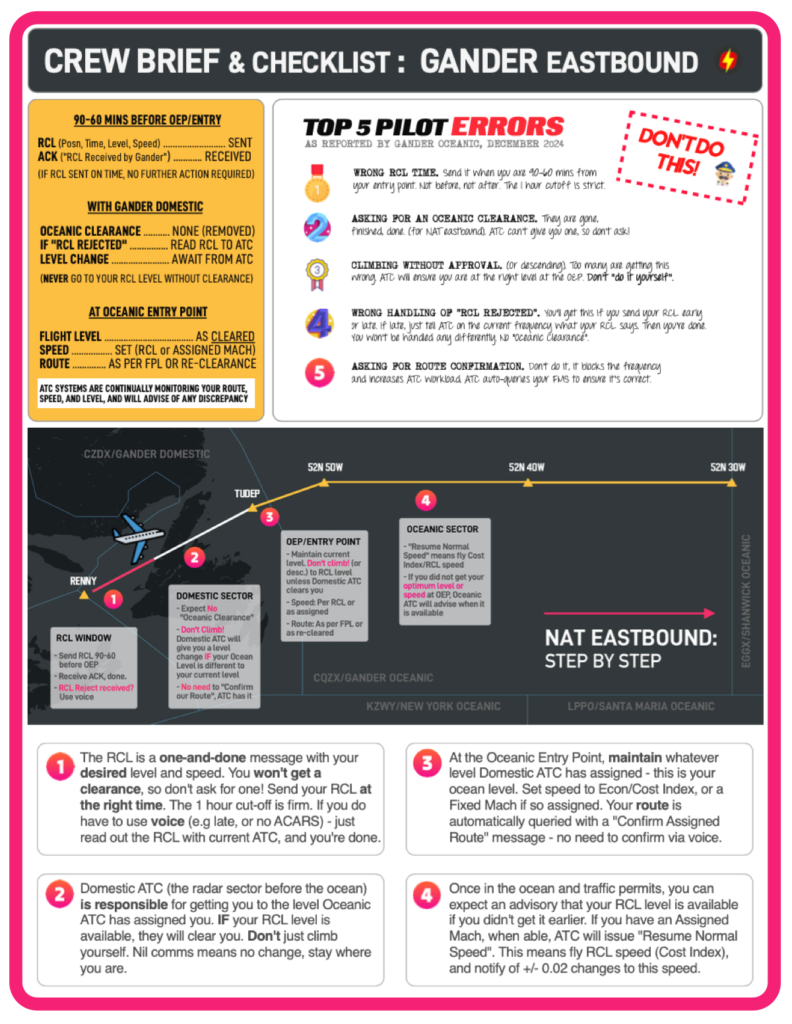
But there have been plenty of cases of flight crew getting it wrong, the top 5 being:

  1. Sending the RCL at the wrong time
  2. Asking for an Oceanic Clearance
  3. “DIY” level changes
  4. Wrong handling of RCL Rejected messages
  5. Repeated voice requests for “route confirmation” blocking active ATC frequencies due to CPDLC UM79 route clearance confusion.

We previously published this Crew Brief and Checklist, which you can download below:

Download the Gander RCL Crew Brief and Checklist (PDF, 1Mb)

⬆️ All the info in the Checklist is still accurate, except for this new change from May 5: Gander will issue all route amendments before the Oceanic Entry Point by VHF voice only, even if the aircraft is logged on to CPDLC. Note that Moncton and Montreal will continue to issue CPDLC UM79 route amendments.

Getting it wrong

Since Canada removed Oceanic Clearances in Dec 2024, things haven’t exactly gone smoothly. Crews are confused. Controllers are overloaded. Frequencies are clogged.

The ICAO North Atlantic Implementation Management Group published this report in April 2025, which gives a bit more info about what’s been going wrong. Here’s a summary:

  1. Misinterpretation of “RCL RECEIVED”. Crews wrongly believe this means their requested level and speed are approved.
  2. Expectation of Verbal Clearance. Crews continue to ask for Oceanic Clearance or confirmation, despite RCL automation.
  3. Confusion Over Clearance Level. Crews question why the cleared level differs from what was requested in the RCL.
  4. Timing Errors. RCLs sent too early or too late are rejected, leading to further confusion.
  5. Old Habits Die Hard. Habits from the previous Oceanic Clearance system persist among crews.
  6. Interpretation Problems with UM79. Some crews are reading the UM79 and thinking “direct to the Clearance limit,” which is wrong.
  7. Incomplete Route Displays. Missing route chunks – Depending on the avionics, not all of the routing shows up properly, or crews miss them.
  8. FMS Issues and Fuel Warnings. The FMS throws up alerts. Crews wonder if something’s off with the routing.
  9. Reluctance to Load Routes. Crews hesitate to load the Clearance into the FMS without voice confirmation – they’d rather check with ATC first, just to be sure.
  10. General Avionics Variability. Every aircraft is different – and so is how it shows the message. It’s not standard, which means more chances to mess it up.
  11. Incorrect or Partial Route Loading. Frequent errors like skipping waypoints or only partially loading Clearances – or just loading it wrong altogether!
  12. BizAv-Specific Confusion. Not sure how true this is, but the doc says that BizAv crews in particular are struggling with strange LL coordinate formatting.
  13. Increased Voice Frequency Use. Radio overload – all these doubts mean more calls to ATC. VHF is getting slammed.
  14. High ATC Workload. ATC are super busy with constantly jumping in to prevent route deviations due to misinterpretations.
  15. Prevented Deviations. A high number of potential lateral or vertical deviations are being caught just in time by ATC.

Phew! Who knew this whole Removal of Oceanic Clearances thing was going to be so much work!

Getting it right

In our previous post, we did attempt to draw out some straightforward guidance for crews heading eastbound on the NAT through Gander on how to get it right. But for those of us who prefer cold hard text rather than little pictures and maps, here’s some step-by-step guidance:

  1. File your flight plan. Do this as usual, including your planned route, speed, and flight level(s).
  2. Log on to CPDLC. The Gander Domestic logon code is CDQX. Gander Oceanic logon is CZQX. No need to add anything else as the transfer of connections should be automatic.
  3. Submit your RCL. Do this via the ACARS 623 process between 90-60 mins prior to the OEP for Gander. Remember, this RCL is a message you send to ATC telling them your desired route, level, and speed across the NAT. It’s not asking for a Clearance – it gives ATC the details needed to build your optimal profile.
    Submit the RCL by voice instead of the ACARS 623 process if any of the following apply:
    – You don’t have datalink capability or it’s not working.
    – You’re departing from an airport less than 45 minutes’ flying time from the OEP (send the RCL 10 minutes prior to start-up).
    – You receive an “RCL REJECTED” message for any reason.
    – You don’t receive an “RCL RECEIVED” response within 15 minutes.
  4. 🆕 Expect any Oceanic route amendments from Gander Domestic via VHF voice, not CPDLC. Between 5 May and 31 December 2025, Gander Domestic controllers will issue any route amendments via VHF voice only, even if you’re logged on to CPDLC. This is a temporary change to reduce confusion, controller workload, frequency congestion and hopefully identify mitigations for the UM79 errors. Any route changes after you progress by the OEP will still be issued via CPDLC or HF by Gander Oceanic.
  5. Don’t request a clearance! There is no eastbound Oceanic Clearance anymore, so don’t ask ATC to confirm your route!
  6. Don’t climb! Maintain your domestic cleared level. Domestic ATC (the radar sector before the ocean) is responsible for getting you to the level Oceanic ATC has assigned you. If your RCL level is available, they will clear you. Do not climb without a clearance! Nil comms means no change, stay where you are. At the OEP, set speed to Econ/Cost Index, or a Fixed Mach if so assigned. Your FMS routing is automatically checked with a “CONFIRM ASSIGNED ROUTE” message – no need to confirm via voice. If there’s a problem, ATC will contact you.
  7. Once in Oceanic airspace… Any further route or level changes will be issued via CPDLC or HF, as before. Once in the ocean and traffic permits, you can expect an advisory that your RCL level is available if you didn’t get it earlier. Continue normal NAT procedures, including position reporting (as required), speed change notifications, and monitoring of appropriate frequencies.
Back to the Radio

For crews, these temporary changes will feel like stepping back in time to the old school pre-CPDLC era. After years of progress toward datalink-driven automation, we’re now back to copying Oceanic route amendments over VHF – just like the old days. Until the system catches up, have your pens ready and your radios tuned – because Gander is going retro, at least for now.

What about flights heading the other way across the NAT?

Westbound flights are still fully doing things the old-fashioned way, as Shanwick have still not removed Oceanic Clearances yet!

They initially planned to drop these in Dec 2024, but identified some system issues at the last minute which would have created major problems in providing a full ATC service.

The latest news from them is that they don’t expect to do this before Summer 2025 – and NATS will give at least 2 months’ notice before making any changes.

For more on that, Opsgroup members can check this briefing.


Oceanic Clearance Removal mess – Version 4!

Update: 19th June 2024

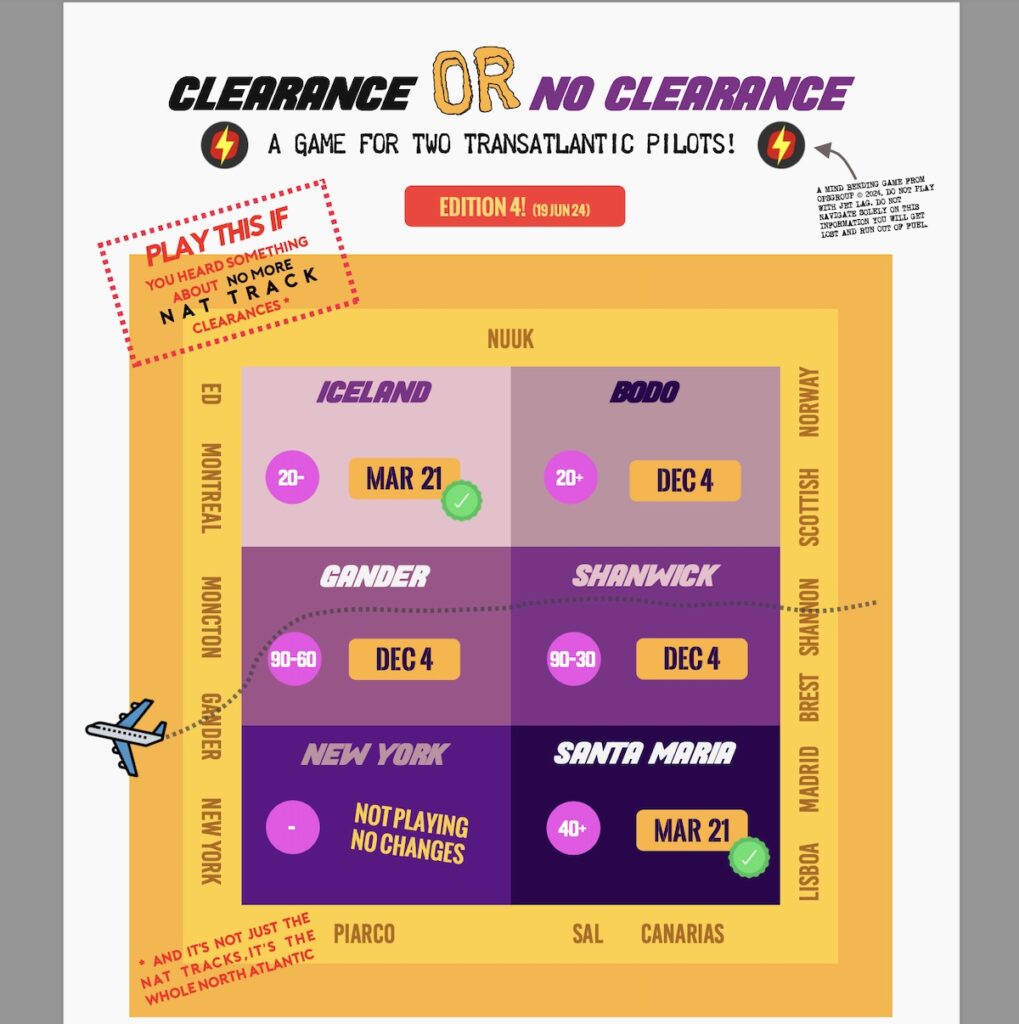
Our excitement at seeing another OACC cross the “Oceanic Clearance Removal” finish line has been short lived. Bodø implemented the change on June 17, but it did not go well. As a result, they’ve rolled back the software, and have now decided to try again on December 4, when Shanwick and Gander are doing theirs. So, as things stand – Iceland and Santa Maria have removed the clearance requirement, and Bodø, Shanwick, and Gander will now all transition on the same day in December.


Original Story

Last August, the headlines pointed to a promising development for all of us: No More Oceanic Clearances Required on the North Atlantic. The reason? Rapid improvements in comms and surveillance coverage (through satellite-based CPDLC and ADS-C) have created an environment far more like a regular radar sector. The idea of getting a separate Oceanic Clearance was becoming dated.

The reality from the pointy end is – you guessed it – not quite as exciting. After the Oceanic Centre changes to OCR (Oceanic Clearance Removal), you don’t have to request an Oceanic Clearance. This is true. But you do have to send a new-style “RCL message”, which is precisely the same message as if you were getting an Oceanic Clearance. In fact, that Oceanic Clearance does still exist, behind the scenes. You just don’t get a copy of it any more. More on that below.

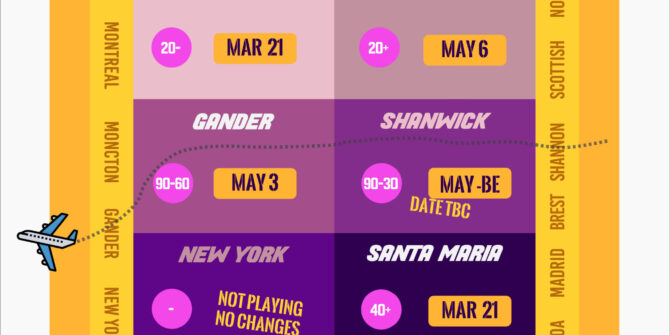
The bigger issue for operators and pilots is trying to align cockpit procedures and crew expectations with the ever-shifting dates of when this is happening. Originally, all 5 Oceanic Centres (Shanwick, Gander, Iceland, Bodø, Santa Maria) were going to do this in March of this year. The current dates are now:

    • Shanwick: April 9  May  Q4 2024  December 4
    • Gander: March  May 3  December 4
    • BodøMarch  May 6 June 17  December 4
    • Santa Maria: completed March 21
    • Iceland:  completed March 21

Shanwick, Gander and Bodø have now delayed OCR implementation until December 4. This creates a 2024 year-long limbo for NAT crews, and raises some questions about the way in which changes to this complex airspace are made.

OCR Delayed – So, what now?

  • If you are crossing the NAT solely via Shanwick and Gander‘s airspace, don’t worry about OCR/RCL changes until December 4. Do everything as you normally do. You will request, and get, a clearance as normal. But keep in mind that a lot of confusing documentation will now be out there with incorrect dates and procedures that are not yet in place.
  • If you are entering via Iceland or Santa Maria, the Oceanic Clearance Removal has been completed. You don’t need a clearance, but you do need to send an RCL message. The same will apply in Bodø from December 4. If you are transiting into Shanwick or Gander, you don’t need a separate clearance. Iceland/Santa Maria will take care of that for you.
  • If you are entering via New York, nothing has changed, and won’t. New York already operate without Oceanic Clearances, and your flight is coordinated tactically with the next Oceanic Unit.
  • ICAO NAT Bulletin 001/23 (Rev 4) was issued on June 20, and all the dates are now finally correct!

Gotcha’s to watch out for

  • NAT Doc 007 is unreliable. The Chapter on Oceanic Clearances (Chapter 5) was removed for the current edition, and crossings now refer to an RCL process that the majority of traffic will not use.
  • Your EFB/Ops manuals are likely to have incorrect dates and procedures regarding Oceanic Clearances.
  • AIP, AIP SUP, and AIRAC updates relating to Oceanic Clearances are likely to be confusing, as a lot of AIP changes have already been made for the planned March/May dates – which are now not happening.

Complexities and Confusion

The North Atlantic is probably the most complex piece of airspace in the world for crews to get to grips with. NAT Doc 007, the bible for NAT Ops, runs to about 170 pages. This complexity is the primary reason for the NAT “HLA” airspace itself, and needing specific approval to be able to operate within it. Crews need to know a lot.

Every change on the North Atlantic imputes responsibility on the flight crew to understand and execute it. Being able to do that requires clear and simple wording, and above all, for the information to align between the various centre’s and domestic units involved. Potential confusion for flight crew should be minimised, and not underestimate just how hard it is for pilots to keep up with the litany of changes around the world every month.

The Oceanic Clearance Removal change has now created quite significant doubt in the minds of crews as to what is happening, and when. In the first place, the headline story “No More Clearances” is misleading. There is still an Oceanic Clearance, we’re just not getting a copy of it (An Oceanic Clearance Message (OCM), is still sent to domestic ATC units, so they can see your clearance!). This mismatch between what the pilot thinks is happening (no Oceanic Clearance), and what is actually happening (there is still an Oceanic Clearance) gives rise to understandable confusion, and potential for errors. This explains why an RCL is still required … and also explains why trying to think of the RCL as something other than “Request for Clearance” is difficult.

The continual shuffling of dates further creates a big workload for operators and pilots, and points to the need for a more integrated approach to making changes on the North Atlantic. One single date for a change of this magnitude would have been ideal, but as mentioned, it’s complex airspace. Nonetheless, the way this has played out has been frustrating for everyone involved.

Clearance game update

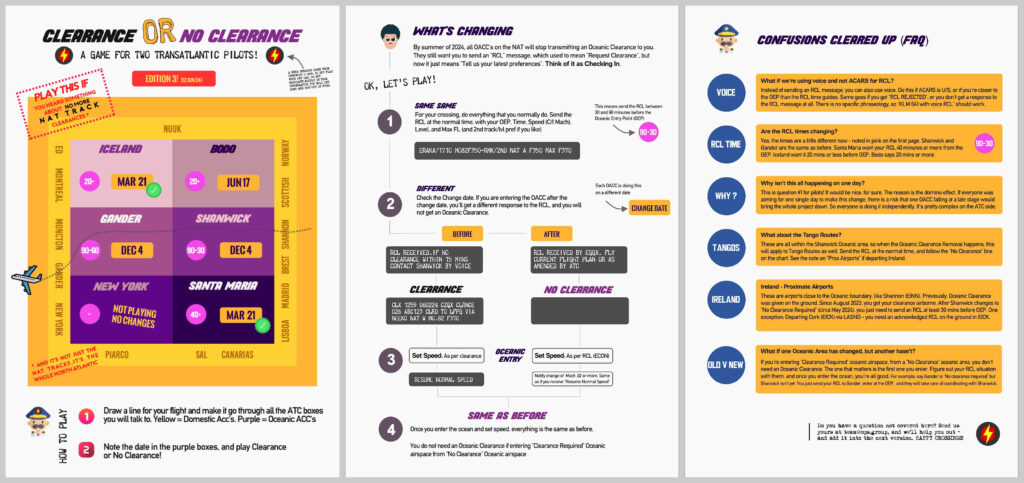
We’ve updated the “Clearance or No Clearance” game with the new dates, and some FAQ.

Download the current version (PDF, 0.5 Mb).


NAT Clearance changes – a game! (V4)

  • We’ve made a little game to help with Oceanic Clearances changes on the NAT.
  • You can download it here.
  • Updated June 19, 2024 – Edition 4!

Why the game?

By Christmas of 2024, all OACC’s on the NAT will stop transmitting an Oceanic Clearance to you. They still want you to send an “RCL” message, which used to mean “Request Clearance”, but now it just means “Tell us your latest preferences”. Think of it as Checking In.

There are different dates when Oceanic Clearances will cease to be issued in the following FIRs:

  • Shanwick: April 9  May  Q4 2024  December 4
  • Gander: March  May 3  December 4
  • BodøMarch  May 6 June 17  December 4
  • Santa Maria: completed March 21
  • Iceland:  completed March 21

But let there be no further blather about it here! We’ve done enough of that already – check here for our full post on the topic. Just play the game – it’s fun, and will tell you everything you need to know in 3 pages! Print it out, share it, pin it on a wall somewhere if you so desire. We do so desire.

And if you have a question not covered in the game, send it to us at team@ops.group, and we’ll help you out – and add it into the next version.