Chad Airspace Update
Chad’s long term President, Idriss Déby died this week, having spent more than three decades in power as one of Africa’s longest-serving leaders. So why did his death result in the temporary closure of the country, and what is the impact to aviation?

The background

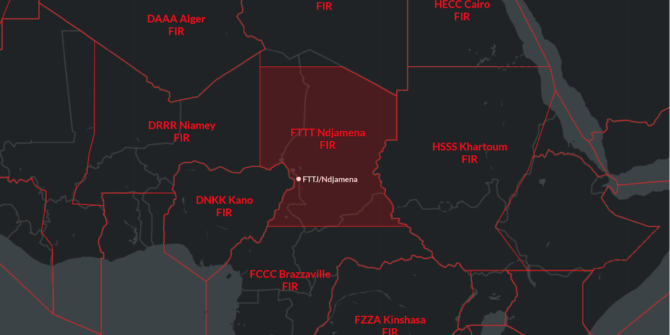
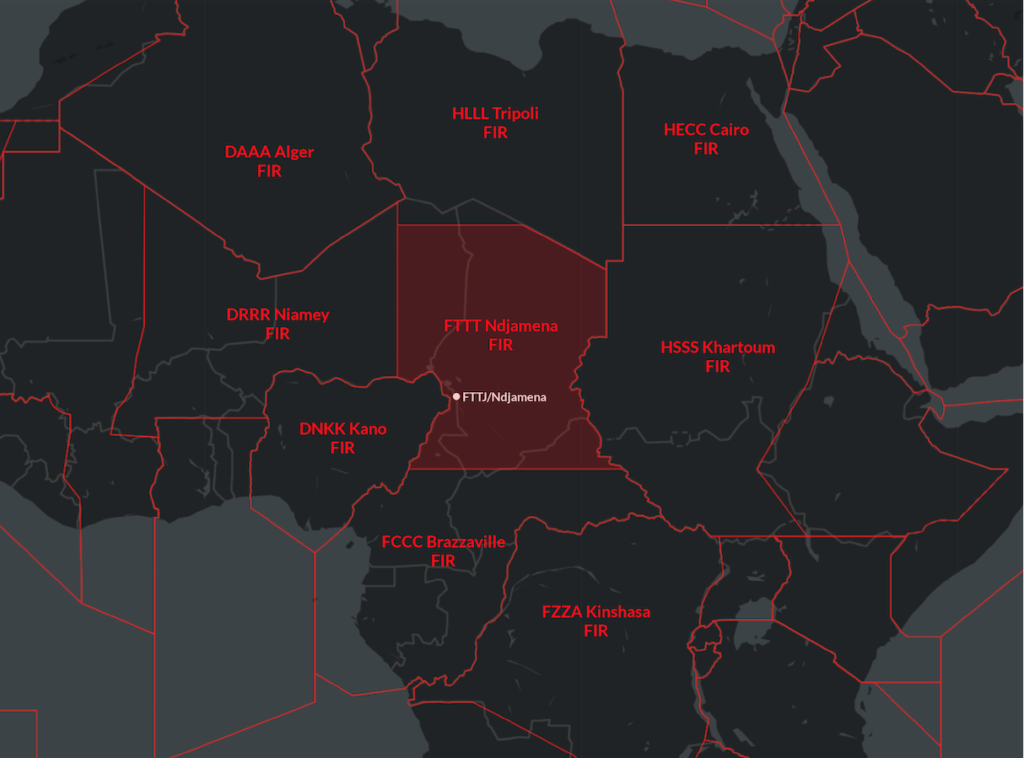
Chad is a large landlocked country in Africa, bordered by Sudan, Libya, the CAR, Cameroon,Nigeria and Niger.

Déby was focused on building a more democratic society and he had strong allies in France and with other Western powers through his continued fighting against Jihadist groups. Provincial elections were already underway with projections suggesting he would be successful in winning a sixth term.
However, Chad is also one of the poorest nations in the world, with big problems around poverty, corruption and human rights, and with that came civil unrest.

What happened?

Déby was injured during a visit to troops who were battling against rebels belonging to a group called Fact (the Front for Change and Concord in Chad). The big concern now is who will become the next leader – Déby’s son has stepped in – but the government has been dissolved and conflict is escalating in the country as opposing parties fight for power.

The military elected initially to close land and maritime borders, but then closed all airports as well, whilst putting in a strict countrywide curfew.

The Impact for Aviation

Initially, a Notam was issued stating that FTTJ/Ndjamena airport was closed, and that Contingency Procedures were in effect across the FTTT/Ndjamena FIR. Then a couple of days later, on Apr 21, the Notam was cancelled and the US Embassy issued a Security Alert advising that FTTJ airport has reopened.

In the short term however, landings are not advised, and overflying aircraft should be familiar with Contingency Procedures. You can download the Contingency Plan from the Acesna AIP here.

This plan lays out the arrangements for situations where the Air Navigation Services are partially or totally disrupted, and aims to ensure overflights remain possible. Effectively, it aims to coordinate with neighboring ATS units so control of the N’Djamena UIR is temporarily assigned to them – Brazzaville ACC and Niamey ACC are the primary units being used.

Pilot operating procedures while Contingency Procedures are activated are shown under section 8.3 and the advises the following:

  • Maintain contact with Brazzaville or Niamey control until entering, and contact the next control at least 10 minutes prior to exiting.
  • Operate along the assigned contingency route (as listed in the table), although SLOP is recommended.
  • Reach your assigned level at least 10 minutes prior to entering N’Djamena UIR and maintain throughout unless an emergency arises requiring you to diverge from it.
  • Listen out on 12.6 and transmit position reports.
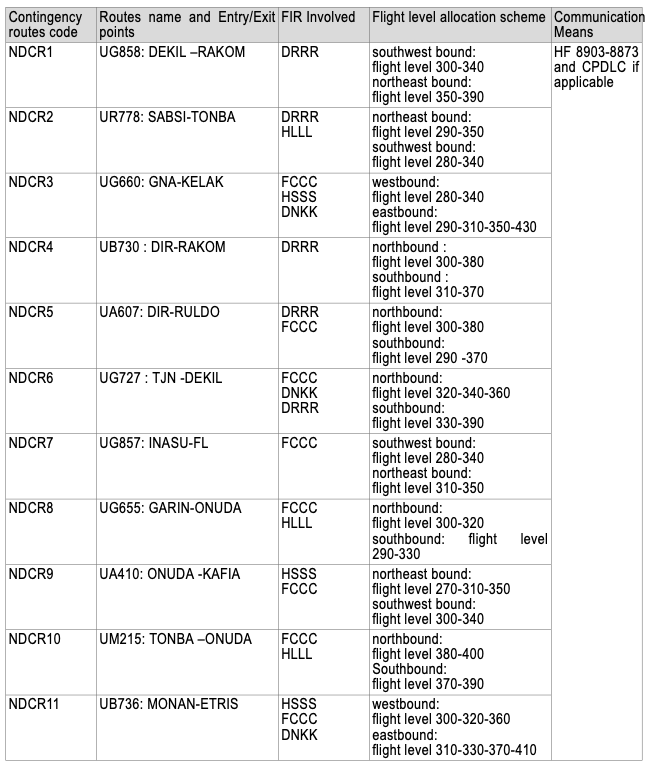
Contingency routes laid out in the ASECNA AIP ENR 1.8

What else do we know?

N’Djamena in the past was a popular fuel stop in central Africa, but multiple travel warnings now advise against travel here (see the UK advice here, and the US advice here). No official state Notams have been issued, but risk remains high. A state of emergency remains in place for the Lake Chad region. Overall there is a high threat for terrorism and it is strongly advised to avoid landings.

Midweek Briefing: New Wake Turbulence Categories, Fiji Cyclone Winston

New Wake Turbulence Categories 24FEB New Wake Turbulence Categories will begin a slow introduction in Europe on 22MAR at Paris Airports LFPG/De Gaulle and LFPB/Le Bourget, where the current four (Light, Medium, Heavy, Super) will become six. Those six new categories are Light, Medium (with Lower and Upper), and Heavy (with Lower, Upper and Super). Read the full article …

Fiji Cyclone  Winston 24FEB Fiji sustained widespread damage throughout the Islands on 21FEB from Tropical Cyclone Winston; most airports are open and operating again, including all international airports (NFFN/Nadi, NFNA/Suva). The following domestic airports are also open: Kadavu, Labasa, Rotuma, Labasa, Rotuma, Gau, Kadavu. NFNA/Suva has no overnight parking available at present due to congestion caused by the Relief effort.


NFFN/Nadi, Fiji Hit by Tropical Cyclone Winston on 21FEB, while there is widespread damage throughout the Islands, most airports are open and operating again, including all international airports (NFFN/Nadi, NFNA/Suva). The following domestic airports are also open: Kadavu, Labasa, Rotuma, Labasa, Rotuma, Gau, Kadavu. Note that NFNA/Suva has no overnight parking available at present due to congestion caused by the Relief effort.

KAGS/Augusta, USA Special Procedures in place 07-10APR for US Masters Golf Tournament.

EXXX/Europe New Wake Turbulence Categories will begin a slow introduction in Europe on 22MAR at Paris Airports LFPG/De Gaulle and LFPB/Le Bourget, where the current four (Light, Medium, Heavy, Super) will become six. Those six new categories are Light, Medium (with Lower and Upper), and Heavy (with Lower, Upper and Super). The rules are part of the RECAT-EU project, with the intention of squeezing more traffic into busy European Airports by applying more precise turbulence separation rules. The separation minima are determined specific to each Aircraft Pair. For example, at the moment, an A330 following a B777 (Heavy behind heavy) requires 4 miles in trail. With the new rules, that is reduced to 3nm. An A320 can now follow 4 miles behind a B777, instead of the current 5nm. There are no Flight Planning Changes (continue to use /L,M,H,J for the ICAO Category). For crews, you’ll notice the smaller separation, but there are no changes to callsigns or pilot obligations – for now. Read full article.

DRRR/Niamey FIR Air Traffic Control 48HR strike 24 and 25FEB. The ASECNA Contingency plan is activated, with ATC provided by neighbouring ACC’s Dakar and N’Djamena.

LTXX/Turkey We have received several reports that Overflight Permits, which were removed as a general requirement for non-scheduled flights in 2015, are being requested by Turkey for Business Aviation aircraft, specifically M- and VP- registrations. Reports welcomed to clarify to bulletin@fsbureau.org.

RCTP/Taipei Airport works on several parking positions may create availability issues from 04MAR-04APR especially for Airbridge gates. Check with handler.

LFPB/Paris Le Bourget Due WIP airport will be closed during 10 nights from 15FEB to 26FEB, every night from 2045 to 0500Z. No Medevac flights will be possible.

EPKK/Krakow Runway 07/25 is closed daily 2330-0430 until 03MAR.

UXXX/Simferopol FIR EASA published an updated SIB 2015/16 regarding the use of Simferopol FIR on 17FEB. The key change is the phased reintroduction of the use of Simferopol FIR for international transit traffic, on the basis of an evaluation of the high seas portion of the airspace (ie. outside the 12nm territorial limit of the Crimean Peninsula). This airspace provides routes UL851 and UM856 (Odesa South Sector), which since 17FEB are suggested by EASA for use by overflying traffic.

YMML/Melbourne will host the Formula 1 Grand Prix 17-20MAR, with additional traffic to both YMML and YMEN/Essendon during these dates.

EHAM/Amsterdam has changed the callsign of Schiphol Start-up to “Schiphol Planner”.

OYAA/Aden, Yemen Airport closed and all flights cancelled since 21FEB due to security concerns.

NVVV/Port Vila On 17FEB local officials signed an agreement with a private contractor to begin repairing the runway. Several airlines suspended flights on 23JAN due to safety concerns with the airport’s runway. Aviation officials stated that the renovations should begin in March.

View the full International Bulletin 24FEB2016