Update on GA/BA flight requirements to the Bahamas

With the lockdowns and flight bans in Grand Bahama and New Providence now at an end, all islands of the Bahamas with Airports of Entry have re-opened to international private and charter flights. Prior approval is required – send your request to covid19@bcaa.com and COVID19INTLTRAVEL@bahamas.gov.bs.

Here’s the lowdown on ops to the Bahamas right now:

Quarantine

Quarantine rules are changing from September 1. A 14-day quarantine will still be mandatory for all travellers, but they are now allowed to spend it in their own accommodation – a private residence, rental property, hotel or private/chartered yacht, all are considered quarantine facilities.

When quarantine is finished, anyone who wishes to stay must agree to be tested again. It is worth noting that you can leave the Bahamas at any point, as long as you notify authorities first.

Covid test

All travellers must obtain a negative RT/PCR Covid that is less than 5 days old before flying and apply for a Travel Health Visa which can take up to three days to process. Once in the country, all arrivals will be monitored by the ‘Hubbcat App’ on their phone. 

Crew arriving to pick up passengers only, cargo and courier flights who are staying with their plane, military and emergency medical flights must obtain the Travel Health Visa.

If crew will be in the country for less than 24hrs, they need to quarantine in the hotel but do not need proof a Covid test.

Some OPSGROUP member reports indicate that the Bahamas Travel Health Visa is not working properly, and will not complete the application process. So expect delays for a Health Visa until their systems are fully functional. Submit the form at least 24-48 hours prior to arrival. An automated response will be provided upon completion, only those who receive a green color-coded response can travel. It is essential that travellers present proof of confirmation upon arrival in their destination.

Hours of operation

Hours of airport operations are reduced, and prior approval for after-hours operations is required. A call before flying is strongly recommended. Fees for after-hours ops, restrictions to curfews, and limited availability of hotel rooms are additional considerations.

Local handling agent Odyssey Aviation are open as follows (requests for after-hours operations will be reviewed on a case by case basis):

MYNN/Nassau
Email: info.mynn@odysseyaviation.com
Opening hours: 0700-1800 local (1100-2200z)

MYEF/Exuma
Email: exuma@odysseyaviation.com
Opening hours: 0800-1700 local (1200-2100z)

MYSM/San Salvador
Email: info.mysm@odysseyaviation.com
Opening hours: 0800-1700 local (1200-2100z)

MYEM/Governor’s Harbour
Email: frontdeskeleuthera@odysseyaviation.com
Opening hours: 0800-1700 local (1200-2100z)

MYER/Rock Sound
Email: frontdeskeleuthera@odysseyaviation.com
Opening hours: 0800-1700 local (1200-2100z)

Where to look for latest updates

For updates to the rules, the Bahamas official page is here, but it tends not to get updated very quickly after new announcements from the government. The US Embassy keep a dedicated page on the Bahamas updated here, but that can sometimes lag behind a bit too. The most up-to-date source seems to be the one published by the UK FCO, which you can view here.

Odyssey Aviation also posts the latest updates on requirements and changes for Private Aviation on their Facebook page, and check out the Association of Bahamas Marinas website too – they work closely with the authorities and are often faster at getting their info out than other government entities!

Oh, and OPSGROUP too 😊 – the quickest way to get all the latest info we know on something is to head over to the #george channel in Slack. George is our friendly Ops-Bot. Ask him something, and he’ll dig into the OPSGROUP vault to see what the group knows. He understands a whole load of commands: permits, weather, ICAO codes, airport names, countries, keyword searches. If you’re still stuck for an answer, ask other members in the group in the #questions channel, or shoot us an email and we’ll see what we can dig up.
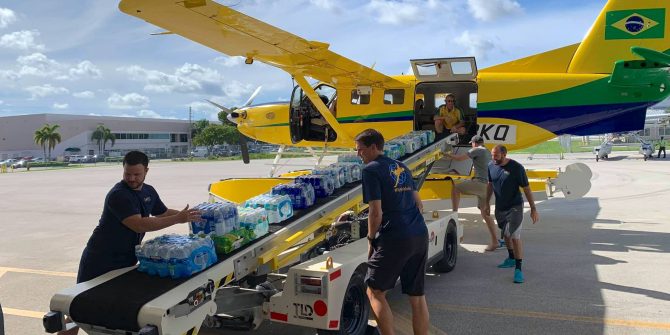

Bahamas Relief Flights – here’s what happened in the first five days

Hello all,

We’re standing down. The purpose of our involvement in the Bahamas Relief effort was twofold – to provide an accurate information flow from an aviation perspective, and to help coordinate in some way the massive amount of civil aircraft that started taking part last Thursday.

Once the winds had died down on Thursday morning, and it became safe for aircaft to start operations, what we initially saw was a void of information on the situation – which airports were available, and what the approval process from Bahamas CAA/NEMA was and how that worked. Nobody was quite sure. But hundreds wanted to help. So, we made contact with many of the pilots and operators, and Bahamas ATC, to get accurate status reports from Nassau, Freeport, Treasure Cay, Marsh Harbour, and Sandy Point – the five locations where the relief efforts were focused at the end of last week, and got that information out in a twice daily briefing. We also worked with the Bahamas CAA approvals team to get word out on how to apply, and what that process looked like.

The response from Business and General Aviation was overwhelming to say the least. Hundreds of flights were flown on Thursday and Friday bringing in much needed first-response supplies. The initial situation was challenging – airports had not been secured and there was a rush to get relief items arriving, creating an unsafe security situation for crews in some locations. Nonetheless, efforts continued. It quickly reached a saturation point. There was no ATC, and the entire Abaco area was on one Unicom frequency. Airports that normally have a few movements per hour were seeing in excess of 60 aircraft per hour at times. Some were operating without transponder and radio calls.

On Friday evening, it showed no sign of abating, and airspace safety was now the primary concern. We worked with AOPA and NBAA ATS in an effort to reduce the level of GA traffic, especially as larger aircraft were now coming on scene and could do more to help. Saturday proved to be another exceptionally busy day, and we coordinated with Miami Center to get routes in place to manage that flow of traffic, and get word out to use those routes. Freeport opened up, with limited ATC.

Finally, by Sunday afternoon, there was some respite in the traffic, and the picture of airport status was clear, but there was still a need for coordination among the many separate organizations, and individual operators, conducting relief flights. We worked with Odyssey, Aerobridge, Operation Airdrop, Banyan, numerous FBO’s, the US Coast Guard, and probably 150 individual pilots, all part of the flotilla of floatplanes, helicopters, business jets, and private aircraft helping to bring relief. At the same time, airlines and military were now providing larger aircraft for the mass evacuations from Abaco that we saw Sunday and Monday. The marine relief effort was even bigger.

Throughout, we were in contact with the NEMA coordinator, UN OCHA, Bahamas CAA and ATC – and later, NGO’s – who all did an exceptional job given the extreme circumstances. The geography of the Bahamas was the biggest challenge – scores of tiny Cay’s, and with bridges out and roads washed away, there were – and still are – many pockets of cut-off communities, all needing help.

On Thursday night I started a Facebook group to bring as much information into one place for the operators and pilots involved as we could. It’s been a tremendous success. Thanks to all the volunteers participating, we’ve had a steady stream of updated information on airports and airspace, and more importantly, we’ve been able to coordinate everything from Search and Rescue helilifts, flights for teams of Doctors, medication transport, evacuation flights, and determine very specific locations to bring aid to.

And now? The presence of the UN, the USAF, International Navy vessels, and upwards of 50 NGO’s, all at full tilt, means that the vast majority of relief efforts are being taken care of on a larger scale.

Make no mistake. The situation is still dire. People still need help, in a massive way. Whole towns are gone. The death toll is much higher than than the small numbers first reported. Individual flights can and will continue to make a difference. We’ll keep this group open and running, so you can post and share info. I and the OPSGROUP team will get back to work on what we normally do, but we’ll keep an eye here to help out where we can.

So – a big THANK YOU to every single one of you that has been part of this effort. None of us have slept much in the last five days, and it’s been heartwarming to see the massive generosity of time, effort, aircraft, pilots, and supplies, and help. Simply amazing. Much love to you all!

Mark.