Canadian Operators need Special Authorization to keep flying in the NAT

Transport Canada has said that all old NAT MNPS authorizations are no longer valid for flights operating across the North Atlantic as of 31st Jan 2020 in NAT HLA airspace between FL290-410. In its place, a new special authorization called NAT HLA MNPS will have to be added to the operator’s PORD or AOC in order to fly in this airspace, which includes the NAT Tracks and Blue Spruce Routes. Airspace above FL410 or below FL290 is not affected by this.

Transport Canada did issue a Civil Aviation Safety Alert (CASA) about this back on 10th Jan 2020, but later admitted it was too vague and difficult to understand – therefore they will reissue the CASA. But in the meantime, the requirement to get this new special authorization still stands. Here’s how it works:

How do you apply for this new SA?

It appears to be fairly simple. The operator emails TC applying for the NAT HLA MNPS special authorization. TC will reply by email including a compliance guide to verify equipment and training requirements.

If you wish to operate in the Organized Track System, there are 4 Special Authorizations that Canadian operators must hold:

  1. NAT HLA MNPS;
  2. RVSM;
  3. RNP 4 or RNP 10; and
  4. PBCS (ADS-C with proof of contract)

What if you don’t have PBCS? Where can you operate?

If you hold the first 3 SAs listed above and the ADS-B SA you may operate on the Blue Spruce Routes only. That’s ADS-B for Broadcast.

So to summarize…

Scenario one is that you already possess RVSM, RNP 4 & 10, and PBCS (ADS-C with proof of contract). Your process is to to e-mail TC for the application for the NAT HLA MNPS special authorization. A compliance guide will be sent out to verify equipment and training requirements. Once it has been returned and reviewed, a new PORD or AOC will be issued which will contain the new NAT HLA MNPS special authorization.

Scenario two is you do not possess PBCS with ADS-C, but you are either ADS-B capable or already hold a special authorization for ADS-B. In this case the process will be to apply for the NAT HLA MNPS vis email and a similar compliance guide will be sent out to verify equipment and training requirements. The difference is that your special authorization will be restricted to the Blue Spruce Routes only. You can request the ADS-B special authorization in the email if you don’t have it already. Simply note that in your e-mail request.

Further reading

CBAA new forum information, with login credentials: https://www.cbaa-acaa.ca

CASA links can found here: https://www.tc.gc.ca/en/services/aviation/reference-centre/safety-alerts.html

Original CASA 2019-10 Issue 01 that will be replaced: https://www.tc.gc.ca/en/services/aviation/documents/CASA-2019-10.pdf


Thanks to the Canadian Business Aviation Association who helped provide the information in this post.


Your MNPS approval is about to expire (so don’t get banned from the NAT)

U.S. operators with the old MNPS approvals issued before 2016 have until 31 Dec 2019 to get these updated if they want to keep flying on the North Atlantic!

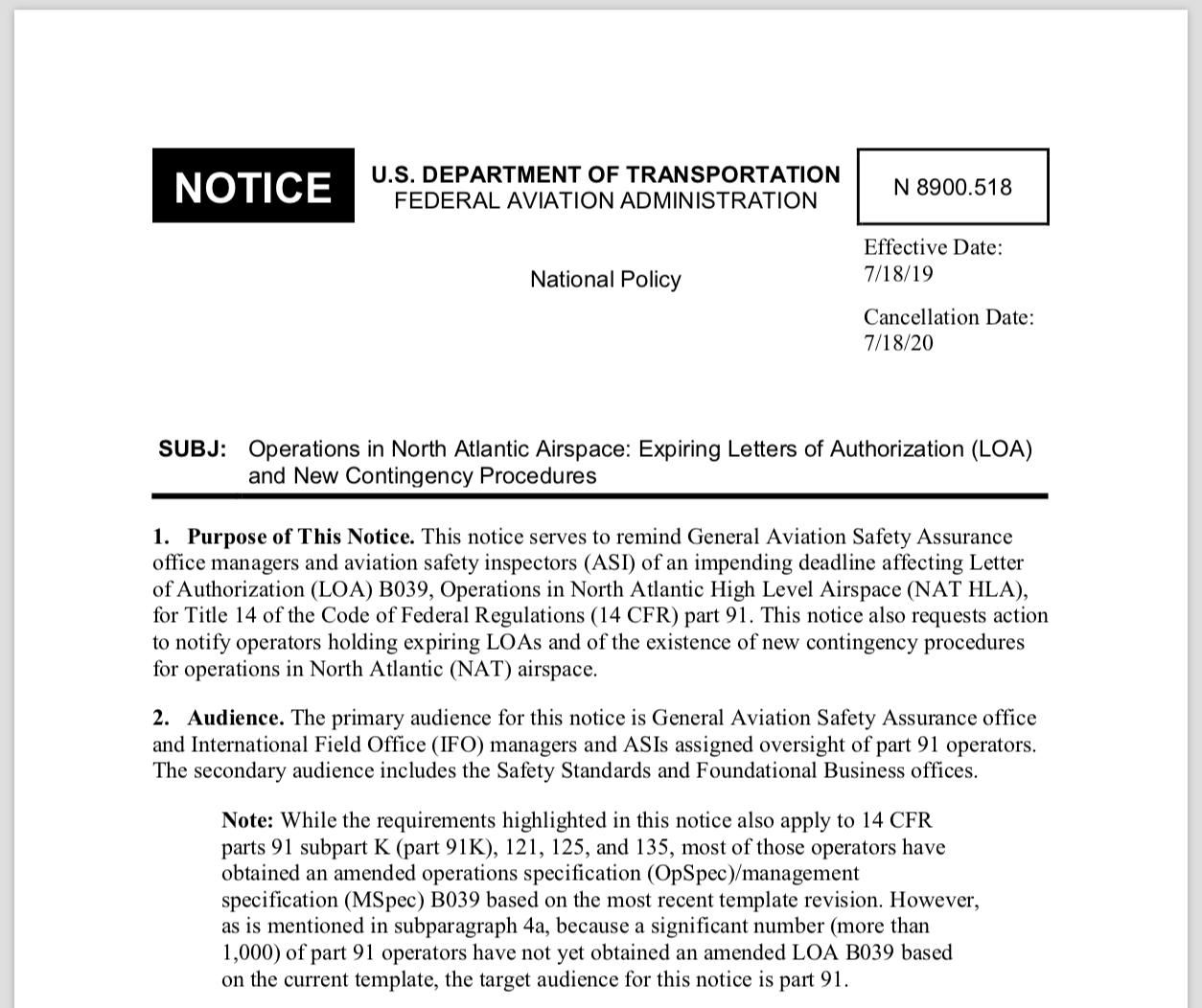
The FAA issued new guidance on this on 18 July 2019:

They say that there could be more than 1,000 GA operators who still have old NAT MNPS approvals, and all these operators will need to get new B039 LOAs to be able to continue flying on the North Atlantic beyond 31 Dec 2019.

The new B039 LOA is for “Operations in the North Atlantic High Level Airspace”. To get it, operators need to provide evidence of compliance with the NAT HLA requirements particularly in regard to RNP 10 equipage, flight crew training (including the new contingency procedures), and have operating procedures in place.

Operators will also need to make sure they have an B036 LOA for “Oceanic and Remote Continental Navigation Using Multiple Long-Range Navigation Systems”.

Here’s the lowdown: If you have an old MNPS approval, you need to apply for the B039 LOA very, very soon! The closer we get to the Dec 31 deadline, the stronger the chance that it will take longer for the FAA to process yours, and this means that 2020 will not get off to a good start when you have to explain why you’ve been banned from the NAT! Help yourself, and the FAA, get through this by applying for it as soon as possible.

Mitch Launius is an International Procedures Instructor Pilot with 30West IP and can be contacted through his website: www.30westip.com


Oceanic Errors

Unfortunately, we don’t fly with three in the cockpit anymore – or even four. The navigators job falls squarely onto the front two seats. Over one weekend in April there was one Gross Navigation Error, and two close calls reported on the North Atlantic.

April 22nd (Friday)
Democratic Republic of the Congo Boeing 727 100 (9QCDC/DRC001) from Santa Maria Island, Azores (LPAZ) to St. John’s NL (CYYT)
At 1235Z, Observed on radar to be over position 4720N 4745W, which was approximately 60 miles north of the cleared route 45N 45W – 47N 50W. The crew reported correctly while in oceanic airspace. The flight was cleared direct to YYT and landed without incident at CYYT. There was no traffic, and no other impact to operations.

April 24th (Sunday)
Neos Airline Boeing 767-300 (INDDL/NOS730) from Ferno, Italy (LIMC) to Havana, Cuba (MUHA)
Cleared via 49N030W 48N040W 45N050W. At 30W, the flight reported 48N040W 44N050W. The aircraft recleared to 45N050W prior to proceeding off course.

Apr 25th (Monday)
Transportes Aereos Portugueses Airbus A330-202 (CSTOO/TAP203) from Lisbon, Portugal (LPPT) to Newark, NJ (KEWR)
Cleared 46N030W 46N040W 45N050W. The aircraft reported proceeding via 46N030W 46N040W 44N050W, as per the original flight plan. The aircraft was recleared via 45N050W prior to proceeding off course.

Did you notice how hard it was to find the error in the above two examples?


Gross Navigation Errors are a really interesting topic, and relevant not just on the North Atlantic but in any Oceanic or Remote airspace where ATC cannot monitor the aircraft tracking.

What defines a GNE? Normally, 25nm: That is, when on “own navigation” the aircraft departs the cleared route by more than 25nm. The NAT Central Monitoring Agency (CMA) now defines a Gross Navigation Error as 10nm instead of 25nm.

Annually, the biggest offenders in order of “market share” are: 1. Corporate/Private, 2. Military/State 3. Civil airlines.

How to Avoid a GNE?
(aka How to avoid a Nastygram from the Authorities):

In general, when operating outside of ATC Radar coverage in any airspace:

  • Crews: Don’t have more than one paper copy of the Flight Plan in the cockpit. Mark the active one “Master Document”. Hide any other copies where you won’t find them.
  • Ops: If you send a new Flight Plan to the crew, tell them what the changes are – especially if you’ve filed a different route in Oceanic or Remote Airspace.
  • Fly the Clearance, not the Filed Plan. This is the biggest gotcha. As soon as you reach the Oceanic Entry Point, or leave radar airspace – refer only to the most recent Clearance from ATC. The filed plan is a request only – sounds obvious, but most GNE’s occur because the crew fly the filed plan although there was a reroute.
  • Be aware of the ‘ARINC424 problem’: In the aircraft FMS, and map display, the current common waypoint format is 5230N for position 52N030W (as prescribed by ARINC 424). To show position 5230N030W – ARINC 424 offers a format N5230. The potential for confusion is clear. ICAO, in NAT Ops Bulletin 3/15, have recommended that operators use the format H5230, if a five-letter FMS format waypoint is required. In addition pilots are recommended to cross check any waypoints that don’t have a ‘name’.
  • Use a plotting chart – it’s mandatory. You don’t have to use ours, but use one.
  • Use an Oceanic/Remote Area Checklist (sample link below).

And specifically on the Atlantic:

  • Read the advice on the Daily Track Message – waypoint cross check, Fly the Clearance (and be sure it is the clearance!)
  • Know the weather deviation procedures: Even with the new “Half Tracks”, there are no changes to the in flight contingency procedures and weather deviation procedures as detailed in PANS ATM Doc444 Para15.2 & 15.2.3.

Here’s some links and resources that we think are really useful:


For regular notices and content like the above, consider joining OPSGROUP.


Did you know MNPS is over? Meet HLA, the new North Atlantic Airspace.

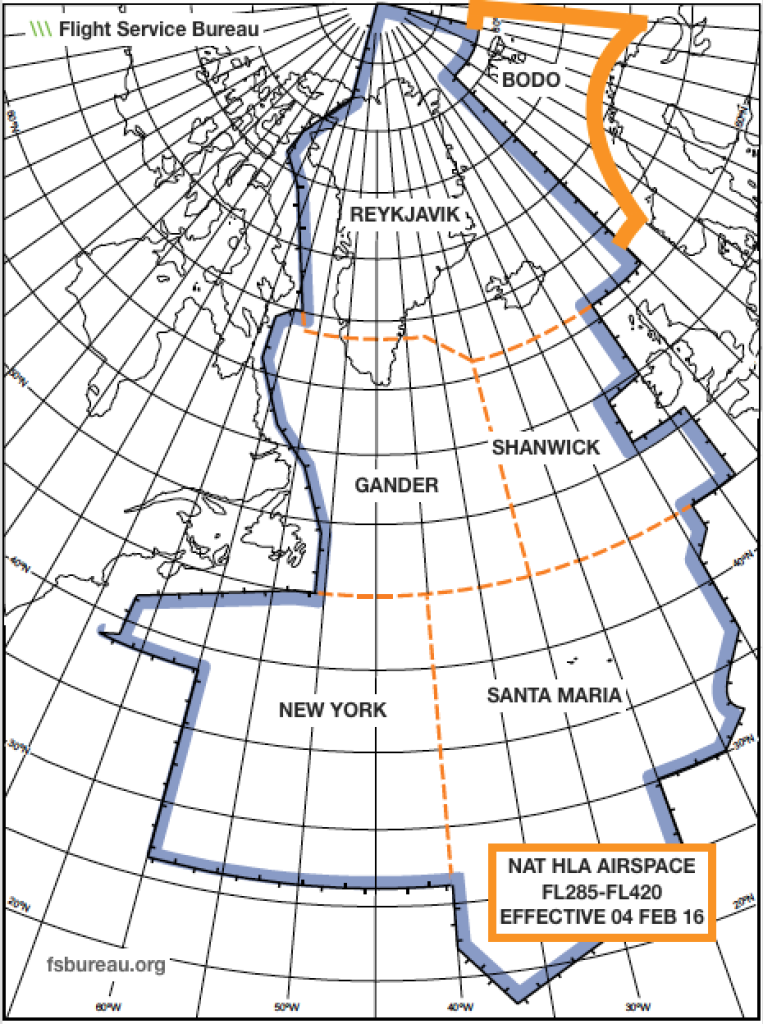
From Feb 4th, 2016, MNPS (Minimum Navigation Performance Specifications) Airspace is being dumped as a term (no loss, really), and replaced by the much more user friendly NAT High Level Airspace or NAT HLA. MNPS first came into being in 1977, and this change is significant in that the requirements for approval to enter the new NAT HLA are updated – you must now have RNP4, or RNP10. Also, the rest of the Atlantic welcomes Bodø Oceanic to the fray – it joins Shanwick, Gander, Reykjavik, New York, and Santa Maria to make up the new NAT HLA, which keep the original vertical profile of FL285-FL420.

In short, that’s all you need to know. You should read our International Ops Notice 01/16 for the full story.