Watch Out For APU Fines at Le Bourget

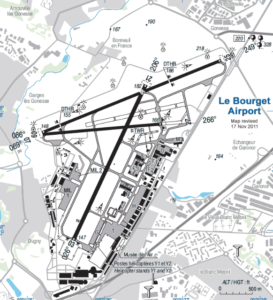
The summer peak is nearly upon us, and so too is the busiest season for BizAv at LFPB/Le Bourget.

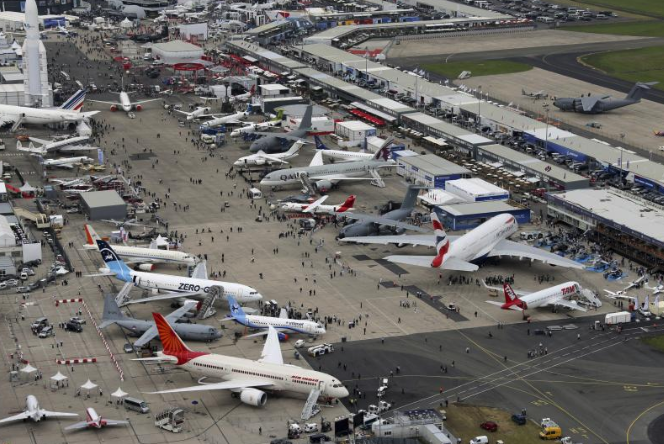
Several upcoming events will see an influx of traffic to the airport including the French Open (May 19 – June 8), the Paris Air Show (June 16 – 22) and Paris Fashion Week (June 24 – 29).

While this isn’t a new change, if you’re heading into LFPB it’s a good time to remind yourself of the strict rules for APU usage lest you fall victim to some potentially large fines.

They’re not mucking around either – two groups are involved. The Air Transport Gendarmerie is responsible for monitoring APU usage at the airport and making sure operators follow the rules. If not, a group known (in English) as the Airport Nuisance Authority (ACNUSA) will get involved and issue fines.

In a recent year, ACNUSA imposed 334 fines for non-APU compliance across French airports. Their haul? €6.9 million – that’s an average of more than €20,000 per fine. This has been confirmed as accurate and current by a local handler. Both the operator and PIC can be held liable.

The French AIP (LFPB AD 2.21) has the full rules – but here’s what you need to know…

Know the time limits

Since 2023, the rules at Le Bourget have depended on whether your parking stands have ground facilities or not:

Departing Flights – APU use limited to 10 minutes prior to the EOBT if your stand is equipped with ground air and power, or 45 minutes on stands without these services.

Arriving FlightsAPU use limited to 5 minutes after arrival if your stand is equipped with ground air and power, or 20 minutes on stands without these services.

There are limited exemptions to the rules, these include:

  • Humanitarian and medical flights.
  • Military aircraft.
  • Aircraft carrying live animals, perishables, medical or cosmetic goods that require active air flow.
  • The sake of flight safety (which specifically includes passenger, crew or handler health). For departing aircraft it’s worth noting it can take up to 30 mins to cool the cabin of a larger jet (such as a G650, or Falcon 8X) to comfortable temp when the ambient temp outside is more than 30 deg C (86 deg F).

You can enact limited exemptions for APU use, but make you have a solid case for it.

For BizAv flights, determining whether or not the FBO is “equipped with ground air and power” is a slightly tricky business. One FBO reported the following:

We have some mobile GPUs, but not for every space. That creates two interpretations:

The first one: if we have a mobile GPU available, so it is 5 minutes on arrival and 10 minutes on departure; and if we don’t have it available, it is 20 minutes on arrival and 45 minutes on departure.

The second one: they consider that as we are not able to provide one GPU to each aircraft, we are in the 20 minutes on arrival and 45 minutes on departure category by default.

But as the second way is not an “official” one, it is only a tolerance, that’s why you might get different replies from the different FBOs about how the rules work here.

I need an exemption

This is at the PIC’s discretion, but you need to be able to justify it using one of the conditions above.

To do so, you’ll need to provide your agent with a declaration for the Gendarmerie that you intend to break the APU rules, and most importantly why.

Feedback from local agents

Here’s what handlers at Le Bourget had to say when we reached out to them directly.

  • “…the airport authorities are very strict with the use of APU’s here. The authorities may fine you for failure to comply – we are able to provide a GPU at the request of the crew…”
  • “…there are some unexpected and random inspections by the authorities, after which they write a report and impose a fine…”
  • “…the use of the APUs is randomly controlled by the Gendarmerie here in LFPB. The maximum amount of the fine for APU infractions is 20,000€…”
  • “…the Captain may only deviate from APU rules for safety reasons. Violation is heavily penalized by the ACNUSA agency, with fines generally exceeding €10,000!…”

Why the fuss anyway?

Two things – noise and pollution.

APU’s are noisy things – a typical one produces 113 decibels, an equivalent noise range to a power saw, jackhammer or even a rock concert. Le Bourget is noise sensitive and located in close proximity to residential areas.

Then there’s the dinosaurs we’re burning – carbon dioxide, nitrogen oxides and other nasties are ejected from our APU exhaust. Reducing runtime helps lower emissions and improves air quality near the field. In fact, here is a surprising statistic – approx. 30% of an airport’s carbon emissions come from aircraft on the ground (with APU use being a significant factor).

This is all in line with global and EU climate goals (such as Fit for 55 or the Paris Agreement). Agree or not, we have to play by the rules – or find ourselves paying a hefty price.

Have a report to share?

Have you been stung or know someone who has? Please share your story with us (as always, our reports are always de-identified). There are several thousand crew out there who will owe you a beer. You can reach us around the clock on news@ops.group.


Paris Le Bourget – New Requirement to list parking in Flight Plan

In the recent France AIP August update a new requirement was added for all aircraft inbound to LFPB/Paris Le Bourget to list their parking position and handler on Field 18 of their flight plan.

Mentioned twice in the local traffic regulations (the translation is a little iffy but you get the idea):

Mandatory assistance by approved based companies. The name of the assistant society must be stated in field 18 of the FPL as a remark (RMK).

and

It is required to the crews to indicate in field 18 of the flight plan, the traffic area of destination and the name of the handling provider.

We understand that this came about due to “much confusion” of the parking stand locations after aircraft land.

Remark 18 should include

  1. Handler Name
  2. Your parking stand location (e.g. HANDLER ABC T1 APRON FOXTROT 2)
    • For heavy aircraft (A330/A340/A350/B747/B787/B767/C130) apron Golf, Sierra or Foxtrot 3 will suffice. Your local handler should give you confirmation ahead of your expected flight.
  3. Your handlers phone number.

So it should look something like this:

(FPL-FGTRY-IG

-C525/L-SDFGRWY/S

-LFMD0610

-N0360F340 OKTET UM733 GIPNO UT26 LOGNI UN854 DJL

-LFPB0120 LFPN

-PBN/A1B2D2S1 DOF/180903 IFP/MODESASP ORGN/KBLIHAEX RMK/HANDLER ABC TERMINAL 1 APRON FOXTROT 2 TEL : +3312345678)

Do you know more? Feel free to comment or drop us a line!

Also- here is a video of a Beech Bonanza flying under the Eiffel Tower 


Aircraft security search now a requirement departing France

Update July 20th: Looks like this is not only happening in France, but some other EU countries too: we’ve had reports of the same procedure being required at some airports in Italy, Greece, and the Netherlands. If you have any further knowledge or recent experience to share, please let us know!

According to various reports we’ve had from Business Aviation aircrew and handlers, as of July 16, all aircraft departing specific French airports are now required to have completed a security search before departure, and to complete a form to be left with the handler. This applies to all aircraft unless the previous departure point was one of the following:

  • 28 countries of the European Union + Norway / Iceland / Switzerland / Lichtenstein
  • USA
  • Canada
  • Isle of Man
  • Montenegro
  • Faeroe Islands
  • Guernsey and Jersey

This new rule applies to all aircraft, no matter the country of registration or status (private, commercial or charter).

The security search is basically to check that no “prohibited articles” are on board (the usual things – guns, explosives, etc.). It’s common practice amongst airlines, but seems until now not to have been enforced as a rule for business aviation or private operations.

Once completed, this form must then be given to the ground handler, who will store it, in case the French authorities want to see it at some point.

It seems this new procedure is governed by an EU directive that was published in 2015, namely: the European decision (UE) C (2015) 8005 (Appendix 3-A) and the regulation (UE n°2015/1998 (Appendix 3-B32). Who would have thought that a new rule with such a tantalising name as this could go unnoticed until now ?

So it seems that all EU countries should be implementing this new procedure, but so far only certain French airports have done so – the ones we know about so far are:

LFMN/Nice
LFMD/Cannes
LFPB/Paris-le-Bourget

(Quite possibly the reason that it’s only French airports which have implemented the new procedure is that it was something that was cited in a French national audit conducted in Nov 2017!)

Can the handler provide the crew with a “security search” form?
Answer – Probably not. As the security search is done by the crew, it’s down to the operator to provide the form – the only responsibility of the handler is to receive it signed from the Captain and store it, that’s it.

What about flights that have arrived from the United Kingdom ?
Answer – You won’t need to do the search, as the UK is still part of the EU… for now! We will wait and see what their status will be once the “Brexit” happens, but until then, no worries 🙂

If a flight is operating PART 135 Air Ambulance, would they be subject to this search as well ?
Answer – Yes, if they arrived in from somewhere other than those countries mentioned above. The procedure is linked to where the aircraft came from, not to the aircraft reg or its status (be it commercial, private, charter, cargo, air ambulance, quick-turn, night-stop, fuel stop, transit flight, etc).

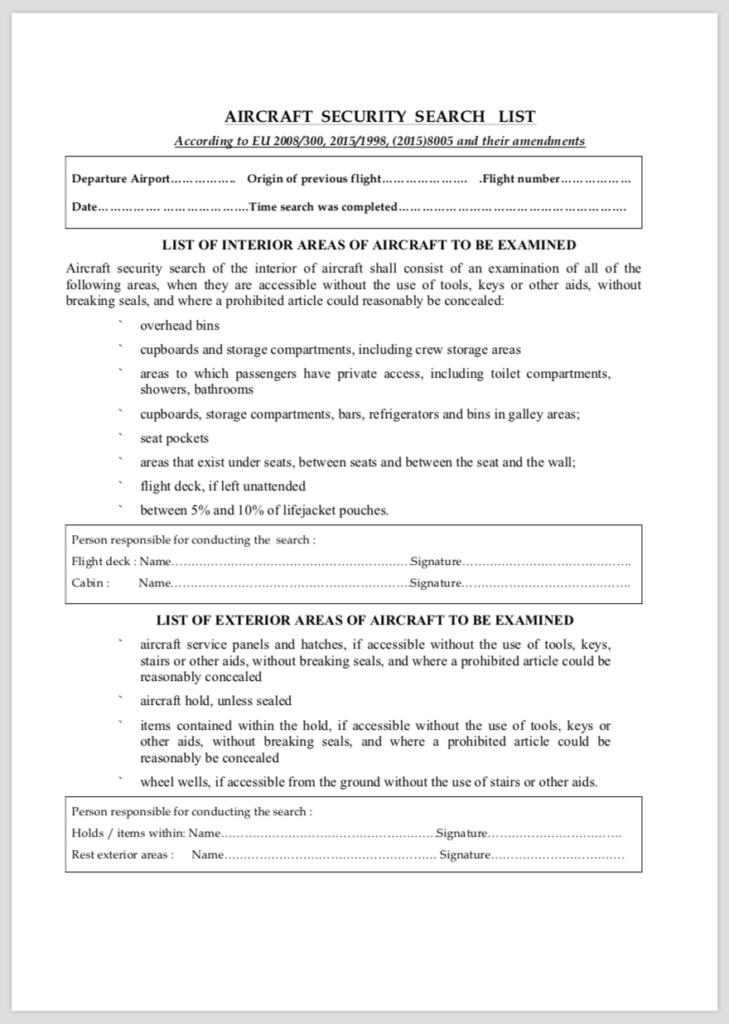
What kind of info should be in the form?
Answer – This kind of info:
Flight Information: Flight number / Date / Aircraft Number / Airport of Origin / Airport of Destination
Aircraft Interior: Flight Deck / Storage Area in the Galleys / Lavatories / Catering Trolley and Containers / Seat Pockets / Area Under the Seats / Area Between Seats / Area Between Seats and Bulkheads/ Jump Seats / Trash Bins / Overhead compartments / Pax and Crew Storage Compartment.
Between 5 and 10% of the life vest bags are to be checked as well.
Aircraft Exterior: Aircraft Holds / Service Panels / Bays / Wheel Wells / Fuselage / Engines / AOG Spare in Hold
Search Information : The search must be performed by a member of the cockpit crew. The name of the Captain must appear on the form as well as the date and a place for him/her to sign the document.

You probably have a standard form in your OEM for something like this. But if not, then fear not! The good folks at Signature have provided us with a standard template. Click the image below to download!

If you have any further knowledge or recent experience to share, please let us know!

Further reading:


Caution Wake Turbulence: New Rules for the EU

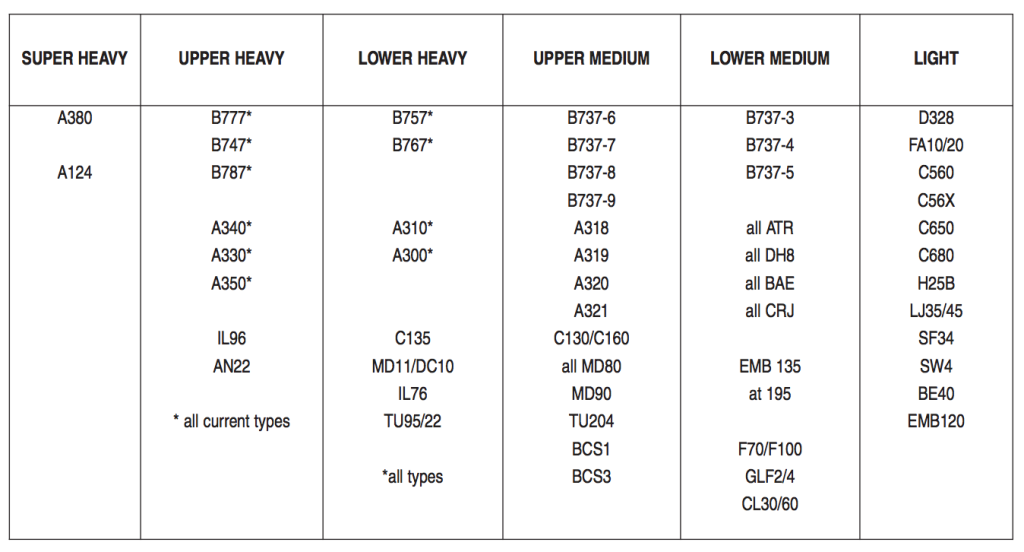
What Wake Turbulence Category is a B757? That long favoured question by Dispatch Trainers and ATC Instructors will become a thing of the past under new rules slowly being introduced in Europe, where the current four (Light, Medium, Heavy, Super) will become six. The first place you will see this happening is at LFPG/Paris Charles de Gaulle and LFPB/Paris Le Bourget, from 22 MAR 2016.

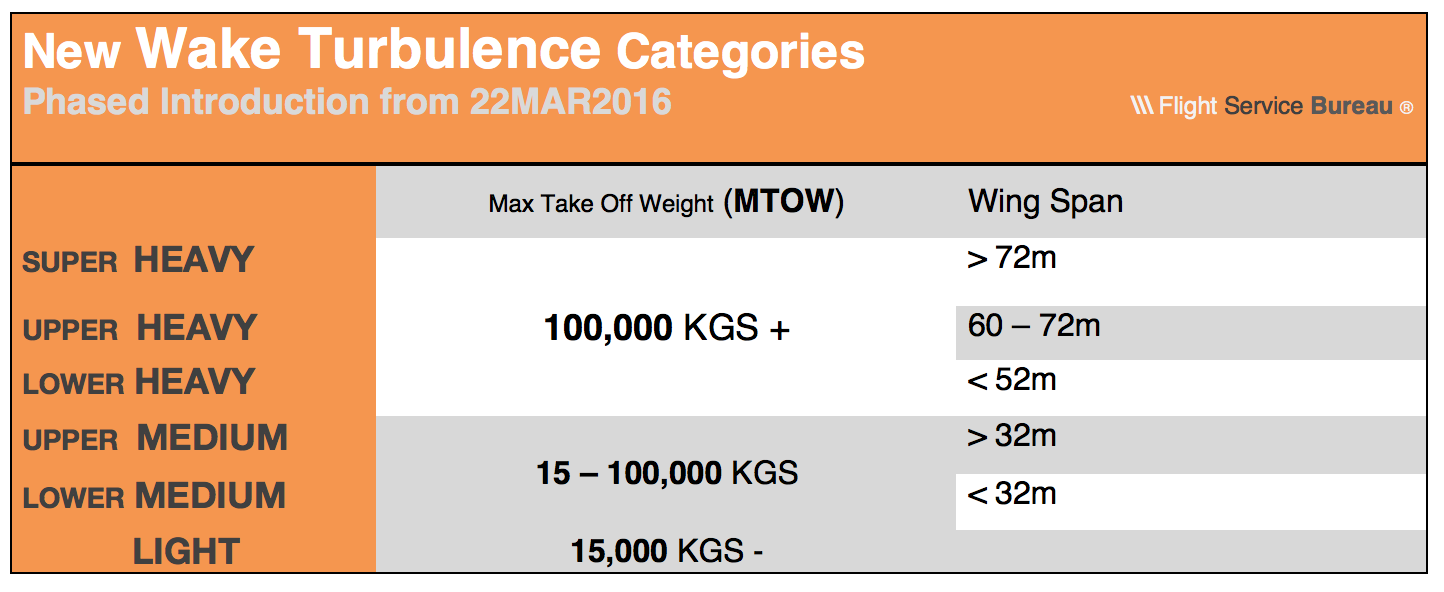
Those six new categories are Light, Medium (with Lower and Upper), and Heavy (with Lower, Upper and Super). The rules are part of the RECAT-EU project, with the intention of squeezing more traffic into busy European Airports by applying more precise turbulence separation rules.

The separation minima are determined specific to each Aircraft Pair. For example, at the moment, an A330 following a B777 (Heavy behind heavy) requires 4 miles in trail. With the new rules, that is reduced to 3nm. An A320 can now follow 4 miles behind a B777, instead of the current 5nm.

There are no Flight Planning Changes (continue to use /L,M,H,J for the ICAO Category). For crews, you’ll notice the smaller separation, but there are no changes to callsigns or pilot obligations – for now.

New-Wake-Turbulence-Categories-RECAT-EU


Sample-Aircraft-Categories-RECAT EU

 
References: