Formula 1 & Movie Stars: Special Procedures in Southern France
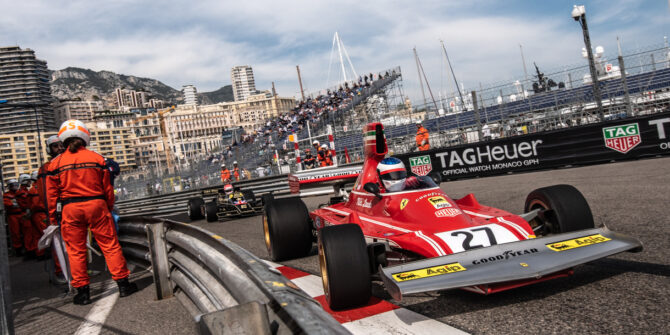
In Southern France, two of the biggest events of the year are taking place almost simultaneously – and it’s the perfect storm for an influx of private jet traffic to the region’s main airports.

The Cannes Film Festival has just started, and will run until May 28. This is followed by the Formula 1 Monaco Grand Prix on May 29.  As one of the most famous events in motorsport, it attracts huge crowds. Both these events are happening within 50nm of each other.

As a result, the nearest major airports, LFMD/Cannes and LFMN/Nice will see much higher traffic volumes than normal – and both airports are heavily restricting operations.

Three AIP SUPs have been issued for the events . Don’t feel like delving into all of them? We don’t blame you. Here’s a quick summary of what they cover.

LFMD/Cannes

AIP SUP 052/22 has the deets here.

The apron is going to be full. The airport isn’t normally coordinated, but you’ll need a slot if operating in or out between May 17 – 30. You’ll get a slot ID that needs to go into Item 18 on your ICAO flight plan.

Even if you like to manage things yourself, the use of handling agents will be mandatory during this time.

Also, if you’re planning on a short hop to LFMN/Nice on May 28-30, no bueno. More on that below.

Monaco

Monaco itself doesn’t have an airport. In fact, it is the second smallest country in the world and is found on France’s Côte d’Azur – its south-eastern coast. Inside Monaco is the district of Monte Carlo, where the race is taking place.

The majority of passengers for the Grand Prix will enter via LFMN/Nice which is found around 20nm further west along the coast.
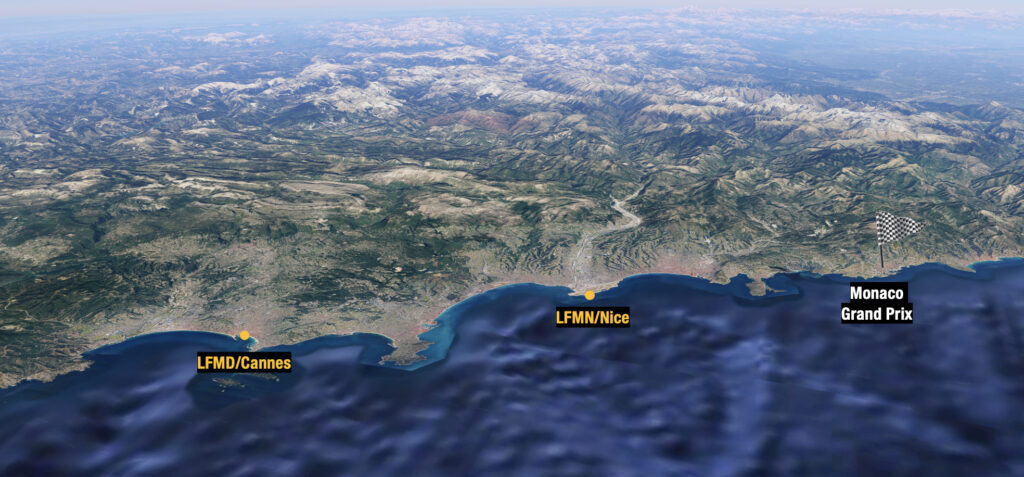
LFMN/Nice is the closest major airport to Monaco. Further west is LFMD/Cannes.

LFMN/Nice

AIP SUP 058/22 is the one to check here.

  • All arriving and departing aircraft operating at Nice from May 24 -30 will also need to co-ordinate a time slot. You can either request one directly, or ask your handling agent to get one for you.
  • You won’t be eligible for a slot unless your handler has guaranteed you a parking space when you get there – so make sure there is room for your ride first.
  • When filing your flight plan, commercial operators won’t need to include their slot ID number. But if your arrival or departure time is outside your allocated slot, your plan will bounce back.

Restricted airspace.

Info on this is published in yet another SUP – this one: AIP SUP 107/22

  • From May 28 – May 30, special restrictions will apply to all traffic.
  • All VFR ops will be banned, and IFR flights will not be allowed between LFMN/Nice and LFMD/Cannes, which is a little further west along the coast.
  • There will be intensive low level helicopter traffic to look out for. For IFR traffic departing on a SID, it is important to follow published climb gradients and altitude requirements.
  • If you don’t think your ride will make it, you’ll need to let ATC know with your start up request. In that case you may get hit with a delay, but don’t spring it on them at the last minute.
  • A temporary restricted area will be in effect which will primarily affect traffic over the event, and at LFMN/Nice airport, and will apply from surface to 3,500’.
  • If you’re operating on a valid flight plan, the impact will pretty minor. Just make sure you are in contact with Nice Tower on 122.375, and follow their instructions. You’ll need permission to enter it.
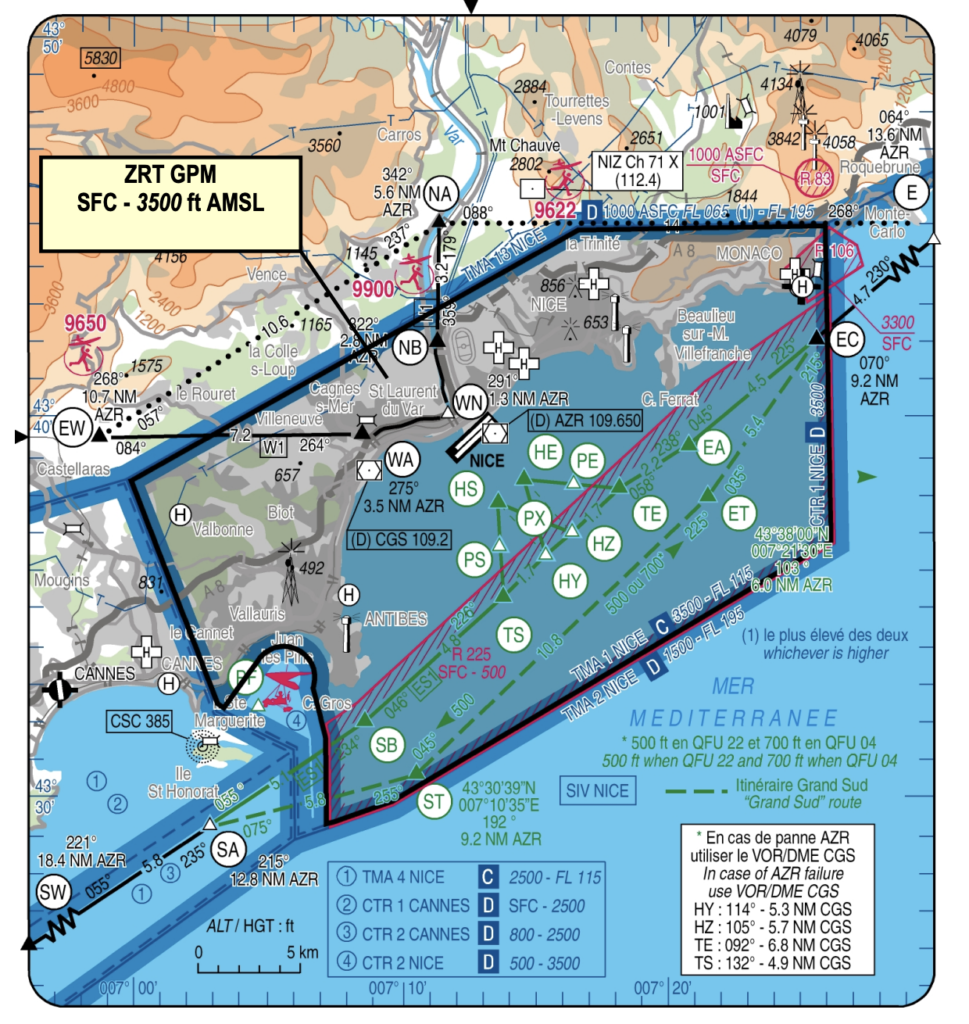
Temporary restricted airspace will be in effect – make sure you’re in contact with Nice Tower before entering.

The big question, who will win?

Not only is he the championship leader, but Ferrari driver Charles Leclerc is also a local to Monaco. He’s the home favourite to top the podium on race day.

Some useful contacts.


LFMD/Cannes Airport Authority +33 (0) 4 89 88 98 28.

Handling

Skyvalet  +33 (0) 4 93 90 41 10, operations-acm@cote-azur.aeroport.fr


LFMN/Nice Airport Authority +33 (0) 4 93 17 21 18. If you’re looking to get a slot approval directly from them, email nice-caz-agta-ld@aviation-civille.gouv.fr.

Handling

Menzies +33 (0) 4 83 76 26 02, Florence.augustyniak@johnmenzies.aero

Signature +33 (0) 4 93 21 82 18, NCE@signatureflight.fr

Swissport  +33 (0) 4 93 21 58 12, nce.operations@swissportexecutive.com


Aircraft security search now a requirement departing France

Update July 20th: Looks like this is not only happening in France, but some other EU countries too: we’ve had reports of the same procedure being required at some airports in Italy, Greece, and the Netherlands. If you have any further knowledge or recent experience to share, please let us know!

According to various reports we’ve had from Business Aviation aircrew and handlers, as of July 16, all aircraft departing specific French airports are now required to have completed a security search before departure, and to complete a form to be left with the handler. This applies to all aircraft unless the previous departure point was one of the following:

  • 28 countries of the European Union + Norway / Iceland / Switzerland / Lichtenstein
  • USA
  • Canada
  • Isle of Man
  • Montenegro
  • Faeroe Islands
  • Guernsey and Jersey

This new rule applies to all aircraft, no matter the country of registration or status (private, commercial or charter).

The security search is basically to check that no “prohibited articles” are on board (the usual things – guns, explosives, etc.). It’s common practice amongst airlines, but seems until now not to have been enforced as a rule for business aviation or private operations.

Once completed, this form must then be given to the ground handler, who will store it, in case the French authorities want to see it at some point.

It seems this new procedure is governed by an EU directive that was published in 2015, namely: the European decision (UE) C (2015) 8005 (Appendix 3-A) and the regulation (UE n°2015/1998 (Appendix 3-B32). Who would have thought that a new rule with such a tantalising name as this could go unnoticed until now ?

So it seems that all EU countries should be implementing this new procedure, but so far only certain French airports have done so – the ones we know about so far are:

LFMN/Nice
LFMD/Cannes
LFPB/Paris-le-Bourget

(Quite possibly the reason that it’s only French airports which have implemented the new procedure is that it was something that was cited in a French national audit conducted in Nov 2017!)

Can the handler provide the crew with a “security search” form?
Answer – Probably not. As the security search is done by the crew, it’s down to the operator to provide the form – the only responsibility of the handler is to receive it signed from the Captain and store it, that’s it.

What about flights that have arrived from the United Kingdom ?
Answer – You won’t need to do the search, as the UK is still part of the EU… for now! We will wait and see what their status will be once the “Brexit” happens, but until then, no worries 🙂

If a flight is operating PART 135 Air Ambulance, would they be subject to this search as well ?
Answer – Yes, if they arrived in from somewhere other than those countries mentioned above. The procedure is linked to where the aircraft came from, not to the aircraft reg or its status (be it commercial, private, charter, cargo, air ambulance, quick-turn, night-stop, fuel stop, transit flight, etc).

What kind of info should be in the form?
Answer – This kind of info:
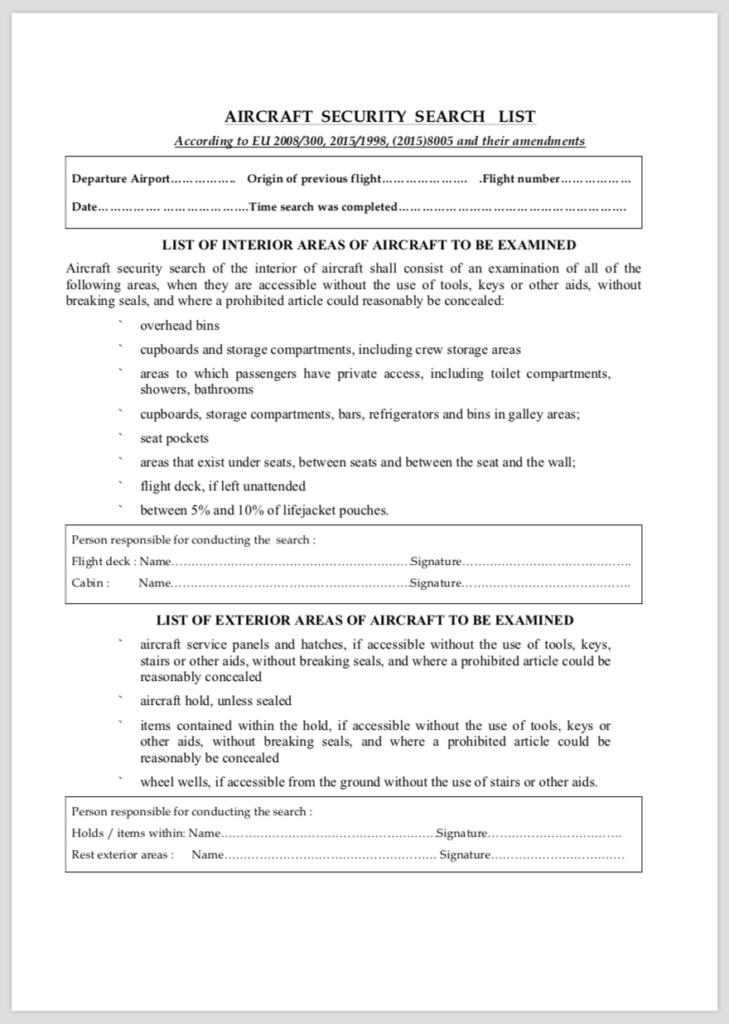
Flight Information: Flight number / Date / Aircraft Number / Airport of Origin / Airport of Destination
Aircraft Interior: Flight Deck / Storage Area in the Galleys / Lavatories / Catering Trolley and Containers / Seat Pockets / Area Under the Seats / Area Between Seats / Area Between Seats and Bulkheads/ Jump Seats / Trash Bins / Overhead compartments / Pax and Crew Storage Compartment.
Between 5 and 10% of the life vest bags are to be checked as well.
Aircraft Exterior: Aircraft Holds / Service Panels / Bays / Wheel Wells / Fuselage / Engines / AOG Spare in Hold
Search Information : The search must be performed by a member of the cockpit crew. The name of the Captain must appear on the form as well as the date and a place for him/her to sign the document.

You probably have a standard form in your OEM for something like this. But if not, then fear not! The good folks at Signature have provided us with a standard template. Click the image below to download!

If you have any further knowledge or recent experience to share, please let us know!

Further reading: