Flying to the L.A. Super Bowl in Feb 2022
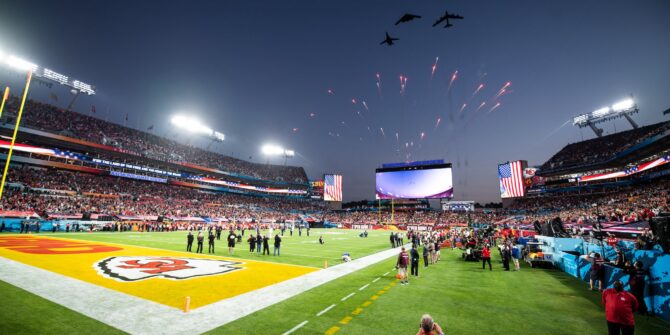
The Super Bowl is coming around again which means traffic procedures, prior reservations, a big TFR and various other things to plan for.

Save the date

The Super Bowl officially takes place on February 13 2022, but restrictions will start to come in from at least February 9th, and probably be in place to around the 15th. You might also want to start planning for this soon because spots fill up fast and reservations are already being taken.

(By soon, we mean now).

Compared to the last two events held in Florida, traffic is expected to be even more limited this time around! Business Aviation flights are being recommended to plan and book ‘drop-n-go’ reservations and not overnight parking.

The main airports in the area will also more than likely be Prior Permission Required (PPR) for the game day weekend so get in touch with those FBOs and start confirming.

Click on the pic to link to the official Super Bowl website

Which airports?

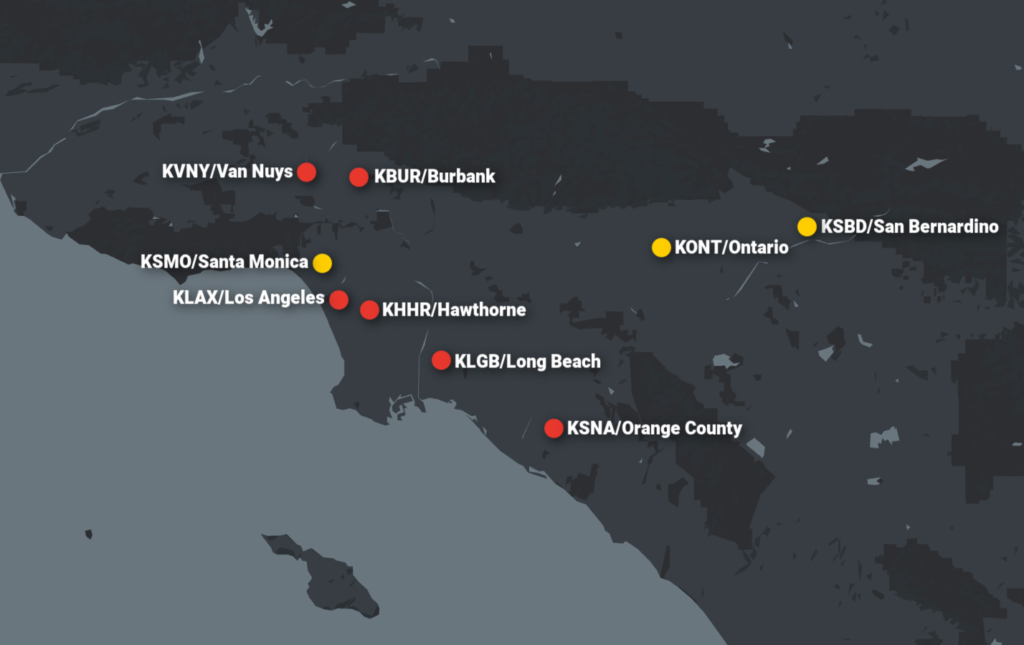
The big ones you definitely need reservations for in the area are these:

  • KLAX/Los Angeles
  • KVNY/Van Nuys
  • KBUR/Burbank
  • KLGB/Long Beach
  • KHHR/Hawthorne Municipal
  • KSNA/Orange Country

On a good note, KVNY/Van Nuys will be extending its operation hours on the Sunday and KLAX/Los Angeles over-ocean overnight ops restrictions will be available later into the night.

It is probably a good idea to get a reservation for any of these too if these if you think you’ll be heading there:

  • KONT/Ontario
  • KSBD/San Bernardino
  • KSMO/Santa Monica

The LA Basin will see high traffic levels.

Where else?

A few other places. These aren’t included in the reservation program, but they will be heavily utilised for overflow traffic and for their parking spots because the ones above will be extremely limited on availability. All this means ramp congestion, delays in and out and the possibility that they are included in FAA initiatives to manage the traffic levels if it all gets too busy.

So keep an eye on:

  • KPSP/Palm Springs
  • KSAN/San Diego
  • KLAS/Harry Reid
  • KPHX/Phoenix Sky Harbour
  • KSDL/Scottdale

Who to talk to for your reservation

Talk to your FBO. They are the ones with the slot allocations and will be able to keep you updated on any changes nearer the time.

There will be Special Air Traffic Procedures & FAA Initiatives…

The increase in operations mean delays, and delays mean unhappy airplanes with rapidly emptying fuel tanks. So, in attempt to reduce these and manage the traffic more efficiently there will be special procedures in place for the main, and the surrounding airports. Keep an eye out for info on these nearer the time.

ATC will also be under a lot of pressure, particularly in the LA basin airspace. The peak traffic times are expected to be:

  • Arrivals: Feb 9 -12, 1000 to 1800 local, Feb 13 0900 to 1400 local
  • Departures: Feb 13, 2000 to 0300 local, Feb 14 0700 to 2000 local

If you can avoid flying in the area during those times the do. It will save you (and ATC) a lot of hassle. If you can’t avoid it though then be prepared for the usual initiatives – from Ground Delay Programs to Airspace Flow Programmes, metering, holds and ground stops…

Route Structures will be in force

There are going to be preferred IFR arrival and departure routes to help ATC manage the traffic flows. These can change because it can be a bit of a dynamic situation. Keep an eye out for updates on them.

The TFR

The exact details will be out 10 days before the event in NOTAM form, but you can expect a 10 mile no-go ring around the event for all general aviation traffic and some other restrictions in a 30nm ring. Standard TFR stuff. This is usually active several hours prior to the event to at least an hour after.

KLAX will have TSA screening and gateway procedure in place during this time.
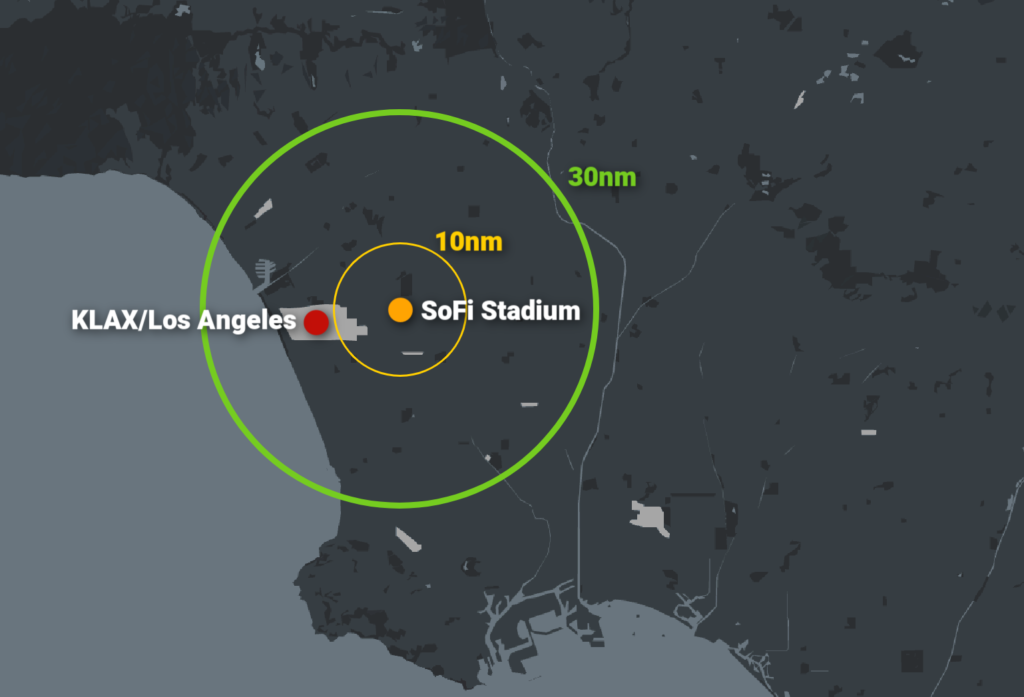
The TFR rings around the SoFi Stadium.

Anything else to think about?

Consider you alternates. Options are going to be limited and restricted because of the high traffic levels. Unless you are in an emergency situation, you’re going to need a plan in advance and know where you can go.

Consider your fuel. There are going to be BIG delays possible even with all the initiatives and reservations in place.

Check your documents. Ensure you have your pilot’s license, company ID (if applicable), applicable aircraft documentation, and access to copies of all reservations/confirmations. Increased security operations may involve ramp checks, security searches, or routing through a gateway airport for TSA screening.

Really plan in advance. We mean from about now to avoid disappointment and disruption. File your flight plan between 22 and 6 hours ahead of departure. Preferably nearer the 22 hours end of that limit to help ATC build their initiatives.

Keep the bigger picture in mind. Airspace and airports will be congested, ATC will be working hard, and there are going to be TFRs to think about as well. Know what is going on and what to expect before you get airborne.

The ball is in your court.

(I couldn’t think of a football related pun).

Check out the FAA’s Super Bowl Safety Plan here.

Get in touch with your FBO to make your reservations and start planning early.

Be prepared! There will be delays, high traffic levels and all the risks and threats that come with these. So… again… be prepared!
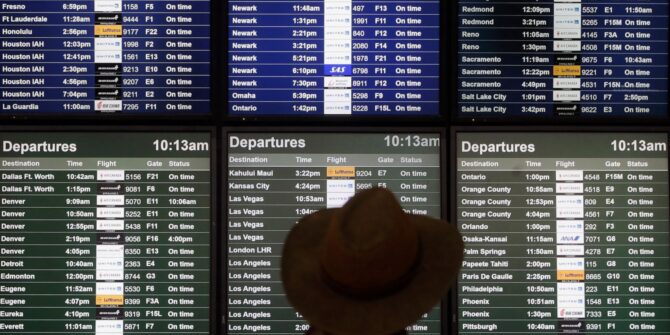
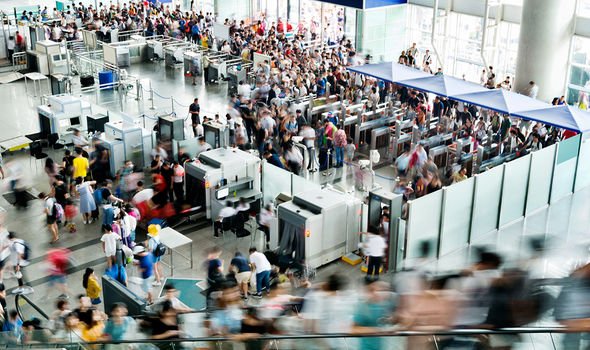
What’s the delay in the USA?

We took a look at the stats the FAA publish about on-time performance to find out what the most common causes of delays are, which airports are worst affected, and what we can do to manage it.

On your marks…

First up, what counts as a delay? Your airline or operator might be a bit stricter on this, but the FAA consider a flight delayed if it arrives more than 15 minutes late. Which is probably what your passengers really care about as well.

The FAA gather their info from a bunch of carriers, and break it all down into five basic categories of delay:

  • Air Carrier: This is something under the airline’s control like crewing, maintenance type issues. So that time you wanted a Starbucks coffee and the queue was really long and you held the flight up.
  • Extreme Weather: We are talking the big, bad stuff like hurricanes, blizzards, tornadoes… the things that shut airports for hours.
  • National Aviation System: This is pretty broad and covers ATC, airport ops, high traffic volume sorts of situations. They also throw general weather into this (the stuff that airplanes and ATC should be able to deal with).
  • Late-arriving aircraft: A knock on effect from a previous flight delay.
  • Security: Broken X-ray machines, long queues because of that passenger who thought he could sneak a tiger on in his hand luggage type scenarios.

Pick a month

Here come the statistics…

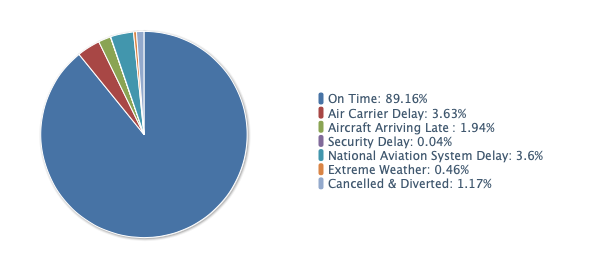
In January 2021, 89.16% of flights were on time – which ain’t bad, but ain’t great. So, of the remaining 10.84%, what were the reasons for the delay?

Air Carrier Delays are the big offender, checking in at 3.63%. The airlines only have themselves to blame…

Although, NAS came in a close second with 3.6%.

Then there was the knock-on effect of one late flight making the next flight late. This accounted for 1.94% of delays, with 1.17% because of previous cancellations and diversions.

Extreme weather came in at just 0.46%, while security delays only resulted in 0.04% (probably because those passengers were just left behind).

Weathering the delays

Weather only accounts for 4% of delays, which might seem low, but remember we are talking ‘extreme weather’. Non-extreme weather should be manageable which is why “normal weather” causing delays falls under NAS.

If we dig a bit deeper and take a snapshot look at a random month (we picked May 2019 because everything was fairly normal back then), then weather was the reason for 65.62% of NAS delays. That is a whopping 27,864 delayed flights or 1,822,469 minutes.

Which airport is the worst?

Let’s take a look at the airports to look out for.

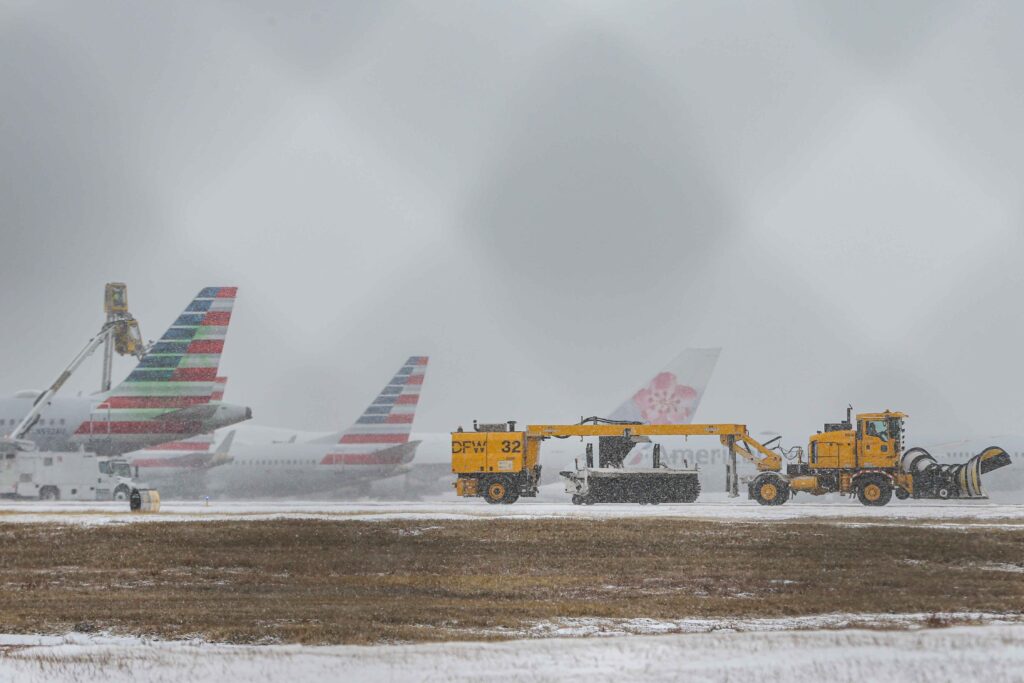
KDFW/Dallas Fort Worth in Texas. A check of all the 29 major US airports in Jan 2021, and Dallas was the only one coming in with an on time performance below 80%.

10.48% of KDFW’s delays were down to NAS. But let’s not be too quick to tell off ATC yet. Just under 21% was due to high volumes of traffic. Just under 31% was because of runway closures and a whopping 45% was due to nasty weather (major winter storms).

The runners-up for worst delays were KORD/Chicago and KFLL/Fort Lauderdale which came in at 84.58% and 86.44% respectively. Fort Lauderdale’s NAS accounted for just over 6% and 8% was because of traffic volume problems.

Stop boring me with statistics

OK, that is enough facts and figures. What are we really talking here? Well, the two biggies are the Air Carrier delays and delays from NAS (most of which seem to boil down to weather).

Bad weather means a backlog of traffic, often a lot of detour requests to manage, or diversions to support and this means a much higher workload for our ATC colleagues to try and deal with. Even when it is “just” rain, or a windy day, this leads to delays. We can’t change the weather, but we can plan for it.

Delays are not just a cost and customer service issue – they are also a big fuel consideration…

So what can we do about them?

  • Check the forecasts. Planning for those delays in advance is a good idea because chances are they are going to result in some long holds, and long holds need fuel. Don’t just think about your destination weather – have a look at the alternates as well because when one airport shuts because of weather, others nearby probably will as well. If they don’t, then they are going to fill up fairly fast with diverting traffic.
  • Check the peak times. If you are not a scheduled carrier then try to plan your flights to head in at non-peak times to avoid high traffic volume delays.
  • En-route stuff. If you are delayed out of somewhere then you can try and make that time up en-route. Speeding up might seem like a good plan, but in reality unless you’re talking a mega long flight this probably isn’t going to make a huge difference to your time (but probably will to your fuel burn). Asking for directs however, is a good way to chop the time down.
  • Check the schedule. If you depart late then check your schedule time. With a decent tailwind you might find your flight time still brings you in early in which you don’t want to go speeding up and then find yourself having to wait for a parking spot
  • Winter planning. Winter (de-icing) is probably the biggest cause of delays out so get those calls in early if you need to de-ice and plan ahead.

On-time performance is great, but sometimes delays are just unavoidable. So while we can all “think on time” a bit more, thinking about safety (and not rushing) is still the best mentality any pilot can have.


US to require Covid tests for all international passengers

From January 26, all international passengers need a negative Covid test that is less than 72 hours old to board a flight to the US.

The US CDC has published the full details of the requirements here, and they’ve done a good job too – it includes a pretty thorough Q&A section split into separate sections for passengers and crew.

Here’s a summary of the main points:

  • All international travellers aged two years or older need a test, including citizens and foreigners.
  • Applies to all flights, including private and charter flights.
  • Applies only to international flights – from “anywhere that is not a state, territory, or possession of the United States”. Therefore, passengers do not need a test if coming from: American Samoa, Guam, the Northern Mariana Islands, Puerto Rico, and the US Virgin Islands.
  • It needs to be a “viral test” (NAAT or antigen test) – antibody tests will not be accepted. The PCR test is a type of NAAT test (Nucleic Acid Amplification Test), so those are accepted. You can read more about the different types of tests here.
  • The test must be done within three calendar days of departure to the US. If passengers have one or more connecting flights to the US, it gets a bit more complicated.
  • Airlines and operators will need to check that their passengers meet the requirements prior to travel.
  • For crew travelling to the US: you don’t need to get a Covid test in advance as long as you’re “active crew” – i.e. you’re operating the flight or travelling in an assigned deadhead status. You also have to follow the health and safety rules set out in the FAA’s SAFO 20009. However, we’ve had several reports saying that if you are positioning crew into the US via an airline for any reason, the reality is that you will likely be asked to show proof of a Covid test. More guidance on the definition of “active crew”, check out the CDC’s dedicated webpage.
  • If crew/pax can prove they have already had Covid, have recovered from it, and can provide documentation to this effect, they don’t need to get a test.
  • Operators must distribute and collect Passenger Attestation Forms prior to embarkation, and keep copies of these for 2 years. Operators do not need to keep copies of passenger test results.
  • If you’re heading out of the US, and plan to return within 72hrs, you will still need a test. You can get this done in the US before you leave. But if you end up staying out of the US for more than 72hrs, you will need to be retested before your return flight.
  • Quarantine rules: Technically, all pax inbound to the US now have to quarantine for 10 days upon arrival, as per the Executive Order that went into effect on Jan 26. However, it looks like the CDC will not actually be enforcing this – at least for now.

Important to note: the old rules banning certain pax from entry still stands: with specific exemptions, foreign nationals who have been present within the past 14 days in the European Schengen area, the UK and Ireland, mainland China, Iran, and Brazil will still be barred from entry – with or without a negative test. The ‘specific exemptions’ part basically means this: US residents and family members, and flight crew traveling to the United States on C, D or C1/D visas. For more details on this rule, check the US Government webpage here.


US no longer limiting international arrivals to 15 airports

From September 14, the US is no longer limiting international arrivals from higher risk countries to specific airports. Under previous rules, any passenger from China, Iran, the Schengen area of Europe, the UK, Ireland and Brazil had to enter the United States through one of fifteen centralised airports capable of providing enhanced health screening. This is no longer be the case.

The previous system was deemed ineffective because so many people who transmit the disease don’t show symptoms. A new approach is being launched, which authorities say will better mitigate the risk of Coronavirus by focusing more on the individual passenger. Here’s how it will work:

  • Pre-departure, in-flight and post-arrival health education for passengers.
  • Robust illness response at airports.
  • Voluntary collection of contact information from passengers using electronic means as proposed by some airlines to avoid long lines, crowding and delays associated with manual data collection.
  • Potential testing to reduce the risk of travel-related transmission of the virus that causes COVID-19 and movement of the virus from one location to another.
  • Country-specific risk assessments to assist passengers in making informed decisions about travel-related risk.
  • Enhancing training and education of partners in the transportation sector and at U.S. ports of entry to ensure recognition of illness and immediate notification to CDC.
  • Post-arrival passenger recommendations for self-monitoring and precautions to protect others, with enhanced precautions, including staying home to the extent possible for 14 days for people arriving from high-risk destinations.

You can read the announcement by the Centers for Disease Control and Prevention here, and confirmation from US CBP here.

Although the 15-airports rule has gone away, all other US rules on inbound travel remain in place. The main one is this – with specific exemptions, foreign nationals are not allowed to enter the US if they have been in any of the following countries within the past 14 days: the European Schengen area, the UK and Ireland, mainland China, Iran, and Brazil. The ‘specific exemptions’ part basically means this: US residents and family members, and flight crew traveling to the United States on C, D or C1/D visas. For more details, check the US Government webpage here.


Covid restrictions by US state

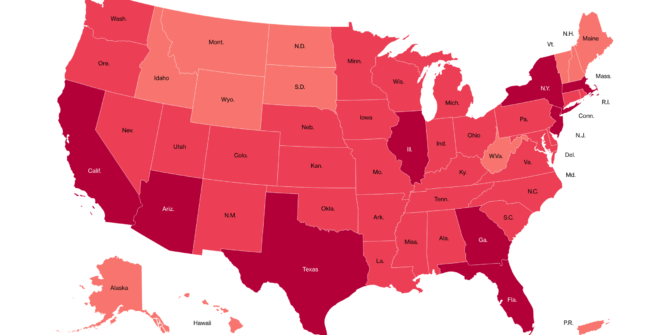
With the United States seeing new hotspots for Covid-19 cropping up, varying forms of restrictions have been implemented by the individual states. Restrictions imposed at the state level are below, and also include links that may be helpful. States in red text have stronger regulations than the standard ‘mask and social distancing’ and are worth a closer look. All information is accurate to the best of our knowledge as of 28 July 2020. 

However, here are a few things to keep in mind regardless of where you plan to fly:

  • Always check all NOTAMs and relevant publications before flying
  • Consider fuel levels and alternates in light of unexpected ATC closures/restrictions
  • Follow CDC and state/local government guidance – this may include masks, gloves, Covid-19 testing, and cleaning/disinfection regimes
  • Check with your handler or airport representative to verify that city or county government regulations do not differ from the state regulations, and to confirm availability of services at the airport
  • Aviation is considered an essential business by the U.S. Federal Government, but some states may not have explicitly named it as such in their regulations. 

However, keep in mind that U.S. federal regulations still restricts international travel into the U.S. for those who are not citizens or permanent residents. There’s a long list of countries where passengers are not allowed to have travelled to within the past 14 days if they want to enter the US. This includes the European Schengen area, the UK and Ireland, mainland China, Iran, and Brazil. Passengers who have been in one of these countries in the past 14 days but who are exempt from the restriction to enter the US (i.e. they are US residents or family members), are only able to land at one of 15 airports: ATL, BOS, ORD, DFW, DTW, HNL, LAX, MIA, JFK, EWR, SFO, SEA, IAD, FLL and IAH. More information can be found on the Centres for Disease Control website

Alabama:

  • All individuals are required to wear a mask when within six feet of a person from another household.
  • Social distancing of six feet is also required between members of different households. 
  • https://covid19.alabama.gov/

Alaska:

  • All travellers from outside Alaska must fill out a declaration form, and present results of a negative Covid-19 PCR test from within the last 72 hours. If your test results are from the previous five days, you must be tested again on arrival.
  • In either case, those remaining in Alaska must also take another PCR test 7-14 days after arrival.
  • There is no mandate to wear a mask or social distance, but it is strongly encouraged. 
  • Alaska has a large number of remote settlements that may not have a robust healthcare system, and as a result may have instated stronger regulations – check local resources.
  • https://covid19.alaska.gov/

Arizona:

  • There is no statewide mandate to wear a mask or social distance, but it is strongly encouraged. 
  • Phoenix (Maricopa County), Mesa, Tucson, Flagstaff, Tempe, and a host of other cities have enforced masks/face covering requirements – check local resources. 
  • http://azhealth.gov/COVID19

Arkansas:

  • There is a statewide mandate requiring masks/face coverings to be worn in indoor public areas, and in outdoor areas where social distancing cannot be guaranteed.  
  • https://govstatus.egov.com/ar-covid-19

California:

  • There is a statewide mask/face covering mandate in place, and social distancing is encouraged.
  • https://covid19.ca.gov/

Colorado:

Connecticut:

  • Visitors to Connecticut from certain high risk states are required to quarantine for 14 days upon arrival and fill out this form. The states are: Alaska, Alabama, Arizona, Arkansas, California, Delaware, Florida, Georgia, Idaho, Indiana, Iowa, Kansas, Louisiana, Maryland, Mississippi, Missouri, Montana, Nebraska, Nevada, New Mexico, North Carolina, North Dakota, Ohio, Oklahoma, South Carolina, Tennessee, Texas, Utah, Virginia, Washington and Wisconsin.
  • Face coverings are required in all public areas where social distancing cannot be maintained.
  • https://portal.ct.gov/Coronavirus

Delaware:

District of Columbia (Washington, D.C.): 

  • Masks are required in public areas and social distancing is encouraged.
  • Those who have participated in non-essential travel to/from high risk states must quarantine for 14 days upon arrival. The states are: Arkansas, Arizona, Alabama, California, Delaware, Florida, Georgia, Idaho, Iowa, Kansas, Louisiana, Mississippi, Missouri, Montana, Nebraska, Nevada, New Mexico, North Carolina, North Dakota, Ohio, Oklahoma, South Carolina, Tennessee, Texas, Utah, Washington, Wisconsin.
  • https://coronavirus.dc.gov/

Florida:

  • There is no statewide mask/face covering requirement, but many individual cities and counties have one in place this site lists them.
  • Visitors from the Tri-State area (New York, New Jersey, Connecticut) must isolate for 14 days upon arrival. 
  • Florida is emerging as a hotspot, and many local authorities are rolling back plans to open businesses as a result – check with local contacts for the most up to date information.
  • https://floridahealthcovid19.gov/

Georgia:

Hawaii:

  • All interstate travellers must quarantine for 14 days on arrival in Hawaii, although this may be avoided from September 1 through the presentation of a negative PCR test from the preceding 72 hours. 
  • Inter-island travellers must fill out this form.
  • There is a statewide mask/face covering mandate in place, and social distancing is encouraged.
  • https://hawaiicovid19.com/

Idaho:

  • Ada County, which includes Boise, is encouraging a 14 day quarantine for those entering the area. Other counties are further along in their reopening plans and do not request a quarantine. 
  • Some counties are requiring the usage of masks/face coverings and others only encourage them. Social distancing is still encouraged. 
  • https://coronavirus.idaho.gov/

Illinois:

  • There is a statewide mask/face covering mandate in place, and social distancing is encouraged.
  • Travelers from the following states should quarantine upon arrival in Chicago: Alabama, Arkansas, Arizona, California, Florida, Georgia, Idaho, Iowa, Kansas, Louisiana, Mississippi, North Carolina, Nevada, Oklahoma, South Carolina, Tennessee, Texas, and Utah. Effective Friday, July 31, travelers from Missouri, Wisconsin, Nebraska, and North Dakota will also be directed to quarantine.
  • https://coronavirus.illinois.gov/

Indiana:

Iowa:

Kansas:

  • There is a statewide face covering mandate in place, and social distancing is encouraged.
  • Those who have travelled to/from Florida will be required to quarantine for 14 days upon arrival in Kansas. The same applies to anyone arriving from China, Iran, the European Schengen area, the United Kingdom, the Republic of Ireland and Brazil, and anyone returning from a cruise ship. 
  • https://covid.ks.gov/

Kentucky:

  • There is a statewide face covering mandate in place, and social distancing is encouraged. 
  • Individuals who have travelled to/from Alabama, Arizona, Florida, Georgia, Idaho, Mississippi, Nevada, South Carolina, Texas, and Puerto Rico are advised to quarantine for 14 days upon arrival in Kentucky. 
  • https://govstatus.egov.com/kycovid19

Louisiana:

  • There is a statewide face covering mandate in place, and social distancing is encouraged. Local areas have the ability to opt out of the mask mandate if they meet certain criteria.
  • http://ldh.la.gov/Coronavirus/

Maine:

  • There is a statewide mask/face covering mandate in place, and social distancing is encouraged.
  • Only those residents of Vermont, New Hampshire, Connecticut, New York and New Jersey can enter the state without restriction. All others must have a negative test result or must quarantine for 14 days – and must sign a Certificate of Compliance which is necessary to check-in to lodging in Maine. 
  • Maine residents who visit one of the five exempted states may return without restriction, but visits to any other states are still subject to testing and/or quarantine upon return. 
  • https://www.maine.gov/covid19/

Maryland:

Massachusetts:

  • There is a statewide mask/face covering mandate in place, and social distancing is encouraged.
  • All those entering the state must complete the Massachusetts Travel Form and quarantine, unless coming from a low-risk state or able to present a negative test result from the preceding 72 hours. Low-risk states are Connecticut, New York, New Hampshire, New Jersey, Hawaii, Maine, Rhode Island, Vermont. 
  • https://www.mass.gov/info-details/covid-19-updates-and-information

Michigan:

  • There is a statewide mask/face covering mandate in place, and social distancing is encouraged. Businesses may deny entry to those not wearing face coverings. 
  • https://www.michigan.gov/coronavirus/

Minnesota:

Mississippi:

Missouri:

Montana:

  • There is a statewide mask/face covering mandate in place for counties with more than four active cases – 25 counties currently meet the criteria. Social distancing is encouraged.
  • The state also includes multiple areas of tribal land governed by local councils – check local resources to see what rules may apply. 
  • https://www.visitmt.com/montana-aware

Nebraska:

Nevada:

New Hampshire:

  • There is no statewide mask/face covering mandate, but the use of them is encouraged along with social distancing. 
  • Those travelling into the state from outside the New England area are encouraged to quarantine for 14 days. 
  • https://www.nh.gov/covid19/

New Jersey:

  • There is a statewide mask/face covering mandate in place, and social distancing is encouraged.
  • Travellers from high-risk states are asked to voluntarily quarantine for 14 days, and provide contact information. States include Alaska, Alabama, Arizona, Arkansas, California, Delaware, Florida, Georgia, Idaho, Indiana, Iowa, Kansas, Louisiana, Maryland, Mississippi, Missouri, Montana, Nebraska, Nevada, New Mexico, North Carolina, North Dakota, Ohio, Oklahoma, South Carolina, Tennessee, Texas, Utah, Virginia, Washington and Wisconsin. 
  • https://covid19.nj.gov/

New Mexico:

  • There is a statewide mask/face covering mandate in place, and social distancing is encouraged.
  • All out of state travellers are required to quarantine for 14 days upon arrival.
  • https://cv.nmhealth.org/

New York:

  • There is a statewide mask/face covering mandate in place, and social distancing is encouraged.
  • Those who have spent more than 24 hours in a high-risk state must quarantine for 14 days upon arrival. The states include Alaska, Alabama, Arizona, Arkansas, California, Delaware, Florida, Georgia, Idaho, Indiana, Iowa, Kansas, Louisiana, Maryland, Mississippi, Missouri, Montana, Nebraska, Nevada, New Mexico, North Carolina, North Dakota, Ohio, Oklahoma, South Carolina, Tennessee, Texas, Utah, Virginia, Washington and Wisconsin.
  • Those arriving at New York area airports will be required to fill in a Health Department traveller form. 
  • https://coronavirus.health.ny.gov/home

North Carolina:

North Dakota:

Ohio:

  • There is a statewide mask/face covering mandate in place, and social distancing is encouraged.
  • Travellers from high-risk states are asked to voluntarily quarantine for 14 days. States include Alabama, Arizona, Florida, Georgia, Idaho, Mississippi, Nevada, South Carolina and Texas.
  • https://coronavirus.ohio.gov/

Oklahoma:

  • There is no statewide mask/face covering requirement, but many individual cities and counties have one in place, including Oklahoma City. 
  • https://coronavirus.health.ok.gov/

Oregon:

Pennsylvania:

  • There is a statewide mask/face covering mandate in place, and social distancing is encouraged.
  • Travellers from high-risk states are asked to voluntarily quarantine for 14 days. States include Alabama, Arizona, Arkansas, California, Florida, Georgia, Idaho, Iowa, Kansas, Louisiana, Mississippi, Nevada, North Carolina, Oklahoma, South Carolina, Tennessee, Texas and Utah.
  • https://www.health.pa.gov/topics/disease/coronavirus/Pages/Coronavirus.aspx

Rhode Island:

  • There is a statewide mask/face covering mandate in place, and social distancing is encouraged.
  • Travellers from high-risk states are asked to voluntarily quarantine for 14 days, although this can be avoided with a negative test result from the preceding 72 hours. States include Alabama, Arizona, Arkansas, California, Colorado, Florida, Georgia, Idaho, Indiana, Iowa, Kansas, Kentucky, Louisiana, Maryland, Minnesota, Mississippi, Missouri, Nebraska, Nevada, North Carolina, North Dakota, Ohio, Oklahoma, Oregon, Pennsylvania, South Carolina, South Dakota, Tennessee, Texas, Utah, Virginia, Washington, Wisconsin and Wyoming. Visitors from Puerto Rico must also quarantine.
  • https://health.ri.gov/diseases/ncov2019/testindex.php

South Carolina:

South Dakota:

  • There is no statewide mask/face covering requirement, and social distancing is encouraged. 
  • The state also includes multiple areas of tribal land governed by local councils – check local resources to see what rules may apply. 
  • https://covid.sd.gov/

Tennessee:

Texas:

  • There is a statewide mask/face covering mandate in place for counties with more than twenty active cases. Social distancing is encouraged. 
  • https://www.texas.gov/covid19/

Utah:

  • There is no statewide mask/face covering requirement, but many individual cities and counties have one in place, including Salt Lake City.
  • https://coronavirus.utah.gov/

Vermont:

  • There will be a statewide mask/face covering mandate in place effective August 1, and social distancing is encouraged.
  • Most arrivals to the state have to quarantine for 14 days, unless coming from a list of approved states/counties. Unlike other states, you may quarantine elsewhere before entering Vermont, provided you travel in a private vehicle and only make essential stops while wearing a mask. Quarantine may be shortened to seven days with a negative test result. 
  • https://www.healthvermont.gov/response/coronavirus-covid-19

Virginia:

Washington:

West Virginia:

Wisconsin:

  • There is no statewide mask/face covering requirement, but many individual cities and counties have one in place, including Milwaukee.
  • Wisconsin residents have been asked not to travel to summer or holiday homes, and local restrictions may apply.
  • https://www.dhs.wisconsin.gov/covid-19/travel.htm

Wyoming:

  • There is no statewide mask/face covering requirement, but many individual cities and counties have one in place.
  • https://covid19.wyo.gov/

For more information on some of the wider restrictions in place at US state level beyond the realm of aviation, Kayak.com keeps a pretty neat little page updated here.


Many US Bizav Airport Towers To See Hours Cut

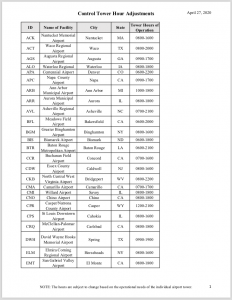
The FAA has published a list of 93 airports which will be getting their tower operating hours cut due to the reduction in traffic caused by the coronavirus pandemic.

Here’s the list of airports, with the new planned tower operating times:

The NBAA say these extended night closures will start to be implemented next week, beginning May 4.

In announcing its plans, the FAA said the following – “These facilities have seen a significant reduction in flights, especially during the evening and nighttime hours, since the pandemic began. Adjusting the operating hours will further protect our employees and reduce the possibility of temporary tower closures from COVID-19 exposures by ensuring enough controllers are available to staff the facilities during peak hours. It also will enable us to allocate difficult-to-source supplies where they are most needed.”

When the towers at these airports are closed overnight, the radar facility with oversight controls the airspace – the FAA plans to begin adjusting the operating hours of some of these facilities later this month. More info is available on the FAA page here.


FAA warns about fuel contamination

The FAA Safety Team have issued a mysterious new Notam today, about a possible fuel contamination problem at airports in the central U.S.

Update: The FAA has sent a follow up, seems things weren’t as widespread as they made it sound:

SPECIAL..NOTICE..

THE FAA CONTINUES TO INVESTIGATE A FUEL CONTAMINATION PROBLEM. SUBSTANTIAL EVIDENCE INDICATES THE CONTAMINATION HAS BEEN ISOLATED TO GENERAL AVIATION AND MILITARY AIRCRAFT AT EPPLEY AIRFIELD, OMAHA, NE (KOMA) DURING THE TIME PERIOD NOVEMBER 18-20, 2017. FAA RECOMMENDS THAT ALL AIRCRAFT OPERATORS CHECK NOTAMS FREQUENTLY FOR POSSIBLE CHANGES TO THIS ONGOING SITUATION.

FOR FURTHER INFORMATION CONTACT FLIGHT STANDARDS AIR TRANSPORTATION DIVISION AT 202-267-8166.

Here’s what they have to say:

FDC 7/4900 (A1362/17) - FL..SPECIAL NOTICE..THE FAA IS CURRENTLY INVESTIGATING 
A FUEL CONTAMINATION PROBLEM THAT HAS RECENTLY APPEARED IN JET FUEL WI THE CENTRAL U.S. THE EXACT SOURCE AND THE GEOGRAPHICAL SCOPE OF THE CONTAMINATION IS UNKNOWN. THERE HAVE BEEN REPORTS OF BLOCKAGES IN FUEL FILTERS, FUEL NOZZLES, AND FUEL TANKS. THIS HAS RESULTED IN SEVERAL ENGINE FLAMEOUTS AND OTHER ERRATIC ENGINE OPS. ALL OPERATORS ARE ADZ TO CLOSELY FOLLOW FUEL SAMPLING PROC AND REPORT ANY DISCOVERY OF CONTAMINATION OR ERRATIC ENGINE OPS TO THEIR FLIGHT STANDARDS DISTRICT OFFICE OR NEAREST FAA FACILITY. 30 NOV 00:20 2017 UNTIL 30 DEC 00:20 2017. CREATED: 30 NOV 00:48 2017

We haven’t seen or heard any reports about this issue recently. The FAA Safety Team say that this is currently still under investigation, and can’t provide any additional information just yet. We’ve also reached out to a few of the major suppliers, who are saying pretty much the same thing – no more info yet, beyond the Notam.

Several sources are telling us the NOTAM is related to a fuel issue at KOMA, limited to a single truck at a single FBO:

F0013/17 NOTAMN Q) ZMP/QFUXX/IV/NBO/A/000/999/4118N09553W005 A) KOMA B) 1711211550 C) 1712212359 E) [DEFENSE LOGISTICS AGENCY ENERGY ADVISORY] CONTRACT FUEL NOT AVAILABLE TRUMAN ARNOLD COMPANIES DBA TAC AIR IS HEREBY NOTIFIED TO CEASE REFUELING ON ALL U.S. AIRCRAFT UNDER INTO-PLANE CONTRACT SPE600-16-D-0066 AT LOCATION KOMA – EPPLEY AIRFIELD AIRPORT, NEBRASKA. DUE TO SAFETY OF FLIGHT ISSUES REPORTED ON TWO AIR FORCE AIRCRAFT REFUELED AT THEIR FACILITY 18 NOV 2017 THAT RESULTED IN EMERGENCY LANDINGS. REFUELING OF U.S. GOVERNMENT AIRCRAFT IS IMMEDIATELY SUSPENDED AND SHALL REMAIN SO UNTIL THE DLA ENERGY CONTRACTING OFFICER NOTIFIES YOU OTHERWISE IN WRITING.


If you’ve experienced any fuel contamination issues recently, we’d love to hear about it! Email us at team@flightservice.org


New, single CPDLC logon for US airspace

In case you missed the several hundred Notams this week, KUSA is the new identifier for all datalink logons in the US, including CPDLC-DCL, and enroute, which came into use on October 22nd. Now, the only logon you need is KUSA.

For all you could possibly want to know about Datalink operations in the US, take a peek at the new AC90-117, ” an overview of data link communication operations for U.S. domestic
operations and in oceanic and remote continental airspace”, which we’ve uploaded here.

More readable is the FAA’s CPDLC-DCL guide, uploaded here.

There are some comments that it doesn’t work properly if you don’t have an active FPL in the box, let us know your experiences on that in the comment section below.


Enhanced Security – new rules for US Inbounds

KZZZ/USA The US has opted for ‘Enhanced Security’ instead of a wider laptop ban. In fact, the existing ban is likely to end once airports can comply with the new rules. The information in the official DHS release is somewhere between vague and zero, which kind of makes sense.

So, the story is pretty simple – there is no wider laptop ban, but no specifics have yet been released publicly as to what exactly ‘Enhanced Security’ means for Aircraft Operators. The DHS will work directly with larger AO’s directly affected.


Immediate US Visa ban on 7 countries – Aircrew also

KZZZ/USA Now in force, is an immediate ban on US visas (and therefore US travel) for citizens from 7 countries: Iraq, Iran, Syria, Yemen, Sudan, Somalia and Libya. This is distinct from the Visa Waiver Program ban in effect since January 2016. The ban is posted for 90 days, but may last longer.

Admission will be refused to visitors with a passport issued by the following 7 countries: Iran, Iraq, Libya, Somalia, Sudan, Syria, and Yemen, and holding a valid immigrant or non-immigrant visa for the US.

This travel ban does not apply to:
– Lawful Permanent Residents (Green Card holders) of the USA who also hold a passport issued by one of the aforementioned countries
– Dual Nationals, holding and traveling with a valid passport issued by USA as well as a passport issued by one of the aforementioned countries
– Dual Nationals holding and traveling with a valid passport issued by a third country as well as a passport issued by one of the aforementioned countries
– Passengers with diplomatic visas, North Atlantic Treaty Organization visas, C-2 visas for travel to the United Nations and G-1 ,G-2 ,G-3 ,and G-4 visas

Aircrew
This affects aircrew as well, whether travelling on a C1/D visa, or whether on duty or off duty.

That’s the situation as we understand it, we’ll keep this page updated.