Three Ways To Escape From New York

Key Points
  • If you’re flying out of the New York area, expect delays. ATC staffing and tech issues, along with heavy traffic, are causing slowdowns.
  • But there are three lesser-known routing options (SERMN, Deep Water, TEC) that can get you airborne faster – if you’re willing to fly lower, carry extra fuel, and meet a few added requirements.

In the middle of last year, the FAA transferred control of Newark’s airspace from New York TRACON (N90) to Philadelphia TRACON’s Area C due to a shortage of staff.

And it hasn’t been smooth sailing. Philly itself is understaffed, and has reported several failures recently with data sent from New York via aging copper lines affecting both radar and communication equipment.

Recent murmurings from OPSGROUP members indicate EDCT delays are rife – even at outlier airports. We’re talking hours here, not minutes.

And in the short term at least, it looks like things will get worse before they get better.

The Memorial Day Weekend set records for US air travel, and the Summer peak is nearly upon us.

A couple of weeks back some clever folk from the NBAA, FAA and the Teterboro Users Group (TUG) got together to talk about the recent disruptions in the Northeast and what to do about it. You can view a replay of their excellent session here.

Some of the juiciest intel was the use of not-so-secret ATC routes to significantly reduce departure delays and get you clear of New York’s airspace post-haste.

In fact, three less conventional route options were discussed to help you escape the Big Apple.

A Quick Word on Fuel

A recurring theme here is ‘operational flexibility.’ None of these options will save you fuel, only time.

To use these routes, you will need to carry more. In some cases enough to operate at low level (less than 10,000’) for up to 100nm. But letting ATC know you are willing and capable of flying them may well see you jump an extremely long queue for conventional routes.

Escape Plan #1: SERMN Routes

When weather gets in the way of things, the FAA has a literal playbook of strategic options to help manage high volumes of traffic. You can find it here.

Within this playbook, is something called SERMN Routes. SERMN stands for SWAP Escape Routes – Metro New York. SWAP stands for severe weather avoidance plan. With me so far?

They comprise a low-level game plan to help ATC manage traffic out of the NY Metro area when the regular routes are not available due to nasty build-ups.

When this happens, ATC has three plays available (depending on the direction you’re headed):

🏈 SERMN North (BUF, ROC, SYR, YYZ etc). Example routing ex KTEB: COATE → LAAYK → STUBN →BENEE → BUF→ KROC. Jets capped at 10,000′ until exiting NY  Center’s airspace.

🏈  SERMN South (DCA, CLT, ATL etc). Example routing ex KTEB: ELVAE → COL → DIXIE → T303 → LEEAH → T315→ TAPPA→ THHMP→ CAVLR6→ KIAD Jets capped at 8,000′.

🏈  SERMN East – (BOS, North Eastern Corridor). Example routing ex KTEB: BREZY → V39 → CMK → V3 → WOONS → KBOS. Jets capped at 9,000.’

Their aim is to get you under weather and away from traffic.
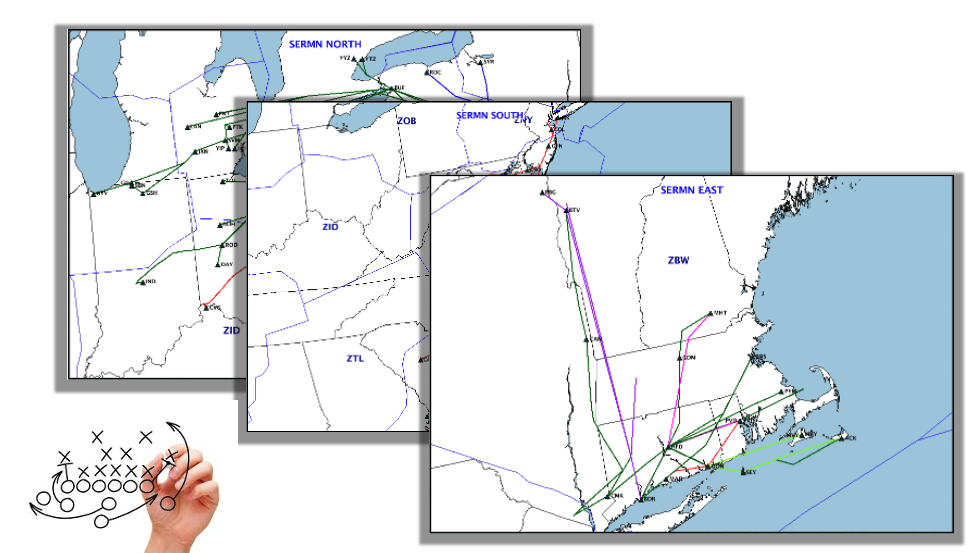
Click for the SERMN routes in the FAA’s National Severe Weather Playbook.

But here’s the kicker (football pun intended). You don’t necessarily need bad weather to fly em.’ If hit with a departure delay, communicate with Clearance Delivery that you’re fuelled and willing to accept a SERMN route. Or any of the other routes below (TEC and Deep Water) for that matter.

If you can get it, it may be good option to beat the crowds.

Hey, what about SERMN West?

It doesn’t actually exist, for a few reasons. Predominantly because western departures from the NY Metro area are heavily managed by other established routes such as J80 and J6.

Westbound traffic is also not as typically constrained by adjacent airspace as those aircraft headed in the other directions – and in any case there are other plays in the play book available for westbound traffic, they just don’t carry the title SERMN.

Escape Plan #2: Deep Water Routes

Another option to consider are Deep Water routes which run north and south off the coast between the Northeast and Florida.

If you have the right gear on board, don’t be afraid to get your feet wet.

The FAA advises they can be useful routes out of the area by getting you out of the way of traffic and restricted airspace along the coast.

But before you dive on in, it’s important you are familiar with the requirements of these routes to fly them.

For instance, in NY Oceanic airspace if you are not RNP 4 or 10 capable you need to let ATC know so that they can apply additional separation. If you do have RNP 4/10, you need to comply with those requirements which includes holding the appropriate Opspec/LOA and having the right equipment on board (such as two independent long range navigation systems).

And don’t forget your survival gear either – which can include lift vests, a raft, survival kits, an ELT and pyrotechnic signalling devices depending on what part of the law you’re operating under. You can find these under FARs 91.509, 135.167 and 121.339.

It’s also important you’re thoroughly familiar with the contingency procedures for oceanic airspace including what to do in the event of a navigation failure (especially loss of RNP capability).
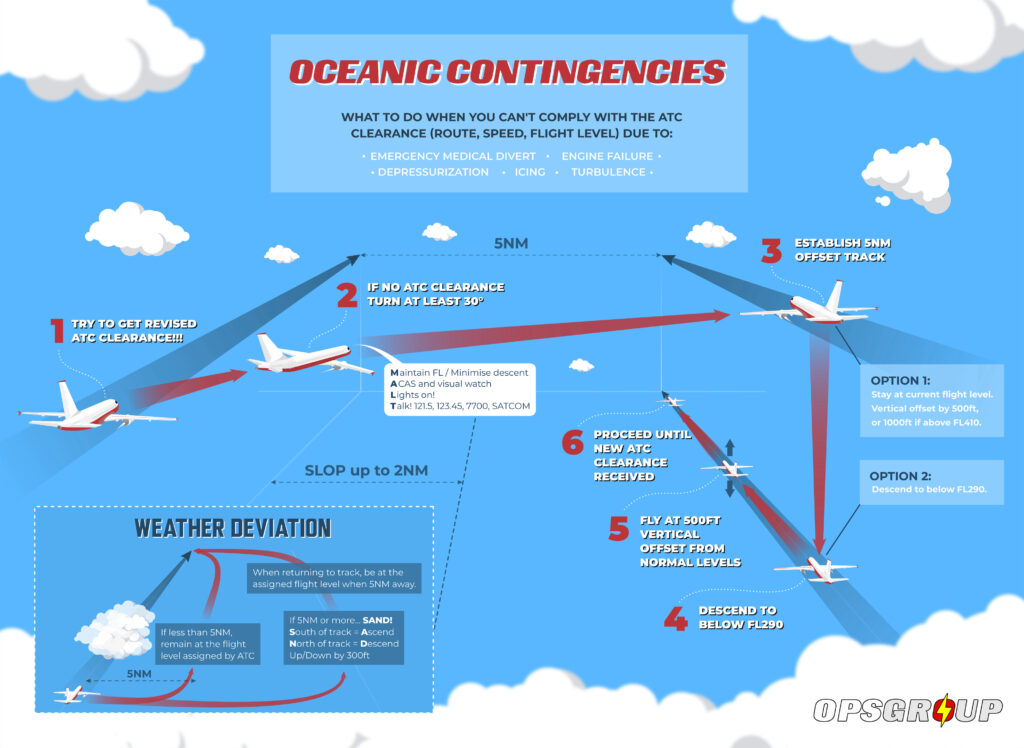
Click for PDF.

Escape Plan #3: TEC Routes

If you’re not headed far from New York, consider the use of FAA TEC Routes (Tower Enroute Control).

These are low-altitude IFR routings (typically 5000 –  17,000’) used for short-distance flights (usually less than 500nm) and often link nearby metropolitan centres.
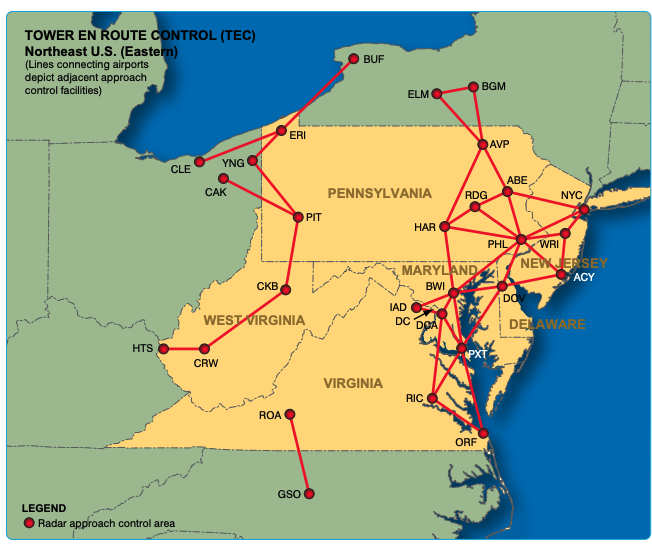
The idea behind them is to keep aircraft within TRACON (Terminal Radar Approach Control) without the need to hand them off to enroute centers. They are by design, simple and efficient.

These routes reduce controller workload, and keep you away from busier airways. They are typically used by turbo-prop aircraft, so let delivery know you have the fuel to fly them as they may not be immediately considered for jets.

You can find the NE TEC routes in the FAA Chart Supplement here.

Finally, stay clued in.

You can avoid delays by predicting when and where they are most likely. The FAA provides a head’s up via three useful sources – fly.faa.gov, nasstatus.faa.gov and X (formerly Twitter). This includes daily briefings on incoming weather, disruptions and the plans in place to mitigate against them.

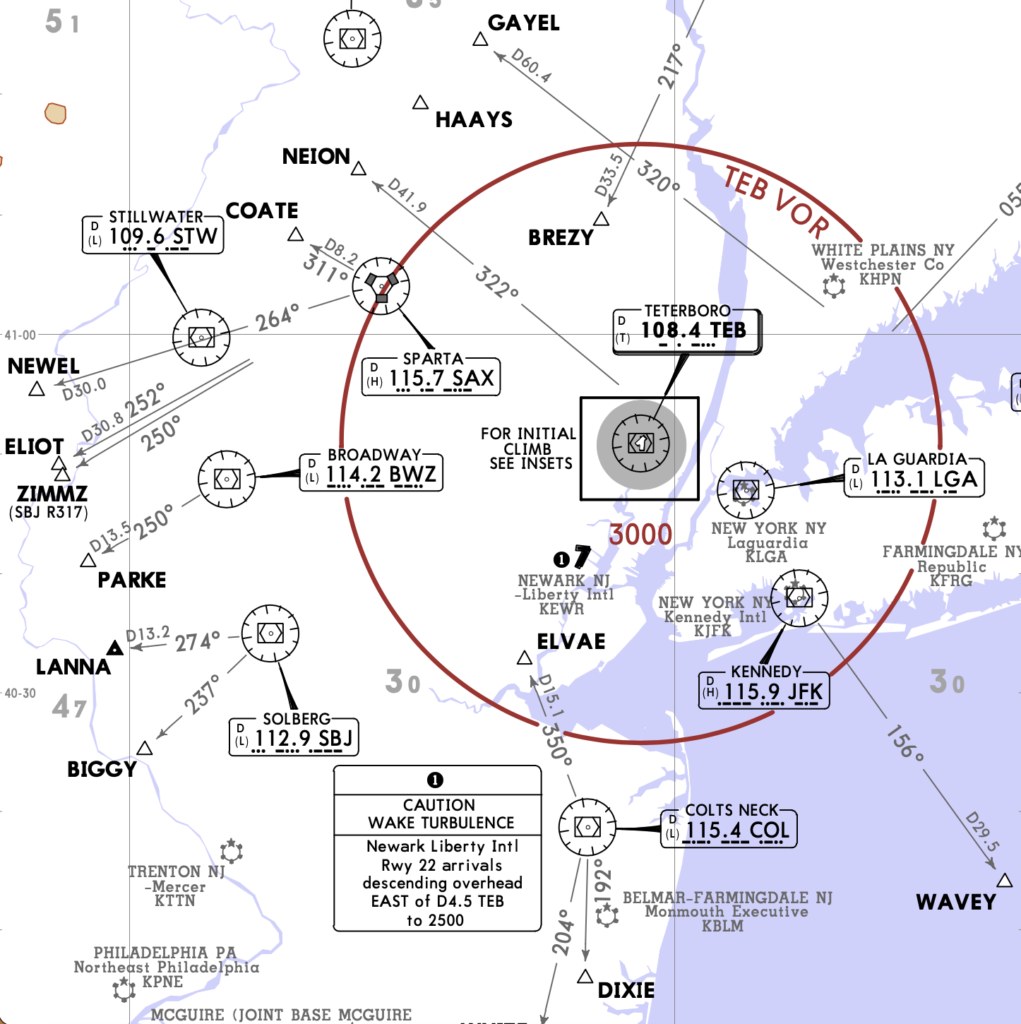
New York ATC is grumpy for a reason

This started off as (and still really is) a very specific post just aimed at folk who operate into KTEB/Teterboro – because the runway 06/24 rehab project has begun!

So we copied all the information from the Teterboro User’s Group site and threw it into here. But then we realised the ‘problem’ with KTEB is that it’s very, very close to a lot of other bigger airports…

So if you operate into KEWR/Newark, KLGA/La Guardia or KJFK/New York Kennedy then we reckon it’s worth a read too. Because you might not realise what is going on underneath you and having an idea of the lay of the land (so to speak) is useful for that old SA we all harp on about…

So Teterboro is back in rehab?

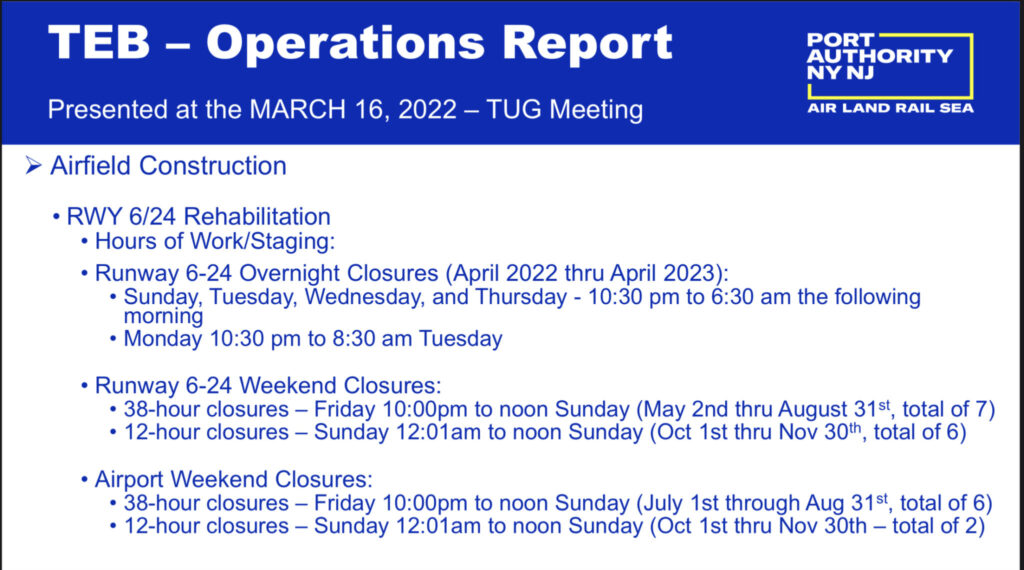
They have a whole 11 months of works (to April 2023) planned for runway 06/24. Mostly it means closures, and these are pretty much all planned over night and on weekends.

Overnight closure timings:

  • Sunday, Tuesday, Wednesday, Thursday 22:30 – 06:30
  • Monday 22:30 – 08:30

Weekend Runway closure times and dates:

  • Friday 22:00 – Sunday 12:00 (until August 31)
  • Sunday 12:01 – Sunday 23:59 (until November 30)

Weekend Airport closure times and dates:

  • Friday 22:00 – Sunday 12:00 (July 1 until August 31)
  • Sunday 12:01 – Sunday 23:59 (October 1 to November 30)

But it is more than just the closures that you need to think about if you operate in here.

Arrival Stuff

Northerly Flow:

Depending on wind and weather, and what’s happening at KEWR/Newark you can usually expect an ILS 6 with a Circle to Rwy 1 or the RNAV (GPS) X Rwy 6

They are trying to bring in lateral and vertical guidance for Rwy 1. Watch this space. The circle to Rwy 1 is a nasty little thing so check out their guidance on it.

Departure Stuff

Southerly Flow

If its a southerly flow you can expect the Teterboro 4 SID which means delays.

Why?

Because they try to keep a 10nm gap between KEWR/Newark 22L arrivals and KTEB 19 departures. Which is why there is also the Dalton 2 visual departure (which only needs a 5nm gap).

Expect an infinite delay…

Well, that sounds bad. It doesn’t actually necessarily mean a lengthy delay though, particularly if you can accept the Dalton 2. The Dalton 2 keeps you down at 1,300’ and 180 knots in VFR until clear of all the KEWR traffic then you can expect a transition to an IFR clearance.

There is a meeting!

Yep, there is, on June 15 at 10:00 am EST. Organised through the Teterboro Users Group (TUG) which we strongly recommend you getting yourself in on if you do operate here and aren’t already in on it.

What else is going on down there though?

Well, like we mentioned, you’ve got several major international airports to consider as well, and some smaller executive airports and a military base. We counted and found more than 10 just in the immediate proximity to Teterboro.

KJFK, KEWR and KLGA have the dubious titles of ranking first, third, and fourth for worst delays in the nation. They are looking at ways to improve this, but most of them involve building more runways which won’t necessarily help poor old KTEB stuck underneath the every growing traffic flow.

Then there is the weather.

The east coast of the US gets hit with some pretty heavy storms. In April, a single day of bad weather saw over 4500 flights into the east coast delayed and the knock on effect across the busy airspace is considerable.


What’s the news at Newark?

KEWR/Newark Liberty International is the other, other international airport serving the New York metropolitan area – the busiest airport system in the US – along with KJFK/New York JFK and KLGA/La Guardia.

Whilst JFK airport is the largest, Newark is actually the busiest in terms of number of flights. It is also the 6th busiest airport in the US in terms of international traffic, and 15th busiest in general in the country.

So, what is happening now?

Runway works. And a general redevelopment program which includes a plan to replace Terminal A, due to be fully finished by 2022. You can read about that here.

But it is the runway rehabilitation we are most interested in, because it involves runway 04R/22L. The runway was last upgraded in 2012 so this is long overdue, particularly given that it serves 47 percent of the airport’s traffic load.

Of course, there is a Notam to warn everyone about the closure.

Does anyone remember AC Flight 759?

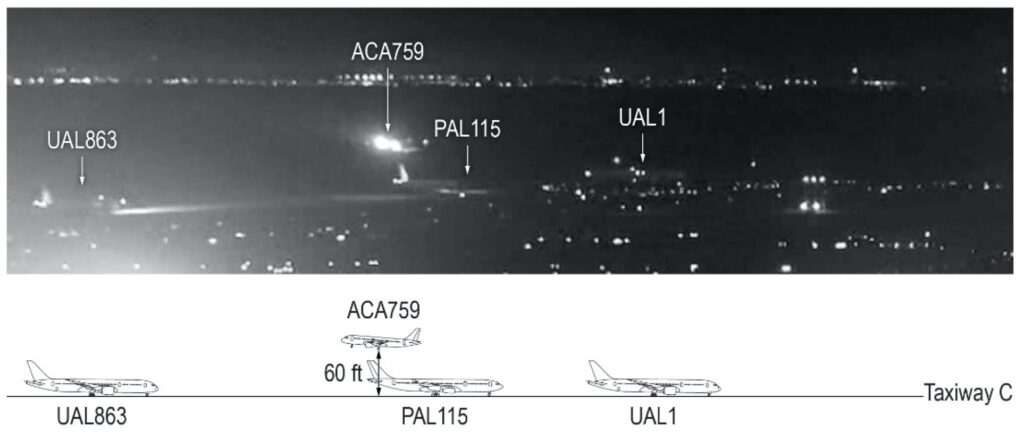
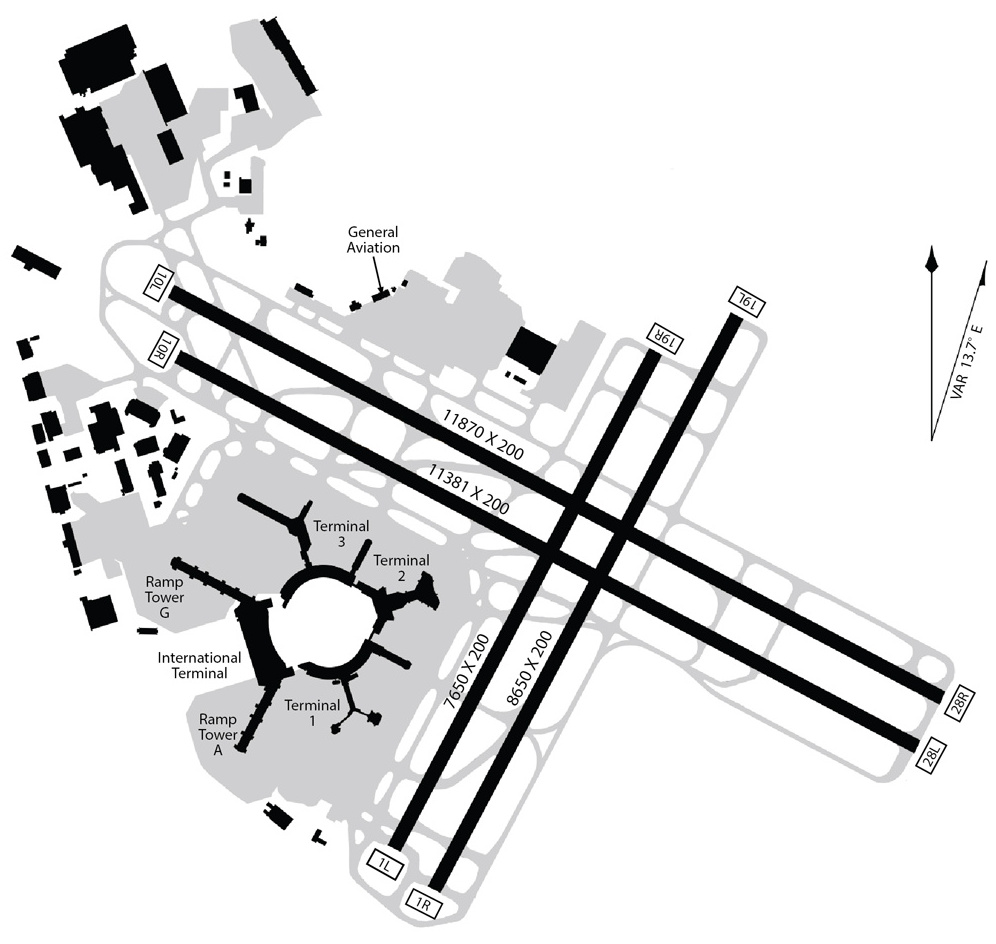
Air Canada Flight 759 is the one that, in 2017, very nearly had a very nasty accident at KSFO/San Francisco. By very nearly, we mean avoided it by less than about 14 feet. That was the reported distance between the bottom of the Air Canada aircraft and the tail of a Phillippine Airlines A340 sitting on Taxiway C.

One of the probable causes the NTSB cited was the pilots mistaking taxiway C for runway 28R because they had overlooked the closure of runway 28L in the Notam report.

So, let’s take a look at the Notams you will see for KEWR/Newark should you operate in there today.

We downloaded a report straight from the FAA Notam site, and it is here if you would like a look.

This may well differ to what you would receive in your flight plan pack, we have not included any filters and the layout is a little less user friendly. It is possible your flight planning department / system / whatever you use does present this in a clearer way, but it is also possible it does not.

We had this highlighted to us by a member whose exact words were “Talk about getting lost in the weeds – that’s just crazy.”

So, what is the concern?

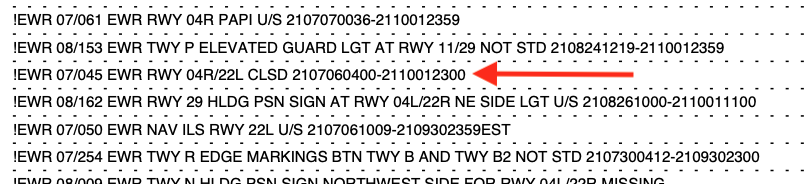
Well, there are 5 pages, with 108 Notams in total and hidden away on page 4 is Notam 07/045

Which is why we mentioned the KSFO incident.

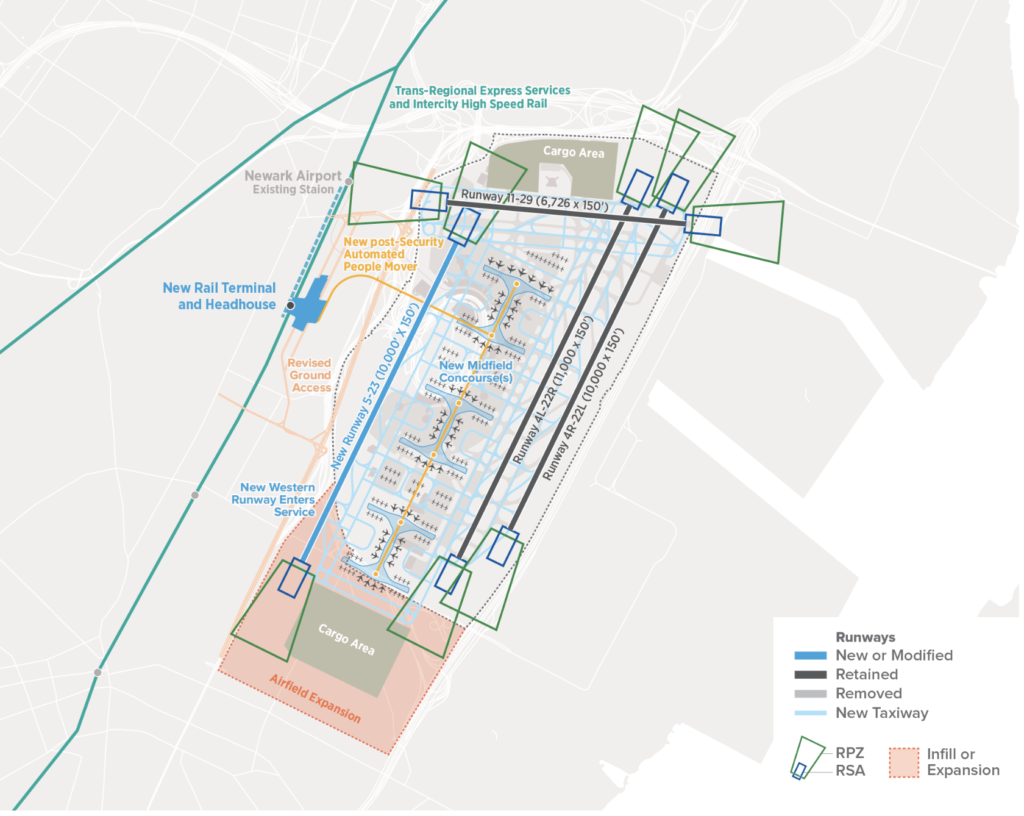
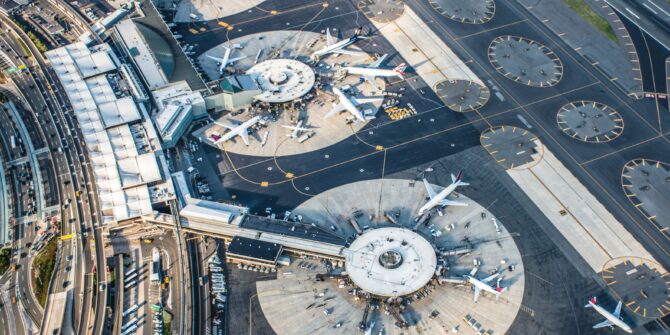
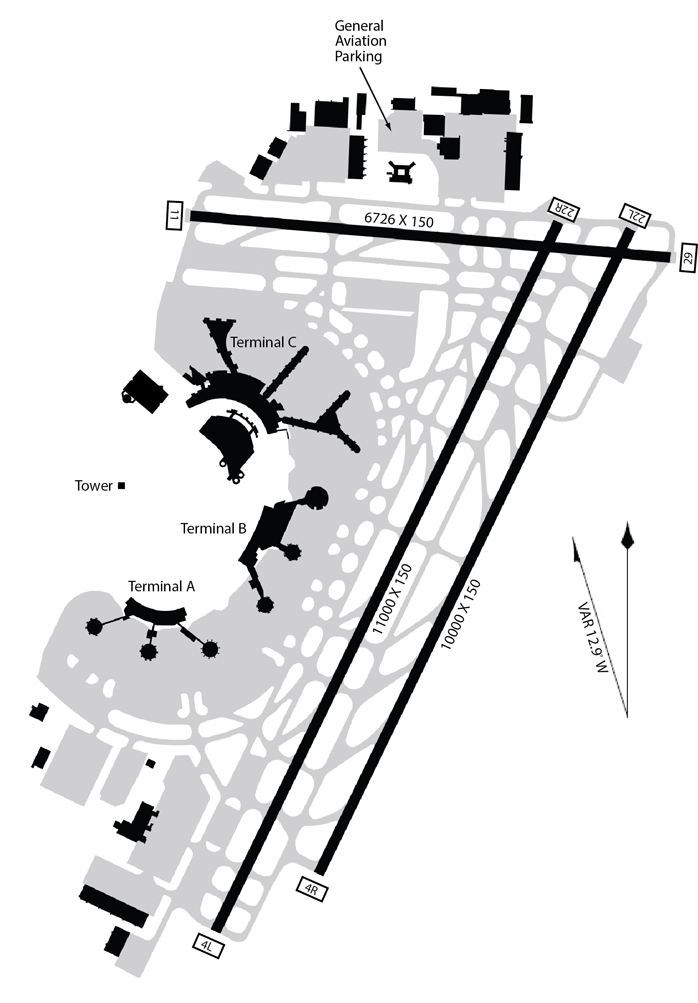
Newark’s runway layout looks like this – 

San Fran’s runway layout is this –

And while KSFO’s layout, with taxiway C to the outer side of runway 28R led to a more likely visual mistake, the mixing of this Notam within a swamp of over 100 others does mean it might be missed, particularly by an operator who is not familiar with the airport.

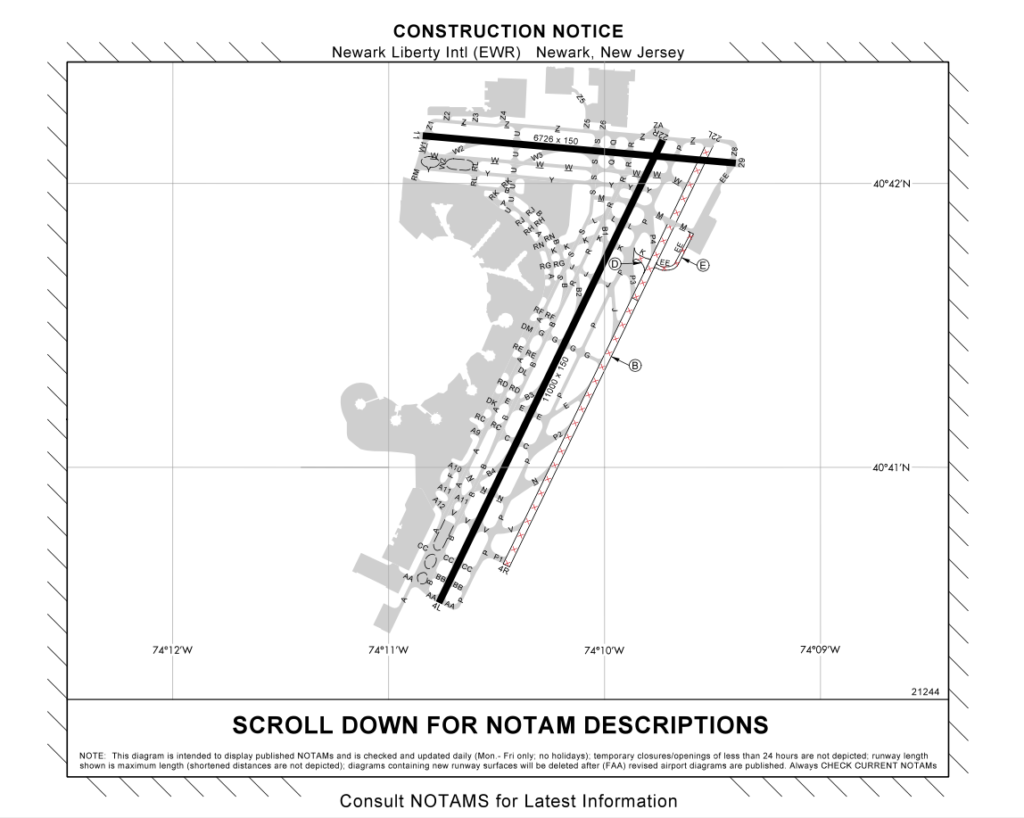
Notam 07/045

The Notam advises that runway 04R/22L will be closed from 06 July 2021 until 01 October 2021.

There is, if your filter includes it, also a construction plan.

What about the other 107 notams?

Nothing can substitute flight planners and pilots reading the Notam packs thoroughly. However, faced with 108 Notams for an airport (especially if you’re not familiar with it), it might be daunting.

So here is a summary of what to look out for, (as of September 15 2021).

In the air:

  • Rwy 11 has PAPIs but no VASIs. The visual glide slope indicators should not be used as they do not coincide with the ILS of RNAV glide paths
  • There are a lot of  VORs which have been permanently taken out of service, but many of the arrivals and some of the missed approaches require them. If you don’t have a suitable GPS equipped RNAV system then you are not gong to be able to fly a fair few arrivals and departures to the airport, or the ILS or VOR DME approaches for runway 11
      • TEB, COL, CRI, OTT, SBJ
  • The ILS and the LOC/DME procedures for 04L are not available
  • You cannot circle to runway 29 or 11 at night. The RNAV visual for 29 is also unavailable
  • There are a lot of cranes in the area. Some as high as 150′
  • The approaches for 04R/22L are not available… probably because the runway is closed
  • Runway 04R/22L is closed

On the ground:

  • A lot of the ground markings are faded so watch out while taxying.
  • The centre line markings for 11/29 are also in pretty poor condition. Actually, a lot of lead off lines and other runway markings for the other runways are faded too
  • And a lot of signs are missing or are missing lights, or are non-standard. So a general caution while on the taxiways.

Any other notices to know?

There is a long list of Letters to Airmen published for Newark. If you have not been there before, or seen these, then they are worth a read because they give helpful info on operations for the airport, and for the general NY area.

LTA-EWR-47 highlights the procedures for engrossing and egressing the ramp. So in plain English, entering and exiting. If you have just arrived then call ground control with your ramp entrance once you’ve crossed 04L/22R. If you’re departing then let ground control know which ramp exit you want when you request your taxi clearance.

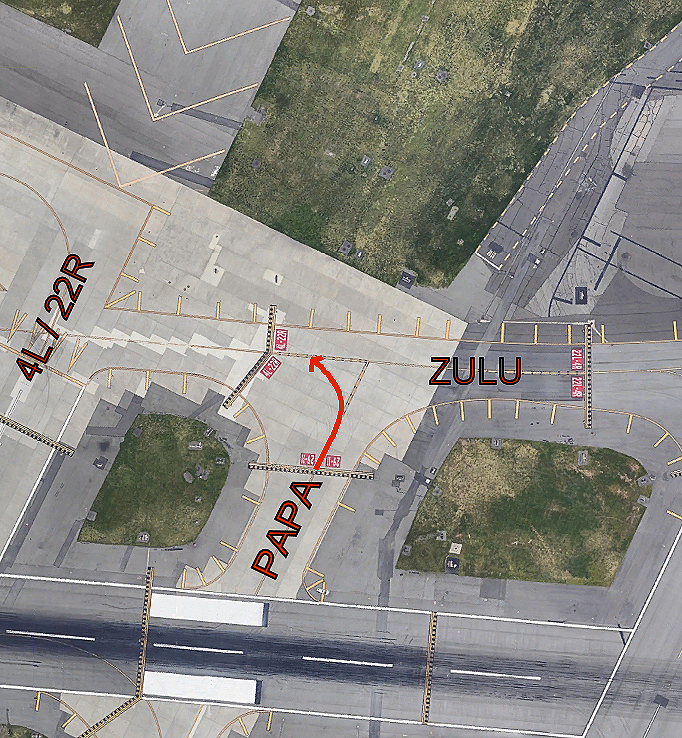
LTA-EWR-44 talks about the big Hotspot at the end of 22R/04L. A lot of GA flights make the mistake here. You’re going to be told to taxi PAPA, cross runway 11 then turn left on SULU and hold short runway 04L”. The turn is tight and the hold short is right there so don’t go too far!

And the others…

  • LTA 51 is warning operators about non-visible areas – basically where ATC can’t see you so be extra careful of other traffic.
  • LTA 45 says be ready for takeoff when cleared, don’t dawdle on the runway.
  • LTA 46 is about helicopter departures.
  • LTA 48 is your info on LAHSO.
  • LTA 49 warns that ATC might issue multiple runway crossings using various different taxiways. Watch out for other traffic, but its not a race!
  • LTA 50 is all about line up and wait clearances at night.
  • LTA 52 is about simultaneous intersecting runways ops for arrives to 4Rand 29 – and the fact ATC are allowed to do it.
  • LAT 53 is your available distances for intersection departures.
  • LAT N90-67 warns to watch your climbs and descents in busy NY airspace.
  • LAT N90-73 It is really busy and aircraft often get vectored in and out of Class B airspace. This lists the airspace “hotspots” for traffic in the areas surrounding each major airport.

Any other things to share?

Aircraft are reporting they have been given the Stadium Visual when heading in from the North. One to look over if not familiar, particularly if you’re not familiar with visual approaches and are expecting a nice straightforward ILS of some sort.

We only have one Airport Spy review for KEWR/Newark and yet it is a challenging airport in a challenging region where we know a lot of folk have flown. So here is our call for your operational hints and tips!

If you are familiar with KEWR/Newark then please share those “gotchas” or need to know “heads ups” – and we will share them on to everyone in the group. You can file an Airport Spy report here: ops.group/blog/spyreport