Spot The Difference: Oceanic Airspace With Non-Standard Contingency Procedures
On 5th November 2020 the new ICAO PANS-ATM Doc 4444 sprung into action like a super hero in a paper cape. Doc 4444 is the Standard for Air Traffic Management. It is a big deal in the world of documents. It is what provides the worldwide recommendations on Procedures for Air Navigation Services, including those for Contingency and Weather Deviation situations.

But…

That does not mean states have to follow it. They really should. But if they don’t that is ok, they just need to let everyone know in their AIP what their different procedures are.

One Contingency Procedure to Rule them All

So, on 5th November the new recommended Contingency Procedures came into being. In fact, these were the procedures that had been in place in the North Atlantic Region since March 2019. But with the release of the new ICAO Doc 4444, the plan was for these procedures to now be rolled-out everywhere – so there would be one standard set of Contingency and Weather Deviation Procedures for all oceanic airspace worldwide.

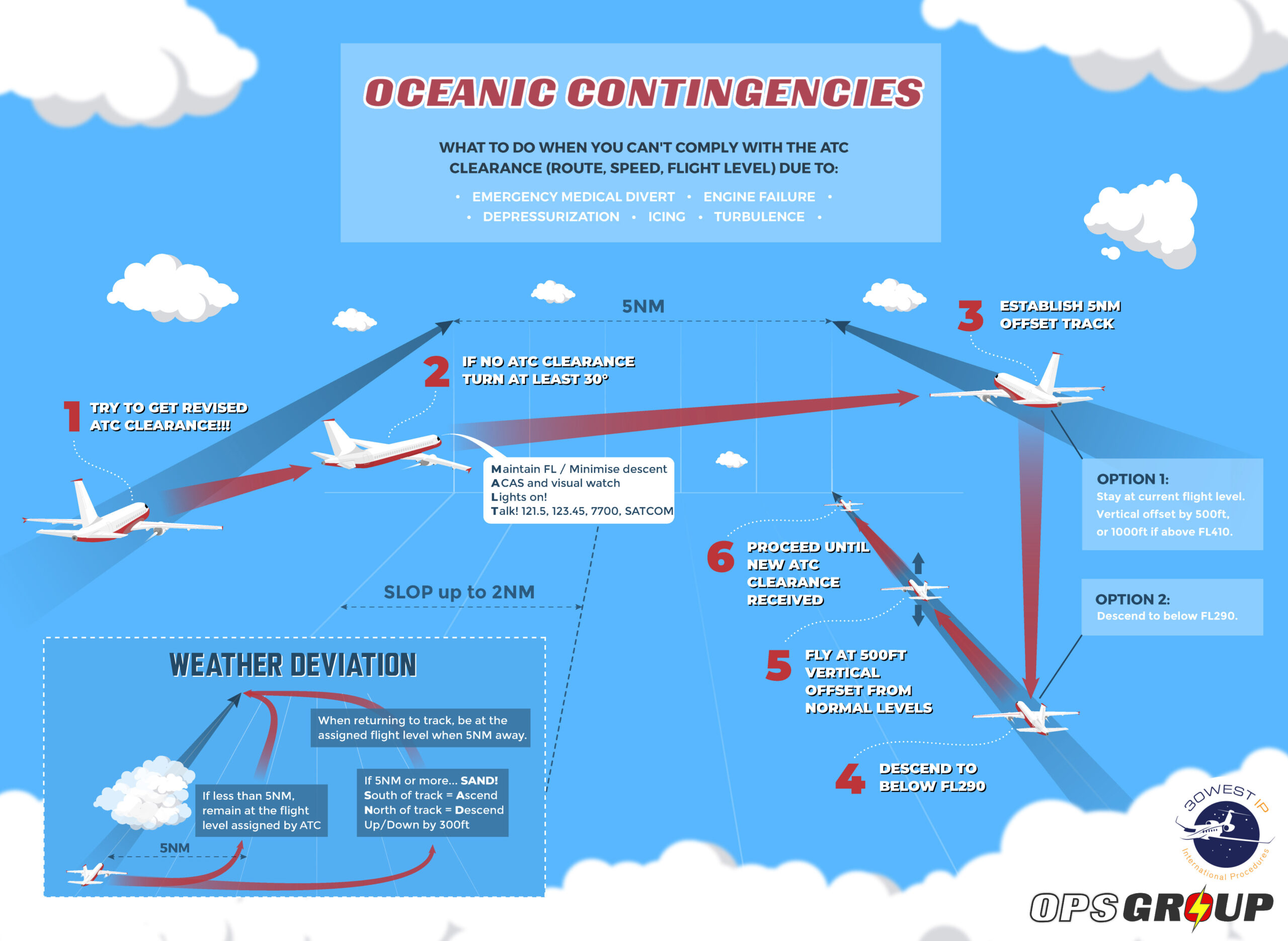
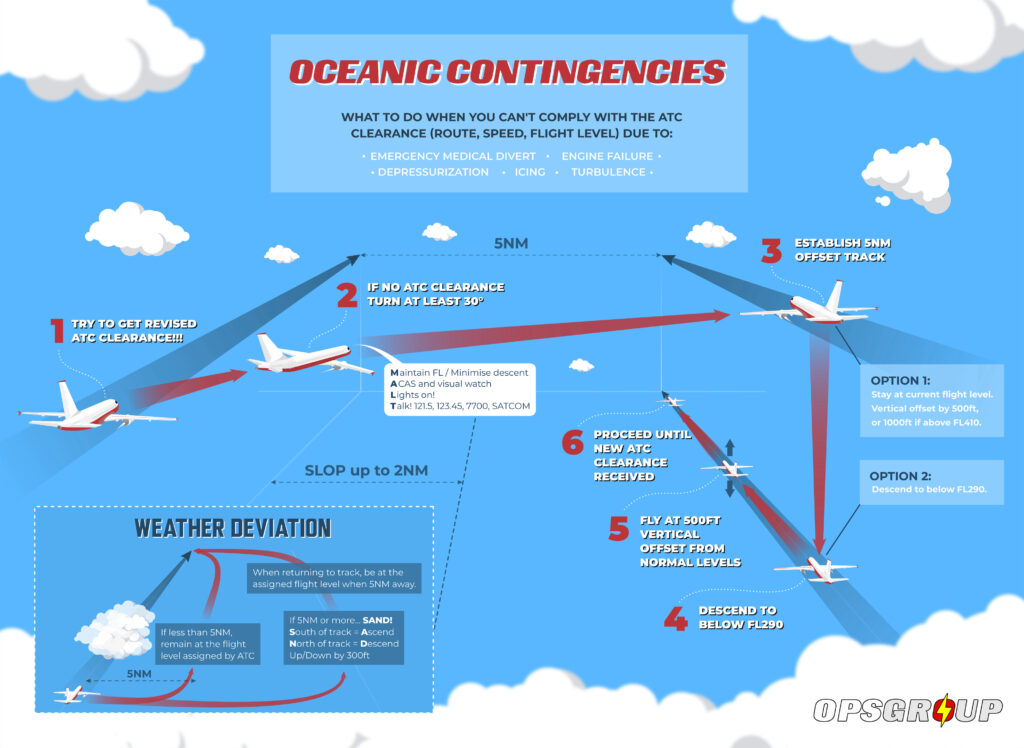
The procedure is straightforward: Contingency offsets that previously were 15nm are basically now all 5nm offsets with a turn of at least 30 degrees.

Here’s how it works:
But you know this already, so why are we repeating it?

And that would be great. Pilots, no matter where they are, would know exactly what to do when something goes wrong. But…

Some places aren’t playing by the (new) rules

There are four named oceans on Earth – the Atlantic, Pacific, Indian and Arctic. They are quite big. So big they are often “broken” into North and South as well, and who rules the airspace above said oceans is a mishmash of who borders what bits.

This means while you might just be routing over the Indian Ocean, you might not just be under Indian control, which also means the contingency for each bit of airspace might vary since it is up to each State to decide whether to implement the standard procedure over their bit of the ocean. And not all of them have.

So which ones do we know of that you still need to look out for?

India

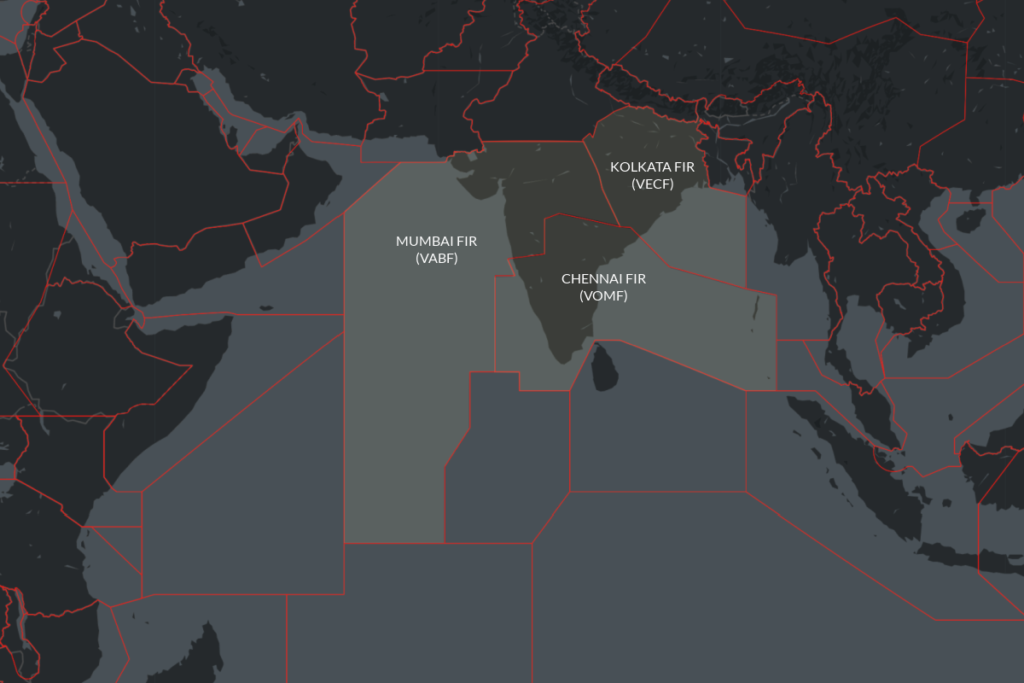
India control a big bit of Oceanic Airspace which falls under their VABF/Mumbai, VOMF/Chennai and VECF/Kolkata FIRs.

Until August 12 2021 India did not follow the standard ICAO contingency. From then, they do.

Here is a copy of the new AIP SUP updating their manuals.
China

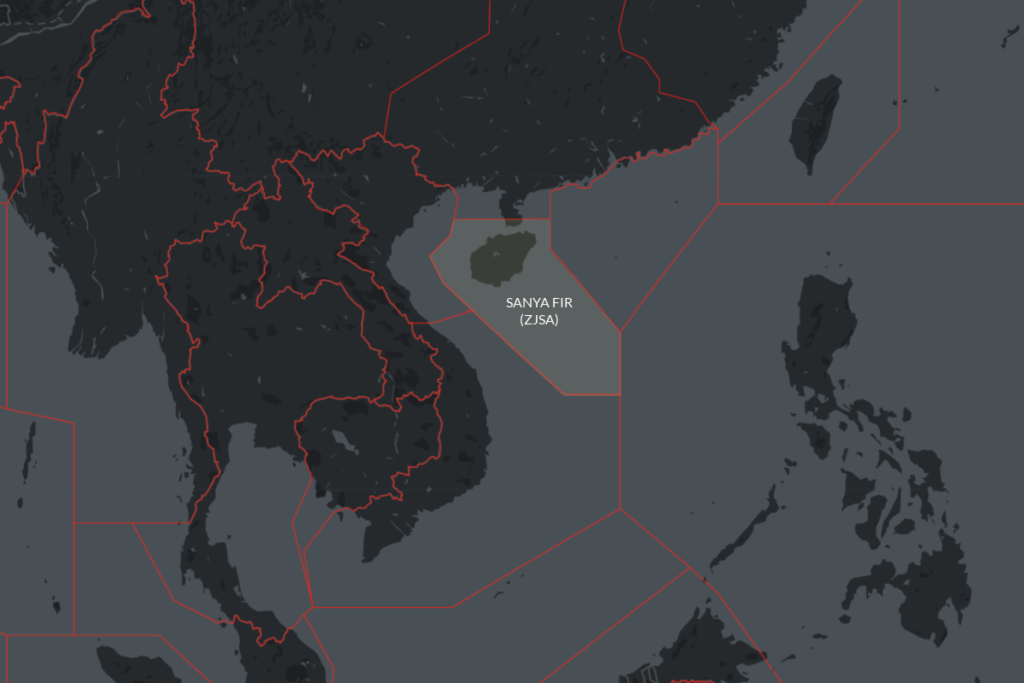
The ZJSA/Sanya FIR includes an oceanic portion in the South China Sea. It is a “marginal sea” that is part of the Western Pacific Ocean (marginal meaning: would just be the ocean only a bunch of islands and archipelagoes sort of divide it off a bit).

China also do not follow ICAO standard contingencies and instead require you to turn 90 degrees right or left, offset by 25nm and then climb or descend 500ft.

China are pretty strict on deviations and detours. They even use different sized airways in some spots. So check their AIP and China specific Rules and Regs before a flight.
French Guiana

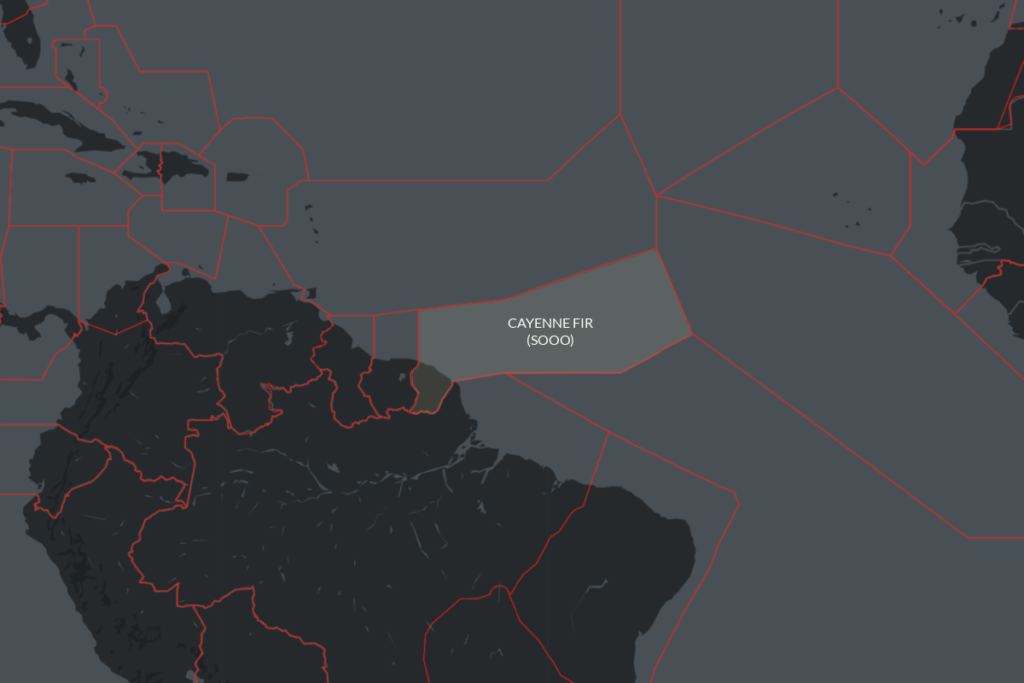
The SOOO/Cayenne FIR extends halfway across the South Atlantic Ocean towards Cape Verde and the West African coastline. The procedures here are also yet to be updated. The French AIP here has the info (ENR section 1.8.5) and tells you to turn left or right by 90 degrees, offset by 15nm and climb or descend 500ft. Nothing strange, but it ain’t your ICAO standard.
French Polynesia

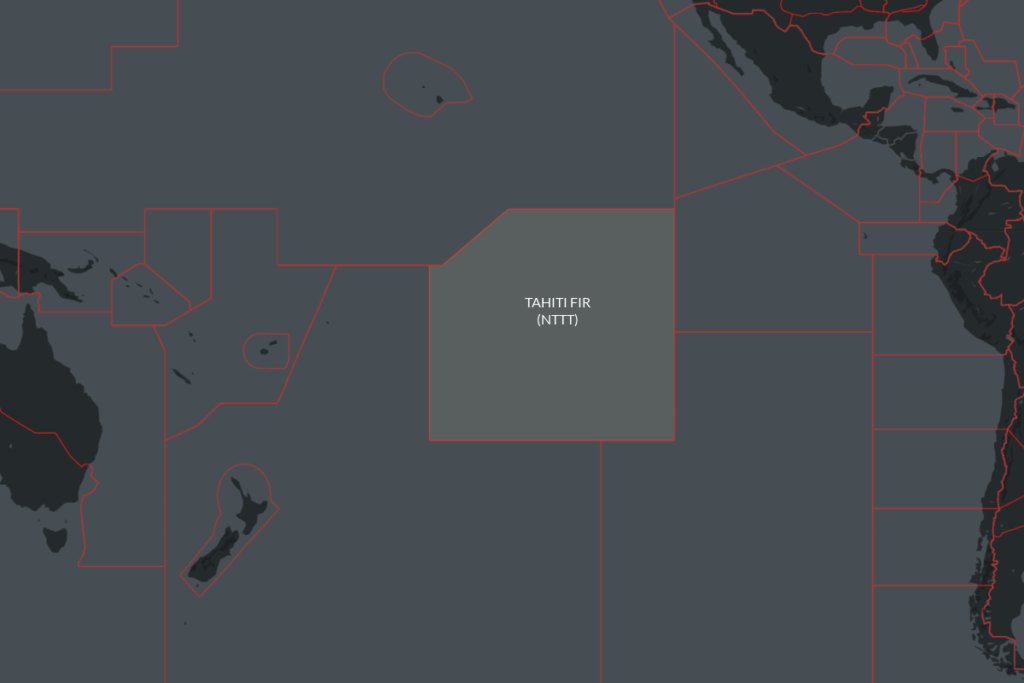
The NTTT/Tahiti FIR in the Central Pacific ocean is another one that comes under the French AIP and still uses old procedures – the now familiar 90 degrees left or right and 15nm offset.
Cape Verde

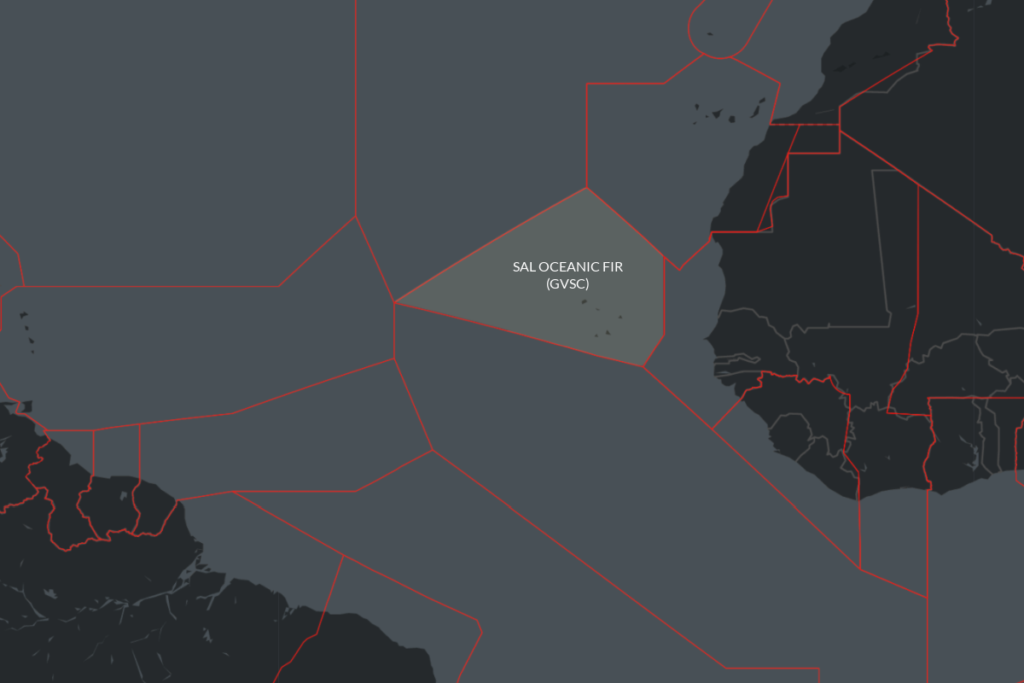
In the GVSC/Sal Oceanic FIR you are also going to find the old procedures are still in force – the 90 degrees left or right and 15nm offset. You might also want to keep an eye on areas with only 30nm separation and avoid shooting through those 15nm offsets.
Malaysia

The WMFC/Kuala Lumpur FIR Oceanic Airspace requires a 90 degree left or right and 15nm offset

Maldives

They don’t refer to the VRMF/Male FIR as ‘Oceanic’, we think it is so we are not sure on this one. We do know that if you need to do an emergency descent, they want you to remain on away T456. If you are on airways Z653 or Z749 then you can leave the route.

Seychelles

There is a special procedure if you are in FSSS/Seychelles Oceanic FIR. It is in the Seychelles AIP SUP 02/2014. The procedure is a 45 degree turn and a 15nm offset. If you are able to maintain your flight level then once at 10nm, select a level 500′ different to assigned (if at or below FL410), or 1000′ different (if above FL410)

If unable to maintain your assigned level, then pick a level you can maintain and apply the 500’/1000′ difference above, but watch out for aircraft who might be on a SLOP

Where else? We need you to tell us!

If you are flying through a region and spot a non-standard contingency or “different to ICAO” note in the AIP then be a superhero and share it with us, and then we can share it with you all and help keep everyone safe and up to date. Email us at: news@ops.group

The 511 on the Nov 5th ICAO changes

A whole bunch of procedural stuff will be changing from 5 Nov 2020, with the release of a new amendment to ICAO’s Procedures for Air Navigation Services document. There will be changes to Oceanic Contingency and Weather Deviation Procedures, Wake Turbulence Separation, SLOP Procedures, and how the FAA defines Gross Navigation Errors.

What is the PANS-ATM (ICAO Doc 4444)?

Procedures for Navigation Services – Air Traffic Management. In other words, the ‘go to’ manual for aircrews who operate internationally. It explains in detail the standard procedures you can expect to be applied by air traffic services around the world, and what they expect in return.

Here is a summary of the most important changes coming on 5 Nov 2020. Thanks to Guy Gribble at International Flight Resources for this update.

Oceanic Contingency Procedures

Basically, what you should do if you need deviate from your flight path without a clearance. Weather avoidance, turbulence, depressurisation, engine failure – you get the picture. Published procedures are changing: there will be one standard set of Contingency and Weather Deviation Procedures for all oceanic airspace worldwide.

If you’ve been flying in the North Atlantic Region over the past year and a half, you’ll be familiar with how it works – the new procedures were introduced there back in March 2019, and now they’re being rolled out everywhere.

The main change here is that Contingency offsets which previously were 15 NM are basically now all 5 NM offsets with a turn of at least 30 degrees (not 45 degrees).

For more on this, check out our article.

Wake Turbulence

Flight Plan Category
There will be a new wake turbulence category for flight plans:

No longer will ‘Heavy’ rule the skies. ‘Super’ is about to be added, which will cover the largest aircraft including the A380-800, and Antonov 225. You will even get to say it after your callsign on initial contact with ATC.

ICAO Doc 8643 will shortly include all aircraft which qualify for the category.

You’ll need to tell them your category in Flight Plan Item #9 too. For Super, the letter ‘J’ is what you’ll need to include.

Here’s the new line up:

J – SUPER (Check Doc 8643 to see if you qualify)
H – HEAVY (Max take-off weight greater than 136,000kg/300,000Lbs)
M – MEDIUM (Max take-off weight greater than 7,000kg/15,500Lbs)
L – LIGHT (Max take-off weight less than or equal to 7,000kg/15,500Lbs)

Wake Turbulence Separation Categories
Countries may choose to use the ICAO wake turbulence codes above to determine how much room to give you from preceding traffic, or they can elect to use a grouping.

Currently, ICAO groupings are based simply on weight and there’s only three of them. The problem with that approach is that sometimes the separation provided is excessive which slows down the flow of traffic and creates unnecessary delays.

The US and Europe were on to it when several years ago the FAA and Eurocontrol joined forces to look at the wake characteristics of aircraft in more detail. They came up with a better system – it was a process known as Aircraft Wake Turbulence Re-Categorization or simply, RECAT.

Turns out that when you take into account factors such as approach speeds, wing characteristics and handling abilities of various aircraft it is possible to safely reduce separation.

As a result, six new categories were created. You can read about those in FAA SAFO #12007 and EU-RECAT 1.5 if you would like to know more.

The point is, ICAO is now adopting those categories.

So why does it matter?
Because the separation applied when following smaller aircraft may be reduced to as low as 2.5nm on approach. Closer than you may be accustomed to.

Out with the old, in with the new. Here’s what you can expect to see in November:

Old:
HEAVY (H) – aircraft of 136,000kg or more
MEDIUM (M) – aircraft less than 136,000kg but more than 7,000kg
LIGHT (L) – aircraft of 7,000kg or less

New:
GROUP A – ≥136,000kg and a wingspan ≤80m but >74.68m
GROUP B – ≥136,000kg and a wingspan ≤74.68m but >53.34m
GROUP C – ≥136,000kg and a wingspan ≤53.34 m but >38.1m
GROUP D – <136,000kg but >18,600kg and a wingspan >32m
GROUP E – <136,000kg but >18,600kg and a wingspan ≤32m but >27.43m
GROUP F – <136,000kg but >18,600kg and a wingspan ≤27.43m
GROUP G – <18,600 kg or less (no wingspan criterion)

Separation standards will soon be published accordingly.

Strategic Lateral Offset Procedures (SLOP)

Wait, what?
As a result of extremely high levels of accuracy in modern navigation systems, if an error in height occurs there is a much higher chance of collision. It is also greatly increases the chance of an encounter with wake turbulence.

In some airspace, when the lateral separation applied or the distance between adjacent parallel routes is greater than 6nm, aircraft can deviate up to 2nm right of track without a clearance. This is what is known as SLOP.

The way in which it is applied is changing
Where the lateral separation minima or spacing between route centerlines is 15NM or more; offsets to the right of the centerline will allowed up to 2nm.

When the lateral separation minima or space between route centrelines is less than 15nm (but more than 6nm), you will be able offset up to 0.5nm right of track.

So, it is important you are familiar with what kind of lateral separation is being applied in the airspace you are operating.

The FAA will change their definition of GNE’s

On 5 Nov 2020, the US FAA will change their definition of Gross Navigation Errors to mean anything more than 10nm (down from 25nm), to align with ICAO’s 10nm definition that currently exists on the NAT HLA. So after this date, the FAA will require you report all lateral errors, 10nm or greater worldwide.

More on this from Guy Gribble at International Flight Resources:

“Keep in mind that ATC does not always advise a crew that it files a report; therefore, the FAA inspector will try and contact the crew as soon as possible so the crew will remember details of the event. ATC keeps voice and communications records for between 30-45 days. New York Radio and San Francisco Radio keep voice communications for 30 days. The FAA directs that oceanic error investigations should be complete within 45 days of the incident.”


One Contingency Procedure to rule them all

From 5 Nov 2020, there will be one standard set of Contingency and Weather Deviation Procedures for all oceanic airspace worldwide.

If you’ve been flying in the North Atlantic Region over the past year and a half, you’ll be familiar with how it works – the new procedures were introduced there back in March 2019, and now they’re being rolled out everywhere.

The FAA has already published a Notice to say that these procedures will take effect in US oceanic airspace from 5 Nov 2020, and ICAO is expected to formally publish the Standard in an update to PANS-ATM (ICAO Doc 4444) to take effect from the same date.

Rarely do we see worldwide oceanic contingency procedures undergo a formal revision. The last time a major revision occurred was in 2006 when ICAO standardized a 15 NM offset executed with a turn of at least 45 degrees. Prior to that, the North Atlantic and the Pacific had used different offset distances and a 90 degree turn.

Wait… what are “contingency procedures”?

These are basically any time you have to do things differently if you need to deviate from your cleared route, and for one reason or another you cannot get permission from ATC first.

Why would you need to bust your clearance? You may not have the ability or capacity to communicate with ATC, or they may not be able to respond to your request quickly enough for a variety of reasons – meteorological conditions (severe turbulence and weather avoidance), aircraft performance, loss of pressurisation, immediate diversion, or a loss of navigational accuracy.

What are the new procedures?

The short answer
Contingency offsets that previously were 15 NM are basically now all 5 NM offsets with a turn of at least 30 degrees (not 45 degrees).

The long answer
Read the FAA Notice.

The slightly less long answer
– Turn at least 30 degrees (reduced from 45) to the left or right of track and establish yourself on a parallel track that is offset by 5nm (reduced from 15).
– The direction of turn is up to you, but you should consider airways around you – the likely direction of other aircraft, the applicable SLOP procedures, the direction of your diversion airport and of course terrain. (If going left or right is a 50/50 choice, going right is probably better – it gets you out of the way of all the SLOP offset traffic that might be coming at you from the opposite direction!)
– When established on your offset track, maintain an altitude that is vertically offset by 500 feet from normal levels (or 1000 feet if above FL410).
– In areas of parallel airways, it is recommended you descend below FL290.
– Watch your TCAS, and if possible, keep your eyes outside for other aircraft.
– Make sure your transponder is set to TA/RA (if able).
– Be seen – turn on as many exterior lights as possible.
– Squawk 7700.
– Try and talk to ATC via voice or CPDLC, and declare a PAN PAN, or MAYDAY.
– Establish comms with other aircraft on 121.5 MHz or 123.45 MHz. Make a position/intention report as you would in TIBA procedures.

The best answer
A picture! So often the best answer. And this one’s pretty neat. Not least because you can click on it, download it, print it out, and put it in your flight bag to take with you. (If you’d also like to laminate it, we’re ok with that).

Weather deviations

If you have to deviate from your assigned track due to anything weather-related, there’s a whole different procedure to follow.

Here’s what to do:

  • In the first instance, up the urgency with the phrase “WEATHER DEVIATION REQUIRED.” ATC will attempt to provide separation, and if they can’t they will ask you to advise your intentions.
  • If you intend to deviate, let them know. Say something like – “I am deviating under PIC emergency authority. At 5 NM from course I will employ the Weather Deviation contingency.”

Then apply the following:

  • Declare a PAN.
  • Deviate away from other airways if practical.
  • Talk to other aircraft on 121.5 and 123.45.
  • Keep an eye on your TCAS and outside.
  • Turn on all your exterior lights.

For deviations of less than 5 NM, remain at the flight level assigned by ATC.

For deviations of 5 NM or more, when you are at the 5 NM point initiate a change as follows:

If flying EAST, descend left by 300ft, or climb right by 300ft.

If flying WEST, climb left by 300ft, or descend right by 300ft.

In other words – SAND! (South of track = Ascend, North of track = Descend; Up/Down by 300ft)

Once you are back on track, resume your cleared level. If you’re already deviating and cannot get a clearance to deviate further. Change your level immediately in accordance with the table above.

Turnback procedure

The new guidance has left out any specific reference to how to divert across the flow of traffic or turn-back procedure, and instead simplified it to just “proceed as required by the operational situation”. Turning back would assume you either employ the 5NM offset as per the new contingency procedure, or else get a new revised clearance.

Bottom line

Download the pic, and give the new procedures a good read (they’re not actually that long). Beginning 5 Nov 2020, the new procedures are expected to be implemented. You might want to prepare changes for your ops manuals and checklists too.